Oct
9
Current Update of Fed Model, from Alex Castaldo
October 9, 2008 | 13 Comments
SPX = 1000
Estimated Earnings = 97.74
=> earn yield 9.77%
10-yr Treasury Yield = 3.65%
=> spread 6.12%
=> SPX fair value = 2676 = earnings/10-yr
=> undervaluation -62.64%
=> expected return = 33.74% = 0.082 + 4.172 * spread
The model is forecasting a one year return of approximately 34%.
Sep
20
The Long Spoon, from Victor Niederhoffer
September 20, 2008 | 7 Comments
 I wonder naively, with the news of the bailout: will there not be clamors with the $1 trillion of assets that are being bought by the government at above market values, to extract some bits of flesh from those who are bailed out? Peter Public is being robbed to pay Paul Financial Firm, so to speak. But will Peter not complain and get his ounces of flesh? And will that not tarnish the luster of the gains in financial institutions in due course?
This is a speculation about which I have no expertise and no recommendation over and above saying, as I have for 30 years, that when you get out of the market because it's a "bear market," you have to get back in some time to reap the drift, and I don't know anyone astute enough to overcome that drift while he's out.
Alex Forshaw adds:
It reminds me of the October 15, 2007 announcement, except that this time the "Super Siv" (or MLEC) is $1 trillion-plus in size (instead of $75-100bn), the regulations are all the more drastic, the government has thrown $1 trillion away to save Wall Street's richest socialists, and… yeah, that's pretty much it.
If one had actually stuck to one's capitalist convictions throughout all this, one might actually not even be very surprised at the enormity of Bernanke's and Paulson's failure.
Alan Millhone worries:
I wonder if that 'long spoon' cradles castor oil? You hear the term hard to swallow. To me this applies to the bailout as the Bureau of the Treasury is running the presses 24/7 with someone holding the oiling can to keep down the sparks from the printing presses and all that paper may over time become nothing more than shin plasters!
Nigel Davies writes:
 On the long term drift: Can someone please show me the data for all these centuries in which stocks went up 1 million percent, or are we talking about just one, the 20th? The last 24 hours have admittedly seen some of the most desperate short covering from a heavily leaning market, but I don't think one should extrapolate too much from this.
About the bailout: Maybe these measures will "save the system," but there's a huge cost involved for Mr Taxpayer. And as Mr Taxpayer is also Mr Voter I wouldn't want to bet against his supporting some heavy handed regulation by those seeking office. Not to mention the fact that he's being hit real hard in the wallet region by this mess.
James Sogi comments:
 The problem with the rescue plan and the upcoming regulation is that the creators of the plan are filled with hubris. Why should these few men with limited experience and knowledge compared to the smartest people of the entire financial world be able to solve the problems that the entire financial world was unable to? Like central planners around the world, they will just create new problems and backlogs and inefficiencies that were so prevalent in the authoritarian and socialist countries.
The country is sliding into socialism, which is the extension of the moral hazard. Where there is no more risk, there will be little reward. On the television, the prevailing meme seems to be the bailout is for the benefit of the greedy Wall street moguls and is paid for by Joe Sixpack. In any case, it will create new opportunities as cycles change yet again. Today's S&P high from yesterday's low was the greatest up move. This is a signal of new cycles, just as much as February 28, 2007 was a signal to move into a high vol cycle. The definition of cycles resists quantitative testing, so the qualitative will have to suffice.
Alex Castaldo takes a turn to the left:
Why should these few men with limited experience and knowledge compared to the smartest people of the entire financial world be able to solve the problems that the entire financial world was unable to? — James Sogi.
Yes, but don't we also need to revise downward our estimate of how smart the so-called smartest people were? When the Warren Spector's, the Dick Fuld's, etc. etc. issue so much mortgage debt to people who now can't pay, that the entire financial system is put at risk, can we really continue to call them the smartest people?
Irrespective of that (…maybe I would have made the same error…), doesn't it make sense at this point to have the "smartest people" take a time out while the second-rate people in government (and I fully agree that they are second rate) try to patch up the problem so the game can resume again? Or do we just let the system blow up because the mistakes were made in good faith by the smartest people available at the time?
Don't tell me that markets are better than Soviet style central planning, Mr. Sogi, I already know that. Tell me what is to be done under these circumstances.
Someone told me today that the nationalisation of AIG is just like what happens in France and Argentina. I am sorry but again I have to disagree. The French government ran Air France for 40 years. The AIG measure is temporary; rather than a nationalisation in the Argentinian sense I would call it a controlled liquidation of AIG. Rather than be liquidated immediately (as was about to happen) they will do so gradually over two years; rather than receive subsidies from the Argentinian government they will have to pay LIBOR plus 8%, a punitive rate, etc. The differences are major. Let's not put all government interventions on the same plane.
Back to the "smartest people" issue. The analogy I see is the following: you have been operated on by the best available surgeon; unfortunately he made a mistake and left a clamp in your abdomen before sewing you up. It is midnight on a Saturday and the only available surgeon is a semi-retired practitioner of average skills. Would you agree to have him operate on you to save your life? It may well be that you would have not agreed to be operated on by this guy in the first place. But what do you do now?
[Disclosure: Alex is a depositor of Washington Mutual and owns Morgan Stanley stock].
James Sogi replies:
It is the spoiled child syndrome. Each time the spoiled child is saved from his mistakes, errors, rudeness, tantrums – he is inadvertently being trained to make these mistakes again. Better to mete out a measured negative punishment, time out, a reprimand, or suffering the consequences of bad behavior. Soon the child learns. There are behavioral cycles, adaptive mechanisms inherent in nature and free markets. By tampering with these, we end up with worse and worse swings as the adjusters over-adjust. Better to let Dick Fuld, and the overborrowers, take the hit. The entire financial system will not fail. It will start up again the next day no matter what happens. It may look different. There may be different players, but it will be there.
Remember the bitter pills Volcker dealt out in the 1980s with 24% mortgage rates, 14- 17% bonds. I saw many people take the hit. But inflation was crushed, and we enjoyed 20 years of moderation and prosperity. That was worth the price. Those who make bad choices should not be bailed out. It will encourage wild swings. It's the Greenspan Put all over again. If people know there's no second chance, they won't take the risks. If they do, they should be entitled to their profit or the pain of failure. When you do it your way, there is no cleansing cycles, and the toxin remains. Like Japan. It's just hiding the problems and they'll resurface somewhere else. Better to kill it now.
Let the big banks, big brokerages go down. New ones will take their place, smaller, faster moving. The market will find a way.
Sep
13
Ron King Retains Freestyle Checkers Title, from Alex Castaldo
September 13, 2008 | Leave a Comment
 Ron "Suki" King of Barbados retained his title as World Champion in GAYP (Go-As-You-Please) checkers today. He defeated the challenger Lubabalo Kondlo of South Africa on the 24th and last game in the series, held in Medina, OH. All previous games had ended in draws. The referee was Alan Millhone. Our congratulations to the winner.
[In Go-As-You-Please Checkers, the players begin in the starting position shown, and can make any opening move. In Restricted Opening Checkers, the first three moves are drawn at random to generate the starting position, and the players continue from there].
Jun
28
Reading Atlas Shrugged, from Sushil Kedia
June 28, 2008 | 4 Comments
 Finally I could invest the time to start reading Atlas Shrugged. I have chosen the word invest advisedly here; I have finished reading Part I and decided to take a pause at the end of page 312.
Bearing fully in mind the introduction by Leonard Peikoff that begins by stating that Ayn Rand held that art is a “re-creation of reality according to an artist’s metaphysical value judgments”, it strikes me very hard to seek your opinion if really in the America of the last century there indeed were characters such as Jim Taggart, Orren Boyle and the sort of hoi polloi that has been described continuously in these 312 pages. I have no doubt that there were a lot of Dagny Taggarts, Hank Reardens, Ellis Wyatts who helped (re)build modern America further, but it beats me if really there was a time when the over-riding thought and action of the day was being shaped by Jim Taggart and Orren Boyle types as well. What do you think? Has the author erred in stretching the shadows far longer to produce the effect or was there really an America like that also?
Alex Castaldo attempts a reply:
You are not the first non-US reader of Ayn Rand to be puzzled by this question. As a foreign-born American I was surprised that her books were set in the US when you could easily come up with better examples of government/business connivance from other countries. Americans can consider themselves lucky that they are better off in this respect than some others. Indeed I have often asked myself where is the Italian Ayn Rand who would speak up about how some of Italy's wealthiest people have made their fortune largely through political connections and improper operations, and explain the difference between this and true entrepreneurship. Sadly he/she does not seem to exist (possibly for lack of readers).
Part of the answer may be that Ayn Rand was most familiar with Russia and the US, so of course she chose to write about these countries. Also, she was concerned about trends and developments rather than the immediate situation; the US in her books is perhaps the model of what could happen to any country if the disturbing developments she saw around her were to continue. Her books are, among other things, a plea for the US to retain (and improve) its traditional values and not adopt those of the then ruling class in Soviet Russia.
Jun
6
In Memory of Ken Smith, from Alex Castaldo
June 6, 2008 | 3 Comments
 We have learned that Ken Smith, a frequent contributor to this web site, passed away on June 2, 2008 at age 78 (of an apparent heart attack).
Ken travelled to many places over his life, was involved in all kinds of interesting situations and shared many of them with us through his writing. Several of us had a chance to meet him in person as well.
Our condolences to his wife Ina.
* * *
* *
* * *
* *
* * *
* *
Andrew Moe remembers:
Here is my favorite post from a good friend who often gleaned remarkable insight from the wonderful life he led and was generous enough to share it with us. A true Spec.
####### Original Post by Ken Smith #######
At 6 am I looked out to the front lawn and observed a lone American Robin listening for worms and insects in the dew-moist grassy ground. The bird shuffled from point to point in a random-appearing change of direction. This is breeding season; the birds are now carnivores. After breeding they will switch to a vegetarian diet. The Robin was patient at each stop, giving his senses time to pick up the signals nature has programmed him to use in his search for food, food which furnishes him with reproductive energy. He has arisen early and discovered this niche for himself, my front lawn, recently watered.
A signal from the ground is perceived and Sir Robin quickly has his prey, no hesitation. This guy is an active hunter, as in active trader. His little computer brain and sense organs are crawling the field in search of prey, a morsel to fatten his resources. Sir Robin will switch to another lawn or playground or marsh when his present search produces less energy than the energy required to do the search.
He will fly away, perhaps randomly choosing the next site for exploration. When breeding season is over, the eggs hatched and nurtured, Sir Robin will change his diet preference. And the turning of the earth, the sun, and the moon will influence him to change his territory, his environment, his location in relation to these planetary orbits. A trader seeks a niche, as the good Doctor Niederhoffer has suggested. Sir Robin, as an epitome of nature's example, has a bird brain yet survives, breeds, and flourishes. How complicated do we need to be to survive as traders?
"Once breeding season is over, the sweet-singing and familiar robin of our backyards becomes more furtive and shy. Large nomadic flocks form and range over the countryside in search of berries such as mulberry, sumac, grape, viburnum, and cedar, as they shift from their breeding season diet of insects and earthworms to become wholly vegetarian. By September, many are moving south from the northern parts of the eastern half of the country to winter with southern residents in the Middle Atlantic and Gulf states. In the West, Robins wander broadly in search of food and move generally to areas of lower altitude. But some linger as far north as Canada when food supplies are adequate, so the first robin you see in spring may not have come from too far away." (Cornell U. ).
Apr
10
The Subprime Mess, from Craig Mee
April 10, 2008 | 6 Comments
Is the Subprime mess one more indicator of the devil may care, not my fault, no care no responsibility, times we are living in? Are the Fed bailouts the ultimate back up to keep this poor social situation alive, leading to a poor thought process for the next rogue trader, head fund manager, and for that matter retail trader sitting down at his platform.
Is this ultimately leading to a internal breakdown of our own risk mismanagement on our own accounts even though at the end of the day it's us on our private accounts and we will be ultimately responsible.
How can we change the situation - When is someone going to stand up and say, "I'll take the hit , I'll wear the pain , It was me!"
Janice Dorn explains:
Maslow's hierarchy of needs is often shown as a pyramid where people go from the base to the apex in terms of what they focus on. The lowest level (base of the pyramid) reflects the most basic human needs– food, health, sleep, physiological needs). The next level is shelter and safety from danger. The next three have to do with belonging (love, affection, socialization), esteem (self and from others) and-finally-the highest state is self-actualization (evolution to a higher consciousness, authenticity, achievement of individual potential, transcendence, creativity).
Humans are unable to progress to the higher levels when they are preoccupied with the needs of the lower levels. In order to distract people from higher levels, one need do nothing more than threaten their basic needs. When people are focused on their basic needs, they do not have the capacity to deal with powerful issues such as personal responsibility. They are too busy focusing on either feeding themselves, dealing with illness or worrying if they will have a roof over their heads tomorrow.
Throughout history, the best way to strip power from a person is to divert their progress up the pyramid by doing something that forces them to stay "stuck" near the base of the pyramid.
We are not evolving. Rather, it appears that there is a not insignificant amount of devolution occurring. As long as we look to "the powers that be to get us out of this mess, the less chance we have to move through the bottom two stages and get on with creative evolution. We will, as a nation, remain, worried, frightened, and sick. The way that power was taken from kings was to poison them. They did not die, but they stayed sick and thus fell down the pyramid to the lowest level.
The person that must stand up and take the hit and wear the pain is the person who looks back at each of us in the mirror. If we cannot do this, we will turn to everyone else to rescue us, to fix the mess, to take care of us, to save us from ourselves. The war against personal responsibility and individual empowerment is in full force. We are unraveling.
Alex Castaldo notes:
I was surprised by the headline in the Financial Times on April 10 "Banks take blame for crisis". Maybe there is hope after all.
Russ Humbert offers a deeper perspective:
While nobody wants to take responsibility for the sub-prime mess, the media has certainly laid blame at the feet of the capitalist. "Capitalists acting too aggressive", "Capitalists only out for their own self interest", are a couple of the "causes" I have heard from the media. However, if the origins and the incentives in the sub-prime markets are studied or in other words the true "cause" is explored, it clearly was due to the markets letting socialism creep into their midst.
The timing of the GSEs entry into subprime seems highly suspect.
The deterioration of underwriting standards can be understood, if you understand the rating agency or risk management was graded almost solely on industry average and industry statistics. Such "pooling" of risk management might as well been pooling of agricultural production. What happens is nobody works. It was a mad rush to capitalize on others' efforts.
Thankfully, the capitalist inspired puts in the contract led to most of those irresponsible enough to think they could get a free ride on everybody else's risk management efforts paying the price. The capitalist insisted they had a least enough skin long enough that they couldn't ignore it without getting caught. Thankfully, some of those capitalists caught this problem early enough and are driving a hard bargain to make sure this mess gets cleaned up fast and making sure it won't happen again. While this may be a high price to pay, just imagine if those aggressive capitalists hadn't all dived in at once. The march to socialism might have been slower, but like a boiling a frog, this would have slowly allowed the GSE's to eat a cancerous toxin, driving them to a slow painful unavoidable death. Or if the short sellers had not been allowed to price the actual risk, those executives responsible would have crippled the banking system and the economy for perhaps a decade, bleeding but not admitting wrong doing to stay in power (as happened in Japan).
Capitalist was the cure, socialism the cause.
Mar
21
Triple Top, from Alex Castaldo
March 21, 2008 | 1 Comment
Three peaks in VIX (all of them above 30) on 11/12, 01/22 and 03/17. It never went below 15 after end of July 2007.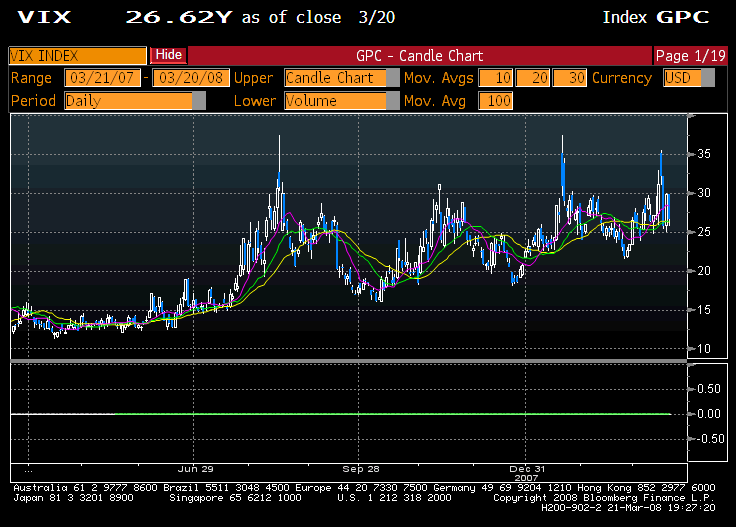
Feb
18
Frequency of Double Digit S&P Daily Moves, from Alex Castaldo and Victor Niederhoffer
February 18, 2008 | 2 Comments
How often do the S&P futures change in price (up or down) by more that 10 points?
Date         Num Days Num Days
Year Mon       Up >10   Dn >10          Tot    Diff
2000   1            5       8            13      -3
2000   2            6       6            12       0
2000   3            9       6            15       3
2000   4            4       7            11      -3
2000   5            8      10            18      -2
2000   6            6       4            10       2
2000   7            6       6            12       0
2000   8            5       2             7       3
2000   9            3       6             9      -3
2000  10            5       8            13      -3
2000  11            3      10            13      -7
2000  12            6       8            14      -2
2001   1            5       3             8       2
2001   2            3       9            12      -6
2001   3            7       8            15      -1
2001   4            9       5            14       4
2001   5            4       6            10      -2
2001   6            4       5             9      -1
2001   7            3       6             9      -3
2001   8            2       8            10      -6
2001   9            4       6            10      -2
2001  10            6       3             9       3
2001  11            7       1             8       6
2001  12            3       4             7      -1
2002   1            4       3             7       1
2002   2            6       4            10       2
2002   3            4       3             7       1
2002   4            3       4             7      -1
2002   5            5       6            11      -1
2002   6            2       7             9      -5
2002   7            5      11            16      -6
2002   8            7       7            14       0
2002   9            5       7            12      -2
2002  10            8       8            16       0
2002  11            6       4            10       2
2002  12            3       6             9      -3
2003   1            4       7            11      -3
2003   2            3       4             7      -1
2003   3            3       4             7      -1
2003   4            6       3             9       3
2003   5            5       1             6       4
2003   6            4       4             8       0
2003   7            3       4             7      -1
2003   8            0       1             1      -1
2003   9            3       3             6       0
2003  10            2       2             4       0
2003  11            2       1             3       1
2003  12            4       0             4       4
2004   1            3       1             4       2
2004   2            3       0             3       3
2004   3            5       6            11      -1
2004   4            1       3             4      -2
2004   5            2       2             4       0
2004   6            1       3             4      -2
2004   7            1       3             4      -2
2004   8            3       3             6       0
2004   9            1       1             2       0
2004  10            3       3             6       0
2004  11            2       1             3       1
2004  12            2       1             3       1
2005   1            1       2             3      -1
2005   2            3       1             4       2
2005   3            2       3             5      -1
2005   4            2       7             9      -5
2005   5            2       2             4       0
2005   6            1       1             2       0
2005   7            1       1             2       0
2005   8            1       2             3      -1
2005   9            2       2             4       0
2005  10            4       6            10      -2
2005  11            3       0             3       3
2005  12            1       1             2       0
2006   1            3       1             4       2
2006   2            2       3             5      -1
2006   3            3       0             3       3
2006   4            1       2             3      -1
2006   5            3       5             8      -2
2006   6            3       5             8      -2
2006   7            3       2             5       1
2006   8            2       0             2       2
2006   9            3       1             4       2
2006  10            2       0             2       2
2006  11            2       2             4       0
2006  12            2       0             2       2
2007   1            1       2             3      -1
2007   2            2       2             4       0
2007   3            4       4             8       0
2007   4            4       1             5       3
2007   5            3       2             5       1
2007   6            3       6             9      -3
2007   7            4       6            10      -2
2007   8           10       6            16       4
2007   9            3       3             6       0
2007  10            6       4            10       2
2007  11            6       9            15      -3
2007  12            6       7            13      -1
2008   1            7      11            18      -4
2008 2*             4       4             8       0

.                            Autocorr   0.658   0.197
The highest volatility (by this measure) occurred in January 2008, with 18 double-digit moves, although we have a tie with May 2000.
Generally, there were a lot of such days (>10) in 2000-2002, few in 2003-2006, and many again starting in July of 2007.
Feb
18
Frequency of Double Digit S&P Daily Moves (Part II)
February 18, 2008 | 1 Comment
It is interesting to look at a chart of the number of large S&P moves per month.

Jan
4
Fed Model Update, from Alex Castaldo
January 4, 2008 | Leave a Comment
 The Fed Model postulates that if the forward earnings yield of the S&P Index is higher than the 10-year treasury yield, stocks are “undervalued“, and vice versa. As of December 31, the S&P was at 1468.36 and expected forward S&P 500 earnings for the next 12 months were 101.86, making the forward earnings yield 6.94 percent (101.86/1468.36). The yield on the 10-year T-note was 4.02 percent.
Historically, subsequent market returns have been correlated with the differential between the S&P forward earnings yield (estimated 12 months earnings divided by the S&P 500 level) and the 10-year treasury yield. On the 10 occasions when this differential has been greater than 1 percent, the S&P 500 has risen ten out of ten times for an average of 13.5 percent in the subsequent 12 months. (This differential currently stands at 2.92 percent, which the highest it has ever been at year end).
We have found that the best way to specify the Fed model relationship for forecasting purposes is with a linear regression in the form:
S&P Return[t+1] = a + b * ( Forward Earnings Yield[t+1] - 10 Year Yield[t] )
Estimating this regression using yearly data since 1980, we obtained the following equation:
S&P Return[t+1] = 0.082 + 4.172 * ( Forward Earnings Yield[t+1]  -   10 Year Yield[t] )

t-stat     2.66      1.85

p-values   1.32%     7.53%
The R-Squared of 0.12 is quite high for a predictive regression in the financial markets and indicates that 12 percent of variation in subsequent returns was explained by the independent variable over the time period studied.
To determine current Fed Model forecast:
Current S&P (as of 12/31/07) stands at 1468.36
Forward Earnings = 12 months consensus forward earnings for the S&P 500 = 101.86
Forward Earnings Yield = Forward Earnings / S&P = 101.86/1468.36 = 6.94 percent
10.Year.Yield = The Current Yield on 10-Year government note is 4.02 percent
The Differential (Earnings Yield - 10.Year) = 2.92 percent
Substituting these numbers into the regression formula :
0.082 + 4.172 * (0.0694 – 0.0402 ) = 0.203
Therefore, Fed Model yields a forecast of 20.3 percent for next 12 months.
Jason Humbert asks:
How does Dr. Castaldo counter the failings of the Fed model in other G10 countries? Japan has been horrible under that model. Germany has been OK, barely statistically significant. UK has been good, like the US.
Alex Castaldo replies:
I believe Mr.Humbert is referring to the paper "The Fed Model: A Note" FRL (2006) by Javier Estrada who tested the Fed model in a number of foreign markets. I have exchanged Emails with the professor but neither one of us was convinced by the other's arguments; we will just have to disagree.
Jan
1
How to Get Rich by Felix Dennis, Briefly Reviewed by Alex Castaldo
January 1, 2008 | Leave a Comment
Two insights from How to Get Rich by Felix Dennis, a British publishing entrepreneur:
1. If you are too concerned with fitting in, with being well regarded by others, with avoiding public faux pas or highly visible mistakes, then you will have difficulty becoming very wealthy
2. The entrepreneur should try to retain 100% ownership (which, however, raises the question of how to motivate employees) but not be involved in the company 100% of the time (in fact he should disappear from time to time and let others run the company)
A fuller review will be coming soon. For the impatient, this old article on the web summarizes some of the main points of the book.
Dec
13
Oh I See, from George Zachar
December 13, 2007 | 1 Comment
The Fed's upcoming liquidity swaps will be keyed off the OIS rate for one month funds, which I mistakenly assumed was roughly the rate for a term loan of the duration.
I have since learned that the OIS is effectively the same as the rate on the second Fed Funds future, which is currently ~4.20%, a modest discount from the spot target rate of 4.25% and substantially lower than the 4.75% discount rate.
This makes the upcoming set of auctions a one-off discount rate cut, albeit in relatively small size. The two day window between bid submission and auction award announcements further muddies the program's value.
Alex Castaldo remarks:
I have the impression that the Fed is experimenting with a view to a permanent auction mechanism for supplying liquidity, based on this paragraph in the news release:
Experience gained under this temporary program will be helpful in assessing the potential usefulness of augmenting the Federal Reserve’s current monetary policy tools–open market operations and the primary credit facility–with a permanent facility for auctioning term discount window credit.
This mechanism would be similar to the weekly auctions that the ECB holds (the so called main refinancing operations). From ECB web site:
Main refinancing operations are regular liquidity-providing reverse transactions with a frequency and maturity of one week. They are executed by the [National Central Banks of the Eurosystem] on the basis of standard tenders and according to a pre-specified [weekly] calendar. The main refinancing operations play a pivotal role in fulfilling the aims of the Eurosystem's open market operations and provide the bulk of refinancing to the financial sector.
European fashions in Central Banking coming to the U.S. ? We shall see.
Nov
13
Enumeration of Large Up Moves, from Alex Castaldo
November 13, 2007 | 2 Comments
Here are the largest upward point moves in the S&P (cash) index from 1999 up to (and not including) November 13, 2007.
Largest one day point moves since 1999

(up to and not including 11/13/2007)
Rnk       Date Px Last     Chg

1   03/16/2000 1458.47   66.33

2   01/03/2001 1347.56   64.29

3   12/05/2000 1376.54   51.57

4   04/05/2001 1151.44   48.19

5   04/25/2000 1477.44   47.58

6   10/19/2000 1388.76   46.63

7   04/18/2001 1238.16   46.35

8   07/29/2002  898.96   46.12

9   10/28/1999 1342.44   45.73

10  07/24/2002  843.42   45.72

11  04/17/2000 1401.44   44.88

12  05/30/2000 1422.45   44.43

13  10/13/2000 1374.17   44.39

14  09/18/2007 1519.78   43.13

15  04/18/2000 1441.61   40.17

16  10/15/2002  881.27   39.83

17  11/13/2007  1478.6   39.42

18  05/08/2002 1088.85   39.36

19  09/03/1999 1357.24   38.13

20  01/07/2000 1441.47   38.02
Today's rise of 41.87 would be the 15th entry.
Jim Sogi adds:
All of them are from the 1999-2002 period or from 2007. There are none from the low volatility years 2003, 2004, 2005, 2006. The list of big down moves is similar.
Oct
13
Brown Shoes or Black? from Alex Castaldo
October 13, 2007 | 5 Comments
 Years ago a friend of mine applied for a clandestine job at a major intelligence agency and was invited to McLean VA for a series of interviews. His story may be of interest if you are looking for a similar job.
The first interview was quite uninteresting, even boring, according to my friend. He was ushered into a small nondescript office by an average looking guy who seemed to want to do most of the talking. My friend perhaps expected the agent to "sell" the agency to him with recitals of interesting adventures during his career, but it was nothing like that. The man talked mostly about himself, but in a dull, matter of fact way, full of details. Just as an example of how boring and pointless the conversation was my friend said that on two occasions the man pulled out a battered wallet and showed him pictures of his children; the second time my friend's eyes glazed over and he looked away. My friend was not impressed by the caliber of people working at the agency, to say the least.
After 45 tedious minutes the meeting was over and my friend went to his next appointment with a man who was obviously a top official, sitting in a nice big office. Now the real interview began, as the official fired question after question at my friend: Tell me about the man you just met: what did he look like, what would you estimate his height and weight? Did he wear brown shoes or black? Please summarize what he said. Did he mention anything about American policy in the Philippines? How many children does he have? Are they boys or girls? Unfortunately my friend had not paid enough attention during the first meeting; he thought of himself as detailed oriented and having a good memory, but was surprised at how difficult it was to come up the information requested.
Well, he did not get the job, but instead joined a big accounting firm, became a partner and lived happily ever after.
Oct
11
Complex Variation, by Victor Niederhoffer
October 11, 2007 | 10 Comments

I've been studying complex variables lately because I find the imaginary very important these days, and I had to brush up on them for one of my daughters.
It led me to consider the imaginary part of the moves during a day or week, and the real part. Consider last week. O/H/L/C:
9/28 1538.20 1545.20 1519.00 1538.10
9/21 1491.80 1552.00 1485.20 1534.40
The real part of the move, from 1534.40 to 1538.10 was 3.70. The low of the week 1519 so there was a -15.40 point imaginary negative part, and the high was 1545.20 so the imaginary positive part was 10.80.
A similar calculation could be done for the day, looking at the amount below the previous close, the amount above the close, and the final move.
We can look at the two points on an Argand like diagram. I claim that the length and the angle between the two lines connecting the negative and positive imaginary could be useful as a predictor. Better yet, the two angles themselves and the real part. Similarities might be useful. Such angles should be quantified , classified, and subjected to prediction and falsification.
Another example. The week of August 17 showed a real move of -1.10 and a negative imaginary of -76.00 and a positive imaginary of 21.50. A small real move but non-negligible imaginary moves.
Laurence Glazier adds:
I'd also be interested in trying volatility as the orthogonal parameter (it is to do with the imagination after all.)
Michael Cook follows up:
I love complex variables - it is one of the most beautiful subjects in mathematics. Everything comes together and illuminates and integrates everything that's gone before in the traditional mathematics curriculum.
I don't understand how you are defining the imaginary part of price moves - can you clarify? I am intrigued!
Alex Castaldo explains:
If I understand Vic correctly, he defines two complex numbers, the AboveMove and the BelowMove:
AboveMove = (c[t]-c[t-1]) + i (h[t]-c[t-1])
BelowMove = (c[t]-c[t-1]) + i (l[t]-c[t-1])
And plot these as two vectors on the Argand diagram. The real parts are the same, but the imaginary parts are different (and always of opposite sign). Next you can get the angles and the lengths.
Adi Schnytzer queries:
Are these the complex components of the change simply because they exceed the bounds of the price at the start and end of the week? If so, why a week and not a day or a month? And perhaps more to the point, can the maths of complex numbers then be used to predict? Analyze the moves?
Sep
26
The Plunger, from Ryan Carlson
September 26, 2007 | 1 Comment
With the amazing moves in wheat lately, I'd like to recommend The Plunger by Edward Jerome Dies. Published in 1929, The Plunger focuses on Benjamin Hutchinson, a legendary Chicago trader. 'Old Hutch' was King of the Wheat Pit in the late 19th Century and I read in awe about how he dominated trading at the CBOT. There are reprint editions made in the mid 1970s at a reasonable price.
Alex Castaldo adds:
As a reminder of how difficult it is to hedge a generalized deflation, let us look at a chart of wheat prices from Kindleberger's book The World in Depression, on page 88. If wheat prices in 1929 are set at 100, they subsequently plunged to under 50 in 1931, 1932 and 1933 before gradually recovering and reaching 100 again in 1938. In the prosperous year of 1925 they had reached a maximum of 120. A terrible time for wheat producers indeed…
J. T. Holley remarks:
I have on the back of an envelope somewhere a study I did on softs/grains. I did this study to learn scale trading. The counting that stuck in my head is that when corn, soybeans, and wheat reached the top five percentile of their historical price distribution they were significantly lower two years from the date of entry. My staring point was that 1974 high of 650, which was probably breaking massive statistic rules!
Sep
13
A Statistical Question, from Bruno Ombreux
September 13, 2007 | 2 Comments
I have two time series A and B with 120 monthly observations each. I want to test whether A's yearly changes predict B's yearly changes. But there are only 10 non-overlapping years. What is the least horrible method that would use overlapping 12-months changes? I am thinking of a bootstrap but looking around, I found mention of the Generalized Method of Moments (aka Generalized Estimating Equations) which looks complicated. Do readers have other suggestions?
Alex Castaldo replies:
The traditional approach used in the literature (by Shiller among others) is to do a rolling (i.e. overlapping) predictive regression and then correct for the overlap by using Newey-West standard errors (rather than the usual standard errors that regression software normally uses).
Victor and Laurel do not like the Newey-West approach, and the literature has been coming around to their point of view. The problem is that Newey-West is correct asymptotically (that is, as the number of data points goes to infinity) but in these problems we do not have a large amount of data (that is why we are resorting to using overlap). Simulation studies show that in small samples the Newey_West method can be biased.
What is the solution? I don't know; it is an open research problem. There is something called the Hodrick (1992) method which is said to be free from small sample bias. (It is different from the Hansen-Hodrick method). Also you might try to read recent papers on the subject, such as Ang and Bekaert "Stock Return Predictability" (2006) and the references therein.
Adi Schnytzer writes:
This is what Stata throws up: package lomackinlay from RePEc
TITLE
'LOMACKINLAY': module to perform Lo-MacKinlay variance ratio test
DESCRIPTION/AUTHOR(S)
lomackinlay computes a overlapping variance-ratio test on a
timeseries. The timeseries should be in level form; e.g., to
test that stock returns vary randomly around a constant mean,
you consider the null hypothesis that the log price series is a
random walk with drift. The log price series would then be
given in the varlist. If the assumption of homoskedastic
errors in the process generating the differenced series is not
reasonable, the robust option may be used to calculate a
variance ratio test statistic robust to arbitrary
heteroskedasticity. This is version 1.0.5, corrected for errors
in logic identified by Allin Cottrell.
KW: variance ratio test
KW: random walk
KW: heteroskedasticity
KW: time series
Requires: Stata version 9.2
Distribution-Date: 20060804
Jul
6
Probabilities, from Allen Gillespie
July 6, 2007 | Leave a Comment
 There is always much debate whether to equal weight or cap weight indices. If there are 30 securities (country ETFs or stocks) in a portfolio, given that they have similar though different return distributions, what is a good way to estimate how frequently one would expect a cap weighted portfolio to outperform an equal weighted portfolio?
Scott Brooks writes:
It really comes down to what do you see doing better, the larger companies or the smaller companies (large or small in reference to that index/ETF that you are looking at).
If you expect the larger stocks in an index to do better, then go with the cap weighted. If you expect the smaller stocks to do better, then go with the equal weighted. For instance, RSP the SPEWI ETF has nicely outperformed the SPY SP cap weighted ETF for quite a few years now.
Alex Castaldo adds:
I would suggest a bootstrapping approach. Imagine the actual data arranged in a four column table:
Period Ticker CapWgt Return
1 GE 0.4 1.05%
1 IBM 0.2 -0.85%
1 …
1 XYZ 0.01 0.97%
2 …
From this table the cap weighted and equal weighted returns can be easily computed. Now generate artificial data by scrambling (i.e permuting) the entries in the return column while leaving the other columns unchanged; compute the cap weighted and equal weighted returns for the artificial table.
Repeat the process 10,000 times and see how the real-life returns stack up compared to the 10,000 artificially generated cases. Some details need to be filled in, but you get the general idea.
Charles Pennington adds:
Alex is sending you on a snipe hunt. It is obvious by symmetry that the required probability is 50%.
Jun
13
Kids’ Books, from Russell Sears
June 13, 2007 | 1 Comment
 I have been researching on the web how to teach children to dream. What is left out is how to develop a passion for life when dreams fail to develop. I suspect their father's example is the best teacher.
John Floyd writes:
I am looking for recommendations for children’s books. I would like to include the right mix of education, capitalism, logic, reason, imagination, and individuality among other things. A few books and stories that I have found, and the kids enjoy: Jonathan Livingston Seagull, Thidwick the Big Hearted Moose, An Airplane is Born, and The Little Prince.
Scott Brooks adds:
As much as we push education in our home, we've had a dickens of time getting our children to read outside of school. Finally last year, my oldest daughter got into reading the Goose Bumps series. She loves them and needs no prodding to read up on them.
My youngest son somehow got into reading the Star Wars books. He doesn't read them religiously, but will read outside of class if given a little reminder. Interestingly, I bought him a book on bullets at the Quality Deer Management Association national convention in Chattanooga last week and he's been perusing it almost everyday. He's 8 years old and it's way above his level, but he seems fascinated by it. He had his home school teacher read it with him and explain the more difficult parts to him.
For my 12-year-old, we've had to use a different tactic. He doesn't read unless we push him to do it. However, he's really into the markets and learning about investing. So he reads stuff on the net about companies he's thinking of buying and watches and reads investing information.
I guess the key is to immerse your kids in reading and let them find what they like. When I was kid, I'd read one or two Hardy Boys book's a week. I tried to get my kids into them, but to no avail. Keep searching to help your kids find something that they like. There have been a lot of good books recommended here (and I'm saving this thread for future reference for my kids and their home school).
Many of these books are important and are one's that I'll have the kids read as part of their school work assignments (whether they want to or not). But the biggest thing that I've searched for is, how do I instill in them a love for reading a thirst for knowledge? I can't do that by forcing books on them. Sure, I can help them to learn important lessons by requiring that they read certain books. But what I really want to see is them sitting down curled up with a book reading it because they want to. I believe that should be goal!
From Bill Humbert:
One of my children was a reading-avoider. My goal was to get the kid reading and I happened to see the movie League of Their Own in which the Madonna character teaches the non-literate character to read by using trashy novels. I believe the quote was something like, Who cares? She’s reading isn’t she? It’s a scene we always laugh at.
Well, I didn’t use trashy novels, but I did use comic books. We started with the superhero genre and then I gradually slipped in the newer version of the old Classic Comics. For certain works I also acquired Books on Tape, which is more useful than listening to the radio in the car and it gave the child a general understanding of the work.
Since the brain stores different types of input in different locations, this child had an advantage over the children who only had read say Homer’s Odyssey. The child had the pictures from the Classic Comics, the audio from Books on Tape and the printed word itself. After a while the child started to excel in those classes. And only then did the overall desire to read take over. I think it was like a pump that needed to be primed.
Get the child reading. "What" does not matter. If the child finds that useful and desired knowledge comes from reading, eventually that child will take to the books. But you have to prime the pump by starting with something that they want to read, which is not always what we want them to read.
Larry Williams adds:
When I wanted my kids to read a book I was reading I told them they probably should not read it — that it was too adult for them. A cheap trick, I know, but they pick up those books like a brown trout seeing a grasshopper in August.
Nat Stewart writes:
My parents did much to foster my love of reading. In early grade school I would go with my mother to the local library, where I was allowed to pick any books I wanted for that week. I quickly fell in love with the selection of children's books that focused on biographies of America's great heroes. My particular favorites where books on:
1. Thomas Jefferson
2. Thomas Edison
3. George Washington
4. Paul Revere
5. John Paul Jones
6. George Washington
7. Davey Crockett
8. Henry Ford
9. Daniel Boone
10. the Wright brothers
I loved these books! The children's books focus on a narrative of struggle, adventure, and heroism, ingenuity, and are often historically accurate enough to prove very educational. I remember reading them late into the night, hoping no one notice that I had my light on long past the official bed time.
My parents also spent a good deal of time reading to me. My favorites included books about King Author and Nights of the Round Table, "Little House on the Prairie" books, and The Chronicles of Narnia.
Let a kid explore the library and pick favorites. Provide enough options so that reading can become an adventure rather than a chore. Spend some time reading to them over summer vacation.
From Bill Rafter:
 We all remember our trips to the library. However that cannot be replicated today. The libraries simply cannot compete with television and the Internet either with content or "wow" factor. The answer to the problem will be in using the new technology not avoiding it. Television, even the good stuff like National Geographic or Ken Burn's "Civil War", is still second-rate because it's passive. The Internet is active, and thus has more potential as a learning tool.
Games can be very helpful. One that had particularly helped me (both myself and subsequently my children) was Scrabble. After a street game of "boxball" we would dig out the Scrabble board while we cooled down. Those games got very competitive to the extent that several of us kids started doing research on words by randomly reading the dictionary. Scrabble also required you use arithmetic to keep score.
My favorite Scrabble word was "ennui," as it cleaned out your collection of accumulated poor-value tiles. It also led to challenges, which led to another turn and more points. While researching through the dictionary I stumbled upon the word "eunuch", which also had good Scrabble possibilities. Being in 6th grade, I didn't care what it meant, but kept a mental file for future use.
Well somehow I got into a name-calling event in the schoolyard with a girl and called her a eunuch. She had no idea what it meant, but the teacher Sister Mary Hatchetface was in earshot and she most certainly knew. The next thing that happened was that I was in the principal's office (Sister Jane Battleaxe). My father was summoned. He was a Philadelphia policeman, and he happened to be in uniform.
So there I was in the Holy of Holies with the two nuns in their penguin uniforms and Dad in his, trying to learn what trashy literature I was reading. The revelation that it was the dictionary left them with no solution.
Ahhh, the ability to stick it to authority…priceless.
May
23
 I attended a presentation by Andrew Lo on 'The Psychology of Trading,' on May 21 2007. Here is a brief summary of his remarks:
On the one hand the Efficient Markets Hypothesis is at the foundation of Finance (for example all the work by Black-Scholes assumes that the market for options is efficient) on the other hand many people nowadays find it hard to believe that EMH is literally true. This has led to the development of Behavioral Finance, which studies biases that may hinder financial decision making. BF has acceptance problems of its own: it brings up so many possible biases that it is hard to believe (if all these biases are true) that anyone is ever able to make a correct decision. Many economists ask if the behavioral biases even exist.
To try to advance beyond the EMH/BF debate, Andrew Lo has been working on his own framework, which he calls the Adaptive Market Hypothesis, and has been investigating the role of emotion in trading by reading the neuropsycholgy literature and conducting experiments, some of which will be described below.
Do perceptual biases really exist
The first experiment involved the audience. They were invited to watch a video showing college students, some in white T shirts and some in black T-shirts throwing basketballs to each other. Lo told the audience to concentrate on the white T-shirt players and count the number of times they passed the ball to each other. The exercise was made more difficult by the fact that the black-T shirt players intermingle with the white shirt players and that Lo kept talking throughout the video to try to confuse the audience.
After the video was over Lo asked "how many people saw the gorilla?". More than half the people in the audience had not seen any gorilla. [I personally did not see the gorilla, even though I knew that Andy Lo is famous at MIT for showing a video in which a gorilla appears !]. Lo replayed the tape, and sure enough a man dressed as a black gorilla walks through the scene halfway into the tape. Lo explained that people who are concentrating on white figures will often miss black objects; in some sense the human perceptual system is filtering out the black objects.
In conclusion, said Lo, in any debate between economists and psychologists as to whether perceptual biases really exist is going to be won by the psychologists, who have demonstrated these phenomena beyond doubt through careful experiments.
The neuropsychology literature
The book "Descartes Error" by A. Damasio has changed how we view rationality. The classical philosophers believed emotion and rationality were polar opposites. Damasio investigated people who have suffered serious brain injuries and found that people who do not perceive emotions correctly will act irrationally. Emotion is necessary for rational behavior, Damasio says. Emotions allow you to choose quickly and easily among the many choices constantly available to you, saving you time and allowing you to zero in on correct solutions to problems.
The Triune Model of the Brain was proposed by Paul McLean. The human brain is made up of three parts: -the brain stem, which controls basic functions such as breathing and wakefulness is the oldest part of the brain, philogenically speaking. It exists in reptiles as well as in higher life forms. -the midbrain is involved in emotions (such as fear and greed, sexual preference and so on). It exists in mammals. -the neocortex controls higher functions, is the seat of thinking, language, etc. and exists only in hominids. There is a definite order of priority among these three subsystems; a painful stimulus for example will disrupt the processing functions of the neocortex for several hours according to experiments in which blood flow to the brain is measured via MRI scans. When a lower level is activated it disrupts (or takes priority over) the higher level mental functions.
From a financial point of view it is clear that risk-preferences and decisions under risk arise from interactions between the midbrain and the neocortex. Rational decision involves a balance and/or cooperation between the emotional and calculating parts of the brain.
Experiments in neuropsychology and finance
(1) Studying professional traders as they go about their job. Lo attached sensors to traders to measure emotional responses. (2) Lo also interviewed 80 neophyte traders who were learning to trade in a class given by LBR and reviewed their trading
Conclusions
a. emotion is definitely involved in trading decision making, even in the case of experienced decision makers (i.e. it is not solely the beginners who experience these emotions). However, the emotions are somewhat more controlled among the more experienced or more able decision makers. b. traders who experience little emotion during trading have a lower P&L, however traders who experience a great deal of emotion during trading also have a lower P&L. It appears that there is an optimum level of emotion somewhere in the middle. c. people who excessively internalize the outcomes (i.e. attribute everything that happens to their own doing) have a lower P&L, however people who attribute everything to luck also have a lower P&L. Again there appears to be a proper balance, i.e an attitude that events are partly due to ability and partly to luck.
The Adaptive Markets Hypothesis
The AMH takes a biological/evolutionary view of markets, whereas the EMH took a physical/engineering view.
The AMH postulates that financial decision makers:
1. act in their own self-interest
2. make mistakes
3. learn and adapt (through heuristics, not through optimization)
4. competition drives adaptation and innovation
5. natural selection drives the ecology of the markets
6. evolution drives market dynamics
With regard to point 3. Lo has a high regard for Herbert Simon and his idea of "safisficing" (not optimizing), and of making decisions through simplified (and non-optimal) heuristics (since an optimal decision is computationally infeasible). A question that Simon could never answer is "where do heuristics come from", but Lo thinks the answer is that "evolution determines heuristics" (point 5). He did have not elaborate on this. Lo expressed the view that Simon's work is even more important than the Theory of Rational Expectations, even though it has received less attention in economics.
The AMH implies that anomalies can appear, disappear and then reappear again as the market ecology changes. For example the profits to Statarb have waxed and waned over the last 15 years. It is true that the profits have dropped sharply after the Summer of 2002, but this does not mean that hey have been permanently arbitraged away. Statarb profits may not be gone forever, they may come back at some time under different market conditions than what we have now.
So far the AMH is incomplete. Lo is working on extending it and convincing others.
MAIN CONCLUSION
We need emotions to be rational. We need both, it is not either/or. In trading there is a right level of emotion. There is a "right zone". The Zen of Trading.
Jean Paul Schmetz writes:
It is almost impossible to see the gorilla [see video] if you concentrate on the players. I have tried this video with 100+ people in the room and very rarely did more than 10% see it. It usually helps to mention beforehand that males or females are better than the other at keeping score (you do not tell which and so people concentrate even more).
Chris Hammond adds:
There is an article in Scientific American this month that discusses a game called the "Trader's Dilemma," which is a variant of an older game called "Prisoner's Dilemma." Experiments involving this game address some of the issues mentioned earlier. There is, of course, some extraneous background story, but essentially, the game works as follows: two people pick a dollar amount between 2 and 100. The smaller of these two amounts will be awarded to both players, except the person who chooses the smaller amount will receive an additional $2 and the person who chooses the larger amount will receive $2 less than the lower of the two amounts.
If the players pick the same amount, then there is no penalty or reward. If you assume that both players are working solely for their own self-interest and make rational decisions, then both will pick $2. However, in an experiment where the range was between 80 and 200 cents, and the penalty/reward varied between 5 and 80 cents, the player's average choice was never the Nash equilibrium of 80 cents. For the 5-cent penalty, it was 180, and when the penalty was 20 cents, it was 120. This particular study used economics students. A similar study used game theorists, and the results were similar.
More interesting is what happens when people play the game repeatedly. Apparently, for "large" rewards, the amount that is picked as people play many times tends towards the low number, 80. For "small" rewards, the amount moved towards the high, 200. The article is not more specific than that.
Here, a system evolves as participants learn. It's also interesting that there is a bifurcation at some particular reward amount, and that the system evolves completely differently on either side of that value. Also worth noting is that not even game theorists think like game theorists.
Yishen Kuik writes:
I have been reading E.O. Wilson's Consilience, which has a nice chapter on what we know about the brain.
He also has a good chapter on what it takes to be a productive scientist engaged in the business of discovery, some of which seemed to me to be uncannily applicable to describing the business of uncovering statistical edges to trading.
May
10
We previously looked at the performance of five Bloomberg indexes of companies located in low tax states up until February 10, 2006.
We have now updated the study:
Bloomberg company indexes for low tax states (performance update)
SPX
State PrevDate PrevPrice CurDate CurPrice PrcChg PrcChg
——— ———- ——— ——– ——– —— ——
Arizona 2/10/2006 529.92 5/7/2006 566.90 6.98% 19.14%
Nevada N/A
North Caro 2/10/2006 127.56 5/7/2006 147.73 15.81% 19.14%
South Caro 2/10/2006 148.30 5/7/2006 162.23 9.39% 19.14%
Florida 2/10/2006 135.16 5/7/2006 144.51 6.92% 19.14%
Texas 2/10/2006 395.19 5/7/2006 465.81 17.87% 19.14%
The out performance we noted earlier has not continued in this most recent period. A result probably not inconsistent with natural variation.
Steve Ellison adds:
Market Price Price
cap ($B) 2/10/2006 5/7/2007
MGM 18.3 38.58 63.71
HET 15.9 72.41 85.21
IGT 13.4 36.84 40.08
WYNN 10.1 59.50 101.85
STN 5.0 67.94 87.57
SRP 4.1 13.56 18.77
BYD 4.0 44.72 45.76
MDG 2.6 23.74 26.01
PNK 1.8 27.98 27.82
CDL 1.0 11.61 9.05
Price-weighted
average 39.69 50.58
Change 27.5%
May
3
Today's break through the 1500 level by the S&P index is the first break through of a round number since Nov-17-2006 (1401.2). It is also the seventh consecutive movement upwards through an hundred level without a fall through an hundred level since Nov-01-2002 (900.96).
A chart of the S&P shows a relatively continuous movement up from 100 in 1980 to 1100 in 1998, then a little backing and filling, and then a rise to 1500 (3/22/2000). This was then followed by a precipitous decline back to 800 (7/23/2002).
This raises all sorts of questions about randomness, continuity, tendency for long runs, the drift, and gravitation.
We thought we'd start by looking at a few of the more obvious ones.
SPX Index Daily Data, 100 point box size
| Date | Reference | Close | Dist. frm Ref. | Move |
| 1/2/1980 | 105.76 | |||
| 11/21/1985 | 100 | 201.41 | 101.41 | UP |
| 3/23/1987 | 200 | 301.16 | 101.16 | UP |
| 12/26/1991 | 300 | 404.84 | 104.84 | UP |
| 3/24/1995 | 400 | 500.97 | 100.97 | UP |
| 11/17/1995 | 500 | 600.07 | 100.07 | UP |
| 10/4/1996 | 600 | 701.46 | 101.46 | UP |
| 2/12/1997 | 700 | 802.77 | 102.77 | UP |
| 7/2/1997 | 800 | 904.03 | 104.03 | UP |
| 2/2/1998 | 900 | 1001.27 | 101.27 | UP |
| 3/24/1998 | 1000 | 1105.65 | 105.65 | UP |
| 8/31/1998 | 1100 | 957.28 | -142.72 | DOWN |
| 11/2/1998 | 1000 | 1111.6 | 111.6 | UP |
| 12/21/1998 | 1100 | 1202.84 | 102.84 | UP |
| 3/15/1999 | 1200 | 1307.26 | 107.26 | UP |
| 7/9/1999 | 1300 | 1403.28 | 103.28 | UP |
| 8/9/1999 | 1400 | 1297.8 | -102.2 | DOWN |
| 11/16/1999 | 1300 | 1420.03 | 120.03 | UP |
| 3/22/2000 | 1400 | 1500.64 | 100.64 | UP |
| 4/14/2000 | 1500 | 1356.56 | -143.44 | DOWN |
| 7/14/2000 | 1400 | 1509.98 | 109.98 | UP |
| 10/10/2000 | 1500 | 1387.02 | -112.98 | DOWN |
| 12/20/2000 | 1400 | 1264.74 | -135.26 | DOWN |
| 3/12/2001 | 1300 | 1180.16 | -119.84 | DOWN |
| 5/21/2001 | 1200 | 1200 | 1312.83 | UP |
| 7/6/2001 | 1300 | 1190.59 | -109.41 | DOWN |
| 9/7/2001 | 1200 | 1085.78 | -114.22 | DOWN |
| 9/20/2001 | 1100 | 984.54 | -115.46 | DOWN |
| 10/25/2001 | 1000 | 1100.09 | 100.09 | UP |
| 6/21/2002 | 1100 | 989.14 | -110.86 | DOWN |
| 7/18/2002 | 1000 | 881.56 | -118.44 | DOWN |
| 7/23/2002 | 900 | 797.7 | -102.3 | DOWN |
| 7/30/2002 | 800 | 902.78 | 102.78 | UP |
| 10/7/2002 | 900 | 785.28 | -114.72 | DOWN |
| 11/1/2002 | 800 | 900.96 | 100.96 | UP |
| 6/16/2003 | 900 | 1010.74 | 110.74 | UP |
| 12/29/2003 | 1000 | 1109.48 | 109.48 | UP |
| 12/14/2004 | 1100 | 1203.38 | 103.38 | UP |
| 3/15/2006 | 1200 | 1303.02 | 103.02 | UP |
| 11/17/2006 | 1300 | 1401.2 | 101.2 | UP |
| 5/3/2007 | 1400 | 1501.31 | 101.31 | UP |
| TODAY | 1500 |
We noticed a tendency for UP's to be followed by UP's (and vice versa) so we tested this with a two by two contingency table (previous move listed at the side):
Transition Matrix
=================
| UP | DOWN | |
| UP | 19 | 7 |
| DOWN | 7 | 6 |
Fisher's exact test p=0.19
Although the tendency is there, it does not seem to be statistically significant.
 Bruno Ombreux writes:
A classic runs test yields the same p-value in the 2-tailed case. The one-tailed test has obviously half the p-value. That's 0.097, which, as Tukey would say, "is leaning in the right direction". That's not significant but warrants further exploration.
I have a few questions:
- In these cases, is it legitimate to use a one-tailed test? After all, we suspected UP was followed by UP.
- We are testing on the data used to formulate the hypothesis. It is not good practice but in such a long-term study, there is no choice, is there? Not enough data.
- Aren't we wasting our time anyway, UP followed by UP just being an artifact of the positive drift everybody already knows about? What I mean is that the whole exercise is assuredly non-predictive but raises an interesting philosophical question: one-tailed or two-tailed?
Runs Test
Data: S&P Standard Normal = -1.301, p-value = 0.193 alternative hypothesis: two-sided <==> non-random
Data: S&P Standard Normal = -1.301, p-value = 0.097 alternative hypothesis: less <==> trending
Apr
24
Pythagorean Scale and Markets, from Alex Castaldo and Victor Niederhoffer
April 24, 2007 | 1 Comment
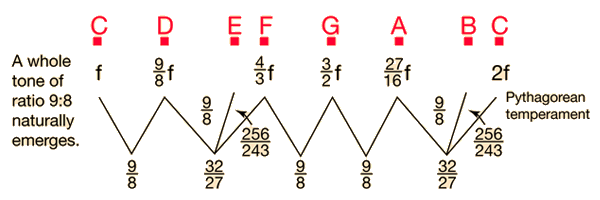 The musical scale that Pythagoras invented and that forms the foundation for all Western music is based on relationships between small integers. Both the frequencies of musical notes and the intervals between them are ratios of certain integers, as follows:
Scale of Just Intonation
Note C D E F G A B C'
Frequency 1/1 9/8 5/4 4/3 3/2 5/3 15/8 2/1
Interval 9/8 10/9 16/15 9/8 10/9 9/8 16/15
How could similar relationships be uncovered for the S&P? As a first step we might force all S&P daily moves into bins one point wide, that is we could call all moves of 1.0 to 1.9 points "one point moves," and so forth.
We calculated the number of occurrences of each integer move, and also the number that would be expected if we assumed a normal distribution having the same mean and standard deviation. The result may be familiar to some readers but new to others, so we show it here:
S&P Daily moves in increments of 1 point
1999 to 2007/2/28
NormDist
LO HI Cases ExpCases
-500 -40.1 10 2.46
-40 -39.1 1 0.63
-39 -38.1 0 0.79
-38 -37.1 1 0.98
-37 -36.1 2 1.21
-36 -35.1 3 1.49
-35 -34.1 3 1.83
-34 -33.1 1 2.22
-33 -32.1 4 2.68
-32 -31.1 7 3.22
-31 -30.1 3 3.85
-30 -29.1 9 4.58
-29 -28.1 2 5.41
-28 -27.1 9 6.35
-27 -26.1 8 7.42
-26 -25.1 6 8.62
-25 -24.1 5 9.95
-24 -23.1 13 11.42
-23 -22.1 13 13.03
-22 -21.1 20 14.79
-21 -20.1 16 16.69
-20 -19.1 13 18.73
-19 -18.1 15 20.89
-18 -17.1 16 23.17
-17 -16.1 17 25.55
-16 -15.1 19 28.01
-15 -14.1 24 30.54
-14 -13.1 28 33.10
-13 -12.1 29 35.67
-12 -11.1 39 38.23
-11 -10.1 43 40.73
-10 -9.1 53 43.15
-9 -8.1 46 45.45
-8 -7.1 55 47.59
-7 -6.1 52 49.56
-6 -5.1 52 51.31
-5 -4.1 54 52.82
-4 -3.1 60 54.06
-3 -2.1 70 55.01
-2 -1.1 79 55.66
-1 -0.1 76 56.00
0 0.9 94 56.02
1 1.9 85 55.71
2 2.9 91 55.09
3 3.9 89 54.17
4 4.9 74 52.95
5 5.9 69 51.47
6 6.9 54 49.74
7 7.9 52 47.80
8 8.9 59 45.67
9 9.9 53 43.38
10 10.9 35 40.98
11 11.9 43 38.48
12 12.9 38 35.93
13 13.9 28 33.36
14 14.9 26 30.79
15 15.9 25 28.26
16 16.9 17 25.79
17 17.9 18 23.40
18 18.9 14 21.11
19 19.9 14 18.94
20 20.9 10 16.89
21 21.9 7 14.98
22 22.9 6 13.20
23 23.9 5 11.57
24 24.9 6 10.09
25 25.9 15 8.74
26 26.9 4 7.53
27 27.9 8 6.45
28 28.9 7 5.50
29 29.9 2 4.66
30 30.9 2 3.92
31 31.9 3 3.28
32 32.9 2 2.73
33 33.9 2 2.26
34 34.9 1 1.86
35 35.9 2 1.52
36 36.9 3 1.24
37 37.9 0 1.00
38 38.9 2 0.81
39 39.9 4 0.65
40 500 16 2.52
The main features of the distribution as compared to the normal are: an excess of small changes (say from -6 to +6 points), a deficit of medium sized moves (of about +-16 points) and a modest excess of very large moves (+-35 points or more). A description in terms of these three features is a better one, in my opinion, than simply focusing on the size of the negative tail (as too many people do).
From Laurel Kenner:
In mathematics, Dr. Castaldo is on Parnassus and I am on the "Gradus ad." I do know a little about music and writing, and so I will nevertheless venture to observe that Pythagoras did not actually invent the musical scale. As Stuart Isacoff puts it in his masterful book "Temperament":
"Pythagoras's discovery was that the most 'agreeable' harmonies [e.g., the octave, fifth and fourth] are formed by the simplest kind of mathematical relationships. If the vibrations of one tone are twice as fast as the vibrations of another's, for example, the two will blend so smoothly the result will sound almost like a single entity [he is referring to an octave]. The separate constituents of this musical marriage are oscillating in the proportion 2:1."
Closer to our day, Helmholz wrote that consonant tonal relationships are embedded in the essential physical structure of notes — the sound waves. Look at a graph, and you'll see greater spikes in intensity around the octave, fifth, fourth, etc. These spikes are known as harmonics. Their intensity levels depend on the shape of the instrument that produces the sound, and the resulting mixture contributes to the distinctive sound of each instrument.
(Hold a bass note on the piano down and strike the same note, stacatto, a few octaves higher and listen closely — you'll hear sonorities of tones still higher. Or experiment with harmonics on a vibrating guitar string.)
The market's ever-changing significant levels might be viewed (heard) as harmonics of past turning points. The Chair's insights on the continuing psychological impact of catastrophic events would seem to be in this genre.
The mathematical relations found in music are tempting to apply to the physical structure of the universe, and people have done that at least since Pythagoras. But I will leave that to the physicists.
Todd Tracy adds:
We might be socialized to market intervals in much the same way as to musical intervals. I found this interesting.
Evolutionary Effects by Robert Fink, 2004
General human evolution has provided us with voices that are acoustically musical, and with ear receptors that are appreciative of, or attracted to, acoustically-musical sounds (i.e., not noisy). Why this evolution?
Without these physiological capacities, then:
* Mothers would not coo to their babies; nor would the babies love the sound of it;
* Nor would evolution of language and the socializing sounds of the voice have been as possible;
* Nor would the noisy (i.e., not-acoustically musical) sounds from any nearby destructive event or attack, or of the sounds of breakage, screams or cries of pain, have served as a noisy warning [unattractive or repelling] to alarm or alert us — Some sounds make us come, others make us run….
And, as a result, our collectivized survival might not have been as efficient, and we could have gone the way of the extinct Dodo.
All those same capacities [regarding being able to distinguish noise from "musical" sound] also served to allow the development of musical systems to arise and evolve wherever there were curious people with time to play or experiment with the stimuli around them.
Tom Ryan extends:
I find this Pythagorean scale discussion fascinating and have thought about various applications of musical scales and notes to market prices often over the years. Pythagoras believed the universe was an immense monochord and many of the Pythagorean teachings at Crotona are remarkable insights, especially with respect to what we now call string theory.
Pythagoras believed that by studying music mathematically, one could develop an understanding of structures in nature. One of the more interesting aspects that I have found in this is the lambdoma table, which is a 16×16 dimensional matrix of ratios starting with 1/1 and ending with 16/16,
1/1 1/2 1/3 1/4 1/5 1/6 1/7…….1/16
2/1 2/2 2/3 2/4 2/5 2/6 2/7…….2/16
3/1 3/2 ………..
.
.
.
.
16/1 16/2 16/3……………….16/16
The lambdoma is composed of two series. The first represents the divisions of a string which represent frequencies or tones. The second level represents harmonics. For example the first 16 harmonics of C are 256 hz (C), 512 hz (C), 768 hz(G) 1024 hz(C) 1280 (E) 1536 (G) 1792(B-) 2048(C) 2304(D) 2560(E) 2816(F#) 3072(G) 3328(A-) 3584(Bb-) 3840(B) and finally 4096 hz (C again since 4096/256 =16/1). This series represents the overtones or partial and whole harmonics of C and are represented by ratios in the table
Through the ratios one can study other types of natural structures as well. Botanists in particular have studied geometrical structure and many plant structures (leaves, flowers) have been noted to be geometrically developed in consistent ways where the key geometric ratios fall into a contiguous grouping or overtones of a fundamental, i.e. a pattern of squares within the lambdoma matrix. Leaves for instance often have simultaneous ratios of thirds (5:4) and fifths (3:2). The Renaissance studies including Da Vinci's notebooks note that the human body develops along particular lines as well, namely an abundance of major sixths (3:5) and minor sixths (5:8).
These whole number ratios or pattern of harmonics, as Laurel noted, form the basis for musical scales,
Octave 1:2
Fifth 2:3
Fourth 3:4
Major sixth 3:5
Major third 4:5
Minor sixth 5:8
Minor seventh 5:9
Major second 8:9
Major seventh 8:15
Minor second 15:16
Tritone 32:45
The question is whether specific harmonic patterns occur at times in the market and whether these can be quantified in some way. Victor discusses market prices as music in his book EdSpec.
One way would be to classify movements as ratios, and see the patterns of ratios as they unfold, classifying movements in price as patterns on a scale or within the lambdoma. From that one might be able to find a few meager predictable patterns. But there is a problem with this: to calculate ratios in a contiguous strip of real time prices one must arbitrarily choose reference points in order to calculate the ratios.
This means that there is a substantial level of subjectivity in developing the ratios from which the patterns can be studied. But one could arbitrarily divide the day into segments and look at ranges or deltas within those segments (say 30 minutes) and then calculate ratios of adjacent periods. There are probably an infinite variety of ways to segment and calculate ratios and therein lies the dilemma.
Apr
10
Price as a Signal, from Alex Castaldo
April 10, 2007 | Leave a Comment
 James Kynge, in The Financial Times:
The first inkling the British had of the 13th-century Mongol invasion of Europe, a cataclysm for the continent, was when the price of fish at Harwich, a harbour on the North Sea, rose sharply. The explanation for this, people learned later, was that the Baltic shipping fleets, abruptly deprived of sailors required to fight the enemy approaching by horse from the east, had remained at their moorings. That had reduced the supply of cod and herring to Harwich, and prices had risen accordingly.
Ken Smith remarks:
That was a fishy tale. Pacific salmon are disappearing and lovers of the odor of fish cooking in an apartment building with no air conditioning are lamenting this fact.
For one six-month season I worked out of Dutch Harbor, on an ocean tug pulling a fuel barge around the Bering Sea and Gulf of Alaska. Dutch Harbor in the Aleutian Island chain has a stream running from the hills above to the harbor. This steam is lined with homes built by natives. Homeowners fished off back porch, simply stepped into the stream and grabbed a meal if willing to risk the rushing water.
That was in 1955. Fish were free then. Since salmon are disappearing, there may soon be fish wars in the village at Dutch Harbor.
In the harbor, moored at the Chevron tank-farm wharf, we merely dropped a line over the side to snag 100 lb halibut, any time, day or night. Things have changed since Asian fisheries now have boats on every wave crest.
From Denis Vako:
Here is an outlier's observation. Never was there such a thing as a Mongol invasion of Europe or Russia. It is a fairy tale invented by Romanovs to legitimize their power grab in Russia. Cossacks, Slavs, Vikings and other Russians are the ones who in fact invaded Europe.
A history book, fiction or science, by Anatoly Fomenko has the whys and the proofs. I found only 2 volumes on Amazon in English, but he has seven in Russian, including mathematical evidence.
Apr
9
 The worst mistake in business is to get in over your head. Don't ever let yourself do it. The market will always be around. Do keep a lab notebook and hand records of all your trades. Try to do as much of your research by hand whenever you can, as it lets you see more things.
Always enumerate your entire computer output by trade so you'll see how it's doing over time and bunches. Try not to listen to smart people on a macro basis, as their views can be marginal and some are smarter than others. Only trade active markets.
Also, don't be afraid to give up on markets. Find a niche where you have an edge and do concentrate on it. I started out with about 10,000 under management. If you can make a little above average, you'll have all the business in the world.
Bill Rafter adds:
The Chair is absolutely correct about keeping notes. And there is nothing as good as a lab notebook. But everything has the disadvantages of its advantages. I have found in both research and trading that the handwritten lab notebook is essential for thinking through ideas and theoretical problems. But it falls short in terms of practical research because your notes will essentially be anecdotal.
We have found that when researching a particular idea we get excited and may sometimes make manual research "runs" several times a minute. That's too fast to keep adequate handwritten notes. Additionally we may set up research to run thousands of variations overnight in an attempt to find the statistical "truth" of something. In such a case you must have a way of saving each result and sorting and comparing the whole lot. Anecdotal notation is not enough.
The same is true with trading. Every time you make a trade have the results saved according to the type of trade it was. The types are specific to you. Someone else might characterize them differently. The more information the better.
For both research and trading it's best if you create software to save your results. Have the results of each research run or trade stored in a text file, and then have the ability to plop the results of all such research and trades in an excel file for comparison. You may not be the smartest "natural" researcher or trader, but your documentation and filing system will enable you to avoid future mistakes.
Most people fail at the business of trading. Most people trade "anecdotally." My guess is that the Venn diagrams of these shows considerable overlap. As the demigod said, it's perspiration, not inspiration.
Hany Saad comments:
What is getting in over your head? Is leverage getting in over one's head? Is over leveraging? What is overleverage? should one be only trading on a 1 to 1 … 1 to 3, or use the maximum leverage possible? Should one diversify? if you are trading the stockmarket, is anything above 15 positions really necessary? Is anything above that even easily trackable by a manager?
It is unfortunate that the first advise seasoned managers offer you is to diversify. I believe this is the mistake managers make the most. They over-diversify and they lose track of the raison d'etre of their positions in the first place. Do not over-diversify.
On a side note, I am guilty of not following Vic's advise about hand studies. I only started after reading this post by simply putting down prices on graph paper, and let me tell you that the feeling you get out of the process is incredible. Things you would very easily miss by using the computer become clear to you. The only problem is that the process can be very time consuming, but not without its benefits.
Alex Castaldo offers:
What is getting in over your head?
Really you don't know? We have some experts on this right here on the Spec-List. Or is it a rhetorical question?
What is over-leverage?
Ed Seykota has a good explanation on his web site. (I don't like Ed Seykota, BTW, too arrogant.) For a given expectation, as you increase leverage at some point the rate of return decreases. A hump shaped curve.
Should one diversify?
Let's not waste time on this; Markowitz already got the Nobel Prize for answering it.
If you are trading the stock market, is anything above 15 positions really necessary?
Do you think that Jim Simon or David Shaw have portfolios of fewer than 15 stocks?
Is anything above [15 stocks] even easily tractable by the manager?
With a computer you can keep track of 1500 stocks practically as easily as 15.
I believe this is the mistake managers do the most. They over-diversify.
Think of it from the Markowitz point of view. You have a quadratic program in terms of means, variances, and covariances, plus you add a constraint "no more than 15 stocks." Solve the QP. Now remove the constraint of only 15 stocks and solve the QP again. What happens to the rate of return? In all but pathological cases it increases (and it never decreases) by removing that constraint.
Think of it also from the Statarb point of view. You have an algorithm that successfully predicts stock excess returns. As long as the excess returns are greater than the transaction cost, you might as well include as many stocks as possible in the portfolio. By limiting the portfolio to 15 stocks you are leaving money on the table.
From Sushil Kedia:
The picture captioned Guru has some inspiring stories to tell. This particular snapshot shows Abhishek Bacchan - the current contender for the superstar slot in Bollywood. In this recent blockbuster titled Guru he is playing the role of Gurukant Desai - a pseudonym for Dhirubhai H Ambani - the biggest tycoon ever in Indian business.
The sea of umbrellas in the backdrop is a touching sense of cinematography and attempts to capture that historic moment when nearly two decades ago for the first time in India a Public Limited Company held its Annual General Meeting in a sports stadium for the first time. Mr. Ambani is credited to be the father of the raging equity cult in this nation. The lashing rains, it is said, did not dissuade a near histrionic crowd from dispersing. This picture thus has a story of a man, who was barely literate but had all the speculative and risk taking genetics to inspire milling crowds to supply capital.
Mr. Ambani was a rank outsider in the industrial club of post-independence India. The son of a village schoolteacher who resigned from secure employment to create the largest ever-industrial enterprise in India. The Reliance group of companies that he went onto create have had grown within twenty years of coming to life to be the largest market capitalization companies in their respective sectors, largest sales, largest profits, largest number of shareholders, largest everything.
The movie is a reasonably close depiction of many of his facets (and three hours can't be enough to justly portray the racing pace of two decades of growth). An ace natural speculator, his enterprises have continued to expand in ways very typical of a trader who pyramids correctly and manages risk. This movie depicts inspiringly enough for any trader how a rank outsider without any crutches of a business lineage or modern education applies commonsense, correct usage of the envelope and pencil device (hand-studies), intelligence and sheer diligence to beat the system at its own tracks.
Lores suggest that when Dhirubhai was working as a clerk for a commodity trader on the port of Aden at the age of sixteen, suddenly the town started discovering the trading prowess of the lad with acumen. A particular denomination of coins vanished gradually first and completely later out of circulation. The value of the silver content had gone higher than the nominal value of the coins. It is believed his first large wad of capital originated from this arbitrage. [Not shown in the movie though]
A ticklishly touching sequence from the movie shows that when the Futures exchange in Mumbai was shut down by the orders signed by a bureaucrat that described speculation as unproductive gambling, Guru / Dhirubhai hires a truck and dumps long and fat rolls of polyester yarn in the living room of this bureaucrat. The officer scared of a possible tarnishing of his reputation that others may think all this yarn is lying in his house asks him to remove it immediately. Dhirubhai walks off saying the only two ways the officer can dispose off the yarn is by either dumping it all in the sea or re-opening the exchange where it is possible to buy and sell. Perplexed for several days, the officer tracks Dhirubhai down over and orders the re-opening of the exchange turning the David a darling of the Goliaths.
If anyone is interested in figuring out how modern India's business structures operate, what is the "inside picture", what is to be not done and what must be done this is a must watch movie. For those purely interested in trading philosophies the ingenuity of the hero of this saga has continuous positive surprises. For a rise as meteoric as this in such short time, what is remarkable is that for all his aggression he clearly believed and lived inside out that, "the worst mistake in business is to get in over your head." He is more Aggressive and more humble than the competition and in equal measure.
Of the hundreds of popular Ambanisms one would in the present context mention these few:
"No one was ever issued an invitation to profits."
"If I have to salute a peon in someone's office to get past my objectives, it is part of my work to do so."
"Calamity is the origin of other opportunities."
"Think big, think fast, think ahead. Ideas are no one's monopoly."
Vic replies:
One of the greatest mysteries to me is how trading firms like the ones mentioned can garner over sized returns with short term activities, considering the massive bid asked spreads and exposure to the principles of ever changing cycles. Smart people I have known, like my first partner who was a champion bridge player as well as number one in M.A.A. comp., have never understand that whatever looks like it works is doomed to failure. Despite this, to his credit he was a buy and hold man with a reasonably positive view of the resilience of enterprise, and was thus able to participate in the drift of the 10,000 fold return per century.
On the other hand the firms mentioned are riddled by those who hate enterprise and would seem to favor things like long/short, making their inability to overcome the bid asked spread even more incredibly likely to me. But as they say, when I pose similar lacnunae against the sport-term owner, he is the one who owns the big teams and I am still a very small operator. I am a poster boy for how volatility and chronic bullishness can lead to disaster, as well as the butt of the mojo of the expert derivatives man who is so ready and able to take all my meager chips on the all too frequent black swan events.
Mar
15
Heyne on Speculation, from Alex Castaldo
March 15, 2007 | Leave a Comment
Pages 178 and following of The Economic Way of Thinking: a brief summary.
(1) Speculation arises because of uncertainty about the future and is quite common. Many everyday activities involve an element of speculation. For example a college student getting an education is speculating (he hopes, but cannot be sure, that the increased income he will get after graduating will outweigh the cost and effort of going to college). Another example might be a motorist who passes by a gas station hoping to find another station with a cheaper gas price further down the road, even though the next one might actually be more expensive.
(2) A more important example involves price speculation on agricultural commodities such as corn.
If it is expected that the next corn crop will be smaller than usual (perhaps because of signs of corn-leaf blight in the Midwest corn fields) a number of economic responses take place that tend to reduce current consumption of corn and increase the amount stored for future consumption. Some of these are the result of the actions of ranchers, or companies who use or store corn in their operations; others are the result of organized futures markets. All these can be classified as speculation. The result is an increase in the spot price of corn. Heyne emphasizes that this is a beneficial effect; the price increase is a signal that corn is scarce and it encourages people to consume less corn or store more of it for the future.
As Heyne says:
"the speculative activities cause corn to be transported over time from a period of relative abundance to one of relative scarcity".
The price increase takes place even before the next corn crop comes on the market, and this is as it should be (even though some people do not appreciate it): if corn is going to be scarce we might as well start economizing on its use right away. It is entirely possible of course that the predicted corn blight will not occur, but the speculators are rewarded for being right, they lose out if they are wrong.
Participants in the futures markets include both hedgers and speculators:
"Futures markets allow people to allocate their risks and deal with uncertainty as they see fit. Those who wish to reduce their risk have the option to hedge, those who wish to increase their exposure to risk have the option to speculate."
(3) The futures markets generate information (namely accurate prices for commodities) and are thus valuable even to people who do not participate in them. For example farmers can use futures prices for corn to make crop decisions. The futures markets also encourage the generation of information, in the sense that the speculators are rewarded if they understand all factors (fundamental and technical) that affect prices and are presumably hard at work to uncover them.
(4) A favorite passage of Vic's appears on page 179:
"Adam Smith once compared those who speculate on the future price of grain to the prudent captain of a sailing ship, who puts the crew on short rations the moment he discovers there is not enough food on board to last through the voyage. Grain speculators, Smith argued, reduce the suffering that bad harvests cause by inducing consumers to start economizing early."
Mar
6
Measuring the True Cost of Active Management by Mutual Funds, from Alex Castaldo
March 6, 2007 | 1 Comment
Article by Daily Spec's Professor Ross Miller, from Alex Castaldo, in latest issue of Journal of Investment Management.
This article describes a rigorous method for allocating fund expenses between active and passive management. It also enables one to compute the implicit cost of active management. Computing this "active expense ratio" requires only a fund's published expense ratio, its R-squared relative to a benchmark index, and the expense ratio for a competitive fund that tracks that index. This method is then applied to the Morningstar universe of large-cap mutual funds and active expense ratios are found to average more than 7%. The cost of active management for other classes of mutual funds is also found to be substantial.
Feb
8
Negative Feedback and Trend Following, by Victor Niederhoffer
February 8, 2007 | Leave a Comment
 There has been entirely too little thought given to the mechanism, pathways and reasons that negative feedback works in markets. Perhaps the main reason is that the feeding web is based on a reasonable stability in what and how much is being eaten and recycled.
The people who consume and redistribute must maintain a ready and stable supply of those who produce. They develop mechanisms to keep everything going. One of them is the specialization and great efficiency in their activities. If markets deviate too much from the areas and levels within which the specialization has developed, then much waste and new effort and mechanisms will be necessary.
Aside from the grind that trend following causes (i.e. the losses in execution), and the negative feedback system of movements in the supply and demand schedules that equilibrate, which Marshall pioneered and are now standard in economics, and the numerous other reasons I've set forth (e.g. the fixed nature of the system and the flexibility to profit from it), this appears to me to be the main reason that trend following doesn't work.
Here are a few interesting articles on the subject:
How Great Traders Make Millions in Up or Down Markets
Does Trend Following Work On Stocks?
Interviews At RealWorld Trading
Bill Rafter writes:
Dr. Bruno had posed the idea of beating an index by deleting the worst performers. This is an area in which we have done considerable work. Please note that we do not consider this trend-following. The assets are not charted, just ranked.
Let us imagine an investor who is savvy enough to identify what is strong about an economy and invest in sectors representative of those areas, while avoiding sectors representing the weaker areas of the economy. Note that we are not requiring our investor to be prescient. He does not need to see what will be strong tomorrow, just what is strong and weak now, measured by performance over a recent period.
What is a market sector? The S&P does that work for us, and breaks down the overall market (that is, the S&P 500) into 10 Sectors. They further break it down into 24 Industry Groups, and further still into 60-plus Industries and 140-plus Sub-Industries. The number of the various groups and their constituents changes from time to time as the economy evolves, but essentially the 500 stocks can be grouped in a variety of ways, depending on the degree of focus desired. Some of the groupings are so narrow that only one company represents that group.
Our investor starts out looking at the 10 Sectors and ranks them according to their performance (such as their quarterly rate of change). He then invests in those ranked first through fourth (25 percent in each), and maintains those holdings until the rankings change. How does he do? Not bad, it turns out.
www.mathinvestdecisions.com/Best_4_of_10.gif
From 1990 through 2006, which encompasses several types of market conditions, the overall market managed an 8 percent compound annual rate of return. Our savvy investor achieved 10.77%. A less savvy investor who had the bad fortune to pick the worst six groups would have earned 7.23%. Those results are below. (Note, for comparison purposes, all results excluded dividends.)
www.mathinvestdecisions.com/Worst_6_of_10.gif
How can our savvy investor do better? By simply sharpening one's focus, major improvements can be achieved. If instead of ranking the top 4 of10 Sectors, our savvy investor invests in a similar number (say the top 4, 5 or 6) of the 24 Industry Groups, he achieves a 13.12% compoundedannual rate of return over the same period. Note that the same stocks are represented in the 10 Sectors and the 24 Industry Groups. At no time did he have to be prescient.
www.mathinvestdecisions.com/Going_to_24_groups.gif
One thing you will notice from the graphs above is that the equity curves of our savvy and unlucky investors mimic the rises and declines of the market index itself. Being savvy makes money but it does not insulate one from overall bad markets because the Sectors and even the Industry Groups are not significantly diversified from the overall market.
Why not keep going further out and rank all stocks individually? That clearly results in superior returns, but the volume of trading is such that it can only be accomplished effectively in a fund structure - not by the individual. And even ranking thousands of stocks will not insulate an investor from an overall market decline, if he is only invested in equities. The answer of course is diversification.
It is possible to rank debt and alternative investment sectors alongside equities, in the hope of letting their performances dictate what the investor should own. However the debt and commodities markets have different volatilities than the equities markets. Anyone ranking them must make adjustments for their inherent differences. That is, when ranking really diverse assets, one must rank them on a risk-adjusted basis for it to be a true comparison. However if we make those adjustments and rank treasury bonds (debt) against our 24 Industry Groups (equity) we can avoid some of the overall equity declines. We refer to this as a Strategic Overlay:
www.mathinvestdecisions.com/Strategic_diversification.gif
Adding this Strategic Overlay increases the returns slightly, but more important, diversifies the investor away from some periods of total equity market decline. We are not talking of a policy of running for cover every time the equities markets stall. In the long run, the investor must be in equities.
Invariably in ranking diverse assets such as equities, debt and commodities, our investor will be faced with a decision that he should be completely out of equities. It is likely that will occur during a period of high volatility for equities, but one that has also experienced great returns. Thus, our investor would be abandoning equities when his recent experience would suggest otherwise. And since timing can never be perfect, it is further likely that the equities he abandons will continue to outperform for some period. On an absolute basis, equities may rank best, but on a risk-adjusted basis, they may not. It is not uncommon for investors to ignore risk in such a situation, to their subsequent regret.
Ranking is not without its problems. For example, if you are selecting the top 4 groups of whatever category, there is a fair chance that at some time the assets ranked 4 and 5 will change places back and forth on a daily basis. This "flutter" can be easily solved by providing those who make the cut with a subsequent incumbency advantage. For a newcomer to replace a list member, it then must outrank the current assets on the selected list by the incumbency advantage. This is very similar to the manner in which thermostats work. We have found adding an incumbency advantage to be a profitable improvement without considering transactions costs. When one also considers the reduced transaction costs, the benefits increase even more.
Another important consideration is the "lookback" period. Above we used the example of our savvy investor ranking assets on the basis of their quarterly growth. Not surprisingly, the choice of a lookback period can have an effect on profitability. Since markets tend to fall more abruptly than they rise, lookback periods that perform best during rising markets are markedly different from those that perform best during falling markets. Determining whether a market is rising or falling can be problematic, as it can only be done with certainty in retrospect. However, another key factor influencing the choice of a lookback period is volatility, which can be determined concurrently. Thus an optimal lookback period can be automatically determined based on volatility.
There is certainly no question that a diligent investor can outperform the market. By outperforming the market we mean that he will achieve a greater average rate of return than the market, while limiting the maximum drawdown (or percentage equity decline) to less than that experienced by the market. But the average investor is generally not up to the diligence or persistence required.
In the research work illustrated above, all transactions were executed on the close of the day following a decision being made. Thus the strategy illustrated is certainly executable. Nothing required a forecast; all that was required was for the investor to recognize concurrently which assets have performed well over a recent period. It is not difficult, but requires daily monitoring.
www.mathinvestdecisions.com/about.htm
Charles Pennington writes:
Referring to the MathInvestor's plot:
www.mathinvestdecisions.com/Worst_6_of_10.gif :
At first glance it appears that the "Best" have been beating the "Worst" consistently.
In fact, however, all of the outperformance was from 1990 through 1995. From 1996 to present, it was approximately a tie.
Reading from the plot, I see that the "Best" portfolio was at about 2.1 at the start of 1996. It grew to about 5.5 at the end of the chart for a gain of about 160%. Over the same period, the "Worst" grew from 1.3 to 3.2, a gain of about 150%, essentially the same.
So for the past 11 years, this system had negligible outperformance.
One should also consider that the "Best" portfolio benefits in the study from stale pricing, which one could not capture in real trading. Furthermore, dividends were not included in the study. My guess is that the "Worst" portfolio would have had a higher dividend yield.
In order to improve this kind of study, I would recommend:
1.) Use instruments that can actually be traded, rather than S&P sectors, in order to eliminate the stale pricing concern.
2.) Plot the results on a semilog graph. That would have made it clear that all the outperformance happened before 1996.
3.) Finally, include dividends. The reported difference in compound annual returns (10.8% vs 8.0%) would be completely negated if the "Worst" portfolio had a yield 2.8% higher than the "Best".
Bill Rafter replies:
Gentlemen, please! The previously sent illustration of asset ranking is not a proposed "system," but simply an illustration that tilting one's portfolio away from dogs and toward previous performers can have a beneficial effect on the portfolio. The comparison between the 10 Sectors and the 24 Industry Groups illustrates the benefits of focus. That is, (1) don't buy previous dogs, and (2) sharpen your investment focus. Ignore these points and you will be leaving money on the table.
We have done this work with many different assets such as ETFs and even Fidelity funds (which require a 30-day holding period), both of which can be realistically traded. They are successful, but not overwhelmingly so. Strangely, one of the best asset groups to trade in this manner would be proprietarily-traded small-cap funds.
Unfortunately if you try trading those, your broker will disown you. I mention that example only to suggest that some assets truly do have "legs," or "tails" if you prefer. I think their success is attributed to the fact that some prop traders are better than others, and ranking them works. An asset group with which we have had no success is high-yield debt funds. I have no idea why.
A comment from Jerry Parker:
 I wrote an initial comment to you via your website [can be found under the comments link by the title of this post], disputing your point of view, which a friend of mine read, and sent me the following:
I read your comment on Niederhoffer's Daily Spec in response to his arguments against trend following. Personally, I don't think it boils down to intelligence, but rather to ego. Giving up control to an ego-less computer is not an easy task for someone who believes so strongly in the ability of the human mind. I have great respect for his work and his passion for self study, but of course disagree with his thoughts on trend following. On each trade, he is only able to profit if it "trends" in a favorable direction, whether the holding period is 1 minute or 1 year. Call it what you will, but he trades trends all day.
He's right. I was wrong. Trend following is THE enemy of the 'genius'. You and your friends can't even see how stupid your website is. You are blinded by your superior intelligence and arrogance.
Victor Niederhoffer responds:
Thanks much for your contributions to the debate. I will try to improve my understanding of this subject and my performance in the future so as not to be such an easy target for your critiques.
Ronald Weber writes:
When you think about it, most players in the financial industry are nothing but trend followers (or momentum-players). This includes analysts, advisors, relationship managers, and most fund or money managers. If there is any doubt, check the EE I function on Bloomberg, or the money flow/price functions of mutual funds.
The main reason may have more to do with career risk and the clients themselves. If you're on the right side while everyone is wrong, you will be rewarded; if you're on the wrong side like most of your peers you will be ok; and if you're wrong while everyone is right then you're in trouble!
In addition, most normal human beings (daily specs not included!) don't like ideas that deviate too much from the consensus. You are considered a total heretic if you try to explain why, for example, there is no link between the weak USD and the twin deficits. This is true, too, if you would have told anyone in 2002 that the Japanese banks will experience a dramatic rebound like the Scandinavian banks in the early '90s, and so on, or if you currently express any doubt on any commodity.
So go with the flow, and give them what they want! It makes life easier for everyone! If you can deal with your conscience of course!
The worse is that you tend to get marginalized when you express doubt on contagious thoughts. You force most people to think. You're the boring party spoiler! It's probably one reason why the most successful money managers or most creative research houses happen to be small organizations.
Jeremy Smith offers:
 Not arguing one way or the other here, but for any market or any stock that is making all time highs (measured for sake of argument in years) do we properly say about such markets and stocks that there is no trend?
Vincent Andres contributes:
I would distinguish/disambiguate drift and trend.
"Drift": Plentifully discussed here. "Trend": See arcsine, law of series, etc.
In 2D, the French author Jean-Paul Delahaye speaks about "effet rateau" (rake effect), here and here .

Basically, our tendency is to believe that random equals equiprobability everywhere (2D) or random equals equiprobability everytime (1D), and thus that nonequiprobability everywhere/everytime equals non random
In 1D, non equiprobability everytime means that the sequence -1 +1 -1 +1 -1 +1 -1 +1 is in fact the rare and a very non random sequence, while the sequences -1 +1 +1 +1 +1 +1 -1 +1 with a "trend" are in fact the truly random ones. By the way, this arcsine effect does certainly not explain 100% of all the observed trends. There may also be true ones. Mistress would be too simple. True drift may certainly produce some true trends, but certainly far less than believed by many.
Dylan Distasio adds:
For those who don't believe trend following can be a successful strategy, how would you explain the long-term performance of the No Load Fund X newsletter? Their system consists of a fairly simple relative strength mutual fund (and increasingly ETF) model where funds are held until they weaken enough in relative strength to swap out with new ones.
The results have been audited by Hulbert and consistently outperform the S&P 500 over a relatively long time frame (1980 onwards). I think their results make a trend following approach worth investigating…
Jerry Parker comments again:
All you are saying is that you're not smart enough to develop a trend following system that works. What do you say about the billions of dollars traded by trend following CTAs and their long term track records?
Steve Leslie writes:
If the Chair is not smart enough to figure out trend following, what does that bode for the rest of us?
There is a very old yet wise statement: Do not confuse brains with a bull market.
Case in point: prior to 2000 the great tech market run was being fueled by the hysteria surrounding Y2K. Remember that term? It is not around today but it was the cause for the greatest bull market seen in stocks ever. Dot.com stocks and new issues were being bought with reckless abandon.
New issues were priced overnight and would open 40-50 points higher the next trading day. Money managers had standing orders to buy any new issues. There was no need for dog-and-pony or road shows. It was an absolute classic and chaotic case of extraordinary delusion and crowd madness.
Due diligence was put on hold, or perhaps abandoned. A colleague of mine once owned enough stock in a dot.com that had he sold it at a propitious time, he would have had enough money to purchase a small Hatteras yacht. Today, like many contemporary dot.coms, that stock is essentially worthless. It would not buy a Mad magazine.
Corporations once had a virtual open-ended budget to upgrade their hardware and software to prepare for the upcoming potential disaster. This liquidity allowed service companies to cash in by charging exorbitant fees. Quarter to quarter earnings comparisons were beyond belief and companies did not just meet the numbers, they blew by them like rocket ships. What made it so easy to make money was that when one sold a stock, all they had to do was purchase another similar stock that also was accelerating. The thought processes where so limited. Forget value investing; nobody on the planet wanted to talk to those guys. The value managers had to scrape by for years while they saw their redemptions flow into tech, momentum, and micro cap funds. It became a Ponzi scheme, a game of musical chairs. The problem was timing.
The music stopped in March of 2000 when CIO's need for new technology dried up coincident with the free money, and the stock market went into the greatest decline since the great depression. The NASDAQ peaked around 5000. Today it hovers around 2500, roughly half what it was 7 years ago.
It was not as if there were no warning signs. Beginning in late 1999, the tech market began to thin out and leadership became concentrated in a few issues. Chief among the group were Cisco, Oracle, Qwest, and a handful of others. Every tech, momentum, and growth fund had those stocks in their portfolio. This was coincident with the smart money selling into the sectors. The money managers were showing their hands if only one could read between the lines. Their remarks were "these stocks are being priced to perfection." They could not find compelling reasons not to own any of these stocks. And so on and on it went.
After 9/11 markets and industries began to collapse. The travel industry became almost nonexistent. Even Las Vegas went on life support. People absolutely refused to fly. Furthermore, business in and around New York City was in deep peril. This forced the Fed to begin dramatically reducing interest rates to reignite the economy. It worked, as corporations began to refinance their debt and restructure loans, etc.
The coincident effect began to show up in the housing industry. Homeowners refinanced their mortgages (yours truly included) and took equity out of their homes. Home-buyers were thirsty for real estate and bought homes as if they would disappear off the earth. For $2000 one could buy an option on a new construction home that would not be finished for a year. "Flipping" became the term du jour. Buy a home in a hot market such as Florida for nothing down and sell it six months later at a much higher price. Real estate was white hot. Closing on real estate was set back weeks and weeks. Sellers had multiple offers on their homes many times in the same day. This came to a screeching halt recently with the gradual rise in interest rates and the mass overbuilding of homes, and the housing industry has slowed dramatically.
Houses for sale now sit on the blocks for nine months or more. Builders such as Toll, KB, and Centex have commented that this is the worst real estate market they have seen in decades. Expansion plans have all but stopped and individuals are walking away from their deposits rather than be upside down in their new home.
Now we have an ebullient stock market that has gone nearly 1000 days without so much as a 2% correction in a day. The longest such stretch in history. What does this portend? Time will tell. Margin debt is now at near all-time highs and confidence indicators are skewed. Yet we hear about trend followers and momentum traders and their success. I find this more than curious. One thing that they ever fail to mention is that momentum trading and trend following does not work very well in a trendless market. I never heard much about trend followers from June 2000 to October 2002. I am certain that this game of musical chairs will end, or at least be temporarily interrupted.
As always, it is the diligent speculator who will be prepared for the inevitable and capitalize upon this event. Santayana once said, "Those who cannot remember the past are condemned to repeat it."
From "A Student:"
Capitalism is the most successful economic system in the history of the world. Too often we put technology up as the main driving force behind capitalism. Although it is true that it has much to offer, there is another overlooked hero of capitalism. The cornerstone of capitalism is good marketing.
The trend following (TF) group of fund managers is a perfect example of good marketing. As most know, the group as a whole has managed to amass billions of investor money. The fund operators have managed to become wealthy through high fees. The key to this success is good marketing not performance. It is a tribute to capitalism.
The sports loving fund manger is a perfect example. All of his funds were negative for 2006 and all but one was negative over the last 3 years! So whether one looks at it from a short-term one year stand point or a three year perspective his investors have not made money. Despite this the manager still made money by the truckload during this period. Chalk it up to good marketing, it certainly was not performance.
The secret to this marketing success is intriguing. Normally hedge funds and CTAs cannot solicit investors nor even publicly tout their wares on an Internet site. The TF funds have found a way around this. There may be a web site which openly markets the 'concept' of TF but ostensibly not the funds. On this site the names of the high priests of TF are repeatedly uttered with near religious reverence. Thus this concept site surreptitiously drives the investors to the TF funds.
One of the brilliant marketing tactics used on the site is the continuous repetition of the open question, "Why are they (TF managers) so rich?" The question is offered as a sophist's response to the real world question as to whether TF makes money. The marketing brilliance lies in the fact that there is never a need to provide factual support or performance records. Thus the inconvenient poor performance of the TF funds over the last few years is swept under the carpet.
Also swept under the rug are the performance figures for once-great trend followers who no longer are among the great, i.e., those who didn't survive. Ditto for the non-surviving funds in this or that market from the surviving trend followers.
Another smart technique is how the group drives investor traffic to its concept site. Every few years a hagiographic book is written which idolizes the TF high priests. It ostensibly offers to reveal the hidden secrets of TF.
Yet after reading the book the investor is left with no usable information, merely a constant repetition of the marketing slogan: How come these guys are so rich? Obviously the answer is good marketing but the the book is moot on the subject. Presumably, the books are meant to be helpful and the authors are true believers without a tie-in in mind. But the invisible hand of self-interest often works in mysterious ways.
In the latest incarnation of the TF book the author is presented as an independent researcher and observer. Yet a few days after publication he assumes the role of Director of Marketing for the concept site. Even the least savvy observer must admit that it is extraordinary marketing when one can persuade the prospect to pay $30 to buy a copy of the marketing literature.
Jason Ruspini adds:
"I attribute much of the success of the selected bigs to being net long leveraged in fixed income and stocks during the relevant periods."
I humbly corroborate this point. If one eliminates long equity, long fixed income (and fx carry) positions, most trend-following returns evaporate.
Metals and energies have helped recently, after years of paying floor traders.
Victor replies:
I don't agree with all the points above. For example, the beauty of capitalism is not its puffery, but the efficiency of its marketing and distribution system as well as the information and incentives that the prices provide so as to fulfill the pitiless desires of the consumers. Also beautiful is in the mechanism that it provides for those with savings making low returns to invest in the projects of entrepreneurs with much higher returns in fields that are urgently desired by customers.
I have been the butt of abuse and scorn from the trend followers for many years. One such abusive letter apparently sparked the writer's note. Aside from my other limitations, the trend following followers apparently find my refusal to believe in the value of any fixed systems a negative. They also apparently don't like the serial correlation coefficients I periodically report that test the basic tenets of the trend following canon.
I believe that if there are trends, then the standard statistical methods for detecting same, i.e., correlograms, regressions, runs and turning point tests, arima estimates, variance ratio tests, and non-linear extensions of same will show them.
Such tests as I have run do not reveal any systematic departures from randomness. Nor if they did would I believe they were predictive, especially in the light of the principle of ever changing cycles about which I have written extensively.
Doubtless there is a drift in the overall level of stock prices. And certain fund managers who are biased in that direction should certainly be able to capture some of that drift to the extent that the times they are short or out of the market don't override it. However, this is not supportive of trend following in my book.
Similarly, there certainly has been over the last 30 years a strong upward movement in fixed income prices. To the extent that a person was long during this period, especially if on leverage, there is very good reason to believe that they would have made money, especially if they limited their shorts to a moiete.
Many of the criticisms of my views on trend following point to the great big boys who say they follow trends. To the extent that those big boys are not counterbalanced by others bigs who have lost, I attribute much of the success of the selected bigs to being net long leveraged in fixed income and stocks during the relevant periods.
I have no firm belief as to whether such things as trends in individual stocks exist. The statistical problem is too complex for me because of a paucity of independent data points, and the difficulties of maintaining an operational prospective file.
Neither do I have much conviction as to whether trends exist in commodities or foreign exchange. The overall negative returns to the public in such fields seem to be of so vast a magnitude that it would not be a fruitful line of inquiry.
If I found such trends through the normal statistical methods, I would suspect them as a lure of the invisible evil hand to bring in big money to follow trends after a little money has been made by following them, the same way human imposters work in other fields. I believe that such a tendency for trend followers to lose with relatively big money after making with smaller amounts is a feature of all fixed systems. And it's guaranteed to happen by the law of ever-changing cycles.
The main substantive objection to my views that I have found in the past, other than that trend followers know many people who make money following trends (a view which is self-reported and selective and non-systematic, and thus open to some of the objections of those of the letter-writer), is that they themselves follow trends and charts and make much money doing it. What is not seen by these in my views is what they would have made with their natural instincts if they did not use trend following as one of their planks. This is a difficult argument for them to understand or to confirm or deny.
My views on trend following are always open to new evidence, and new ways of looking at the subject. I solicit and will publish all views on this subject in the spirit of free inquiry and mutual education.
Jeff Sasmor writes:
Would you really call what FUNDX does trend following? Well, whatever they do works.
I used their system successfully in my retirement accounts and my kids' college UTMA's and am happy enough with it that I dumped about 25% of that money in their company's Mutual Funds which do the same process as the newsletter. The MFs are like an FOF approach. The added expense charges are worth it. IMO, anyway. Their fund universe is quite small compared to the totality of funds that exist, and they create classes of funds based on their measure of risk.
This is what they say is their process. When friends ask me what to buy I tell them to buy the FUNDX mutual fund if their time scale is long. No one has complained yet!
It ain't perfect (And what is? unless your aim is to prove that you're right) but it's better than me fumfering around trying to pick MFs from recommendations in Money Magazine, Forbes, or Morningstar.
I'm really not convinced that what they do is trend following though.
Dylan Distasio Adds:
For those who don't believe trend following can be a successful strategy, how would you explain the long-term performance of the No Load Fund X newsletter?
Michael Marchese writes:
In a recent post, Mr. Leslie finished his essay with, "I never heard much about trend followers from June 2000 to October 2002." This link shows the month-to-month performance of 13 trend followers during that period of time. It seems they did OK.
Hanny Saad writes:
Not only is trend following invalid statistically but, looking at the bigger picture, it has to be invalid logically without even running your unusual tests.
If wealth distribution is to remain in the range of 20 to 80, trend following cannot exist. In other words, if the majority followed the trend (hence the concept of trends), and if trend following is in fact profitable, the majority will become rich and the 20-80 distribution will collapse. This defeats logic and history. That said, there is the well-covered (by the Chair) general market upward drift that should also come as no surprise to the macro thinkers. The increase in the general population, wealth, and the entrepreneurial spirit over the long term will inevitably contribute to the upward drift of the general market indices as is very well demonstrated by the triumphal trio.
While all world markets did well over the last 100 yrs, you notice upon closer examination that the markets that outperformed were the US, Canada, Australia, and New Zealand. The one common denominator that these countries have is that they are all immigration countries. They attract people.
Contrary to what one hears about the negative effects of immigration, and how immigrants cause recessions, the people who leave their homelands looking for a better life generally have quite developed entrepreneurial spirits. As a result, they contribute to the steeper upward curve of the markets of these countries. When immigrants are allowed into these countries, with their life savings, home purchases, land development, saving and borrowing, immigration becomes a rudder against recession, or at least helps with soft landings. Immigration countries have that extra weapon called LAND.
So in brief, no - trends do not exists and can not exist either statistically or logically, with the exception of the forever upward drift of population and general markets with some curves steeper than others, those of the countries with the extra weapon called land and immigration.
A rereading of The Wealth And Poverty Of Nations, by Landes, and the triumph of the optimist may be in order.
Steve Ellison adds:
So Mr. Parker's real objective was simply to insult the Chair, not to provide any evidence of the merits of trend following that would enlighten us (anecdotes and tautologies that all traders can only profit from favorable trends prove nothing). I too lack the intelligence to develop a trend following system that works. When I test conditions that I naively believe to be indicative of trends, such as crossovers of moving averages, X-day highs and lows, and the direction of the most recent Y percent move, I usually find negative returns going forward.
Bacon summarized his entire book in a single sentence: "Always copper the public play!" My more detailed summary was, "When the public embraces a particular betting strategy, payoffs fall, and incentives (for favored horsemen) to win are diminished."
Trend Following — Cause, from James Sogi:
Generate a Brownian motion time series with drift in R
WN <-rnorm(1024);RW<-cumsum(WN);DELTAT<-1/252;
MU<-.15*DELTAT;SIG<-.2*sqrt(DELTAT);TIME<-(1:1024)/252 stock<-exp(SIG*RW+MU*TIME) ts.plot(stock)
Run it a few times. Shows lots of trends. Pick one. You might get lucky.
Trend Following v. Buy and Hold, from Yishen Kuik
The real price of pork bellies and wheat should fall over time as innovation drives down costs of production. Theoretically, however, the nominal price might still show drift if the inflation is high enough to overcome the falling real costs of production.
I've looked at the number of oranges, bacon, and tea a blue collar worker's weekly wages could have purchased in New York in 2000 versus London in the 1700s. All quantities showed a significant increase (i.e., become relatively cheaper), lending support to the idea that real costs of production for most basic foodstuffs fall over time.
Then again, according to Keynes, one should be able to earn a risk premium from speculating in commodity futures by normal backwardation, since one is providing an insurance service to commercial hedgers. So one doesn't necessarily need rising spot prices to earn this premium, according to Keynes.
Not All Deer are Five-Pointers, from Larry Williams
 What's frustrating to me about trading is having a view, as I sometimes do, that a market should be close to a short term sell, yet I have no entry. This betwixt and between is frustrating, wanting to sell but not seeing the precise entry point, and knowing I may miss the entry and then see the market decline.
So I wait. It's hard to learn not to pull the trigger at every deer you see. Not all are five-pointers… and some will be bagged by better hunters than I.
From Gregory van Kipnis:
 Back in the 70s a long-term study was done by the economic consulting firm of Townsend Greenspan (yes, Alan's firm) on a variety of raw material price indexes. It included the Journal of Commerce index, a government index of the geometric mean of raw materials and a few others. The study concluded that despite population growth and rapid industrialization since the Revolutionary War era, that supply, with a lag, kept up with demand, or substitutions (kerosene for whale blubber) would emerge, which net-net led to raw material prices being a zero sum game. Periods of specific commodity price rises were followed by periods of offsetting declining prices. That is, raw materials were not a systematic source of inflation independent of monetary phenomena.
It was important to the study to construct the indexes correctly and broadly, because there were always some commodities that had longer-term rising trends and would bias an index that gave them too much weight. Other commodities went into long-term decline and would get dropped by the commodity exchanges or the popular press. Just as in indexes of fund performance there can be survivor bias, so too with government measures of economic activity and inflation.
However, this is not to say there are no trends at the individual commodity level of detail. Trends are set up by changes in the supply/demand balance. If the supply/demand balance changes for a stock or a commodity, its price will break out. If it is a highly efficient market, the breakout will be swift and leave little opportunity for mechanical methods of exploitation. If it is not an efficient market (for example, you have a lock on information, the new reality is not fully understood, the spread of awareness is slow, or there is heavy disagreement, someone big has to protect a position against an adverse move) the adjustment may be slower to unfold and look like a classic trend. This more often is the case in commodities.
Conversely, if you find a breakout, look for supporting reasons in the supply/demand data before jumping in. But, you need to be fast. In today's more highly efficient markets the problem is best summarized by the paradox: "look before you leap; but he who hesitates is lost!"
Larry Williams adds:
I would posit there is no long-term drift to commodities and thus we have a huge difference in these vehicles.
The commodity index basket guys have a mantra that commodities will go higher - drift - but I can find no evidence that this is anything but a dream, piquant words of promotion that ring true but are not.
I anxiously stand to be corrected.
Marlowe Cassetti writes:
"Along a similar vein, why would anybody pay Powershares to do this kind of work when the tools to do it yourself are so readily available?"
The simple answer is if someone wishes to prescribe to P&F methodology investing, then an ETF is a convenient investment vehicle.
With that said, this would be an interesting experiment. Will the DWA ETF be another Value Line Mutual Fund that routinely fails to beat the market while their newsletter routinely scores high marks? There are other such examples, such as IBD's William O'Neal's aborted mutual fund that was suppose to beat the market with the fabulous CANSLIM system. We have talked about the great track record of No-Load Fund-X newsletter, and their mutual fund, FUNDX, has done quite well in both up and down markets (an exception to the above mentioned cases).
For full disclosure I have recently added three of their mutual funds to my portfolio FUNDX, HOTFX, and RELAX. Hey, I'm retired and have better things to do than do-it-yourself mutual fund building. With 35 acres, I have a lot of dead wood to convert into firewood. Did you know that on old, dead juniper tree turns into cast iron that dulls a chain saw in minutes? But it will splinter like glass when whacked with a sledgehammer.
Kim Zussman writes:
…about the great track record of No-Load Fund-X newsletter and their mutual fund FUNDX has done quite well in both up and down markets… (MC)
Curious about FUNDX, checked its daily returns against ETF SPY (essentially large stock benchmark).
Regression Analysis of FUNDX versus SPY since inception, 6/02 (the regression equation is FUNDX = 0.00039 + 0.158 SPY):
Predictor Coef SE Coef T P
Constant 0.00039 0.000264 1.48 0.14
SPY 0.15780 0.026720 5.91 0.00
S = 0.00901468 R-Sq = 2.9% R-Sq (adj) = 2.8%
The constant (alpha) is not quite significant, but it is positive, so FUNDX did out-perform SPY. Slope is significant and the coefficient is about 0.16, which means FUNDX was less volatile than SPY.
This is also shown by F-test for variance:
Test for Equal Variances: SPY, FUNDX
F-Test (normal distribution) Test statistic = 1.17, p-value = 0.009 (FUNDX<SPY)
But t-test for difference between daily returns shows no difference:
Two-sample T for SPY vs FUNDX
N Mean St Dev SE Mean
SPY 1169 0.00041 0.0099 0.00029
FUNDX 1169 0.00045 0.0091 0.00027 T=0.12
So it looks like FUNDX has been giving slight/insignificant out-performance with significantly less volatility; which makes sense since it is a fund of mutual funds and ETFs.
Even better is Dr Bruno's idea of beating the index by deleting the worst (or few worst) stocks (new additions?).
How about an equal-weighted SP500 (which out-performs when small stocks do), without the worst 50 and double-weighting the best 50.
Call it FUN-EX, in honor of the fun you had with your X that was all mooted in the end.
Alex Castaldo writes:
The results provided by Dr. Zussman are fascinating:
The fund has a Beta of only 0.157, incredibly low for a stock fund (unless they hold a lot of cash). Yet the standard deviation of 0.91468% per day is broadly consistent with stock investing (S&P has a standard deviation of 1%). How can we reconcile this? What would Scholes-Williams, Dimson, and Andy Lo think when they see such a low beta? Must be some kind of bias.
I regressed the FUNDX returns on current and lagged S&P returns a la Dimson (1979) with the following results:
Regression Statistics
Multiple R 0.6816
R Square 0.4646
Adjusted R Square 0.4627
Standard Error 0.0066
Observations 0.1166
ANOVA
df SS MS F Significance F
Regression 4 0.0444 0.0111 251.89 8.2E-156
Residual 1161 0.0511 4.4E-05
Total 1165 0.0955
Coefficients Standard Error t-Stat P-value
Intercept 8.17E-05 0.000194 0.4194 0.6749
SPX 0.18122 0.019696 9.2007 1.6E-19
SPX[-1] 0.60257 0.019719 30.5566 6E-151 SPX[-2] 0.08519 0.019692 4.3260 1.648E-05 SPX[-3] 0.04524 0.019656 2.3017 0.0215
Note the following:
(1) All four S&P coefficients are highly significant.
(2) The Dimson Beta is 0.914 (the sum of the 4 SPX coefficients). The mystery of the low beta has been solved.
(3) The evidence of price staleness, price smoothing, non-trading, whatever you want to call it is clear. Prof. Pennington touched on this the other day; an "efficiently priced" asset should not respond to past S&P price moves. Apparently though, FUNDX holds plenty of such assets (or else the prices of FUNDX itself, which I got from Yahoo, are stale).
S. Les writes:
Have to investigate the Fund X phenomenon. And look to see how it has done in last several years since it was post selected as good. Someone has to win a contest, but the beaten favorites are always my a priori choice except when so many others use that as a system the way they do in sports eye at the harness races, in which case waiting for two races or two days seems more apt a priori. VN
I went to the Fund X website to read up, and the information is quite sparse. It is a very attenuated website. I called the toll free number and chatted with the person on the other line. Information was OK, but, in my view, I had to ask the proper questions. One has several options here. One is to purchase the service and do the fund switching themselves based on the advice of their experts. The advisory service tracks funds that have the best relative strength performance and makes their recommendations from there, www.fundx.com.
Another is to purchase one of four funds available. They have varying levels of aggressiveness. Fund 3 appears to be the recommended one.
If one purchases the style 3 one will get a very broad based fund of funds. I went to yahoo to look up the holdings at www.finance.yahoo.com/q/hl?s=FUNDX.
Top ten holdings are 47.5% of the portfolio, apparently concentrated in emerging markets and international funds at this time.
In summary, if money were to be placed into the Fund X 3 portfolio, I believe it would be so broad based and diversified that returns would be very watered down. Along with risk you would certainly be getting a lot of funds. You won't set the world on fire with this concept, but you won't get blown up, either.
Larry Williams adds:
My 2002 book, Right Stock at the Right Time, explains such an approach in the Dow 30. The losers were the overvalued stocks in the Dow.It is a simple and elegant idea…forget looking for winners…just don't buy overvalued stocks and you beat the idex.
This notion was developed in 1997, when i began actually doing it, and written about in the book. This approach has continued to outperform the Dow, it is fully revealed.
Craig Cuyler writes:
Larry's comment on right stock right time is correct and can be used to shed a little bit of light on trend following. This argument is at the heart of fundamental indexation, which amongst other points argues that cap weighting systematically over-weights overvalued stocks and under-weights undervalued stocks in a portfolio.
Only 29% of the top 10 stocks outperformed the market average over a 10yr period (1964-2004) according to Research Affiliates (this is another subject). The concept of "right stock right time" might be expressed another way, as "right market right time." The point is that constant analysis needs to take place for insuring investment in the products that are most likely to give one a return.
The big error that the trend followers make, in my mind, is they apply a homogeneous methodology to a number of markets and these are usually the ones that are "hot" at the time that the funds are applied. The system is then left to its own devices and inevitably breaks down. Most funds will be invested at exactly the time when the commodity, currencies, etc., are at their most overvalued.
Some worthwhile questions are: How does one identify a trend? Why is it important that one identifies a trend? How is it that security trends allow me to make money? In what time frame must the trend take place and why? What exactly is a trend and how long must it last to be so labeled?
I think it is important to differentiate between speculation using leverage and investing in equities because, as Vic (and most specs on the list) point out, there is a drift factor in equities which, when using sound valuation principles, can make it easier to identify equities that have a high probability of trending. Trend followers don't wait for a security to be overvalued before taking profits. They wait for the trend to change before then trying to profit from the reversal.
Jeff Sasmor adds:
As a user of both the newsletter and the FUNDX mutual fund I'd like to comment that using the mutual fund removes the emotional component of me reading the newsletter and having to make the buys and sells. Perhaps not an issue for others, but I found myself not really able to follow the recommendations exactly - I tend to have an itchy trigger finger to sell things. This is not surprising since I do mostly short-term and day trades. That's my bias; I'm risk averse. So the mutual fund puts that all on autopilot. It more closely matches the performance of their model portfolio.
I don't know how to comment on the comparisons to Value Line Arithmetic Index (VAY). Does anyone follow that exactly as a portfolio?
My aim is to achieve reasonable returns and not perfection. I assume I don't know what's going to happen and that most likely any market opinion that I have is going to be wrong. Like Mentor of Arisia, I know that complete knowledge requires infinite time. That and beta blockers helps to remove the shame aspect of being wrong. But there's always an emotional component.
As someone who is not a financial professional, but who is asked what to buy by friends and acquaintances who know I trade daily (in my small and parasitical fashion), I have found that this whole subject of investing is opaque to most people. Sort of like how in the early days of computing almost no one knew anything about computers. Those who did were the gatekeepers, the high priests of the temple in a way. Most people nowadays still don't know what goes on inside the computer that they use every day. It's a black box - opaque. They rely on the Geek Squad and other professionals to help them out. It makes sense. Can't really expect most people to take the time to learn the subject or even want to. Should they care whether their SW runs on C++ or Python, or what the internal object-oriented class structure of Microsoft Excel is, or whether the website they are looking at is XHTML compliant? Heck no!
Similarly, most people don't know anything about markets; don't want to learn, don't want to take the time, don't have the interest. And maybe they shouldn't. But they are told they need to invest for retirement. As so-called retail investors they depend on financial consultants, fee-based planners, and such to tell them what to do. Often they get self-serving or become too loaded with fees (spec-listers who provide these services excepted).
So I think that the simple advice that I give, of buying broad-based index ETFs like SPY and IWM and something like FUNDX, while certainly less than perfect, and certainly less profitable than managing your own investments full-time, is really suitable for many people who don't really have the inclination, time, or ability to investigate the significant issues for themselves or sort out the multitudes of conflicting opinions put forth by the financial media.
You may not achieve the theoretical maximum returns (no one does), but you will benefit from the upward drift in prices and your blended costs will be reasonable. And it's better than the cash and CDs that a lot of people still have in their retirement accounts.
BTW: FOMA = Foma are harmless untruths, intended to comfort simple souls.
An example : "Prosperity is just around the corner."
I'm not out to defend FUNDX, I have nothing to do with them. I'm just happy with it.
Steve Ellison writes:
One might ask what the purpose of trends is in the market ecosystem. In the old days, trends occurred because information disseminated slowly from insiders to Wall Streeters to the general public, thus ensuring that the public lost more than it had a right to. Memes that capture the public imagination, such as Nasdaq in the 1990s, take years to work through the population, and introduce many opportunities for selling new investment products to the public.
Perhaps some amount of trending is needed from time to time in every market to keep the public interested and tossing chips into the market. I saw this statement at the FX Money Trends website on September 21, 2005: "[T]he head of institutional sales at one of the largest FX dealing rooms in the US … lamented that for the past 2 months trading volume had dried up for his firm dramatically because of the 'lack of trend' and that many 'system traders' had simply shut down to preserve capital."
I saw a similar dynamic recently at a craps table when shooters lost four or five consecutive points, triggering my stop loss so that I quit playing. About half the other players left the table at the same time. "The table's cold," said one.
To test whether a market might trend out of necessity to attract money, I used point and figure methodology with 1% boxes and one-box reversals on the S&P 500 futures. I found five instances in the past 18 months in which four consecutive reversals had occurred and tabulated the next four points after each of these instances (the last of which has only had three subsequent points so far). The results were highly non-predictive.
Starting Next 4 points
Date Continuations Reversals
01/03/06 3 1
05/23/06 1 3
06/29/06 2 2
08/15/06 2 2
01/12/07 1 2
—– —–
9 10
Anthony Tadlock writes:
I had intended to write a post or two on my recent two week trip to Cairo, Aswan, and Alexandria. There is nothing salient to trading but Egypt seems to have more Tourist Police and other guards armed with machine guns than tourists. It is a service economy with very few tourists or middle/upper classes to service. Virtually no westerners walk on the streets of Cairo or Alexandria. I did my best to ignore my investments and had closed all my highly speculative short-term trades before leaving for the trip.
While preparing for taxes I was looking over some of my trades for last year. Absolute worst trade was going long CVS and WAG too soon after WalMart announced $2 generic pricing. I had friends in town and wasn't able to spend my usual time watching and studying the market. I just watched them fall for two days and without looking at a chart, studying historical prices and determining how far they might fall, decided the market was being stupid and went long. Couldn't wait to tell my visitors how "smart" a trader I was and my expected profit. It was fun, until announcement after announcement by WalMart kept causing the stocks to keep falling. The result was panic selling near the bottom, even though I had told myself before the trade that I could happily buy and hold both. Basically, I followed all of Vic's rules on "How to Lose."
Trends: If only following a trend meant being able to draw a straight line or buy a system and buy green and sell red. The trend I wrote about several months ago about more babies being born of affluent parents still seems to be intact. I have recently seen pregnant moms pushing strollers again. Planes to Europe have been at capacity my last two trips and on both trips several crying toddlers made sleep difficult, in both directions. Are people with young children using their home as an ATM to fund a European trip? Are they racking up credit card debt that they can't afford? Depleting their savings? (Oh wait - Americans don't save anything.) If they are, then something fundamental has changed about how humans behave.
From James Sogi:
My daughter the PhD candidate at Berkeley in bio-chem is involved in some mind-boggling work. It's all very confidential, but she tried to explain to me some of her undergrad research in words less than 29 letters long. Molecules have shapes and fit together like keys. The right shape needs to fit in for a lock. Double helices of the DNA strand are a popular example, but it works with different shapes. There is competition to fit the missing piece. They talk to each other somehow. One of her favorite stories as a child was Shel Silverstein's Missing Piece. Maybe that's where her chemical background arose. Silverstein's imagery is how I picture it at my low level.
Looking at this past few months chart patterns it is impossible not to see the similarity in how the strands might try fit together missing pieces in Wykoffian functionality. The math and methods must be complicated, but might supply some ideas for how the ranges and strands in the market might fit together, and provide some predictive methods along the lines of biochemical probability theory. I'll need some assistance from the bio-chem section of the Spec-list to articulate this better.
From Kim Zussman:
Doing same as Alex Castaldo, using SPY daily change (cl-cl) as independent and FUNDX as dependent gave different resluts:
Regression Analysis: FUNDX versus SPY ret, SPY-1, SPY-2
The regression equation is FUNDX = 0.000383 + 0.188 SPY ret - 0.0502 SPY-1 - 0.0313 SPY-2
Predictor Coef SE Coef T P
Constant 0.000383 0.00029 1.35 0.179
SPY ret 0.187620 0.03120 6.01 0.000* SPY-1 -0.050180 0.03136 -1.60 0.110 SPY-2 -0.031250 0.03121 -1.00 0.317 *(contemporaneous)
S = 0.00970927 R-Sq = 3.2% R-Sq (adj) = 3.0%
Perhaps FUNDX vs a tradeable index is the explanation.
Jan
25
The Whaleship Essex, from Dr. Alex Castaldo
January 25, 2007 | 2 Comments
 On November 20, 1820 the whaling ship Essex was rammed twice and sunk by a sperm whale, an incident which inspired the conclusion of Melville's "Moby Dick." The crew of twenty men salvaged what food and equipment they could as the ship sank, and set out with three whale boats in an attempt to reach the coast of South America. (They were aware that the Marquesas Islands were much closer, but chose not to go there for fear of cannibals). They reached Henderson Island a month later, but found only a meager water source and not enough forage to sustain them all. Three men chose to remain there, the rest of the crew sailed on. When the food supply ran out, they subsisted on the corpses of their dead shipmates and one man (a relative of the Captain) was chosen by lot to be shot and eaten. Pitcairn Island, with food, water, and friendly inhabitants, was only a few days sail from Henderson Island, but the Essex crew were unaware of its existence. In February 1821 two of the whale boats were picked up near the coast of S. America. The crew members on Henderson Island were rescued in April 1821. In total eight men survived. Owen Chase, the first mate of the Essex, published his memoirs soon afterward and Herman Melville is known to have had a copy. Chase's memoir, as well as that of Thomas Nickerson, the cabin boy, may be found along with other primary sources relating to the Essex in the book "The loss of the ship Essex sunk by a whale".
Victor Niedehoffer adds:
I have commissioned a painting of the Essex — the painting has particular significance as described in Practical Speculations.
After his ordeal with the Essex, the captain immediately received a second commission and promptly grounded the new ship on ice. He refused to be rescued on the grounds that he'd be considered a hoodoo from then on. I have regularly used that second disaster as a sales prop, the way my daughter Galt uses her baby Magnolia in her movie meetings — "I can't afford to let it happen again as they'll consider me a hoodoo, look at my responsibilities." And in my case "if I fail a second time I won't be able to support my seven kids and 45 dependents, and I can't get a job as a squash pro because the hard ball game I played is obsolete." That was always good for some deep sagacious nods among my prospects, as it seemed to them a very good reflection of my concern for risk.
Pitt T. Maner III writes:
I remember seeing a small exhibit on the Essex at the Nantucket Whaling Museum several years ago. It is really quite amazing to see how important and profitable the whaling industry was in the early 1800s.
If you type the term "Essex" into the Nantucket Historical Society's multi-media search engine you should see some interesting items (photos, sketches, ship logs, etc.) on the subject.
Jan
25
Looks Like Uncle Roy is Right, by Kim Zussman
January 25, 2007 | Leave a Comment
Here is the data for the cases when prior 20 week returns were greater than +10%:
Date stdev hi chg hi nxt
11/22/82 0.037 0.239 0.177
08/04/80 0.019 0.208 0.105
02/09/87 0.015 0.204 0.093
03/23/98 0.024 0.181 -0.030
04/11/83 0.016 0.177 0.039
04/29/91 0.021 0.165 0.019
12/28/98 0.032 0.157 0.082
01/27/97 0.016 0.155 0.143
08/11/03 0.016 0.147 0.119
05/30/89 0.015 0.147 0.066
06/16/97 0.023 0.143 0.032
07/17/95 0.011 0.140 0.115
07/10/00 0.039 0.132 -0.129
05/05/86 0.023 0.128 -0.024
12/29/03 0.015 0.119 -0.013
12/04/95 0.009 0.115 0.058
04/04/88 0.033 0.113 -0.036
12/22/80 0.026 0.105 -0.032
12/16/85 0.014 0.102 0.128
Note that currently we are at the end of a 20 week gain of 10.9%, which had a weekly standard deviation of 0.009 (tied for low in 1995).
Alex Castaldo comments:
Overlapping returns are correlated, and therefore the normal statistical procedures that we use with independent variables are not applicable, and will give misleading results. Either we switch to non-overlapping periods or we have to make adjustments for overlap (which is tricky).
The example that Prof. Andrew Lo likes to give is the computation of 20-year returns from monthly CRSP data.
Here is an example of a flawed study: First we calculate the stock market return from January-1926 to December-1945 (20 years). It is a very nice positive number, about 8% I believe. Then we calculate February-1926 to January-1946, and so forth until January-1987 to December-2006. A total of 62 twenty year (overlapping) periods are examined. If only two of these periods have negative returns (hypothetically), then we conclude: the probability of losing money when you invest for 20 years is 2/62.
This result is completely bogus due to overlap. We have not really tested 62 independent periods, so the use of 62 in the denominator is not valid. The periods used are highly overlapping; for example January-1926 to December-1945 and February-1926 to January-1946 are almost the same. They differ only by the dropping of January-1926 and the addition of January-1946. The returns differ by a few percentage points at most. In some sense, the second period is not telling us much that we don't already know from the first; the reason we like independent variables is that each brings us the same amount of new information.
A more correct approach is to note that the period from January-1926 to the present contains only about 4.05 nonoverlapping twenty year periods. We could then look at how many of these are positive or negative. (Of course the strength of any conclusions drawn from four observations will not be very high).
Scott Brooks adds:
This conversation reminds me of tracking deer when bowhunting. When I arrow a deer, it will usually expire in less than thirty seconds, almost always within five to ten seconds. However, in that ten seconds, it can run a long way and disappear into the brush.
Sometimes the blood trail is obvious, other times it's not.
When I'm on the trail of a non-obvious blood trail, I have to employ different methods of looking for the deer. To make a long story short, I slowly walk down what I think is the trail, taking one step and stopping. I then look around 360 degrees … searching very slowly, breaking my surroundings up into mental grids, and scanning those grids carefully.
Then, before I take another step, I squat down so that my line of sight is about three feet off the ground, and then I repeat the 360 degree scan, mental grids and all.
After that, I get down on my hands and knees and carefully scan the area as close the ground as I can, especially looking ahead in the area where I'm about to step (when I move forward on the trail) to make sure there isn't the slightest bit of sign that could lead me to the deer (that I would have otherwise destroyed with my boot if I took my next step forward).
I then step forward and repeat the process.
The point I'm trying to make is this: Isn't what Kim Zussman did just one way of looking at the "landscape" of the market? His calculations of non-overlapping time frames were the equivalent of looking at one grid of the "market landscape," and looking from an upright point of view.
The professor then suggested non-overlapping periods. In my mind's eye, I see that as squatting down and looking at the same market landscape, but from a different view … and from that view, we see the same landscape but in a whole different way.
Both methodologies would seem to have value. Just as in tracking a deer, I may see "what I'm missing" or the "key piece of data." For instance:
a slight hoof indention in the ground - extra volume,
a drop of blood - over selling on fear of some nebulous announcement or rumor (see George Zachar's post, Deception of Taxonomy Notation)
a bent branch - a large money manager is trying to build/unload a position in stealth mode … without alerting the market
a pool of blood where the deer laid down (meaning that you didn't get as good a shot as you thought and you pushed the deer out of it's bed by tracking it too soon … mark that spot, backtrack carefully out of the woods and don't come back for at least three hours) - A bad announcement caused a stock to be driven down. The bloodied stock found support, but then continued to move down (maybe it's time to wait for this buy … no bottom feeding today … come back tomorrow and take a look).
a bunch of crows and buzzards in the area - time to go in and see if you can at least salvage the antlers … and then let the scavengers pick the bones clean. Even though I didn't get the meat, the trophy antlers will look good on the wall - Too late for a profit, unless your a scavenger … however, maybe you can find some talent within that company (every company has some talent). Watch where they go and see if there is a VC or an IPO opportunity!
That's why looking at the market from different angles in a meticulous, orderly and objective manner is so important. What works for deer hunting also works for investing/trading/advising!
Dec
11
Considering International Stock Markets, By Dr. Alex Castaldo
December 11, 2006 | Leave a Comment
 About 15-20 years ago a number of academic articles were published (by Fama-French and Shiller among others) claiming that aggregate stock market returns are partly predictable using variables such as P/B, dividend rates, the term structure of interest rates and so on. This is the ‘market predictability’ literature. More recently a number of articles have appeared that claim this ‘predictability’ is weak and not useful from a practical point of view. This article by Giot & PetitJean, entitled International Stock Return Predictability: Statistical Evidence and Economic Significance, belongs to the strand of the literature that grants that predictability may have existed in the past but doubts that it will continue and/or finds that it is of no practical value. I’ll call it the ‘predictability is pretty useless’ school. There is also another line of criticism to which you can subscribe, that is more radical and I will call the ’statistical malpractice’ school, that believes the apparent predictability does not exist even in the past data and is an artifact of flawed statistical procedures such as overlapping multi-year stock returns and/or too few degrees of freedom for proper inference when the procedures for overlap-adjustment are known to give bad result in small samples, etc., etc..
The two little known Belgian authors examine five variables: dividend yield, earnings/price ratio, short term interest rate, long term interest rate, and interest rate spread. They look at the stock markets of 10 major countries, and they use an ‘Out of Sample’ methodology in which the relationship is estimated over a period and then applied to the following period, i.e. a predictive study. They use a statistical test I am not familiar with, due to McCracken (2004), which is apparently a variant of the Diebold-Mariano test that I discussed with Professor Diebold the other day.
The conclusion in their words:
The short-term interest yield and, to a lesser extent, the long government bond yield are the best out-of-sample predictors of stock returns. However, the out-of-sample predictive power of these variables does not appear to be economically meaningful across countries and investment horizons.
This is all I could glean from a quick and partial reading of the article.
Dec
6
Manufacturing, by Victor Niederhoffer & Alex Castaldo
December 6, 2006 | Leave a Comment
10:00 *ACTIVITY AT 58.9%; NOV. NON-MANUFACTURING ISM REPORT 10:00 *U.S. NOVEMBER ISM NON-FACTORY INDEX ESTIMATE WAS 55.5 10:00 *U.S. NOVEMBER ISM NON-FACTORY INDEX AT 58.9 AFTER 57.1 10:00 *U.S. NOV. ISM NON-FACTORY INDEX RISES TO 58.9 FROM 57.1 10:00 *U.S. OCT. DURABLES ORDERS FALL 8.2%; NON-DURABLES FALL 0.3% 10:00 *BUSINESS ACTIVITY AT 58.9%; NOV. NON-MANUFACTURING ISM REPORT 10:00 *U.S. OCTOBER FACTORY ORDERS DECLINE LARGEST SINCE JULY 2000 10:00 *U.S. OCT. FACTORY ORDERS COMPARE WITH FORECAST 4.2% DECREASE 10:00 *U.S. OCT. FACTORY INVENTORIES RISE 0.4%; SHIPMENTS RISE 0.1% 10:00 *U.S. SEPT. FACTORY ORDERS RISE 1.7%; REVISED FROM 2.1% RISE 10:00 *U.S. 10-YEAR NOTE YIELDS 4.4520 PERCENT 10:00 *TREASURIES DECREASE AFTER RELEASE OF NON-MANUFACTURING REPORT 10:01 *DOLLAR TRADES AT $1.3314 PER EURO, 114.87 YEN 10:01 *DOLLAR GAINS VERSUS EURO AS SERVICE INDUSTRY INDEX RISES
 Neither does it take into account the quantity theory of money, where if one sector is reduced, that is because another has risen: p1 x Delta q1 + p2 x Delta q2 = 0. The declining share of our GNP that manufacturing holds is part of a secular trend of less skilled manual labor requirements being replaced by more highly skilled, humanistic roles. Because outsourcing is a common part of this trend, as well as just-in-time inventory management, the normal statistical problems of assessing monthly figures can become confounding. The mistake that “Doc” Greenspan and his 90 year old followers make is in believing that the value of the American economy can still be measured in the blast furnace statistics they used to study in their youth, and still look at in the bathtub…
This pessimism on the US economy and the need for manufacturing is based on many other fallacies too, and what an opportunity it provides, when durable orders or factory orders go down, for Doomsdayists who have not studied choice and substitution to try and bear down the markets. This is all for much the same reasons that Doomsdayists hate immigration — the more obvious/material things are so much easier for them to try to understand.
Nov
2
Market Queries From a Northern Neighbor, by John Burckett
November 2, 2006 | 1 Comment
 I am a 27-yr old professional equity derivatives trader with several questions and comments for Dr. Niederhoffer and Ms. Kenner. I just read Practical Speculation. I had previously read Joel Greenblatt’s The Little Book That Beats the Market. Needless to say, the two works propound extremely different views on the relative merits of growth versus value stocks and on the ideas of Benjamin Graham. I’m sure this is a debate that has been beaten to death before I was born, and I’m sure you are entirely sick of the whole thing, but please bear with me. I am interested in reconciling the ideas of the two authors. I would like your opinion on Mr. Greenblatt’s work and his “system” for investing.
I wondered specifically what Dr. Niederhoffer and Ms. Kenner’s response would be to the data cited in Greenblatt’s book. Is this evidence entirely worthless due to statistical and sampling errors? Is it only since 1965 (the Value Line data in the book was for 1965-2002) that growth has overtaken value? What do Dr. Niederhoffer and Ms. Kenner think is the correct way to value a stock? Since it’s difficult to precisely ascertain current or even past “real” earnings for a single stock, let alone the mkt, how can one hope to accurately predict the level of future earnings (as you must do for growth stocks). What valuation model should be used? What valuation model can be used that works for both “growth” and “value” stocks (it seems fairly silly to categorize all stocks into one of these two fairly arbitrary columns, but that’s what seems to happen).
Anyone can go to Mr. Greenblatt’s website and get a list of “value” stocks. He argues that his system (buy 20 or 30 of these value stocks and then sell them after a year and get new ones from an updated list on his website) will beat market returns over time. I am suspicious, but where is the logical flaw or statistical error in Mr. Greenblatt’s book. Will his method really work, and if not, why ? Mr. Greenblatt posted excellent returns over many years (I believe 10 years of returns are necessary to eliminate luck as the explanation of a trader’s returns) at his hedge fund. I’m sure he wasn’t simply applying the method from his book, but he is clearly a “value” investor.
To me, the strength of “value” investing, especially as described by Mr. Greenblatt, is its seeming logic. Even though you can’t buy a stock portfolio for 50% of its liquidation value as Graham suggested, the market and especially individual stocks can fluctuate fairly wildly even over short time frames, so clearly it is possible at times to buy good stocks or the whole market “cheaply.” As I write this, AMD has a 52 week range of 16.90 - 42.70… with roughly 485 million shares outstanding, that means in terms of market value AMD was (according to the market) “worth” almost $21 billion in late January, and only $8 billion or so in late July. Maybe some of this move was due to new (bad) information, but in all probability (since the stock subsequently recovered- then dropped again) it was due to the overtrading and ridiculous focus on short-term results that Dr. Niederhoffer and Ms. Kenner lambaste in their book. Take a look at the way retail stocks move around on monthly same-store sales numbers or oil and gas move on weekly reserves numbers for further examples of ridiculous overtrading and short-term focus.
Nevertheless, to ignore volatility (which is how I make my living) and keep your eyes firmly on the long-term potential of a stock leads to two pitfalls. First, you miss out on opportunities when the stock swings around in the short run (for example, you could have sold some medium-dated calls in AMD in Jan, then used the proceeds to buy additional stock in July). Second, you are ignoring risk; in the short-run, you could see such severe swings that you go broke instead of getting your 1.5million % a century return. Volatility might be much higher than it “should” be, it might be due to overtrading, and it certainly is the result of a focus on meaningless short-term information, but it is a fact of life. In my opinion, it’s better to take advantage of this fact than to ignore it.
One solution is to actually buy volatility itself. There are several studies showing that a portfolio containing a volatility component of 10% or so will outperform a similar portfolio with no volatility component (an example of a volatility component would be VIX futures or a similar instrument, essentially just a long option position). The general basis for this is that implied volatility in the options market usually increases when the market drops. You are diversifying your portfolio with a negatively correlated asset. Since the VIX hovers at a very cheap 10 or so these days, it seems like a great hedge.
Any reply or even a suggestion of further reading on the value/growth debate would be greatly appreciated. I have also emailed Mr. Greenblatt’s website with similar questions (you can find that email below).
Doc Castaldo illuminates:
He has so many inter-related questions it is hard to know where to begin. The Tim Loughran article “Do Investors Capture the Value Premium?” which some Spec (Dr. Zussman perhaps?) sent to Steve Wisdom recently seems relevant, and I sent it to him (the answer Loughran gives is no). I believe Prof. Pennington and Mr. Dude reviewed the Greenblatt book and found it well done; though some of us have doubts as to how well the results will hold up going forward.
Steve Leslie adds:
I have studied this deeply and although impossible to adequately reconcile this argument, my reply is that there is enough room in the world for value investors and growth investors. One is more of a science and the other is more of an art. And that which works for one will not work for another. And they tend to be complementary, whereas when value investing is in favor growth is out of favor and vice versa.
Case in point late ’90s. Nobody and I mean nobody wanted to be a value investor. At the time I was with a regional brokerage firm and we had one of the best value fund managers around, and he was never asked to speak anywhere. Everybody wanted growth and hard chargers. He told me directly that the worm would turn and that which one is hated will once again be loved. In 2001 and onward his style came back into vogue. His numbers became very good when the implosion of growth occurred and value turned to the good.
I feel that value investing is more of a quantitative approach to investing. It requires arcane methods and such as roe, price to sales, price to book. You can have value investors, deep value, vulture investors etc. And it is very important that with value investing that one be a patient investor with longer term time frames. I have referenced the Hennessy Funds as excellent quant funds. They have a very rigid stock selection process and rebalance their portfolio annually which they bought the rights to from James O’Shaughnessey who brought this methodology out in his book How to Retire Rich. Their long term track record is very good and they did very will since 2000 but this year for the most part the results have been flat. Martin Whitman is a deep value investor and his Third Avenue Fund has done very well over time. As has the Davis Funds. The First Eagle funds does excellent work with their global funds.
Growth investing is more of an art. It requires timing. Growth investing such that William O’Neil supports can be very successful yet very volatile. Small cap growth investors many times requires a longer term time horizon as the swings in price can be quite hard to take. I have always liked Ralph Wanger (A Zebra in Lion Country) and Tom Marsico in this area.
It is very important that the style of investing one uses incorporates their financial education, character and personality among others. They most definitely require knowledge and different wiring.
As to the trading of that the chair employs, I will let him speak for himself but I am confident that he will say the methods that one uses for value investing and growth investing would never work for his methods of day trading or swing trading.
To use a poker analogy (alas it always comes down to poker) I liken value investors to people like Dan Harrington, Howard Lederer and Phil Hellmuth. They are percentage players very methodical. They wait for premium hands and play those. These are the tight players.
On the other side of the ledger are the growth investors such as Phil Ivey and Gus Hansen, aggressive sometimes to a fault and they play many hands and many times on feel.
Both styles and much more in between are effective and can bring one to the promised land, they just take different routes.
Dr. Phil McDonnell reminisces:
Many years ago I was engaged in fundamental research on stocks for a finance class at Berkeley. Upon showing my results to one of the rising young finance Professors in the Business School I had a rude awakening. He promptly but kindly pointed out to me the myriad of biases which enter into such a study.
It prompts one to paraphrase the poem poem by Elizabeth Barrett Browning:
“How Do I Confound Thee?” Let me count the ways in which fundamental stock data can confound:
- Stale Data. Data are not always reported on time. Some is late, but most studies do not account for this adequately.
- Retrospective Bias. Most fundamental databases use the current ‘best’ information believing that is what you want now. But for historical studies that means the data may have been retrospectively edited as much as several years after the fact. This is a form of knowledge of the future. If you analyzed Enron before its collapse the fundamentals looked good and the stock was too cheap. If you analyzed today with a retrospective database you know that the company had catastrophic losses. But the truth about the losses was not known at the time and the adjusted numbers only came out years later.
- Sample or Survivor Bias. Use of a current database often results in a sample bias due to the fact that only companies which continue to exist in the present will be included in the sample. In order to avoid this issue one must go to an historical source in existence at the time in order to manually select the sample for each month by hand. Many companies are delisted or otherwise stop trading. For these the data must be manually reconstructed from historically extant sources. Otherwise this bias translates into a strong bias in favor of value investing strategies. A strategy which buys out of favor, or high risk or near bankrupt companies will always do well with this bias. The bias guarantees that they will still be around years later because they are still in the database.
- Data Mining. There are many variables to choose from with fundamental data. There are countless more transformed ratios or composite variables which can be constructed. This leads to the ability to try many things. Thus the researcher may have inadvertently tried many hypotheses before coming to the one presented as the best. Because fundamental data are low frequency (quarterly at best) there are only 40 observations in a 10 year period. True statistical significance can quickly vanish in a study of many hypotheses.
- Data Mining by Proxy. Everyone reads the paper and keeps up with current trends in investments. Thus our thoughts are always influenced by findings of other researchers. Thus even if a researcher did a study which avoided the usual data mining bias it may be simply because he took someone else’s results as a starting point. In effect he used their results as a form of data mining by proxy to rule out blind alleys.
- Fortuitous Events. In the 1990’s F*** & Fr**** published papers about factor models to augment the Sharpe beta model. Their significant new factor was Price to Book ratio. In James O’Shaugnessy’s book What Works on Wall Street one can see a sudden upward surge in value strategies in the early 1990’s coincident with the publication of the F & F model. However the event was a single one time upward valuation of value models in the 1990’s. Before and after that, the effect vanishes.
- Post Publication Blues. After publication of any academic paper or book the money making method usually stops working. Sometimes it is due to data mining or some flaw in the study and the putative phenomenon was never really there. The market is efficient. If everyone knows something it will usually stop working even if the original study was valid.
Prof. Greenblatt’s book is a fun read and remarkably brief. In fact if someone wanted to just get the gist of it, each chapter ends with a very clear summary of the key points in that chapter. It would be possible to get all the main points in about 10 minutes simply by reading the summaries. Let me say that if one were to use a fundamentally oriented strategy then the profit margin and Book to Price are probably the first two on the list. To be fair to the author, reciting one’s efforts to avoid sample biases in a book intended for a popular audience probably would not help sales. Such discussion is usually reserved for academic papers but nevertheless its absence does not give reassurance that all possible bias was eliminated.
The best way to test this strategy is not to go to the library and do all the work yourself. Rather one could simply go to the web site and copy down all the stocks recommended. Then in 6 months and 12 months revisit them to see how they have done and to see if the performance was statistically significant.
Ever since those Berkeley days more than 30 years ago I have always been distrustful of fundamental studies. That lesson from then Prof. Niederhoffer has helped shape my market studies in many ways. The bias of fundamental data is yet another way the market can confound the research oriented trader.
Jaim Klein replies:
Let’s simplify. The market universe is large and diverse enough to accommodate different successful strategies. One catches fish with net, another with bait. Regarding the value of anything, no such. The value of a thing is the price it can fetch in a certain moment and place. At 27 I was also confused. Experience is the best (probably the only) teacher. He has to do his own work and reach his own conclusions. It is time consuming, but I know no other way. He can also observe what successful people is doing and try to copy them till he can do it too.
Prof. Charles Pennington rebuts:
Dr. Phil lists 7 things that can go wrong in research on stock performance and its relation to fundamentals. Oddly enough, the Greenblatt book itself also lists exactly 7 such reasons on page 146! They’re not exactly the same ones, but there is plenty of overlap. I’ll list Greenblatt’s 7 with my own paraphrasing:
- Data weren’t available at the time (look-ahead bias)
- Data “cleaned up”, bankruptcies, etc., removed (survivorship bias)
- Study included stocks too small to buy
- Study neglected transaction costs, which would have been significant
- Stocks outperformed because they were riskier than the market
- Data mining
- Data mining by proxy
Greenblatt: “Luckily the magic formula study doesn’t appear to have had any of these problems. A newly released database from Standard and Poor’s Compustat, called ‘Point in Time’, was used. This database contains the exact information that was available to Compustat customers on each date tested during the study period. The database goes back 17 years, the time period selected for the magic formula study. By using only this special database, it was possible to ensure that no look-ahead or survivorship bias took place.”
To all the biases that we consider, I’ll add the “not invented here” bias. It’s too easy to assume that no one else out there can do rigorous research. I think Greenblatt’s is fine.
(He didn’t however do any original results on jokes. His jokes are all out of the Buffett/value-school jokebook. Fondly recall “There are two rules of investing. 1. Don’t lose money. 2. Don’t forget rule number 1.” That one’s there along with all your other favorites.)
Dr. Phil McDonnell replies:
The way we all remember the late 1990s is the dot com bubble. It was the front page mega meme. The stealth meme was the value stock idea.
Rather than think of it as a single paper consider the paper as the seminal idea of a meme. From the original paper there were follow on papers by various academics as well as FF. From there the meme spread to the index publishers who always want a new ‘product’ to generate marketing excitement. Naturally the index guys sold it to the funds and money mangers who promptly started new funds and rejiggered old funds along the lines of the new meme. The money management industry always wants new products but also each firm needs to act defensively as well. For example Vanguard cannot eschew the new fad and leave the playing field open for Fidelity. As with all memes it grows slowly and diffuses through society.
In all fairness one can never ‘prove’ cause but only correlation using statistics. But it is clear to me that something happened which caused the value part (really just Magic Formula) of the market to triple during those years albeit with only negligible public awareness early on.
For the sake of argument assume that the cause was not the FF paper and its impact on the value meme. Then what was Dr. Zussman’s ‘unseen factor(s)’ which caused a triple in value? Which factor or factors are more plausible?
My prediction for the end of the next meme is the collapse of the Adventurer’s bubble. To play it one needs to sell. But I would guess that it is only a one to three year collapse.
Oct
20
Drift and the Long Bond, by Victor Niederhoffer
October 20, 2006 | Leave a Comment
I recently reviewed a paper which drew my attention to the long term rise of the US Treasury long bond future (continuously adjusted with all contract shifts), showing a price rise from 78-20 to 114-06 from 1977 to present. The question we are batting around the office is whether there is any economic reason for there to be a long term upward drift in prices. Such a drift would be related to the normally rising structure of the yield curve, with long term yields higher than short term. The upward shape is supposed to occur because of increased price variability of the long term bond vs. short term and liquidity preference; the desire to have your money sooner rather than later because your risk on holding the investment until it expires is greater. Liquidity would also seem to relate to the ability to trade the issue at tight spreads. Any educated comments on the subject would be welcomed.
 Prof. Charles Pennington replies:
I assert that Treasury futures will have a long term upward drift if and only if long term bonds outperform short term in total return, over the long term.
Suppose that a bond maturing in 30 years is trading at price 100, and let’s assume that long term yield are 10% and short term yields are 2%.
Consider a futures contract on 30-year bonds that settles in one year, and suppose that this contract is trading at price P.
We could construct a risk-free portfolio consisting of a long position in treasury bonds and a short position in the treasury bond futures contract. This should earn the short term risk-free rate (and let me assume that 1 year is close enough to being “short term”).
Let’s also suppose that after one year, the price of the 30-year Treasury, which will also be the settlement price of our futures contract, has risen by $1 to a value of 101.
The final value of our portfolio, which cost 100 initially, is:
101 + 10 + (Pi-101)
(The “10″ is the dividend, and “Pi-101″ is the gain or loss on the short sale.)
This final value should be equal to 102, since we should earn the risk-free return. From that, we can solve Pi and get 92.
So in this example, the total return of a Treasury bond was 11% (10% dividend and 1% capital gain). The total return that we would have had by going long the futures contract would have been (101-92)=9, or 9% of the notional value. That’s equal to the total return that we would have had from holding the bond minus 2%, the short term rate.
In other words, the return from the futures contract is “as if” we had borrowed at the short term rate and bought the long term bond.
If that strategy makes money over the long term, then the continuous futures contract will show a long term upward drift. The Siegel book indicates that that strategy was about breakeven from 1802 through about 1980 and then did quite well since then.
 Paul DeRosa Responds:
It is true that the bond future trades at a discount to its delivery value equal to the positive carry on the cash bond. If that carry is negative, the future will trade at a premium. There are hundreds if not thousands of traders who spend their days bent over desks enforcing that condition. It doesn’t necessarily imply the price of the futures contract will drift upward over time. They drift upward only within each quarter. So in the example you give, the contract will start each quarter at a discount of 2% to its maturity value. If the level of market interest rates were to stay at 10%, the next contract also would start the quarter at a 2% discount, but it would have the same maturity value as its predecessor. I would add one caveat, which sounds like a technicality but who overlooking as been the cause of tens if not hundreds of millions of dollars in trading losses during the past 30 years. The 2% discount I alluded to can be reliably captured only by owning the contract and being short the so called “deliverable” bond. At any point in time, several different bonds can satisfy the delivery conditions against the contract, only one of which is cheapest to deliver. Being long the contract and short the wrong bond can lead to any one of several outcomes.
George Zachar replies:
Yes. The accretion of the forward months should be identical to the positive carry one would receive by owning the underlying bond outright and financing it at the overnight/repo rate. You can make the money by carrying the “cash” or buying the forward, but the dollar amounts should be the same. This is carry and not drift/true price appreciation.
There is very slight positive carry on bond futures now:
USZ6 Dec06 110-18
USH7 Mar07 110-17
USM7 Jun07 110-16
The two-year future shows the impact of negative financing/curve inversion, where holding the instrument costs money (as your asset yields less than its cost to carry).
TUZ6 Dec06 101-28 3/4
TUH7 Mar07 102-02 s
The carry/deliverables/basis on these contracts is perhaps the most “crowded” trade on the planet.
“In the day”, one could make money in the forward mortgage market, when lenders would sell their production forward at a discount to carry. Those glorious days are long gone.
 Carry hogs, er, traders have been known to “ride the Japanese curve” with enough leverage to make your eyes tear.
JBZ6 Dec06 133.56
JBH7 Mar07 132.83
They’d buy the forward Japanese bond, and pocket the carry, enduring the interest rate, yield curve and currency risks along the way.
The takeaway here is that one must be aware of all this when looking at fixed income debt futures prices. To evaluate long term interest rates cleanly, it is best to look at yields of relevant “constant maturity” indices.
Earlier posters observed that very long-term secular trends of dampened reported inflation and declining risk premia since the financial shocks of the Volcker era account for the observed trend toward lower yields and higher bond prices. I wholeheartedly second that analysis.
Stocks, famously, have unlimited long-term upside. Fixed income has the “zero bound” on rates, and central banks who have shown themselves willing to ensure that Deflation is rarely seen. Therefore, with an assurance that there’ll always be a little inflation, debt instruments are effectively capped out when their yields reach the low single digits.
Michael Cohn responds:
I would recommend everyone find a way to get “Rolling Down the Yield Curve” by Martin Leibowitz, circa early 1980s. Few articles as clear about how bonds work. I stopped trading basis myself in 1989 when four JGB basis-traders for what was then Mitsubishi Bank took me out to lunch one day in Japan.
Very little can go wrong when you are long the cheapest to deliver and short the future. Depending upon the set-up it was also a way to play changes in yield curve shape but now there are so many instrument, such as swaps, to play it an explicitly.
Jon Corzine made his name at Goldman by trading the delivery options and the dead period after the US bond contract stopped trading each delivery cycle. The legendary trader Mark Winkleman at Goldman made his name buy buying the bond basis and funding it cheaper. He had it to himself and our friends at Salomon. The old days were relatively easy.
You need to have a firm grasp of reverse repo rates for the deliverable bonds, and yield curve volatilities, to play from short side where you are short the bond and long the future. I recall the programs at my firm for modeling the change in deliverables to be extensive, as I use to play the bund basis, but with no apparent skill as I did not control the collateral, as could a German insurance company.
Dr. Alex Castaldo responds:
The question that started this thread was: is there an upward drift in fixed income markets like there is in equities?
The article by Vesilind claimed that this is so, and this drift arises from the fact that the yield curve is (on average) upward sloping due to the “liquidity preference hypothesis” and/or the “preferred habitat hypothesis”. In other words the “expectation hypothesis” of interest rates does not hold and there is a non-zero “term premium” embedded in interest rates.
Certainly there have been plenty of academic articles in recent years saying the expectation hypothesis does not hold. But I am more interested in the practical money-making potential here.
A simple strategy to capture the drift, that works well according to Vesilind, is to be long the “fourth nearmost eurodollar future”. I decided to test an even simpler strategy: each September buy the eurodollar future with one year to expiration and hold it until expiration.
You can think of it as a test of the good old “Keynesian normal backwardation hypothesis”: is the price of the future one year before expiration biased low compared to the expectation of what the settlement price will be.
Here is the data:
Contract Date Price ExpDate Price Chg
EDU6 06 9/19/2005 95.690 9/18/2006 94.610 -1.080
EDU5 05 9/13/2004 97.045 9/19/2005 96.080 -0.965
EDU4 04 9/15/2003 98.165 9/13/2004 98.120 -0.045
EDU3 03 9/16/2002 97.535 9/15/2003 98.860 1.325
EDU2 02 9/17/2001 96.425 9/16/2002 98.180 1.755
EDU1 01 9/18/2000 93.470 9/17/2001 96.890 3.420
EDU0 00 9/13/1999 93.755 9/18/2000 93.340 -0.415
EDU9 99 9/14/1998 95.040 9/13/1999 94.490 -0.55
EDU8 98 9/15/1997 93.825 9/14/1998 94.500 0.675
EDU7 97 9/16/1996 93.700 9/15/1997 94.281 0.5812
EDU6 96 9/18/1995 94.260 9/16/1996 94.440 0.18
EDU5 95 9/19/1994 93.180 9/18/1995 94.190 1.01
EDU4 94 9/13/1993 96.070 9/19/1994 94.940 -1.13
EDU3 93 9/14/1992 96.140 9/13/1993 96.810 0.67
EDU2 92 9/16/1991 93.550 9/14/1992 96.870 3.32
EDU1 91 9/17/1990 91.670 9/16/1991 94.500 2.83
Avg 0.724
T Stat 1.940
At first the results look impressive: there is a 72.4bp per year gain, with a t-statistic near 2. However, much of the result is driven by the first two years (1991 and 1992) when interest rates were dropping rapidly. Without these two years the gain is only 39 basis points with a t-statistic of 1.15.
As mentioned by others, it is difficult to distinguish the term premium from the general interest rate decline after 1990.
George Zachar adds:
The Vesilind paper is an excellent and reasonably accessible overview of mechanistic currency trading systems that execute carry trades based on yield differentials, and volatility (implied riskiness).
The authors find, retrospectively, that during a period of irregularly declining rates and risk premia (1993-2006), rotating capital between currency pairs offering high yield spreads at times of high perceived risk earned worthwhile alpha.
The carry/risk aversion trade is a standard formula for speculating in currencies, and the authors “kept it simple”, making evaluation of their strategy relatively easy.
The study’s charts neatly show the performance of different strategies as the cycles change.
I must, however, disagree with the chair that currency pairs trading per se can be said to showcase “drift”. The time period involved was particularly favorable to yield chasers, and the regular shifting of positions from one set of underlyings to another strikes me as antithetical to the notion of passive drift.
That said, I believe there is a different speculative lesson to be drawn from this study, and that is the seeking of relative value within the confines of a large, complex set of related instruments.
Relative value among currency pairs based on yield/return vs. vol/risk strikes me as analagous to relative value within the stock market between sectors and individual stocks. There’s no shortage of relaive value measures with which to “count” fundamental and performance dispersion in stocks. Ditto risk/vol.
The paper at hand provides a nice introductory framework for setting up relative value/risk matrices.
Oct
10
Bayesian Forecasting of Option Prices, by Prof. Tony Corso
October 10, 2006 | Leave a Comment
An interesting paper is downloadable here. The gist of the paper is that combining 30 days of historic data with implied volatility gives a better forecast of option prices than simple implied volatility. They demonstrate this by calculating the usual stats (root mean squared error of the forecast, etc.) and by running a 'trading contest'. They describe 5 rules (they call them agents) that, at the simplest, used 30 days of returns to generate a forecast of the stocks distribution, and at its most complex, used Bayes rule to combine 30 days of returns data with implied volatility data to make a forecast of the stocks distribution. They then sell (overnight) ''over priced'' options and buy ''under priced'' options. Naturally, the simple rule makes very little money and the sophisticated Bayes rule makes a ton of money
Some things I would have liked to have known that weren't mentioned:
1. They aren't buying and selling straddles, but individual options (i.e. the simulation isn't delta hedged)… and they do not differentiate between how much of their profit is do to a favorable move in the underlying, and how much of the profit/loss is due to correctly predicting the implied volatility.
2. They do not breakdown how many profitable trades were shorting options, and how many were going long options…it makes a difference to me if I make money while I'm long gamma rather than short gamma
One thing that strikes me as making this hard to try to replicate in other markets is the time structure of volatility problem It may be okay to take 30 days of OEX/S&P futures (or spot) data and use it when deciding about options that expire quarterly, but I'm leery of trying that with options that expire monthly. Lets say its Feb 1, and you are looking at options expiring March 1. For stock indexes, the prior January's data will not have any, err, ''structural reason'' to be terribly different from the index future performance data from Feb 1 thru March 1. Not so with say, oil. During January, the prompt futures contract is February. The January data is using data from Jan 1 (a 30 day forward price against the February contract) through Jan 30 (a one day forward price against the February contract). If you believe (as I do) that things get more volatile as one approaches spot, the January data is a biased representation of what one expects the market to do from Feb 1 to Feb 2 (the overnight trading part of the simulation). The January historic data is a blending of variances of 30 day forwards (Jan 1's vs Jan2's observation) and overnight forward prices (Jan 30's vs. Jan31's observation), but we want to ''overnight trade'' an option on a 28 day forward contract (the March option expiring March 1) — the variances don't ''match up''.
Do any statwise people have an idea as to how I might get around this time structure of volatility problem in trying to reconstruct this simulation using oil prices? (Let's leave the seasonality problems alone for the moment).
N.B. Oil savvy specs will realize I've fudged the expiration cycle/dates a little for the sake of clarity
Dr. Alex Castaldo replies:
Academically it is an interesting paper. They were able to derive extremely messy mathematical expressions for the posterior distribution that are new to the option literature as far as I know. (Bayesian stats sounds good until you try to do the math… often you just hit a brick wall and can't get anywhere).
From a practical point of view I share Prof. Corso's concerns. There are a number of real life issues (like term structure, skew, etc) that are left out.
Also I am bothered that they use (page 17) the "mean of the implied volatilities over the 30 days preceding" and the 30 day realized volatility in their Bayesian estimator. The standard opinion in the industry is that the latest implied volatility is the best estimator and that is one of the estimators they claim they can beat.
Sep
28
The Relationship Between Gamma and Theta, from Dr. Alex Castaldo
September 28, 2006 | Leave a Comment
An interesting approximate relationship, worth knowing, between Gamma and Theta is:
0.5 * S^2 * sigma^2 * Gamma = - Theta
To derive this relationship you can start with the B-S PDE and set the interest rate r equal to zero. Alternatively you can start with the expressions for Gamma and Theta and again setting r=0 show that the left hand side of the above is equal to the right hand side. [read more]
When r is not zero the relationship is only approximate, but in practice reasonably close. So we can write it with a "squiggly" equal sign.
When one hears that "good theta comes with bad gamma and vice versa" this is what is meant. A positive theta (i.e. you earn income from time decay) is associated with a negative gamma (you suffer losses from dynamic hedging) and vice versa.
Sep
7
Option Valuation Using Historical Stock Data, from Dr. Alex Castaldo
September 7, 2006 | Leave a Comment
Thanks to a helpful hint from my colleague Vince Fulco I have recently become acquainted with an academic paper that I do not think I had seen previously, and would like to remark on:
Michael Stutzer: A Simple Nonparametric Approach to Derivative Security Valuation, Journal of Finance, Vol 51 #5, December 1996, pp1633-1652
As my friend Kris Falstaff often points out, the Black-Scholes framework for option valuation is based on an erroneous assumption, that stock price changes are lognormal. Of course alternative models can be and have been developed, such as those that incorporate jumps in prices and fluctuations in volatility, to get around this limitation. But then Kris could reply "that is not the real stock price process either."
A more radical approach is to make no assumptions about the distribution of stock price changes but just use the actual changes that have been observed in the past. This would amount to using a histogram of price changes instead of an analytical form for the distribution (for example the lognormal form). If the observation period is sufficiently long this should give an accurate representation of real life stock price changes. This can be called a 'nonparametric' approach or a 'historical' or 'empirical' approach to option valuation. ('nonparametric' in this context simply means "without assuming a distribution"). The Stutzer paper gives a simple procedure to implement this approach.
In brief there are three steps:
1. Using a large amount of historical price data, compute the empirical distribution of stock price changes over the time horizon T of interest (T= the maturity of the options we are trying to value). This gives a vector RH of all the possible price changes that have occurred over intervals of length T, and a vector PIHAT that assigns a probability to each. Since we have no reason to assume any one outcome is more likely than any other to occur in the future, all the entries in PIHAT should be the same, i.e. an equiprobable distribution. For example if we have 1000 different entries in RH, we should set PIHAT(i)= 1/1000 for i=1 to 1000.
2. We transform the empirical distribution found in (1) into a risk neutral distribution. Stutzer argues this should be done using the Kullback-Leibler Information Criterion. The vector of possible outcomes RH remains the same, but the probabilities PIHAT associated with these outcomes are replaced by a different set of probabilities PISTAR. The beauty of the Kullback-Leibler Criterion is that it gives an explicit, relatively simple way to compute PISTAR:
PISTAR(i) = \frac{exp[\gamma RH(i) / r^T}{\sum_j exp[\gamma RH(j) / r^T}
where \gamma is a constant given by another relatively simple expression, and r is the interest rate.
3. We can now compute the value of any option (or other European-style derivative) by taking the expectation of the payoff under the risk neutral distribution. For example to value a call option we would compute the expectation of Max[S-E,0] over all scenarios contained in the RH/PISTAR vectors.
It is a very interesting algorithm. The part that I am not completely convinced about is the idea that the Kullback-Leibler criterion is the correct one to use to find the risk neutral distribution; Stutzer has an explanation that makes it sound plausible, but somehow it was not completely persuasive (or rigorous) to me.
This is the best published paper on empirical option pricing in my opinion (although there are not many published), and it forms the basis for Emanuel Derman's Strike-Adjusted-Spread concept, that we can talk about next time.
Laurence Glazier comments:
This is very interesting and it would be good to see a worked example. It does rest upon an assumption that previous stock price movement is to some extent predictive of the future. Can we test if this is so? Also if Black-Scholes or similar is universally believed in by options traders does that not make it effectively true in a cultural context? I would be most interested in pricing theory to see an account made of the latent energy of an option, i.e. as the stock drifts slowly up, the option is gearing up, tensing to jump to the next level, and we want to identify this point so we can buy just beforehand. I am thinking here of a spiral motion up from a kind of Argand plane — when a full revolution is made the real option price moves up.
I think the weakness of Black-Scholes is the use of Vega, which is like the god of the gaps. It is a truly useful piece of social engineering, however, which enables the industry to run.
« go back —Archives
- October 2026
- September 2026
- August 2026
- July 2026
- June 2026
- May 2026
- April 2026
- March 2026
- February 2026
- January 2026
- December 2025
- November 2025
- October 2025
- September 2025
- August 2025
- July 2025
- June 2025
- May 2025
- April 2025
- March 2025
- February 2025
- January 2025
- December 2024
- November 2024
- October 2024
- September 2024
- August 2024
- July 2024
- June 2024
- May 2024
- April 2024
- March 2024
- February 2024
- January 2024
- December 2023
- November 2023
- October 2023
- September 2023
- August 2023
- July 2023
- June 2023
- May 2023
- April 2023
- March 2023
- February 2023
- January 2023
- December 2022
- November 2022
- October 2022
- September 2022
- August 2022
- July 2022
- June 2022
- May 2022
- April 2022
- March 2022
- February 2022
- January 2022
- December 2021
- November 2021
- October 2021
- September 2021
- August 2021
- July 2021
- June 2021
- May 2021
- April 2021
- March 2021
- February 2021
- January 2021
- December 2020
- November 2020
- October 2020
- September 2020
- August 2020
- July 2020
- June 2020
- May 2020
- April 2020
- March 2020
- February 2020
- January 2020
- December 2019
- November 2019
- October 2019
- September 2019
- August 2019
- July 2019
- June 2019
- May 2019
- April 2019
- March 2019
- February 2019
- January 2019
- December 2018
- November 2018
- October 2018
- September 2018
- August 2018
- July 2018
- June 2018
- May 2018
- April 2018
- March 2018
- February 2018
- January 2018
- December 2017
- November 2017
- October 2017
- September 2017
- August 2017
- July 2017
- June 2017
- May 2017
- April 2017
- March 2017
- February 2017
- January 2017
- December 2016
- November 2016
- October 2016
- September 2016
- August 2016
- July 2016
- June 2016
- May 2016
- April 2016
- March 2016
- February 2016
- January 2016
- December 2015
- November 2015
- October 2015
- September 2015
- August 2015
- July 2015
- June 2015
- May 2015
- April 2015
- March 2015
- February 2015
- January 2015
- December 2014
- November 2014
- October 2014
- September 2014
- August 2014
- July 2014
- June 2014
- May 2014
- April 2014
- March 2014
- February 2014
- January 2014
- December 2013
- November 2013
- October 2013
- September 2013
- August 2013
- July 2013
- June 2013
- May 2013
- April 2013
- March 2013
- February 2013
- January 2013
- December 2012
- November 2012
- October 2012
- September 2012
- August 2012
- July 2012
- June 2012
- May 2012
- April 2012
- March 2012
- February 2012
- January 2012
- December 2011
- November 2011
- October 2011
- September 2011
- August 2011
- July 2011
- June 2011
- May 2011
- April 2011
- March 2011
- February 2011
- January 2011
- December 2010
- November 2010
- October 2010
- September 2010
- August 2010
- July 2010
- June 2010
- May 2010
- April 2010
- March 2010
- February 2010
- January 2010
- December 2009
- November 2009
- October 2009
- September 2009
- August 2009
- July 2009
- June 2009
- May 2009
- April 2009
- March 2009
- February 2009
- January 2009
- December 2008
- November 2008
- October 2008
- September 2008
- August 2008
- July 2008
- June 2008
- May 2008
- April 2008
- March 2008
- February 2008
- January 2008
- December 2007
- November 2007
- October 2007
- September 2007
- August 2007
- July 2007
- June 2007
- May 2007
- April 2007
- March 2007
- February 2007
- January 2007
- December 2006
- November 2006
- October 2006
- September 2006
- August 2006
- Older Archives
Resources & Links
- The Letters Prize
- Pre-2007 Victor Niederhoffer Posts
- Vic’s NYC Junto
- Reading List
- Programming in 60 Seconds
- The Objectivist Center
- Foundation for Economic Education
- Tigerchess
- Dick Sears' G.T. Index
- Pre-2007 Daily Speculations
- Laurel & Vics' Worldly Investor Articles
