May
11
Guidance, from Sushil Kedia
May 11, 2009 | Leave a Comment
 Someone had said that, "We shall find out when the tide runs out who all have been swimming nude". Now, I want to believe that such wisdom was an advance warning of things to come.
Someone had also said that Derivatives area a weapon of Mass Destruction and I really treasure such pearls of wisdom that can come only from experience & foresight of the coming future.
Someone had also said that one would only buy those companies that were deep in the value and had a margin of safety. One just wishes, why don't experts stick to their expertise only and not experiment with swimming with the sharks in so many novel ways.
One also does not understand if timing never was of any importance, then how a large loss line item can be attributable to "terrible timing".
One also does not understand that if the large horde of cash is finding no good investment avenues and it is not being returned to the stockholders in the most tax efficient way (agreed dividends are a tax leak and hence one never should hope for them) of stock buybacks then that is a good indication of more to come. I see there is a possible argument that hordes of cash can keep one on the optimal risk reward trade-off curve and that a return of such a valuable thing as cash to the investors cannot be utilized by them in any better way including replication because they are not as great investors. But then less than great investors are continuing to hold larger exposure to the big stock.
Something is missing in my logic. I guess I like to think in circular arguments and can never understand the straightforward phenomenon that could explain all this.
Oh ok, it was also said by many that Cash is King. Then so be it. Long live the King.
George Parkanyi responds:
Well, the tide's back in and everyone is quickly swimming to shore to put their clothes back on. Anyway, not every nude swimmer draws the same attention. (I know, my sister-in-law inadvertently set up a family get-together at a "clothing optional" resort. Imagine our surprise, not to mention the kids'.)
Hydrogen bombs and anthrax are weapons of mass destruction. Derivatives are bets (perhaps weapons of mass embarrassment on occasion). Given a choice — I pick derivatives.
If experts stuck to their own expertise, they might not learn to look at things differently and add to their expertise (or, in the case of some, do everyone a favor and answer a new calling).
Timing? Sometimes a grand entrance ends in a face-plant. (terrible timing) People trip over stuff all the time. But they do get up, and the show does go on (then timing indeed does not matter).
If you buy back your own stock, you use up your cash, but if you later needed the cash, you need to go out for financing. In a credit crisis, if part B isn't what it used to be, then your buy-back may look a little foolish. Then there's opportunity cost - what if something you really liked suddenly goes for half-price, but you've used up all your cash buying back your own stock?
There is such a thing as "optimal risk reward trade-off curve"? Do they sell them on E-Bay?
Interesting. What would happen if you ever did get caught in a circular argument? How would you get out of it to think about something else?
Cash is useful. Elvis is King.
May
11
Hares, Tortoises & Snails, from Sushil Kedia
May 11, 2009 | Leave a Comment
 Do High beta stocks tend to be leaders in various time frames of movements and do low beta stocks tend to be laggards?
Such a question carries the in-built flaw that the beta itself is not stable across time frames and hence may require a modification in studying the original question of studying it within say +/- 2 standard deviation ranges of any particular beta level.
Why such a query arose in my mind today is that the ratios of Price levels on various emerging market index futures (Korea, China, India etc.) vs the SP1 tend to reverse ahead of the SP1 at bottoms and tops on visual inspection across last 7 years or so that I inspected. Given the amplitudes or swings of movements across spans of movement ranging from days to weeks to many years is far higher in these markets (including the drift) compared to the SP1 for the last decade one has tended to make a comparison of such with SP1 as being higher beta with the beta of SP1 being 1.
An exercise in quantification of such a frame of thought across either these indices or constituents of any particular index itself vis-à-vis the index may have some utility.
One wonders aloud here, that if the situation is similar as the race between a tortoise and a hare where the hares run ahead, get pompous and lie down for rest while the tortoise does take the hares over (during beta changes) and another variant of the story not told where the hares run so quickly ahead that they genuinely are able to move only very slowly as they get closer to the finishing line while the tortoises continue to turn up at their own pace and the race to the other end of the course begins again similarly.
If one wanted to also think in terms of a third set of players, the snails running the race and never reaching any end of the race track wherein after the tortoise have reached the finishing line the hare and the tortoise start returning and the snail changes course finding them somewhere still in a new race. I would say the likes of C , AXP , BAC , JPM have been the hares, the likes of JNJ , PG , XOM have been the tortoises and the likes of MSFT have been the snails in the last big race.
I am certain that I can learn much, observing good ways of application of quantitative tools on such a theme if some of the proficient quantitative minds on the list do consider this an interesting thought to dissect it in such manner.
Phil McDonnell writes:
 As usual Sushil has raised a deep and interesting question. For clarity one should start by defining two different terms. One is a leading indicator, by which is meant a stock that turns before the entire market turns. The second is the idea of a market leader. A market leader is one that out paces the market during its current move.
We recall that beta is derived from the following regression model:
(stock change) = b * (market change) + a
where b is beta and a is alpha.
From the foregoing definition of beta we can see that a high beta stock will necessarily be a market leader in the sense of moving farther and faster than the market during a given move. The alpha is really a measure of the performance independent of market risk. So in that sense alpha is really what the shrewd investor should seek.
To answer the question as to whether certain stocks turn before the bottom or turn before the top is somewhat different. For that we can look at lead lag relationships. For me the simplest way is to look at correlations at various lags. The chair recently mentioned the weakness in the Nasdaq index relative to the S&P and Dow. If we look at the movements of the QQQQ ETF 4 days ago we find that it is 23% correlated to the SPY ETF changes today. Thus the Q's act as a leading indicator. To be significant the correlation should be about 25% so its a little too weak to be considered academic proof.
Dr. McDonnell is the author of Optimal Portfolio Modeling, Wiley, 2008
May
7
Emotional Intelligence, from Sushil Kedia
May 7, 2009 | 2 Comments
 Bollinger Bands provide so many utilities in figuring out different aspects of the market. I discovered one few years ago and find it pretty useful in getting the broad sense of the fear and greed state of the market. You can try it as follows:
((Next Expiry Futures - Current Expiry) / Current Expiry) X No. of contract rollovers in a year X 100 is the underlying variable you want to calculate and then throw around Bollinger Bands over its ongoing plot. I use the upper standard deviation at +2 and the lower one at -3 standard deviations.
This variable basically plots a cost of carry / yield equivalent of the futures contract differential on a rolling basis. The reason I do not use Current Expiry - Cash is that at expirations there would be huge noise as well as one would have to multiply the ratio by the No. of times the current contracts could rollover found by dividing 365 days by days left to expiry. A bit cumbersome. Also, Cash and futures comparison requires finding out dividend declarations, dates of ex-dividends for various index components. So the formula I have chosen is simpler, easier to build (you can use the CIX function on Bloomberg to build this for example in a minute).
As the reading gets closer to the upper standard deviation line it is a fair indication of the long risk taking capacity exhaustion in the current state & as it slips closer to the lower (deeper) standard deviation line it is the extreme of risk aversion. The %B indicator of Mr. Bollinger provides additional qualifier often. Whenever there is a divergence between the main indicator and %B that is the indicator makes a higher high or a lower low while %B did not it becomes an even securer reading. Trade entry decisions made with other tools thus come with a greater confidence as to whether one is trying venturing into a turning tide or into a running tide.
A perspective of observing the market through such a lens provides to my own psychology a more positive frame of mind. Someone who aspires to consistently be paid by the market can take the attitude of providing some utility and service to the market for which it should be compensated regularly. When the market is at +2 line indicating a state of avarice you supply to the stretched out demand and when the market is at the -3 line indicating a state of panic you demand courage. That way an attitude of being a consistent service provider looking for consistent rewards helps one overcome one's own emotions of fear and greed that cold otherwise arise much more easily with a sense of competition with the system. I find, for myself, that an attitude to serve the emotionally unintelligent is the reason for them to pay me consistently.
John Bollinger adds:
There is a little-used method of calculating a constant-maturity futures contract that constantly looks n days into the future that is sometimes called a perpetual contract. Comparing two of these perpetual contracts with differing look forward lengths, say 10 and 30, would be quite helpful for Sushil's type of analysis.
Apr
27
Enclosed picture of the price movement of Fast Retailing, largest weightage stock on the Nikkei 225, broke under what may be called the dreaded Diamond pattern since there is no place where a diamond has been defined except for the statements that it is powerful, it is rare and it forms a formidable top and that it looks like a pattern similar to a rhombus (explained by the usage of a few such pictures)

If however, this drop under the latest line and outside this said pattern does make me money I do not mind calling it the "A Japanese Kite with a Long Whipping Tail". After all, the Japanese have a very expressive language and all the patterns from there are described in vivid detail and so what if it is not yet a pattern as man times quoted as a diamond, it would still be as rare as that as a pattern. When enough data of such occurrences come some may be able to test it. Until then, let me add to the library of patterns The Japanese Kite with a Long Whipping Tail. Yes it should begin with The and not A.
I think with one look, you should get to see the Long Whipping Tail. No? Try once more you would get it easily. Remember, it's a rare pattern since I saw it the first time myself.
Apr
27
Scrabble, a Good Book and this Summer, by Sushil Kedia
April 27, 2009 | Leave a Comment
How to Build a Better Vocabulary by Nurnberg & Rosenblum is the sort of book I want my daughters to steal and grab away from me so that they adopt it now while they are half the same age compared to the age at which I found a certain zealous attachment to this book.
So, with the recently started summer vacations of the schools me and my wife brought over a new Scrabble Board. The two of us have been playing a few rounds every day creating much WWF style mental teasing at the wins and losses. In the resultant spike of competitive spirits the daughters have started playing the game of Scrabble for far many more hours of the days and the evenings.
In some days we are hoping that the competitive spirits would have soared to a point betwixt the two daughters that they would come to improvising and get at beating Dad at his own game. That's when I intend to leave the very old copy of this book which I used in the ever-competitive MBA entrance tests in India for the vocabulary sections of the exam under a pillow. I am hoping that a surreptitious caught red-handed look on the face would just be the finale of my act at selling the best book on the subject to my daughters at the age where they could gain most by beginning to build a system of continuously enriching their vocabulary.
Across the years, I have yet to discover a better system of building as rich and as utilitarian a vocabulary as this one book has in between its covers. It's a system that it helps with its readers acquire rather than just a focus on memorisation of word lists.
The closing sentence at the preface of the book says it all what lies ahead in the pages, "I love you" is all you would still need to say when you need to despite a vocabulary of the sort you are going to build with this book.
Commonsense, systematic approach to building a knowledge structure on the origin of words, outstanding ways on classifying and connecting with the origin, usage, context and meanings of words are just some of the things I would say in praise here. The rest of the weight of the recommendation would have already been gauged from my sales plan. Think of getting a Scrabble, this book and your own ingenious plan for this summer. Kids would grow up richer with access to more words and stronger with a richer power of expression, over course.
Adam Robinson comments:
Word Power Made Easy by Norman Lewis is the best vocabulary book out there, bar none, even better than mine (though I took a more scientific approach to which words to include, whereas the inimitable Lewis chose words that lent themselves to easy etymological analysis).
An excellent, excellent game, for children and adults, is Rush Hour, which has graduated challenges so can be done by 6 year old (or an Aubrey-esque 3 year old, no doubt!!), or a 60 year old. What I love about the game is that to advance one must be willing to move backwards. Reculer pour mieux sauter, for those who speak French (a good martial proverb in any event).
Apr
26
The Good, the Bad, and the Ugly (Part II), by Sushil Kedia
April 26, 2009 | 1 Comment
If Tuco was the to look ugly being the short-seller into the action of last week and Blondie the good profit taker, they both by now have broken off their partnership to make good off the bounties of Tuco. In the process the two have met up with a horse carriage loaded with dead bodies and have learnt from the only survivor Bill Carson that he and a few others have buried gold in a cemetery. Tuco could only find where the Cemetery is and Blondie could find the name on the grave. Angel Eyes, the Bad man who always finishes a task if paid is now out to look for Tuco & Blondie.
Thus for the road ahead in the week next and the one after I want to remember what Tuco and Blondie said to each other in the movie:
TUCO: There are two kinds of people in the world, my friend. Those with a rope around their neck and the people who have the job of doing the cutting. Listen, the neck at the end of the rope is mine! I run the risks. So the next time, I want more than half.
BLONDIE: You may run the risks, my friend, but I do the cutting. If we cut down my percentage… cigar? Liable to interfere with my aim.
TUCO: But if you miss you had better miss very well. Whoever double-crosses me and leaves me alive, he understands nothing about Tuco. Nothing!
Blondie also said, "You never had a rope around your neck. Well, I'm going to tell you something. When that rope starts to pull tight, you can feel the Devil bite your ass."
Closer to the Climax of the entire drama, when at the cemetery with the gold:
ANGEL EYES: Two can dig a lot quicker than one. Dig. (To Blondie) You're not diggin'.
BLONDIE: (Lights his cigar. Angel Eyes cocks his gun.) If you shoot me, you won't see a cent of that money.
ANGEL EYES: Why?
BLONDIE: I'll tell you why… (kicks lid off coffin, revealing only Arch Stanton's skeleton) Cause there's nothing in there.
TUCO: (Raises shovel to strike Blondie) Why you son-of-a….!
BLONDIE: You thought I'd trust you? Two hundred thousand dollars is a lot of money. We're gonna have to earn it.
So for the fortnight ahead, I would go back and watch this movie once more for the useful lessons in speculation it has to offer at every turn. By their very name we know the Bad ain't the ones who would get the gold. So, between the ex-partnership of the Ugly and the Good and the collective crisis brought upon them by the Bad to forge back into a strongest kind of team, we know there is a cemetery and there is gold & the road to the riches is not movin' in a straight line cause it never did.
Good movie, old classic, works most of the time. Take a look. Oh Ya, the Angel(s) in the marts have the Eyes on them, this time round for sure. Am I saying the Profit taker was Good and that the road to the cemetery would go back through the horse carriage yet again? Why don't you watch this movie over the weekend and see if Good took the Profits or not ultimately?
Before Hans or some others tell me that this ain't such an exceptional movie when you look at the box office collections of recent years all I got to offer humbly is that either you adjust the present to history or the history to present if either is possible to do with workable accuracy & then we are both doing fine.
Apr
26
Pilot Fish: First Right of Passage?, by Sushil Kedia
April 26, 2009 | Leave a Comment
Enclosed humble .gif of Samsung Electronics, the largest market cap stock on the KOSPI200 Index with a 16% weightage, shows a drop of 6% on Friday while the Index itself closed marginally higher.
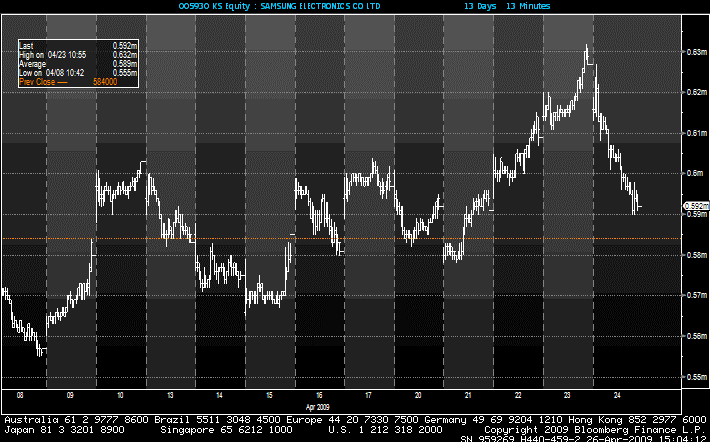
Would observations from other major equity indices in this world suggest that moves of dissonance such as these are another kind of pilot fish. The first right of passage to the leader for reversing ahead while the smaller within the shoal are still lead into the way prevalent?
Apr
18
The Good, the Bad and the Ugly, by Sushil Kedia
April 18, 2009 | 13 Comments
On the one hand it is said that those funds, individuals, traders who could not get on in the 30% plus move across every equity index in the world will destroy this rally, yet on the other it is argued that because this market has remained under-bought any pullbacks will be bought into. These are both opinions, not facts.
Let me ask those who did not buy in because they did not like the news then or those who did not buy because they did not like the patterns in the data they read will they buy the next dip? News-readers will become ticker tape readers or those who are reading the news now of so many remaining under-bought will be able to sell the tape now?
Blondie said in the movie, "The good, the bad and the ugly" that, "You see, in this world, there's two kinds of people, my friend. Those with loaded guns, and those who dig. You dig."
Those who seek incentives of anticipating will anticipate and those who seek benefits of being followers will continue to follow. Nature of men does not change.
So, who is going to shoot this rally, whenever it does get shot? It likely will be those who are not digging (the guns) and those who indeed had the guns at the last set of lows. Those who shoot this rally will also then have a loaded gun to shoot the next drop when it comes. Yes, Blondie has been so correct, those who dig would dig, those who shoot would shoot.
Apr
9
Reading People, from Jeff Watson
April 9, 2009 | Leave a Comment
 A very good exercise for increasing one's mental capabilities is to learn how to read people accurately. Reading people and sizing them up is essential in every walk of life, and one who can make a good read has a built in edge in everything. I like to do a lot of people watching, constantly making a read, and have found the exercise to be very stimulating and illuminating. One starts a read by looking at a person's outward appearance, dress, the condition of their shoes, hands, and what kind of haircut they have.
Moving along, one notices things like posture, gestures, and facial expressions. Do they have a smile, a twinkle in their eye, or do they have dour personalities? Do they speak softly, or loud? Are they well spoken or not? What kind of affectations do they have? I like to observe exactly what people are doing, and the body motions they use, comparing the data to past observations of other people.
People readers get an added bonus is when a person is interacting with another, or in a group. Interactions between two or more people can give volumes of information regarding things like temper, character, and and general mental state. Subtle, nonverbal clues can let you know if the person is a dominant person or a follower, information which can prove to be valuable.
A good reader can tell you the socioeconomic status of the man by sight, can tell you if he has kids, and get a good estimate of what his spouse is like. An experienced reader can make a good estimate of one's income, marital status, level of either happiness or desperation.
The best place to start learning how to make a read is by going to a mall and watching the men sitting by while waiting for their wives who are shopping Practice on men at the mall allows you to size them up, and then check the accuracy of your observations when the wife shows up. This allows one to hone their skills in reading people.
I attempt to read people as a mental exercise, everywhere I go from a restaurant to an airport. Recently, I was at a very nice restaurant and startled my companion with the accuracy of my reads of the various patrons. I learned to read people from too many hours at the poker tables and the wheat pit. In today's electronic markets, reading people might not be as important, but the same thought process and mind set is a very valuable tool in the arsenal of the speculator. Incidentally, some of the best readers are car salesmen, and people in retail.
Reading skills can be learned, although it takes great self discipline and an open mind. Beginning readers will get things wrong but as their skill level increases, their accuracy will approach 80% or more. Learning to read people is a very fun exercise, and will develop critical thinking skills that will ennoble your mind.
Steve Ellison writes:
 Paul Ekman has studied the movements of every facial muscle and what thoughts these movements convey…here he is as described by Malcolm Gladwell in a wonderful article.
Ekman recalls the first time he saw Bill Clinton, during the 1992 Democratic primaries. "I was watching his facial expressions, and I said to my wife, 'This is Peck's Bad Boy,' " Ekman says. "This is a guy who wants to be caught with his hand in the cookie jar, and have us love him for it anyway. There was this expression that's one of his favorites. It's that hand-in-the-cookie-jar, love-me-Mommy-because-I'm-a-rascal look. It's A.U. twelve, fifteen, seventeen, and twenty-four, with an eye roll." Ekman paused, then reconstructed that particular sequence of expressions on his face. He contracted his zygomatic major, A.U. twelve, in a classic smile, then tugged the corners of his lips down with his triangularis, A.U. fifteen. He flexed the mentalis, A.U. seventeen, which raises the chin, slightly pressed his lips together in A.U. twenty-four, and finally rolled his eyes–and it was as if Slick Willie himself were suddenly in the room.
Jordan Low comments:
 It is interesting how we can get different views over different topics from books. Almost similar to how movies come in pairs — Deep Impact and Armageddon, for example. In Gladwell's book The Tipping Point, the NYC crime rate decrease from a host of factors that tipped the scale contrasts with Freakonomics explanation of legalization of abortion lagged 16 or so years. In What Every Body Is Saying by Navarro, he claims that facial movements are the least accurate. The most accurate body part is the feet and as we move up, the conscious brain can fake responses.
Sushil Kedia adds:
 Desmond Morris. I urge everyone interested in the subject of watching, understanding non verbal behavior, deception & an endless array of related subjects to search this name on google. He is a maestro at this social science.
For over two decades I have been searching to obtain his lost title Ape Watching. One of my most revered teachers during my school days had shown me his copy and it was etched deeply in my mind. Resplendent pictures of apes capturing tell-tale nuances. Each picture therein is a unique shade of primal emotions. Just a glimpse through this tome, a flip across the hundreds of pictures taken by Morris was breathtaking. Based on a twenty year old memory, I reccomend you grab howsoever old and tattered a copy of this particular title if you see it. Amazon, google books, many other usual hunting pots in cyberia for books do not even mention it. Wonder if someone who has a serious interest in behavior studies has ensured that this title just vanishes. His numerous other works are fascinating as well, but Ape Watching would stand above any other book on any other subject I have ever seen.
Apr
4
Question, from Sushil Kedia
April 4, 2009 | 3 Comments
What may be a good way for generating synthetic series of stock prices that shows OHLC for each day? What assumptions are reasonable to make in this endeavor?
Adam G Replies:
How about bootstrapping an existing series to remove any serial correlation (which also would remove any persistence of vol shocks)? Could carry further and mix and match daily “bars” from various instruments into one synthetic in random order.
Mar
23
Optical Illusions, from Sushil Kedia
March 23, 2009 | 13 Comments
 A search for the phrase optical illusions on Google throws up a variety of very interesting websites. For a speculator I feel there are many pertinent questions that arise from a survey of these sites and the ensconced illusions in them.
- Why is there an illusion of motion, inter-connected spaces, impossible possibilities in the pictures carrying optical illusions, when actually there is none?
- What market situations produce an illusion of motion and life, when actually there is none?
- Which analytical tools are taken by the illusion of motion and or direction in markets, when actually there is none?
- What attributes of any one analytical technique or set of techniques together would save one from believing the non-existent?
There is a long list of many questions possible when exploring some optical illusions that a student of markets will find. Why not identify some questions that are more relevant to the markets and then try to answer them?
The usual first hand cliché would be that chart-watching is an optical illusion, but it perhaps is better for us to avoid that, so as to get to more useful ideas.
Mar
15
Friday the 13th, from Sushil Kedia
March 15, 2009 | 1 Comment
 Dhirubhai H Ambani, India's largest wealth-creator and whose sons are currently on the Forbes list, chased the number 13 with an unusual vigor. What everyone called unlucky and hence under priced became his favorite bargain. The number plates of his cars totaled 13, the office floors that he would be happy to buy were 13 and so on and so forth. A perfect contrarian risk taker he was always, including in the choice of what constitutes luck. February 7th, 2001, I met him, perhaps primarily on the merit of the duration of the meeting that I sought with him was for 13 minutes. It was simple to decipher from the number plates of his cars what it would take to get me to meet him.
The day after I sent the letter seeking this meeting, his secretary called up asking why would I need to see Mr. Ambani.
I promptly replied to his secretary that, "I assume you must be someone close to him if you are aware that I have sought to meet him. However, without meeting him yet I do not have his permission to reveal to any other the need for which I seek to meet him."
His secretary fumed at me, "What should I tell my boss then?"
I quietly told him on the phone, "If I were in your position I would tell my boss exactly what I hear, though I am not going to the extent of suggesting to you how you should be doing your job."
The Secretary dropped the receiver.
Thirty minutes later he called up informing me that his boss wanted to see me the next morning at 11.30 a.m.
Dhirubhai was known throughout his career for his ingenuity and I hoped through this conversation with his secretary to communicate to him until I met him a certain level of ingenuity in my enterprise.
However, when I got to see him the next day, the charm and charisma of an all time tycoon gripped me very quickly.
At the end of a very motivating 13 minutes or so when I rose to greet him and bid good wishes I still continued to see a plain face.
However, as I reached the exit of his huge personal office I could hear him burst out in a hearty laughter. I looked back at him in amazement and he said, "Son, you have had your tea but you forgot to put the sugar in it."
I recalled his secretary had specifically asked if I would take a tea with sugar or without and I had requested some on the side.
Back in the elevator I thus realized, at the ripe age at which Dhirubhai was then, the power of such minute observation, the persistence to scan through a person without disturbing the process of observation and to derive pure innocent joy that only a child could from things understood minute by others is perhaps the hallmark of a visionary of any times.
Victor Niederhoffer comments:
Just to inject a bit of quantitative mumbo into the picture, the last 23 friday the 13ths have been visited with a rise of 1/4 of % in SPU and unchanged in bonds. Completely insignificant in each.
Feb
12
Lessons From a Life Well Lived, from Jeff Watson
February 12, 2009 | 5 Comments
 My grandfather (1885-1989) was the greatest teacher and influence in my life. His love of life and adventure was unparalleled. A true Renaissance man, he was comfortable with everyone from janitors to presidents. Since he always wrote everything down and was making lists, he once gave me a list on how to live my life. A truncated version:
1. Pay your bills on time
2. Pay your gambling debts first.
3. Never do business with a friend, but allow a friendship to develop out of a business.
4. Never, ever, cosign on a note.
5. Always buy bonds when they hit 60.
6. Always treat everybody at a business, from the bottom up, like he was the president of the company.
7. Always buy real-estate on the cheap.
8. Never touch the capital, and save part of the interest.
9. Live well below your means.
10. Never allow friends to know how much money you have and always "cry poor."
11. Spread your money and investments around.
12. Never lend more than pocket change to friends.
13. Family first in everything.
14. Congratulate your opponent when he wins, and be gracious when he loses.
15. Don't be a deal hog, and leave something for the next guy.
16. Speak little and listen a lot.
17. Never be afraid to say no.
18. Learn poetry, history, philosophy, and a second language.
19. Keep current in events, and keep an ear on the street for opportunities.
20. Learn good manners.
21. Treat every woman like she was going to be your future wife.
22. Don't trust the government, and never trust politicians.
23. Circumnavigate the globe at least once in your life.
24. Big game fishing is a manly pursuit.
25. Don't ever get drunk in public.
26. Don't ever embarrass yourself or family.
27. Never complain about your family to outsiders.
28. Teach someone your business and pass your skills along.
29. Never listen to race track touts or tipsters of any kind.
30. If they're selling it, why is it such a great deal or opportunity.
31. Never cheat at anything, nor be dishonest.
32. Never welsh on a deal or wager.
33. Always keep your promises.
34. Pay your people a fair wage.
35. Never pay retail for anything, but don't be a hog.
36. Allow your opponents to save face.
37. Never keep a mistress within 300 miles of your home.
38. Always give a guy on hard times some spare change.
39. Support a charity.
40. Be a stand up guy in all areas of your life.
41. Respect the flag.
42. Respect and listen to old people, as they know more than you do.
43. Work as hard as you can and play as hard as you can.
44. Keep your house and business tidy.
45. Allow your kids to be themselves and have fun.
46. Learn to play at least one musical instrument.
48. Respect other races and nationalities.
49. Never argue religion or politics.
50. If it sounds too good to be true, it probably is.
My grandfather was full of life lessons, and I listened.
Sushil Kedia adds:
Here are some more important lessons to consider:
1. Other Points of View (OPV): Accepting, rather than denial or immobilizing fear, is the beginning. The situation definitely gets refined when one looks at it from Other Points of View. One must look at the situation from the views of ones adversaries as well as from the perspective of an unengaged onlooker. Dispassionate observation is facilitated by comparing OPVs with one's own view and building up a strategic process that is always computing the odds.
2. Grow beyond wrong and right: Anger originates as sequence of feeling wronged and guilt originates as a sequence of having done wrong. In winning, it is crucial to be beyond computations of wrong and right. Focus instead on what defines winning for you and what is appropriate for achieving that win.
3. Economy of Movement: Decisive action including communicating the bare minimum necessary innuendos (action as well its absence are both communications) not only helps conserve energy it consumes the energy of the adversarial situation or people.
4. You are the problem: The same situation involving another man has another solution. Recognize your unique gifts and the precious effort that must go in to defending and growing this uniqueness. No handicap is thus in the middle of battle a drain on your resources. Viewing the complete picture with you at the center of the problem is necessary to identify the path of least effort applicable to you.
5. Be your own decision maker: Responsibility for all outcomes is the facilitator for achieving a focus beyond destiny and helplessness. Assume no help will come but will have to be obtained.
6. Don't celebrate your success, in the usual way: Deception is an ingredient of every contest. Feign strength when weak and display weakness when strong is something Sun Tzu taught centuries ago, in any case.
7. The Pain gain formula: Nothing comes free. Pain & gain are often the two sides of the same coin. Always check if an advantage achieved or to be achieved has not come or will not come at an unfair cost incurred unknowingly elsewhere. With such a focus the need to enjoy the journey is extraneous. What may begin with pain could be the ticket to gain and vice versa. The driver of joy being the final destination, the journey will become worth engaging in all situations.
8. Beautiful mind: Beauty of cause is a state of the mind. Being conscious that the mind has states and one can by conscious choice alter those states one may overcome the definition of mind as espoused by Edward de Bono that, "mind is a self organizing pattern seeking system." You and the situation together are the problem. Be conscious of your cognitive states.
9. Believe that you will succeed: You cannot argue with this point since as much as is true that seeing is believing so also is it true that believing is seeing. The solution and the current moment are separated in time. In traveling across the correct strand of time, one would need to traverse the correct strand of time. Believing is the lens to find the correct strand.
10. Be the witness: Changing the perspective from being the doer to one who is a witness to the struggle drives objective and rational sides of the self organizing pattern seeking system called the mind. Fear and hope that are the normal controls of minds in normal states need to be put aside whilst input and output control need to take over.
11. Do, only whatever is necessary: One can always be aware of not creating more problems while solving the ones at hand.
12. Give up when required, only temporarily: need for rest, rejuvenation, re-organizing apart. Many times silence, inaction, inactivity provide the ultimate deceptive veil for more lethal and smashing action.
Jim Sogi comments:
The Pain gain formula: Nothing comes free. Pain & gain are often the two sides of the same coin.
I love this, and Jeff's list too. But I wonder why pain and gain are so correlated? Is it the issue of going against the herd vs the genetic urge to comply? It applies in physical fitness. I sure would appreciate some ideas on this one.
Jim Rogers replies:
Pain is a necessary, but not sufficient, condition for gain.
Additionally, not all pain produces gain, but both concepts are relative. Because of the differences in both pain "tolerance" and measurements of gain (in terms of "value"), it's pretty difficult to turn this observation into any type of concrete maxim.
Finally, it seems that there are occasions where the value of a gain outweighs the pain endured, indicating some type of arbitrage situation. However, the pain of spending one's time looking for free lunches (combined with the "pain" of acquiring the skills to recognize arb opportunities) may minimize the net gain.
Alston Mabry writes:
What about that special pain the Mistress inflicts with volatility? One takes a position that then goes against, and one has to try to wait it out until it turns back in one's favor. So many times one gives in, escapes the position and the pain, only to watch the fulfillment come in exactly as predicted. Book the loss, learn the lesson, try again.
Marion Dreyfus responds:
You cannot win a great body without heavy working out. You don't fall into piles of earnings and wealth–you invest judiciously. Pain is obviously correlated to gain — otherwise we would leave the womb and float through life with strawberry sundaes glissando-ing off our lanais as we polish off language texts in the Copacabana with cognac fountains spurting gleefully in the front 40. We don't. We have to work to elicit goodies.
Feb
3
Self Appraisal, from Sushil Kedia
February 3, 2009 | Leave a Comment
 A little boy went into a drug store, reached for a soda carton and pulled it over to the telephone. He climbed onto the carton so that he could reach the buttons on the phone and proceeded to punch in seven digits.
The store-owner observed and listened to the conversation:
Boy: 'Lady, Can you give me the job of cutting your lawn?'
Woman: (at the other end of the phone line): 'I already have someone to cut my lawn.'
Boy: 'Lady, I will cut your lawn for half the price of the person who cuts your lawn now.'
Woman: 'I'm very satisfied with the person who is presently cutting my lawn.'
Boy: (with more perseverance): 'Lady, I'll even sweep your curb and your sidewalk, so on Sunday you will have the prettiest lawn in all of Palm Beach.'
Woman: 'No, thank you.'
With a smile on his face, the little boy replaced the receiver. The store-owner, who was listening to all this, walked over to the boy.
Store Owner: 'Son… I like your attitude; I like that positive spirit and would like to offer you a job.'
Boy: 'No thanks.'
Store Owner: 'But you were really pleading for one.'
Boy: 'No Sir, I was just checking my performance at the job I already have. I am the one who is working for that lady I was talking to!'
This is what a friend sent to me with the label self-appraisal.
I have been left wondering since reading this if the market is not that phenomenon where such a self appraisal is an ongoing activity.
Jan
25
Slumdog Millionaire, from Sushil Kedia
January 25, 2009 | 3 Comments
 After ten academy awards nominations, Slumdog Millionaire has suddenly caught the fancy of every Indian, including other film-makers, artists and the likes. I got to view this movie today.
What struck me was a rather ingenious business mind that is securely and fairly quickly taking over the Bollywood masala-movie-making adventurorium. Think about what such a movie would have done during "good times" unlike the "gloomy times" surrounding the globe today.
It's about a dream-run wherein the least expected of any — a slumdog gets to win the ultimate game of acceptable avarice, who wants to be a millionaire, igniting the passions, the morale & the imagination of a world grappling with a meltdown. Throw in high-strung contrasts of skyscrapers jutting out of vast slums spinning a yarn of a rare positive black swan wherein the entire life-sequence of a guy growing with the flow (sounds familiar with the traders' going with the flow) comes to be captured in a set of twenty or so questions. Any probabiliticist would be inspired to see how a rarest of rare flukes gets enacted out, wherein each travesty of a man carried in its womb the answer to each critical question to his final glory.
Luck, chance, bravado, the persistent human spirit and most importantly the all important element of hope in these times spin around. Each of the three child/adolescent actors who portrayed the growing ages of the central character has done some brilliant acting bringing out the made-of-steel character in equal measure. So, perhaps this movie instead of getting a best actors award (since perhaps it cannot be given to three individuals for playing the same character together) could be deserving of the best director's award for bringing such performance out of new actors.
 A catch line in the movie where the malleable brother of the slumdog who has already sold his soul to a gang lord surmises that India is today at the center of the world and he is at the center of the center is the ring fence around the commerce of this movie. The Chindia fears of the West stand diluted in the backdrop of the pain of the slums and yet on the other hand this same moment ignites the global morale back again. A beautiful deploy of the transferred epithet. The other line that comes into justifying my assertion happens when Slumdog yelps to his tourist clients at the Taj Mahal, "You wanted to see the real India, here it is" on being bashed by the tourists' chauffeur when they all return to find that the car tyres and everything else that could have been dismantled have been and taken away by the cronies of the slumdog kid. In sympathy the American Tourists pass on a hundred dollar bill. Yes, this movie tells the Americans that howsoever much goodness you would dole out the real world "Out there" is just what has been shown — a deceitful, emotionless slum!
Even with my critical eyes, I switched off the screen and the player with an elevated morale, that one could just do it, even after landing in a slum.
A savvy commercial play on the mass emotions of the times, produced with one of the lowest budgets with which a film has been made in Bollywood. It perhaps is on its way to jingle the cash boxes in an unprecedented way.
But then, in a free market economy wouldn't the consumer get what it needs most? Here it gets, the "Slumdog Millionaire."
Jan
12
Constants, from James Sogi
January 12, 2009 | 5 Comments
 There are mathematical constants such as the ratio of a circle to its radius we all know as pi, the relationship of a line u and a segment such that u/u+v=u/v or the golden mean, and lim x -> 0+, (1+x)^ 1/x Seattle Phil's favorite constant, "e" a valuable computational tool allowing additive solutions. "e" allows doing complex calculations with relative ease, by replacing multiplications with additions. Pi is used in statistical computations involving the Gaussian distribution. They don't really know who discovered e. Archimedes discovered pi. Such ideas had commercial application in practical things as determining whether the coins were fake, or the volume of the King's golden crown. The curious thing about each is that no computer can state the number since some are irrational or transcendental. Each is critical to whole fields of prediction. Identification of market constants might uncover some regularities otherwise hidden and allow calculations and solutions. Some say market moves often follow the golden mean. I have been pondering what other important but unused constants might exist in the markets. Time, of course, is a constant. The vig is another. The use of the normal distribution might be viewed as a constant for computational ease and allow use of constant ratios such as standard deviation, mean, median. In the past, gold or the dollar might have been a constant but globalization and floating currencies stopped that one. The ratios are important still. What other constants might be in the markets?
Sushil Kedia writes:
I am visualizing two broad categories of market constants. The first category that is a list of constants for all participants and the later one which contains transitory constants for individual participants and varying values of the same constant for different types of participants at a given point in time.
The first variety of constants are relating to the sense/measure of time, of the variety:
1) Minimum Tick Size for each contract / market
2) The weekend
3) Market opening & closing time
4) National & other regular Holidays
6) Occurrence of earnings announcement seasons
7) Presidential Elections (every four years)
8) Options & Futures expiration cycles
… so on and so forth
The second classification of constants comes from a less easy to describe and more amenable to visualize variety that most of us are more often interested in are the price related constants. I would surmise that given any particular state of a trader the amount a particular trader is willing to risk on the next trade is a constant in the near vicinity of his recent wealth / income / consumption matrix. Thus, it may be useful to visualize a +/-2 Standard deviation price move in a day/week/month measured over the same units of time say at 20, 50 and 100 day/week/month span could be that constant threshold which evokes sense of pain/gain for say traders, speculators and investors. Variable constant for different types of participants varying for each over their journeys inside markets and varying across different participants at any given point in time is what makes the market a self sustaining, self perpetuating contest.
If one assumes that a disciplined trader is making repetitive constant sized bets (the search for that "optimal F") and Value at Risk is changing due to changes in volatility at a chosen time horizon then eventually this class of individual state dependent constants are again connecting back to the individual sense of time.
The search for thoughts on market constants is thus taking one back in a loop of figuring out if there is an inner market time.
Nov
11
Recession Prediction by the Markets, from Russ Sears
November 11, 2008 | 2 Comments
It has been mentioned several times here that stocks (S&P 500 index) predict the economy six months in advance. What about interest rate spreads, do they look forward six months in advance?
To test both ideas I looked at stocks' six month prior return before a recession started as defined by NBER. I defined this as the predicted "start" of the recession. I also looked at the six month change in spreads of Moody's BBB index to 10 yr Treasurys. I used the last nine recessions (first one in 1954) and assumed we have begun the 10th one.
Further I defined the predicted middle of a recession as the period from start to six months before the recession ends. Not all recession have a middle as the 1980 recession lasted only six months.
Finally, I predicted the end as the period six months to the end of the recession.
My hypothesis: If the markets "predict" a recession to start six months prior, returns should be negative for stocks and the spread change should be positive (spreads increase). Likewise if the recession is to continue. And opposite if it is to end.
The table displays the results.
. Predicted Predicted
. by by Overall
Predicting Spreads Stocks Count
Start 7 7 10
Middle 6 6 8
End 3 8 9
While most of the hypothesis seems solid, it would seem that credit risk continues to increase even with the recession ending.
I will leave it to the reader to calculate the magnitude of the changes. It is tricky partially because the "start" of the current recession, if there is to be one as I assumed, is not yet defined; and the magnitude of change of prior 6 months greatly depends on the starting month, but not so its being negative.
But to whet the readers appetite, the starts totals changes are not too large in size. The middle is bigger and so are the ends.
And since the scale of the current spread increase and stock decrease is the largest of these, let me refute a meme. It appears that the prior 9 spread change magnitudes at the start had a negative correlation ( r ^2 near 50%) to length of the recession. Perhaps because if the spreads did not predict a recession the dead weight dragged down the economy, but if it did predict and raise competitive cost to borrow, the dead weight died quicker and better capital allocation speeded the recovery. Further, the stock magnitude correlation was near 0.
As noted both indicators are currently more pronounced than the prior 9, so clearly in some ways "this time it is different". But the implication would seem the opposite of the meme from the press. And as for the analysts, let's remember they had a vested interest in keeping the markets booming in the dot com days, as their left hand had a great thirst for leverage and risk then. Perhaps now, with their left hand deleveraging and shunning risk, they would like stocks to remain cheap till they can participate again.
James Sogi adds:
What is so amazing is the speed from which just a little over a year ago the markets were at an all time high and all seemed so rosey. Then so suddenly everything turned so sour in everyone's mind and the entire system seemed so at risk. A good example is the speed of the decline in Iceland. There certainly is a wall of worry in place. The last big bull run started with a bang, literally, even if it didn't shock and awe the Iraqis. Things looked pretty bad in March 2003, and the dot.com crash had wiped out many. One of the characteristics of the last bull run was the low volatility, and the steadiness of the rise, such that buying almost any drop was a winning strategy. Perhaps a retrospective thing to look at is when the market started to go up in relation to the end of the recession.
Sushil Kedia comments:
The Hindi movie superstar of yesteryears — Rajkumar — immortalized in the movie Waqt (meaning time) the line that translates to roughly, "Trees that refuse to bend lower will break down".
If the markets, economies and hoi polloi in general knew that there existed a large unresolved credit problem and still markets were being pushed higher and higher it could very well be that the last skeptic (read the permabear) was being cleaned out. Once achieving the minimum possible pessimism the time varying nature of variance then goes on to catch up (sic down) in a hurry. Trees (read: price structures) that weren't agreeable to bending lower in a timely fashion were then forced to be broken down with time.
Memetics, discussed and mentioned earlier, is about acknowledging that a meme shall prevail until it has got the largest possible number of believers. And so, while things are hurtling lower for now, it too could be that the inertia of observing minds will prevail on a pessimistic mood while prices (the new meme) would uncoil ahead of the perceived economic environment.
Oct
23
More on Volatility: the Cost of (In)decision, from Sushil Kedia
October 23, 2008 | Leave a Comment
 Andrew McCauley says, "Volatility itself can be a decision: Long or short volatility."
That is stretching the point which then can be elucidated by the fact that the cost of (in)decision question would then address the volatility of volatility as the relevant metric.
Stephen Knipe says, "If people were totally indecisive and no trading decisions were made then volatility would equal 0."
Well that's one specific situation in which volatility could be zero. The other situations could be where there is a linear or otherwise perfectly predictable price curve. Could it not be said that since there is uncertainty and / or volatility people trade and not vice versa? In the absence of any trading activity the reading of volatility will keep dropping closer and closer to zero.
Perhaps my own original question suffers from the limitations of language at expressing. I may be able to convey my query better hopefully by paraphrasing that should one lean onto trading strategies / practises / ideas/ habits/ programs whatever anyone follows that tend to increase the frequency of trading as the PRICE of volatility goes up?
We have discussed this before on the lists and I have written that the price of volatility is what is observed in the markets whereas the value of volatility is unique and different for each unique participant in the same was that the price of the underlying security is same for everyone but the value of the underlying is different for each unique participant.
There is a another possible way to visualize the response mechanism of each participant as to what is volatile and what is not volatile that when a price series spends more time within the boundaries of moves around the mean change over the relevant (for each participant) time span that trigger the sense of pain and gain for each participant it gets increasingly volatile. The less time a security price series spends within the pain and gain definition bounds of a trader / trading system the more number of profitable or loss making trades it generates. I conclude that as each individual's value assessment of volatility increases each individual is induced to trade more. Another twist exists that the law of diminishing marginal utility might not be ruled out here. As the individual sense of volatility goes past a certain optimal threshold for each the desired frequency of trading does come down. In such a context, when the commonly accepted and agreed upon price (not value) of volatility is going up (option implied volatilities or the vix index) the actual prices of the security are jumping around the mean path more widely triggering crossovers of pain and gain thresh-holds with a larger frequency. However the paradox then arises that options writers (volatility sellers) are providing to the options buyers (getting more uncertain about market in the coming future) a protection from the perils (expected by the option buyers) of taking decisions. By such an argument is it then not true that at any given point in time the buyers of options or protection are those whose optimal point for increasing the number of decisions with rising volatility has already been reached while the writers of options have an optimal point on the volatility vs trading frequency curve further ahead?
Volume, I would like to submit to Mr. Knipe, according to me is the struggle for the discovery of price. Volume itself can be erratic or steadily rising or falling. Perhaps, akin to the kind of insight the volatility of volatility could provide about the state of markets the volatility of volume may aide in understanding the market's willingness in contesting or not contesting the discovery of price. Volume I do not agree is the "decisiveness to trade" but it perhaps is the anti-thesis of the prevailing price meme in that a rising volume provides a rising chance / facility to trade rather than a rising willingness to trade.
If the volatility-frequency of trading relationship can be tested to the applicability of the law of diminishing marginal returns of volatility in inducing trading then it may be possible to demonstrate that strategies that are pegged on buying large packets of insurance with an aim to living under long periods of non-achievement to gain some day on the unpredictability of dooming uncertainty arising at some point are rather than getting fooled aiming to fool the rest on the concept of randomness.
Oct
19
Volatility: Cost of (In)decision? from Sushil Kedia
October 19, 2008 | 6 Comments
In the context of markets, a cost is a reduction in equity or a forgone opportunity of enhancing equity. A decision, in the context of markets, is a new trade. A rise in the price of volatility is, in general, accompanied by a fall in the price of the underlying and vice versa.
A rise in the price of volatility is a reflections of the higher cost of protection market participants are willing to pay for their indecisiveness.
Hence, volatility is the cost of unwillingness to decide. Should one then, being a contrarian, not be keen to take a larger number of decisions during periods of higher volatility? How may one be able to study and understand if volatility is the cost of decisions or the cost of not making the decisions?
Matt Johnson comments:
Volatility is an expression of uncertainty (risk), not an ‘unwillingness to decide.’ For me, an unwillingness to decide is the lack of a clear trading plan. I make most of my money in periods of higher vol, but I’m in at the beginning, when I’m most uncertain — not at the end.
Sep
19
The Mother of All Short Squeezes, from Victor Niederhoffer
September 19, 2008 | Leave a Comment
This is similar to what happened to the H#nt brothers when they made money from buying silver and gold. Not only did they lose their gains,…
Nigel Davies adds:
It's difficult not to feel some sympathy for the shorts. The chess equivalent would be for the tournament director to take a look at your position and, on seeing your rooks poised to penetrate the opposing ranks, declare that for the next ten moves they could move only backwards.
Kim Zussman agrees:
Who wants to compete in games where the rules are unstable?
Victor Niederhoffer comments:
When the exchange rules on silver were suspended, the gold and silver markets ceased to exist for about eight years, especially in Chicago. I wonder if many people feel as Dr. Zussman does, and whether this will lead to a tremendous diminution of trading.
Sushil Kedia writes:
 A short position, in general, turns out to be a postponement of purchases. Even though they are intended to be opened with an objective of purchasing lower, it is just a potential demand in the future; since buying may happen lower or higher out of a short position.
With short sales not existent or not allowed afresh this one key source of periodic demand into the future is absent. Such markets tend to go down with way more ease than those markets that do have an existing short interest. A large subset of emotive responses that can be forced into buying the dips or the squeezes is non-existent.
Likewise, a ban on short sales rather than solving the problem of weak markets only postpones the inevitable weakness into states where there are only herds of long only hands turned into sellers and no motivated buyers to step into the dips.
This perhaps can be studied, if data can be obtained, by comparing the downside swings during periods when short selling was not available and since when it has.
Kevin Depew sees another historical parallel:
Arthur "Bull" Cutten some 70-odd years ago was trotted out before the grain futures commission where he was declared guilty on six counts of "price manipulation." Same type of villification of short sellers occurred then too. I wrote about this in June during the "oil speculator" hearings because I found his declaration after the trial quite apt. I don't wish to self promote my article, the gist of it is this:
Some 70-odd years ago, the Grain Futures Commission declared that Cutten was guilty on six of the price manipulation counts he was charged with and ordered him suspended from all U.S. grain exchanges for two years. After the verdict Cutten declared, "What's the use of trading? The market doesn't move."
Jul
13
I find the paper Simulating Collective Misbeliefs in the Journal of Artificial Societies Simulation interesting.
Notable how it predicts a tendency for cults to grow based on the beliefs of dead individuals.
I think the same techniques may be applied to look at trading systems and trends, as shared beliefs can become self-fulfilling prophecies, sometimes weakened when a bubble bursts. In life it is equally hard to distinguish between consensus belief and reality. Even time and space are human concepts, although when people look for aliens they scan with their telescopes the vast reaches of outer space.
Sushil Kedia adds:
Wonderful. May I be permitted to generalize Mr. Glazier's statement further that everything that mankind debates as within the possible and not within the possible is again a matter of the human cognitive faculties. Recognition is subjugate to cognition. Observation, testing, conclusion is but a chain in the ever improving cognitive processes.
What would the list suggest be a good way to read, learn and think about the history and or the evolution of human cognition? What may be the must read sequence of works in that area?
"Cogito, Ergo Sum" - Rene desCartes
Jun
28
Reading Atlas Shrugged, from Sushil Kedia
June 28, 2008 | 4 Comments
 Finally I could invest the time to start reading Atlas Shrugged. I have chosen the word invest advisedly here; I have finished reading Part I and decided to take a pause at the end of page 312.
Bearing fully in mind the introduction by Leonard Peikoff that begins by stating that Ayn Rand held that art is a “re-creation of reality according to an artist’s metaphysical value judgments”, it strikes me very hard to seek your opinion if really in the America of the last century there indeed were characters such as Jim Taggart, Orren Boyle and the sort of hoi polloi that has been described continuously in these 312 pages. I have no doubt that there were a lot of Dagny Taggarts, Hank Reardens, Ellis Wyatts who helped (re)build modern America further, but it beats me if really there was a time when the over-riding thought and action of the day was being shaped by Jim Taggart and Orren Boyle types as well. What do you think? Has the author erred in stretching the shadows far longer to produce the effect or was there really an America like that also?
Alex Castaldo attempts a reply:
You are not the first non-US reader of Ayn Rand to be puzzled by this question. As a foreign-born American I was surprised that her books were set in the US when you could easily come up with better examples of government/business connivance from other countries. Americans can consider themselves lucky that they are better off in this respect than some others. Indeed I have often asked myself where is the Italian Ayn Rand who would speak up about how some of Italy's wealthiest people have made their fortune largely through political connections and improper operations, and explain the difference between this and true entrepreneurship. Sadly he/she does not seem to exist (possibly for lack of readers).
Part of the answer may be that Ayn Rand was most familiar with Russia and the US, so of course she chose to write about these countries. Also, she was concerned about trends and developments rather than the immediate situation; the US in her books is perhaps the model of what could happen to any country if the disturbing developments she saw around her were to continue. Her books are, among other things, a plea for the US to retain (and improve) its traditional values and not adopt those of the then ruling class in Soviet Russia.
Jun
26
Seven Years, from Sushil Kedia
June 26, 2008 | Leave a Comment
Someone I met recently told me that in about seven years time each and every atom is replaced in our bodies. Then how come the much analyzed chemical reactions of the body and brain retain memories and learning acquired across years? Irrespective of the proverbial seven year itch arising in the 7th, 6th or 8th is it then about revisiting the premises left now only in memories upon which the original pleasance of the relationship rests still upon?
Like in a computer where one keeps on upgrading each and every component and on average ending up replacing every part in about seven years when nothing existing today was in the original computer the data, the feel of the desktop remain the same and we still call it the same computer. Is life and the kind of computing the human brain does more similar to network computing? What else might a social process be similar to from the world of computing? Can principles of computer networking be applied to find valid applications in a social process called the stock market?
Is life using more of google spreadsheets kind of structures than using the locally resident ex*el type utilities? How come across generations within family trees certain patterns of thought, action and being are ingrained? What then is the reason for a flapping of a butterfly's wings in one nook of the Earth bringing about a typhoon in another corner of this planet if life being a seamless network of information and matter is really incidental to its carriage?
Would a market be over N years not replacing each and everything that existed before that period and still be the same market? DJIA has just one original stock for an example. It is still the same market. It is the same stories and folklores. What is the value of that N for each different security, each different market sector etc. etc. Will the differences in N reveal any differences about the markets, assuming measurement of such an N will be feasible somehow?
Is reality, in the markets and otherwise, just a continuum of information while matter keeps getting replaced, regurgitated, re-structured, re-invented etc. etc.? Why does then someone as successful as the Sage proffer wisdom that one ought to own companies that do the same routine thing that we would require all our lives? The coke is the same as it was twenty years ago? It perhaps is getting different again at its own pace. In the same vein then why is there only one company such as 3M yet that persists on achieving not less than 60% of its sales from products that did not exist three years ago?
May be a good point to begin on this trail is to first imagine and find which variable(s) from the characteristics of securities or companies can be those that which change completely in N years across a set of securities, value of N being then the next variable to study?
Jun
1
Sleeping and Trading, from Sushil Kedia
June 1, 2008 | 3 Comments
My father handed over the wealth of his knowledge from a lifetime of speculating the night before I was leaving home and starting a career in the markets of Mumbai:
1) Sleep well and enough and at regular hours. Deprived sleep doesn't get compensated by catching up.
2) Eat well and at regular hours. An upset stomach makes the mind waver. Drink lots of water.
3) Speak only when necessary. Never loudly.
4) Listen.
5) Gather facts, steer clear of opinions.
6) Stay away from losses. Money will come from chance.
7) Don't trust anyone completely. But trust.
8) Write your books of accounts everyday.
9) Adjust sleep if any of these don't work well.
Dad wrote this list to me many times in several of his letters again and again across years. I am still trying to improve. He tells me his father gave him this list.
Mar
20
Another Way to Look at Volatility, from Nigel Davies
March 20, 2008 | 1 Comment
Another way to look at changes in volatility (increase/decrease in price swings per unit time) is to view it as having a typical overall move in price but with the time scale expanding and contracting. This might offer some additional insights, for example point and figure charts by ignoring time also ignore volatility. So if you test these they'll produce a quite different set of patterns which are essentially 'volatility blind.'
Sushil Kedia replies:
A filtration process such as Point & Figure is essentially based on defining one's tolerance for noise in the price series. The box size achieves that. Point & Figure is the only method in Technical Analysis to not plot the time axis. It is perhaps the only method of looking at prices which has a nature similar to the time/distance equivalence in Einsteinian physics. There perhaps is a case for finding a congruence in defining a unit of time for a particular security based on a certain standard movement in its price.
Bill Rafter explains:
Point & Figure purports to separate "signal" from "noise" and discard the latter. Every time you run data through a filter, you eliminate both some signal and some noise. The short-term data that you assume to be all noise contain substantial signal. Thus, it is illogical to assume that you will improve results by discarding information. Further, and most-importantly, we applied Point & Figure filtering to all of our trading methodologies and the degradation of results was universal.
Phil McDonnell expands:
The Grand Master poses an interesting question and Mr. Kedia wisely suggested an analogy to Einstein's relativity theory. There is much to be learned from these ideas.
Suppose we have two assets which substitute for each other in investment portfolios. For example they might be stocks (s) and bonds (b). Given that there is only a constant supply of funds (m) available for these two investments we can posit that their combined value would be equal to:
m ~= ( s^2 + b^2 )^.5
The above is essentially the equation of a circle of radius m. One possible flaw is that the market for s may be much smaller than the market for b. Thus a given fixed disinvestment from b might move s by considerably more. Our model would therefore no longer be a circle. Without loss of generality we can assume the fixed quantity m to be 1 (100% of all the money). Then we have:
1 = ( s^2 / a^2 + b^2 / d^2 )^.5
where a and d are two constants of proportionality which relate to how quickly the two markets move. Thus each market now has its own ease of movement parameter in this new elliptical model.
One of the key properties of the theory of relativity is that as one approaches the speed of light both time and space are distorted. In particular the Lorentz transformation governs this process and is given by:
gamma = 1 / ( 1 - v^2 / c^2 ) ^ .5
where v is the velocity of the spaceship and c is the speed of light. This represents the transformation in the x direction which we shall assume is the direction of acceleration. Referring back to the elliptical model formula above we see that the one dimensional form looks remarkably similar to the denominator of the Lorentz transform (gamma).
Qualitatively such a model would be consistent with the Davies/Kedia conjectures. Time would slow down as the market moved faster. Magnitude in the price direction would dilate as well as a function of velocity.
Having a theoretical model of the market is all very nice but unless the market follows it then it is useless. To test this a study was done of the above stock to bond relationship using SPY and TLT ETFs. Fitting the parameters a and d to past data one finds that the constants were 200 and 100 respectively. Then the fitted model was compared to the actual past history of SPY and TLT and found to provide very good agreement. Perhaps we may look at these constants as the speed of financial information (light) in the stock and bond medium respectively.
Feb
23
Guaranteed to Happen, from Victor Niederhoffer
February 23, 2008 | 10 Comments
 What must not be gainsaid is that the rise of 22 points in S&P futures from 3:30pm to 4:00pm on February 22 from 1334 to 1356 was the greatest rise in history. The rise of 24 points from 3:00pm to 4:00pm from 1332 to 1356 was the second greatest in history, failing by only a point to match the Société Générale rally on 01/17. It was beautiful the way the market set up exactly the same way it did the Friday before all the money was made by frontrunning and running stops associated with the $7 billion loss. Also beautiful was the way the move from 1327 to 1357 (low to high) on Friday basically recapitulated in half an hour the entire range of the last two weeks. That's what a classical symphony is supposed to do at the end of the piece, recapitulate all the themes, bring them together and close with a bang. Also of note was the sentinel function of the bonds in the entire mass, staying down nicely even while the market at the two week lows. It was all guaranteed to happen.
J.P. Highland adds:
Natural gas also had a nice day, settling above $9 for the first since February 2006. It's been quite a run since December 2007 when it was trading below $7. Nearby months are selling at discount, but open interest is decreasing.
Jeff Watson noticed:
While the S&P rallied today at the close, there was also great volatility in the wheat market. The nearby months in Minneapolis did a mongoose/cobra dance today, and the mongoose won. There aren't any shorts in Minneapolis wheat who are making money right now.
Kim Zussman studies:
In relation to the joyful pop near Friday's close, I was wondering how to design an experiment in which subjects obsess about short-term gratification in a system with long-term utility.
(ES on Friday from open to 1130 PST was -18, and from 1130-cl was +25.25. Over recent 100 days, when op-1130 < -10, 1130-cl average= -1.5, T=-0.7)
During recent 100 days , lucky longs celebrated some or all of the following:

Yet during the entire period, the net change was -217.
The mean O-C was a dull -2, but certainly there was much along the way to self-flagellate or congratulate over, depending on the spin of the wheel:
Lon Evans queries:
In regards to "It was all guaranteed to happen": Why so?
Note that the AmBac information was released towards the end of a Friday's afternoon session, replete with low volume and high volatility. Note, as well, that the news was released as the S&P was tumbling dangerously close to the dreaded 1320 level. Take also into account that no (pesky) details were included in the given information. Finally, acknowledge that the Bush administration is actively involved in the bail-out considerations (which suggest but another timely release of disinformation from a cabal that would rather climb a greased pole to tell the lie, than stand on the ground to tell the truth).
Without the mentioned announcement, was Friday's reversal "guaranteed?"
Let's consider another scenario. Friday closes at 1324, after bouncing off 1320. We awake on Monday to Asia's having sold off heavily in a tidal wave of red. Spitzer, again, rattles his saber in demanding that the rating agencies come clean with timely and honest evaluations of the monolines' status. And a credible evaluation of accelerating inflation hits the wires.
Given the above scenario, would a Monday's close below 1320 have been a reasonable possibility?
Where is the science in your predictive model? It seems to me that all you've done is demand that a arbitrary result validate a biased opinion. Other than betting upon an "inevitable" inevitable, I don't understand that your system of analysis is any more logical than that of a friend who utilizes tarot cards to guide his investment strategy.
No one can argue that Friday was very profitable for the quick-witted daytrader (full disclosure: I was among the less acute, managing to cover my short with only a couple handle loss, and just as my limit was so close I could smell it). But having cut my teeth on a day-trading floor during the dot-com boom/bust, I'm as aware as any what an accumulation of the quick-witted can impel given the intraday scenario, particularly a Friday scenario.
Will the calvary route the savages, succor the wagon train, and unite the dashing captain with the demure beauty? Only the details will tell. Should this boil down to a Federal bail-out, I'll cover my puts and look to go long. Should it be but a bickering viper's nest of plutocrats and the over-privileged, I sit tight. Either way, there is little science involved in my decision. I'm only interested in what target the guy with biggest stick swings at.
Sushil Kedia observes:
On Thursday, the Indian futures index CNX Nifty produced exactly the same pattern. Meandering lower the whole day and going up in a straight line in the last 30 minutes to finish at the high of the day.
Shorts got squeezed for sure as the futures discount of 30 points got compressed to just about 5 points. Chartists gruntled with joy oh a hammer and the Index jumped from the 5080 area to 5200.
However, the next morning the market opens with a large down gap at 5130 explained primarily by the overnight move in the US, stays throughout the day at the downgap as the resistance for the day dipping in between by a percent from the open some 20 times. The market saw the move on Friday as a dead /dyeing man's heart beat really going nowhere.
One wonders if there is a global trading pump that is on microcosmic level driving the same algorithm in every market?
The rare downgap opening after the move such as on Thursday in India could well be explained with the higher significance of the larger market called US the night after. However, if Asia did still trade lower on Monday would that call for the traders in the US to be ready for a lower market on Monday there despite the move of Friday?
Feb
21
Fear of Stagflation, from Sushil Kedia
February 21, 2008 | Leave a Comment
Why should a bull be afraid of Stagflation? Somebody bullish on life is someone who is a producer of a net overplus. Being bullish on the markets is a matter of finding the markets that are representing economies producing overpluses.
On one hand markets have been shaking off on fears of an extended form of reflation called recession and yet on another the all knowledgeable squakboxes say markets are afraid of stagflation! Something does not add up if negative is negative and positive too is also negative. This is the tell of the times that everything appears negative and thus the near future is likely to witness the dawn of a new cycle. Why cant a new cycle take over before the imagined troughs of the ongoing cycle are seen?
Inflation in pure and simple commonsense terms is a redistribution of income and or wealth. Those with a net positive wealth / income stand to gain and those with a net negative income and / or wealth lose when inflation persists. However when inflation goes down those with an overplus stop gaining and those with a deficit accelerate their losses. So, the trick is that manageable inflation is what is the vehicle of all progress in the organised economic world.
Today when Hang Seng sold off after a large upgap opening the moment it was announced that Hong Kong banks are not following lock-in-step with the US Fed one sat down wondering if efforts to contain a redistribution of income will not accentuate the redistribution of wealth. Like energy cannot be destroyed but only transformed it is likely that inflation of consumables being contained will transform into a higher inflation of assets. Maintain the rising interest rate differential and prepare to face a wall of cash gushing in. As the wall hits the larger packets of liquidity are grabbed first by hands that have an overplus and thus can afford to invest and speculate. Inflation morphses into expanding the asset pricing, thus.
So if stagflation is similarly in commonsense terms (by the way the word economics originates from Oikon Nomics — The study of household preferences — which cannot be confined to ivory towers and thinktanks alone) an apparent redistribution of wealth it is the perfect background for speculation to be a good business of several others. Then you have the squakboxes labelling that there is a fear of stagflation and we know fear is the aphrodisiac on which bulls will persist further, despite the recent flounder. It suits a speculation even if all / most economies are going to be running on treadmills and be actually reaching nowhere except where they are since it is far better than the talk of death and disease in economies that is near given in most minds now.
At the risk of repetition, I would like to bring to the table the striking mirror image that is what the Capitalistic Communists are doing in China today of what the Communist Capitalists in Russia did in the last century. The Party in Russia kept on selling the commodities down holding the value of its own money higher while the Party in China is driving the commodities higher holding the value of its own money lower. If what Russia did was dangerous it is easy to see that what China is doing is certainly more dangerous. Every accounting Shenanigan in the universe has had fiddled with managing the Income Statement with the Balance Sheet or vice versa.
America, to a neutral observer with a dispassionate view of what you are doing, you are doing fine. Facing the reality and not fiddling. By this count alone, ain't it clear that the Chinese decision makers find the American money more useful than their own, in the longer run?
Fear and greed are the extremes of the emotional pendulum and when observers see the extremes while the pendulum is just in equilibrium (if there is another commonsense meaning of stagflation it perhaps is the solitary variant of inflation with highest relative equilibrium) it is that zen moment which builds the business of speculation further. What has been correcting at a systemic level globally is the underpricing of risk. Risk getting dearer cannot necessarily imply that opportunities will get scarcer. Recent few years' correlation may be an aberration in the larger cycles of progress. If risk and returns are not to be seen as coexsting together on the same Mobius Strip of perceptions then the fortunes that were created by the forefathers at times of war, turbulence, mass immigrations, disease and famine cannot be explained. Don't worry Wall Street you are doing fine too, since stagflation is going to be round soon, speculators will do well. Risk itself is the opportunity, always and very much today.
Jim Sogi adds:
"Most economies are going to be running on treadmills and be actually reaching nowhere"
Like SP this week and last, a treadmill with 30 point range. Reminiscent of the 70's stagflation scenario and its market 40% range. This scenario is a good middle ground between the bear's crash scenario and the bull's ever higher call. I guess you could call it the Rancher scenario: works the range between the bulls and bears.
Feb
21
Sun Rises in the East, from Sushil Kedia
February 21, 2008 | Leave a Comment
Inspired by Vic and Laurel's observation that Eastern markets lead the Western markets, I have been observant of the global equity indices relative moves. At the interday level, data observation of 10-15 days windows, it seems most Western markets are fiddling with deciding to break out or not to break out of the 20 day highs. Similar situation is visible on the very Eastern markets of Nikkei and Hang Seng. The market in between, India, which has had no holidays in the recent few weeks has run ahead on the form of the movements. It broke out of the 20 day high range to deceive and then slid. Last five days are witnessing a rally from this slide.
Jan
15
A Diamond, from Sushil Kedia
January 15, 2008 | Leave a Comment
A diamond pattern as described in the Encyclopedia of Technical Market Indicators by Colby & Meyers is established on the Brazilian Bovespa with today's slip under 60700. Given its rarity as a pattern no clarity has had established as to its statistical significance. But then a large number of Technical Analysts will be watching this in coming days. What do the coming emotions offer to a globally connected trader?
Yashwan Tup writes:
Last time when you spoke on CNBC India about a diamond pattern forming in Brazilian Bovespa and it slipped below 60700 on 15 Jan 2008, now on 22 Feb 2008 closing at 64608. Any pattern which you could follow after the formation of the diamond triangle and the present day charts?
I also saw you speak on CNBC on 22 Feb 2008. Your observations are beyond imagination — probably very few in India have a mindframe and observations like yours. I'm a follower and a diehard fan of your observations.
Jan
3
As Many Shades as Joseph’s Coat, from Stefan Jovanovich
January 3, 2008 | 2 Comments
 One of the measurable facts about S.A.T.s, I.Q.s and most other standardized tests is that test subjects can have their scores improved by 10% or more if they are allowed to intensively study for 6-10 weeks, take repeated practice tests and be coached on the keys (i.e. the tells) for the test. That is why cram schools have become a multi-billion dollar business.
When I asked Dad why he hadn't invested in cram schools for I.Q. test as he had for the other standardized tests, his answer was that I.Q. testing already had a limited market because people mistrusted the results; if they learned how malleable the results really were, it would ruin what little demand there was. Then he laughed and said that the irony was that the tests were not to be trusted not because study and hard work would change your score but because they diminished the actual range of difference in intelligence; like school itself they pushed people towards the social middle, when the reality was that there was as much distance between a genius and a near-genius as there was between the near-genius and "handicapped" child.
I had far more arguments with my father than I am happy to remember; and he was as capable of folly as any genius, but he knew the reality, practice and even the theory of standardized testing better than anyone. The vast majority of his customers wanted to believe that "intelligence" was a measurable quantity, like height or the atomic weight of copper. Many of them needed that belief to buttress their neo-Darwinian assumptions about the poor being poor solely because they were stupid.
By the end of his life, as the child of an illiterate, Dad felt more than a little disappointment and even shame at the fact that few, if any, curricula were founded on the assumption that intelligence came in as many shades as Joseph's coat and as many forms and rhythms as nature itself. A few months before his death, when the pain had begun to make him more than usually cranky, he gave me his last word on the subject: "There has always been a lot of talk about each child's reaching his potential; but the potential better be something that could be measured in 40 minutes and scored on a Scantron." Some shadows on the wall are produced by the sun shining on rocks that can be kicked; others are the pure projections of the faulty assumptions of social (sic) science.
Nigel Davies adds:
 Having hung around a lot of high IQ people for most of my life I think your Dad was spot on. Some have evident trouble with things like shoelaces. And they don't necessarily make the best chess players, which at first seems really baffling when one considers that a nice closed environment like chess should be perfect for someone with a high IQ. But when you play against these guys you start to realise the issues they have.
A common trait, for example, is for them to look at chess as a kind of mathematical puzzle in which their brilliant brain will eventually work out a solution The problem with this 'pure' view of the game is that it can make them highly predictable, so all you then need to do is find a problem with one of their lines.
Their solution based view also makes them highly vulnerable to provocation should you play a line which might be considered inferior. They'll want to punish your move (in their paradigm it is incorrect) and start to lose their objectivity. And then the problem is that they won't easily be able to pull themselves back from this state of mind because of a belief that their 'brilliant mind' is not capable of anything but objective, pure analysis.
De Bono also mentions the 'intelligence trap,' which is the tendency for people with high IQs to show off how quickly they can see something. This manifests itself as bad thinking habits, for example a failure to consider alternatives. So in chess someone with a high IQ will often calculate a single variation very quickly, but fail to consider alternatives along the way.
There can of course be advantages to high IQ, but I suspect that other talents also need to be in place to make it work for someone. And the problem may be that these may actually be inhibited during their development.
Sushil Kedia extends:
 I believe a number of Daily Spec readers are members of Mensa.
There is a serious problem with Mensa India. Some who have catapulted themselves to be the managers of Mensa India have not been letting it grow at all. The last several years there have been no examinations done to let in new members. Forget about elections to the management bodies, new people can't get in now.
If you check the Mensa India website and call the phone numbers listed there they tell you for the last two years that the number of Mensa has changed and Ms. Sudha Tendulkar (she is a secretary to an Indian industrialist who has manipulated Mensa) will always tell you that in a few days the new numbers of Mensa India will be put on the website.
Requesting all readers who are also members of Mensa if they will kindly escalate it through their local chapters to the Mensa worldwide management that Mensa India needs their attention.
Jan
2
Oxygen, from Sushil Kedia
January 2, 2008 | Leave a Comment
 Breathing brings in the much needed oxygen for helping unlock energy from food. However, oxygenation also is the process which brings in fatigue, aging and breakdown of tissue. Rejuvenation therapies, food supplements, etc., are in vogue for helping de-oxygenate.
There is a belief in certain segments of Hindu spirituality (it's claimed in the Vedas, which are mainly ancient sciences interpreted in different ways during different times and incorrectly included within the spiritual literature) that each living entity comes into existence with a fixed number of breaths to determine its life. This one line has been eating my mind away for years to figure out how each system and its configuration has its internal sense of time as opposed to the commonly defined sense of time as measured by the movements of the Earth and the Sun.
Extending this further, the whole idea of Pranayam (the yogic practice of modulating breathing) is to be able to pace oxygenation such that enough and just enough oxygen should be available to the system but not excess, helping enhance longevity.
Now within markets if oxygen is an epithet for cash and/or cash equivalents that enable risk-taking, one wonders:
1) What pace of cash inflow into a trading state is optimal for maintaining that state? Extend this into a larger generalization, what pace of change of an independent variable is optimal for the maintenance of the relationship that the dependent has with it and what triggers an impairment of the relationship, or cycle changes?
2) What, if any, is the internal time sense of each contract's price behavior? If time measurement is limited in our minds to the delay between completion of a particular event that its repetitive then is a repetitive measure of volatility behaviour the direction to explore for figuring out the internal time of prices? If not, what else is a better characteristic to examine the internal sense of time of a market/contract ?
3) Companies, securities and instruments that have vanished due to business failures, takeovers, mergers, spin-offs, changed regulations, etc., leave another rankling question: Is there anything measurable common to such extinctions and if there, one can those measurable variables provide decisions for predicting such extinction in advance for other existing entities?
Dec
25
The Stronger are Subtler, from Sushil Kedia
December 25, 2007 | 2 Comments
Trees loaded with fruit tend to bend lower (except perhaps coconut). Humility.
Sun Tzu said, feign strength when weak and vice versa. Deception.
And in the rivers that flow quietest, the waters run deepest. Viscocity.
Amongst the flowers, those that can attract the agents of pollination by their strong aromas are less colourful. Least Effort.
Lions do not accumulate food. When a lion has had its fill, the antelope play nearby with bliss. Ants and birds and man accumulate. Path of Least Resistance.
All of these examples have different degrees of the same theme –that Nature has structured itself such that the stronger are subtler.
Dec
25
Of Willingness and Ability, from Sushil Kedia
December 25, 2007 | Leave a Comment
The issue at stake before the global markets in layman terms appears to be the classical factors of demand as well as supply both being a function of willingness and ability. Whilst the Central Banks are displaying ability with the mint to churn fresh currency out the willingness is what is dwindling lower and further.
There are two possible scenarios here. The possible death of willingness in credit marts is being visualized by the majority of columnists as not only highly probable but also that would lead to the deterioration of willingness in other asset markets (for us of major interest is equities, ASSuME).
The other scenario is one where the perceived spread of the death of willingness is leading to an underbought state in several other asset markets on one hand and the creation of a liquidity implosion. By implosion I mean a system that has gone past the kindling temperature, a configuration that has received all the catalysts, a process which has unplugged all incubators yet it is tied down with the strong threads of unwillingness (or perceived unwillingness across all assets). Such a system rather than dying out as a failed device is more likely to implode before failing.
Given that for the first time in the history of the universe a concept of free money has existed for several recent years (The ground wire in the currency marts made so well only by Japanese technology) that my mind would read the odds to be favouring the sustenance of the biggest bubble in history further.
Inside a bubble who said disbelief, shock, pain, fear, panic cannot be seen multiple number of times? Why are these emotions to be seen only after a bubble has reached its logical conclusion of a burst? Why can they not be essential ingredients of the process of the formation of the bubble itself?
The lesser thought and spoken about possibility at the moment is the latter one. Without the numbers available for counting, one would thus still incline to count the probability more in favour of that. The bubble is only beginning to form, it is quite far from bursting down yet.
Now a third improbable possibility does exist as well. That's imagining without any reason or rhyme though. Perhaps it is how the devil would think if not its advocate. In a situation such as the one prevailing currently including the balance sheets and the minds a larger event such as one that happened with Russia in 1987 could perhaps throw all counts haywire and make the first possibility more true. So, if China is known to be the supplier of volatilities in recent years to different markets it can exert an influence on what stops them from jolting the system hard enough? That leads to another question if I could imagine such in the middle of the night what are the minds of those, who are controlling the mints around the globe and who can figure this out and have the might to stop China from endeavouring such a thing, thinking and doing at the moment?
Since this third bit is hopefully only a third rate imagination for now and in any case ordinary mortals like me cannot have any ascertainment of the chance of such or equivalent black swan appearing I would still believe the biggest liquidity implosion will cause the bubble to start swelling for now rather than burst it before it has swelled.
Hopefully this last one ain’t a self-fulfilling prophecy that a known risk is no longer the risk that will play out since markets will respond to an anticipated event differently than the unanticipated one, I might as well imagine China will try its best to play the same games they are known to in markets ranging from Nickel & Pig Iron to finally the currencies and bonds as well. If many others will believe, despite China trying its hand out market would in the medium term have all the chutzpah to surprise the bears.
Oct
19
MMAP, from Sushil Kedia
October 19, 2007 | Leave a Comment
Function MMAP on Bloomberg produces a table very similar looking to what may come up when one visualizes Vic and Laurel's thoughts on constructing a periodic table of stocks. Bloomberg has chosen to call this table by another of Vic and Laurel's terms, Heat Map. Across rows are industry sectors (selected from pulldown menus) and across columns are marketcap sizes. That seems like a small tweak of Vic and Laurel's original thought of transposing the valency and atomic mass from columns to rows and vice versa. Based on a variety of menus of fundamental and technical variables, classification along rows and down columns can be produced with a few clicks. MMAP produces a frequency table along the rows as well as down the columns. Other than plotting frequency of observation within a particular classification, I wonder what else can be achieved using MMAP?
Sep
28
Trading Metaphysics, from Sushil Kedia
September 28, 2007 | 2 Comments
 What comes to be known as being unknowable may or may not be consistent with randomness, rather than, what is unknown. Let unknowns be distinct from the random lest the spirit of inquiry, scientific or even otherwise, be stifled.
Within the unknowables, there are many types of problems (for one example, those suffering data insufficiency) that are not worthy of achieving the classification of belonging to the random. By the way, why does the classification consistent with randomness carry that less worthy connotation?
It is the consistency with randomness that helps insurance companies buy risk, shop floor foremen decide that maintenance shutdown is yet not required, two surfaces are allowed to produce sufficient friction to make the value of work to be non-zero, etc. etc.
A generalized extension is that all cognitive systems including human traders and non traders are able to undertake risk and achieve when they recognize that their willingness to assume the ascertained level of risk is going to produce a draw down, a negative incursion, an unprofitable outcome etc., over a course of several such ventures consistent with randomness. Whenever there is a risk expectation inconsistent with randomness the system would stop and re-evaluate if that is rather an opportunity playing the negative system.
To be consistent with randomness is not useless but useful in specific decisions. It is more valuable than what we do not know or will not know or will not be able to know.
The negation of a negative expected outcome is the way to capture positive outcomes.
If a regression of the results of the trading activity of various participants on an information curve ranked by their seniority would produce an R square that would explain how much of that information seniority explains the trading outcome and thus help explain to those existing at the bottom of the curve that there was no randomness in the impact of information and trading.
Thus, consistent with random is a classification within the larger subset of the knowns rather than unknowns.
Therefore I would surmise that for trading as much as any other human endeavor the idea is to filter the potential impact of consistent with randomness fate and luck away, and focus on effort. Maybe this is what is implied by the saying "fortune favors the brave."
Adi Schnytzer responds:
I'm sorry, Sushil, but I don't buy it. Imagine that you knew every order that was going to be placed when the market opened today and also knew all the financial details of all the brokers and traders and market-makers. And that you knew all of the news of the world and inside info. And, further, that you had a serious computer at your disposal. I suspect that little in the way of randomality would remain. In other words, in a market, I would argue that the "error term" is basically missing variables, many of which won't ever be known to any single trader even if all are known to the aggregate of all analysts. Bottom line: get the info you can and learn really well how to analyze it.
Kim Zussman adds:
The big Wall Street firms, hedge funds, etc., have the most accurate and up-to-date research, and it's hard to imagine we can beat them at that game. But what makes it still a game is that the reaction can be quite hard to predict — even if you could know the future.
For example, Ben's 50bp cut — only now in hindsight do we get to weigh his put (about 50 S&P points). However it was also possible the market could have taken these cuts to mean the risk of unpreventable recession was higher than expected, and they sold. That the prior week was up also threw a false signal — that the market had already priced a big cut.
Perhaps panning for fear in its many disguises, even getting it right only 52% of the time, is the best place to prospect.
Sep
13
Big Contango, from Sushil Kedia
September 13, 2007 | Leave a Comment
Big contango: big bullish move ahead! That's an old speculators' principle on Dalal Street. Essentially if the market witnesses high contangos it reflects that speculative demand for stocks is continuing to either persist or is being forced at higher costs of financing. If prices of the securitiy/stock continue to remain firm despite a high contango (read: high cost of speculation) it reflects larger bullishness ahead.
Similarly this time round oil has hit a new high and the blogs, yet the print and broadcast press have, to my eyes and ears, not given this event the usual high decibel attention. Is it a reflection that finally the world is willing to accept that in growing economies a higher energy bill is less a worry, but more a proof of reasonable well-being in the underlying real economy? Or is that worries about oil prices is an old boring story?
Aug
13
A Ghost, from Sushil Kedia
August 13, 2007 | 2 Comments
 I stepped out for a smoke during dinner this evening. A clean looking, 50ish healthy man darted by asking if I had a spare cigarette. I passed on a cigarette to be greeted with "I bless you. I will make a miracle come true for you." I asked what kind of a miracle? He said depends if you want a good one or a bad one. I asked why would I want a bad one? He said well many do. I will help you in your business and if anything else is possible for me.
I asked where do you live? He said that he was homeless. I asked then why don't you do the miracle to get yourself a home first? He said he didn't need one. He told me the new President of India is a smart woman (I understand he keeps up with current affairs). Then he says he is God and he wanted the dollar to go down. He said at a time the dollar was more than the pound and now he sees it going to a point where there would be 14 dollars required to get one pound. He concluded with telling me that his blessing to me is to go short the dollar and the I will be very rich. All of this within three minutes of igniting a cigarette and dragging in the last puff.
What sort of a ghost it is? I have never met with a market ghost before. What should one do with this conversation? Ignore? Come back to your computer to look at the charts and get more conviction that the dollar is rallying at least 10% in the next 12 months? Or should just one beware of lending cigarettes to unknowns ever again in life?
Jul
27
A Lesson From Trees, from Sushil Kedia
July 27, 2007 | Leave a Comment
 Rajkumar, a famous Bollywood star of yesteryear known for his powerful one-liners, said in the movie Waqt (means "Time") that, "Those trees that have an inability to bow down eventually break down." Days such as today point to the relevance of such a thought.
With many factors building in the background, still prices of certain stocks refuse to buzz lower, confusing students of the market. There is much strength in a market that is shrugging off various woes and concerns. However, price regimes that lack volatility eventually, in the growth and decay cycle, just break down.
A breakdown is a point of a new beginning. Precious soil, air and water supplies that were blocked out by a structure that had reached the limits of its growth are available again for a new cycle to begin.
Jul
5
Building India? from Sushil Kedia
July 5, 2007 | 2 Comments
 The largest ever IPO in India listed today. DLF Limited that has "Building India" as its corporate slogan is a real estate company. An issue for about 2.2 billion USD worth of stocks witnessed total bids for about 7.4 billion USD. The company's website announces with pride, "The company could have priced the issue at the top end of the price band. However the company chose to price the IPO at Rs. 525 per share as a gesture of their appreciation to the tremendous response and keeping in mind the long term relationship with investors."
Now might one dare ask a company that comes into existence in public markets starting its career as one of the top 10 market capitalization companies on the day this market made an all-time high to figure out the rational of this one declaration of pride from any angle? If you are selling shares to new stockholders taking up 10% of your stock at prices less than you could have sold them at then are you being fair to the existing private promoter shareholders? If not, don't we understand business is business and there are no free lunches?
The company notes further on this webpage that subscription came in even measure from every corner of the globe in the institutional portion of the issue and that majority of the applications came in from long ("long" underlined) only funds. Now do we understand that fund managers who know and can short sell stocks did not find it worthwhile to apply for this issue?
Well, today the Indian equities market witnessed close to 10% of the volume in single stock futures segment coming from real estate stocks only. TV channels are proud of this arrival of the real estate stocks. Every commentator is finding more headroom ahead. Doesn't larger volume mean larger struggle for discovery of price? The markets here have discovered a new financial tool as a comforting aid to continue to believe real estate stocks are cheap. At 1.2 times Market Cap./NAV, most public commentators are suggesting there is no unfair pricing yet in these stocks!
My dear genius stock pickers, with real estate being a liquidity nightmare, what does the NAV as a denominator for this comforting ratio suggest other than the fact that the stock market pricing with its liquidity attraction is already 20% higher than the pricing of the illiquid land bank these companies hold? The relevance of P/E Ratios, ROCE, RONW having been left behind long ago, with relatively zero entry barriers in the business a price/book type Market Cap/NAV is suggestive of what? Desperation to justify the price?
Those hedge fund managers having avoided this largest ever IPO in India may have much to find comfort in one fact unique to India. In yesteryears, great companies like Dabur, Thermax, Jet Airways, BPL (a household consumer durables name then, extinct today), etc, all grew to be household names before coming out with an IPO. The other common fact that many other similar companies in India share is that each of these highly popular-named IPOs came at the peaks of their respective valuation cycles. For years a one-way hemorrhage of investment values continued.
If not a common mind playing the chords of price discovery, there certainly has existed a common mindset. The commentators have nevertheless several bullish arguments. Short term interest rates are likely to begin softening and hence real estate is still not looking bad, as if long term investing is to be done with a short term expectation. They will then hasten to tell you DLF is not a leader in any of the property segments it operates in and hence there is room for surprise, as if the franchise factor of a P/E multiple is higher for runners-up.
The large market cap is going to bring DLF into every major equity index, so buying will come in, as if all buying will happen without any matching selling. I asked my teammate who tracks the Indian Realty sector what is his take on the eight percent higher closing of this grand IPO and all he offered, with a chuckle, was "From a song by Roger Waters: What is the shelf life of a sixteen-year-old beauty queen?"
Jun
19
Height of Hubris, from Sushil Kedia
June 19, 2007 | 2 Comments
 China began construction of a highway yesterday leading to the northern base camp to Mt. Everest in preparations for the 2008 Olympics. They want to host the Olympic Torch at Everest en route to the five continent torch relay. This smart display of hubris comes at a Chinese stated cost of just under 20 million USD.
I wonder, with a cost of constructing the 108 kilometer path for the torch-bearers much less than the cost of constructing the top floors of the world's tallest skyscrapers, are the Chinese not real smart at making a global statement?
Irrespective of the stated cost being Chinese and irrespective of the fact that it is a smart statement of intent, isn't hubris all about profound gestures of ambition? I find it difficult to assume that China with a continuous history of conquests and occupation of foreign lands is trying to take Olympian harmony and brotherhood alone to the highest heights.
Jun
16
Geneva, from Sushil Kedia
June 16, 2007 | 1 Comment
 I noticed a society much at peace with itself managing nearly one fourth of the world’s wealth while traversing across Geneva for three days. Not a single war in the last five hundred and fifty years. Yet despite continued prosperity they have not built even one skyscraper! The chairman’s hubris indicator has another corroboration from this metropolis. Yes, the only real tall structure out there is a giant fountain in the middle of a huge and clean lake that overshadows all other low-hung medieval looking architecture. Here is a society that has clearly known that there is no money in ego.
For a first-timer like me in a new city deciphering the map to the last building is not always easy. At each occasion that I had to request help seeking directions to any particular addresses I was shocked positively that they were willing to take a small walk ranging from 50 to 250 yards showing where I needed to go. In all other cities that I have been the best help I have received ranged from a helpless smile to a quick pointing of the finger. Hoi polloi of Geneva are happy, positive, and willing to spare time for a total stranger.
The city has a very proactive pro-business administration. Each tourist or foreign national arriving into Geneva is given a free pass by their hotels, paid for by the city administration, that entitles the recipients to travel freely in Geneva using all public transport. No rushed trains, no filled up trams, buses stopping by to let pedestrians pass (not just private vehicles but big buses stopping!), near zero pollution, hoards of art-dealers, bankers, jewelers, confectioners, members of the oldest profession, politicians, bureaucrats, aspiring summer interns — you could see them all passing by in a single day, at peace with their diverse objectives conjoint only at wealth and power in this one city.
A visit to the United Nations reminded me of the many key pacts, conventions, and treaties signed at and containing the name of Geneva.
I had a negative experience too. On the first day of my arrival I went to the McDonald’s on the Rue de Laussane knowing that it is one hygienic food parlor that will have some fare for a vegetarian too. I found it but had my wallet picked up. Within three hours of landing in a new city, to be left with a situation where all your credit cards and cash are gone can be a shock. However, the manager of this McDonald’s took me to his cubicle and surprised me with a replay of the tapes of at least four different hidden cameras installed in the store. In less than 10 minutes we were zooming on the face of the individual who picked up my wallet. The famous Corps de Police of the Republique et Canton de Geneve were called in. They took 20 minutes to arrive and promised to collect a copy of the recording from the store manager the next day. Then they noted down the physical features of the wallet-picker with a few replays of the tape. The police officers promised me all positive action and left graciously.
However, a sixth sense told me to grab the phone, call my banks and cancel all the cards immediately and seek activation of the replacement cards. The last day that I was leaving Geneva I visited the police station and the McDonald’s to check if any action happened. I discovered the police officers had not yet returned to the store to collect the tape and had not yet flashed the physical features of the wallet picker on their wireless vans!
I am certain that McDonald’s does not have hidden cameras across their stores in possibly any other country. Bottom line: the big brother in Switzerland is watching everyone. But credit card thieves, small pickpockets, and denizens of this universe without the potential of owning a numbered account yet can fend for themselves.
But then a city thriving upon 500 years of warless prosperity gave me a sufficiently happy time to forgive and forget.
Ronald Weber replies:
 I am surprised but nevertheless pleased by your impressions of Geneva. Although it's my hometown, it is not particularly known for its friendliness toward visitors.
The infrastructure, aesthetic, and the quality of life have declined remarkably over the past 20 years. Geneva had its golden era in the 60s and 70s with oil money, but everything is relative and it's still a wonderful place to live. May I suggest that you also visit Zurich on your next trip?
Perhaps you are familiar with the famous quote from Orson Welles in The Third Man, "The violent Italian culture that produced the Borgias also produced Michelangelo, while all the Swiss, known for 500 years of order and good manners, could come up with was the cuckoo clock!"
Jun
6
Ta, Tha, Da, Dha, Na are the five alphabets in Hindi that according to old wisdom of the market around Dalal Street categorize the five types of winners that markets can produce. Each alphabet stands for a particular type of winner.
- Ta stands for Tarawaniwala – the jobber or the marketmaker. Trading the spread the marketmaker has the lowest vig to face. Needs no further elaboration.
- Tha stands for Thoda – the word thoda means less or frugal. The under-leveraged have a far higher chance of coming out winners in the long run. Survival is not endangerd during adverse incursions.
- Da stands for Dayalu – the word dayalu means the one who can take it easy. Easy on oneself, easy on others and benevolent in general. A worked up scarcity driven mind maketh a poor trader. Scarcity alone is not a sustainable driver of wealth since substitutions can and will occur. Abundance driven value creating minds produce wealth.
- Dha stands for Dhanwaan – the word dhanwaan means the one who has access to riches. A line of cash and /or a line of stock being available is a clear pre-requisite to surviving any sorts of squeezes. This adds up with point 2 above of being less than fully leveraged as well.
- Na – oh that’s a unique word in the markets. Na means no. The one who can say no to account debits and the one who does not pay up will not lose. Wonder if Worldcoms, Enrons, LTCMs are mere accidents on the streets of high-finance?! No, it is at least equally likely that there creators clearly knew that if you can amass so much risk within yourself as to be a black hole in the system, the house will come down to the point of re-calibrating the chips. Well at least the creators of the next such event would know it. By this extension the creators of all such previous events have known it, since ages.
May
31
China, from Sushil Kedia
May 31, 2007 | Leave a Comment
 China stocks advance, rebounding from a $161 billion rout:
Bloomberg.com reports China's stocks rose, rebounding from a rout that yesterday wiped out $161 billion of market value. The CSI 300 Index gained 41.49, or 1.1%, to 3927.95 at the close, having earlier lost as much as 5.2%. It yesterday plunged 6.8%, the most since Feb. 27, after the finance ministry tripled the tax on share trades to cool a rally was drawing more than 300,000 new investors a day. "The government definitely doesn't want to see a big correction,'' said Howard Wang, who helps manage JF Asset Management's $443 mln JF China Pioneer A-Share Fund in Hong Kong. "What it wants is for local investors to think of returns as more symmetrical than they have been. If the market comes off 20 percent, then you're looking at a social issue.''
From government-administered resource markets in the USSR to government-administered financial markets is truly not much of a leap. Power corrupts and absolute power corrupts absolutely, said an illustrious British Prime Minister. It applies well today.
This reminds me of when the Hong Kong market went on to create its peak in the first half of the 90s and then the government was on the defending end of a hedge funds' selling blitzkrieg. Eventually the government came out a winner, having made enormous profits, but not before the market capitalization was cindered.
If such a thing plays out in China, which is unlikely given the cautious administration, it would be by some other handle the mistress would inevitably pull. As was true the last time it happened in Hong Kong, men with canes will be hobbling yet again in the financial marts of Shanghai.
May
29
The USA is by far the top global destination for economic migrants and political refugees. The notion that we're hated is absurd and countably false. That foreign elites with hands on bureaucratic and media levers hate the USA, for easily understood reasons of envy and competitive fear, is equally obvious.
USA elites who wish to subsume American power into a global cauldron of "expert" rule, simply exaggerate the nonsense spewed by their overseas sympaticos.
David Wren-Hardin responds:
In some ways I agree with the critics, though not to a great degree. But if everyone in the world is against us, why did France just elect a president who ran on a platform of increased cooperation with America?
Shui Kage replies:
I am not aware of any French military cooperation with the US in Iraq. If the new French president has decided to do so, then I cannot understand why the French elected such an insane president.
Marion Dreyfus remarks:
The US is envied and lusted for. Big Bro is so powerful it dwarfs the modest claims of the littler countries. And France's new president is not "insane" because he professes more support for a country that has in the past done a great deal for the people of his modest state.
Chirac was a nasty bit of work, and we are deserving of a man whose raison d'etre is not hatred of the US for no particular reason other than to regain the Sun King reputation France lost so very long ago and has been striving to recapture foolishly and with an ugly complexion.
Stefan Jovanovich adds:
I don't think that we Americans should spend much time being unhappy about the world press's not liking us. We are the only country that has the military capability to destroy every major city on the planet. That is hardly the kind of power that makes people want to say nice things about you. China has been bent on expanding its "sphere of influence" for quite a while. Notably, its East Asian neighbors are pushing back. Taiwan, South Korea and Japan are all undergoing major military expansions in their naval and air capabilities. On balance, the Chinese, even with their expansion, have less relative clout in the region than they did five years ago. Then, political reunification seemed a distinct possibility for Taiwan, given the presumption of China's military dominance. One does not need to like the Russians to concede that, from their point of view, enlarging NATO and establishing military bases in Central Asia could be seen as threats to their diminishing territories. But there is little the Russian Federation can do except bluster. The decline in the capabilities of the great conscript People's militaries of the Marxist world (first China, then Vietnam, then Russia) is the most important change in the past third of a century. Then, the U.S. had trouble invading the island of Grenada, and the Soviets could, simply by hinting at their strategic capabilities, force the IDF to let the Egyptians walk away from the east bank of the canal. Now, both the Chinese and the Russians have extreme difficulties in attracting even half-bright people into their militaries. They know that conscription does not work, but they have no ready alternative to it. They both have the money, but they are not willing to spend it. Both the Russians and the Chinese think their foreign currency reserves are more potent weapons than an all-volunteer military.
May
18
Pseudo Math Talk, from Victor Niederhoffer
May 18, 2007 | 5 Comments
 One of the giveaways of imposters is their use of highly technical terms, as if they are on a loftier plane of understanding higher math than you and I. For instance, the Fake Doctor said today "at the moment, I still say as I said before, by algebraic implications, the odds are 2 to 1 we won't have a recession," referring to some probabilities from Fed researchers about the odds of a business slowdown, when the yield curve is inverted or when the expansion has run X quarters or more.
There are so many problems with such "algebraic" implications, starting with changing cycles, retrospection, multiple comparisons, the part-whole fallacy, and the general impossibility of predicting from retrospective small numbers of observations. But it brings up the general subject of key semantic indicators of poseurs and imposters. What key words do CEOs, advisers, et al, use when attempting to appear rigorous and profound and smart? Words that should act as a leading indicator of staying away and avoiding such poseurs? To start off, I would propose lognormal and neural networks as two other key semantic posings.
Martin Lindkvist adds:
Greenspan has been all over the media today, but I saw the headline yesterday evening, so perhaps some people got frightened and used it as a reason to sell. He now says there is "a 2 to 1 chance that the US avoids a recession." But he said something like "a 1 in 3 risk of a recession" in February. Is he trying to be funny? Or maybe he just wants to avoid being called a pessimist? Why is it that he always is in the headlines talking about recession as soon as the market goes down? Does he miss the limelight?
Victor Niederhoffer remarks:
Yes. I believe he suffers from the old lion displaced from the pride syndrome that so many other old men suffer from. It is limned in grotesque detail in the indie movie, Little Miss Sunshine.
George Zachar adds:
Another old lion scandalized by youth:
May 16 (Bloomberg) — Nothing in John Whitehead's 37-year career at Goldman Sachs Group Inc. prepared him for the excesses of today's Wall Street. "I'm appalled at the salaries," the retired co-chairman of the securities industry's most profitable firm said in an interview this week. At Goldman, which paid Chairman and Chief Executive Officer Lloyd Blankfein $54 million last year, compensation levels are "shocking,'' Whitehead said. "They're the leaders in this outrageous increase.''
From Gordon Haave:
I have always thought the #1 way to spot a fraud would be based on the percentage of falsifiable statements per total words spoken/written. The issue you raise, i.e., speaking on a plane above others, would count to total words but not towards falsifiable statements. The general point of such statements is "until you have my level of education on this subject, you are unqualified to falsify my statements". Of course, one can't attain that level of education, because part of the education would be agreeing with them.
An example in the world of trading would be a discussion of Elliot wave theory. The Elliot wave folks defend themselves by taking it deeper and deeper into the theory to a level that you can't attain without spending years studying it. If you study it with an open mind, you will quit studying it after a few weeks. If you push on, you will have a heavy bias towards believing it in order to justify the amount of time you put in.
This is also very prevalent in academia. The most useless of all professors tend to just make up entire new words, and speak in the most complicated of matters solely to keep you from pointing out that the emperor has no clothes.
Now, you ask how to quantify and test? I have given a shot at quantifying, but you can't test. That is the whole point. They prevent you from testing because the statements are always non-falsifiable.
From Sushil Kedia:
Regarding the Chair's posting, focusing back upon CEOs and their ilk operating or claiming to operate at a higher plane:
1. Descriptive handles: for example when on CN*C market analysts / advisors start describing market as a tough animal, as G_d etc., etc., and not answering to the point, that is, where do they think the analysis is going.
2. Deflective handles: words like in spite of, despite, even after, in the face of a hostile, or for example a Chairman's report / comment in corporate annual reports saying that despite competitive challenges your company has done well.
3. Picking the Fly: secondary variables of valuation like market share, cost management, planning. An example is,"We have chosen to push for a continued growth in market share and are certain that in the long run this would continue to accrue value to our shareholders." [Oh I thought returns in excess of the cost of funds created value, unless you believe in today's age and times you would one day become a monopoly while continuing to feed the expansion of your ego.]
4. Shifting in Time: that brings to mind another key handle called, "In the long run". Would a bad trade qualify to become a good investment? Oh, often it would if you are in the presence of an advisor. In the long run, none of them have died.
John Floyd writes:
This may get off the track of the question's intent but I think there are a number of facets of this to explore that are of use in vetting imposters, as well as helping to find profitable trading opportunities. There is choice of words, clothes, cars, etc. that all give clues.
Beyond the actual word choices and phrases, I think one should look at the number of times certain words are used and word choices changed. The currency markets, for example, have had a fixation on Trichet of the ECB's use of the words "strong vigilance". Another example would be the number of times certain words such as "slower" are used in U.S. Fed comments. The degrees to which these words are expected and unexpected by markets as well as the shifts in language often expose opportunities. Yesterday for example the fact that the market had become calloused to "strong vigilance" yielded no reaction and the Euro actually weakened in part on the comments.
Steven Pinker has done some interesting work on linguistics and cognition. I have also heard that both Mark Frank and Paul Ekman have done some worthwhile work on non-verbal communication. Marc Salem, while some of his work is clearly of the "fun" and non-scientific variety, is entertaining and I would recommend his live shows when he is in town.
Vic replies:
I had in mind terms such as "Pareto distribution" and "infinite variance" and "closed-form solutions" or attempts to absorb prestige from academic institutions like Stanford, Caltech, MIT, or Princeton, through their "luster" and "close encounters" thereto, a la the magician who can bend keys and spoons at will.
From Easan Katir:
There was a certain bond trader in London who was horrible at trading, but could talk such a good story he was able to move from one high-paying desk to another. He was head of trading for a Japanese Bank, last I checked. Anyway, his favorite word to throw into a conversation was "hypersclericity". I don't know how to test prospectively, but retrospectively, when the secret account where he hid his losses came to light, it was game over.
Vincent Andres writes:
As a programmer working with algorithms, I must say that I'm a bit distressed seeing algorithms often blamed as faulty rather than the users. Every morning I use my razor. Yet in the hand of a baby, a razor would clearly be horrible. Should I throw my razor away?
It's exactly the same thing with algorithms, though this is not to say that there aren't bad algorithms. Hundreds are invented every day (mainly rococo useless constructions). But generally those algorithms don't reach the news.
Jason Ruspini remarks:
For many people, even "bootstrapping methods" is buzzwording. It does come back to the user/context. "Correlation" can be a buzzword, and often is. Count the unnecessary syllables. On Friday's 8pm show a CEO cited a "one hundred basis point" improvement in margins.
Vic comments again:
Part of the pseudo-math is using a terms when one does not know the first thing about what it means. The idea that the frequency distribution of some aspect of market prices or paths more closely fits a normal distribution than a log-normal distribution, and that this explains long tails/isn't properly priced, is so complicated that it would take the most competent of practicing statisticians to unravel it.
When the person who has never had a statistics course uses it, and pretends that he has the same understanding as great 'mathletes' such as the mediaval liberal fund, or the Harvard opera fundist, or the math arbitragers from Columbia use it — why that's transference and flimflammery squared.
It amazes me that it is so easy to fool so many with these high sounding words. The other aspect of course, is that those who know math and use the words properly often lack the wisdom to consider why such exact and precise and computationally intensive methods are completely useless except as a marketing tool, due to such things as the law of simplicity, the principle of ever changing cycles, and multiple comparisons.
Apr
9
 The worst mistake in business is to get in over your head. Don't ever let yourself do it. The market will always be around. Do keep a lab notebook and hand records of all your trades. Try to do as much of your research by hand whenever you can, as it lets you see more things.
Always enumerate your entire computer output by trade so you'll see how it's doing over time and bunches. Try not to listen to smart people on a macro basis, as their views can be marginal and some are smarter than others. Only trade active markets.
Also, don't be afraid to give up on markets. Find a niche where you have an edge and do concentrate on it. I started out with about 10,000 under management. If you can make a little above average, you'll have all the business in the world.
Bill Rafter adds:
The Chair is absolutely correct about keeping notes. And there is nothing as good as a lab notebook. But everything has the disadvantages of its advantages. I have found in both research and trading that the handwritten lab notebook is essential for thinking through ideas and theoretical problems. But it falls short in terms of practical research because your notes will essentially be anecdotal.
We have found that when researching a particular idea we get excited and may sometimes make manual research "runs" several times a minute. That's too fast to keep adequate handwritten notes. Additionally we may set up research to run thousands of variations overnight in an attempt to find the statistical "truth" of something. In such a case you must have a way of saving each result and sorting and comparing the whole lot. Anecdotal notation is not enough.
The same is true with trading. Every time you make a trade have the results saved according to the type of trade it was. The types are specific to you. Someone else might characterize them differently. The more information the better.
For both research and trading it's best if you create software to save your results. Have the results of each research run or trade stored in a text file, and then have the ability to plop the results of all such research and trades in an excel file for comparison. You may not be the smartest "natural" researcher or trader, but your documentation and filing system will enable you to avoid future mistakes.
Most people fail at the business of trading. Most people trade "anecdotally." My guess is that the Venn diagrams of these shows considerable overlap. As the demigod said, it's perspiration, not inspiration.
Hany Saad comments:
What is getting in over your head? Is leverage getting in over one's head? Is over leveraging? What is overleverage? should one be only trading on a 1 to 1 … 1 to 3, or use the maximum leverage possible? Should one diversify? if you are trading the stockmarket, is anything above 15 positions really necessary? Is anything above that even easily trackable by a manager?
It is unfortunate that the first advise seasoned managers offer you is to diversify. I believe this is the mistake managers make the most. They over-diversify and they lose track of the raison d'etre of their positions in the first place. Do not over-diversify.
On a side note, I am guilty of not following Vic's advise about hand studies. I only started after reading this post by simply putting down prices on graph paper, and let me tell you that the feeling you get out of the process is incredible. Things you would very easily miss by using the computer become clear to you. The only problem is that the process can be very time consuming, but not without its benefits.
Alex Castaldo offers:
What is getting in over your head?
Really you don't know? We have some experts on this right here on the Spec-List. Or is it a rhetorical question?
What is over-leverage?
Ed Seykota has a good explanation on his web site. (I don't like Ed Seykota, BTW, too arrogant.) For a given expectation, as you increase leverage at some point the rate of return decreases. A hump shaped curve.
Should one diversify?
Let's not waste time on this; Markowitz already got the Nobel Prize for answering it.
If you are trading the stock market, is anything above 15 positions really necessary?
Do you think that Jim Simon or David Shaw have portfolios of fewer than 15 stocks?
Is anything above [15 stocks] even easily tractable by the manager?
With a computer you can keep track of 1500 stocks practically as easily as 15.
I believe this is the mistake managers do the most. They over-diversify.
Think of it from the Markowitz point of view. You have a quadratic program in terms of means, variances, and covariances, plus you add a constraint "no more than 15 stocks." Solve the QP. Now remove the constraint of only 15 stocks and solve the QP again. What happens to the rate of return? In all but pathological cases it increases (and it never decreases) by removing that constraint.
Think of it also from the Statarb point of view. You have an algorithm that successfully predicts stock excess returns. As long as the excess returns are greater than the transaction cost, you might as well include as many stocks as possible in the portfolio. By limiting the portfolio to 15 stocks you are leaving money on the table.
From Sushil Kedia:
The picture captioned Guru has some inspiring stories to tell. This particular snapshot shows Abhishek Bacchan - the current contender for the superstar slot in Bollywood. In this recent blockbuster titled Guru he is playing the role of Gurukant Desai - a pseudonym for Dhirubhai H Ambani - the biggest tycoon ever in Indian business.
The sea of umbrellas in the backdrop is a touching sense of cinematography and attempts to capture that historic moment when nearly two decades ago for the first time in India a Public Limited Company held its Annual General Meeting in a sports stadium for the first time. Mr. Ambani is credited to be the father of the raging equity cult in this nation. The lashing rains, it is said, did not dissuade a near histrionic crowd from dispersing. This picture thus has a story of a man, who was barely literate but had all the speculative and risk taking genetics to inspire milling crowds to supply capital.
Mr. Ambani was a rank outsider in the industrial club of post-independence India. The son of a village schoolteacher who resigned from secure employment to create the largest ever-industrial enterprise in India. The Reliance group of companies that he went onto create have had grown within twenty years of coming to life to be the largest market capitalization companies in their respective sectors, largest sales, largest profits, largest number of shareholders, largest everything.
The movie is a reasonably close depiction of many of his facets (and three hours can't be enough to justly portray the racing pace of two decades of growth). An ace natural speculator, his enterprises have continued to expand in ways very typical of a trader who pyramids correctly and manages risk. This movie depicts inspiringly enough for any trader how a rank outsider without any crutches of a business lineage or modern education applies commonsense, correct usage of the envelope and pencil device (hand-studies), intelligence and sheer diligence to beat the system at its own tracks.
Lores suggest that when Dhirubhai was working as a clerk for a commodity trader on the port of Aden at the age of sixteen, suddenly the town started discovering the trading prowess of the lad with acumen. A particular denomination of coins vanished gradually first and completely later out of circulation. The value of the silver content had gone higher than the nominal value of the coins. It is believed his first large wad of capital originated from this arbitrage. [Not shown in the movie though]
A ticklishly touching sequence from the movie shows that when the Futures exchange in Mumbai was shut down by the orders signed by a bureaucrat that described speculation as unproductive gambling, Guru / Dhirubhai hires a truck and dumps long and fat rolls of polyester yarn in the living room of this bureaucrat. The officer scared of a possible tarnishing of his reputation that others may think all this yarn is lying in his house asks him to remove it immediately. Dhirubhai walks off saying the only two ways the officer can dispose off the yarn is by either dumping it all in the sea or re-opening the exchange where it is possible to buy and sell. Perplexed for several days, the officer tracks Dhirubhai down over and orders the re-opening of the exchange turning the David a darling of the Goliaths.
If anyone is interested in figuring out how modern India's business structures operate, what is the "inside picture", what is to be not done and what must be done this is a must watch movie. For those purely interested in trading philosophies the ingenuity of the hero of this saga has continuous positive surprises. For a rise as meteoric as this in such short time, what is remarkable is that for all his aggression he clearly believed and lived inside out that, "the worst mistake in business is to get in over your head." He is more Aggressive and more humble than the competition and in equal measure.
Of the hundreds of popular Ambanisms one would in the present context mention these few:
"No one was ever issued an invitation to profits."
"If I have to salute a peon in someone's office to get past my objectives, it is part of my work to do so."
"Calamity is the origin of other opportunities."
"Think big, think fast, think ahead. Ideas are no one's monopoly."
Vic replies:
One of the greatest mysteries to me is how trading firms like the ones mentioned can garner over sized returns with short term activities, considering the massive bid asked spreads and exposure to the principles of ever changing cycles. Smart people I have known, like my first partner who was a champion bridge player as well as number one in M.A.A. comp., have never understand that whatever looks like it works is doomed to failure. Despite this, to his credit he was a buy and hold man with a reasonably positive view of the resilience of enterprise, and was thus able to participate in the drift of the 10,000 fold return per century.
On the other hand the firms mentioned are riddled by those who hate enterprise and would seem to favor things like long/short, making their inability to overcome the bid asked spread even more incredibly likely to me. But as they say, when I pose similar lacnunae against the sport-term owner, he is the one who owns the big teams and I am still a very small operator. I am a poster boy for how volatility and chronic bullishness can lead to disaster, as well as the butt of the mojo of the expert derivatives man who is so ready and able to take all my meager chips on the all too frequent black swan events.
Apr
4
Coffee, from Jim Sogi
April 4, 2007 | 2 Comments
 The best coffee is Arabica. You guys drink the worst coffee. I'll bring some good Kona stuff out when I come next.
I got a sampler of eight different international coffees with the new iRoast 2, in green bean from Mexico, Peru, Timor, Sumatra, Congo, Panama, Nicaragua, Guatemala, and a few others. I'm not sure if it's what they're trying to sell or just trying to get rid of, but none held a candle to fresh roasted homegrown hand-picked sun dried Kona Coffee. Most were bland. Peruvian was about the best of the bunch, but still rather bland. Some were close to undrinkable. Sumatra tasted like dirt, Panama very bland, Nicaragua very bitter, and Peru mellow, good to mix 10% with 90% Kona.
Sam Humbert asks:
Why does anyone voluntarily drink "flavored" coffee? I'm having a cup just now, because "hazelnut flavored" beans were all we had on hand in the office today. But I feel like the high-school stoner who's so desperate he'll smoke roaches. The stuff tastes like something the EPA would send HazMat-suited guys out to Jersey to detoxify.
Who buys it? Is it a ladies' drink? Would appreciate insight.
Yishen Kuik adds:
A coffee importer once told me that the flavoured coffee industry grew out of a desire to use cheaper robusta beans and yet avoid the inferior aftertaste that caused manufacturers to prefer arabica. But then flavoured coffee took off.
J T Holley writes:
Having earned and financed my college education working at various coffee shops such as Mill Mountain Coffee and Tea in the Roanoke Valley, and Food For Thought in Missoula, MT, I can tell you very few [buy flavored coffee]! Most coffeehouses have pots of coffee lined up on the counter of some sort for self pouring. The ratio to the best of my knowledge on refilling those was around 5 to 1 compared to regular coffees of many varieties.
Not that what you drank was good but there are two ways to flavor coffee. I have utilized both ways. One is with a horrible flavored oil and the other is via bottled syrup. The oiled way is to roast a rather cheap Columbian bean and then mix the oil and coat the beans (like applying chemicals to kill weeds). The other is much better and that is having an individual cup of coffee and adding a shot of flavored syrup. This seemed less toxic to me even though both are probably the same.
I witnessed very few people other than women that would order flavored coffee. Espresso drinks would be the exception to that. I would classify flavored coffee along the lines of 100 cigarettes. We used to joke that those extra long 100's were for people that like to ash not smoke. They don't smoke the cigarette they simply puff to be able to "ask" so they look sleek and sexy or something. Same with flavored coffee drinkers I've witnessed. They don't drink coffee like you and me, they sip and end up throwing half of it away in those plastic lined trash cans that weren't made to hold liquids!
My experience in the Navy taught me something about coffee as well. Cream and sugar were rarely added to a cup on my ship. Your sexual orientation back in the early 90s when I served was questioned if you had a stir stick in the cup. It was taunting or hazing thing on my ship. Words were slung at you in humiliating ways and made a man either quit drinking coffee altogether or go with the straight black cup of coffee to avoid the hassle.
It's amazing how psychological warfare works. I drank my coffee straight anyways so it wasn't a bother to me, but literally saw fights break out. Can't even imagine what would've come about if someone would have brought their own International Flavored Coffee onboard.
On a lighter note, I spent 6 to 8 years of my life roasting and serving coffee in all of its varieties. I have to confess that it is amazing how much caffeine is abused and that literal addicts consume the beverage. The mark-up on a cup of coffee from raw bean, to roasting, to brewing and serving is utterly amazing to me as well. The shops that I worked in did absolutely zero advertising as well, another fascinating fact of the coffee business.
Pitt Maner adds:
I hate to think of the abuse one might get for using the following, but based on a crude experiment it does seem that cold brewing makes for a smoother (some say lack of) taste.
With respect to Nicaragua there seems to be a fair amount of variability in the taste of the coffee. The best coffee growing region is up around Matagalpa and Jinotega in northern Nicaragua.
The Nicas seem to like to drink it black with a fair amount of sugar.
Problem with all coffee though seems to be how long it has been sitting on the shelf. You don't always get a "born on date" on the package. Of course you can pay $9 a pound for some of the brands that are sealed with nitrogen gas.
I know of someone who actually was marketing small discs that you put in your coffee maker to flavor the coffee of your choice. Better living through chemistry indeed.
Pamela Van Giessen writes:
The Irish coffee flavored stuff is the worst. My mother served it to me once when I was visiting. Being sleepy I didn't focus on the malodorous nature but the second it hit my taste buds I literally spit it out. Thankfully we were outside. I think that stuff was made for older ladies.
Scott Brooks writes:
Chicory is a plant that I use in my food plots to feed and attract deer and turkey. It is highly desirable, palatable, and nutritious to deer and turkey as well as many species of birds, and other assorted animals.
Gordon Haave adds:
I am a big chicory fan. The only kind to get is Cafe Du Monde. Every other kind I have tried is terrible. That being said, I don't know that it mellows the flavor, unless the underlying coffee is much more harsh than regular. I drink it with sugar and cream.
Apr
2
200 DMA Breached in India, from Sushil Kedia
April 2, 2007 | 3 Comments
 The flagship contract of Nifty Index Futures closed below the 200 DMA today. So many people were talking about it on the TV, on phones, and elsewhere, as if a strike on the markets similar to what came by in the movie Independence Day from aliens is around the corner.
Also, Nifty Futures has witnessed five whipsaws of the 200 DMA since mid 2003, each witnessing a breach of 3-5% followed by a giant return of the bull. So, one could not resist telling curious clients that today's breach is the first alert for polishing the cane and keeping it ready for a walk by late tomorrow.
Also, in the movie Independence Day the collective crisis facing the globe forced all political philosophies across the globe to rally their resources and belief behind Air Force One. The tool of collective crisis in building teams and solving insurmountable problems has such close parallels with days such as today when you almost take the cane out, but resist the desire to hobble to the big building for a day or two.
Apr
2
Lobagola: After 700% Rises, from Sushil Kedia
April 2, 2007 | Leave a Comment
 After 700% rises when big reputed hedge funds get in such stocks as Atlanta Ltd., a mind-numbing real estate success story until not ago, Lobagolas are but natural. What are the investment ideas other than real estate plays where there is yet undiscounted inherent collateral global damage?
Examples as these clearly illustrate that illustrious long short players worldwide need to develop first strong local competencies to discern between the coming herd of the elephants and the hidden elephant trenches.
Mar
29
Turtle Trader, from Sushil Kedia
March 29, 2007 | 2 Comments
Surfing the web today, I landed on Turtle Trader and noticed:
- The significant angst with which the author has latched onto the long-since-lost-its-value device of obtaining cheap popularity by attacking Dr. Niederhoffer's 1997 glitch.
- No mention of Steve Cohen. Noticeable because the author has compiled a pull-down menu of Top Traders, classifying them as Hall of Fame, Market Wizards, Turtle Traders & Trend Followers, and has SAC nowhere in that list. The author hasn't found a reason to classify this success anywhere?
Larry Williams replies:
Sushil has scratched a very dark surface here. Long story to this website; mostly negative, vile stuff about people that is not correct, and sets themselves out as the savior. Orignated by a guy who does not trade (so a real Turtle told me — who knows?) but the bitterness expressed towards others is the clue to the soul of these people.
I had a tiff with these guys a few years ago when they were putting me down. Where is their track record? Where is their heart? This is not how good thinking people treat others. There are many ways to make a good cup of market soup.. some like it hot, some like it cold, some like it in the pot, nine days old.
The site lists among its heroes a multi-year loser of clients' funds, and a mystic who (as I understand it) has not traded for years, just holds navel-gazing seminars sprinkled with platitudes. If I am wrong on this… I would sincerely like to know.
Mar
27
Point and Figure, by Victor Niederhoffer
March 27, 2007 | Leave a Comment
Today I did a quick hand study to make a point and figure chart. I looked at swings of five or more points, only above an S&P futures level of 1400, and starting on the 15th of March. I defined a sequence as a plus plus (++) or minus minus (- -), a negative reversal as a plus followed by a minus (+-), and a positive reversal as a minus followed by a plus (-+).
There has been a nine long (++++++++++) positive sequence up to the 1450 level, then a negative sequence of three (- - - -) to 1434, and then a positive sequence of one (++) to close again at 1450 . There has since been a negative reversal of length one to bring us to 1439.
I hypotheize that the expectations after negative reversals of length 1 are negative.

Bill Rafter writes:
Two years ago we wrote some code to test Point and Figure data. Our goal was to quantify some of the anecdotal claims going around. We were predisposed to like the concept of running data through a P&F filter, as the resulting data is non-linear.
It is also asymmetric (it usually takes more points to reverse than to continue) and in the classic version, adaptive. We found that smoothing the data with all varieties of P&F filters did produce better results than obtained by using raw data, by reducing "noise."
However, it was vastly inferior to most other filters, mainly because the P&F process introduced additional lag. So, the dog hunts, but he doesn't hunt as well as the other dogs.
Sushil Kedia writes:
Dr. Rafter's post has invigorated the ever hungry mind. Without trying to pry any profitable filtering ideas from list members, one is curious to learn how to think of suitable filters.
What properties, in general, should one look for in including a particular filter or filtering system on the list of "need to test further or develop further?" And which attributes would help put the rest on the other list?
The more learned could help neophytes sharpen their thought and creativity tools to focus better. Thanks in advance.
Bill Rafter replies:
By filters we mean filtering the data, not spam filters for email, although the principle is the same: weeding the wheat from the chaff. By filtering we create a surrogate dataset. The goal is to create a dataset with all of the good attributes of your original and minus a few of the bad features of the original. We are of two opinions that are not necessarily mutually exclusive, but approaching it:
1. It is not a question of separating the short-term noise from a long-term signal, which is the general consensus. According to our research, the true signal is in what most refer to as the noise. That is the counter-intuitive point of view. A good example of this is illustrated where we break down the put-call ratio by wavelet de-noising, and then reassemble the shortest time frame components.
2. Opposing that is the fact that we have found that some minor smoothing universally improves our results. I suggest that you look at 3-period medians and 2-period exponentials for a start. Medians have some great advantages. I definitely recommend against midranges (daily or otherwise), although that's what many "experts" tout.
The consensus refers to filtering as smoothing. That's not always the case. Some filtering will result in data that seems to be more erratic or discontinuous. A fairly inclusive "course" on this can be found at one of our sites.
Mar
11
If Everything Had A Reason, Then…, from Sushil Kedia
March 11, 2007 | 1 Comment
…what series of events other than the moves in Yen/Dollar could bring about, across global equity markets?
- A re-test of last week's lows in the coming week, including a minor breach within 1%?
- A re-test of this year's highs in the month after the ensuing week, including a minor breach of 3%?
- A re-test of last year's lows in the quarter after the current month, including a failure / breach of -/+ 10%?
- A significant breach of the highs as formed in line two, exceeding 30% or more in the year following the rolling quarter (September 2008 most likely)?
The origins of these conjectures are the mumboistic irregular b wave prevalent right since the June of 2003.
If I have to graduate beyond the mumbo, I have to find ways to convert these questions into testable hypotheses. If there were no good ways to test "targets" then I would need to ask questions framed better but still trying deciphering similar musings.
So any brickbats, balms or illuminating lanterns that help answer the original question, howsoever poorly framed, or better still any answers as to how to frame these questions that facilitate countable answers are sought sincerely.
Feb
7
A New Regime, by Victor Niederhoffer
February 7, 2007 | 1 Comment
The stock market has emerged in last 5 days and it isn't captured, I dont think, by the normal things. Here are the high and low closes for recent days:
date open high low close
206 1454.0 1454.8 1447.8 1453.3
205 1451.5 1454.0 1448.1 1453.7
202 1452.2 1454.0 1448.1 1453.7
201 1446.3 1451.7 1444.0 1450.8
The average absolute change in highs, lows, and closed, from day to day, is 1. This has to be an all time non-holiday low. IBM also is trading at exactly 100 after swinging back and forth 4 times in last month above and below. What does it portend?
Not having any keys, although I do have the book by Ken Follett, I would like to consider some childlike questions about it. Others might think about this and the generalizations of same, I think, with value.
Sushil Kedia writes:
The lull before the storm. A single day's behaviour such as this would be dismissed as indecision.
Similarly, a second day would, at best, be termed market failed to get out of its indecision.
A third day again like this would make one tilt towards thinking the simplest of possible explanations, that a lull often is seen before the storm.
As distinct from any breakouts, which might not exist for a profit seeker, a simpler visualization appeals here. In ball games, from a football to a cricket ball, the point in the trajectory where a noticeable spin seems to be developing is a similar moment of quickly vanishing lull. Not a point of reversal, not a point of inflexion, just a point where the mistress will try to shuffle out the maximum number of players diving in either direction.
I clearly have no clue how I could translate this string of thought into a testable hypothesis.
Kim Zussman writes:
SPY, daily partitioned into 10d non-overlapping periods (from today's close) back to 2000; every 10d period checked standard deviation of daily closes, return for this 10 days, and return for next 10d.
Ten day return regressed against concurrent 10d standard deviation was negatively correlated (T=-1.9). Regression of next 10d return against prior 10d standard deviation and return showed positive correlation with prior standard deviation (t=1.8), and slight positive with prior 10d return (t=0.9).
Going to 5d non-overlapping, the current 5d standard deviation is 6th lowest of 352. The same regressions showed different results, with slight/NS correlation between 5d returns and concurrent standard deviation. The multiple regressions for next 5d return showed significant negative correlation with prior 5d return (t=-3), and slight positive/NS with prior 5d standard deviation (t=0.24).
So it looks like over short intervals, SPY returns related more to prior returns than volatility; but in longer intervals prior standard deviation is more important.
Vincent Andres writes:
"The average absolute change in highs, lows, and closed, from day to day, is 1. This has to be an all time non-holiday low. IBM also is trading at exactly 100 after swinging back and forth 4 times in last month above and below. What does it portend?
Not having any keys, although I do have the book by Ken Follett, I would like to consider some childlike questions about it. Others might think about this and the generalizations of same, I think, with value."
Some related thoughts:

1.) K. Lorenz often put emphasis on the pair: stimulus and duration (and duration is often considered on spec list). Not surprisingly, in general, the longer the duration, the smaller the needed stimulus to provoke an identical reaction. Maybe wrong, but I wouldn't be surprised if duration were often a good candidate to explain our stats, residues, and even more.
On more elaborated stimuli, K. Lorenz and Tinbergen speaks about "triggering schema" (schéma déclencheur). This concept may be an appropriate frame for some of our stimuli. Tinbergen got the Nobel Prize with Lorenz and Frisch. R. Dawkins was a student of Tinbergen.
2.) Remembering the previous "trend" thread, we may consider non-trending phases as quite rare events. So, if the stimulus part alone is rare, this seems a condition propitious for the whole pattern being non-random.
Apologies, no counts (… not yet).
PS: "I have found the missing link between the higher ape and civilized man: It is we." K. Lorenz.
Jan
3
Magic, by Sushil Kedia
January 3, 2007 | Leave a Comment
When magic of the markets is felt every moment, why is there no organized market for magic?
For New Years Eve, one chose to be at the Mela restaurant, (Mela a word from the Indian vernacular means the village fair). Among a host of activities from a village fair, the restaurant specializes in bringing a personal magic show to your table for a small fee, and the question arose right there at the dinner table as to why is there no organized market, not even a national or trans-national company that specializes in retail or wholesale magic?
There are several national and international companies with listed stock in the arena of restaurants, hotels, movie making, movie screening, bowling alleys, vacation organizing, vacation sharing, culture companies, etc., but there is not a single listed stock or organized magic company. Why?
Here are some possible explanations:
- Markets are expected to be normal, and magic is expected to be paranormal
- Markets are about bringing anticipations of the future, and magic is about beating the anticipations of the future
- Markets are about overcoming the deceptions and magic is about indulging and revelling in the deceptions
- Markets are about finding a rational and magic is about believing something irrespective of the rational
- Seeing the effect the magician had on my daughters I believe magic to be a very personal thing
Many more ideas come to mind, but then the thoughts have stayed lingering around this one point about being personal. All other human endeavours in the arena of entertainment and services that have been able to overcome the personal factor and lend themselves to being productized, standardized, predictable, mass-emulated, mass-transported, mass-communicated etc. have come to evolve into giga-corporations. Individualistic personal pursuits of acting, dramatizing and magic have failed to turn the magic of the markets to their advantage.
So, is the magic really in the crowds rather than in the magic itself. What important lessons could one derive from the failure of magic to draw the magic of the markets to its advantages?
Easan Katir adds:
This weekend I had a front-row center seat amidst a sold-out house at the Geffen Theater in L.A., to view up close a talented sleight-of-hand master, Ricky Jay and his 52 Assistants, directed by David Mamet. Consequently, I have been contemplating similar corollaries between the conjuror’s art and the trader’s art. Certainly there is plenty of misdirection and deception in both arenas. There is also plenty of explanation to convince one that the impossible is normal. Mr Jay produced winning poker hands, and explained that a card cheat must not only give himself a good hand, but give the suckers good enough hands to inspire them to stay in the game.
Steve Ellison offers:
An important parallel between magic and the markets is the role of patter in distracting customers’ attention from the sleight of hand. A thing to which a magician is drawing the audience’s attention is almost certainly not the main event. The weekly enumeration of reasons to be bearish is an example of market patter.
Laurence Glazier comments:
Magic is also a matter of political or sociological point of view. Is our very existence magic, or the random walk of chemicals? If I construct a chord progression which moves the e-motions, is it science or something more? The magician who bends forks and keys - the process often continuing after after he has ceased touching them - wil never convince the “component parts” of science, and likewise neither would those who have vibhuti.
I am not sure that music works well in the market - where it is there the market - a la Adorno - may affect it adversely, and similar considerations may apply to real magic. If life is to be magical, it must have magical qualities. It is easier for children to see them, though, so let’s stay young.
Andres Vincent counters:
Forgive me for disagreeing, but DNA strands, crystal organization, life itself, a snow flake, clouds, animal life, glass, light, rainbows, electromagnetism, classical mechanics, relativity, etc., etc.. The whole universe is magical, so to see magic there is no need to hallucinate. Just read the book of nature. But to appreciate this beauty its complexity must be (at least a bit) understood, i.e. we have to observe, to work, to learn — in other words, try to become adults.
If adults stay young, and that’s unfortunately the case of the majority, the only magic provided today is overconsumption and/or religion, i.e. deceptions.
Bruno Ombreux mentions:
I would add geology and botany to your list. I got undergraduate classes in both of those, an it is incredible what learning about these subjects does for you.
After studying geology, for instance, one sees the world in a different way. Walking in the countryside — you don’t see the normal countryside any more. You can see how landscapes came to be, you can see millions of years of evolution, movement, shocks, erosion, chemical reactions. And you don’t see rocks anymore, you see names.
You can call a stone by its true name, that is magic. It actually kills all the poetry of a walk in the countryside though, so I am glad I forgot my geology classes.
Dec
19
China May Undergo A Financial and Political Crisis, from Sushil Kedia
December 19, 2006 | Leave a Comment
China May Undergo A Financial and Political Crisis, from Sushil Kedia
This is the essence of China views espoused by the Palindrome in person on a live interview on CNBCTV18 an hour ago. He mentioned clearly that growth does not reach up to the heavens. Indonesia too had two decades of rapid growth but could not handle the corrective period due to an inappropriate political structure. That lead the country to a crisis of giant proportions. China, per him, has similar inherent structural deficiencies. I interpret this as an affirmation of my own long-standing belief that China is best viewed as a weightlifter with arthritic knees, desperately pumping iron, impressing everyone around.
According to the Palindrome, the Chinese rulers are very nervous now and that makes him wary of China even more. Does he expect China to go through a crisis? He said “not in the immediate future.”
 The next question asked of the Palindrome was whether the investments of his funds reflected his India bias and his answer was somewhat “yes.” Add to this the fact that he laughed out loud and said “no” when the anchor asked him if his India exposure is as much as a billion dollars? So a safe inference is that his exposure to China on a net long basis is certainly substantially lower than a billion dollars also.
His funds have some large exposures to a few companies in Indian real estate, retail and pretty much in CNBC India itself. He left it at saying that he doesn’t interfere in investment selection at this level and leaves it to his team of experts. His concern for India was that there are indeed stark dualities with large sections of population being underserved (he mentioned he doesn’t like to use the word underclass) and that the growth story in India needs to take care of correctly distributing money internally.
Dec
12
Haryana Hubris, from Sushil Kedia
December 12, 2006 | Leave a Comment
Gurgaon is one of the most rapidly expanding township in India, adjacent to the National Capital Region of New Delhi. The Chair’s well analyzed hubris indicator is preparing to unleash here. If plans go right, the 4 tallest towers in the world are being planned here with construction expected to begin in early 2007 and running into completion in 2010. So will early 2007 be a decent intermediate top and 2010 be the final top out here?
 The top engineering graduate of 2006, one of the nephews of my boss, got an offer to be hired from his campus at IIT Kanpur (the number one engineering college) for 120 Thousand Dollars by UBS, which is what he would get paid in the USA as a freshman.
On the other hand, for my much humbler operations recently while interviewing a software engineer with a well-written c.v. but coming from an unheard of engineering college (tier IV) and one year’s experience wanted to be hired at 50,000 USD per annum. Expectations have been running further far and faster still than this bountiful reality. Both the extremes of the hiring market are displaying the Indian competitive advantage of low cost skilled managerial pool is exhausted. Does anyone recruit many freshmen engineers even in the USA at these numbers?
The way cost of real-estate is multiplying around our office it seems in few months time it would be economically unviable for the small cigarette and snack food stalls to operate any longer. So, will all smokers and junk-food lovers working in various offices quit working here or take a few hours for a lunch break to travel to other localities? Cigarette vendors are seeking a premium on the printed price in my locality and the only explanation they have is that cost of doing business forces them to do so!
Hubris, Extreme Money Illusion, severe supply side restraints (bottlenecks in the making) and scarcity mentality have been driving everything here of late, including prices of securities. Money it seems is growing on trees right now in India (oh, until three trading sessions ago).
Dec
1
Taming time, from Sushil Kedia
December 1, 2006 | Leave a Comment
A market moving through an entire day repeatedly between two prices, roughly encapsulating a daily normal volatility range, could imply a relatively quiet day for a long term investment manager, while the same market could mean an extremely volatile patch for a position trader over a few days, and yet also imply a great profit making spot for a scalper.
Does that not bring one to the question whether volatility is really different for different people? If indeed volatility were the same for all participants one could not have traded it in the form of a contract. What we are trading in the name of volatility is actually the price of volatility, the value of volatility similar to the value of the underlying is different for each.
If true, then to estimate an applicable calculation of volatility for oneself, one needs to first assess which layers of market flow one is most comfortable in. If markets were a giant ocean then am I most comfortable catching the long currents or am I more profitable surfing the waves that are arising from near the shores? Or am I more comfortable playing up in the waters that are getting thrusted in between a row of rocks?
Rather than define volatility over units of time, as measured in the real world over days weeks and months, am I better placed in assessing the length of moves that I am able to measure most, and what degree of variations over those lengths of moves are upsetting my plans — hence the defining unit of volatility for me? The whole issue of timing markets while not having a scientifically applicable definition of time itself to differentiate security price series is saddening. Does the approach of looking at different volatilities for different market objectives have a way of eliminating the indefinable time out?
If I do not understand time my approaches at timing are only partially rigorous attempts. Eliminating time and studying price versus price appeals as a method of timeless timing. This thought took over my mind recently yet again taking me back to reviewing all of the popular ways of plotting prices on the charts. One age old approach, not finding much favor at this moment however, is actually relying on not plotting prices against time but only against prices — it is the Point & Figure method. What possible improvements can one make on this loosely defined way of charting that takes into account a few logical constructs relating to one’s understanding or lack thereof, of volatility?
A lot of words I know, without a single formula, equation or quantifiable expression. But then a fog only turns into a raining cloud as electrical charge is induced. I am submitting this haze to the more electrical minds on the list, and hoping for a downpour.
Steve Ellison adds:
Mr. Bollingerr’s book presents an innovative approach to point and figure charting, building on earlier work by Frederick Macaulay and Arthur Merrill.
I find the point and figure approach a fertile source of ideas. For example, the forecasting literature generally argues that changes in stock prices cannot be forecast with accuracy; put another way, the best forecast of a future stock price is the current price. However, if one represents the price history as a series of moves, rather than a series of prices, one redefines the forecasting challenge to whether the next move will be up or down. Unchanged is not an option.
Point and figure data has much in common with a Galton box. For example, what is the probability that a ball that has moved three jumps to the right of its starting point will move X jumps farther to the right before moving three jumps to the left?
Since June 6, there have been 53 movements of 1% in the S&P 500 futures, 31 moves up and 22 moves down. After the 22 down moves, 14 of the next moves were up and 8 were down. After the 30 up moves excluding the most recent, 17 of the next moves were up, 13 were down.
Oct
31
Humor of the Markets, By Vic Niederhoffer
October 31, 2006 | Leave a Comment
I am attempting to consider the analysis of jokes, e.g. James Lackey’s often stated “…get the joke…” as an aid to market analysis. The work of Arvo Krikman on Contemporary Linguistic Theories of Humour has been helpful. He divides this analysis into:
- Incongruence theories; the intersection of two different planes, incongruities, contrasts.
- Linguistic theories; those based on similar phonics or normal interpretations.
- Freudian theories; those based on the theory of the effect of humor on the recipient in allowing release.
There are many events associated with markets that make one wish to roll on the floor with laughter. The selling out at the exact low, the attempt to make a profit without risk, the guarantees of profit, the attempt to make money the usual tested way that leads to oblivion because the cycles have changed, the assurance that the fund is in great shape the day before it fails, the loss of an estate built up over 60 years with one trade, the failure by one tick to make a good profit with a limit order, the trader that calls you with a seemingly good bid or offer that you trade on right before a number or news event or earnings report terribly against you that its 99% they knew about when making the quote, the change in position based on an economic number that’s completely random, ephemeral, and certain to be revised in your favor as soon as you get out, the market move that occurs way before the news, the constantly one sided analyst who explains every event, no matter how improbable as supporting his view, the forecasters who can’t forecast, the Chinese Wall that supposedly separates the buy and sell side and advisory role of Wall Street, the constant backdrop of explanations for the market moves and reasons to extricate from positions when buy and hold would be so much more appropriate, the shooting stars and falling comets, the attempt to couch a bearish sentiment in bullish terminology, the profits that can come from disaster and the losses from triumph, the inevitable fall from the top of yesterdays superstars, the inevitable results of overconfidence, the tweaking from the recommended 60% weighting in stocks to 58%, the flimsiness of the foundation for many runups or rundowns, the executive of the public company that chisels a hundred bucks on his expense account or dating of options when his salary is $100 million a year, the investments that’s made partly for reasons that make one unpopular in the hallways of the service that you lose your entire stake on, the commentator that’s always bearish who relies on the broken clock to be right once, the fundist who hits the top when his sector finally goes his way and receives great public acclaim for it.
All this humour, and so much more, which I call upon readers to contribute, calls out for a general theory of market humour which is falsifiable and predictive, and helpful to the trading process.
I am more partial to a mathematical theory which strangely I haven’t seen, i.e. most of humor seems to be based on two events in some sort of probabilistic relation to each other- contrasts, collisions, unusual couplings, ambiguities, startling events et al. usually of a pithy nature. That’s it. When an event A given B is highly likely, P(A|B) is near 1 and B occurs and not A occurs or P(A|B) is near 0 and B occurs and A occurs, that’s usually the foundation of humor. Alternately if P(A|B) is much higher then P(A|C) and A occurs, but even though it’s much more likely that B occurred, C really occured, then that’s another Bayesian revision sort of humor. A linguistic aspect of humor typified by the bronchial joke must also be considerd. That’s the joke where a very attractive young man with a bronchial condition knocks on the door of his Dr.’s house and whispers to his very attractive young wife, “Is the doctooor in?”. “No, come right in she says”. That would be typified by P(A|C) is much higher than P(B|C). C occurs and then B occurs but not A.
J.T. Holley responds:
The one that jumps out to me is the old formula that is not defined but given as:
Tragedy + Time = Comedy/Joke
The key being what is the definition of a tragedy and equally important what is the appropriate time elapsed?
Looking at 1819, 1837, 1906, all the “Black Days” in ‘29 - ‘32, Oct. ‘87, 10/27 in ‘97, ‘98 Ruskie, the Internet Debacle ‘00-’02, one would say that we have had our tragedies. Throw in the Hunt Bro’s, Nick Leeson, and now Brian Hunter and you have more to poke at, but is it appropriate? Is the punch line the drift that the Mistress gives? It ain’t funny when you lose, especially money. The further we do get away, time has a wonderful way of healing due to our tenacity to come back. The bear camp doesn’t see the tragedies as lines in the joke; they don’t even get to laugh with giggles of resiliency?
I am so glad that I have the Holley genes that makes me have a love of peanut butter on my pancakes, and a smile on my face. This has always been thrown back at me as a sign of not being serious about life, but I can’t act or see life any other way than as Nock stated “as it is” with that smile.
Jimmy Buffet wrote the line “if we all couldn’t laugh we’d all go insane”.
I was thinking that the opposite of the formula above is also a wonderful joke the market provides if you have a sick sense of humor:
Comedy/Joke + Time = Tragedy
How many think they can trade/speculate but really haven’t any clue and submit their money to the Mistress? They give and as Vic states “lose more than they have any right”. This is the sickest of sickest jokes involving the markets due to the plethora of examples many more times than that of Tragedies listed above. Maybe that’s a key to those that have been Body Snatched? They aren’t aware of the part they play in the joke?
Sushil Kedia adds:
- Newspapers : All newspapers that cannot refrain from offering explanations of market moves post-facto. Particularly the electronic screen famous for its dark- back ground-orange text, despite its outstanding analytical tools.
- Experts: Columnists, newsletterists, bar-waitresses, friendly cabbies all espouse opinions worth only the size of their exposure to the markets. The world doesn’t want to get the joke because the formal from such ones are the experts who are selling ideas which as though would otherwise still be getting rich on their own.
- Margin of Safety : So bad that one holy grail is believed to be truly existent since the wealthiest of the the investors seems to have actually implemented this but nothing else.
- Insider trading regulation: the assumption probably supporting such expenditure of effort is that one day they will be able to or willing to put to end from where information on each thing begins! End the beginning? What’d be leftover then?
- Free markets: well to put the idea getting my mind for a while on this core issue finally a joke: girl fights up with her boy saying he is being much of an easy flirt. Boy laughs back saying, “Well, you are quite a believer in free sex. Aren’t you?” Girl yells red-eyed, “free sex! My foot” Boy says with a deep cold sigh, “well just tell me then what have you started charging ?”
James Sogi responds:
Humor has the element of surprise, the unexpected. That’s what the market gives, the unexpected. Its never what you might think it is, its always something else, something counterintuitive, not what you expect. And it knows ahead of time what you are going to do and sees you coming. Like the thread on the group mean, the group knows everyone’s secrets, for it is theirs. The market trains you to go the wrong way, feints, always gets you off balance. You need to be a step ahead, look over the horizon, over your shoulder. You can’t be a step behind, reactive, you have to lead and take the initiative. Following is too late. The reflexes are not fast enough to defend in the market, you have to punch first, and let the others in the market defend, and have that split second initiative advantage. On longer terms get that strategic edge moving the troops first,. Like lack says, don’t let the joke be on you. You have to beat it to the punch line. Why do you think its called the “punch” line? Just like a punch, the reaction is always slower. Got to beat the market to the punch, bob and weave, come in low. Keep your distance. Always protect yourself. It really not all that funny except in a self deprecating sort of way.
Tom Larsen replies:
While I was working as a no-advice broker, a Texan who had added several spreads to his option position, told me: “I got myself so I don’t know what I want the stock to do”. Maybe it’s funnier when I say it out loud with a drawl. In any case, it shows how people think they have a simple financial product figured out and then realize that they are in over their head. Some people who hear this are laughing at the guy who seems inferior, but thinking, “this could be me!” Or it could be reminding us to not get too cute with our positions. Don’t take on more complexity than necessary. This is probably just a variant of a common form of joke where we laugh at somebody who gets confused. Superiority humor?
While working as an option market maker in the pit, it was common for traders to deconstruct the trading day in the brokers lounge after the close. During one such conversation another market maker told me that during the day he had been so desperate that he “would have paid anything for those puts. Fortunately no one would sell them to me.” This is very deep for me, and reminds me that sometimes you can be unaware flying full speed toward disaster, and the only thing that saves you is grace. and it reminds me not to panic. This joke is probably funny because of the reversal implied as the speaker is clearly aware of his good luck. It’s like the feeling you get when you tell someone about the near collision you avoided on the freeway. There is a release, relief and relaxation at the end.
James Lackey responds:
Why did god make chartists? To make weather men look good. The mistress of the markets can make traders look so foolish at times, it is much better to laugh than to cry. Your only as good as your last trade. However, your next trade might be your last, make it a good one.
The worst market jokes are those that everyone has known for years. The market makes “you feel” like a child. You start your joke to friends: a priest, Jesse Jackson and Clinton are all on an airplane that is about to crash. Your Dad, the old man immediately chimes in and crushes your joke “only two parachutes get back to work!” They have heard them all before.
The joke is “housing is a disaster, the consumer is all tapped out” the news tape blinks Bulletin: “US Housing lowest level in 30 years.” The market immediately goes to the punch line. The old codgers come in, at the market “take it and bid it.” The time and sales boys say “my limits never get filled all size trades the offer all day, who knew?”
Perma bear brain teaser: Bond prices fall as traders sell bonds to buy relatively cheap US stocks.. .interest rates rise, consumer sentiment falls, bonds rise on slowdown fears, stocks rise due to lower interest rates and future uptick in consumer spending, bonds fall as traders sell bonds to buy stocks. Market rallies 6 weeks in a row on short covering.
We watched Yes Men last night. The movie is a Sundance comedy. A couple of jokers start a website to mock the WTO. To their delight no one actually reads the website and offers them speaking engagements. They mock “free trade” and the “government of, by and for the corporation.” Their last speech they had to regrettably cancel their presentation to Australian accountants. Their reason for a program change was the WTO was to be disbanded. The post interviews with the seminar participants was hilarious. “its great to see an organization admit their faults, scrap the program and restart from scratch.” I was laughing so hard my wife called upstairs to see if I was okay! I said yea this skit is hilarious. Now the sad joke. She says, “that is good Jimmie, that is the first time Ive heard you laugh in 6 weeks” yes Jennifer as you have heard, the markets were strait up for 6 weeks.
About two weeks into the fall rally, the headlines read Ford Motor company might go private. All the talk of how bearish and difficult SBOX is for public companies we thought, wow a double bullish whammy for the indexes. IPOs are far more difficult, the cash flow rich, no growth, dead money stocks are going private, a simple reduction in supply. All that index money must be reinvested in the market. Ill buy the next pull back. What if there is no pullback? Joke is first down move was after a huge “made in China,” bank IPO.
Speaking of Chinese stocks…Is it possible to make an ETF of Chinese stocks that are unregisterable on the NYSE, yet float the ETF as a “Chinese investment”. Oh the joke is an ETF on private equity.
The daytraders joke they are never right, why bother? The funniest joke is everyone can be right if they wait long enough. You might go broke waiting, but eventually you can be right. Funny debate between admitting your wrong or the market is right vs. your right, just too early. Of course we strive to be rich rather than right, until your rich, right?
The worst market joke. Get even post from Mr. Clive. From the Yra Harris interview….Inside the house of Money:
The worst thing you can do in a trade is try to get back to even. I call that the “prayer trade.” I can spot guys on the floor who have it on because they shake back and forth, basically in prayer, mumbling, “oh, please God, just let it come back to me. Let me break even.” What is that? Break even? That’s a loser. I’m not in this business to break even. There’s always opportunity in the markets, so forget breaking even. If breaking even is your goal, you’re not trading anymore.
Rick Foust on traders:
Here is a short one that reminds me of some trades/traders.
Question: What is an Ohno bird?
Answer: A bird with 5 inch balls and 3 inch legs. When he comes in for a landing…
Quick followup.
I have this placard on the instrument panel of my Cessna.
“TAKEOFFS ARE OPTIONAL. LANDINGS ARE MANDATORY.”
Craig M. shares a market truism:
The best joke of all is that the market allows you to think you actually know what you’re doing at times, and while you may profit during these times you never ‘make enough’ and when you lose it seems even worse. The actuality is that you never really knew anything in the first place.
Oct
19
Diwali, the Festival of Lights, by Sushil Kedia
October 19, 2006 | Leave a Comment
There are so many things associated with Diwali that to connect all of them together in one single perspective may be a difficult exercise. However, the salient mythological/religious/social ideas are:
1. Lord Rama, one of the 10 incarnations of Vishnu (the Senior most God amongst a million Gods that Hindus worship and the creator of the Universe) triumphed over Ravana the senior most demon of that age after a long struggle of 14 years. Rama symbolizes the ideal human conduct - truth, trust, patience, virtue. In fact Hindus call this incarnation of Rama as Purushottam Ram.
Purush means Man and Uttam means the best hence the best man ever Rama. The epic Ramayana depicts the ideal manly conduct as per the scriptures. Now the lighting of lamps, the fireworks and celebrations and mind-numbing spending on new clothes, truck-loads of gifts and everything is supposed to have been continuing for tens of thousands of years since the day the Favourite Prince Rama returned back to the State Capital of Ayodhya after triumphing over evil and bringing back his kidnapped wife Sita with him. The citizens of the kingdom had been atoning for the sins of the Queen Mother due to whose Machiavellian antics Rama was forced to confine himself to the jungles for 14 years renouncing the ascension to the throne in favour of his younger step-brother. So the denizens of the empire celebrated with lights, crackers, sweets, new clothes, renovation of homes and offices upon the return of the favourite prince from exile and the triumph of ideal over evil. Diwali always falls on the New Moon night and the lighting of lamps is interpreted by many as the citizens’ zest to welcome the Prince back with as much light as could be.
2. The worship of Goddess Lakshmi who as per the Hindu mythologies is the wife of the Supreme amongst Gods — Vishnu is incidental. Because of the state-wide civilian mourning for over a decade even merchants of the empire decided on Rama’s return to open new books of accounts on the festive day of Diwali; it has per tradition continued to remain until today to be the day of initiation of new books of accounts, re-invigorating business relationships. Worship is the most widely prevalent religious ritual in Hinduism.
3. The mythological descriptions of different Gods (well we have a God and many more demons for each and everything) have been conveying since ages that Laxmi - the Goddess of Wealth is the wife of and thus only under the willful control of the most powerful in the Universe - Vishnu. For all others including mortals She is only a guest flowing at free will and never staying in any one’s house permanently. Depending on how much and how well you welcome her and treat her appropriately she chooses to be your guest for that much longer. Clean homes, clean minds, clean attitudes and “appropriate” treatment of money make the one who causes all the flows to enjoy the appropriate ambience you setup for her at your abode. Worshipping is the ritual, while most have lost the pursuit of figuring out the message behind the rituals. The association of respecting and worshipping Laxmi on this day of the Calendar was a byproduct of the new initiatives merchants in Rama’s Ayodhya took up eons ago. By now, merchants as well as the rest continue to follow it.
Laurel Kenner responds:
I learned about Diwali this week from some Indian friends down the hall. I had known from books and movies that Diwali is the festival of lights and that people light lots of candles. But there’s more to Diwali than candles. Here is what Alka Singh, a charming and formidable U Chicago grad, told me:
The celebration of Diwali lasts five days. The earth is lit by lamps and candles, and fireworks illuminate the sky. People decorate their doorsteps and courtyards, and hang garlands in their doorways. They buy gold ornaments, clothing and things for the home. Everybody wears new clothes for Diwali.
In the evening, people worship coins, representing wealth. They light hamps and conduct a special ceremony to welcome Lakshmi, the goddess of wealth, into their home and hearts.
I was astonished at the contrast with the complicated Western feelings about riches. In past centuries, Americans saw wealth as a reward for virtue. But in the past 100 years or so, aside from Ayn Rand, who adopted the dollar sign as her ensign (and Jon Hoenig, the Capitalist Pig), I think the unabashed and joyous worship of wealth has no parallel in the West. Perhaps some of our cultural experts and Indian specs will add to my understanding of this.
Pradeep Bonde elaborates:
The Hindu religion lays out four ‘Purusharthas’ or goals of human life. Each individual is expected to achieve these. The concept of Purusharthas in Hinduism emphasize a life of balance, achievement and fulfillment.
Purusha means human being and artha means object or objective. Purusharthas means objectives of man. According to the Hindu way of life, a man is expected or should strive to achieve four chief objectives (Purusharthas) in his life. In order of importance:
1. Dharma (righteousness)
2. Artha (material wealth)
3. Kama (desire)
4. Moksha (salvation)
Hinduism emphasizes the importance of material wealth for the overall happiness and well being of an individual. A house holder requires wealth, because he has to perform many duties to uphold dharma and ensure the welfare and progress of his family and society.
A person may have the intention to uphold the dharma, but if he has no money he would not be able to perform his duties and fulfill his dharma, therefore material wealth is the second most important objective in human life.
Oct
3
Briefly Speaking, from Victor Niederhoffer
October 3, 2006 | Leave a Comment
 Why is it that when oil rises from $60 to $75 per barrel, interest rates from 4.5% to 5.5%, and gold from $500 to $700, 99% of the commentary is how bearish and 'Steve Roach like', this is for the stock market and real estate? Also, how come the Fed has 'no choice but to tighten', even though when the reverse happens, (because of the effects pointed out in our review of the bestselling travel book, and most recently regarding the first stop being the best), there is supreme quiet about things being bullish.
Andrew Moe comments:
The authors of these bearish articles have absolutely no idea what the forward direction of the market will be. Instead, they are most interested in getting eyeballs to their pages and this is done via sensationalized stories of imminent demise.
As quants, we are already trying to drive our car by looking in the rear view mirror. Introducing news is like putting a blindfold on and trying to drive by listening to a backseat full of drivers who are each looking in a mirror of their own — many of which do not even point to the road behind.
"Watch out for that grain silo"
"Don't hit the canyon"
"A herd of cows is in the way"
"Wow, I look good today"
GM Nigel Davies adds:
One has to ask: what is the motivation of the bears? In most cases they have no positions in the market, instead deriving their income from their views.
What will they choose to write about? Well, nothing attracts attention quite like disaster (car crash, plane crash, market crash), probably because it is an affirmation for those who never take risk. The market may go up a million percent without them, but they get to delight in a 5% drop, or at least salivate over the thought of it.
J. T. Holley offers:
Those who disregard paths of least resistance, Gresham's Law, the Law of Ever Changing Cycles, etc, and cling to "black and white" fixed trading systems seem to always have a sense of permanency to the direction of markets. The exception to this is when everything is running its natural course and they "think" they will try being a contrarian, just at the wrong time. DailySpeculations, more importantly than anything else, has a spirit of teaching and espousing "seeing things as they are" and utilizing tools to do so. Other authors do not do such, as it is easier for them to attach their feelings and decisions to those things that are in the direction of loss or some voodoo formula.
When oil goes from $20 to $40 to $60 to $80 it is easy to not do any math on supply and demand and project it to $400 a barrel, and then have fiction fill in the lines. With the markets it is so easy to be a bearish contrarian and cherry pick evidence from days of yore, and to do this at the wrong time when the odds just do not have it in the stack of cards, and the game has changed. I have always wanted to ask someone what he would do if he timed a 60-90% downside move and shorted everything "under the sun" (no explosion) and also bought every single available put option while it was happening? "So you won, everyone is broke, the banks cannot pay you because of their own runs at the doors, pestilence, vermin, and gloom is the theme and you are going to tell me you have a smile on your face?"
It is the sense of permanency that they attack, and their disregard for change.
Scott Brooks mentions:
 Three things sell best to the masses; envy, greed and fear. Therefore, if you want to sell your writings to publishers, you must employ one of these methods.
As I sit around at holidays listening to my relatives (who have a very blue collar mentality) talking, I have to bite my tongue to keep silent (risk being murdered by my wife if I start another debate with the mentally unarmed) listening to the sky is falling mentality. These people love fear.
I also listen to them talking about greed. Their new get rich quick schemes or poorly thought out business opportunities. Or complaining about all the money that is being made by someone who does not deserve that much money ("no one is worth that much money" … as I sit there and smile and hold my tongue).
So the masses will greedily chase returns from the investments that they wish they had purchased last year (as is probably true of the highly intelligent "accredited investor"). They will over-react to anyone telling them the sky is falling and run away from what they should be embracing, or embrace what the should be running away from. And they will elect politicians that will stick it to those that "have more than they deserve".
That's what the writers like Abelprechursaskyisfallingallthetime are selling too; fear, greed, envy. And it works (well, for them to earn a paycheck, at least!)
Thomas Miller contributes:
When the commentators get particularly bearish, it seems no one mentions the incredible growth and upward trend in corporate earnings, which are still growing nicely. To test this I suppose one would have to count and track the number of bearish articles in numerous publications and "experts" on CNBC and compare that to market actions over time. It would really be another sentiment indicator. Probably time consuming, but my guess is that it would be of value.
Jeff Sasmor adds:
I would submit that stocks are products sold to various types of customers. Like autos, so your stockbroker is actually a new/used car salesman. I am not being flippant.
My attitude is based on being someone having gone through the IPO and road-show process as a company officer and becoming quite friendly with one of the underwriters.
Sushil Kedia comments:

Behavioural Finance is a website with a long list of plausible explanations for the Permabears maintaining their stoic silence now, but mounting the rooftops the moment their original framework appears on the markets' horizons. Some of the ones that caught my attention immediately were:
- Cognitive Dissonance
- Communal Reinforcement
- Illusion of Knowledge
- Curse of Knowledge
- Selective Thinking
- Self Deception
- Framing
Ronald Weber adds:
Following Mr Sushil Kedia's comments on behavioral finance, may I mention the Investment Office website which contains (among others) information on behavioral finance on the left side of the navigation, under "market characteristics" (not yet optimized for Apple!).
Aug
14
Can’t Get the Drift, from Sushil Kedia
August 14, 2006 | Leave a Comment
Every short position in the market is a postponement of demand for the underlying into the future. If this is true, which seems clear since it cannot be negated, then every long position too should be a postponement of supply into the future.However, the majority of the positions in the market are long (if not leveraged then owned stock) and despite such postponement of supply into the future, prices of equity have multiplied at the fastest pace for over a 100 years. How does this add up? If such a perspective of interpreting longs and shorts was correct then the behavior of equity prices should not have been any different than of commodities etc. in the long run. What is missing?
Over and above the multiplication in value coming by due to re-investment in growth there appears to be another deeper explanation possible. The later one participates in owning the means of production and means of growth and value the more one has to pay for them. Like the insurance policy for a term of 20 years when bought at the age of 35 will cost substantially more than if done at the age of 25 and the same way in which an investor stands to capture more compound if she starts investing earlier in life. At a social level the Capitalist engine of markets seems to be dispensing equitable economic justice.
Those who are undertaking the risks of owning the means of production and the means of creation of growth and value are compensated increasingly by the latter participants. From each according to his capacity, to each according to his needs, as espoused by Lenin is actually thus being played out with genuine alacrity and fairness by the markets. The Socialist focus was on getting income in these ways, while markets have taken care of allocating the means of producing income and sharing of risks too in an equitable way.
So, despite a short position being a source of demand for a financial instrument into the future and despite a long position being the source of supply similarly, the under-ownership of risk as getting more and more evenly distributed is more than compensating for the inverted supply curve in the investment markets.
Could, deep in the unforeseeable future, there be such an even distribution of ownership of means of production per one’s capacity and per one’s needs that the under-ownership premium would then vanish? Is the drift in equity prices over the last 100 years a causation of the human enterprise or is it due to a skewed distribution of the ownership of the human enterprise?
« go back —Archives
- October 2026
- September 2026
- August 2026
- July 2026
- June 2026
- May 2026
- April 2026
- March 2026
- February 2026
- January 2026
- December 2025
- November 2025
- October 2025
- September 2025
- August 2025
- July 2025
- June 2025
- May 2025
- April 2025
- March 2025
- February 2025
- January 2025
- December 2024
- November 2024
- October 2024
- September 2024
- August 2024
- July 2024
- June 2024
- May 2024
- April 2024
- March 2024
- February 2024
- January 2024
- December 2023
- November 2023
- October 2023
- September 2023
- August 2023
- July 2023
- June 2023
- May 2023
- April 2023
- March 2023
- February 2023
- January 2023
- December 2022
- November 2022
- October 2022
- September 2022
- August 2022
- July 2022
- June 2022
- May 2022
- April 2022
- March 2022
- February 2022
- January 2022
- December 2021
- November 2021
- October 2021
- September 2021
- August 2021
- July 2021
- June 2021
- May 2021
- April 2021
- March 2021
- February 2021
- January 2021
- December 2020
- November 2020
- October 2020
- September 2020
- August 2020
- July 2020
- June 2020
- May 2020
- April 2020
- March 2020
- February 2020
- January 2020
- December 2019
- November 2019
- October 2019
- September 2019
- August 2019
- July 2019
- June 2019
- May 2019
- April 2019
- March 2019
- February 2019
- January 2019
- December 2018
- November 2018
- October 2018
- September 2018
- August 2018
- July 2018
- June 2018
- May 2018
- April 2018
- March 2018
- February 2018
- January 2018
- December 2017
- November 2017
- October 2017
- September 2017
- August 2017
- July 2017
- June 2017
- May 2017
- April 2017
- March 2017
- February 2017
- January 2017
- December 2016
- November 2016
- October 2016
- September 2016
- August 2016
- July 2016
- June 2016
- May 2016
- April 2016
- March 2016
- February 2016
- January 2016
- December 2015
- November 2015
- October 2015
- September 2015
- August 2015
- July 2015
- June 2015
- May 2015
- April 2015
- March 2015
- February 2015
- January 2015
- December 2014
- November 2014
- October 2014
- September 2014
- August 2014
- July 2014
- June 2014
- May 2014
- April 2014
- March 2014
- February 2014
- January 2014
- December 2013
- November 2013
- October 2013
- September 2013
- August 2013
- July 2013
- June 2013
- May 2013
- April 2013
- March 2013
- February 2013
- January 2013
- December 2012
- November 2012
- October 2012
- September 2012
- August 2012
- July 2012
- June 2012
- May 2012
- April 2012
- March 2012
- February 2012
- January 2012
- December 2011
- November 2011
- October 2011
- September 2011
- August 2011
- July 2011
- June 2011
- May 2011
- April 2011
- March 2011
- February 2011
- January 2011
- December 2010
- November 2010
- October 2010
- September 2010
- August 2010
- July 2010
- June 2010
- May 2010
- April 2010
- March 2010
- February 2010
- January 2010
- December 2009
- November 2009
- October 2009
- September 2009
- August 2009
- July 2009
- June 2009
- May 2009
- April 2009
- March 2009
- February 2009
- January 2009
- December 2008
- November 2008
- October 2008
- September 2008
- August 2008
- July 2008
- June 2008
- May 2008
- April 2008
- March 2008
- February 2008
- January 2008
- December 2007
- November 2007
- October 2007
- September 2007
- August 2007
- July 2007
- June 2007
- May 2007
- April 2007
- March 2007
- February 2007
- January 2007
- December 2006
- November 2006
- October 2006
- September 2006
- August 2006
- Older Archives
Resources & Links
- The Letters Prize
- Pre-2007 Victor Niederhoffer Posts
- Vic’s NYC Junto
- Reading List
- Programming in 60 Seconds
- The Objectivist Center
- Foundation for Economic Education
- Tigerchess
- Dick Sears' G.T. Index
- Pre-2007 Daily Speculations
- Laurel & Vics' Worldly Investor Articles
