Oct
21
The House of Nomura, from Weston Minami
October 21, 2014 |
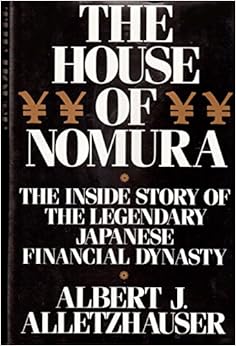 I just read Alletzhauser's House of Nomura (1990, out of print) after an old Japan hand recommended it to me. Highly recommend for anyone who wants to understand the history of Japanese business/markets from the Meiji through Showa eras from the perspective of an outsider turned insider. My summary/review/editorializing of the pre-WW2 era (skip to Four Big Bets section for the more market relevant tidbits).
Since the book released in 1990, the author portrays Nomura as omnipotent and triumphant (it was Japan's most profitable corporation in 1987) in a reverential tone that would seem absurd today. Of course with the benefit of hindsight, we know that Nomura was both partly lucky and partly a beneficiary of circumstances not just in the 1980's bubble but also at its very founding.
Perhaps more interesting is the glimpse into the business world of Meiji, Taisho, and Showa before WWII. What's clear is that Japan had Prussian institutions but an Anglo approach to corporate governance. State capitalism produced large conglomerated oligarchies (zaibatsus) that were run for the interest of shareholders. Behavior typically thought of today as "Anglo-styled capitalism": hostile takeovers, confrontation, shareholder preeminence, creative destruction, cutthroat competition, mobility etc. was a feature of Japanese corporate life. A few elite families dominated pre-WW2 and financial disparities wholly reflected this reality.
After the War, this entirely shifted to an egalitarian culture with corporations operated for the benefit of managers and labor rather than shareholders. Nomura was slightly exceptional for its more entrepreneurial spirit and aggressive culture, but not to the extent most corporations were before the War. The mandarin class gained even more power in this new system so political connections mattered even more after the War.
Mercantile Osaka
In the late Tokugawa (1603 – 1868) and early Meiji (1868 – 1912) eras, Osaka was the center of commerce in Japan whereas Edo (Tokyo), the seat of political power, was the much resented "kanemushi" (money-eating bug). Osaka was host to the world's first futures exchange, Dojima, which traded rice. Money exchanging became the most important, far dwarfing the stock exchange, as Osaka ran on a silver standard and Tokyo on the gold standard. The author points out that Osakans still greet each other with the phrase mokari makka, which loosely translates to "how's business" (though my Osaka friends inform me that this phrase is quite antiquated and fallen into disuse).
Money Changers
In this environment Nomura Tokushichi I (1850 - ?), the illegitimate son of a samurai and a domestic worker, inherited a prosperous money changing shop from his adoptive father. The Japanese, then as even today, regarded money changing as an occupation with low social status , the lowest rung of a class one notch above the untouchables (hierarchy: nobles > samurai > farmers > artisans > merchants > outcasts). However, by the end of the Tokugawa Era, many impoverished noble families had resorted to mercantile activities while the wealthy merchant class exerted tremendous power over the indebted nobles. Tokushichi I became comfortably wealthy and played the part of J.S. Morgan (1813-1890) to his more adventurous son J.P. Morgan (1837-1913)…though with much lower social standing and dominance.
Meiji Restoration
With a new national bimetallic currency and the abolition of feudalism, the Meiji Restoration gradually made money changing obsolete. The Meiji government legalized individual private land ownership and privatized large state-owned businesses. Adopting the centralized Prussian economic model, Japan largely relied on direct finance via banks to allocate capital. However, the formation of companies still required equity issuance, which gave birth to a burgeoning but largely backwater equity market. In Osaka, the stock exchange in Kitahama (in close proximity to the Dojima rice exchange) was open for two short periods a month. The massive bull market of the Meiji era led to the formation of 155 stock exchanges by 1897 of which the Osaka Securities Exchange was one of the largest.
Tokushichi II
Tokushichi I bestowed to Tokushichi II (1878-1945) the benefit of a modest fortune and excellent timing. Like the so-called American robber barons (mostly born in the 1830s), Tokushichi's lifespan happened to align perfectly with crucial events of the Meiji and Taisho eras in relation to equity investing. Unlike his conservative father, the young Nomura Tokushichi II was an inveterate gambler and spendthrift. Tokushichi II's father had to bail him out twice: first when as an apprentice Tokushichi II stole from his employer to speculate in the stock market (and lost) and second when he had a social obligation to indemnify a client who had lost money on his recommendation.
Four Big Bets
Bet 1: Having witnessed the bullish effect of the First Sino-Japanese War (1894-1895) on the stock market, Tokushichi II convinced his father to let him plow half of the family's net worth into a massive expansion of the stock brokerage operation once the Russo-Japanese War broke in 1904. As the stock market rallied as predicted, the gamble paid off and Nomura fully transitioned from a money changer to a stock brokerage.
Bet 2: In 1905, Tokushichi II bet big again when negative rumors circled his brother-in-law's textile business. After investigating the business and finding that the order books were full with wartime orders for uniforms, Tokushichi II accumulated shares at ¥20. Tokushichi II cornered the market, forced a short squeeze, and sent the price to ¥100. The paper profit (¥20,000, then the wages in the lifetime of an average Osakan) equaled the entire original capital invested a year ago to expand the brokerage. After this coup, Tokushichi hired a journalist and moles in trading companies to gather order flow and shipping volume information.
Bet 3: Tokushichi II's bullish bets paid off massively in the 1906 bubble. Seeing a parallel between the Russo-Japanese War and the Sino-Japanese War (which preceded a large bear market), Tokushichi II waited for other major dealers to become net sellers before selling most of his stocks. The determined risk-taker, Tokushichi II went short, but the market kept rising. By January 1907, Tokushichi II, teetering on bankruptcy, sought and received an emergency loan to cover margin calls from a leading Osaka bank by bribing the local branch manager with a senior position at Nomura. The market turned in mid-January 1907 and lost 88% of its value by the end of the year (though the author doesn't make a clear connection to the Panic of 1907, which likely bailed out Tokushichi II). At 28, Nomura Tokushichi II was worth ¥5 million and became a celebrity in the financial community.
Bet 4: With the arrival of WWI, the Bank of England raised the discount rate from 3 to 10%, which precipitated a financial crisis in Japan. Japanese banks called in loans to speculators and brokerages, which in turn sent the equity market into a nosedive and bankrupted a large swath of the financial service sector. Nomura survived this episode in part because at that time it was mostly in the business of earning commissions rather than trading for the house.
Though by now most Japanese speculators understood that war was profitable for the listed corporations, most didn't think that a European war would mean anything for Japan. Tokushichi II speculated that WWI would be bullish for Japanese exporters based on the reports of shortages in Europe. His younger brother, studying in England, sent wireless reports that beat the Japanese newspapers and contained far more objective and accurate information. He also had access to intelligence in the Mitsui House trading empire, which gave Tokushichi II an edge over other speculators. While local Japanese papers gave the impression that the War would end in the winter of 1916, better information directly from his brother in Britain persuaded Tokushichi II to buy the dip that accompanied expectations of peace. The bet paid off as the war dragged on, which augmented Nomura Tokushichi II's already considerable fortune and cemented Nomura's standing as the top/surviving broker in Osaka.
Jesse Livermore
Tokushichi II's story bears remarkable similarity to Jesse Livermore's (subject of Reminiscences of a Stock Operator, 1923). Tokushichi II (1878-1945) was born a year after Livermore and died naturally five years after the latter's suicide. Both had a natural attraction to bucket shops in their youth, possessed high tolerance for risk that resulted in multiple failures, learned early that the stock market was prone to manipulations, and profited from their understanding of war's influence on economic cycles. Both made and almost lost their early fortunes in the Panic of 1907 and made their second fortune during WWI.
Perhaps the key difference between the two men was that Tokushichi II became a big fish in a small pond as a first mover in a nascent market while Livermore was always a minnow relative to the whales who had created their fortunes decades earlier. Tokushichi II used his early winnings to buy social status (eventually elevated to House of Peers in 1928 and repeatedly asked to become Minister of Finance in the 1930's) and ingratiate himself with the business and political elites. He built a network that produced valuable inside and early information. Conversely, Livermore seemed to hurt himself when trading on his "inside information" since he was never truly a member of the business elite himself. While Nomura Tokushichi II earned his fortune from imputing information and later rent seeking, Livermore had to rely more on his technical trading skills.
Nomura Zaibatsu
Once Nomura Tokushichi II exhausted the easy opportunities from stock speculation, he parlayed his fortune into the more stable business of brokering, which became the basis of a fledging pre-WWII zaibatsu with more socially respectable business interests: primarily a bank and a rubber plantation in Borneo. This required him to concentrate more on political protection and opportunism.
The Nomura group never truly achieved the same status accorded to the great zaibatsu merchant houses of Mitsui, Mitsubishi, Sumitomo, or Yasuda. Within Japan, Nomura never earned the same cache or respectability that leading investment houses enjoyed in the US. This may be in part because of its roots in the rough and tumble world of retail brokering (rather than genteel corporate brokering), the strong cultural distaste for seemingly parasitic businesses that deal with secondary markets, and the subordinated role of equities and bonds to bank lending.
anonymous writes:
I have not read Alletzhauser's book so this comment is based solely on what I have learned in my investigations into the WW I gold standard in Japan. The company that made Nomura Tokushichi II's fortune was Koriyama Kenshi Boseki Co.,Ltd. which still exists in a different corporate incarnation.
NT II was a friend of the company's owner, Yutaro Yasuhiro, who showed him the actual books. The company had been rumored to be bankrupt; but, because of the effects of WW I in Europe, there was an effective embargo on textile exports to East Asia, and the company's order book was as full as it had ever been. NT II bought.
Comments
Archives
- October 2026
- September 2026
- August 2026
- July 2026
- June 2026
- May 2026
- April 2026
- March 2026
- February 2026
- January 2026
- December 2025
- November 2025
- October 2025
- September 2025
- August 2025
- July 2025
- June 2025
- May 2025
- April 2025
- March 2025
- February 2025
- January 2025
- December 2024
- November 2024
- October 2024
- September 2024
- August 2024
- July 2024
- June 2024
- May 2024
- April 2024
- March 2024
- February 2024
- January 2024
- December 2023
- November 2023
- October 2023
- September 2023
- August 2023
- July 2023
- June 2023
- May 2023
- April 2023
- March 2023
- February 2023
- January 2023
- December 2022
- November 2022
- October 2022
- September 2022
- August 2022
- July 2022
- June 2022
- May 2022
- April 2022
- March 2022
- February 2022
- January 2022
- December 2021
- November 2021
- October 2021
- September 2021
- August 2021
- July 2021
- June 2021
- May 2021
- April 2021
- March 2021
- February 2021
- January 2021
- December 2020
- November 2020
- October 2020
- September 2020
- August 2020
- July 2020
- June 2020
- May 2020
- April 2020
- March 2020
- February 2020
- January 2020
- December 2019
- November 2019
- October 2019
- September 2019
- August 2019
- July 2019
- June 2019
- May 2019
- April 2019
- March 2019
- February 2019
- January 2019
- December 2018
- November 2018
- October 2018
- September 2018
- August 2018
- July 2018
- June 2018
- May 2018
- April 2018
- March 2018
- February 2018
- January 2018
- December 2017
- November 2017
- October 2017
- September 2017
- August 2017
- July 2017
- June 2017
- May 2017
- April 2017
- March 2017
- February 2017
- January 2017
- December 2016
- November 2016
- October 2016
- September 2016
- August 2016
- July 2016
- June 2016
- May 2016
- April 2016
- March 2016
- February 2016
- January 2016
- December 2015
- November 2015
- October 2015
- September 2015
- August 2015
- July 2015
- June 2015
- May 2015
- April 2015
- March 2015
- February 2015
- January 2015
- December 2014
- November 2014
- October 2014
- September 2014
- August 2014
- July 2014
- June 2014
- May 2014
- April 2014
- March 2014
- February 2014
- January 2014
- December 2013
- November 2013
- October 2013
- September 2013
- August 2013
- July 2013
- June 2013
- May 2013
- April 2013
- March 2013
- February 2013
- January 2013
- December 2012
- November 2012
- October 2012
- September 2012
- August 2012
- July 2012
- June 2012
- May 2012
- April 2012
- March 2012
- February 2012
- January 2012
- December 2011
- November 2011
- October 2011
- September 2011
- August 2011
- July 2011
- June 2011
- May 2011
- April 2011
- March 2011
- February 2011
- January 2011
- December 2010
- November 2010
- October 2010
- September 2010
- August 2010
- July 2010
- June 2010
- May 2010
- April 2010
- March 2010
- February 2010
- January 2010
- December 2009
- November 2009
- October 2009
- September 2009
- August 2009
- July 2009
- June 2009
- May 2009
- April 2009
- March 2009
- February 2009
- January 2009
- December 2008
- November 2008
- October 2008
- September 2008
- August 2008
- July 2008
- June 2008
- May 2008
- April 2008
- March 2008
- February 2008
- January 2008
- December 2007
- November 2007
- October 2007
- September 2007
- August 2007
- July 2007
- June 2007
- May 2007
- April 2007
- March 2007
- February 2007
- January 2007
- December 2006
- November 2006
- October 2006
- September 2006
- August 2006
- Older Archives
Resources & Links
- The Letters Prize
- Pre-2007 Victor Niederhoffer Posts
- Vic’s NYC Junto
- Reading List
- Programming in 60 Seconds
- The Objectivist Center
- Foundation for Economic Education
- Tigerchess
- Dick Sears' G.T. Index
- Pre-2007 Daily Speculations
- Laurel & Vics' Worldly Investor Articles
