Mar
31
Play Ball! from David Lillienfeld
March 31, 2014 |
 Today, in Baltimore as in many other cities across the United States, today is Opening Day, the first game of the 2014 baseball season. For many, spring began on March 21; for fans of baseball, it begins today. In the Baltimore of my youth, on opening day, there were usually a few empty seats in the classroom once noon came around. It was understood that some parents had procured tickets to opening day and that was that. One teacher at my elementary school tried to schedule a test on opening day as a means of getting her students to stay in school. Word of this innovation reached the Mayor, who subsequently called the principal and told her that such approaches were not in the best interests of civic spirit. The test was re-scheduled. My school was not unique, as this episode was reported across the city, and dutifully written up in the Sunpapers and the News American as though it was something novel when it never was.
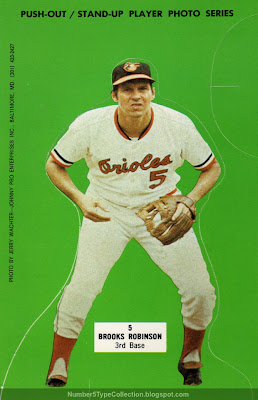 When I was 4, the premier home run hitter in the Orioles line-up was Jim Gentile. I remember screaming myself hoarse at many a games as though my utterances would have any impact on the path of his well hit balls to the deep outfield. Of course, they never did, and most times, the ball was caught. But that interest faded, as Brooks Robinson began what can only be described as his amazing career. (To this day (37 years after retirement), in Baltimore he is known as Mr. Oriole and when he travels in the city, it's as incognito as he can get not so much out of disrespect for the fans but, rather, in deference to them. I remember once waiting at the stoplight at end of the Jones Falls Expressway going into downtown Baltimore. The driver of the car at the head of the next lane over was Brooks Robinson. He was recognized by the driver in the car in the next to him, who promptly exited his car and, with paper and pen in hand, went to Brooks' car. A fellow in the car behind Brooks's car started honking his horn—the light had changed and the driver now by Brooks's car screamed back, "It's Brooks Robinson! Can't you wait a second, fellow?" The driver of that car soon emerged from it, also with pen and paper in hand. This scene repeated a few times, with a mob forming near Brooks's car. He finally got out of the car to rousing applause by the assembled fifty (maybe more) or so drivers and onlookers on the sidewalks leading to the intersection. He asked if anyone else wanted an autograph and as you might imagine, hands went flying into the air. Not a few were by parents with a child in tow, waiting to see the legend. He said he was pulling off to the side of the street on the other side of the light so drivers could exit the expressway and get to where they were trying to go. Of course, that didn't do anything to get the now abandoned cars off the JFX, as it was known. The mass of people moved forward and engulfed the car as Brooks got out of it again. A policeman came over to see what was going on, and there were soon Baltimore Police Department cruisers blocking off the streets around this scene. After about 45 minutes or so, Brooks started pointing at the abandoned cars and thanked everyone for their support over the years and how proud he was of the city and how much he looked forward to seeing them at the stadium. That was Brooks. Years later, Bob Costas was interviewing Cal Ripken after Ripken had broken Gehrig's streak. Costas noted that Ripken was known throughout the city as someone who, when walking somewhere and approached by any—especially anyone young—he would stop and talk with them, sign a piece paper and so on. Costas wanted to know why Ripken did it, it was so unusual for ballplayers. Ripken said that he had grown up "just up the road" from Baltimore, was a lifelong Orioles fan, and that when you grew up near Baltimore, you learned how to play third base by watching Brooks. "Watching Brooks taught me a lot about playing third, and also about living your life. Brooks did it, so I do it too. It's the right thing to do for the fans. Especially the kids.") As with many youth in Baltimore, when my father would take me to see an Os game, I went with my Spalding baseball glove (the one with Brooks Robinson's name in cursive on the palm) and my Johnny Unitas crew cut. If you looked around the stadium, every boy under 10 looked like me, convinced that there would be a ball hit towards them, and that the Brooks Robinson Gold Glove mitt would let they haul it in. I never figured out what the kids behind home plate thought, with the netting and all. If the netting gave way, though, they were prepared with their mitts ready for action and their right hand prepared to drop the soda cup to catch that ball.
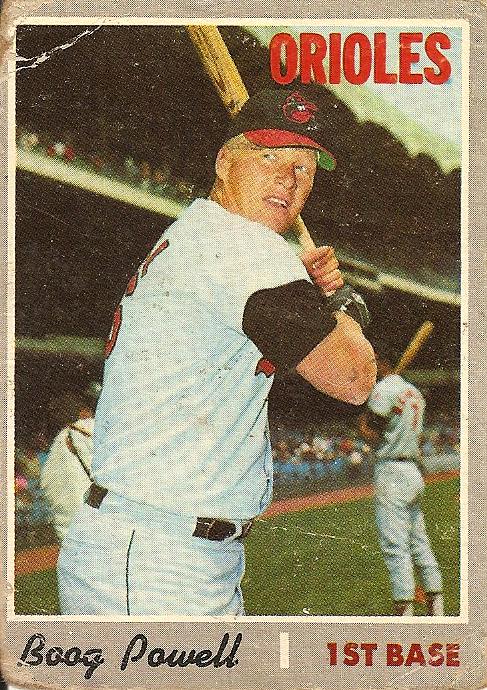 Boog Powell was another fixture of the Orioles of my youth. He played the outfield for a while, but at 6'4 and 225 pounds, he was too good of a target at first base to be left in the outfield. Powell was a strong hitter. He hit over 300 homers during his career—and these weren't balls that maybe without an assist from the wind would have been foul or good for a long fly ball out. Nope, these were creamed. There was no doubt that the ball would soon be gone. Which was good in a way, since Powell batted left handed and was a dead pull hitter. Lots of times, the opposing team would move the shortstop behind second base, the second baseman to midway between between first and second, and the first baseman guarding the line. It didn't much matter when the ball was smashed through the infield into the outfield. In 1970, Boog's AL MVP year, one team once tried a different type of shift. The third baseman playing behind second, the second baseman and the shortstop were playing between first and second, and the first baseman was holding the runner. Boog was the tying run, and the opposing team wanted to make sure he did not get on base. Boog proceeded to hit a curve ball to where the 3rd baseman should have been, in which case it would have been a pretty routine double play and the Os would have lost. The ball had lots of spin on it and after it hit the turf, it took a wicked twist into foul territory. By the time the 3rd baseman fielded the ball, the runner had scored and Boog, representing the tying run, stood at second base with a stand-up infield double. (No error, just badly positioned fielders for that particular player.) Elrod Hendricks (who subsequently became the Os bullpen coach), at least I think it was Elrod, came to the plate and on a 1-1 pitch, lofted a ball just over the right field wall. Os won by a run. There was the time Boog was on first, a left handed hitter at the plate, and Boog got a great jump on the pitcher (what pitcher in his right mind was going to hold Powell on first??). As just about everyone in the stadium fell off their seats (Powell never stole bases, he was simply too slow), the catcher released the ball pretty quick, and the shortstop came into position to take the throw and tag Powell for the out. Assuming of course that Powell was out. Which became a moot question when Boog drops to a slide, left leg extended, spikes visible to all. Seeing 235 pounds of angry pot roast coming at him, the shortstop got out of the way as the ball, thrown perfectly just right of second base, went sailing into center field. Powell wisely didn't try to take a base on the error, he would probably have been out. As it was, he scored two batters later. Someone (I don't remember who) interviewed the shortstop after the game about that throw. The shortstop replied that he could let the ball go by and take the error, or (seeing Powell starting his slide) he could take the throw and deal with the spikes and the mass behind them. He said he could live with the error but observed that it's hard to live when you're dead. Yogi Berra was not the only profound philosopher in baseball.
 There are others in Orioles history I'm sure many already know about—Paul Blair, whom Willie Mays thought covered more of center field than Mays ever could, and if Mays invented the basket catch, Blair perfected it—Frank Robinson, arguably the most intense competitor in the game during his career—even more than Pete Rose at the time and others. Bob Gibson said that Robinson was one of the players he most feared (his word) pitching to—"he has so many ways to beat you." Frank stands out not just for his exploits on the field but also his difficulties in finding a home for his family in Baltimore. This was in 1966, and Baltimore was still de facto (though not de jure) segregated. Robinson had trouble finding a house. He found one eventually, but not before the News-American, at the time with the highest circulation in the city, published a front page (not sports section front page) above the fold article about Robinson's experience. I wonder to this day whether that experience, and the publicity attending it, helped with integration (such as it was) in the city.
It's getting to be time for the game to start, so I'll stop here. It's time to think back to those innocent times as a kid, at Memorial Stadium (I have lots of memories from it), glove on my left hand peanuts in my right, ready for that ball that I was sure was coming my way, my father by my side. Tim M—do you think Tillman wins the opener?
Scott—sorry, I haven't followed the Cards this spring. The season needs to advance some for me to get much of an idea about them this year.
Regardless, it's time to "Play ball!"
Tim Melvin writes:
Nice piece David. Tillman has pitched well all spring so he has a good shot at a win if he can go deep and keep ball out of the hands in the bullpen.
David Lillienfeld replies:
Thanks. I agree with you on both counts.
I've often wondered if the tell on the re-ascendence of the US will be signaled when baseball resumes its long-standing role as the national pastime. The NFL may have over-reached with over-exposure, not to mention health issues. We'll see if the MLB comes back. Football is such a militaristic game (blitz, bomb, mounting a drive, etc). Nothing like that in baseball. Walt Whitman called it "our game, America's game".
Comments
Archives
- October 2026
- September 2026
- August 2026
- July 2026
- June 2026
- May 2026
- April 2026
- March 2026
- February 2026
- January 2026
- December 2025
- November 2025
- October 2025
- September 2025
- August 2025
- July 2025
- June 2025
- May 2025
- April 2025
- March 2025
- February 2025
- January 2025
- December 2024
- November 2024
- October 2024
- September 2024
- August 2024
- July 2024
- June 2024
- May 2024
- April 2024
- March 2024
- February 2024
- January 2024
- December 2023
- November 2023
- October 2023
- September 2023
- August 2023
- July 2023
- June 2023
- May 2023
- April 2023
- March 2023
- February 2023
- January 2023
- December 2022
- November 2022
- October 2022
- September 2022
- August 2022
- July 2022
- June 2022
- May 2022
- April 2022
- March 2022
- February 2022
- January 2022
- December 2021
- November 2021
- October 2021
- September 2021
- August 2021
- July 2021
- June 2021
- May 2021
- April 2021
- March 2021
- February 2021
- January 2021
- December 2020
- November 2020
- October 2020
- September 2020
- August 2020
- July 2020
- June 2020
- May 2020
- April 2020
- March 2020
- February 2020
- January 2020
- December 2019
- November 2019
- October 2019
- September 2019
- August 2019
- July 2019
- June 2019
- May 2019
- April 2019
- March 2019
- February 2019
- January 2019
- December 2018
- November 2018
- October 2018
- September 2018
- August 2018
- July 2018
- June 2018
- May 2018
- April 2018
- March 2018
- February 2018
- January 2018
- December 2017
- November 2017
- October 2017
- September 2017
- August 2017
- July 2017
- June 2017
- May 2017
- April 2017
- March 2017
- February 2017
- January 2017
- December 2016
- November 2016
- October 2016
- September 2016
- August 2016
- July 2016
- June 2016
- May 2016
- April 2016
- March 2016
- February 2016
- January 2016
- December 2015
- November 2015
- October 2015
- September 2015
- August 2015
- July 2015
- June 2015
- May 2015
- April 2015
- March 2015
- February 2015
- January 2015
- December 2014
- November 2014
- October 2014
- September 2014
- August 2014
- July 2014
- June 2014
- May 2014
- April 2014
- March 2014
- February 2014
- January 2014
- December 2013
- November 2013
- October 2013
- September 2013
- August 2013
- July 2013
- June 2013
- May 2013
- April 2013
- March 2013
- February 2013
- January 2013
- December 2012
- November 2012
- October 2012
- September 2012
- August 2012
- July 2012
- June 2012
- May 2012
- April 2012
- March 2012
- February 2012
- January 2012
- December 2011
- November 2011
- October 2011
- September 2011
- August 2011
- July 2011
- June 2011
- May 2011
- April 2011
- March 2011
- February 2011
- January 2011
- December 2010
- November 2010
- October 2010
- September 2010
- August 2010
- July 2010
- June 2010
- May 2010
- April 2010
- March 2010
- February 2010
- January 2010
- December 2009
- November 2009
- October 2009
- September 2009
- August 2009
- July 2009
- June 2009
- May 2009
- April 2009
- March 2009
- February 2009
- January 2009
- December 2008
- November 2008
- October 2008
- September 2008
- August 2008
- July 2008
- June 2008
- May 2008
- April 2008
- March 2008
- February 2008
- January 2008
- December 2007
- November 2007
- October 2007
- September 2007
- August 2007
- July 2007
- June 2007
- May 2007
- April 2007
- March 2007
- February 2007
- January 2007
- December 2006
- November 2006
- October 2006
- September 2006
- August 2006
- Older Archives
Resources & Links
- The Letters Prize
- Pre-2007 Victor Niederhoffer Posts
- Vic’s NYC Junto
- Reading List
- Programming in 60 Seconds
- The Objectivist Center
- Foundation for Economic Education
- Tigerchess
- Dick Sears' G.T. Index
- Pre-2007 Daily Speculations
- Laurel & Vics' Worldly Investor Articles
