Feb
21
Two Good Books, from Richard Owen
February 21, 2014 |
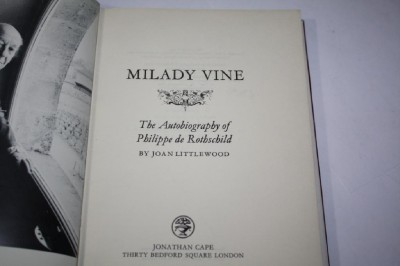 I read two great books lately. The first was Milady Vine, The Autobiography of Baron Philippe de Rothschild and the second was The News: A User's Manual by Alain de Botton
The Rothschild biography begins an ending chapter with a quote from Laurence Sterne:
"His opinion was that there was a strange kind of magic bias which good or bad names, as he called them, irresistibly impressed upon our characters and conduct. How many Caesars and Pompeys, he would say, by mere inspiration of the names, have been rendered worthy of them? And how many, he would add, are there who might have done exceedingly well in the world, had not their characters and spirits been totally depressed and Nicodemus'd into nothing"
Philippe de Rothschild was a French family member with lineage in the arts, society and agriculture rather than the banking franchise which other cousins inherited. The quote captures the burden upon (and rocketship beneath) Baron Philippe as he goes about his adventures. His principal asset becomes Chateau Mouton which, alongside Chateau Lafite is one of France's premier wine estates.
The quote possibly also applies to the author of The News: Alain de Botton is son of Gilbert de Botton, formerly president of Rothschilds in New York and founder of asset manager GAM. de Botton is a specialist in the application of classic philosophy to modern situations and to quote him "somebody who has made a few stabs at trying to bring elite culture into the wider culture".
This is manna to the broadsheet newspapers and possibly why many reviewers of his work try and unfold a psychoanalysis of de Botton's background, rather than taking his writing on its merits. In the case of The News, however, we at Daily Specs can legitimately hope something of de Botton Snr's financial genius was channeled from the ether into de Botton Jnr's assessment of the media's reporting of Economics, Politics and beyond. But nonetheless, de Botton Jnr's flair - like Barron Philippe's - is fully self-made.
But first, back to Barron Philippe. The biography is an efficient and entertaining one, with plenty of salacious content covering Philippe's love life and - perhaps uniquely for a Rothschild biography (albeit I speculate with limited data) - some detailed analysis of his private parts.
It also contains several interesting lessons on business and wealth. Every man is ultimately self-made, and this is no less true for Philippe. One of the themes is how much unhappiness, isolation, and jealousy can come from privilege. High birth has its own unique challenges: Philippe has a very difficult relationship with his mother who openly mocks him as a child in front of friends, until Philippe finally snaps and runs away to live with an Aunt. He then doesn't speak to his mother for many years.
Nonetheless, he inherits his principal asset from his mother: Chateau Mouton. At the time that he takes the estate over, it is in heavy disrepair and loss making. Indeed, a key staff-member has been siphoning off the profits to build his own estate and has even stolen the vines. Barron Philippe is remarkably sanguine about this discovery and doesn't pursue the thief, reasoning that they deserved what they got as negligent landlords. The book is full of examples of the difficulties of managing a large estate and the various dissipations that occur. When his father passes away, many assets cannot be properly traced or tracked.
Philippe's key business success is vertically integrating Mouton as wine producer. At the time he takes over, wine is not fashionable, having taken a backseat to cocktails. Mouton takes the wine only as far as the barrel, and wine is bottled, wholesaled, and retailed via a complex supply chain. Philippe takes out the middleman, and begins bottling on-site. This gives much higher control of the vintages and prevents any interference or fraud by the bottlers.
Baron Philippe has an instinctive understanding of luxury goods with a commodity input. He forms a combine between five elite wine estates who all begin bottling on site. He manages the quality ruthlessly, and happily disposes of 90% of the vintage if it isn't up to spec. This creates supply squeezes and heightens emotional desire through occasional withdrawal. Philippe hires famous artists such as Warhol to provide unique labels each year. Philippe perfects the protection of brand equity whilst delivering a more accessible product: he forms a junior brand "Cadet Mouton" which has a price point accessible to all. This creates a virtuous circle, cementing the name with the public whilst bolstering the inaccessibility and privilege of the elite brand.
Perhaps the most interesting part of the book is Barron Philippe's experience during WWII. Despite a decade of run-up, much political data on the horizon, and plenty of financial resources to prepare, when the moment comes, Philippe has zero assets offshore, has made no preparation for escape, and is rendered an everyman (well almost) by the Vichy government.
Philippe socialises with wealthy French families who sympathise with the Nazis and, having listened to them delivering excoriations about the "jews and freemasons" being responsible for societies ills, he is graced with a caveat that - of course though - they don't mean Philippe: he and the Rothschilds are different.
Ultimately, Philippe has to escape alone on foot to Spain, Portugal, then England. His wife refuses to leave. Albeit she is protected somewhat by membership of an old Catholic French family, the mental hysteresis of uprooting to England is so great that she prefers to face danger at home.
Such is the lack of preparation of his affairs that, had Philippe's estate not been focused upon a hard asset like Mouton (which is commandeered by the Germans), and France not liberated, his financial losses may have been total.
The book is entertaining, Philippe writes very well (albeit he has a ghostwriter), and did I mention the bit about (to adopt own terminology) his cock?
 Now onto The News: A User's Manual by Alain de Botton
de Botton's book is an fascinating essay on the modern media. His ambition, well realised, is to answer "what should the news ideally be? What are the deep needs to which it should cater? How could it optimally enrich us?". de Botton moves by category, and we can contract the answer to his questions as:
- Celebrity News should let us draw inspiration and insight;
- Disaster News, a sense of our ephemeral lives and a gratefulness for our blessings;
- Consumer News, a sense of which goods might best assist us in answering our underlying aspirations for a fulfilled existence;
- Political News should help to create a rounded, tolerable nation;
- World News should open our eyes to the nature of life in foreign countries above and beyond their moments of crisis; and
- Economic News should evoke the human realities that lie beneath the data.
de Botton makes a good case for why we are drawn to celebrity ephemera over serious news. And like Freud, having dawn the underlying neurosis from his own experience, makes us feel more normal for having experienced it too.
Perhaps most interesting for Daily Specs readers are his chapters on economic news. de Botton states *"to assess a nation through its economic data is a little like re-envisaging oneself via the results of a blood test, whereby the traditional markers of personality and character are set aside and it is made clear that one is at base, where it really counts, a creatinine level of 3.2, a lactate dehydrogenase of 927, a leukocyte (per field) of 2 and a C-reactive protein of 2.42". Amen. And this is before adding the Camp Kinder layer of obfuscation that our Daily Specs Chair comments upon regularly.
de Botton even provides a chapter specifically on Investor News, which again to quote him: "investors are like pilots flying high over a landscape at night. For navigation, they rely on only a few beacon signals and visual cues: the nuclear power station on the peninsula, the main north-south motorway and the medieval city, glowing like an encrusted diamond ring at the foot of the mountains. But there is no need to worry about the discussions in the apartment block near the piazza; the dilemmas of the lorry driver at the service station or the dreams of the technician in the turbine hall."
This seems correct, albeit that extending oneself to discover clues in the latter non-standard, non-quantifiable minutiae is possibly a sign of profitable maturity in ones financial analysis.
Overall, the book is perhaps utopian in its aims: to create a news media that serves to enhance us rather than just capture our clicks and attention. But I am sure de Botton well realizes this. One must always have a mighty target on the horizon in order to appropriately set nearer, more realistic goals.
de Botton makes cogent points on the personalisation of news streams available with modern technology. That we risk confining ourselves to informational cul-de-sacs to our own detriment. Indeed, he proposes, "only after extensive self-examination, perhaps with the help of a psychoanalyst, would they be adequately prepared to set the dials on their personal news engines, aware of the sorts of stories that were needed to challenge their defences, expand their horizons and excite in them the right sort of envy."
Or perhaps, as the Chair cogently advises, we should all stick to the National Enquirer.
In sum, an efficient and educative read, and did I mention that there is no bit about (to adopt my own terminology) his cock?
Comments
1 Comment so far
Archives
- October 2026
- September 2026
- August 2026
- July 2026
- June 2026
- May 2026
- April 2026
- March 2026
- February 2026
- January 2026
- December 2025
- November 2025
- October 2025
- September 2025
- August 2025
- July 2025
- June 2025
- May 2025
- April 2025
- March 2025
- February 2025
- January 2025
- December 2024
- November 2024
- October 2024
- September 2024
- August 2024
- July 2024
- June 2024
- May 2024
- April 2024
- March 2024
- February 2024
- January 2024
- December 2023
- November 2023
- October 2023
- September 2023
- August 2023
- July 2023
- June 2023
- May 2023
- April 2023
- March 2023
- February 2023
- January 2023
- December 2022
- November 2022
- October 2022
- September 2022
- August 2022
- July 2022
- June 2022
- May 2022
- April 2022
- March 2022
- February 2022
- January 2022
- December 2021
- November 2021
- October 2021
- September 2021
- August 2021
- July 2021
- June 2021
- May 2021
- April 2021
- March 2021
- February 2021
- January 2021
- December 2020
- November 2020
- October 2020
- September 2020
- August 2020
- July 2020
- June 2020
- May 2020
- April 2020
- March 2020
- February 2020
- January 2020
- December 2019
- November 2019
- October 2019
- September 2019
- August 2019
- July 2019
- June 2019
- May 2019
- April 2019
- March 2019
- February 2019
- January 2019
- December 2018
- November 2018
- October 2018
- September 2018
- August 2018
- July 2018
- June 2018
- May 2018
- April 2018
- March 2018
- February 2018
- January 2018
- December 2017
- November 2017
- October 2017
- September 2017
- August 2017
- July 2017
- June 2017
- May 2017
- April 2017
- March 2017
- February 2017
- January 2017
- December 2016
- November 2016
- October 2016
- September 2016
- August 2016
- July 2016
- June 2016
- May 2016
- April 2016
- March 2016
- February 2016
- January 2016
- December 2015
- November 2015
- October 2015
- September 2015
- August 2015
- July 2015
- June 2015
- May 2015
- April 2015
- March 2015
- February 2015
- January 2015
- December 2014
- November 2014
- October 2014
- September 2014
- August 2014
- July 2014
- June 2014
- May 2014
- April 2014
- March 2014
- February 2014
- January 2014
- December 2013
- November 2013
- October 2013
- September 2013
- August 2013
- July 2013
- June 2013
- May 2013
- April 2013
- March 2013
- February 2013
- January 2013
- December 2012
- November 2012
- October 2012
- September 2012
- August 2012
- July 2012
- June 2012
- May 2012
- April 2012
- March 2012
- February 2012
- January 2012
- December 2011
- November 2011
- October 2011
- September 2011
- August 2011
- July 2011
- June 2011
- May 2011
- April 2011
- March 2011
- February 2011
- January 2011
- December 2010
- November 2010
- October 2010
- September 2010
- August 2010
- July 2010
- June 2010
- May 2010
- April 2010
- March 2010
- February 2010
- January 2010
- December 2009
- November 2009
- October 2009
- September 2009
- August 2009
- July 2009
- June 2009
- May 2009
- April 2009
- March 2009
- February 2009
- January 2009
- December 2008
- November 2008
- October 2008
- September 2008
- August 2008
- July 2008
- June 2008
- May 2008
- April 2008
- March 2008
- February 2008
- January 2008
- December 2007
- November 2007
- October 2007
- September 2007
- August 2007
- July 2007
- June 2007
- May 2007
- April 2007
- March 2007
- February 2007
- January 2007
- December 2006
- November 2006
- October 2006
- September 2006
- August 2006
- Older Archives
Resources & Links
- The Letters Prize
- Pre-2007 Victor Niederhoffer Posts
- Vic’s NYC Junto
- Reading List
- Programming in 60 Seconds
- The Objectivist Center
- Foundation for Economic Education
- Tigerchess
- Dick Sears' G.T. Index
- Pre-2007 Daily Speculations
- Laurel & Vics' Worldly Investor Articles

Pardon the intrusion, Richard, but were you once by any chance a teacher with Berlitz?
Colin Rothery