Nov
14
Some Time Ago, from Victor Niederhoffer
November 14, 2013 |
 Some time ago Mr. Jovanovich posted an anecdote about old man Mellon to the effect that his kids never let him pay for a bill at a restaurant because the old man felt that prices should be the same as they were when he was a young man and that they were too high today. This is a common thing one runs into in certain people of age. They are accustomed to the old p/e, the average of the last 10 years, on those rare occasions in the 1930s when Ben Graham wasn't chasing the skirts, when you could buy companies at below their liquid cash, assuming incorrectly as he did that any shares were available and they weren't losing so much that the previous balance sheets were meaningless.
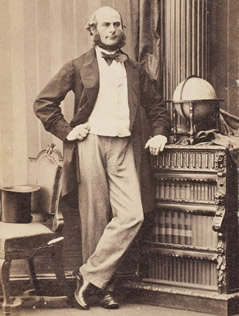
Galton had a way of dealing with such things, and he was the most revered man of his age, commanding universal respect, and heading all the leading scientific and geographic societies. "Let the bygones be bygones". Don't fret about bad things that happened, or look to take back the things that you could have done that would have made you so much better off. The woman you didn't marry. The stock you didn't pick. The limit order that wasn't filled.
I recently ran into this in a business meeting where I was trying to sell a company. When negotiations started the earnings of the company were half what they were when the negotiations resumed. The buyer was stuck on the old price and old earnings. The buyer consequently missed an opportunity to make a tremendous profit, of about 10 times his investment of millions in several years.
One often makes this mistake in the market. You try to catch a falling star and you miss it. And then it goes in the direction you had hoped. But you never come in again because you are trying to catch it at the bygone price. Anatoly once mentioned that he was trained in checkers by the KGB to learn to be an amnesiac so he wouldn't regret moves that he should have made on the board, and would look to the future.
In chess, the good players always say forget about the prices that have been taken and concentrate on the pieces that are on the board. I believe this is a common mistake in life and markets, and would be interested in the scientific and empirical and life and market lessons that you all have learned from similar ruminations.
Richard Owen adds:
 Ted Turner believes a large component of his success is attributable to the fact he readily accommodated and cared not much about what had past. The Buddhist concept of acceptance and Kabbalahist idea of cause and effect are similar.
Compare Germany and Silicon Valley. In Silicon Valley ones past mistakes accrue as experience. In Germany there have been many internet start ups but also inevitably failures. Speaking to German friends, a failure there is carried like a deadweight around ones neck.
Society is destablising somewhat as the record of evidence of one's past peccadiloes becomes more extensive. Nobody can get into office or past congressional approval unless they lived a prude life of Cromwellian perfection. And its not clear one is best led by a Cromwellian prude.
Ralph Vince comments:
There's two ways we learn things, the easy way, and the hard way.
If we learn things the hard way the FIRST time we climb up off of the pavement — that is the definition of a windfall.
Learning things the easy way is to accept facts like an obedient database. The only payoff to learning things the easy way happens when our perspective on the matter at hand altered such that we see it in its proper light and thus actually understand it, rather than merely as data.
To convey ideas to other human beings, we must amend their perspective, their point of reference on the matter, to see it anew from an entry point that they will understand it. To spare them the inevitable beatings of otherwise learning it the hard way is such a gift.
Stefan Jovanovich comments:
In our misbegotten adventures in L.A. we had minor and almost all indirect dealings with the mouth of the South. Mr. Turner was so acutely aware of his father's defeat and death that even in casual dealings outsiders learned how determined he was to avenge/outpace/overcome his family legacy. He also was notorious, even in Hollywood, for accumulating personal grudges.
A great deal of individual success in Silicon Valley has come from the fact that the U.S. income tax code allows the tax-free pyramiding of gains through (1) buying and selling of principal residences and (2) exchanges of corporate interests. When you add the glories of carried interest, the result is a society of the well-connected in which there are very, very few failures who haven't held on to at least a respectable amount of the OPM. From the little I know of the German tax code, none of these opportunities to do a heads I win/tails you lose coin toss has ever existed in that country.
 Cromwell was many things, some of them awful; but he was never a prude. He and Elizabeth Bourchier had 9 children; and he and his wife were both, by religion, Independents. That meant they were those rarest of people who believed that Jews and (from the point of view of their Anglican, Presbyterian and Puritan contemporaries, even worse) Catholics were entitled to political and religious liberty.
What Richard may have meant is that Cromwell, as a military commander, was as piously single-minded as Joan of Arc. Like hers, his army never lost a battle once they had received proper inspiration; and each soldier literally believed in him and "the cause" for which they had a clear catechism. This was not ever going to be good news for anyone (Catholic Irish; Scots Presbyterian) who opposed him just as the Hussites (as dissidents from the true Catholic faith) would not have much mercy from St. Joan.
P.S. I find the history of Cromwell's catechism fascinating. If one were to ever come up for auction, the 1643 edition might be priced at a figure that even lovers of Bacon (the recently mentioned artist, not the writer) would respect.
For the American sequel to the story, check out The American Tract Society.
Victor Niederhoffer adds:
One notes the Chinese proverb on a similar theme: "don't carry your hatreds into the new year" or the English variant, "you can't run a mill with water that's past". All languages seem to have a proverb similar to "let the bygones be bygones". The Jewish custom of asking forgiveness at the new year for all the harms that you have inflicted on other in the past year, and sharing a torte and tea is from a similar vein.
Jeff Watson adds:
One of my proverbs is to take the hit, forget about it, and move on. But then again I don't mind small losses as they are just part of my business, and I take many small losses of a couple of cents when I smell that the trade is going to be wrong. Just like surfing, where there will always be another good wave, in trading, there will always be another good trade.
Alan Millhone writes in:
Dear Chair,
A grudge is a difficult thing to dismiss.
My Mother used to say, " I can forgive — perhaps not forget "
Sincerely,
Alan
Gyve Bones writes:
Oliver Cromwell was an unmitigated bastard and I find no evidence he believed that Catholics were entitled to religious liberty. To the contrary, his raping and pillaging and wholesale theft of Ireland, which was clinging tenaciously to the Catholic faith, and the Penal Laws enacted for the suppression of the faith and Gaelic language starting then and continuing for a couple of hundred years was an attempt, largely successful at cultural and racial genocide.
His puritanism certainly enforced a prudery on England. Within 50 years of Shakespeare's death, his plays could not be performed. And prudery is not the same thing as having a fruitful but chaste (no roaming to other bedsteads) relationship with one's wife.
— G.B.
Show me a Puritan, and I'll show you a son-of-a-bitch. -H.L. Mencken
The President of the Old Speculator's Club writes:
 Though Dailyspec seems to be a great repository of Mencken fans, there were a few voices which, although agreeing with him on many items, diverged on others. One such notable was G.K Chesterton. The two quotes which follow immediately demonstrate some common ground.
"The whole aim of practical politics is to keep the populace alarmed (and hence clamorous to be led to safety) by menacing it with an endless series of hobgoblins, all of them imaginary." —H. L. Mencken
"We are perpetually being told that what is wanted is a strong man who will do things. What is really wanted is a strong man who will undo things; and that will be the real test of strength." —G.K. Chesterton
On the issues of science and religion, however, Chesterton suggested that Mencken was equally skeptical:
I have already noted that, if there is such a thing as religious mania, there is also such a thing as irreligious mania. Just recently, perhaps, it has been the commoner of the two. But a very interesting study of the matter comes from a country in which we may say, without injustice, that both are fairly common. I had occasion to remark recently, in this place, that an American paper had accused me of being an anti-American writer; and I commented on the curious irony that the American paper was itself an anti-American paper. But, though I may be permitted thus to parry a purely personal charge, and a highly preposterous one, I should not like anyone to suppose that I do not both enjoy and value the magazine in question.
I am quite well aware that Mr. Mencken, the editor of the American Mercury, is really doing his duty as an American citizen in being an anti-American critic. I myself have been regarded often enough as an Anti-English critic, when I regarded myself as a patriot. In short, there are immense internal evils for Mr. Mencken to attack, and he is perfectly right to attack them. All is well so long as the good citizen abuses his own city. The trouble begins when the foreigner abuses it—or, almost as often, when the foreigner admires it. But, anyhow, the chief efforts of the American Mercury have to be directed towards this howling wilderness of sectarian sensationalism.
The popular science, that rages in the American Press and local government, is simply a dance of lunacy more ghastly than a dance of death. And an exceedingly valuable and important protest against it can be found in the same number of the Mercury from which I have picked the examples of theological hysteria. The protest is all the better because it is not the sort of protest that I should write, or that any person of my beliefs would write. The critic is writing entirely in the interests of Science, and is perfectly indifferent to the interests of Religion. And he enters a virile and telling protest against that science, which is his only religion, being dragged through the mire as a degrading superstition.
From a great article: "Religion in American History: I
Hate Methodism; and G. K. Chesterton vs. H. L. Mencken: Battle of the
Monogrammed Dudes. Surprising or Otherwise Interesting Primary Sources,
Pt IV"
Richard Owen writes:
This is fascinating stuff. The modern day argo in British English of referring to something as Cromwellian is along the lines Gibbons indicates, although at one step removed perhaps.
Cromwell instilled the Protestant Work Ethic in puritanical fashion. That still pervades much of British psyche today, and is captured in popular imagination, for example, in the writings of the Daily Mail and the books of Tom Bower, Britain's foremost hatchet biographer of businessmen (I say this with great respect; his books are well written and I suspect Mr. Bower would be glad to acknowledge his genre bias).
Thus the Protestant Ethic mentality is to be rich and industrious. But with the emphasis on the latter. As Martin Sosnoff said of his Dad, something like: *"he never thought he'd earn an easy dollar, and he never did".*
The one thing that really irritates the Cromwellian mentality is to find out, after slogging ones guts up to Vice President and exiting to early retirement with a Carriage Clock and blue chip pension, is to find out the reason for corporate downsizing was because a kid from the JFS, assorted Anglo Norman public school boys, or an Asian immigrant rustled up a grub stake into Forbes Four Hundredism. And possibly even had some good sex, bad drugs, and hella fun in the process.
Not to make light. These are complex neuroses and threaded reasonable sense given each parties bias.
Craig Mee writes:
Victor, the point can also be made that although a potential lost opportunity arises and there are fewer pieces on the board, the situation is then more clear. Although you may not establish the solid position you initially hoped for, many more tighter risk reward opportunities now present themselves, sometimes allowing you a defiant win on the move all the same. However, this outcome may be related to your initial and ongoing foresight about what's unfolding.
Comments
Archives
- October 2026
- September 2026
- August 2026
- July 2026
- June 2026
- May 2026
- April 2026
- March 2026
- February 2026
- January 2026
- December 2025
- November 2025
- October 2025
- September 2025
- August 2025
- July 2025
- June 2025
- May 2025
- April 2025
- March 2025
- February 2025
- January 2025
- December 2024
- November 2024
- October 2024
- September 2024
- August 2024
- July 2024
- June 2024
- May 2024
- April 2024
- March 2024
- February 2024
- January 2024
- December 2023
- November 2023
- October 2023
- September 2023
- August 2023
- July 2023
- June 2023
- May 2023
- April 2023
- March 2023
- February 2023
- January 2023
- December 2022
- November 2022
- October 2022
- September 2022
- August 2022
- July 2022
- June 2022
- May 2022
- April 2022
- March 2022
- February 2022
- January 2022
- December 2021
- November 2021
- October 2021
- September 2021
- August 2021
- July 2021
- June 2021
- May 2021
- April 2021
- March 2021
- February 2021
- January 2021
- December 2020
- November 2020
- October 2020
- September 2020
- August 2020
- July 2020
- June 2020
- May 2020
- April 2020
- March 2020
- February 2020
- January 2020
- December 2019
- November 2019
- October 2019
- September 2019
- August 2019
- July 2019
- June 2019
- May 2019
- April 2019
- March 2019
- February 2019
- January 2019
- December 2018
- November 2018
- October 2018
- September 2018
- August 2018
- July 2018
- June 2018
- May 2018
- April 2018
- March 2018
- February 2018
- January 2018
- December 2017
- November 2017
- October 2017
- September 2017
- August 2017
- July 2017
- June 2017
- May 2017
- April 2017
- March 2017
- February 2017
- January 2017
- December 2016
- November 2016
- October 2016
- September 2016
- August 2016
- July 2016
- June 2016
- May 2016
- April 2016
- March 2016
- February 2016
- January 2016
- December 2015
- November 2015
- October 2015
- September 2015
- August 2015
- July 2015
- June 2015
- May 2015
- April 2015
- March 2015
- February 2015
- January 2015
- December 2014
- November 2014
- October 2014
- September 2014
- August 2014
- July 2014
- June 2014
- May 2014
- April 2014
- March 2014
- February 2014
- January 2014
- December 2013
- November 2013
- October 2013
- September 2013
- August 2013
- July 2013
- June 2013
- May 2013
- April 2013
- March 2013
- February 2013
- January 2013
- December 2012
- November 2012
- October 2012
- September 2012
- August 2012
- July 2012
- June 2012
- May 2012
- April 2012
- March 2012
- February 2012
- January 2012
- December 2011
- November 2011
- October 2011
- September 2011
- August 2011
- July 2011
- June 2011
- May 2011
- April 2011
- March 2011
- February 2011
- January 2011
- December 2010
- November 2010
- October 2010
- September 2010
- August 2010
- July 2010
- June 2010
- May 2010
- April 2010
- March 2010
- February 2010
- January 2010
- December 2009
- November 2009
- October 2009
- September 2009
- August 2009
- July 2009
- June 2009
- May 2009
- April 2009
- March 2009
- February 2009
- January 2009
- December 2008
- November 2008
- October 2008
- September 2008
- August 2008
- July 2008
- June 2008
- May 2008
- April 2008
- March 2008
- February 2008
- January 2008
- December 2007
- November 2007
- October 2007
- September 2007
- August 2007
- July 2007
- June 2007
- May 2007
- April 2007
- March 2007
- February 2007
- January 2007
- December 2006
- November 2006
- October 2006
- September 2006
- August 2006
- Older Archives
Resources & Links
- The Letters Prize
- Pre-2007 Victor Niederhoffer Posts
- Vic’s NYC Junto
- Reading List
- Programming in 60 Seconds
- The Objectivist Center
- Foundation for Economic Education
- Tigerchess
- Dick Sears' G.T. Index
- Pre-2007 Daily Speculations
- Laurel & Vics' Worldly Investor Articles
