Mar
22
The Right Angles in Basketball and Markets, from Victor Niederhoffer
March 22, 2010 |
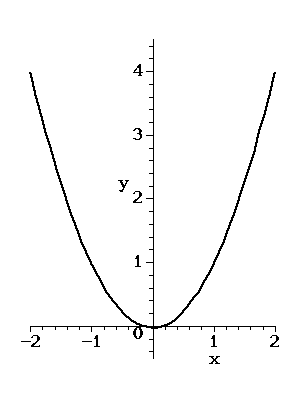 An interesting and scholarly article on basketball angles and spins in the Washington Post, kindly sent my way by Dan Grossman of Florida, indicates that physics calculations show that the angle with which a shot is thrown influences its accuracy. The gist is that the higher the arc, the greater then chances it will go through. Also, the higher the height the ball is launched from, the greater the margin of error on the shot, and the greater the success. Taking one thing with another, a launch angle of between 45 degrees and 55 degrees seems best.
Angles have played a big role in stock market technical analysis. The most influential angles are those derived from the work of W. D. Gann who believed that when price breaks through an angle of 30, 45 or 60 degrees from a previous low to previous high, a continuation in direction of the break through was possible. As to how to compute the previous low or high, where it should start, where it should end, and what the time scale should be — why, that's why there are 1.4 milion entries on the subject of Gann angles with most concluding that they have been superceded by more sophisticated tools in these days of modern computers.
Being one to believe that taking the pencil to paper might help to find regularities, I computed some subsequent prices moves for the last 15 years for daily, weekly, and monthly prices. I looked at the angle between the two last moves of an index. For monthly prices, I looked at the subsequent moves following the moves in the previous two months. For example I looked at the moves in January and February to predict March. For weekly moves, I looked at the two previous weeks to predict the third week. For exampe the first and second week of the month to predict the third. For daily moves, I looked at the previous two days to predict the third. For example, Monday and Tuesday to predict Wednesday. The angles formed could be computed by using trigometric identities to compute the adjacent angles and noting that the sum of the three angles is 180 degrees. Here are the results:
subsequent period prior previous expectations number of obs
monthly + + 4 53
monthly + - -4 41
monthly - + 7 40
monthly - - -6 33
weekly + + -2 185
weekly + - 4 186
weekly - + -3 189
weekly - - 1 147
daily + + -0.7 952
daily + - -0.5 898
daily - + 0 904
daily - - 1 744
The many regularities that this table reveals are a good start to find angles that are useful for success in shooting for profits in markets.
Bill Rafter offers:
If there is some mystical or otherwise relationship of price to time, it would perforce need to dictate the scale of the price charts for any angles to describe that relationship. In earlier times graphs and charts were drawn in pencil on standard graph paper, such as 10 x 10 to the inch. If everyone kept the same charts in the same scale, an argument can be made (i.e. the self-fulfilling prophesy) for various angles, Gann or otherwise. However the person who used a scale not similar (in the geometric sense of the word) to the standard scale would have different points of intersection with respect to the same angles as the standard scale. Fast-forward to today and we find computers rescaling charts to fit on the visual page to the extent that no longer is there a standard scale. So at the very least, there can no longer be a self-fulfilling prophesy. Whether there is a price-time relationship, I do not know. But the next time I see Master Yoda I will ask him.
Dr. Rafter is President of Mathematical Investment Decisions, a quantitative research consultancy
Jim Sogi writes:
 One of the problems is asymmetry. Contrary to symmetry theory, the markets are not symmetrical. It makes the Gann ideas or other symmetrical equations inaccurate. This includes normal distributions.
Sushil Kedia comments:
A few years ago Mr. Sogi had written a review of a book from a publisher in Australia providing co-ordinate geometry treatments of the Mathematics of the Divine Ratio. The Chair and Dr. Castaldo too have written about the applications of polar co-ordinates to transforming prices to study appropriately, thereon. Perhaps a number of ideas from that book could be applied to produce suitable transforms and then fitments to the effect of say treating the rate of drift as equivalent to an angle of zero or one would provide perhaps some worthy examinations of the other standard angles as 1/3rd or 2/3rds (pi/12 or pi/6) etc.
Jim Sogi replies:
Why is it that the last few weeks, the price followed an upper and lower line so well as moving mechanically upward? It has kind of broken that recently, but it seems more than random things the mind puts together like a taking patterns out of random dots. I've graphed random series and seen the so called trends, but they don't seem as linear. And it seems to continue for days and weeks.
On the subject of the negative time idea Rocky talked about earlier, and since it's spring now, a look at our Gregorian calendar shows the inaccuracies in the counting system. Assume as a mind experiment that the market operates on absolute time. Given an inaccurate Gregorian system, at times the measurement of absolute time might appear to jump or reverse at various adjustment points. See the wikipedia entry on Julian Day Calculation and on the accuracy of Gregorian Calendars.
Pitt T. Maner III writes:
 The discussion on shooting angles in basketball reminded me of one of John Wooden's favorite ideas which is to use the backboard or "glass".
Within days of implementation of this new 'back' board, players found that they could gauge the angle and use this new tool to their advantage to make shots. The problem today is that players have either forgotten or never learned its full advantage. Arguably the most successful coach of his era and probably of all time, UCLA Hall of Fame Coach John Wooden was renowned for teaching his players to use the glass both in the post and especially off of fast break transition. Coach Wooden's teams won 9 straight NCAA Titles (10 in 11 years) a feat unparallel before or since in collegiate basketball. Coach Wooden believed that if his players practiced making 5-10 foot bank shots at the 45 degree angle off the break and could make them at a rate of about 75-80% these shots were nearly as good as getting a lay-up. For those young players that missed the opportunity to see the great UCLA teams they were almost always successful in transition. Probably the single greatest scoring performance ever in an NCAA Championship Game was by UCLA's Bill Walton’s 21 for 22 field goal shooting performance against Memphis in the 1973 title game. Bill Walton’s' patented move was the up and under using the glass.
I have found that it is possible to use the target square on the backboard to advantage when shooting free throws and banking shots in instead of trying to get a "swoosh" each time. Having a visual target behind the "bucket" seems to help.
Banking in shots, however, is probably best used (like Wooden suggests) when shooting from the sides in basketball. Wooden believed in playing percentages and when a basketball hits the backboard it has almost a "second" chance of going in as opposed to hitting the front or side of the rim or completely overshooting or undershooting the mark. I think the coach would have preferred a sure layup over a dunk any day—and how many times has one seen a sure dunk pop out when thrown down with too much force when a layup would have scored two.
Not quite sure what a market analogy would be for a backboard–perhaps some type of straddle where you can make money on the continuation of the angle in either direction?At any rate one of the fun aspects of the NCAA basketball tournament is getting a chance to see various styles of play and the leveraging of seemingly higher risk approaches. The Cornell–Kentucky game on Thursday night, for instance, if it stays close, could be an example of excellent, confident outside shooting and defense vs. more pure interior power, younger talent and athleticism (and good outside shooting too). But as they say, you can "live and die by the 3-pt. shot".
Comments
Archives
- October 2026
- September 2026
- August 2026
- July 2026
- June 2026
- May 2026
- April 2026
- March 2026
- February 2026
- January 2026
- December 2025
- November 2025
- October 2025
- September 2025
- August 2025
- July 2025
- June 2025
- May 2025
- April 2025
- March 2025
- February 2025
- January 2025
- December 2024
- November 2024
- October 2024
- September 2024
- August 2024
- July 2024
- June 2024
- May 2024
- April 2024
- March 2024
- February 2024
- January 2024
- December 2023
- November 2023
- October 2023
- September 2023
- August 2023
- July 2023
- June 2023
- May 2023
- April 2023
- March 2023
- February 2023
- January 2023
- December 2022
- November 2022
- October 2022
- September 2022
- August 2022
- July 2022
- June 2022
- May 2022
- April 2022
- March 2022
- February 2022
- January 2022
- December 2021
- November 2021
- October 2021
- September 2021
- August 2021
- July 2021
- June 2021
- May 2021
- April 2021
- March 2021
- February 2021
- January 2021
- December 2020
- November 2020
- October 2020
- September 2020
- August 2020
- July 2020
- June 2020
- May 2020
- April 2020
- March 2020
- February 2020
- January 2020
- December 2019
- November 2019
- October 2019
- September 2019
- August 2019
- July 2019
- June 2019
- May 2019
- April 2019
- March 2019
- February 2019
- January 2019
- December 2018
- November 2018
- October 2018
- September 2018
- August 2018
- July 2018
- June 2018
- May 2018
- April 2018
- March 2018
- February 2018
- January 2018
- December 2017
- November 2017
- October 2017
- September 2017
- August 2017
- July 2017
- June 2017
- May 2017
- April 2017
- March 2017
- February 2017
- January 2017
- December 2016
- November 2016
- October 2016
- September 2016
- August 2016
- July 2016
- June 2016
- May 2016
- April 2016
- March 2016
- February 2016
- January 2016
- December 2015
- November 2015
- October 2015
- September 2015
- August 2015
- July 2015
- June 2015
- May 2015
- April 2015
- March 2015
- February 2015
- January 2015
- December 2014
- November 2014
- October 2014
- September 2014
- August 2014
- July 2014
- June 2014
- May 2014
- April 2014
- March 2014
- February 2014
- January 2014
- December 2013
- November 2013
- October 2013
- September 2013
- August 2013
- July 2013
- June 2013
- May 2013
- April 2013
- March 2013
- February 2013
- January 2013
- December 2012
- November 2012
- October 2012
- September 2012
- August 2012
- July 2012
- June 2012
- May 2012
- April 2012
- March 2012
- February 2012
- January 2012
- December 2011
- November 2011
- October 2011
- September 2011
- August 2011
- July 2011
- June 2011
- May 2011
- April 2011
- March 2011
- February 2011
- January 2011
- December 2010
- November 2010
- October 2010
- September 2010
- August 2010
- July 2010
- June 2010
- May 2010
- April 2010
- March 2010
- February 2010
- January 2010
- December 2009
- November 2009
- October 2009
- September 2009
- August 2009
- July 2009
- June 2009
- May 2009
- April 2009
- March 2009
- February 2009
- January 2009
- December 2008
- November 2008
- October 2008
- September 2008
- August 2008
- July 2008
- June 2008
- May 2008
- April 2008
- March 2008
- February 2008
- January 2008
- December 2007
- November 2007
- October 2007
- September 2007
- August 2007
- July 2007
- June 2007
- May 2007
- April 2007
- March 2007
- February 2007
- January 2007
- December 2006
- November 2006
- October 2006
- September 2006
- August 2006
- Older Archives
Resources & Links
- The Letters Prize
- Pre-2007 Victor Niederhoffer Posts
- Vic’s NYC Junto
- Reading List
- Programming in 60 Seconds
- The Objectivist Center
- Foundation for Economic Education
- Tigerchess
- Dick Sears' G.T. Index
- Pre-2007 Daily Speculations
- Laurel & Vics' Worldly Investor Articles
