May
27
Battleship, from Stefan Jovanovich
May 27, 2009 |
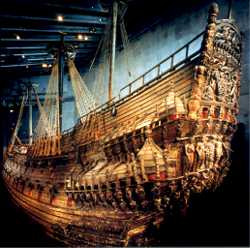 Was the Vasa was the greatest warship of her time? By the time Samuel Pepys (great gossip, even greater Gilbert & Sullivan head of the Queen's Navy) became Secretary, the Stuart Navy was successfully challenging the Dutch and the French and offering its protection the Swedish merchant marine ships in their trade in the West Indies.
In his Miscellany Pepys lists the following classes of ship:
Rate Name Length Beam Draft Tons Men Guns
First Sovereign 127 46 19 1141 600 100
Second Fairfax 116 34 17 745 260 52
Third Worcester 112 32 16 661 180 46
Fourth Ruby 105 31 15 556 150 40
Fifth Nightingale 88 25 12 300 90 24
Sixth Greyhound 60 20 10 120 80 18
A comparison of the Sovereign with the Vasa is dispiriting. The Vasa was roughly the same size - 1200 tons; but it was nearly twice as long - 230 ft. - and its beam was 8 ft narrower (38 ft.). That is a length to beam ratio of 6 to 1.
That was asking for trouble. The rough rule of thumb since people first started sailing and capsizing boats is that a monohull should be three times as long as she is broad. This should not have been news to the Vasa's architects. The Mary Rose (built 90 years before the Vasa) had a ratio of 3 to 1.
There is a reason for the Vasa's builders to have wanted it to be so long. There is even an explanation of why they thought they could build to such an extreme ratio. The longer a boat is, the less beam she needs proportionately. A boat's resistance to being overturned varies as the fourth power of her waterline length, the heeling moment of the wind pressure on the sails or the waves and swells against the hull in an engine powered ship varies as a cube of her length. Length is desirable in itself because the maximum speed of a vessel is - roughly - 1.2 times the square root of its length at the water level.
The Vasa's builders were trying to achieve the same results that American naval architects produced with the Iowa class battleships — the last ones ever built by the U.S. and the last battleships to operate on the high seas. The Iowas had to fit through the Panama canal and be able to keep up with the carriers (which were much lighter and, therefore, faster for the same propulsive power). As a result, they had an extreme beam to length ratio (8 to 1).
Then, why did Iowas survive typhoons while the Vasa sank literally in port? The answer is that the added stability of length can be horribly offset by increases in height. The Vasa had a height of 172 ft. - 75% of its length. For the Iowas to have had the same proportion, their hulls would have had to be 500 ft. high! Adding another 3+ ft. and a great deal more ballast kept the Vasa's sister ship from sinking in the Baltic, but it could never have survived the North Sea. Even using the 3.5 to 1 length-to-beam ratio that the smaller rated ships in Pepys' fleet (the Worcester, for example) would have required the Vasa and its sister to have beams of at least 65 ft; and, in the age of sail, there was no way for them to reduce its height to the dimensions of the Iowas.
The analogy with financial engineering is certainly appropriate. Somewhere in Stockholm in 1630 there must have been some bright young men who looked at the extraordinary success of the ancient Viking long ship designs thought "leverage can only lead to greater glory." But, the little matter of the Viking long boat's limited sail height seems to have be ignored. There are no surviving rigs for the long ships, but the best estimate for a 30 meter boat is that it had a mast height of 12 meters or roughly 40% of its length.
Phil McDonnell writes:
 I visited the Vasa Museum. It is a fascinating story of the greatest warship of her time that heeled over and sank within minutes of first setting sail in moderate conditions. In many ways it is the story of man's attempts to master engineering, be it naval or financial. The ship was only raised in the last century with modern engineering and is over 90% preserved due to salinity conditions in the Baltic. The interesting sequel to the Vasa disaster is that her sister ship which was completed two years later was only one meter wider but had significantly improved ballast engineering. The redesigned ship actively served Sweden in the war against the King's cousin, the King of Poland. Highly recommended tour.
Dr. McDonnell is the author of Optimal Portfolio Modeling, Wiley, 2008
Paolo Pezzutti comments:
 Maybe the ship was top-heavy. If the ballast, for example, is not enough, the metacentric height (distance between the center of gravity and the metacenter) is too low, the ship would be unstable.
From the thesaurus:
"metacenter - (shipbuilding) the point of intersection between two vertical lines, one line through the center of buoyancy of the hull of a ship in equilibrium and the other line through the center of buoyancy of the hull when the ship is inclined to one side; the distance of this intersection above the center of gravity is an indication of the stability of the ship".
(The center of buoyancy is the line of action of the resultant of all buoyant forces of the immersed portion of the ship).
(The center of gravity is a function of the distribution of the weights on board the ship and the ships itself).
There could have been different problems. An initial instability because of low metacentric height. Shifting of weights on board the ship may have altered the center of gravity. Or both.
Is how to calculate the metacentric height of a market a silly question?
Comments
Archives
- October 2026
- September 2026
- August 2026
- July 2026
- June 2026
- May 2026
- April 2026
- March 2026
- February 2026
- January 2026
- December 2025
- November 2025
- October 2025
- September 2025
- August 2025
- July 2025
- June 2025
- May 2025
- April 2025
- March 2025
- February 2025
- January 2025
- December 2024
- November 2024
- October 2024
- September 2024
- August 2024
- July 2024
- June 2024
- May 2024
- April 2024
- March 2024
- February 2024
- January 2024
- December 2023
- November 2023
- October 2023
- September 2023
- August 2023
- July 2023
- June 2023
- May 2023
- April 2023
- March 2023
- February 2023
- January 2023
- December 2022
- November 2022
- October 2022
- September 2022
- August 2022
- July 2022
- June 2022
- May 2022
- April 2022
- March 2022
- February 2022
- January 2022
- December 2021
- November 2021
- October 2021
- September 2021
- August 2021
- July 2021
- June 2021
- May 2021
- April 2021
- March 2021
- February 2021
- January 2021
- December 2020
- November 2020
- October 2020
- September 2020
- August 2020
- July 2020
- June 2020
- May 2020
- April 2020
- March 2020
- February 2020
- January 2020
- December 2019
- November 2019
- October 2019
- September 2019
- August 2019
- July 2019
- June 2019
- May 2019
- April 2019
- March 2019
- February 2019
- January 2019
- December 2018
- November 2018
- October 2018
- September 2018
- August 2018
- July 2018
- June 2018
- May 2018
- April 2018
- March 2018
- February 2018
- January 2018
- December 2017
- November 2017
- October 2017
- September 2017
- August 2017
- July 2017
- June 2017
- May 2017
- April 2017
- March 2017
- February 2017
- January 2017
- December 2016
- November 2016
- October 2016
- September 2016
- August 2016
- July 2016
- June 2016
- May 2016
- April 2016
- March 2016
- February 2016
- January 2016
- December 2015
- November 2015
- October 2015
- September 2015
- August 2015
- July 2015
- June 2015
- May 2015
- April 2015
- March 2015
- February 2015
- January 2015
- December 2014
- November 2014
- October 2014
- September 2014
- August 2014
- July 2014
- June 2014
- May 2014
- April 2014
- March 2014
- February 2014
- January 2014
- December 2013
- November 2013
- October 2013
- September 2013
- August 2013
- July 2013
- June 2013
- May 2013
- April 2013
- March 2013
- February 2013
- January 2013
- December 2012
- November 2012
- October 2012
- September 2012
- August 2012
- July 2012
- June 2012
- May 2012
- April 2012
- March 2012
- February 2012
- January 2012
- December 2011
- November 2011
- October 2011
- September 2011
- August 2011
- July 2011
- June 2011
- May 2011
- April 2011
- March 2011
- February 2011
- January 2011
- December 2010
- November 2010
- October 2010
- September 2010
- August 2010
- July 2010
- June 2010
- May 2010
- April 2010
- March 2010
- February 2010
- January 2010
- December 2009
- November 2009
- October 2009
- September 2009
- August 2009
- July 2009
- June 2009
- May 2009
- April 2009
- March 2009
- February 2009
- January 2009
- December 2008
- November 2008
- October 2008
- September 2008
- August 2008
- July 2008
- June 2008
- May 2008
- April 2008
- March 2008
- February 2008
- January 2008
- December 2007
- November 2007
- October 2007
- September 2007
- August 2007
- July 2007
- June 2007
- May 2007
- April 2007
- March 2007
- February 2007
- January 2007
- December 2006
- November 2006
- October 2006
- September 2006
- August 2006
- Older Archives
Resources & Links
- The Letters Prize
- Pre-2007 Victor Niederhoffer Posts
- Vic’s NYC Junto
- Reading List
- Programming in 60 Seconds
- The Objectivist Center
- Foundation for Economic Education
- Tigerchess
- Dick Sears' G.T. Index
- Pre-2007 Daily Speculations
- Laurel & Vics' Worldly Investor Articles
