Nov
19
Stochastic Portfolio Optimization, from Chris Hammond
November 19, 2008 |
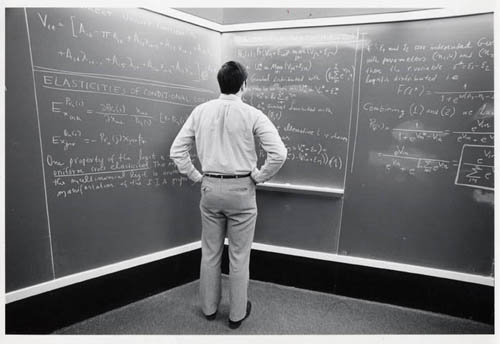 The Math Department at the University of Michigan has held an annual lecture series called the Ziwet Lectures since 1936. Past speakers include von Neuman, Kac, Thurston, and about a half a dozen Fields medalists. This year, the speaker is I. Karatzas . He is giving a series of three lectures. Today he discussed Stochastic Portfolio Optimization (the next lectures will be on Volatility and Arbitrage respectively). He spent a lot of time introducing the subject, which was good for me. One assumes that there are n risky assets available, S_1, . . .,S_n, and they evolve according to the stochastic differential equation

where dW_i(t) is Brownian motion. X(t) is one's wealth at time t and p_i(t) is the percent of one's wealth invested in asset i at time t. Denote by p=(p_1,…,p_n) our portfolio. U(x) is a utility function, i.e., any increasing function that is concave down. Our goal is to maximize the expected value of utility at the time T. In other words, we let V(x)=sup{E[U(X(T)]} where the supremum is taken over all possible portfolios given that our initial wealth was X(0)=x. Apparently we are guaranteed existence of such a thing in general, but finding the optimal strategy is not very tractable, so as always, one starts with special cases.
If we assume that the utility function is U(x)=log(x) or U(x)=x^{a}/a for 0<a<1, then one can find a reasonable solution. However, the solution depends on having reliable values for sigma_{i,j}(t) for all times t as well as for the interest rate.
If one assumes that all coefficients involved are constant, then we can handle the problem of a general utility function. The solution is characterized by a partial differential equation called the Hamilton-Jacobi-Bellman (HJB ) equation. Because we have assumed U is concave down, we can apply the Legendre transform and linearize the partial differential equation. We can then solve the linearized equation.
Karatzas ended the talk with several open problems.
I am not sure whether this lends itself directly to practical application, but perhaps it inspires some more practical ideas.
Jeff Rollert asks:
Why would one assume the coefficients are constant?
Chris Hammond responds:
One answer is that over a reasonably short time horizon, they would be approximately constant. I think the same question could be asked of the Black-Scholes model. It is assumed that if S is the price of an asset, dS=S*r*dt+S*sigma*dW(t), where r is the expected return on the asset, sigma is its volatility, and W(t) is Brownian motion. More sophisticated models assume that the volatility is also a random variable that changes with time sigma=sigma(t). But it makes sense to start with the simpler, constant, case.
In some situations in math, it is insightful to assume very simple behavior to get a model case and view reality as some sort of perturbation of that.
I am not sure it is a good answer, but I'm trying to learn more about these things, so if I find a more satisfying answer, I'll let you know.
Comments
Archives
- October 2026
- September 2026
- August 2026
- July 2026
- June 2026
- May 2026
- April 2026
- March 2026
- February 2026
- January 2026
- December 2025
- November 2025
- October 2025
- September 2025
- August 2025
- July 2025
- June 2025
- May 2025
- April 2025
- March 2025
- February 2025
- January 2025
- December 2024
- November 2024
- October 2024
- September 2024
- August 2024
- July 2024
- June 2024
- May 2024
- April 2024
- March 2024
- February 2024
- January 2024
- December 2023
- November 2023
- October 2023
- September 2023
- August 2023
- July 2023
- June 2023
- May 2023
- April 2023
- March 2023
- February 2023
- January 2023
- December 2022
- November 2022
- October 2022
- September 2022
- August 2022
- July 2022
- June 2022
- May 2022
- April 2022
- March 2022
- February 2022
- January 2022
- December 2021
- November 2021
- October 2021
- September 2021
- August 2021
- July 2021
- June 2021
- May 2021
- April 2021
- March 2021
- February 2021
- January 2021
- December 2020
- November 2020
- October 2020
- September 2020
- August 2020
- July 2020
- June 2020
- May 2020
- April 2020
- March 2020
- February 2020
- January 2020
- December 2019
- November 2019
- October 2019
- September 2019
- August 2019
- July 2019
- June 2019
- May 2019
- April 2019
- March 2019
- February 2019
- January 2019
- December 2018
- November 2018
- October 2018
- September 2018
- August 2018
- July 2018
- June 2018
- May 2018
- April 2018
- March 2018
- February 2018
- January 2018
- December 2017
- November 2017
- October 2017
- September 2017
- August 2017
- July 2017
- June 2017
- May 2017
- April 2017
- March 2017
- February 2017
- January 2017
- December 2016
- November 2016
- October 2016
- September 2016
- August 2016
- July 2016
- June 2016
- May 2016
- April 2016
- March 2016
- February 2016
- January 2016
- December 2015
- November 2015
- October 2015
- September 2015
- August 2015
- July 2015
- June 2015
- May 2015
- April 2015
- March 2015
- February 2015
- January 2015
- December 2014
- November 2014
- October 2014
- September 2014
- August 2014
- July 2014
- June 2014
- May 2014
- April 2014
- March 2014
- February 2014
- January 2014
- December 2013
- November 2013
- October 2013
- September 2013
- August 2013
- July 2013
- June 2013
- May 2013
- April 2013
- March 2013
- February 2013
- January 2013
- December 2012
- November 2012
- October 2012
- September 2012
- August 2012
- July 2012
- June 2012
- May 2012
- April 2012
- March 2012
- February 2012
- January 2012
- December 2011
- November 2011
- October 2011
- September 2011
- August 2011
- July 2011
- June 2011
- May 2011
- April 2011
- March 2011
- February 2011
- January 2011
- December 2010
- November 2010
- October 2010
- September 2010
- August 2010
- July 2010
- June 2010
- May 2010
- April 2010
- March 2010
- February 2010
- January 2010
- December 2009
- November 2009
- October 2009
- September 2009
- August 2009
- July 2009
- June 2009
- May 2009
- April 2009
- March 2009
- February 2009
- January 2009
- December 2008
- November 2008
- October 2008
- September 2008
- August 2008
- July 2008
- June 2008
- May 2008
- April 2008
- March 2008
- February 2008
- January 2008
- December 2007
- November 2007
- October 2007
- September 2007
- August 2007
- July 2007
- June 2007
- May 2007
- April 2007
- March 2007
- February 2007
- January 2007
- December 2006
- November 2006
- October 2006
- September 2006
- August 2006
- Older Archives
Resources & Links
- The Letters Prize
- Pre-2007 Victor Niederhoffer Posts
- Vic’s NYC Junto
- Reading List
- Programming in 60 Seconds
- The Objectivist Center
- Foundation for Economic Education
- Tigerchess
- Dick Sears' G.T. Index
- Pre-2007 Daily Speculations
- Laurel & Vics' Worldly Investor Articles
