Apr
6
Art, from Jeff Watson
April 6, 2008 |
 As a very serious collector of art, I see people buy art for the purpose of investment all the time. I'm asked to give my opinion on the worth of a particular piece of art a few times a month. When the public sees headlines touting record price for Van Gogh, Renoir or Matisse, they rush out to buy art for investment. Some major companies have also put the shareholders at "art market risk" by owning large collections of art for investment purposes. The cottage industry of consultants that has sprung up dealing with the art investment field is full of swindlers, thieves, liars and cheats. The consultants, dealers, and auction houses are the ones who profit, not the average collector. Even some reputable dealers have been known to sell fakes, such as works by Dali, which are 99% fake (except for his signature). While it is possible to make some money in the art market, it is very improbable for the collector to profit. A collector should stick to buying art he loves, has beauty, wants to display forever, and is willing to bequeath to a relative or museum upon death. The art hanging on our walls and in our collections is owned by history, and we are merely the caretakers of the art. Incidently, despite the spin by Sotheby's and others, the mid-range market for good Impressionist art is rather soft. There are also some good prices to be found in the Old Masters. I used to tell my lovely wife that the price of good mid-range art fluctuates inversely with the number of margin calls on the Street.
Sam Marx remarks:
 I believe a lot of modern art is a fraud. Jackson Pollock's splatter paintings — how can anyone take them seriously? Yet they are sold for millions of dollars. A painting (not a Pollock) hung in the Museum of Modern Art in NYC for a number of years before it was discovered to be upside down.
Marion Dreyfus critiques:
Your grasp of modern art is not strong; if you know the continuum of the field's development, you would not say that. It marks a yahoo sensibility, alas. There are fraudulent practitioners, but Pollock is not one. Suffice to say there are less well researched and annotated and revered artists around to pick on. In general, if you are going to pick on frauds and fakes, better to pick on a very current artist whose chops are not yet firmly implanted in the historical record and universally accepted.
Just as there are 'collectors' without an ounce of sophitication in what they are amassing, there are quick-buck artists eager to make use of the investing/collecting sensibility when they adjudge the market to be a bunch of gullible wallets circling for a kill.
And though it sounds foolish, because much of modern art is nonrepresentational, if the artist is not present while the museum hangs the piece, it is forgivable if the canvas is not the way the artist intended: The average viewer could not tell which side was intended to be down, which up, so one ought not hold the museum guilty for such an understandable error.
Sam Marx retorts:
What makes Pollock’s work worth millions? One critic called Pollock's work colorful "wallpaper designs." I don't believe Pollock precisely measured the hole he created in the bottom of the paint can and a slight change in the hole size in the can of paint that he was dripping from would've resulted in a very different painting. If you don't have a precise control over what you're doing, I have doubts about it as a masterpiece.
Michael Bonderer assays:
-white-center-(small).jpg) Sam, easy boy! Kindly try to put Pollock specifically, and the Abstract Expressionists of the budding NY School Artists more generally, in the context of post Hiroshima/Nagasaki, post WW II ethos and emerging Cold War ethos of the late 40s and early 50s, to understand their aesthetic and important place in global art and their brilliance. Particularly interesting would be for you to trace Pollock's pre-Abstract Exprisionist work to see how he as an artist developed and emerged as a leading Abstract Expressionist. As the atom's understanding came to mass consciousness, you will see bio-morphic imagery present in many artists' work, including Pollock's. This gave rise to the 'explosive canvas' of Pollock and others and the magnificient 'color-field' work of Rothko, as they all came to grips and a better understanding of where we as a society were going on a certain level from 1945 to the present. Collecting and investing in art is an aesthetic and a lifestyle, and to do it well you really have to immerse yourself, e.g., Paris in the 20s and 30s, NYC in the late 40s, 50s and 60s, LA and SF Bay area in the 50s and 60s and 70s and the LA Chicano art of the 70s and 80s and now Shanghai today with its phenomenal present day contemporary pieces and artists. Sam, I kindly direct you to the Art Tab on Costco's web site!
Sam, easy boy! Kindly try to put Pollock specifically, and the Abstract Expressionists of the budding NY School Artists more generally, in the context of post Hiroshima/Nagasaki, post WW II ethos and emerging Cold War ethos of the late 40s and early 50s, to understand their aesthetic and important place in global art and their brilliance. Particularly interesting would be for you to trace Pollock's pre-Abstract Exprisionist work to see how he as an artist developed and emerged as a leading Abstract Expressionist. As the atom's understanding came to mass consciousness, you will see bio-morphic imagery present in many artists' work, including Pollock's. This gave rise to the 'explosive canvas' of Pollock and others and the magnificient 'color-field' work of Rothko, as they all came to grips and a better understanding of where we as a society were going on a certain level from 1945 to the present. Collecting and investing in art is an aesthetic and a lifestyle, and to do it well you really have to immerse yourself, e.g., Paris in the 20s and 30s, NYC in the late 40s, 50s and 60s, LA and SF Bay area in the 50s and 60s and 70s and the LA Chicano art of the 70s and 80s and now Shanghai today with its phenomenal present day contemporary pieces and artists. Sam, I kindly direct you to the Art Tab on Costco's web site!
Lon Evans adds:
Should this be 1910, Sam, you’d be offering to pass on any available Van Gogh.
Adam Robinson offers:
 Alas, what's not strong is modern art's grasp on what moves the human heart.
If anyone wants to take up the affirmative position that modern art resonates with the human soul and psyche anywhere near as much as does any Old Master painting, I'll take up the negative banner onto the debate field with gleeful alacrity.
As a rule of thumb, in any field of human production, whether art or literature or essay writing or science, I lay it down as axiomatic that the time and consideration that ought to be accorded to the appreciation and evaluation of human products is proportional to the time and consideration that went into their creation.
Some might argue that talent or brainpower ought to figure in to the calculus of merit, also, so for those who like to quantify things, let's say,
PT x BP/T = k x CAT (production time of creation times the creator's brain power/talent equals some positive constant times the claim on an audience's time)
Show me a piece of art — or an idea even — that took two years of a human being's life to conjure and produce, and another that took two days, and the assuming the talent of the creator's to be the same, I'll give the later maybe 1% as much of my time weighing and appreciating as I will the former.
Michael Bonderer explains:
 And therein lies the adventure and challenge. To effectively emmerse oneself into the Shanghai art and media cognoscenti and find the Shanghai Pollock and Rothko and Diebenkorn. Scour the streets and allys and lofts for the work-product of the Tiananmen-inspired dissidents and new-found 21st Century Shanghai sensabilities. Maybe even find the Costco art-mill progenitor and take him out for tea and latte and pick his brain. He may be nothing more then a knuckle dragger, but then again, he may point you to a street that is having a new showing Friday night.
Jeff Watson responds:
There are some prefectly dreadful works from the Old Masters out there. Just go to the Prado or Louvre, and you'll see plenty of examples. While I'm not a fan of most modern art, I do like some of it, and have one piece in my collection. Good art is good art, in any genre, be it music, literature, or theater, and the heart will respond to to what's good. Some have pre-existing opinions on the merits of a certain genre, and it could cause them to miss out on something beautiful. Pre-existing opinions have cost me a lot of money in the market over the years, and this has taught me to sample everything, and keep an open mind.
Steve Leslie ponders:
Why is it that a painting of a nude is considered artform when a photograph can be considered pornography? As an addendum, do I need Freudian therapy if I am a fan of Robert Mapplethorpe?
Why would someone spend millions for a stolen work of art yet know in advance that he may never reveal it for public viewing?
Along the lines of burglary, How can billions of dollars worth of artwork be stolen every year and vanish for decades?
What happened to all the artwork that the Germans plundered from France, Italy, Denmark and other places during World War II and has not been seen since?
Where does someone draw the line between art and garbage? Along those lines what, defines Dali as a genius and not mildly psychotic?
Was Andy Warhol an accomplished artist because he drew for Campbell’s soup labels or in spite of it?
Who else thinks that Frank Frazetta is genius personified?
Are dogs playing poker classified as modern art, especially with the Phoenix-like rise in popularity of the game?
Do velvet Elvis paintings increase in value?
Alston Mabry postscribes:
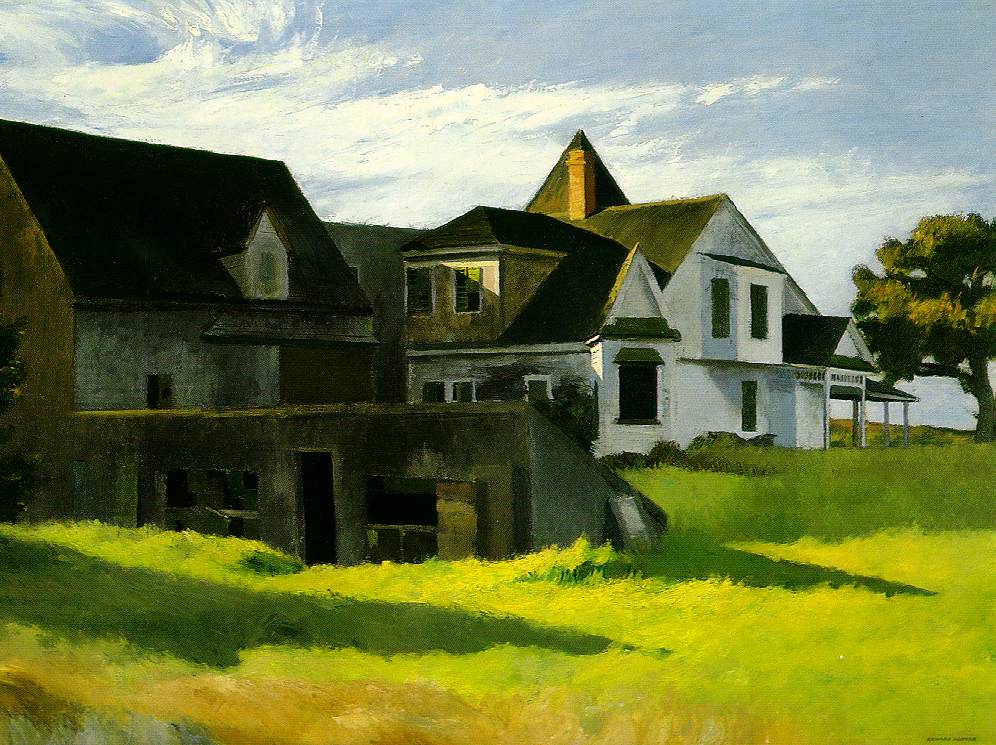
I enjoy using artwork as wallpaper on my computers. Two very good sources are Mark Harden's Artchive and WebMuseum. It is crucial to get a good scan, that has decent color saturation and sharpness. For example, Hopper's Cape Cod Afternoon from WebMuseum, in which the colors are very rich, and you can actually see the grain of the canvas.
Comments
Archives
- October 2026
- September 2026
- August 2026
- July 2026
- June 2026
- May 2026
- April 2026
- March 2026
- February 2026
- January 2026
- December 2025
- November 2025
- October 2025
- September 2025
- August 2025
- July 2025
- June 2025
- May 2025
- April 2025
- March 2025
- February 2025
- January 2025
- December 2024
- November 2024
- October 2024
- September 2024
- August 2024
- July 2024
- June 2024
- May 2024
- April 2024
- March 2024
- February 2024
- January 2024
- December 2023
- November 2023
- October 2023
- September 2023
- August 2023
- July 2023
- June 2023
- May 2023
- April 2023
- March 2023
- February 2023
- January 2023
- December 2022
- November 2022
- October 2022
- September 2022
- August 2022
- July 2022
- June 2022
- May 2022
- April 2022
- March 2022
- February 2022
- January 2022
- December 2021
- November 2021
- October 2021
- September 2021
- August 2021
- July 2021
- June 2021
- May 2021
- April 2021
- March 2021
- February 2021
- January 2021
- December 2020
- November 2020
- October 2020
- September 2020
- August 2020
- July 2020
- June 2020
- May 2020
- April 2020
- March 2020
- February 2020
- January 2020
- December 2019
- November 2019
- October 2019
- September 2019
- August 2019
- July 2019
- June 2019
- May 2019
- April 2019
- March 2019
- February 2019
- January 2019
- December 2018
- November 2018
- October 2018
- September 2018
- August 2018
- July 2018
- June 2018
- May 2018
- April 2018
- March 2018
- February 2018
- January 2018
- December 2017
- November 2017
- October 2017
- September 2017
- August 2017
- July 2017
- June 2017
- May 2017
- April 2017
- March 2017
- February 2017
- January 2017
- December 2016
- November 2016
- October 2016
- September 2016
- August 2016
- July 2016
- June 2016
- May 2016
- April 2016
- March 2016
- February 2016
- January 2016
- December 2015
- November 2015
- October 2015
- September 2015
- August 2015
- July 2015
- June 2015
- May 2015
- April 2015
- March 2015
- February 2015
- January 2015
- December 2014
- November 2014
- October 2014
- September 2014
- August 2014
- July 2014
- June 2014
- May 2014
- April 2014
- March 2014
- February 2014
- January 2014
- December 2013
- November 2013
- October 2013
- September 2013
- August 2013
- July 2013
- June 2013
- May 2013
- April 2013
- March 2013
- February 2013
- January 2013
- December 2012
- November 2012
- October 2012
- September 2012
- August 2012
- July 2012
- June 2012
- May 2012
- April 2012
- March 2012
- February 2012
- January 2012
- December 2011
- November 2011
- October 2011
- September 2011
- August 2011
- July 2011
- June 2011
- May 2011
- April 2011
- March 2011
- February 2011
- January 2011
- December 2010
- November 2010
- October 2010
- September 2010
- August 2010
- July 2010
- June 2010
- May 2010
- April 2010
- March 2010
- February 2010
- January 2010
- December 2009
- November 2009
- October 2009
- September 2009
- August 2009
- July 2009
- June 2009
- May 2009
- April 2009
- March 2009
- February 2009
- January 2009
- December 2008
- November 2008
- October 2008
- September 2008
- August 2008
- July 2008
- June 2008
- May 2008
- April 2008
- March 2008
- February 2008
- January 2008
- December 2007
- November 2007
- October 2007
- September 2007
- August 2007
- July 2007
- June 2007
- May 2007
- April 2007
- March 2007
- February 2007
- January 2007
- December 2006
- November 2006
- October 2006
- September 2006
- August 2006
- Older Archives
Resources & Links
- The Letters Prize
- Pre-2007 Victor Niederhoffer Posts
- Vic’s NYC Junto
- Reading List
- Programming in 60 Seconds
- The Objectivist Center
- Foundation for Economic Education
- Tigerchess
- Dick Sears' G.T. Index
- Pre-2007 Daily Speculations
- Laurel & Vics' Worldly Investor Articles
