Jun
18
Is Checkers a Solved Game? from Charles Pennington
June 18, 2010 |
 I was having a discussion with a colleague on the topic of Chess vs. Checkers. Somewhere I had the impression that Checkers had been "solved" –that it is ultimately an elaborate version of tic-tac-toe, i.e. there is a well-defined correct move to make in every situation. Chess though is different, as I understood it–there is no known correct way of playing in every situation, either because it can't be known in principle or because the computers just haven't found it yet. Can someone set me straight on this topic? (Background: I haven't played chess or checkers in over 30 years, but I am quite good at tic-tac-toe.
Nigel Davies weighs in:
As I understand it there is no 'solution' as such to either game and that with checkers in particular it is quite easy to make it considerably harder by playing on a larger board and with more pieces (one can also play 'big chess', though this looks somewhat artificial to my eye). With regard to board games being 'computer proof' it's also worth checking out Shogi and (especially) Go where computers are still rather mediocre compared to the best humans.
From the point of view of educating children all of these games are wonderful in that they can teach the young to falsify their own ideas. In order to play 'well' one must find out what's wrong with a move before playing it on the board.
One major consideration in the choice of game might be the number of opponents to be found. In the West at least I believe this is where chess shows to advantage.
Hope this helps.
Pitt T. Maner III writes:
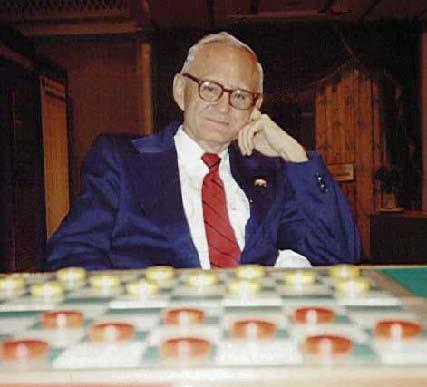 Dr. Schaeffer wrote an appreciation of one of the best checker players ever, Marion Tinsley, who actually liked the challenge of facing a computer (nicknamed Chinook).
After Chinook's first game against Tinsley in 1990, we started analyzing the game. Tinsley began recounting the history of the line we played, recalling games he played in the 1940's! The move sequences flowed easily from him without hesitation, sometimes annotated with the name of the opponent, date or place where the game was played! 1947 was as vivid in his memory as if it were only yesterday. The second facet to his play was his incredible sixth sense. A glance at a position was sufficient to tell Tinsley everything he needed to know. For example, in 1990 Chinook was playing Tinsley the 10th game of a 14 game match (won by Tinsley 1-0 with 13 draws). I reached out to play Chinook's 10th move. I no sooner released the piece when Tinsley looked up in surprise and said "You're going to regret that". Being inexperienced in the ways of the great Tinsley, I sat there silently thinking "What do you know? My program is searching 20 moves deep and says it has an advantage". Several moves later, Chinook's assessment dropped to equality. A few moves later, it said Tinsley was better. Later Chinook said it was in trouble. Finally, things became so bad we resigned. In his notes to the game, Tinsley revealed that he had seen to the end of the game and knew he was going to win on move 11, one move after our mistake. Chinook needed to look ahead 60 moves to know that its 10th move was a loser. In my experience with tournament chess and checker players, the sixth sense is experience. It is well-known how intensely Tinsley studied the game, analyzing anything from a Grandmaster game to a game between novices. His uncanny ability to know good from bad and safe from dangerous, is the direct result of all his hard work. Strong chess players have the same ability, but perhaps it is not quite as evident as it was with Tinsley .
Nigel Davies writes:
Seems like we get a whisker away from quite deep philosophical questions. My personal belief is that the goal of 'replacing humanity' in the cause of 'efficiency' is a deeply flawed one. It always feels to me like the attempt to show that computers can 'play' these games much better makes our attempts at self-improvement appear futile, an idea which many people will buy into. Is it too fanciful to suggest that they represent a 'greater goal' of being looked after by machines whilst humans have mindless 'fun'? Nigel Davies
David Hillman writes:
This is not unlike giving up the warm, tactile sensation of the paper page in a book for the slick plastic of a Kindle, or the daily newspaper's beautiful scent of cheap pulp and ink replaced by the netbook's display. The aromas of silicone and polymers do not mix as kindly with the scent of espresso wafting on the morning air. My own livelihood is derived from computer-based industrial productivity and efficiency systems, but my life is kept on a yellow legal pad with a #2 pencil. Balance, always balance. To paraphrase Queen, "we need it all and we need it now." The Deep Blue's, Chinook's, etc. may be wondrous, but there is simply no mineral nor petrochemical-based substitute for the hug of a happy child, for the lap of a caring spouse upon which to lay one's head at the end of a bad day, or for the twinkle in a grand-master's eye across the chessboard when he mates you in 6 moves.
Nigel Davies responds:
I don't think it's the same thing David. An analogy with having a kindle versus a book would be to play chess against a human via your PC. Having computers do the playing and trying to demonstrate their 'superiority' is more like having them write the books, and purportedly do it more efficiently than humans; fewer words for the same meaning perhaps, 'War and Peace' reduced to 10 pages.
Chris Tucker agrees:
I agree with you completely Alan, my point is just that programmers are not out to replace us completely (yet, anyway), but they are out to codify decision making. Games are a good place to do this because the rules and possible moves are very limited, even though the number of possible outcomes can be astronomical. The arena is structured and they can test and validate their ideas within this framework. The idea of game playing is much deeper, philosophically, (as Nigel suggests) than most care to admit. I will leave that bit for you two to explore. Machines that can replace the humanity of squaring off with an opponent do not exist, there are simply too many levels of interaction there.
Nigel Davies replies:
Chris, there is no decision making in the programs or any attempt to replicate human thinking, they simply use brute force to analyze all the possibilities (with chess slapping in a primitive evaluation function) and the mathematical limitations of the games enable them to get away with it and 'win'. Perhaps when they started out the intention was to create 'artificial intelligence', but I don't see that this claim can be maintained given the route they have taken. Looks like an ego driven attempt to 'beat mankind' of the type which enables a car to go quicker than someone on two legs.
Dave Bacon addresses the original question:
I believe Checkers on a standard sized board has indeed been solved. The reference is Science, Sept. 2007, Vol. 317. no. 5844, pp. 1518 - 1522.
“Checkers Is Solved” Jonathan Schaeffer, Neil Burch, Yngvi Björnsson, Akihiro Kishimoto, Martin Müller, Robert Lake, Paul Lu, Steve Sutphen
The game of checkers has roughly 500 billion billion possible positions (5 x 10^20). The task of solving the game, determining the final result in a game with no mistakes made by either player, is daunting. Since 1989, almost continuously, dozens of computers have been working on solving checkers, applying state-of-the-art artificial intelligence techniques to the proving process. This paper announces that checkers is now solved: Perfect play by both sides leads to a draw. This is the most challenging popular game to be solved to date, roughly one million times as complex as Connect Four. Artificial intelligence technology has been used to generate strong heuristic-based game-playing programs, such as Deep Blue for chess. Solving a game takes this to the next level by replacing the heuristics with perfection.
Comments
Archives
- October 2026
- September 2026
- August 2026
- July 2026
- June 2026
- May 2026
- April 2026
- March 2026
- February 2026
- January 2026
- December 2025
- November 2025
- October 2025
- September 2025
- August 2025
- July 2025
- June 2025
- May 2025
- April 2025
- March 2025
- February 2025
- January 2025
- December 2024
- November 2024
- October 2024
- September 2024
- August 2024
- July 2024
- June 2024
- May 2024
- April 2024
- March 2024
- February 2024
- January 2024
- December 2023
- November 2023
- October 2023
- September 2023
- August 2023
- July 2023
- June 2023
- May 2023
- April 2023
- March 2023
- February 2023
- January 2023
- December 2022
- November 2022
- October 2022
- September 2022
- August 2022
- July 2022
- June 2022
- May 2022
- April 2022
- March 2022
- February 2022
- January 2022
- December 2021
- November 2021
- October 2021
- September 2021
- August 2021
- July 2021
- June 2021
- May 2021
- April 2021
- March 2021
- February 2021
- January 2021
- December 2020
- November 2020
- October 2020
- September 2020
- August 2020
- July 2020
- June 2020
- May 2020
- April 2020
- March 2020
- February 2020
- January 2020
- December 2019
- November 2019
- October 2019
- September 2019
- August 2019
- July 2019
- June 2019
- May 2019
- April 2019
- March 2019
- February 2019
- January 2019
- December 2018
- November 2018
- October 2018
- September 2018
- August 2018
- July 2018
- June 2018
- May 2018
- April 2018
- March 2018
- February 2018
- January 2018
- December 2017
- November 2017
- October 2017
- September 2017
- August 2017
- July 2017
- June 2017
- May 2017
- April 2017
- March 2017
- February 2017
- January 2017
- December 2016
- November 2016
- October 2016
- September 2016
- August 2016
- July 2016
- June 2016
- May 2016
- April 2016
- March 2016
- February 2016
- January 2016
- December 2015
- November 2015
- October 2015
- September 2015
- August 2015
- July 2015
- June 2015
- May 2015
- April 2015
- March 2015
- February 2015
- January 2015
- December 2014
- November 2014
- October 2014
- September 2014
- August 2014
- July 2014
- June 2014
- May 2014
- April 2014
- March 2014
- February 2014
- January 2014
- December 2013
- November 2013
- October 2013
- September 2013
- August 2013
- July 2013
- June 2013
- May 2013
- April 2013
- March 2013
- February 2013
- January 2013
- December 2012
- November 2012
- October 2012
- September 2012
- August 2012
- July 2012
- June 2012
- May 2012
- April 2012
- March 2012
- February 2012
- January 2012
- December 2011
- November 2011
- October 2011
- September 2011
- August 2011
- July 2011
- June 2011
- May 2011
- April 2011
- March 2011
- February 2011
- January 2011
- December 2010
- November 2010
- October 2010
- September 2010
- August 2010
- July 2010
- June 2010
- May 2010
- April 2010
- March 2010
- February 2010
- January 2010
- December 2009
- November 2009
- October 2009
- September 2009
- August 2009
- July 2009
- June 2009
- May 2009
- April 2009
- March 2009
- February 2009
- January 2009
- December 2008
- November 2008
- October 2008
- September 2008
- August 2008
- July 2008
- June 2008
- May 2008
- April 2008
- March 2008
- February 2008
- January 2008
- December 2007
- November 2007
- October 2007
- September 2007
- August 2007
- July 2007
- June 2007
- May 2007
- April 2007
- March 2007
- February 2007
- January 2007
- December 2006
- November 2006
- October 2006
- September 2006
- August 2006
- Older Archives
Resources & Links
- The Letters Prize
- Pre-2007 Victor Niederhoffer Posts
- Vic’s NYC Junto
- Reading List
- Programming in 60 Seconds
- The Objectivist Center
- Foundation for Economic Education
- Tigerchess
- Dick Sears' G.T. Index
- Pre-2007 Daily Speculations
- Laurel & Vics' Worldly Investor Articles
