Oct
15
Charts, from Victor Niederhoffer
October 15, 2013 | 2 Comments

From Anatoly Veltman:
I just saw this Weekly SP chart, and it's honestly… Ugly (link).
I can't imagine how we're supposed to be Bullish on such chart. Mock me all you want, I am no buyer here, sorry. I'll probably miss another tremendous growth opportunity.
Victor Niederhoffer comments:
Needless to say my silence about the chart interpretations should not be taken as acceptance. And aside from the ecology of markets, deception, avoidance of fear, relation to music and barbeque and sport, longevity, board games, etc, the whole genesis of this site from its founder was to avoid such mumbo jumbo.
Gary Phillips writes a poem:
beware of greeks bearing gifts
and single data points
they support a myopic view
and play into the hands of the deceivers
at any given point in time
an equally compelling case
can be forged in either direction
depending on one's bias
the thing about charts
is that they fail to let one see
the markets for what they are,
but instead, for what they appear to be
Kim Zussman writes:
Charts! Charts!
Like musical Tarts
The more you looks
The more it smarts
So look away
From Siren curves
Or you will get
What you deserves
anonymous writes:
I refer everyone to Bruce Kovner's quote regarding the utility of charts below. If you have a better track record than he does, then you are entitled to mock his wisdom. I will gladly wager that no one who is reading this comes anywhere close to his long-term, continuous, audited track record.
There is a great deal of hype attached to technical analysis by some technicians who claim that it predicts the future. Technical analysis tracks the past; it does not predict the future. You have to use your own intelligence to draw conclusions about what the past activity of some traders may say about the future activity of other traders.
For me, technical analysis is like a thermometer. Fundamentalists who say they are not going to pay any attention to the charts are like a doctor who says he's not going to take a patient's temperature. But, of course, that would be sheer folly. If you are a responsible participant in the market, you always want to know where the market is – whether it is hot and excitable, or cold and stagnant. You want to know everything you can about the market to give you an edge. Technical analysis reflects the vote of the entire marketplace and, therefore, does pick up unusual behavior. By definition, anything that creates anew chart pattern is something unusual. It is very important for me to study the details of price action to see if I can observe something about how everybody is voting. Studying the charts is absolutely crucial and alerts me to existing disequilibria and potential changes.
Gary Phillips writes:
Indeed, I look at 22 charts on 4 screens myself. But, what I should have said while in my rush for cynicism, is no one single chart stands out and provides me with a competitive advantage or a forward-looking view of the market; at least not in the time honored edwards and magee kind-of-way. But when charts are related to a broader network of market events, themes, and correlated markets, etc., and provide (to borrow from the chairman) a consilience, then one can assess the departures from value that govern trading opportunities. which is what, I may say, you do so well.
Victor Niederhoffer adds:
Please forgive my not using the term "armchair speculatons" or "furshlugginer" with reference to all those untested hypotheses and impressionist descriptives but not predictive things about chart movements and also ideas about secular bearish markets when we are within 1% of all time high, and a Dimson 1 buck in 1899 would have risen to 60,000 at present.
Scott Brooks writes:
I say this respectfully. Vic and I have jousted on this front several times (and I believe the back forth has always been good natured). But my overarching point on secular bear/bull markets is valid to the average investor.
The extreme highs and lows we've experienced since 2000 is all well and good for the speculator who can take advantage of the market ups and downs.
But to the average 401k investor, 2000 - 2013 has been the lost decade (plus 3+ years).
Yeah, they've continued making deposits and benefited from DCA'ing. But for far too many of working class Joe's, there is very little gain outside of deposits.
The trader can benefit from the market movements. Johnny Lunchbucket has no idea what to do except to move his money around chasing last years returns, and after a few years of that, he is just flat out frustrated. Johnny Lunch Bucket and Working Class Joe do not care that the market is near all time highs. What they intuitively know (maybe even only on a subconscious level) is that even though the market is near all time highs, they've lost something far more important–13+ years of time for that their money should have been, but wasn't, compounding.
I'm not trying to be contentious with the Chair….I'm just trying to present a different POV that many on this list never experience….the plight of the average investor.
Gary Rogan comments:
Scott, the average investor is handicapped by having the urge to sell low. If you sold during the 2008/2009 lows and waited to get in you are certainly left with a very negative impression of the market that feels like a bear market. The only feasible way for an average investor to think about the market is to look at their 45 or so year workspan as the period to evaluate market performance. 13+ years should mean nothing in that frame of reference. Now, if you start investing when you are 55, it means a lot, but you are doing the wrong thing so getting the wrong impression comes with that.
It is true, in my opinion, that the market today is expensive by such measures as total capitalization to GDP ratios. This is somewhat likely to limit returns in the next 15 years although it means very little for the next say 7 years, but within any 45 year period starting from 45 years ago to 45 years into the future market returns are likely to remain close to their historical average (barring a major calamity). The average investor who knows next to nothing should learn this very simple behavior: put a certain percentage of your income into stocks every year, and stop complaining.
Scott Brooks responds:
The best thing that the middle class working man who who is NOT eligible to invest with top tier money managers (due to accredited investor rules) and is stuck with 15 expensive mutual funds in his 401k or his cousins fraternity brother as a broker or some State Farm guy as his insurance agent, is TIME.
Over time he can make handle the ups and downs. But the fact that the S&P peaked at around 1550 in '00, and is now in 2013 getting ready to hit 1700 means he wasted 13+ years with less than a 1% average annual growth rate. Sure, he picked up a point or two in dividends and maybe benefited from DCA'ing….assuming he wasn't one of the many that stopped putting in money into their 401k's for whatever reason (got scared, saw his pay cut or his job outsourced or his spouse got laid off….or whatever)…..but when you subtract out management fees and 401k fees, he almost certainly netted 1% and maybe less.
That my friends is a secular bear market…..and that's the world that 90% of America has lived in for the last 13+ years.
We gotta remember that people on this list are not like the rest of the country, and it's easy to lose sight of that.
I hope it is clear to everyone that I don't pretend to be something that I'm not. I don't pretend to be a counter or even a trader. I'm a simple man who was raised in a lower middle class world and 90% of my family still lives in that world. I'm not trying to raise anyone's ire with these posts. I'm just trying to shed some light on a subject that is very real…..
And maybe somewhere in my words there is a way to create even more profit for those of us that are blessed with:
1. a brain that works better than 95% of the population and
2. have a burning desire to use that brain to it's fullest.
Oct
3
A Chart, from Victor Niederhoffer
October 3, 2013 | 1 Comment
 "Business Insider: The Stock Market Looks Like 1967 All Over Again"
A chart overlay showing similarities between the S&P in 1993 and this year appears below in this article. I have seen other overlays by the bespoke group showing almost exactitude with this market and I believe 1926 or some such. Harry Roberts, where are you, with your proof that random charts look just like stock market charts. What are the chances that such idempotent overlays would occur by chance if you could pick out the closes match over the last 93 years or so.
Rocky Humbert adds:
And 1954 too. From that link:
U.S. stocks are trading virtually in lockstep with 1954, the best year for American equity and the time when shares finally recovered all their losses from the Great Depression.
The Standard & Poor's 500 Index's returns in 2013 are tracking day-to-day price moves in 1954 almost identically, according to data compiled by Bespoke Investment Group and Bloomberg.
In no other year are the trading patterns more similar to 2013 since data on the index began 86 years ago. The correlation coefficient between this year and 1954, when the benchmark gauge rose 45 percent, is 0.95 out of a maximum of 1.
Kim Zussman writes in:
Using SP500 weekly returns for 2013 (Jan - Sept), checked correlation of these 39 weekly returns with weekly returns of prior 39 week periods back to 1950.
Here are the 10 most correlated:
Date Correl Month
09/30/13 1.000 9
01/05/70 0.506 1
04/11/55 0.506 4
02/19/80 0.482 2
07/26/65 0.479 7
11/12/12 0.476 11
07/21/97 0.450 7
06/21/04 0.448 6
09/21/64 0.436 9
04/08/85 0.431 4
The current 39 week period correlates perfectly with the current 39 week period.
Next closest correlation was the period ending January 1970.
The most correlated Jan-Sept period ended Sept 1964, which along with $7.95 will buy a cup of coffee.
Sep
19
Market Return Perception and Timescale Transformation, from Kim Zussman
September 19, 2013 | Leave a Comment
Is there a better way to map time-series data to reflect the (presumably) non-linear perception and memory of market events?
Log transformation of the price axis seems a reasonable approximation for reaction to price. But what about transformation of timescale as well? How long do significant market events influence current judgement, how are they weighted, and at what rate does this influence fade in comparison with recent events?
Let's assume that traders are not influenced by events more than 1600 trading days ago. SP500 daily return 1960-present was log transformed:
lnRET = ln (today's close / yesterday's close)
These traders care more about recent events than past events. Partly because memory is not conserved, and partly because many processes in the biological world are more logarithmic than linear (eg visual and auditory dynamic range). "Countback days" are simply the count of days from the present to the past, from 1 to 1600. Weighting consisted of scaling each day's lnRET by it's respective ln(countback day)
Current "return perception" of SP500 is the sum of 1600 prior lnRET values, each weighted by ln(countback day):
Current return perception = sum (1-1600) {lnRET/lncountback day}
This process was repeated back in time, starting from March 2013 to Jan 1960 (attached)
current transformed perceived return = sum (lnprice/lncountback days)
The chart of current return perception shows an all-time peak in year 2000. There were large amplitude variations in the 1970's-1980's, then in the early 90's return perception took off. In terms of 1600 day perception, the 2001 bear market never fully recovered, and the 2008-09 decline appears similar to the bear market ca early 1970's.

Sep
13
Rocky’s Challenge, from Rocky Humbert
September 13, 2013 | 1 Comment
 Voyager 1, launched back in 1977, has become the first man-made object to pass into the unknown vastness of interstellar space. News Report.
I have a serious challenge for you. Name a single man-made device that has worked continuously for 40+ years without any human physical intervention. The winner will receive Rocky's usual prize: A unique gift of dubious monetary value.
Chris Cooper has a go at it:
There must be any number of vintage self-winding watches that still work. If it must be wound, does that still match the spirit of your inquiry? Of course, there are many watches and clocks which must be wound by hand that are still operating. You can find some self-winding watches for sale on eBay.
Kim Zussman replies:
I am man-made and have worked continuously for well over 40 years (though currently half time for the government).
Bill Rafter adds:
Without doing any looking, there are lots of low-tech human creations that have survived the test of time. Many dams have performed their functions for decades and even centuries. I'm not speaking of hydroelectric dams, but simple river control devices. The Marib dam in Yemen is still there (after two millennia) and would be working if there was enough rainfall. Many artificial harbors also have exceptional longevity. Some Roman harbor constructions are still operational; the Romans having been expert in concrete manufacture. And don't forget Roman roads.
In more recent times, I am certain there is some electrical cable that is still functioning from half a century ago, if only to ground lightning rods.
Sep
2
President Obama, from Kim Zussman
September 2, 2013 | Leave a Comment
Evidently the "red line" was the one crossed from below by the market in the last minutes Friday.
Aug
23
Hot Tightwads, from Kim Zussman
August 23, 2013 | Leave a Comment
 "A Penny Saved is a Partner Earned: The Romantic Appeal of Savers"
Abstract:
The desire to attract a romantic partner often stimulates conspicuous consumption, but we find that people who chronically save are more romantically attractive than people who chronically spend. Saving up to make a particular purchase also enhances one's romantic appeal, as long as the planned purchase is not materialistic. Savers are viewed as possessing greater general self-control than spenders, and this perception mediates the relationship between spending habits and attractiveness. Because general self-control also encourages healthy behaviors that promote physical attractiveness, savers are viewed as more physically attractive as well. However, general self-control is not always coveted in potential mates: dispositional and situational factors that increase the need for stimulation reduce the preference for savers. Nevertheless, capitalizing on the general preference for savers over spenders, people are more likely to deceptively describe themselves as savers when completing a dating profile than when completing a private questionnaire. Our work sheds light on how a fundamental consumption behavior (spending and saving decisions) influences the formation of romantic relationships.
Aug
22
The Fact that the Dax Was Up, from Victor Niederhoffer
August 22, 2013 | Leave a Comment
 The fact that the Dax was up 3 ratio points against the US markets shows that the largesse of the flexions on our numbers is not withheld from those who make recipes for the bernaise and bechamel sauces in Brussels .
Alan Millhone writes:
Dear Chair,
Am afraid the bernaisacky sauce might upset my stomach.
Note Dow was below 15. That is upsetting enough to many without adding any sauces.
Sincerely,
Alan
Kim Zussman writes:
It was dyspepsia from absence of Bernanke sauce.
Peter St. Andre writes:
I really need to write a little poem that starts with "Ben Bernanke makes me cranky"…
Gary Rogan contributes:
There once was a man named Bernanke
Engaged in some bad hanky panky
But he went AWOL
and skipped Jackson Hole
And now the markets are cranky.
Craig Mee adds:
Bernanke the captain of Fed
Resembles Titanic's, Smith Ed
Evades all bergs, engines full out
Bond infinity, no damnable doubt
"Untapered, untwisted, now screwed", he said.
Aug
19
Taking Stock Tips, from Kim Zussman
August 19, 2013 | Leave a Comment
 Many years ago one followed the Wall St. Journal stock-picking / dart throwing contest. The Journal claimed that the expert stock pickers were well ahead of the darts over many iterations. Holdings in those days were all mutual funds or indices. So for a first foray into individual stock ownership, I bought shares of "TCBY treats" - a frozen yogurt franchise - which was touted by the analyst in WSJ dart contest.
His analysis was, "The balance sheet looks good". I checked his background and he seemed well educated and reputable (remember this was pre-enlightenment vis. shibboleths of Ivy degrees and name shops).
I never checked the balance sheet because it was unlikely my novice reading would provide more insight than the market, and in any case the analyst was trained, experienced, and (in essence) endorsed by WSJ.
Some time later the analyst could point to brief intervals when TCBY was higher. However as you might guess the stock went into a long/slow slide into oblivion.
Following recommendations without understanding their basis and the motives of the recommender is risky business.
Rocky Humbert writes:
Dr. Zussman is absolutely correct. One should never ever listen to any recommendations or thoughts that I espouse as my motives are suspect; my analytics are flawed; and my thought processes are clouded by insomnia and senile dementia. (I view these albatrosses as my secret edge in the markets.)
Furthermore, I myself follow Dr. Zussman's advice religiously and assiduously avoid reading newspapers or books, avoid conversations with intelligent people and spent 23 hours per days in a saline-filled sensory deprivation tank (from which I emerge to occasionally pen SpecList posts.)
Gary Rogan writes:
I have been told by many people, on multiple occasions, and for a variety of reason to avoid stock tips, mainly because you can never know exactly why the person likes them and also because they are unlikely to fit into your "trading system" (and I would guess investment system). I find this advice hard to evaluate. I suppose if one knows some stats of the person's previous picks this makes it easier. If you can deduce that the person isn't simply talking their book, that's probably better as well. But fundamentally, a stock can't know that someone has recommended it to you. If you have a system, you should at least know whether the person intends for the pick to be a short-term trade or a long-term investment and judge accordingly. Rocky doesn't give a lot of stock tips, so what should one think of one when it suddenly appears? Hard to know. On the other hand, I think I have a pretty good idea who Rocky really is and he is an upstanding member of the community with a good track record, and can't possibly be thinking of moving AAPL significantly by talking about it here, so is it really wrong to follow his recommendations?
Aug
9
IWM. SPY and Normality, from Kim Zussman
August 9, 2013 | 3 Comments
A question for Kim or Victor: Since IWM has more stocks than SPY, does it follow that daily returns on IWM are closer to the Normal Distribution than SPY? - A Reader
Victor Niederhoffer replies:
It does, as a consequence of the Central Limit Theorem .
Kim Zussman replies:
Let's look at it empirically. Here is the "Anderson - Darling" test for normality of daily SPY returns, 2000-present (SP500).

Next is the same test for IWM (Russell 2000 ETF), 2000-present.

Rocky Humbert writes:
Vic, I'm not sure that the central limit theorem is the right paradigm. An unknown is whether the covariance within the two groups is sufficiently different to offset the CLT. I have never tested this. And testing is tricky because you need to use compounded total returns with dividends reinvested. The index and stock prices produce misleading results because dividends are greater for big caps.
Intuitively, I believe that most of the perceived differences can be explained by 2 things:
1) the dividends…which is really just a duration effect and 2) the reality that companies leave the R2k only when they are incredibly successful or when they die. Stocks only leave the SP500 when they die. They never leave the SP500 and go to the R2k when they are successful. So over time, the perceived differences are a micro sampling of a survivor bias between the 2 indices. Not sure how to test this theory…
What we do know is the implied volatility of r2k is almost always higher than the implied volatility of the SPX. I think this could be an analogue to the fact that out of the money puts are more expensive than out of the money calls. Put another way, if you are long SPX and short r2k in equal dollar amounts, you will usually make money during violent and persistent market downdrafts. I think this is proof that the distributions are different.
Victor Niederhoffer writes:
Those are good points you make about areas that I should have considered in estimating the departures and distributions of comparative performances. It is also amazing to me that the statistical tests, especially the Kolmogorov Smirnov, show such departures. I am a great believer that the risk premium on untried and small stocks is much bigger and that they should perform better and that buying two handfuls of them will have a limiting distribution that converges to a return a percentage or two above the 8 % you get from the average NYSE stock. I must go back and check my premises. It reminds me of how I told the people in my family to buy the riskiest vanguard over the counter fund, and they tell me that they are always getting notes in the mail that the funds I recommended are being sued by their holders as the worst performing funds in history due to all sorts of wrongs of a practical and theoretical nature. I mean this response in a humble and appreciative way although it is sometimes hard to communicate that by email in the face of all the errors that are elicited.
Ralph Vince writes:
Like everything else in this realm, it depends on the unit of time used in analysis. If you use annual data, things play much more nicely to Normal. The shorter the time unit used, the less so.
Jul
8
There Is Only One Silicon Valley, from Kim Zussman
July 8, 2013 | 3 Comments
Interesting article by Vivek Wadhwa in Technology Review "Silicon Valley can't be copied".
(Regrettably omitting the role of resourceful governance).
By 1960, Silicon Valley had already captured the attention of the world as a teeming technology center. […] French president Charles de Gaulle paid a visit and marveled at its sprawling research parks set amid farms and orchards south of San Francisco.
Soon enough, other regions were trying to copy the magic. The first serious attempt to re-create Silicon Valley was conceived by a consortium of high-tech companies in New Jersey in the mid-1960s. [The plan] could not get off the ground, largely because industry would not collaborate.
In 1990, Harvard Business School professor Michael Porter proposed a new method of creating regional innovation centers. […] Sadly, the magic never happened—anywhere. Hundreds of regions all over the world collectively spent tens of billions of dollars trying to build their versions of Silicon Valley.
The reasons [for Silicon Valley's unique success] were, at their root, cultural.
Californian Stefan Jovanovich adds:
There is an element that is not mentioned. California, for better or worse, has always been the place people went to strike it rich. People came to Silicon Valley for the same reason they went up into the Sierras or stayed in San Francisco and sold shovels in the 1850s - they intended to make their fortune, not just get a "good job" (pun intended). What literally disgusts those of us who loved the place is that the same greed exists today but the enterprise is almost entirely directed to fleecing the government in the name of (pick one) "curing cancer, saving the environment, some other socially responsible activity that just happens to attract a good deal of non-profit and government cash". As one of our friends, who left for Idaho a decade ago, said, "Sleaze is always a part of the hustle that comes with "making it new"; but now the whole state is the music business without any new music - everything is just sampling what has already been done and filing a claim to protect what was not even invented in the first place."
Carder Dimitrioff speculates:
Actually, it could be argued that Silicon Valley is a replication of Boston. Up until the Nixon Administration, the greater Boston area was the nation's technology highway. Fed by Lincoln Labs, MIT, Harvard, Northeastern University, Boston University, Boston College, University of Massachusetts, Worcester Polytechnic Institute, Clark, Rensselaer and other great technology centers, companies like MITRE, DEC, Polaroid, WANG, and dozens others popped up all over Boston's Route 128.
Then, Massachusetts became the "one and only" state not to vote for Nixon in 1972. Nixon was from California. Silicon Valley is in California. Maybe there is a connection?
Peter Saint-Andre writes:
I forwarded this article to Jim Bennett (co-author of "America 3.0") and he noted:
"One of the under-appreciated factors was Stanford's rule that allowed professors to work part-time for companies and take stock options in pay. Most universities forbid that as being vulgar, as gentlemen are not supposed to engage in trade."
Carder Dimitroff replies:
In my experience, most technology professors in the Boston area were part-time academics. Most wanted to start their companies based on their areas of interest. Most Boston area universities allowed such.
EG&G is an early example. The letters represent the names of three MIT professors. My dad was one of their first ten employees. He worked under Doc Edgerton - not in MIT or Lincoln Labs, but in EG&G, Inc. This was decades ago.
One of my beefs with MIT is their lack of dedicated faculty. Even professors in their Sloan School spend most of their time in consulting firms. A lot of their faculty seem like they are adjunct professors.
Jun
16
Was First Hunch Correct? The Case of the Problematic Tooth, from Ed Stewart
June 16, 2013 | 3 Comments
 I have recently had a lot of pain related to a problematic tooth. It is a tooth that has been giving me trouble on and off for years and I have no idea why. Dentists have suggested it suffered some type of trauma when I was younger, but if that was It I don't remember the event.
Went to the emergency room last January (weekend, regular doctor closed) because I was in massive pain over the holiday weekend.
It turns out that it had become infected and was putting pressure on the nerve in the Jaw. Since that time I have had a root canal on the tooth, but that did not solve the problem. I have had two other procedures, the last one this morning because the prior one did not heal properly and got infected again. Really aggravating experience, no need to go in to details. Today I am holed up recovering, jaw aching on a beautiful day.
The thing is, back in January, I had a gut reaction that the best thing to do would be to just forget all the treatments and have the problematic tooth yanked out. Based on the trouble it had caused me to that point, it just seemed to be the solution that made sense — likely to be final and just "end" the problem.
Yet, I was told that was too extreme and "the tooth could be saved" etc. No professional I spoke with thought it was a good idea, in fact they seemed astonished that I suggested it. And today, after treatments and quite a bit of discomfort, things not going right, etc, I am inclined to think my initial hunch was correct. Forget treatment. Just get rid of the problem.
I wonder how often this happens.
A clear cut solution to a problem exists, but a bunch of complex alternatives are presented and the resolve to do what is likely required to the end the problem with certainty is dampened. Not to push the analogy to far, but does this not also happen in trades, businesses, and relationships that are going wrong. Rather than end a problem trade, it is easy to tinker with it, look for hedges, "scalp" around the position, etc. but instead of a resolution only more pain is created. Or a relationship that has stopped working — "keep fixing it" but only more delays for the inevitable split which is more painful than a clean break.
It is hard to tell what is hindsight quarterbacking, and what is a life lesson. In this case I am still not sure which it is. I wonder if there are any general rules or ideas that can be applied to these situations to give better outcomes.
anonymous writes:
Absolutely, the best case is to always treat (your tooth or a losing trade), like it was bad meat and spit it out. Deal with it immediately, no messing around, just take the hit and get over it. Bad trades, like bad relationships, have a way of metastasizing into something worse, and the old cliche comes to mind, "Your first loss is the least."
Personally I remember once having a relationship with a nice gal that went south (but as a guy I was totally oblivious to the whole thing and didn't see the obvious signs). I was out with the lady in question in public at a restaurant and she gave me "the blow-off speech." I was so confused that I didn't even see it coming (One could make a case that infatuation is insanity). In retrospect, I should have gotten up, picked up the check, paid her carfare, bid her adieu, and walked out, never to see or communicate with her again…..like one exits a bad trade. Instead I lingered for months in an emotional limbo, like a sick puppy, suffering great humiliation and many bad feelings. In retrospect, like a bad trade, that relationship wasn't worth it and there was no bargaining, hedging, covering it with options that was going to save it. It had to be pitched immediately, and I broke my cardinal rule by not pitching it (emotions again).
Bad trades, like bad relationships can teach one many lessons in life and trading if one listens to what the situation (market) is telling you. If only, when dealing with that person, I had used my trading persona instead of my emotional side, I would have not lingered in emotional limbo for months.
This supports a great case for dispassion, and a big part of the Masonic obligation is to "learn to subdue your passions." But like the ying and yang, good things happened out of that debacle and I ended up seeing a very cultured, erudite, successful, powerful, and beautiful woman that I married a few months ago. I'm happy for the first time in five years, and that's what's important. Bad teeth, bad trades, bad relationships…..get rid of them, they are just nuisances that get in the way of life.
A commenter adds:
But that thinking of could have, would have, should have is very deadly in the markets. Although hindsight is always 20/20, my eyesight of 20/100 does not allow such indulgences and my defensive game does not allow for such risk. I'm trying to make money, not keep my finger in the dike like the little Dutch boy. The Dutch boy was wasting his time.
Gary Rogan writes:
Bad women and bad teeth rarely get better by themselves, although some teeth that seem to need a root canal sometimes do. Equities do it a lot more frequently, so to this day I don't know how to reliably tell when a bad equity trade needs to be spit out. "Your first loss is the least" obviously applies to some situations, but for instance I still own a stock that lost me 20% two days after I bought it, 50% three months after I bought it, but now two years later it's up 70%, having been up 120%. Rocky talked a lot about his thoughtful decision to exit HPQ back when it was relentlessly moving south, but it's back. What used to be RIMM is still in the dump, but someone who bought it in September doubled their money. If you could always make a wise decision by just getting out of a (currently) losing trade, everyone would be a lot richer than they are.
Rocky Humbert responds:
Mr. Rogan,
Indeed HPQ has been inexorably working its way back and may keep climbing. Who knows? What we do know is what the S&P index has done subsequent to my exiting HPQ. And we also know what other alternative investments (gold, real estate, etc) have done over the same period of time. Taking the hit and putting the (remaining) capital into the alternatives would have been better than suffering. Hence in these matters, one must consider not only the ongoing pain, but also the opportunity cost. To the extent that one is monogamous, the analogy holds for personal relationships.
Is there an opportunity cost for teeth? Not sure.
Gary Rogan replies:
Sure, there is always the opportunity cost. The question is, how well do we know it in advance? My point was that if say you bet all your money leveraged 10 to 1 on wheat, and your position is down 10% you may want to exit, but if you own 100 stocks and one is down 10% or 50% or even 90% what to do at that point outside of any tax considerations and without any additional information isn't exactly clear. Given my preference for 52 week lows in the absence of any other information it may make sense to buy more or do nothing. If the sudden move lower really attracted your attention, and upon further study you conclude that this is only the beginning, of course you may want to sell. But then a sudden move up or a long period of flatlining or something you happen to read or hear may attract your attention as well.
A commenter writes:
The key phrase that piqued my interest was when you said, "you bet all your money leveraged 10 to 1 on wheat." Why would you "bet" all your money? Wouldn't you want to just "bet" a small part of it, and keep the rest of your powder dry? Anyways, betting signifies gambling, and gambling is wrong.
Gibbons Burke writes:
Anonymous, I am like you—I don't see any value in pissing my money away in a known negative expectation game, so I sympathize with your view. I have never found enjoyment in gambling, personally. But I can't extrapolate from my subjective view and experience onto the world because everyone's utility and entertainment functions are different.
Gambling in the United States has several positive social functions… State lotteries support education of children… Gambling on Native American reservations is a voluntary form of reparations to that people… and, it gets money out of mattresses and back into economic circulation, transferring capital from those who are not prudent in their stewardship of that capital (otherwise they wouldn't be gambling, would they) and putting it into hands where it will be more efficiently employed.
Part of the freedoms cherished in this Constitutional Democratic Republic is the freedom to act the fool, on occasion, as long as you don't infringe upon the rights of others, or forsake the duties to yourself or those in your charge.
Kim Zussman adds:
You would not have regretted your decision to accept professional opinion / treatment had everything gone well.
The mistake is assuming you could have made a better decision - to extract the tooth - simply because in hindsight the treatments have not worked.
For any decision there is a range of outcomes. Perhaps your treatment had 80% chance of success (defined as rapid pain reduction, elimination of infection, and saving the tooth). But so far you are in the 20%, and for you the failure feels like 100%. "If only I'd extracted"
Do you expect portfolio managers or sound strategies to never lose, or abandon them only when they do? (Buy high / sell low)
Dentist and physician success rates are mostly unknowable but patients use cues to evaluate them. Cues such as trusted referral, reputation, diplomas, demeanor, looks, office decor, exhibited technology, etc.
Your treating dentists are simultaneously incentivized to obtain good results (reputation, future referrals) as well as make money (perform treatment). Those with consistently poor results have trouble competing with those with good results, and you are less likely to wind up there.
Jun
3
Trader Burnout, from Kim Zussman
June 3, 2013 | Leave a Comment
Inspired by the concept of burnout from the medical world, it might it be useful for traders to review every once in a while as a tool for when to take a break.
Or conversely take out the cane.
May
14
The Difference Between a Speculator and a Gambler, from Larry Williams
May 14, 2013 | Leave a Comment
 I first saw the 'dead eyes' look of a poker player/loser when I was 13 or so. Still gives me restless nights and I know I cannot become that way.
My dad took me into the "stockman's bar" in Billings, Montana to impress upon me what degenerate, greedy people turn into.
Probably another sleepless tonight tormented by that devil.
Gary Rogan asks:
What is the real difference between gambling and speculation (if you take drinking out of the equation)? Is it having a theory about the odds being better than even and avoiding ruin along the way?
Tim Melvin writes:
I will leave the math side of that answer to those better qualified than I, but one real variable is the lifestyle and people with whom one associates. A speculator can choose his associates. If you have ever been a guest of the Chair you know he surrounds himself with intelligent cultured people from whom he can learn and whom he can teach. There is good music, old books, chess and fresh fruit. The same holds true for many specs I have been fortunate to know.
Contrast that to the casinos and racetracks where your companions out of necessity are drunks, desperates, pimps, thieves, shylocks, charlatans and tourists from the suburbs. Even if you found a way to beat the big, the world of a professional gambler just is not a pleasant place.
Gibbons Burke writes:
 Here is something I posted here before on this distinction…
Being called a gambler shouldn't bother a speculator one iota. He is not a gambler; being so called merely establishes the ignorance of the caller. A gambler is one who willingly places his capital at risk in a game where the odds are ineluctably, mathematically or mechanically, set against the player by his counter-party, known as the 'house'. The house sets the odds to its own advantage, and, if, by some wrinkle of skill or fate the gambler wins consistently, the house will summarily eject him from the game as a cheat.
The payoff for gamblers is not necessarily the win, because they inevitably lose, but the play - the rush of the occasional win, the diversion, the community of like minded others. For some, it is a desire to dispose of money in a socially acceptable way without incurring the obligations and responsibilities incurred by giving the money away to others. For some, having some "skin in the game" increases their enjoyment of the event. Sadly, for many, the variable reward on a variable schedule is a form of operant conditioning which reinforces a compulsive addiction to the game.
That said, there are many 'gamblers' who are really speculators, because they participate in games where they develop real edges based on skill, or inside knowledge, and they are not booted for winning. I would include in this number blackjack counters who get away with it, or poker games, where the pot is returned to the players in full, minus a fee to the house for its hospitality*.
Speculators risk their capital in bets with other speculators in a marketplace. The odds are not foreordained by formula or design—for the most part the speculator is in full control of his own destiny, and takes full responsibility for the inevitable losses and misfortunes which he may incur. Speculators pay a 'vig' to the market; real work always involves friction. Someone must pay the light bill. However the market, unlike the casino, does not, often, kick him out of the game for winning, though others may attempt to adapt to or adopt his winning strategies, and the game may change over time requiring the speculator to suss out new rules and regimes.
That said, there are many who are engaged in the pursuit of speculative profits who, by their own lack of skill are really gambling; they are knowingly trading without an identifiable edge. Like gamblers, their utility function is not necessarily to based on growth of their capital. They willingly lose their capital for many reasons, among them: they enjoy the diversion of trading, or the society of other traders, or perhaps they have a psychological need to get rid of lucre obtained by disreputable means.
Reduced to the bare elements: Gamblers are willing losers who occasionally win; speculators are willing winners who occasionally lose.
There is no shame in being called a gambler, either, unless one has succumbed to the play as a compulsion which becomes a destructive vice. Gambling serves a worthwhile function in society: it provides an efficient means to separate valuable capital from those who have no desire to steward it into the hands of those who do, and it often provides the player excellent entertainment and fun in exchange. It's a fair and voluntary trade.
Kim Zussman writes:
One gambles that Ralph and/or Rocky will comment.
Leo Jia adds:
From the perspective of entering trades, I wonder if one should think in this way:
speculators are willing losers who often win; gamblers are willing winners who often lose.
David Hillman adds:
It is rare to find a successful drug lord who is also a junkie.
Craig Mee writes:
One possible definition might be "a gambler chases fast fixed returns based on luck, while a speculator has time on his side to let the market decide how much his edge is worth."
Bill Rafter comments:
Perhaps the true Speculator — one who is on the front lines day after day — knows that to win big for his backers, he HAS to gamble. His only advantage is that he can choose when to play.
 Anton Johnson writes:
A speculator strives to be professional, honorable, intellectual, serious, analytical, calm, selective and focused.
Whereas the gambler is corrupt, distracted, moody, impulsive, excitable, desperate and superstitious.
Jeff Watson writes:
I know quite a few gamblers who took their losses like men, gambled in a controlled (but net losing manner), paid their gambling debts before anything else, were first rate sports, family guys, and all around good characters. They just had a monkey on their back. One cannot paint with a broad brush because I have run into some sleazy speculators who make the degenerates that frequent the Jai-Alai Frontons, Dog Tracks, OTB's, etc look like choir boys.
anonymous writes:
Guys — this is serious, not platitudinous, and I can say it from having suffered the tragic outcomes of compulsive gambling of another — the difference between gambling and speculating is not the game, the company kept, the location, the desperation or the amounts. The only difference is that a gambler, when asked of his criterion, when asked why he is doing this, will respond with "To make money."
That's how a compulsive gambler responds.
Proper money management, at its foundation, requires the question of criteria be answered appropriately, and in doing so, a plan, a road map to achieving that criteria can be approached.
Anton Johnson writes:
It's not the market that defines whether a participant is a Gambler or a Speculator, it's his behavior.
Gibbons Burke writes:
That's the essence of my distinction:
"gamblers are willing losers who occasionally win"
That is, gamblers risk their capital on propositions where the odds are either:
- unknown to them
- cannot be known
- which actual experience has shown to have negative expectation
- or which they know with mathematical precision to be negative
They are rewarded for doing so on a random schedule and a random reward size, which is a pattern of stimulus-response which behavioral scientists have established as one which induces the subject to engage in the behavior the longest without a reward, and creates superstitious as well as compulsive behavior patterns. Because they have traded reason for emotion, they tend not to follow reasonable and disciplined approach to sizing their bets, and often over bet, leading to ruin.
"speculators are willing winners who occasionally lose." That is, speculators risk their capital on propositions where the odds are:
- known to have positive expectation, from (in increasing order of significance) theory, empirical testing, or actual trading experience
They occasionally get unlucky, and have losing streaks, but these players incorporate that risk into the determination of the expectation. Because their approach is reason-based rather than driven by emotion, they usually have disciplined programs for sizing their bets to get the maximum geometric growth of their capital given the characteristics of the return stream, their tolerance for drawdown.
If a player has positive expected value on a bet, then it is not a gamble at all. The house does not gamble. It builds positive expectation into its games. It is a willing winner, although it occasionally loses.
There are positive aspects of gambling, which I have pointed out earlier in the thread and won't belabor. To say that "all gambling is bad" is to take the narrowest view. Gamblers who are willing losers (by my definition all are) provide the opportunities for willing winners (i.e., speculators) to relieve gamblers of the burden of capital they clearly have no desire to hold onto, or are willing to trade in a fair exchange for the excitement of the play, to enable their alcoholic habit, to pass the time, to relieve their boredom, to indulge delusions of grandeur at the hoped-for big win, after which they will quit playing, or combinations of all of the above.
Duncan Coker writes:
I found Trading & Exchanges by Larry Harris a good book on this topic and he defines all the participants in the exchanges and both gambler and speculators have a role to play. Here is something taken from page 6 that make sense to me: "Gamblers trade to entertain". Speculators to "trade to profit from information they have about future prices."
He divides speculators into those that are well informed versus those that are not. One profits at the expense of the other. Investors "use the markets to move money from the present into the future". Borrowers do the opposite.
May
8
This chart plots compounded return for SPY day and night (open-close, close-open) for the prior bull market of 3/03-10/07. Most of the period's gain occurred overnight, though day returns were strong in the initial rally. The overnight returns were consistently good over the period.

This is a similar chart of compounded SPY day and night returns for the recent bull market 3/09-present. Unlike the prior one, the current bull market was up both day and night with advantage going to daytime returns.
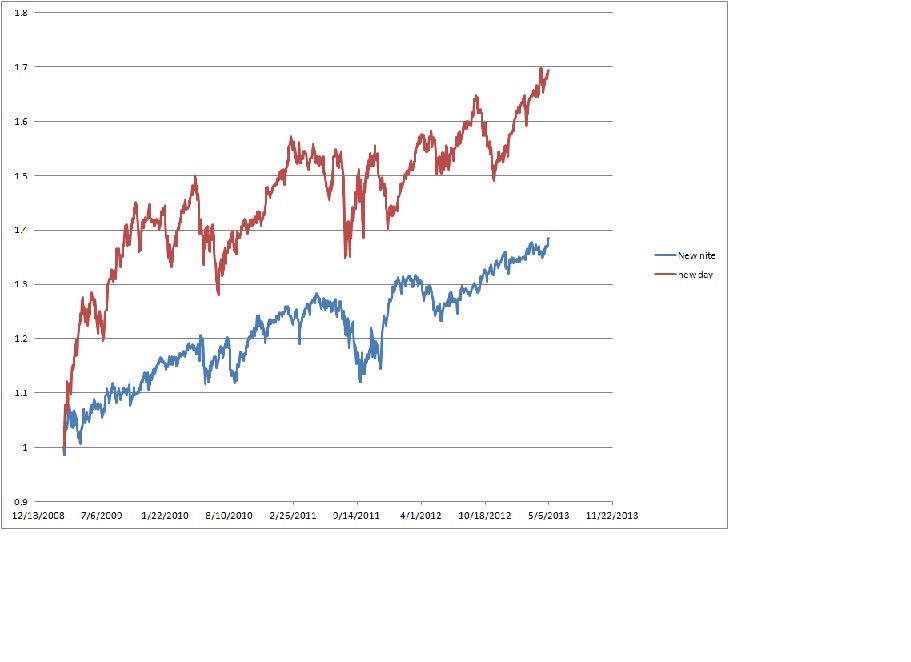
One possible explanation would be the visible hand of Ben and Co: heavily pulling levers during market hours to maximize return (of voters).
Apr
30
Buy in May for Another 7%, from Kim Zussman
April 30, 2013 | 1 Comment
In 2013, stock market return for January - April is about 12% (SPY: Dec 31 - end of april). Going back to 1994, regressed subsequent May- October returns against return of prior Jan-Aprils shows a positive correlation:
Regression Analysis: May-Oct versus Jan-Apr
The regression equation is
May-Oct = - 0.0107 + 0.753 Jan-Apr
Predictor Coef SE Coef T P
Constant -0.01071 0.03092 -0.35 0.733
Jan-Apr 0.7530 0.4125 1.83 0.086
S = 0.115422 R-Sq = 16.4% R-Sq(adj) = 11.5%
Though not quite significant, in the absence of a miraculous recovery in economic activity (and unlikely FED tightening), the regression equation suggests another +7% through October.
Apr
23
There is always something new to someone with many gaps in knowledge like mine. And the minimum spanning tree which I saw in an astronomy article "bootstrap, data permuting and extreme value distributions" by Suketo Bhavsar (which I couldn't understand but sent to Dr. Z as he could and Mr. Grain who could also understand it and it seems like a very good thing for technical analysis. But I will have to study it when not losing in market (all too rare).
Kim Zussman adds:
The article is unfortunately significantly beyond my boundaries. Observationally I would worry also about what we can see vs what is obscured by interstellar dust, but presumably they adjust by using infared (which penetrates dust better).
But I see your point vis traded price path:
"The Minimal Spanning Tree or MST (Zahn 1971) is a remarkably successful filament tracing algorithm that identifies filaments in galaxy maps (BBS; Ung 1987; BL I). The technique, derived from graph theory, constructs N - 1 straight lines (edges) to connect the N points of a distribution so as to minimize the sum total length of the edges. This network of edges uniquely connects all (spans) N data paints, in a minimal way, without forming any closed circuits (a tree). In order to distil the dominant features of the MST from the noise, the operation of "pruning" is performed. A tree is pruned to level p when all branches with k galaxies, where k < p, have been removed. Pruning effectively removes noise and keeps prominent features."
Victor Niederhoffer writes:
But it's descriptive right? I don't see anything about how to use it as predictive?
Kim Zussman replies:
They seem to be trying to lift signal (filaments) from background noise. Do you think some market moves are signal and others noise?
Victor Niederhoffer responds:
Yes. Like when bonds and stocks are both up on the day. The green on our chart or a break of a round number. Like an orgasm. But I can't understand the astronomy of the Indian paper so can't unravel it.
Apr
12
Shave, from Victor Niederhoffer
April 12, 2013 | 2 Comments
 Today was a day that I lathered the face at 7:00, and checked on the prices and the shaving cream is still there. Gold down a nice 35 bucks and bonds up a point and stocks down 8. The Dax down 150 and crude down 2 bucks. A take away from the trading. When the pain is too great to withstand adding to the position, and you utter an "oh , no!", that's when you should be standing solid as a stone wall and adding to the fortress, I think.
Vince Fulco writes:
I've been looking at some historical chart of the softs and other extreme situations recently and per the Chair's comments it is remarkable how quick and painful the washout can be before the trend changes direction violently and puts on multiples of the initial move.
How many times if we just walked away from the desk for a couple of hours to read, jog, or do anything, would we return back to clover? If only one had the fortitude to stand firm at all times.
Kim Zussman writes:
A possible key is a human inability to shift attention time-scales, i.e, if one is used to thinking (stressing) ticks (minutes, hours, points), it's hard to switch to weeks or months, then back again — in order to be profitable under different states of the market.
It may also help explain early buying and selling.
Apr
8
Current Epidemic Extinction, from Kim Zussman
April 8, 2013 | Leave a Comment
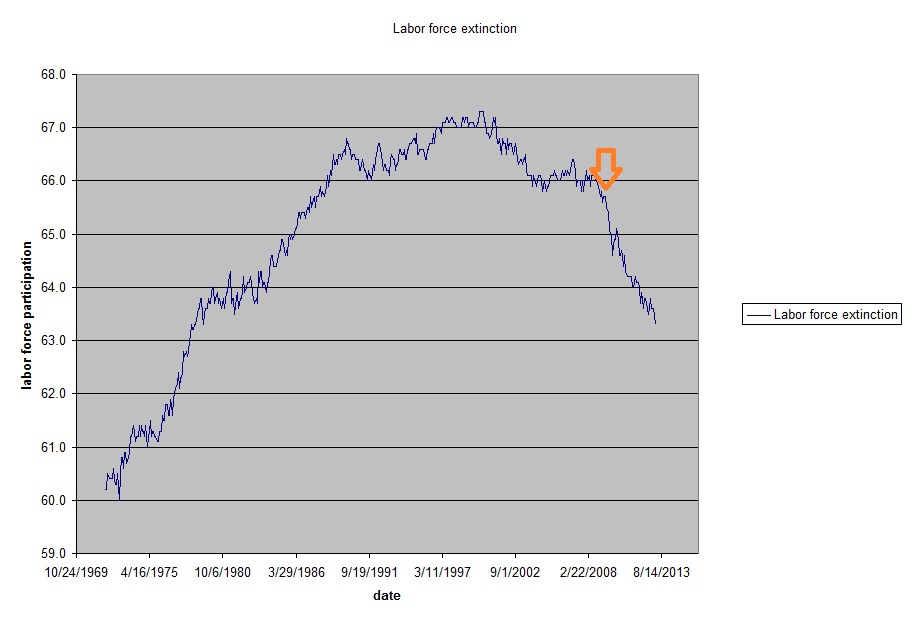
Chart is labor force participation rate 1972-present. RED arrow indicates infection point.
Apr
3
Gold, from Victor Niederhoffer
April 3, 2013 | Leave a Comment
 Many bearish things about gold lately. That it doesn't go up with no inflation, that we're in recession. That the dollar is going up. That there is great overhand of stocks. I am reminded of a question that I always ask when we hear rumblings that we are going into recession and someone suggests that it is bearish for stocks. I always ask, "what does that have to do with the likely outcome of the stock market? Will the drift be lower or higher?" Oh, I haven't tested that is the unspoken answer. Same for gold. I have not been averse to considering speculative buying of it on all the dips and one is not averse to upholding the spirit of Gavekal idea that it is good to consider things of that nature when caught in Africa by natives, or in large deposits by flexions. One notes a 20 day minimum and is not averse to considering expectations thereafter even before Dr. Zussman runs it on small tab.
Kim Zussman writes:
Using ETF "GLD" daily closes (12/04-present), new instances of 20 day lows were defined as the first 20 day minimum in 20 days. For these new 20 day lows, the return for the next 5 day interval was positive but N.S.:
One-Sample T: next 5D
Test of mu = 0 vs not = 0
Variable N Mean StDev SE Mean 95% CI T P
next 5D 32 0.0012 0.0317 0.0056 (-0.0102, 0.0126) 0.22 0.828
However 7 of the last 10 instances of new 20D lows have been followed by 5 day periods which were down:
Date next 5D
02/11/13 -0.027
12/04/12 0.007
10/15/12 -0.005
06/28/12 0.018
05/08/12 -0.040
02/29/12 -0.004
11/21/11 0.021
09/22/11 -0.067
06/24/11 -0.009
01/07/11 -0.007
07/01/10 0.011
03/24/10 0.025
01/27/10 0.020
12/11/09 -0.003
06/22/09 0.017
03/10/09 0.022
01/12/09 0.047
10/16/08 -0.109
07/30/08 -0.032
03/20/08 0.022
08/16/07 0.010
05/10/07 -0.014
03/02/07 0.008
12/15/06 0.011
08/17/06 0.012
06/01/06 -0.026
02/13/06 0.026
12/20/05 0.050
10/20/05 0.026
08/30/05 0.031
07/06/05 0.002
03/22/05 -0.001
Anatoly Veltman writes:
Fantastic work, as always. Now, I will ask a few skeptical questions:
1. So you test a historical period which saw the price move from $400 to $1600. Wouldn't you expect bullish historical results of a purchase made just about any random day?
2. So we're having a market in 2013, bouncing around on any piece of planted news from Cyprus, from EU, from Putin, from Japan, from Fed, from WH, from investment banks, from fund characters (the ilk of the upside-down), etc. How will one adjust one's timing of statistically catching the falling knife - given that the timing of such leaks (releases) has significantly changed from the test years?
3. Also, the market mechanism has changed in those 8 years, on two fronts:
-the increased weight of ETFs vs. bullion/futures
-the increased prolifiration of HFT exploratory orders
My gist: it's good to have a study, but there are plenty of caveats that call for increased amount of discretion.
In fact, here is my idea: I've observed this to work at an increasing rate since the transfer of investment capital from public into the coffers of the banks and funds has been initiated by the Central authority.
So Gold drops too quickly from $1600 to $1563, which rightfully piqued the Chair's interest in the wee hours. So this is what investment banks, playing with unending public capital, do (for a 24-hour play): they buy momentary cheap Gold and sell Oil against it (got to get the quantity mix right). Oil could not be considered cheap following last week's straight rise. Works plenty of times. And when it doesn't (really, once in a blue moon), a short term spread position becomes a longer term hedge, then the books may get cooked, then a rogue trader is disclosed, etc. who knows…But a good statistical trade to be sure. I like it.
Jason Ruspini adds:
If it seems like HFT is degrading certain strategies over time, there might be testable differences between different futures exchanges that support different order types. For example CME supports stop-limits without any additional software, but Eurex and TSE do not. ICE natively supports ice-berging, most don't. HKFE and SFE only support limit orders natively. Does the performance of benchmark momentum or reversion systems on equity contracts differ between these exchanges (without applying slippage assumptions)? They aren't apples-to-apples of course but if HFT has polluted the microstructure for certain strategies, it seems like something should show-up here, even if many participants have ways to create the other order types.
Ralph Vince writes:
Interesting points Jason. Timely too, I believe.
When market meltdowns occur, the technologie du jour is the scapegoat. In 1929, it was margin accounts. In 1987, program trading. Tomorrow, HFT.
Not that HFT caused the meltdown, but the fact that they stepped aside and enormous air pockets formed in the faveolate theatre of perceived liquidity.
Mar
10
As Usual, from Victor Niederhoffer
March 10, 2013 | Leave a Comment
As usual the reports of employment with all the adjustments to the economic numbers, coming from the government employees at the department chaired by the leader who likes her kids to sing the iron anthem, are designed to increase the importance of the department of the interior and redistribution and vote buying as Nock and Tollison and the public choice people said. First, the revised number from last month (which are 100,000 or so lower than previously reported) + the current number are very poor. And the total is about in line with the past dismal figures. (when will all these revisions be taken into account so that there is not such a big opportunity for the public to do the wrong thing).
The decrease in the unemployment rate comes from all the people who are not looking for jobs because they are on disability or given up hope. Third, the numbers are designed to show that when the rate goes up, they can attribute it to the fact that the survey was taken before sequestration (the economics chair has said this and important pro spending leaders of all sexes have it in her or his talking points already), so that when they report worse numbers in the future they can say it was because of the dreaded effect of reducing gov expenditures over 10 years by 800 billion rather than the fact that the numbers themselves are random.
Kim Zussman writes:
"What is then the connection between these numbers and the market?"
1. If unemployment and GDP numbers continue to improve, Oval Occupier takes credit and proving that higher taxes are pro-growth
2. If it worsens, it can only be due to House Republicans protecting the rich
3. If unemployment and GDP numbers continue to improve in a world without investment alternatives, stocks go up
4. If it worsens, time for more QE - which is now well known to be extremely bullish for stocks
Paving Wall St for Hillary (sorry Ross).
Richard Owen adds:
Always get long a fraud short you think is going to print above consensus. Men with gold filings and lucky silver dollars like their trading sardines.
Also, the disenfranchised pipe welder is the new fifties housewife. Instead of the little woman adding her own egg to the betty crocker brownie mix, the oxy acetelene operator adds his own self pity to a bottle of Jack Daniels. Growth in the fifties was still pretty good.
When Kruschev met Nixon and fulminated that Russia would outpace the US inside of seven years, it is easy to look back and laugh. At the time, much harder to be sure Russia wouldn't win out.
Mar
6
New New High, from Kim Zussman
March 6, 2013 | Leave a Comment
Yesterday (3/5/2013) the DJIA passed its all-time high (not adjusted for inflation); the SP500 has only a couple % to do the same.
Going back to 1950, daily SP500 closing prices were identified which were both an all-time high (starting at 1950), AND the first such occurrence in 100 trading days. There were 19 such instances. For these 19 new all time highs, checked the return for the next 1 day, 5d, 10d, and 20d - here comparing the means to zero:
One-Sample T: 1d, 5d, 10d, 20d
Test of mu = 0 vs not = 0
Variable N Mean StDev SE Mean 95% CI T P
1d 19 0.0010 0.0059 0.0013 (-0.0018, 0.0038) 0.77 0.451
5d 19 0.0047 0.0117 0.0026 (-0.0008, 0.0104) 1.78 0.092
10d 19 0.0040 0.0185 0.0042 (-0.0048, 0.0129) 0.95 0.354
20d 19 0.0061 0.0257 0.0059 (-0.0062, 0.0185) 1.05 0.309
>>not much; the most promising being the 5 days after new all time highs. Below are the dates:
Date
5/30/2007
2/14/1995
8/19/1993
7/29/1992
2/13/1991
5/29/1990
7/26/1989
1/21/1985
11/3/1982
7/17/1980
3/6/1972
4/29/1968
5/4/1967
9/3/1963
11/1/1961
1/27/1961
9/24/1958
3/11/1954
6/25/1952
Feb
27
SPYs in the Early 90s, from Kim Zussman
February 27, 2013 | Leave a Comment
SPY daily data was used to calculate a measure of intra-day volatility normalized to current price:
(H-L) / ((H+L)/2)
SPY data was also used to calculate daily intra-day return: (C/O)-1
These ratios were used to calculate the ratio: return / (intra-day volatility) (return per unit realized volatility, intraday)
The plot of return/volatility over time (1993-present) is here.
The plot looks sufficiently random but for a number of "roundish" points in the 93-94 period. Notice that for most of the series (excepting 93-94), there were no instances of "1" or "-1" (either an up day with intraday return = intraday volatility, or a down day with intraday return = -(intraday volatility) ). But there were several instances of 1, -1 in the earliest period. Also in the same 93-94 period there were a number of "0"s for the ratio - corresponding to zero return.
Hypotheses include problems with the data (Yahoo), and problems with the ETF itself.
Feb
5
A Lobagola of a Lobagola, from Kim Zussman
February 5, 2013 | Leave a Comment

Feb
5
Expertise, Comparative Advantage, and Mortality, from Kim Zussman
February 5, 2013 | Leave a Comment
 An expert has great comparative advantage in their area of expertise.
They say it takes 10,000 hours of study and mindful practice to become an expert — not to mention the natural talent, and the practice time it takes to maintain expertise.
Since a work lifespan is ~50 years — along with time needed for play, sleep, food, and social interaction — it would be unusual to become expert at many things. Which suggests that the economic fuel of comparative advantage is not likely to go away.
How is expertise possible in ever-changing markets?
Jeff Rollert writes:
I recommend the book Mindfulness, which contains the research work of Harvard psychologist Ellen Langer on observing and problem solving.
I practice some of her ideas when I walk to work…
Jan
30
There is a Zero Sum Part to Trading, from Victor Niederhoffer
January 30, 2013 | 1 Comment
There is a zero sum part to trading where what one flexion makes, another high frequency or day trader or poor gambler ruined or lack of margined or viged player uses. The win win aspect is that if you hold for a reas period as almost everyone in market is forced to do, you get the drift of 10000 fold a century, except if you lived in the Iron and played a game with kings moving backwards.
Anatoly Veltman writes:
Ok, I'll say it. Drift prevails over a century. And I had no problem with drift as recently as 4 years ago, when the only true drifter I know, a prince of certain oil, was adding to his C holdings by bidding pennies.
I'm having a problem with over-relying on drift now; because now, four years later, you can only bid pennies for C if you add $42 in front of it. All the while the real economic indicators, as Chair pointed out just today, have not and will not improve much any time soon. Now tell me: why assume that there will be much of a drift effect in the near five, or maybe the near ten years? Do you expect policy improvements, or pray for a budget spiral miracle, or Europe culture unity miracle, or what other miracle?
Jeff Watson writes:
Back in 1932, the DJIA made a new all time low that wiped out 36 years of gain. Likewise, the market didn't totally recover from 1969's highs until 1982, and the market has done a 15 bagger since then. I'll stick with the drift, which is a steady wind.
Rocky Humbert writes:
There seem to be two sorts of smart-sounding stock market pundits: (1) those who get bearish because prices have risen. (2) those who get bearish because prices have fallen. I am neither smart nor a pundit but my views of the 3-5 year upside from here (small) and current positions (long inexpensive s&p calls) are known to all.
In the face of the current seemingly relentless rise (which has used up a year's drift in 3 weeks)… I confess that I am looking at my new, over 50% combined tax rate, and positing that higher marginal rates disincentive not only my risk-taking, but also my selling (as the taxes discourage my speculative urge to sell now and buy stuff back at hopefully lower prices.)
With this in mind, an academic study might consider whether changes in capital gains tax rates result in more serial correlation (i.e. trending — as I look around three times) SHORTLY AFTER the higher taxes are imposed. And the effect diminishes over time as people become accustomed to the new regime. Obviously I would guess the answer is yes.
Kim Zussman writes:
Increasing tax regime could be bullish:
1. additional vig against frequent trading (as if there weren't enough already) > 1a. "drift" of holding period toward longer timeframe
2. disincentive to sell = incentive to hold and/or buy (including insiders)
3. restructuring away from dividends toward stock buy-backs
Rocky Humbert writes:
Dr Z may be onto something. Does this mean if Obama raises capital gains taxes to 99%, the stock market will triple over night?
Anatoly Veltman writes:
1. I have no problem with counting to include the last few years
2. I have a problem with counting to include anything pre-2007, let alone pre-2001, and even more so pre-1987.
The reason I have a problem with it: historical price analysis, no matter which way analysis is performed, relies on the notion that participants have not largely changed, and that "their" psychology has not changed. This is not the case - if one goes too far back - because financial market mechanism and participant make-up has changed ever increasingly over the past decade.
One of the victims of methamorphosis was "trend-following". I believe that most previosly successful trend-following rules have died in application to regulated electronically executed markets, because most clients are now automatically prevented from over-leveraging. Thus, "surprise follows trend" rule, for example, lost potency. Nowadays, you get preponderance of surprise "against trend". That's a very significant switcharoo, which has put most of famed trendfollowers of yester-year out of biz.
Also, Palindrome was not much off, predicting the other day hedge fund outflows due to old as age "2&20 fee structure". This structure just can't survive the years of ZER environment. Huge chunk of very cerebral participation has been replaced by bank punk punters, gambling public's money for bonuses.
Gary Rogan writes:
The drift seems to be a long-range phenomenon that has existed in different stock markets for a very long time. It is therefore difficult to make predictions of its demise based on any specific factors. One thing is clear: calamities like revolutions end the existence of the market and obviously the drift. Benito Mussolini was very good for the Italian stock market for a long time, and even way into the war it kept up with inflation, but eventually it succumbed to the realities of war (in real, not nominal terms). Granted, Mussolini initially had much better economic policies than Obama, but who would really expect that faschism could coexist with a great stock market? The question still remains: will there be a total wipeout? Short of that the drift is likely to continue.
Il Duce wasn't chosen completely at random, and the question was (just a little bit) tongue-in-cheek.
I could easily make the contention, and a great case, that fascism co-exists with a great stock market right here in the USA.
Ralph Vince writes:
I think we make a huge mistake when we assume that policy affects long term stock prices. Sure, you might have seen events, like a lot of stocks seeing big ex-dates last year, before big tax theft years — but the long term upward drift is a function of evolution. Like our progress has always been — starts and fits.
Sometimes the fits have lasted 950 years! But it always comes around. I like to get up in the morning, put my shoes on, by a few shares of some random something or other. If it goes against me, buy a little more. When it comes around to satisfy my Pythagorean criterion, out she goes.
As I've gotten older, I like to do it with wasting assets, long options.
It makes it more sporting.
Stefan Jovanovich writes:
I wish that we all could agree that prices only count if you can use the money . Zimbabwe's stock market does not have prices for anyone who wants use the money except in Zimbadwe. The Italian stock market was not quite that bad but close enough to make its "performance" entirely fictional from the point of view of anyone wanting to do what people now take for granted - use their dollars to buy/sell "foreign" stocks, close the trades and then take home their winnings - in dollars. That was not possible in Italy after 1922 or in Germany after 1932, for that matter.
As for Mussolini's economic policies, they were far more destructive than the President and Congress' inability to stop writing checks that the Treasury has not collected the money for. In his Battle for the Lira (1926), Mussolini decided that the currency would be fixed at 90 to the pound, even though the price in the foreign exchange market was 55% of that figure. The result was to create an instant bankruptcy for all exporters and those few remaining financial institutions that dealt in international trade. As a result Italy got a head start on the rest of the world; its Depression began in the fall of 1926. But Quota 90 did create a windfall for the Italian industrialists who were Mussolini's supporters; their costs on their imported raw materials were immediately halved. Like the German industrialists after Hitler took power, they saw their order books boom with all the government spending for guns and butter. And look how well that all turned out.
Baldi writes:
Ralph, you write: "As I've gotten older, I like to do it with wasting assets, long options."
Older? You wrote about doing just that in 1992:
"Finally, you must consider this next axiom. If you play a game with unlimited liability, you will go broke with a probability that approaches certainty as the length of the game approaches infinity. Not a very pleasant prospect. The situation can be better understood by saying that if you can only die by being struck by lightning, eventually you will die by being struck by lightning. Simple. If you trade a vehicle with unlimited liability (such as futures), you will eventually experience a loss of such magnitude as to lose everything you have. […]
"There are three possible courses of action you can take. One is to trade only vehicles where the liability is limited (such as long options.) The second is not to trade for an infinitely long period of time. Most traders will die before they see the cataclysmic loss manifest itself (or before they get hit by lightning.) The probability of an enormous winning trade exists, too, and one of the nice things about winning in trading is that you don't have to have the gigantic winning trade. Many smaller wins will suffice. Therefore, if you aren't going to trade in limited liability vehicles and you aren't going to die, make up your mind that you are going to quit trading unlimited liability vehicles altogether if and when your account equity reaches some pre-specified goal. If and when you achieve that goal, get out and don't' ever come back."
Jan
28
The Seminary Bookstore, from Victor Niederhoffer
January 28, 2013 | 5 Comments
 One of the pleasures of visiting the declining city of Chicago (perhaps the next Detroit), is to visit the Seminary Bookstore in their new location, 5727 S. University Avenue, They have a great collection of quasi academic books, i.e. the kind that professors write for popular consumption, and the current text books can be bought a few blocks west at the University Bookstore.
Compared to the old store, it has much more room, much more light and glass windows, and plenty of places to sit and read. And unlike the old store, it's possible to find your way out without being buried by a ton of musty books if you don't get lost in the basement. I am one of those unfortunates who was not educated enough in my college days to have a good grounding in all the disciplines that make up the world of knowledge so I like to update myself periodically in areas that I am weak in or should know much more about, especially for market actualization or knowledge to share with my kids.
Perhaps the list of books I bought might be of interest to some scholars or would be market people. Microeconomics by Besanko and Braeutigan
Industrial Organization by Luis Cabral
Investments Bodie, Kane, Marcus (ninth edition)
Stochastic Modeling Barry Nelson
Scorecasting Moskowitz and Wertheim
The Evolution of Plants Wills and McElwain
Survival by Minelli and Mannuci
Thieves, Deceivers and Killers, Agosta
The Birth of the Modern World 1780-1914
The Lions of Tsavo, Patterson
Modeling Binary Data by David Collett (second edition)
Historical Perspectives on the American Economy, Whaples
Viruses, Plagues, and History, Olstone
Plastic (a toxic love story), Feinkel (for the collab for her new business)
The Power of Plagues, Sherman
Quantitative Ecological Theory, Rose
Think Python, O'Reilly (for my kids who want a job in the future).
Beautiful Evidence by Edward Tufte
All of Nonparametric Statistics by Larry Wasserman
Number Shape and Symmetry by Diane Hermann and Paul Sally
Nonparametri Statistics with Applications to Science and Engineering, Paul Kvam and Brani Vidakovic
Discrete Multivariate Analysis by Yvonne Bishop et al
Modeling with dta by Ben Klemens
Python Essential Reference by David Beaszley
The Origin of Wealth by Eric Beinhocker
America, Empire of Liberty by David Reynolds
The Entrepreneur (classic texts by Joseph Schumpeter) Marcus Becker
A History of Everyday Things: the birth of consumption in France, Daniel Roche
Civilization by Niall Ferguson (the west and the rest)
The Americans (the Colonial Experience) by Daniel Boorstin
Triumph of the City (how our greatest invention makes us richer, smarter, greener, healthier and happier) by Edward Glaeser
The Big Red Book by Coleman Barks (bought by Susan)
The Founders and Finance, Thomas McCraw
A Nation of Deadbeats (an uncommon history of America's financial disasters) by Scott Reynolds Nelson. (this one I have to read immediately)
Rome by Robert Hughes
The American Game: capitalism, decolonization, world domination and baseball by John Kelley ( 173 5 by 8 pages only)
Exploring the city (inquiries toward an urban anthropology ) by Ulf Hannerz
Brokerage and Closure (an intro to social capital), Ronald Burt
All the Fun's in How You Say a Thing (an explanation of meter and versification) by Timothy Steele
The American Songbook by Carl Sandburg (for Aubrey)
The Measure of Civilization (how social development decides the fate of nations) by Ian Morris
Freaks of Fortune ( the emerging world of capitalism and risk in America by Jonathan Levy
The Invention of Enterprise (entrepreneurship, from ancient mesopotamia to Modern times) by David Landes et al
I feel like Louis L'amour who gave lists of books he likes to read in The Wandering Man without telling what he got out of them, but I do not have enough erudition to tell based on skimming them how valuable or interesting they are. Any suggestions or augmentations on that front would be appreciated and perhaps helpful to others.
Kim Zussman writes:
University of Chicago is now ranked #4 by US News — the highest ever. This is a big jump from the era of the low tax predecessor to the former con law professor, and will hopefully have a favorable impact on South side murder rates.
Dan Grossman writes:
Unintended Consequences by Edward Conard is the best book I have seen on the subprime crisis and current government tax and economic policy.
Jan
28
A Roller Coaster Experience of a Trade Missed, from Leo Jia
January 28, 2013 | Leave a Comment
 I have been doing auto trading of Palm Oil futures for some time using a self-developed system. The system works on the continuous data of the contracts and trades on the most liquid contract.
One morning last week after I started the software before the market open, to my surprise, I discovered the prior day's data was of the wrong contract month. It was not the same as that during the prior day's trading session. Seeing an anomaly of the data, I disabled auto trading prior to the market open.
When the market opened, I saw the system gave a short signal that I believe was due largely to the influence of the wrong data of the prior day. But gradually, it turned out to be a good signal. By the close of trading when the system signaled to closeout the trade, it was a 10% profit. Although I understand that it should not be my expected profit, I was feeling a little upset for not taking the trade.
Then the next day when I started the software, the data was corrected. With the corrected data, the system showed a trade on the past day of actually a 4% loss. I felt a little relieved.
Kim Zussman writes:
This is where the mistress speaks to us. In between the rationally testable segments; where the discretion of experience, discipline, and morality are challenged every day.
Jan
23
Charm, from Kim Zussman
January 23, 2013 | 1 Comment
 "Charm" (decay of option sensitivity to underlying over time) seems an apt model for the decline in male sex drive with age, and the attendant increased attention to youth. Further calculations are required to examine the effects of being in the money, and time-related sensitivity to volatility.
Charm or delta decay, measures the instantaneous rate of change of delta over the passage of time. Charm has also been called DdeltaDtime. Charm can be an important Greek to measure/monitor when delta-hedging a position over a weekend. Charm is a second-order derivative of the option value, once to price and once to the passage of time. It is also then the derivative of theta with respect to the underlying's price.
Jan
11
An Astronomer, from Kim Zussman
January 11, 2013 | 2 Comments
 An astronomer was profiled in the media, ca ~2000. Not for his science, but for the fact that he held onto a position in MSFT stock for ~10X (100X, etc).
He didn't sell after 20% gain. Or 50%. Or 100%. He just irrationally (per nascent behavioral finance) held. Intuition, like in Carl Sagan's "Contact", rather than explicit knowledge of the company's business prospects, valuation, or moving average. Dumb stubborn luck.
MSFT hasn't done much since then, so whether he's still holding or sold out, no matter (because it wasn't AMD).
The astronomer is a standard-bearer for those in the empirical vacuum tempted to sell after a double, or down on their luck and doubling down.
Jan
2
A Study, from Kim Zussman
January 2, 2013 | Leave a Comment
Looking at SPY reversal patterns (2007-present): If two consecutive trading days were each up >1%, and they were preceded by a drop of at least 1%, the next 2-day return was negative (NS):
One-Sample T: DUUXX
Test of mu = 0 vs not = 0
Variable N Mean StDev SE Mean 95% CI T
DUUXX 18 -0.0097 0.025 0.0058 (-0.022, 0.002) -1.64
Variable P
DUUXX 0.119
Jan
2
The Difficulty, from Victor Niederhoffer
January 2, 2013 | Leave a Comment
The difficulty of getting back in once you have sold in stocks is underlined vis a vis the buy and hold strategy, as well as the fate of short selling, as well as timing— by the fast 50 point move in stocks today.
Gary Rogan writes:
It seems like generally speaking one should either trade, as in being in and out "often" or buy and hold. Buying and holding except for periodically being out or short seems to be what Victor is addressing, and I have always been suspicious of "market timing". All it takes is getting it wrong once, and you are in a hole that's expanding for a long time.
I'm still curious how Victor was so sure there would be a deal.
Anonymous writes:
What was the effective date of the STOCK Act to ban congressional insider trading, I wonder. As a staffer, one could have slapped the emini around harder the Khan brothers squash ball.
Victor Niederhoffer replies:
Let us hope that the profits from such activity were sufficient to assuage any such desires for a few days.
Russ Herrold writes:
The dance is a re-run and in prior seasons, the cliff is avoided. Sitcom writers can re-cycle plots endlessly.
Kim Zussman writes:
It's the binary conundrum of markets:
Buy the rumor / sell the news (or buy the news)
Buy and hold (or sell and sit)
You can't time the market (but some can)
Stocks beat bonds (except for the last decade)
Printing presses lead to disaster (which may not come in our lifetime)
The President of the Old Speculator's Club writes in:
I heard a Congressman speak recently and have to admit it was an enlightening experience. Traditionally, members display a certain amount of restraint when speaking of colleagues with whom they find grievous fault. In a refreshing departure from good manners, this gentleman took the gloves off and bluntly stated that a goodly number of his fellow representatives are less than bright. The word "clown" came up several times and "stupid" might have been slipped in.
Although he artfully avoided specifying individuals or party, I couldn't help but believe that he, like many in the "beltway", had come to the same conclusion: the arrival of the Tea Party contingent has been nothing short of a national disaster.
Unsurprisingly, the congressman's public and scathing view is shared by the current establishment elite. (It's dangerous to out there and speak your mind if what you say is out of step with the conventional wisdom.) His case is provided with added cover by a host of recently published and similarly themed books ("It's Even Worse Than It Looks", Mann, "Do Not Ask What Good We Do", Draper, "Beyond Outrage", Reich, and "The Party is Over", Lofgren).
However, the "fiscal cliff" isn't a maiden making her debut. We've had two relatively recent encounters with her; so her charms, though formidable, are familiar. Her appearances in '91 and '95 were just as awesome and, as expected, so compelling that one of the parties bit into the proffered apple. Unfortunately, the fruit, which is bitter and often fatal, is the produce of the tree of Folly. On this most recent visit, though, she is confronted by a group so naive and simple that her blandishments have gone unrequited.
In any event, it's apparent that the respect (whether real or faked) House members used to show each other, at least in public, has been thrown over for a newer, more aggressive, in-your-face approach. Long gone are the clever and informed debates which provided a rich mix of facts, history, and truth. It seems important to figure out why this has developed and if, in fact, a functioning government is still possible.
If one studies what the House has been in the past and what it has evolved into, it's impossible to overlook that this body has lost, or given up, much of it's power and authority. The growth of the executive branch (the Imperial Presidency) is one factor. Back in '96 the congress and the president worked long and hard to create the first welfare reform package. Contrary to forecast of terrible consequences, the new programs worked well.
Yet, in one day, an Executive Order by the current president re-established the old, failed programs. Another assumed power has been the declaration of war, and the most recent threat: unilaterally raising the ceiling on the debt.
While the Executive Order has been increasingly utilized to usurp powers constitutionally granted to the House (and Senate), the greatest loss of power has been though Congress' voluntary abandonment of authority to "regulatory agencies."
Figuring that some issues were just to tough, complex, or time consuming, the country has had foisted upon itself the EPA, FDA, TSA, USDA (with 20 sub-agencies within it), the Dept.of Commerce (with 17 sub-agencies), Dept. of Defense (with 32 sub-agencies) and the list goes on and on. Each agency is staffed by unelected individuals, many with their own agendas, who dictate new regulations that possess the force of law. It's understandable that so much work has to be delegated, but to give it to agencies that are unanswerable to the body that created them is inexcusable.
Then, of course, there is "party discipline." Sam Rayburn of Texas, Speaker of the House for many, many years, gave each incoming freshman representative of his party one piece of advice: "If you want to get along, go along." And they did. Those that didn't faced many difficulties: in committee assignments, in getting their legislation to the floor, in receiving party re-election funds, and they'd be high on the list of targets should redistricting become an issue.
Unfortunately, this approach worked, and worked well. As a result, many constituents found that the views they wished their representatives to promote in D.C., took a back seat to the views favored by the party leaders - many of them from different parts of the country with substantially different interests and goals. The "house of the people" became a house held hostage. Matters reached a new low in representative government when the other party adopted the same process.
Then 2080 rolled around and enough citizens, aggravated at the apparent unresponsiveness of their representatives, threw them out and ushered in the Tea Party. A delicate balance has been disturbed and the Dysfunctional Couple, used to newcomers adjusting to them, failed to realize that these clowns - these yahoos, actually believed in what they'd declared. Whether they win or lose, prevail or fail, their chances for another re-election are small. But for a brief period they have served as reminders that doing the people's business is serious business and that a promise made is a debt unpaid.
For a brief period this collection of vagabonds has added a dose of virility to a confederacy of eunuchs.
As to the President's actions in the recent negotiations, he did nothing, offered nothing…he arrogantly summoned everyone back to D.C. Most came back assuming he had a proposition - he didn't - even CNBC's John Harwood was a little taken aback at the presumptuous gesture. Some time back I suggested I was all for giving this guy everything he asked for - and then letting him perform as he has suggested he would. He has received almost everything; now it's time to lead. This from a guy who, in his short term in the Illinois senate, voted "present" on over half the bills that went through. He is structurally averse to taking a position - preferring, instead, to demonize his opponents.
So, first time at bat, he (and his faithful followers), are hand-wringing over what roadblocks the GOP will/might place before a debt ceiling deadline is reached. It's time he quit talking and started doing.

Nov
29
Billions in Dividends, from Kim Zussman
November 29, 2012 | 1 Comment
 Shouldn't dividend paying stocks consider reducing or eliminating dividends, and instead use free cash flow for share repurchases? Assuming long term cap gains tax will be less than tax on dividends.
Gary Rogan writes:
They have to consider that many of their holders are sub-250K and many hold in tax-shielded retirement accounts. "Widows and orphans" still rely on dividends to some degree, so there is probably some sort of a Laffer-like curve where the post-tax income total return averaged over all the holders is optimized by a particular dividend policy.
Mr. Krisrock writes:
You can't turn on a financial news program without hearing about special dividends. Companies are also rewarding employees with 15% dividends as a year end bonus. Even better is issuing debt, which is tax deductible and buying back stock when ITS is not at a market peak?
This will likely happen sometime next year…not now. Most liberal Californians haven't figured out how Obama has tactically created the seeds for a republican internal war in 2014. Boehner has made sure his entire house leadership is comprised of supporters, and he can cut a deal that enrages the tea party whom he despises. Now tell me who defends personal property rights, when there is a rebellion among republicans. Obama can get back the house in 2014 simply allowing the brain dead rep establishment to self destruct. They are really that dumb…and he is really smart …he won re-election no matter how he did it.
It would be a waste of corporate cash to buy stocks here and now and the more special dividends from companies like Home Depot, the more we can confirm the worst is coming.
Jim Sogi writes:
Isn't the threat of dividend tax a good way to shake out accumulated cash held by corporations? Wouldn't a better way be to get rid of the dividend tax? Equities would go through the roof.
Nov
27
We Are Looking at the Vanguard Study, from Victor Niederhoffer
November 27, 2012 | 3 Comments
We are looking at the Vanguard study that mentions Shiller favorably and it's obviously flawed. The overlap, part whole correlations, and selected starting and ending points, as well as the intrinsic illogic of a 10 year horizon forecasting well but not a 1 year which means that the previous 9 years were much more predictive than the last year, or that the last 5 years are correlated differently from the prior 5 years, comes to mind. But of course, the lack of degrees of freedom with 10 year data with all the overlap, to say nothing of the historical data that Shiller uses, which is retrospective and not reported at the time. But of course one hasn't read it yet, and they purposely make their methodology opaque wherein one could have found the real problems with it.
Kim Zussman writes:
It would seem that in the face of most long-term historical market conclusions the Japanese stock market must be considered an outlier; in terms upward drift as well as P/E.
Alex Castaldo adds:
The study we are talking about can be found here [20 page pdf]. The problem I see is this. They evaluate forecasts over a 1 year horizon and over a 10 year horizon. The one year procedure makes sense to me: You make a forecast, you wait one year to see how it turns out and then you make another forecast. The R**2 is a measure the quality of the forecast, or more precisely it is the percentage of the variance of returns explained by the forecast. The R**2's for one year are small, as one would expect, and nothing to get excited about. But what is the meaning of R**2 in the 10 year case ? You make a forecast in 1990, invest until 2000 and the go back (how? with a time reversal machine?) to 1991 and make a forecast for 2001? I am not sure the procedure is meaningful from an investment point of view. And statistically the return for 1991-2001 is going to be very similar to the return for 1990-2000; so if you forecast the latter to some small extent, you will probably forecast the former as well. It seems to me there is a kind of double counting or artificial boosting of the R**2 going on.
When the predicted variable has overlap it is standard to use the Hansen-Hodrick t-statistic which attempts to compensate for the correlation introduced by the overlap. But because the study only gives an R**2, and not the Hansen-Hodrick t, we don't get any adjustment for overlap.
I am sure that the 10 year R**2 are not comparable to the 1 year R**2, they are apples and oranges. Someone suggested to me that it may still be valid to compare the 10 year R**2 to each other, as a relative measure of forecasting power. I don't know if that is true or not.
Nov
27
A Post, from Victor Niederhoffer
November 27, 2012 | 2 Comments
A post purporting to show that buy and hold investing does not work has appeared on our list. It is reprehensible propaganda and total mumbo. They do not take account of the distribution of returns to investing over long periods that have been enumerated by the Dimson group and Fisher and Lorie. It is sad to see this on our site. The arguments against buy and hold seem to be that the professors found that short term investing didn't work so they erroneously concluded that long term investing must be the alternative. Shiller is mentioned and cited with approval.
Alston Mabry writes:
To explore this issue numerically, I took the monthly data for SPY (1993-present) and compared some simple fixed systems. In each system the investor is getting $1000 per month to invest. If during that month, the SPY falls a set % below the highest price set during a specific lookback period (the 3, 6, 12, 18, 24 or 36 months previous to the current month), then the investor buys SPY with all his current cash (fractional shares allowed). If the SPY does not hit the target buy point this month, then the $1000 is added to cash. Once the investor buys SPY shares, he holds them until the present.
For example, let's say the drop % is 10%, and the lookback period is 12 months. In May of year X, we look at the high for SPY from May, year X-1, thru April, year X, and find that it is 70. We're looking for a 10% drop, so our target price would be 63. If we hit it, then spend all available cash to buy SPY @ 63. Otherwise we add $1000 to cash.
Each combination of % drop and lookback period is a separate fixed system.
Over the time period studied, if the investor just socks away the cash and never buys a share (and earns no interest), he winds up with $239,000. On the other hand, if he never keeps cash but instead buys as much SPY each month as he can for $1000, then he winds up with over $446,000, which amount I use as the buy-and-hold benchmark.
If the investor uses the fixed system described, he winds up with some other amount. The table of results shows how each combination of % drop and lookback period compared to the benchmark $446,000, expressed as a decimal, e.g., 0.78 would that particular combination produced (0.78 * 446000 ) dollars.
Results in this table.
)
The best system was { 57% drop, 18+ month lookback }, or just to wait from 1993 until March 2009 to buy in. Of course, it's hard to know that 57% ex ante. The next best system was { 7% drop, 3 month lookback } coming in at 0.99.
This study is just food for thought. It leaves out options for investing cash while not in the market. And it sticks with fixed %'s without exploring using standard deviation of realized volatility as a measure. So, there are other ways to play with it.
Charles Pennington comments:
Thank you — that is a remarkable "nail-in-the-coffin" result.
Nothing beat buy-and-hold except for the ones with the freakish 57% threshold, and it won by a tiny margin, and it must have been dominated by a few rare events–57% declines–and therefore must have a lot of statistical uncertainty..
That's very surprising and very convincing.
(Now some wise-guy is going to ask what happens if you wait until the market is UP x% over the past N months rather than down!)
Kim Zussman writes:
Here are the mean monthly returns of SPY (93-present) for all months, months after last month was down, and months after last month was up (compared to mean of zero):
One-Sample T: ALL mo, aft DN mo, aft UP mo
Test of mu = 0 vs not = 0
Variable N Mean StDev SE Mean 95% CI T
ALL mo 237 0.0073 0.0437 0.0028 ( 0.0017, 0.0129) 2.58
aft DN mo 90 0.0050 0.0515 0.0054 (-0.0057, 0.0158) 0.92
aft UP mo 146 0.0083 0.0380 0.0031 ( 0.0021, 0.0145) 2.65
The means of all months and months after up months were significantly different from zero; months after down months were not.
Comparing months after down vs months after up, the difference is N.S.:
Two-sample T for aft DN mo vs aft UP mo
N Mean StDev SE Mean
aft DN mo 90 0.0050 0.0515 0.0054 T=-0.53
aft UP mo 146 0.0084 0.0381 0.0032
Bill Rafter writes:
A few years ago I published a short piece illustrating research on Buy & Hold. It contrasted a perfect knowledge B&H with a variation using less-than-perfect knowledge using more frequent turnover. Here's the method, which can easily be replicated:
Pick a period (say a year) and give yourself perfect look-ahead bias, akin to having the newspaper one year in the future. Identify those stocks (say 100) that perform best over that period, and simulate buying them. Over that year you cannot do better. That's your benchmark.
Then over that same period do the following: Buy those same 100 stocks, but sell them half-way thru the period. Replace them at the 6-month mark with the 100 stocks perfectly forecast over the next 12 months. Again sell them after holding them for just half the period. Thus the return from the stocks that you have owned and rotated are the result of less-than-perfect knowledge. Compare that return to the benchmark.
Do this every day to eliminate start-date bias, and then average all returns. The less-than-perfect knowledge results far exceeded the perfect-knowledge B&H. Actually they blew them away in every time frame. It's really obvious when you do this with monthly and quarterly periods as you have so many of them.
The funny thing about this is the barrage of hate mail that I received from dedicated B&H investment advisors, who somehow felt their future livelihoods were threatened.
If anyone wants that old article, send me a message off the list. We called it "Cassandra" after someone with perfect knowledge that was scorned.
Anton Johnson writes in:
Here is a link to BR's excellent study "Cassandra", as it lives on in cyberspace.
Nov
26
Taxing Trading in an Outlying Year, from Kim Zussman
November 26, 2012 | Leave a Comment
Here is a common explanation of the small-stock January effect (should it still exist) is tax-loss selling: Late year dumping of losing stocks resulting in an "over-sold" condition.
From a tax-strategy standpoint, the 2012/2013 transition is currently the most uncertain in many years. Unlike most years capital losses may be more valuable to push to the future (assuming capital gains tax rates jump in 2013). In addition, some of 2012's biggest losers are not small cap and are widely held.
Nov
18
Do People Vote Their Pocket-Book or Clan? from Kim Zussman
November 18, 2012 | 1 Comment
2012 presidential election voting data by state was obtained from this source.
States were analyzed according to income ratio of top 5% to bottom 20% using this data.
Regressing the ratio (top 5%/bottom fifth) vs. fraction voting for Obama did not uncover a significant correlation:
Regression Analysis: 5%/bot fifth versus Obama
The regression equation is
5%/bot fifth = 10.5 + 3.11 Obama
Predictor Coef SE Coef T P
Constant 10.496 1.507 6.97 0.000
Obama 3.111 2.992 1.04 0.304
S = 2.50077 R-Sq = 2.2% R-Sq(adj) = 0.2%
Based on this one cannot conclude that Obama's election results were correlated with income inequality. (NS also regressing vs % voting for Romney) How does this compare to state's racial demographics?
State racial demographic data was obtained from the 2000 census; extracting the ratio of those identifying as "non-hispanic/latino white" to total population (% white).
Using this data, regressed fraction voting for Obama vs % white by state:
Regression Analysis: Obama_1 versus % white
The regression equation is
Obama_1 = 0.740 - 0.334 % white
Predictor Coef SE Coef T P
Constant 0.73967 0.07075 10.45 0.000
% white -0.33382 0.09241 -3.61 0.001
S = 0.106100 R-Sq = 21.0% R-Sq(adj) = 19.4%
In terms of state populations, there was a significant negative correlation between % voting for Obama and % white. A similar opposite) positive correlation was found for % voting for Romney (not shown).
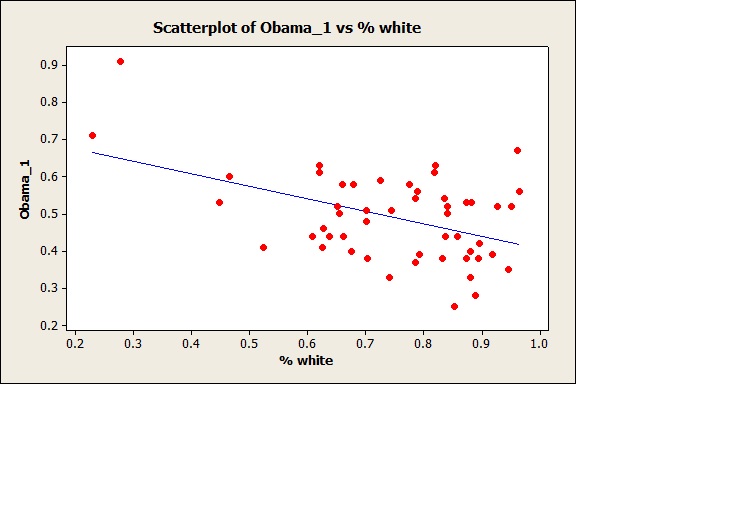
Nov
7
Pre and Post Presidential Election, from Kim Zussman
November 7, 2012 | 1 Comment
Going back to 1984, checked SP500 returns for the two day interval including presidential election day, and the following 3 day interval returns:
One-Sample T: 2D prior, 3D after
Test of mu = 0 vs not = 0
Variable N Mean StDev SE Mean 95% CI T P
2D prior 7 0.0105 0.0145 0.0054 (-0.0029, 0.0239) 1.91 0.104
3D after 7 -0.0162 0.0372 0.0140 (-0.0507, 0.0181) -1.16 0.292
N.S. (low N), but a trend toward reversal. Here is the regression:
The regression equation is
3D after = - 0.0025 - 1.31 2D prior
Predictor Coef SE Coef T P
Constant -0.0025 0.0168 -0.15 0.889
2D prior -1.3125 0.9868 -1.33 0.241
S = 0.0350644 R-Sq = 26.1% R-Sq(adj) = 11.4%
>>Still N.S., but negatively correlated.
Buying rumors and selling news?
Date 2D prior 3D after
11/4/2008 0.038 -0.074
11/2/2004 0.000 0.031
11/7/2000 0.004 -0.046
11/5/1996 0.015 0.023
11/3/1992 0.003 -0.006
11/8/1988 -0.004 -0.026
11/6/1984 0.018 -0.016
Nov
6
The Ashkenazi Jews, from a doctor
November 6, 2012 | Leave a Comment
 Many have seen the paper by academics (from Utah!) attempting to explain the observation of empirical intelligence in Ashkenazi Jews. [Cochran, Hardy, Harpending 2005].
Synopsis: Jews of eastern Europe were excluded from mainstream society and gathered in Shtetls. In these villages, exceptionally intelligent boys studied Torah — and the most talented were skilled at debating meaning between themselves and with the elders. The most intelligent grew up to become religious scholars, who in these societies became wealthy — and the most desirable for marriage to village nubiles.
Unlike many Christian religions, young Jewish religious scholars were expected to reproduce in quantity. Thus conserving and proliferating genes for memory and reasoning, and possibly explaining disproportionate representation among pre-political Nobelists.
It is also possible that the successful among the tribes in Pogromal Russia also favored reproductive survival for the wily in coping with an oppressive state bureaucracy.
One could posit that such selection pressure could explain a measure of Jewish affinity for the heavy-handed state, including an instinct that this environment is rich with opportunities for equivocating, lawyering, and fertile profit.
Mick Tierney writes:
I'm somewhat familiar with the study you refer to, Kim, as well as similar conclusions reached by Charles Murray. But what interested me most about your post was this: "…young Jewish religious scholars were expected to reproduce in quantity." It caught my attention because of a battle that flared up back in June between "Commentary" and "Forward" - both, apparently, Jewish journals with significant influence. Their dispute turns on issues with which various Christian sects are familiar.
The below excerpts (and the entire article) seems to suggest that there might, in fact, be an "affinity for the heavy-handed state" among some of the faithful, but certainly not all. (I understand that there while there're differences between the Ashkenazi and the Haredim, both groups place a heavy emphasis on education.):
"In a city like New York where 74 percent of all Jewish school-age children are Orthodox, there is little question the traditional dominance of secular and liberal Jews is not likely to persist in the long run.
"That this would upset liberals is understandable. But that ought not to excuse the willingness of the editorial page of the Forward when discussing the Orthodox community to engage in the sort of language it would never excuse were such words directed at non-Jews."
"And that is what has apparently goaded the Forward into publishing a rant whose only real purpose is to stigmatize Orthodox Jews as an expanding horde of lazy welfare cheats who ought to be denied assistance as they out-reproduce more responsible liberal Jews."
"…it is one thing to express concerns about the future of that community, it is quite another to write in a manner that speaks of the rising Orthodox birth rate as if we would all be better off if those children were never born.
"…when a critique of the welfare state crosses over into prejudice against specific groups or language that resonates with bias that sounds more like eugenics than political analysis, a line has been crossed."
If it is true that being fruitful has been a successful mechanism for maintaining intellectual superiority (and it's hard to argue with the current "facts on the table") then the current NY contentions could have serious long-term consequences.
Nov
1
The Question Arises, from Victor Niederhoffer
November 1, 2012 | 2 Comments
The question arises, "who can you trust as you get along in life" and "how can you teach your kids or your wife to take care of their financial lives when you are gone" and "how many spouses and family have been victimized when the person that controls considerable wealth is seduced by a much younger and more sexual personage with the intention of relieving him and the family of their wealth"?
an anonymous commenter writes in:
 My friend recommended The Sociopath Next Door a few days ago. Here is a great quote:
"Maybe you are someone who craves money and power, and though you have no vestige of conscience, you do have a magnificent IQ. You have the driving nature and the intellectual capacity to pursue tremendous wealth and influence, and you are in no way moved by the nagging voice of conscience that prevents other people from doing everything and anything they have to do to succeed. You choose business, politics, the law, banking, or international development, or any of a broad array of other power professions, and you pursue your career with a cold passion that tolerates none of the usual moral or legal incumbrances. When it is expedient, you doctor the accounting and shred the evidence, you stab your employees and your clients (or your constituency) in the back, marry for money, tell lethal premeditated lies to people who trust you, attempt to ruin colleagues who are powerful or eloquent, and simply steamroll over groups who are dependent and voiceless. And all of this you do with the exquisite freedom that results from having no conscience whatsoever. You become unimaginably, unassailably, and maybe even globally successful. Why not? With your big brain, and no conscience to rein in your schemes, you can do anything at all."
Ken's book suggests 1 in 25 have the personality type. Sociopath's seem to be an overweight in the business sphere. And Sociopath's organizations echo their personality traits. Thus identifying them would seem to be essential. Unfortunately, there's the chicken and egg issue: by the time you have foreknowledge, it's often too late.
The only ready indicators I've felt: a general feeling that somethings not quite right when you meet them; something about the eyes that is a bit vacant (but as distinct from meeting an introvert).
But I do not claim any success in this measure.
I think the Rockefeller approach of cheating your own sons perhaps has sense. Similarly, I think you need to meet some truly ruthless people to get a sense of them. You might seemingly want to protect children from these sorts of experiences, but perhaps it ultimately costs more later? Unfortunately, ruthless people are not always in ready supply until you are on the battlefield, so to speak.
Jeff Watson writes:
The sociopaths in the S&P pit in the late 80's were legendary. Any
time I would get a trade down, even my own firm's broker stole from me.
He was busted for it in 1989.
Kim Zussman writes:
We trust friends and family based on incomplete information, or empirically based on a sample of trials from which we conclude trust or not. This is true because we can never get into minds of others to understand their true motives and intentions (and even if we could, their motives may be indecipherable as they are invisible to themselves).
Thus it is logical, when presented with unexpected criminal evidence, to question the original basis of friendship or kinship.
Put another way, when should countervailing evidence out-weigh personal connection?
Oct
22
Chokeholds, from Victor Niederhoffer
October 22, 2012 | Leave a Comment
 I can't begin to express my disapproval of letting a son go round putting people in choke holds, and kidding them about their lives. I can't begin to think of a worse thing to do to people, and worse training for a kid. All fathers should put a violent stop to such activities at the first signs of it. I have had people put choke holds on me, and the feeling of helplessness and having death in the hands of a joker is one of the most terrible feelings that one can have. It can lead to all sorts of dire consequences and thank the good one that my friend who mentioned something about this to me is still healthy after their encounters and amusing contretemps in it.
Ralph Vince writes:
I agree that no one (of any age) should go around doing that, and a fortiori, young people must be taught to make sure not to let people come up behind them, to track them in their head, and to have a sense of the whereabouts in the plane surrounding them of all who are about. It's too easy to become preoccupied in thought (or conversation) and lose sense of where the pieces are on the chessboard.
That being said, I think having enemies expedites education. I can only speak for myself, but I live in the middle ages, and wouldn't think of leaving home without a cup and two discrete weapons. A gentle man should look like a gentleman, and above all, never, ever let anyone come up behind them for any reason. Similarly, one should be very careful when coming up behind someone else, to speak to them and them know.
Kim Zussman writes:
Funny no one looked up the actual risks to "choking out".
However this fits with the ubiquitous meme on dailyspec, "we as parents who have lived longer (but aren't necessarily successful / self actualized / or understand fully what we are doing here) will instruct you".
Or, that you should study certain music, sports, chess, religion, etc, in order to have a better life (fit in, reproduce, instruct, etc).
This was apparent this afternoon observing various bird species. The local crows call to each other in a way they all accept. Most likely the calls are reassuring: "we are crows and we got it right!". Also there is a lot of Mexican sage growing here, which attracts legions of hummingbirds. They twit twit continuously, zipping about, arguing over this or that mate but at the same time saying "we are hummingbirds and WE got it right".
New to our neighborhood is the black-hooded parakeet - a non-native parrot released into the wild but living and reproducing happily here. They fly in a tight noisy cluster - from one neighbor's Mexican palm to another's pine. Somehow these two trees are go-to places for the parrots, as they squawk and argue about tabloidesque mating rights.
What does this have to do with Reese Witherspoon putting her Ojai house on the market ?
This:
"Libbey Ranch provides a serene setting to be with her family, and looms large in her approach to parenting. "It reminds me of growing up in Tennessee, where we spent all day outside," she says. "I wanted my children to have that experience, to get muddy and hang out with the animals."
Indeed, Witherspoon has turned Libbey Ranch into a menagerie. A Friesian horse and a chestnut pony share the paddock. There are donkeys, goats, pigs, chickens, and four whimsically named dogs: Hope, Nashville, Coco Chanel, and Hank Williams. Neff fashioned animal silhouettes that are perched on wooden fences around the property. "
An iconic actress teaching that the fond remembrances of her childhood should be impressed on her own children for their own good. But now married to a man who is not these children's father, and expecting his. Evidently the ranch has to go.
But Ojai is not just about Hollywood. In fact other mothers duked it out there Friday on one of my mountain biking trails:
"A 50-year-old woman was walking her three dogs Friday on a road just north of the Ojai city limits and adjacent to Los Padres National Forest when she apparently surprised a California black bear and a cub. The bear, described as cinnamon brown in color, was estimated to weigh 250 pounds and was with a cub that appeared to weigh about 50 pounds, the department said.
The bears ran across the road ahead of the woman, but then the larger one came back to her and scratched her wrist, leaving a 1- to 2-inch wound that was not life-threatening, officials said. The attacking bear began to leave, and the woman turned her back it. But the animal returned and charged the woman, knocking her down an embankment. In addition to the earlier wound, the woman received at least several 6-inch abrasions that appeared to be from a claw, the department said."
Oct
1
Common Errors That Cost a Fortune, from Victor Niederhoffer
October 1, 2012 | Leave a Comment
 What are the common errors, the improprieties, the lack of attention to proper mores, the p's and q of trading that cause so much havoc and could be rectified with a proper formal approach? Here are a few that cost one fortunes over time.
1. Placing a limit order in and then leaving the screen and not canceling the limit when you wouldn't want it to be filled later or some news might come out and get you elected when the real prices is a fortune worse for you
2. Not getting up or being in front of screen at the time when you're supposed to trade.
3. Taking a phone call from an agitating personage, be it romantic or the service or whatever that gets you so discombobulated that you go on tilt.
4. Talking to people during the trading day when you need to watch the ticks to put your order in.
5. Not having in front of you what the market did on the corresponding day of the week or month or hour so that you're trading for a repeat of some hopeful exuberant event which never happens twice when you want it to happen.
6. Any thoughts or actual romance during the trading day. It will make you too enervated or too ready to pull the trigger depending on what the outcome was.
7. Leaving for lunch during the day or having a heavy lunch.
8. Kibbitsing from people in the office who have noticed something that should be brought to your attention.
9. Any procedures that violate the rules of the British Navy where only a 6 inch plank separated you from disaster like in our field.
10. Trying to get even when you have a loss by increasing your size and risk.
11. Not having adequate capital to meet any margin calls that mite occur during the day, thereby allowing your broker to close out your position at a stop while he takes the opposite side. What others do you come up with?
Jeff Watson writes:
I don't know if it is an error or a character flaw, but freezing will create mayhem with your bottom line.
Alston Mabry comments:
"Do Individual Investors Learn from Their Mistakes?"
Steffen Meyer, Goethe University Frankfurt– Department of Finance Maximilian Koestner, Goethe University Frankfurt - Department of Finance Andreas Hackethal, Goethe University Frankfurt - Department of Finance
August 2, 2012
Abstract:
Based on recent empirical evidence which suggests that as investors gain experience, their investment performance improves, we hypothesize that the specific mechanism through which experience translates to better investment returns is closely related to learning from investment mistakes. To test our hypotheses, we use an administrative dataset which covers the trading history of 19,487 individual investors. Our results show that underdiversification and the disposition effect do not decline as investors gain experience. However, we find that experience correlates with less portfolio turnover, suggesting that investors learn from overconfidence. We conclude that compared to other investment mistakes, it is relatively easy for individuals to identify and avoid costs related to excessive trading activity. When correlating experience with portfolio returns, we find that as investors gain experience, their portfolio returns improve. A comparison of returns before and after accounting for transaction costs reveals that this effect is indeed related to learning from overconfidence.
Kim Zussman writes:
Trading a market, vehicle, or timescale that is a poor fit for your personality, temperament, and utility, exacerbated by self-deceptive difficulties in determining this.
George Coyle writes:
Speculation by definition requires some amount of loss otherwise the game is fixed. However, I believe loss can be broken down into avoidable loss and unavoidable loss. Unavoidable loss is, well, unavoidable. But in my personal experience (and based on pretty much all speculative loss I have seen or read about) all avoidable speculative loss is traced back to some core elements/violations: not being disciplined (many interpretations), getting emotional and all of the associated errors and mistakes that brings, sizing positions too big so that regardless of odds you eventually have to reach ruin, not being consistent in your approach (the switches), not managing your risk adequately either via position sizing or stop losses, finally you have to be patient for the right pitch whatever that may be for you.
Jason Ruspini writes:
A similar distraction comes from making public market calls.
Jim Sogi writes:
The Sumo wrestlers' trainers in Japan are conscientious about avoiding mental strife in their fighters since it affects their performance. Sometimes when other life issues intrude, like getting up on the wrong side of the bed, it is better to refrain from entering a large position. You're off balance. How many times have I thought to myself, "I wished I had just stayed in bed this morning"?
William Weaver writes:
Mistakes I'm working on:
-execution error
-having too much size too early — the first entry is usually the worst
-not being able to add size when appropriate — need to add to winners; understanding when to retrade and why — why did the trade fail, was it me or the trade?
-not taking every trade
-need to adjust orders when stale
-not touching orders when not stale
-not getting excited about trades
-not holding until appropriate exits, especially winners — disposition
-not accepting the risk. Must accept the risk.
When we fear, we fail. But we cannot be courageous without risking overconfidence because it leads to recklessness (at least I cannot). So how to not fear and not be courageous at the same time? One of the best traders I know is indifferent to any trade, yet he is excited by his job. He also has (and shoots for) only 40% winners but simultaneously is profitable on a daily basis (and expects to be). These were contraditions to me 8 months ago, now they are just fuzzy in my mind and I understand them but cannot explain them.
Sep
17
Who’s Your Daddy, from Kim Zussman
September 17, 2012 | 2 Comments
Monthly 30Y fixed mortgage rates are published by Freddie Mac, 1971-present: http://www.freddiemac.com/pmms/pmms30.htm
This data was used to calculate mean 30Y mortgage rates by year, 1971-2011. Prof Shiller's quarterly real US house price data was also used to calculate mean yearly real house price, 1971-2011.
These data were then analyzed with regression; first regressing this year's change in real house price vs this year's change in 30Y mortgage rate:
The regression equation is
chg HP = 0.00393 + 0.0108 chg 30Y
Predictor Coef SE Coef T P
Constant 0.00393 0.009442 0.42 0.679
chg 30Y 0.01080 0.09513 0.11 0.910
S = 0.0595077 R-Sq = 0.0% R-Sq(adj) = 0.0%
There was no correlation between this year's change in real house price vs this year's change in 30Y mortgage rate.
Is there a correlation with a lagged regression? This year's change in real house price was regressed against last year's change in 30Y mortgage rate:
Regression Analysis: chg HP L1 versus chg 30Y L1
The regression equation is
chg HP L1 = 0.00281 - 0.127 chg 30Y L1
Predictor Coef SE Coef T P
Constant 0.00281 0.00945 0.30 0.768
chg 30Y L1 -0.12724 0.09436 -1.35 0.186
S = 0.0588827 R-Sq = 4.7% R-Sq(adj) = 2.1%
Not significant, but as one might expect if last year's mortgage rates dropped, this year's house prices increased slightly (see scatter plot).
Evidently there is a weak effect of mortgage rates on real house prices
Just for fun:
The Zombies- Time of the Season [video]
The Zombies- She's Not There[video]

Aug
15
Look to the Stars to Navigate the Market, from Jim Sogi
August 15, 2012 | 1 Comment
 The Perseid Meteor Shower occurred this past Saturday. The Earth passed through the tail of a comet. The meteors were slated to shoot from the constellation Perseus which appeared on the low northeast horizon in the evening. Lying in my cot wrapped in a -30 down sleeping bag in subfreezing temperatures at the 12000 foot level of Mauna Kea in Hawaii, the iPad Stargazer app pointed the constellations. It's always fun to learn new constellations. Cygnus is above Cassiopaea in the Milky Way which in turn is above Perseus and rise in order as the evening passes. We saw a fair number of meteors, but honestly it was so cold, I couldn't even stick my face out far enough to see much of the sky.
The constellations are patterns the mind makes out of random patterns of stars in the sky, yet for centuries they have been used to help navigate and orient lost travelers, tell time, seasons. It's an effective method.
Since charts of random sequences display patterns, I wonder if charts of markets, some of which are not random, properly analyzed and quantified, could be used for navigation and orientation purposes in the market. For so many the visual chart is more meaningful, more easy to understand and digest than tables, number series or verbal input.
Kim Zussman comments:
Allow me to share some of my thoughts on star gazing.
A telescope is not useful for observing a meteor shower. You need dark skies (mountains or deserts away from city lights), a lawn chair or sleeping bag, a meteor shower, and your eyes.
The radiant constellation (Perseus, Leo, etc) isn't important as it is just the general center from which meteor streaks radiate.
Meteor "showers" are often disappointing as the frequency at peak is usually less than one per minute.
If you go to the trouble of traveling to a dark site on a clear night, in between meteors it is great fun to explore the milky way (our galaxy) with binoculars. 7 X 50 is good for this (7 power / 50mm aperture) because it has enough light gathering power to resolve thousands of individual stars with low enough magnification for hand-held mounting (larger binoculars need tripods).
The fun part is realizing how old the light from these stars is, and the likelihood of planets with life out there.
Aug
8
Rate of Change in Gini Ratio by Year, from Kim Zussman
August 8, 2012 | Leave a Comment
The Gini ratio is a commonly used measure of income inequality. Historical GINI data by year is available here.
Higher GINI ratio is greater inequality, and has been widely discussed GINI has risen 1948-2010. This data was used to calculate year-to-year change in GINI, and yearly rate of change was partitioned by presidential party: Democrat (1) and Republican (2). Mean GINI yearly rate of change for the two presidential political parties was compared:
Two-Sample T-Test and CI: yr change GINI, D(1) VS R(2)
Two-sample T for yr change GINI
D(1)
VS
R(2) N Mean StDev SE Mean
1 27 0.0012 0.0206 0.0040 T=-0.58
2 36 0.0038 0.0135 0.0023
The mean yearly rate of change in GINI for both parties was positive (income inequality increasing). Though during Republican administrations the rate increased about three times faster than during Democrats, the difference was not significant (there is no statistical difference in the rate of increase in GINI).
The attached plots yearly change in GINI vs year. One notes the dispersion in yearly GINI change was much higher pre-1980. A possible explanation for this would be changes in the US central bank's approach to the business cycle ("the great moderation")

David Lilienfeld writes:
I have a different take. Prior to 1980, it looks like there is a pretty clear positive slope, whereas after that the line is pretty flat. That strikes me as counter-intuitive.
Ron Schoenberg writes:
I would like to see an analysis based on wealth rather than income which I believe would show a significantly greater inequality. Also, the data referred to below apparently doesn't include capital gains. I believe the results are understating true inequality.
Rocky Humbert wonders:
And how does Ron propose to apportion the so-called wealthy people's share of Federal, State and Local debt? Of the trillions of unfunded liabilities through out the public sector?) Does he propose to allocate it based on "wealth" or per capita? And if he apportions it per capita, how does it deal with the fact that per household debt cannot possibly be serviced by per household income.
It's all reminiscent to the way that a couple going through a contentious divorce to do it: The wife says: "I'll keep the house." Husband: "Ok."Wife: "And I'll keep the dog." Husband: "Ok." Wife: "But you take the debt." Husband: "But, but…."
Aug
6
History as Science, from Kim Zussman
August 6, 2012 | Leave a Comment
A math approach to cycles in human history:
"the researchers found that two trends dominate the data on political instability. The first, which they call the secular cycle, extends over two to three centuries. It starts with a relatively egalitarian society, in which supply and demand for labour roughly balance out. In time, the population grows, labour supply outstrips demand, elites form and the living standards of the poorest fall. At a certain point, the society becomes top-heavy with elites, who start fighting for power. Political instability ensues and leads to collapse, and the cycle begins again.
Superimposed on that secular trend, the researchers observe a shorter cycle that spans 50 years — roughly two generations. Turchin calls this the fathers-and-sons cycle: the father responds violently to a perceived social injustice; the son lives with the miserable legacy of the resulting conflict and abstains; the third generation begins again. Turchin likens this cycle to a forest fire that ignites and burns out, until a sufficient amount of underbrush accumulates and the cycle recommences."
Jul
22
Summmary of Long Term Investment Returns, from Kim Zussman
July 22, 2012 | 2 Comments
The recent paper from BofA/Merrill Lynch on long term returns had several equity market charts which cast doubt on inevitable long-term drift. Given what happened in WWII the charts are as expected in Japan and Germany, but look at France and UK (Picture Guide to Financial Markets Since 1800). [Ed.: sorry, link no longer works].
There are many decade flat to down periods (in USD).
One keeps returning to the question of whether the long-term updrift of US stock market would have occurred had we not been on the winning side of two world wars, one not hot war, and of course the resulting transformation to the first world leader.
Jul
8
Article of the Day, from Kim Zussman
July 8, 2012 | Leave a Comment
 "A Faster Fourier Transformation" :
In January, four MIT researchers showed off a replacement for one of the most important algorithms in computer science. Dina Katabi, Haitham Hassanieh, Piotr Indyk, and Eric Price have created a faster way to perform the Fourier transform, a mathematical technique for processing streams of data that underlies the operation of things such as digital medical imaging, Wi-Fi routers, and 4G cellular networks.
The principle of the Fourier transform, which dates back to the 19th century, is that any signal, such as a sound recording, can be represented as the sum of a collection of sine and cosine waves with different frequencies and amplitudes. This collection of waves can then be manipulated with relative ease—for example, allowing a recording to be compressed or noise to be suppressed. In the mid-1960s, a computer-friendly algorithm called the fast Fourier transform (FFT) was developed. Anyone who's marveled at the tiny size of an MP3 file compared with the same recording in an uncompressed form has seen the power of the FFT at work.
With the new algorithm, called the sparse Fourier transform (SFT), streams of data can be processed 10 to 100 times faster than was possible with the FFT. The speedup can occur because the information we care about most has a great deal of structure: music is not random noise. These meaningful signals typically have only a fraction of the possible values that a signal could take; the technical term for this is that the information is "sparse." Because the SFT algorithm isn't intended to work with all possible streams of data, it can take certain shortcuts not otherwise available. In theory, an algorithm that can handle only sparse signals is much more limited than the FFT. But "sparsity is everywhere," points out coinventor Katabi, a professor of electrical engineering and computer science. "It's in nature; it's in video signals; it's in audio signals."
A faster transform means that less computer power is required to process a given amount of information—a boon to energy-conscious mobile multimedia devices such as smart phones. Or with the same amount of power, engineers can contemplate doing things that the computing demands of the original FFT made impractical. For example, Internet backbones and routers today can actually read or process only a tiny trickle of the river of bits they pass between them. The SFT could allow researchers to study the flow of this traffic in much greater detail as bits shoot by billions of times a second.
Jun
11
Reflexion Weeks, from Kim Zussman
June 11, 2012 | Leave a Comment
This last week the SP was up about 3.8%, following the prior week which was down about -3%. Using SPY, looked for consecutive calendar weeks with the first week down more than -2% ("DN wk"), and the next week up more than 2% ("UP wk"); then checked the return for the third week ("NXT wk"):
One-Sample T: DN wk, UP wk, NXT wk
Test of mu = 0 vs not = 0
Variable N Mean StDev SE Mean 95% CI T
DN wk 37 -0.0462 0.0337 0.0055 (-0.0574, -0.0349) -8.34
UP wk 37 0.0481 0.0260 0.0042 ( 0.0395, 0.0568) 11.26
NXT wk 37 -0.0021 0.0276 0.0045 (-0.0112, 0.0070) -0.47
>>NXT week was down slightly, N.S.
Bivariate regression suggested the size of DN wk was an important predictor (smaller DN wk resulting in higher NXT wk). Here are the results if -0.05 < Dn wk < -0.02 :
One-Sample T: DN wk_1, UP wk_1, NXT wk_1
Test of mu = 0 vs not = 0
Variable N Mean StDev SE Mean 95% CI T
DN wk_1 25 -0.0296 0.0082 0.0016 (-0.0330, -0.0262) -17.95
UP wk_1 25 0.0397 0.0166 0.0033 ( 0.0328, 0.0466) 11.94
NXT wk_1 25 0.0005 0.0251 0.0050 (-0.0097, 0.0109) 0.12
>>Now NXT weeks were about flat, N.S.
Jun
5
Oxytocin, from Victor Niederhoffer
June 5, 2012 | 1 Comment
 Paul Zak has authored a series of papers showing that oxytocin, a hormone released when you're hugging can make people more generous. He can inject people with it, and make them more generous, and find that those with more oxytocin are more generous. He finds that hugging releases oxytocins and encourages hugging in the work place, and follows this practice in the day and fray. The studies seem to be very biased and inconclusive. What is your view of this chicanery or unusual ant like behavior?
Kim Zussman writes:
Volatility is a collective hug.
Daniel Grossman writes:
It probably generates more of that hormone if you have sex with everyone you want to be generous with.
Laurel Kenner writes:
When the Chair and I visited NYU to give a presentation several years ago, the president approached. He started to give Vic a bear hug. Vic stopped him. "You don't need to bother — I've lost all my money." The president looked him over carefully and then said, "I'll hug you anyway."
We later learned that such presidential hugs are often distributed to potential donors to NYU. It is of course immeasurable how much this technique has contributed to the rapid expansion of NYU's campus under his reign, and the question of whether oxytocin is involved is one for the biochemists. I merely note the president's name — Sexton — and speculate in innocent wonderment whether particularly well-endowed dowagers come in for particularly vivacious oxytocin production.
The Chair further speculates that since he had in fact not at that time lost all his money, that oxytocin may have predictive qualities.
Leo Jia adds:
It has been widely debated that the Chinese rich are not generous at all. One strong evidence is that the philanthropic dinner meeting with the Chinese rich hosted by Gates and Buffett received little response. So, the very tradition that Chinese don't hug plays a big role. It was a pity that Gates and Buffett didn't give them big hugs at the meeting.
Jun
4
Glory, from Kim Zussman
June 4, 2012 | Leave a Comment
 Glory
Glory
By Dark Gable
How much glory
Should a glory seeker seek
If a glory seeker
Seeks to seek glory
Thank you. Thank you very much.
Jun
4
The Business of Trading, from George Coyle
June 4, 2012 | 3 Comments
 I'm reading Trading as a Business by Charlie Wright. Pretty good book profiling the evolution from discretionary trader to systematic trader. One of those books where I found myself laughing at having been down the paths. More trend following oriented but I think it is a pretty good synopsis of the systematic world and he covers some bases that added value in terms of elements to consider in one's trading (or at least mine). Decent set of checklists.
Do systematically inclined speculators recommend similar books (besides Victor Niederhoffer's and Larry Williams books).
Also, Tradestation seems to do most anything a trader would want in terms of trend following testing. I have never used it though.
Thoughts?
George Parkanyi writes:
The only flaw I find with systems is that they immediately stop working as soon as you try to use them. I think people need to do more research on fading systems.
Christopher Tucker writes:
Where's the "like" button on the Speclist?
Steve Ellison adds:
Yes, even systems I developed myself stop working when I try to use them because of data mining bias. Even if there legitimately is an edge, some component of the good backtesting performance is better-than-average luck.
Leo Jia writes:
The word "enlightened discretionary" is very appealing. The reason for it, I guess, is because of the word "enlightened" more than the word "discretionary". Everyone hopes to be enlightened in someway. Being enlightened seems to be a spiritual consummation. But I guess that is not the first and real reason why people are after being enlightened. The real reason is that it is mystic and mostly unattainable. This coincides with a human nature of always craving for what they don't have, which is among the reasons why most people are persistently unhappy.
I feel preferring discretion to system is quite illogical. Aren't whatever rules one uses as a discretion by nature a system? It perhaps is not explicitly sketched out, but it by all means is a system of rules that resides in one's head. Couldn't that be phrased and then programmed? I agree some are not very easy. But are they really impossible?
Gary Phillips writes:
I've been doing this long enough to instinctively know what works and what doesn't. I only need to look at my P&L for empirical confirmation. If in doubt I just try to see the market for what it is and not what it appears to be. One needs to understand market structure, liquidity, and price action and develop a framework for analyzing the market, somewhere between bottom-up & top-down lies the sweet spot. This allows you to see the market in the proper context and provides you with a compass, which will keep you from feeling lost and will show you the way.
Craig Mee writes:
Aren't ?
Hi Leo, you probably could say "whatever rules one uses as a discretion by nature is a system", but a system may not have the ability to load up once the move kicks (obviously it can be programmed) but at times the opportunity may appear intuitive, and a trader can do that on relatively short notice, whilst keeping initial risk limited.
Interesting, Gary, the issue with systems seems to be at times data mining against price action and structure which gives strength of understanding. The HFT may work on massive turnover, low commissions and effectively front running, and unless you have those edges then it appears difficult to succeed from a data mining basis (and relatively scary trading something that you don't effectively understand from a logical point of view). However classifying a markets structure, and working off 3-4 premises no more, (as I believe more would allow any edge to be diluted across a range of options), and the ability to leverage once on a move, appears to be something you can work with. This is purely from a hands on execution basis, no doubt the pure programmers can weigh in.
I remember speaking to a guy who professionally programs for others… (admittedly a lot of retail), and we were talking about what are the laws in place for him to not front run me after developing a system I gave him…and he was like "mate, to be honest (probably insinuating "dont flatter yourself") 97% don't make a dime." That was certainly probably expected I suppose, but to hear it in technicolour was confronting and I was surprised he said as much.
Gary Phillips writes:
I really don't believe that discretionary trading today, is any harder than it used to be. The emotional aspects, and risk management, have essentially remained the same. Methodology is different, because algorithmic driven HFTrading has forced intra-day traders to change from momentum chasers to mean reversion traders. And as you stated, there are countless global/macro concerns as a result of the financial crisis and continued global easing. So, it does demand a broader universe of knowledge, and revamped techniques and benchmarks, but it still boils down to identifying what is truly driving price and how it is being driven.
I guess this is what gives you the elusive *edge*. But, as we used to say the *edge* can sometimes be the *ledge.* That being said, trading doesn't have to be about being right or wrong the market, or predicting where the market is headed in the next moment, hour, day or week. Trading can be nothing more than a probabilistic exercise, and a trade nothing more than a statistical data point - the next event in a series of events governed by the statistical random distribution of results.
Kim Zussman writes:
"Trading can be nothing more than a probabilistic exercise, and a trade nothing more than a statistical data point - the next event in a series of events governed by the statistical random distribution of results."
One would suggest that trading is a waste of time if your historical or expected mean are random.
May
30
Channeling Gertrude Stein, from Kim Zussman
May 30, 2012 | Leave a Comment
 Here is a poem I wrote in the style of Gertrude Stein from the perspective of a heart implant patient:
Do I need an implant? Do I really need it? Really need it? What else can I do? Is there something else I can do? You can do? Can I go without it? Without one? One or two? Three for the price of two? What will happen if I do? If I do? And if I don't? What will happen? What will happen in my life? What will happen to my wife? Will we never live in strife? If I do?
When you do how will it feel? Will it hurt? Will I hurt? Will I end with a red shirt? Will my mouth hurt like your back? Will your bones stay in a stack? Will my drivey sex a lack? Can something happen and go wrong? Will I go missing or write a song? Might we start short but end up long?
Tell me now the total cost. What will gain and what gets lost? Each and every piece and part. Throw them in and note your chart! How much will insurance cover? Bill the rest to my old mother.
I think I'll schedule my appointment. (Over and over to your bifointment) In between get more opinions. From sleek Iranians who aren't your minions. They'll tell me this will save my heart. Round and round a healing art.
Mar
20
One of my Favorite Stories, from Victor Niederhoffer
March 20, 2012 | Leave a Comment
 Dr. John Warren, nephew of Joseph Warren who died at Bunker Hill, was Surgeon General and Eminence Grise at Harvard as only an authoritarian Harvard professor can be. Wells, a dentist came to him in 1840 and said he had invented a painless way of doing surgery. It didn't work and Dr. Warren let the students in a cry of "bah humbug". The rest of the story is described in a book, The Century of the Surgeon. They did it again in 1846 and it worked. Dr. Warren started crying, "Gentlemen, this is no humbug". His whole life had been devoted to debunking such plain people and procedures as Dr. Wells. Another Dr. committed suicide knowing his whole life work had been wrong on the subject. I believe Wells died penniless of course. Perhaps some day, I will be present at a demonstration of the joys and virtues of charting. It will work and I will start crying and say, "Gentlemen, this is no humbug" and will die penniless.
Kim Zussman writes:
Besides typical faults of practicing dentistry and attending Harvard Med School in pursuit of romance, Morton was also illiberal (for trying to profit from ether anesthetic). From wiki:
William Thomas Green Morton (August 9, 1819 – July 15, 1868) was an American dentist who first publicly demonstrated the use of inhaled ether as a surgical anesthetic in 1846. The promotion of his questionable claim to have been the discoverer of anesthesia became an obsession for the rest of his life.
Feb
14
DJIA Realized 20 Day Volatility, from Kim Zussman
February 14, 2012 | Leave a Comment
DJIA realized 20 day volatility using close-close daily returns of DJIA since 1928-present. I calculated every 20 trading days the stdev of the prior 20 days return (non-overlapping). The current level of 0.004945 (about 1/2% per day, equivalent to 7.85% per year) is low but not that unusual in the series — ranking between the 14th and 15th percentile.
The attached graph of 20D stdev over the period shows many periods of persistent low volatility of much longer duration than the present.
But on the other hand perhaps painful memories are more durable than pleasant ones.

Feb
9
Another Spec Contest, from Kim Zussman
February 9, 2012 | Leave a Comment
Have you heard of Kaggle?
The Benchmark Bond Trade Price Challenge is a competition to predict the
next price that a US corporate bond might trade at. Contestants are
given information on the bond including current coupon, time to maturity
and a reference price computed by
Benchmark Solutions. Details of the previous 10 trades are also provided.
This would be a perfect contest for the specs to enter.
Pitt T. Maner III writes:
A bit more about Kaggle and its contests and contestants.
One way to find them, Goldbloom believes, is to make Kaggle into the geek equivalent of the Ultimate Fighting Championship.Every contest has a scoreboard. Math and computer science whizzes from places like IBM (IBM) and the Massachusetts Institute of Technology tend to do well, but there are some atypical participants, including glaciologists, archeologists, and curious undergrads. Momchil Georgiev, for instance, is a senior software engineer at the National Oceanic and Atmospheric Administration. By day he verifies weather forecast data. At night he turns into “SirGuessalot” and goes up against more than 500 people trying predict what day of the week people will visit a supermarket and how much they’ll spend. (The sponsor is dunnhumby, an adviser to grocery chains like Tesco (TSCO:LN).) “To be honest, it’s gotten a little bit addictive,” says Georgiev.'
and
'By far the most lucrative prize on Kaggle is a $3 million reward offered by Heritage Provider Network to the person who can most accurately forecast which patients will be admitted to a hospital within the next year by looking at their past insurance claims data. More than 1,000 people have downloaded the anonymized data that covers four years of hospital visits, and they have until April 2013 to post answers.'
Opera Solutions at present leads the Kaggle "hospital problem" contest and its CEO Arnab Gupta, a chess player, is a proponent of "man plus machine". An average player plus a chess machine he claims would beat most grandmasters. The key for him is to extract the "signal" from massive amounts of data.
Given the promise of Big Data, Gupta ascribes to the idea expressed by the chief scientist at the Broad Institute that medicine in 2010 vs 2020 will be like chemistry before and after the periodic table.
Feb
7
More Historical Drumming in the Name of German Unification vs China Today, from Stefan Jovanovich
February 7, 2012 | Leave a Comment
 Xiaonian Xu, a professor of economics and finance at the China Europe International Business School in Shanghai, pointed to "the 1870s for a parallel to China's economy today: German unification under Otto von Bismarck. The "Iron Chancellor" advocated a strong bureaucracy and a private sector tightly linked to the government. That economic nationalism, Xu argued, laid the groundwork for World War I.
Read the article here if you wish.
Details, details. Bismarck did neither of the things attributed to him by Professor Xu. When he was removed from office by the Kaiser (Germany, like Britain, was a constitutional monarchy where the sovereign had the right to frown on the government provided by the legislature and ask that it provide a new one which the monarch had been busily politicking for) in 1890, the Berlin stock market had a larger equity market capitalization and more active trading than either London or New York. The "private sector" was free; and, like all private sectors, it didn't like free enterprise as much as it preferred government contracts. Bismarck was happy to practice balance of power diplomacy and saw Russia (not its rival Austria-Hungary) as Germany's natural ally. He was content to have the German Army be the preeminent ground force in Western Europe so that the French and the Austrians, with which Germany had just fought two expensive, if successful wars, would not be tempted to seek revenge; but he had no interest in seeing Germany challenge the British and French navies. That would be deliberately provocative. That left the Chancellor vulnerable to the demands of Blohm & Voss and everyone else involved in steel fabrication. Now that the railroads were built out, where would the orders come from if not for warships? Bismarck was not, in fact, an economic nationalist in the sense that Professor Xu means. He saw the self-interest of Germany as lying in its ability to export; his tariff policy protected the Prussian nobility from ruinous foreign competition in grain, but Germany was a far more open market for imports than Spain, Austria-Hungary, France or Britain in the 1880s when those countries were already busy establishing or expanding imperial preference.
But for the Kaiser's fatal decision to support Naval expansion and idiotic choice of an enemy (Austria-Hungary) over a friend (Russia) as an ally, WW I would never have happened.
It is hard to see the parallels with China, which is the dominant economic power in East Asia surrounded by wary much smaller trading partners who will be happy to look to the world's dominant naval/air power (the U.S.) for protection and support. If one wants to find parallels with European history, France in the late 17th and 18th centuries would be a much better comparison. The French had the largest economy and population and were the threat to their continental neighbors. The French did embark on a sustained campaign to challenge the British throughout the world in what can best be described as "armed trade", but it did not result in anything approaching a "world war" in terms of men and money spent. After a hundred years of fighting the French across all the oceans of the world, what provoked the British to mount the largest amphibious invasion in their history? Answer: the cheek of some smugglers in Boston.
Feb
7
Dealing with Doctors, from Kim Zussman
February 7, 2012 | 4 Comments
 My friend was saying the other day that it is very rare that any lawyer's or accountant's or architect's office would treat one the way an average doctor's office does. Their office procedures are the worst.
I told him, yes, but attorney and accountant's fees are not controlled by insurance company/ government monopoly. It well demonstrates the effect of central-control of business vs free market.
Locally a number of my medical colleagues have tried to become "concierge" practices, but are finding it difficult as patients can't accurately assess superiority of care and place a value on it.
Feb
6
Financial to Utility Sector Ratio, from Kim Zussman
February 6, 2012 | Leave a Comment
The attached plots the ratio of SP500 financial to utility sector (XLF/XLU) 1999-present.
Could the financial sector's one decade black eye be nearing an end with the recent reflection off a double bottom?

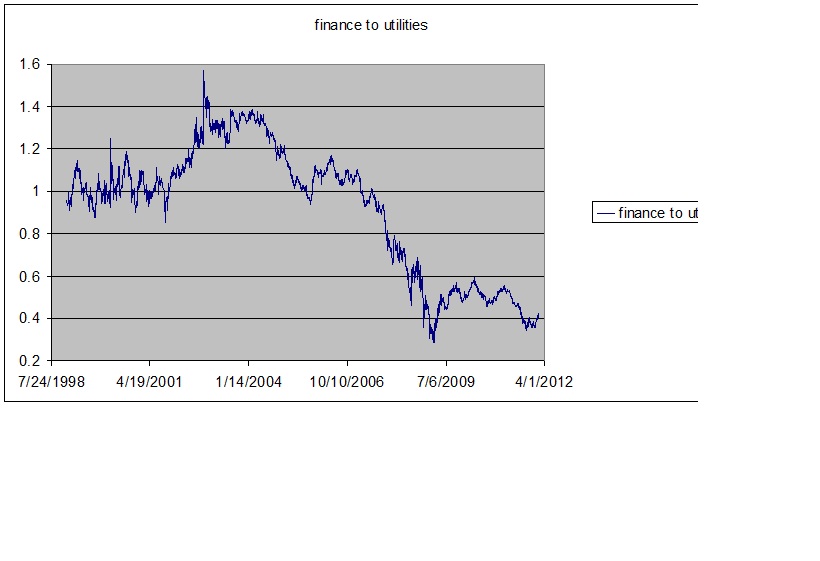
Jan
30
Ten Steps One Should Take to Become a Successful Speculator, from Victor Niederhoffer
January 30, 2012 | Leave a Comment
 I am often asked what ten steps one should take to become a successful speculator.
I would start by reading the books of the 19th century speculators, 50 Years in Wall Street, The Reminiscences of a Stock Operator by Markman, and others.
Next I would read the papers of Alfred Cowles in the 1920s and try to compute similar statistics on runs and expectations for 5 or 10 markets.
Third I would get or write a program to pick out random dates from an array of prices, and see what regularities you find in it compared to picking out actual event or market based events.
Fourth, I would read Malkiel's book A Random Walk Down Wall Street and update his findings with the last 2 years of data.
Fifth, I would look at the work of Sam Eisenstadt of Value Line and see if you could replicate it in real life with updated results.
Sixth, I would start to keep daily prices, open, high, low, and close for 20 of so markets and individual stocks and go back a few years.
Seventh, I would go to a good business library and look at the old Investor Statistical Laboratory records of prices to see whether it gave you any insights.
Eighth, I would look for times when panic was in the air, and see if there were opportunities to bring out the canes on a systematic basis.
Ninth, I would apprentice myself to a good speculator and ask if I could be a helpful assistant without pay for a period.
Tenth, I would become adept at a field I knew and then try to apply some of the insights from that field into the market.
Eleventh, I would get a good book on Statistics like Snedecor or Anderson and be able to compute the usual measures of mean, variance, and regression in it.
Twelfth, I would read all the good financial papers on SSRN or Financial Analysts Journal to see what anomalies are still open.
Thirteenth, of course would be to read Bacon, Ben Green, and Atlas Shrugged.
I guess there are many other steps that should be taken that I have left out especially for the speculation in individual stocks. What additional steps would you recommend? Which of mine seem too narrow or specialized or wrong?
Rocky Humbert writes:
 All the activities mentioned are educational, however, notably missing is a precise definition of a "successful speculator." I think providing a clear, rigorous definition of both of these terms would be illuminating and a necessary first step — and the definition itself will reveal much truth.
Anatoly Veltman adds:
I think with individual stocks: one would have to really understand the sector, the company's niche and be able to monitor inside activity for possible impropriety. Individual stocks can wipe out: Bear Stearns deflated from $60 to $2 in no time at all. In my opinion: there is no bullet-proof technical approach, applicable to an individual enterprise situation.
A widely-held index, currency cross or commodity is an entirely different arena. And where the instrument can freely move around the clock: there will be a lot of arbitrage opportunities arising out of the fact that a high percentage of participation is inefficient, limited in both the hours that they commit and the capital they commit between time-zone changes. Small inefficiencies can snowball into huge trends and turns; and given the leverage allowed in those markets - live or die financial opportunities are ever present. So technicals overpower fundamentals. So far so good.
Comes the tricky part: to adopt statistics to the fact of unprecedented centralized meddling and thievery around the very political tops. Some of the individual market decrees may be painfully random: after all, pols are just humans with their families, lovers, ills and foibles. No statistical precedent may duly incorporate such. Plus, I suspect most centralized economies of current decade may be guilty of dual-bookeeping. Those things may also blow up in more random fashion than many decades worth of statistics might dictate. Don't tell me that leveraged shorting and flexionic interventions existed even before the Great Depression. Today's globalization, money creation at a stroke of a keyboard key, abominable trends in income/education disparity and demographics, coupled with general new low in societal conscience and ethics - all combine to create a more volatile cocktail than historical market stats bear out. 2001 brought the first foreign act of war to the American soil in centuries. I know that chair and others were critical of any a money manager strategizing around such an event. But was it a fluke, or a clue: that a wrong trend in place for some time will invariably produce an unexpected event? Why can't an unprecedented event hit the world's financial domain? In the aftermath of DSK Sofitel set-up, some may begin imagining the coming bank headquarter bombing, banker shooting or other domestic terrorism. I for one envision a further off-beat scenario: that contrary to expectations, the current debt spiral will be stopped dead. Can you imagine next market moves without the printing press? Will you find statistical precedent of zooming from 2 trillion deficit to 14 trillion and suddenly stopping one day?
Craig Mee comments:
 Very generous post, thanks Victor…
I would add, in this day and age, learn tough typing and keyboard skills for execution and your way around a keyboard, so you don't wipe off a months profit in the heat of battle. I would also add, learn ways of speed reading and information absorption, though these two may be more "what to do before you start out".
Gary Rogan writes:
Anatoly, I don't think really understanding the sector and and the niche is all that useful unless one knows what's going on as well as the CEO of the company, which means that in general understanding quite a bit about the company isn't useful to anyone without access to enormous amount of information. It's the subtle, little, invisible things that often make all the difference. There are a lot of people who know a lot about pretty much any company, so to out-compete them based on knowledge is usually pretty hopeless. It is nevertheless sometimes possible to out-compete those with even better knowledge by sticking with longer horizons or by being a better processor of information, but it's rare.
That said, it has been shown repeatedly that some combination of buying stocks that are out of favor by some objective measure, possibly combined with some positive value-creation characteristics, such as return on invested capital, do result in market-beating return. Certainly, just about any equity can go to essentially zero, but that's what diversification is for.
Jeff Watson adds:
 In the commodities markets it's essential to cultivate commercials who trade the same markets as you(especially in the grains.) One can glean much information from a commercial, information like who's buying. who's selling, who's bidding up the front month, who's spreading what, who's buying one commodity market and selling another, etc. When dealing with a commercial, be sure to not waste his time and have some valuable information to offer as a quid pro. Also, one necessary skill to develop is to determine how much of a particular commodity is for sale at any given time…. That skill takes a lot of experience to adequately gauge the market. Also, in addition to finding a good mentor, listen to your elders, the guys who have been successful speculators for decades, the guys who have seen and experienced it all. Avoid the clerks, brokers, backroom guys, analysts, touts, hoodoos etc. Learn to be cold blooded and be willing to take a hit, even if you think the market might turn around in the future. Learn to avoid hope, as hope will ultimately kill your bankroll. When engaged in speculation, find one on one games like sports, cards, chess, etc that pit you against another person. Play these games aggressively, and learn to find an edge. That edge might translate to the markets. Still, while being aggressive in the games, play a thinking man's game, play smart, and learn to play a strong defensive game……a respect for the defense will carry over to the way you approach the markets and defend your bankroll. Stay in good physical shape, get lots of exercise, eat well, avoid excesses.
Leo Jia comments:
Given that manipulation is still prevalent in some Asian markets, I would add that, for individual stocks in particular, one needs to understand manipulators' tactics well and learn to survive and thrive under their toes.
Bruno Ombreux writes:
Just to support what Jeff said, you really have to define which market you are talking about. Because they are all different. On one hand you have stuff like S&P futures with robots trading by the nanosecond, in which algorithms and IT would be the main skill nowadays, I guess. On the other hand, you have more sedate markets with only a few big players. This article from zerohedge was really excellent. It describes the credit market, but some commodity markets are exactly the same. There the skill is more akin to high stake poker, figuring out each of your limited number of counterparts position, intentions and psychology.
Rocky Humbert adds:
I note that the Chair ignored my request to precisely define the term "successful speculator," perhaps because avoiding such rigorousness allows him to define success and speculation in a manner as to avoid acknowledging his own biases. I'd further suggest that his list of educational materials, although interesting and undoubtedly useful for all students of markets, seems biased towards an attempt to make people to be "like him."
If gold is up a gazillion percent over the past decade, and you're up 20%, are you a successful speculator?If the stock market is down 20% over a six month period, and you're down 2%, are you a successful speculator?If you have beaten the S&P by 20 basis points/year, ever year, for the past decade, without any meaningful drawdowns, are you a successful speculator?If you trade once every year or two, and every trade that you do makes some money, are you a successful speculator?
If you never trade, can you be a successful speculator?
If you dollar cost average, and are disciplined, are you a successful speculator?
If you compound at 50% per year for 10 years, and then lose everything in an afternoon, are you a successful speculator?
If you lose everything in an afternoon, and then learn from your mistake, and then compound at 50% for the next 10 years, are you a successful speculator?
If you compound at 6% per year for 10 years, and never have a meaningful drawdown, are you a successful speculator?
If the risk free rate is 6%, and you are making 12%, are you a more successful speculator then if the risk-free rate is 0% and you are making 6%?
If you think you are a successful speculator, can you really be a successful speculator?
If you think you are not a successful speculator, can you be a successful speculator?
Who are the most successful speculators of the past 100 years? Who are the least successful speculators of the past 100 years?
An anonymous contributor adds:
 In conjunction with the chair's mention of valuable books and histories, I would append Fred Schwed's Where are the Customers' Yachts?.
While ostensibly written with a tongue-in-cheek hapless outsider view of 1920s and 1930s Wall Street, it has provided as many lessons and illustrations as anything by Henry Clews. In this case, I am reminded of the chapter in which Schwed wonders if such a thing as superior investment advice actually exists.
Pete Earle writes:
It is my opinion that the first thing that the would-be speculator should do, even before undertaking the courses of actions described by our Chair, is to open a small brokerage account and begin plunking around in small size, getting a feel for the market, the vagaries of execution quality, time delays, and the like. That may serve to either increase the appetite for such knowledge, or nip in the bud what could otherwise be a long and frustrating journey.
Kim Zussman adds:
The obligatory Wikipedia* definition of speculation is investment with higher risk:
Speculating is the assumption of risk in anticipation of gain but recognizing a higher than average possibility of loss. The term speculation implies that a business or investment risk can be analyzed and measured, and its distinction from the term Investment is one of degree of risk. It differs from gambling, which is based on random outcomes.
There is nothing in the act of speculating or investing that suggests holding times have anything to do with the difference in the degree of risk separating speculation from investing
By this definition one must define risk and decide what comprises high and low risk — which may be simple in extreme cases but (as we have seen repeatedly) is not very straightforward in financial markets
*Chair is quoted in the link
Alston Mabry writes in:
I'm successful when I achieve the goals I set for myself. And rather than a target in dollars or basis points or relative to any index or ex-post wish list, those goals may simply be to act with discipline in implementing a plan and then accepting the results, modifying the plan, etc.
Anatoly Veltman adds:
And don't forget Ed Seykota: "Everyone gets out of the market what they want". I find that everyone gets out of life what they want.
Plenty a market participant is not in it to make money. Fantastic news for those who are!
Bruno Ombreux writes:
This will actually bring me back to the question of what is a successful speculator.
In my opinion success in life is defined in having enough to eat, a roof, friendships and a happy family (as an aside, after near-death experiences, people tend to report family first). You can forget stuff like being famous, leaving a legacy or being remembered in history books. If you are interested in these things, you have chosen the wrong business. Nobody remembers traders or businessmen after their death except close family and friends. People who make history are military and political leaders, great artists, writers…
So you are limited to food, roof, friends and family. Therefore my definition of a successful speculator is a speculator that has enough of these, so that he doesn't feel he needs to speculate. I repeat, "a successful speculator does not need to speculate."
Paolo Pezzutti adds:
I simply think that a successful speculator is one who makes money trading. Among soccer players Messi, Ibrahimovic are considered very successful. They consistently score. They experience short periods without scoring. Similarly, traders should have an equity line which consistently prints new highs with low volatility and a short time between new highs. Like soccer players and other athletes it is their mental characteristics the main edge rather than knowledge of statistics. One can learn how to speculate but without talent cannot play the champions league of traders and will print an equity line with high drawdowns struggling losing too much when wrong and winning too little when right. Before dedicating time to find a statistical edge in markets one should assess his own talent and train psychologically. In this regard I like Dr Steenbarger work. In sports as in trading you very soon know yourself: your strengths and weakness. There is no mercy. You are exposed and naked. This is the greatness and cruelty of markets and competition. This is the area where one should really focus in my opinion.
Steve Ellison writes:
To elaborate a bit on Commander Pezzutti's definition, I would consider a successful speculator one who has outperformed a relevant benchmark for annual returns over a period of five years or more. Ideally, the outperformance should be statistically significant, but market returns can be so noisy that it might take much of a career to attain statistical significance.
Jeff Rollert writes:
I propose a successful speculator dies wealthy, with many friends. Wealth is not measured just in liquid terms.
Should a statistical method be preferred, I suggest he is the last speculator, with capital, from all the speculators of his college class.
In both cases, I suggest the Chair and Senator are deemed successful, each in their own way.
Leo Jia adds:
If I may wager my 2 cents here.
I would define a successful speculator as someone who has achieved a record that is substantially above the average record of all speculators in percentage terms during an extended period of time. The success here means more of a caliber that one has acquired which is manifested by the long-term record. Similarly regarded are the martial artists. One is considered successful when he has demonstrated the ability to beat substantially more than half of the people who practice martial arts, regardless of their styles, during an extended period of time. It doesn't mean that he should have encountered no failures during that time - everyone has failures. So, even if that successful one was beaten to death at one fight, he is still regarded as a successful martial artist because his past achievements are well revered.
With this view, I will try to answer Rocky's questions to illustrate.
Julian Rowberry writes:
An important step is to get some money. Preferably someone else's. [LOL ]
Jan
22
Multiple Comparisons of Multiple Expiry, from Kim Zussman
January 22, 2012 | Leave a Comment
Over the past 24 months (through Dec 2011), checked SPY returns for options expiry Fridays ("0"), as well as the individual day's returns counting from 5 days prior to expiry to expiry +5. Here are daily (close-close) returns compared to zero:
One-Sample T: -5, -4, -3, -2, -1, 0, 1, 2, 3, 4, 5
Test of mu = 0 vs not = 0
Var N Mean StDev SE Mean 95% CI T
-5 24 0.00120 0.0111 0.0022 (-0.0034, 0.0058) 0.53
-4 24 -0.00106 0.0086 0.0017 (-0.0047, 0.0026) -0.60
-3 24 0.00179 0.0108 0.0022 (-0.0027, 0.0063) 0.81
-2 24 -0.00075 0.0092 0.0018 (-0.0046, 0.0031) -0.40
-1 24 -0.00201 0.0141 0.0028 (-0.0079, 0.0039) -0.69
0 24 -0.00090 0.0099 0.0020 (-0.0050, 0.0032) -0.45
1 24 -0.00089 0.0102 0.0020 (-0.0052, 0.0034) -0.43
2 24 0.00064 0.0137 0.0028 (-0.0051, 0.0064) 0.23
3 24 -0.00087 0.0113 0.0023 (-0.0056, 0.0039) -0.38
4 24 0.00120 0.0156 0.0031 (-0.0054, 0.0078) 0.38
5 24 0.00396 0.0099 0.0020 (-0.0002, 0.0081) 1.95
By chance alone you might expect 1/20 to test significantly; in this case 1/11 did: only day +5 approached (+0.4%, T=1.95)
Jan
14
Equities and Bonds, from Kim Zussman
January 14, 2012 | Leave a Comment
The attached charts the ratio SPY/TLT 2002-present [The S&P ETF vs the US Treasury ETF]. The current ratio of about 1.06 is near the bottom of the post 08-09 crisis range, but still far from the bottom reached in March 2009.

Victor Niederhoffer writes:
This illustrates the wisdom of the proverb "there is always a web between markets but the web is always changing". Conversely nothing exemplifies this proverb better than the shifting relation between fixed income and stocks.
Alston Mabry adds:
Just as an exploratory reminder to myself, attached is a chart showing the variations in 60-day correlations between two 1000-day series (of % changes) generated randomly but with an overall correlation of -0.3. In other words the true correlation is -0.3 but we pretend we don't know that and measure the 60-day sampled correlation.

Ken Drees adds:
Zussman's chart makes one think about potential energy–the buildup of potential change as one sector grows larger than the other.
Alston Mabry adds:
And again, just to see what it looks like, here's the rolling 20-period correlation for the weekly % changes of Dr Z's SPY and TLT.

Finally, one last chart, combining the previous two ideas: the rolling 20-week correlation of SPY and TLT, graphed with the rolling 20-period correlation of two random series with the same overall correlation as SPY-TLT (-0.41).

Jan
7
Joshua Bell and Put Up Jobs, from Stefan Jovanovich
January 7, 2012 | Leave a Comment

By now you have probably read the Pulitzer prize winning Washington Post article about violinist Joshua Bell performing in the D.C subway.
You have to love the Posties; if they can find a way to diminish and demean their own subscribers, they go for it - because they know that their newspaper can only continue to be the font of wisdom as long as the civil servants believe they have to read it each morning.
Playing Bach in a subway station is like playing baseball indoors; all the skill in the world can't make it anything but a nuisance.
P.S. Bell's virtuosity is unchallengable; his musicianship, like Midori's, so dreadfully earnest that, of course, it gets an A+ from the Wurlitzers of record and requires an audience full of schoolies full of superior appreciation.
Kim Zussman writes:
Aesthetics and taste are subjective and subject to presentation. Examples include statistical inconsistency in rating fine wine and celebrities out of context. When you meet so-called "knock out" actresses in person, more often the surprise is disappointment.
Russ Sears writes:
I am in the middle of reading "Thinking Fast and Slow" by Daniel Kahneman. It tries to describe what psychologist "know" about how intuition (fast thinking) and analysis (slow thinking) work and work together. I will try to give a more complete report once I am finished with it.
However, briefly it mainly describes how thinking creates biases, while at the same time tries to show respect and analyze how amazing "thinking" is.
One of the biases: it is clear most people underestimate the persuasiveness of their surrounding to their effect on their mood, judgment and decision making with even subtle unperceived differences he calls "priming". Such things as a poster with big eyes in the room with a "honor box" for coffee greatly increases the amount put in the box. And a forced smile creates happier people much later.
In the intro- he implied that his main criticism has been the of focusing on the biases rather than the strengths of "thinking", However, so far my main criticism is his over generalizations, and insistence that these studies prove "we" (all of us) are victims of these biases. And so far the book seem to imply that only through analysis (by such studies) can these be recognized and "we" overcome them. Yet, I would suggest that many of the more successful and happy people's "edge" comes from intuitively having perceived many of these biases early on in their lives and having made adjustments to offset them…without perhaps knowing the "science" behind "why".
Such are the people that stopped for the music in the subway station. Even though primed to ignore it. Yet while he insist that "all" are victims of specific biases. Their is perhaps in total evidence that we all accept, the possibility of biases for the power of thinking. But it is natural for life to perceive that they are the superior different one in overcoming these biases. The violinist show many think they would stop and listen, but few actually do.
Even so, the book thinking fast and slow has given me much to think about, and I would recommend it to all.
Dan Grossman writes:
 As a former violinist, I had enjoyed the You Tube video and the seeming fact Bell would play incognito in the subway. But I hadn't realized it was a put-up job by the Washington Post.
It's like all those Kahneman and Tversky experiments everyone is so excited about to show there's no rational man that economics is based on, where students play games with small amounts of money given to them.Contrary to that famous fairness experiment, if the student in the real world were negotiating to divide $1 million dollars of real money and he had the choice of getting 10% ($100,000) or nothing, while the other player got 90%, he would take the $100,000.
Victor Niederhoffer adds:
One would add that when Bell plays, his body movements are very poetic and add immeasurably to the sense of music of the audience. Presumably because this was a set up job similar to what Prof Phil pointed out vis a vis the tag team of beggars and homeless brought in to keep man small, and the chair to his credit first brought to the attention of the list vis a vis The Port Authority in New York, which is always laden with the beggars and homeless to keep man small, a la Ayn Rand's essay on Victor Hugo's The Compafriros, the maimed in Spain raised to show how bad the lot of some people can be relative to the feudal existence of the masses, one can assume that Joshua did not make those body movements and twists and turns that lets the audience know he is really making music, so that it would be more likely that the Wash Post could prove the point that no one would notice. 31 bucks on the other hand seems pretty good considering the lack of charity in workers in the beltway who are living off the fruit of other peoples labor.
Jan
5
A Little Boy Says, from Victor Niederhoffer
January 5, 2012 | Leave a Comment
 A little boy says, "Guess what I'm thinking?". I say "when are we going to play monkey in the middle." The little boy says, "No. I'm thinking of when I am going to be a millionaire?". I ask him when he thinks that will be? He says, "maybe when I'm 10 or 12."
Anatoly Veltman writes:
1. Can't be sure (but the way a few trillion ballooned to 14 trillion deficit), everyone may be a millionaire by then.
2. Can't be sure which prof. on my first day in Business School said: general goals (like becoming rich) don't get one there. It is a step-ladder plan of how to get there that may.
3. Can't be sure of precise spelling after all these years (was it Sir Brian Bixley?), but he introduced "marginal utility" to my Microeconomics 101 audience in an entertaining fashion of "villas at the cote d'azur" vs hamburgers. He further confided that his goal in life was to die with his debt maximized! I pray he hasn't delivered just yet — and is alive and well.
4. Can be sure of one thing. He, of all the lucky kids, will well receive his early lesson: The richest are not the people who have the most. They are the people who need the least.
Kim Zussman adds:
From Greg Mankiw
"De Gustibus non est Taxandum"
Bryan Caplan quotes a passage from Daniel Kahneman's Thinking, Fast and Slow (which I have not read, but plan to):A large-scale study of the impact of higher education… revealed striking evidence of the lifelong effects of the goals that young people set for themselves. The relevant data were drawn from questionnaires collected in 1995-1997 from approximately 12,000 people who had started their higher education in elite schools in 1976. When they were 17 or 18, the participants had filled out a questionnaire in which they rated the goal of "being very well-off financially" on a 4-point scale ranging from "not important" to "essential."…Goals make a large difference. Nineteen years after they stated their financial aspirations, many of the people who wanted a high income had achieved it. Among the 597 physicians and other medical professionals in the sample, for example, each additional point on the money-importance scale was associated with an increment of over $14,000 of job income in 1995 dollars!In other words, one reason that people differ in their incomes is that some people care more about having a high income than others.
Russ Sears writes:
For kids, both money and numbers are largely abstractions. I would suggest that one of the important lessons a parent is to give to kids is to understand how money relates to the reality of "being very well off financially" or goals they set in general. From what I have observed most parents do not tie the kids life goals into what financial steps it takes to get there. While a young kid, parents want to teach their kids not to worry about money, that it is their responsibility to take care of them and supply their needs and wants. Both the epidemic now the norm of assumed "adultlescence" of young 20 somethings (why else would 26 year old need to still be on Mom and Dad's health insurance) and the now common "failure to launch" of young adults suggest that many parents are not doing their kids any favors by perpetuating this when their kids are in their teens.
I would suggest that parents talk about what is expected of the teen starting to go to college, and give a dollar figure to both the profession and life styles young teens and kids talk about when they talk about what they want to do when they "grow-up"; besides just encouraging them to dream and share these dreams.
Jan
3
Article of the Day, from Kim Zussman
January 3, 2012 | Leave a Comment
 Great article on Happiness: "A Wandering Mind is an Unhappy One"
New research underlines the wisdom of being absorbed in what you do
By Jason Castro
We spend billions of dollars each year looking for happiness, hoping it might be bought, consumed, found, or flown to. Other, more contemplative cultures and traditions assure us that this is a waste of time (not to mention money). ‘Be present’ they urge. Live in the moment, and there you’ll find true contentment.
Sure enough, our most fulfilling experiences are typically those that engage us body and mind, and are unsullied by worry or regret. In these cases, a relationship between focus and happiness is easy to spot. But does this relationship hold in general, even for simple, everyday activities? Is a focused mind a happy mind? Harvard psychologists Matthew Killingsworth and Daniel Gilbert decided to find out.
In a recent study published in Science, Killingsworth and Gilbert discovered that an unnervingly large fraction of our thoughts - almost half - are not related to what we’re doing. Surprisingly, we tended to be elsewhere even for casual and presumably enjoyable activities, like watching TV or having a conversation. While you might hope all this mental wandering is taking us to happier places, the data say otherwise. Just like the wise traditions teach, we’re happiest when thought and action are aligned, even if they’re only aligned to wash dishes.
The ingredients of simple, everyday happiness are tough to study in the lab, and aren’t easily measured with a standard experimental battery of forced choices, eye-tracking, and questionnaires. Day to day happiness is simply too fleeting. To really study it’s causes, you need to catch people in the act of feeling good or feeling bad in real-world settings.
To do this, the researchers used a somewhat unconventional, but powerful, technique known as experience sampling. The idea behind it is simple. Interrupt people at unpredictable intervals and ask them what they’re doing, and what’s on their minds. If you do this many times a day for many days, you can start to assemble a kind of quantitative existential portrait of someone. Do this for many people, and you can find larger patterns and tendencies in human thought and behavior, allowing you to correlate moments of happiness with particular kinds of thought and action.
To sample our inner lives, the team developed an iPhone app that periodically surveyed people’s thoughts and activities. At random times throughout the day, a participant’s iPhone would chime, and present him with a brief questionnaire that asked how happy he was (on a scale from 1-100), what he was doing, and if he was thinking about what he was doing. If subjects were indeed thinking of something else, they reported whether that something else was pleasant, neutral, or unpleasant. Responses to the questions were standardized, which allowed them to be neatly summarized in a database that tracked the collective moods, actions, and musings of about 5000 total participants (a subset of 2250 people was used in the present study).
In addition to awakening us to just how much our minds wander, the study clearly showed that we’re happiest when thinking about what we’re doing. Although imagining pleasant alternatives was naturally preferable to imagining unpleasant ones, the happiest scenario was to not be imagining at all. A person who is ironing a shirt and thinking about ironing is happier than a person who is ironing and thinking about a sunny getaway.
What about the kinds of activities we do, though? Surely, the hard-partiers and world travelers among us are happier than the quiet ones who stay at home and tuck in early? Not necessarily. According to the data from the Harvard group’s study, the particular way you spend your day doesn’t tell much about how happy you are. Mental presence -the matching of thought to action - is a much better predictor of happiness.
The happy upshot of this study is that it suggests a wonderfully simple prescription for greater happiness: think about what you’re doing. But be warned that like any prescription, following it is very different from just knowing it’s good for you. In addition to the usual difficulties of breaking bad or unhelpful habits, your brain may also be wired to work against your attempts stay present.
Recent fMRI scanning studies show that even when we’re quietly at rest and following instructions to think of nothing in particular, our brains settle into a conspicuous pattern of activity that corresponds to mind-wandering. This signature ‘resting’ activity is coordinated across several widespread brain areas, and is argued by many to be evidence of a brain network that is active by default. Under this view our brains climb out of the default state when we’re bombarded with input, or facing a challenging task, but tend to slide back into it once things quiet down.
Why are our brains so intent on tuning out? One possibility is that they’re calibrated for a target level of arousal. If a task is dull and can basically be done on autopilot, the brain conjures up its own exciting alternatives and sends us off and wandering. This view is somewhat at odds with the Killingsworth and Gilbert’s findings though, since subjects wandered even on ‘engaging’ activities. Another, more speculative possibility is that wandering corresponds to some important mental housekeeping or regulatory process that we’re not conscious of. Perhaps while we check out, disparate bits of memory and experience are stitched together into a coherent narrative – our sense of self.
Of course, it’s also possible that wandering isn’t really ‘for’ anything, but rather just a byproduct of a brain in a world that doesn’t punish the occasional (or even frequent) flight of fancy. Regardless of what prompts our brains to settle into the default mode, its tendency to do so may be the kiss of death for happiness. As the authors of the paper elegantly summarize their work: “a human mind is a wandering mind, and a wandering mind is an unhappy mind.”
On the plus side, a mind can be trained to wander less. With regular and dedicated meditation practice, you can certainly become much more present, mindful, and content. But you’d better be ready to work. The most dramatic benefits only really accrue for individuals, often monks, who have clocked many thousands of hours practicing the necessary skills (it’s not called the default state for nothing).
The next steps in this work will be fascinating to see, and we can certainly expect to see more results from the large data set collected by Killingsworth and Gilbert. It will be interesting to know, for example, how much people vary in their tendency to wander, and whether differences in wandering are associated with psychiatric ailments. If so, we may be able to tailor therapeutic interventions for people prone to certain cognitive styles that put them at risk for depression, anxiety, or other disorders.
In addition to the translational potential of this work, it will also be exciting to understand the brain networks responsible for wandering, and whether there are trigger events that send the mind into the wandering or focused state. Though wandering may be bad for happiness, it is still fascinating to wonder why we do it.
Jan
2
Stock Correlation Within Index, from Kim Zussman
January 2, 2012 | Leave a Comment
Stocks have more correlated recently than any time over the past 30 years:
1. Correlation between assets and asset classes increases during panic/selloff mode, but in 2011 the stock market finished flat
2. One would expect increasing deployment of ETF's and other index derivatives to increase individual stock correlation per unit volatility over time, but are there other explanations? ZIRP, globalization of markets, HFT, abandonment of stock-picking in favor of beta exposure, other?
3. Is stock correlation mean-reverting (as suggested by the chart), or is there a secular move toward high correlation?
3a. Does high correlation create stock-picking opportunities (babies with bathwater)? Will the type of stocks which traditionally did well after high-correlation periods do well if/when the current high correlation moderates?
4. Does the cause and effect of asset-class correlation differ from stock correlation? Does asset-class decoupling have predictive value (eg commodities, stocks, treasuries in 2011)?
Dec
30
Russian Voting Statistical Anomalies, from Kim Zussman
December 30, 2011 | 1 Comment
There's an interesting WSJ article on recent Russian parliamentary election (subscription required for now though):
Data analysis shows higher % voting for the "United Russia" party in districts with round numbers of voter turnout (ie, 70%, 75%, 80%, etc) as well as for districts with unusually high turnout (>=98%). Strongly suggests ballot stuffing, manufactured counts, etc.
Evidently vaunted Russian mathematicians are not part of the current apparatchik.
Dec
22
More Cheap (Apparently) Stock Tidbits, from Charles Pennington
December 22, 2011 | 1 Comment
The Dec. 12 Barron's, page 32, lists some big cap stocks that have big cash holdings.
I list them in a table below, along with Value Line projections for 2012 earnings, and an "adjusted" P/E–the (price-cash)/earnings, which makes sense if you sort of assume that the cash earned nothing.
column labels:
ticker / cash per share / price / 2012 earnings from ValueLine / (price-cash)/earnings
msft $7 $26 $2.80 7
csco $8 $18 $1.45 7
goog $129 $630 $40 12.5
orcl $6 $29 $2.42 9.5
jnj $11 $64 $5.25 10
pfe $5 $21 $1.60 10
aapl $87 $395 $32.50 9.5
cvx $10 $103 $13.10 7
wlp $53 $65(!) $7.70 1.3
amgn $19 $61 $5.50 7.5
As has been observed here before, stocks are pretty cheap these days.
Kim Zussman adds:
On the subject of AMGN, one of my first posts on spec-list was "Amgen in P/E Stratosphere", ca 2004 or so. Though having no local insights about the stock, the then high P/E ratio was subsequently rectified in the denominator. (and has remained range-bound in Russian fashion since).
Presumably high-flying growth stocks either become value with dividends (also see MSFT) or debubblize (also see HOV, AMD, etc.
Dec
19
All That Glitters Isn’t Silver, from Kim Zussman
December 19, 2011 | 1 Comment
Here is the ratio of GLD/SLV (gold to silver ETFs), 2006-present.

The mean ratio over the past 5 years is 5.6. From July to October 2008 GLD/SLV spiked — possibly evidencing flight to safety (gold being safer than silver as silver oxidizes and you have to keep polishing it). The ratio gradually declined, then plummeted from August 2010 to April 2011. Over the past 8 months GLD/SLV rose to the current 5.4 - quite near the 5 year mean.
In hindsight, there was some good spread trading in silver and gold [link to music video].
Dec
19
War Premium Over? from Kim Zussman
December 19, 2011 | Leave a Comment
Using Wiki data there does appear to be a reduction in % of world population killed in war over time.
http://en.wikipedia.org/wiki/List_of_wars_and_anthropogenic_disasters_by_death_toll
The high and low death toll estimates were averaged for the dependent variable, and the mid-point year of the war period was used as the independent variable. Regressing mean estimated % of world population killed in war vs year:
The regression equation is
mean est % world pop killed = 9.94 - 0.00466 avg year
Predictor Coef SE Coef T P
Constant 9.938 2.693 3.69 0.001
avg year -0.005 0.0016 -2.97 0.007
S = 3.26307 R-Sq = 29.6% R-Sq(adj) = 26.2%
>>Significant; year explains 26% of the variance. However a plot suggests though war has become less deadly over time, it is more frequent.

Dec
15
Top 5 Regrets in Life, from Jeff Watson
December 15, 2011 | 2 Comments
 Have you seen this article about the top 5 regrets of the dying? It is a must read.
Gary Rogan writes:
I really liked all of them, except based on everything that I know I disagree with the statement that "happiness is a choice". Irrational fears are not a choice, depression is not a choice, and neither is happiness.
Gibbons Burke writes:
Well, happiness is dependent on one's attitude, and in many cases, you can choose, control or direct your attitude.
My theory is unhappiness and depression happen when reality does not live up to one's expectations of what life is "supposed" to be like. I think the key to happiness is letting go of those expectations. That action at least is within an individuals purview and control. There is an old Zen maxim: If you are not happy in the here and now, you never will be.
Russ Sears adds:
I think most irrational fears and depression stem from the unintended consequences of one's choices or often, the lack of decisions, such as little or no exercise. However, I believe many of these choices are made when we are children, and we do not fully understand the consequences. Many of these bad choices may be taught often though example by adults or sometimes it is just one's unproductive coping methods that are simply not countered with productive coping methods by the adults in their lives. I think some people are more prone to fall into these ruts, but most of these ruts are dug none the less.
Jim Sogi writes:
The regrets are perhaps easily said on the deathbed but implementing these choices in life is very difficult. Many can not afford the luxury of such choices. When there is no financial security hard work is a necessity. Such regrets are not much different than daydreams such as, oh I wish I could live in Hawaii and surf everyday. The fact of the matter is that the grass always seems greener on the other side. Speak to the lifestyle guys in their old age. Will they say I wish I worked harder and had a career and made more meaning of life than being a ski bum or surf bum?
Gary Rogan responds:
What you say is true about the effects of exercise. But that's just one of many factors that are biochemical in nature. Pre-natal environment, genetics, and related chemical balances and imbalances are highly important in the subjective perception of the level of happiness. There are proteins in your brain that effect how the levels of happiness-inducing hormones and neurotransmitters are regulated and there is nothing you can do about it without a major medical intervention. Certainly some choices that people make affect their eventual subjective perceptions through the resultant stresses and satisfying achievements in their lives, so the choice part of it can clearly be argued. My main point was that by the time the person is an adult, their disposition is as good as inherited. They can vary the levels of subjective perception of happiness around that level through their actions, but they are still stuck with the range, mostly through no fault or choice of their own.
Since a few literally quotations on the subject have been posted, let me end with the quote from William Blake that was used before the chapter on the biological basis of personality I recently read:
Every Night & every Morn
Some to Misery are Born.
Every Morn & every Night
Some are Born to sweet Delight.
Ken Drees writes in:
I believe that you must put effort towards a goal and that exercise in itself begets a reward that bends toward happiness. It's the journey, not the end result. You must cultivate to grow. A perfectly plowed field left untended grows weeds–the pull is down if nothing is done.
Russ Sears adds:
 It has been my experience with helping others put exercise into their lives that few teens and young adults have reached such a narrow range that they cannot achieve happiness in their lives. This would include people that have been abused and people that have a natural dispensation to anxiety. Their "range" increases often well beyond what we are currently capable of achieving with "major medical intervention". As we age however our capacity to exercise decreases. While the effects of exercise can still be remarkable; they too are limited by the accelerated decay due to unhappiness within an older body's capacity. Allowing time for our bodies is an art. Art that can bring the delights of youth back to the old and a understanding of the content happiness of a disciplined life to the young.
Peter Saint-Andre replies:
Horsefeathers.
Yes, hard work is often a necessity. But hard work does not prevent one from pursuing other priorities in parallel (writing, music, athletics, investing, whatever you're interested in). Very few people in America have absolutely no leisure time — in fact they have a lot more leisure time than our forebears, but they waste it on television and Facebook and other worthless activities.
Between working 100 hours a week (which few do) and being a ski bum (which few also do) there lies the vast majority of people. Too many of them have ample opportunity to bring forth some of the songs inside them, but instead they fritter their time away and thus end up leading lives of quiet desperation.
It does not need to be so.
Dan Grossman adds:
Jim Sogi has a good point. The deathbed regret that one didn't spend more time with one's family is frequently an unrealistic cliche, similar to fired high level executives expressing the same sentimental goal.
The fact is that being good at family life is a talent not everyone has. And family life can be difficult, messy and not easy to make progress with. Which is perhaps one of the reasons more women these days prefer to have jobs rather than deal all day with family.
Being honest or at least more realistic on their deathbeds, some people should perhaps be saying "I wish I had spent more time building my company."
Rocky Humbert comments:
 I feel compelled to note that this discussion about deathbed regrets has been largely ego-centric (from the viewpoint of the bed's occupant) — rather than the perspective of those surrounding the deathbed. I've walked through many a cemetery, (including the storied Kensico Cemetery) and note the preponderance of epitaphs that read: "Loving Husband,"; "Devoted Father," ; "Devoted Mother," and the absence of any tombstones that read: "King of Banking" or "Money Talks: But Not From the Grave."
Notably, Ayn Rand's tombstone in Kensico is devoid of any comments — bearing just her year of birth and death. (She is, however, buried next to her husband.)
In discussing this with my daughter (who recently acquired her driver's license/learning permit), I shared with her the ONLY memory of my high school driver's ed class. (The lesson was taught in the style of an epitaph.):
"Here lies the body of Otis Day.
He died defending his right of way.
He was right; dead right; as he drove along.
But now he's just as dead, as if he'd been wrong."
Kim Zussman writes:
Is an approach of future regret-minimization equivalent to risk-aversion?
Workaholic dads have something to show for their life efforts that Mr. Moms don't, and vice-versa.
If so, perhaps the only free epithet is to diversify devotions — at the expense of reduced expectation of making a big mark on the world or your family.
Dec
7
No Lost Decade for S&P EW, from Kim Zussman
December 7, 2011 | Leave a Comment
Small cap stock out-performance explains at some or all of the equal-weighted SP500 out performing the cap-weighted version. The attached is the ratio of two tradeable ETF's: IWM (Russell 2000 stocks) and SPY (SP500 cap weighted), from May 2000 to present.
On a weekly-return basis, though IWM was was more than 2X higher than SPY they were not significantly different:
Two-Sample T-Test and CI: IWM week, SPY week
Two-sample T for IWM week vs SPY week
N Mean StDev SE Mean
IWM week 601 0.0016 0.0341 0.0014 T=0.6
SPY week 601 0.0006 0.0271 0.0011
Though as expected IWM did have significantly higher volatility:
Test for Equal Variances: IWM week, SPY week
95% Bonferroni confidence intervals for standard deviations
N Lower StDev Upper
IWM week 601 0.0320 0.0341 0.0364
SPY week 601 0.0254 0.0271 0.0289
F-Test (normal distribution)
Test statistic = 1.58, p-value = 0.000
Levene's Test (any continuous distribution)
Test statistic = 24.34, p-value = 0.000

Dec
4
What is the Fuel for Melt-Ups, from Kim Zussman
December 4, 2011 | Leave a Comment
Last week SPX gained 7.4%. For prior big up weeks (gaining at least 3%) going back to 1950, what was the maximum drop over the prior 20 weeks? To check this, identified the largest decline from the highest weekly close of the prior 20 weeks to the week before the big up (>+3%).
Since 1950, there there were 191 weeks that gained at least 3%. Regressing their returns vs the maximal decline of the prior 20 weeks shows that the larger the prior drop the bigger the big up-week:
The regression equation is 3% wk = 0.0354 - 0.0970 pr-wk/max20
Predictor Coef SE Coef T P
Constant 0.0354 0.00142 24.93 0.000
pr-wk/max20 -0.0969 0.01119 -8.67 0.000
S = 0.0136929 R-Sq = 28.4% R-Sq(adj) = 28.1%
The recent +7.4% week was preceded by a maximal 20 week decline of -13.8%. The attached regression graph shows this point outlined -near the upper edge of the data cloud. Arguably last week was somewhat atypical, as most big up-weeks of similar magnitude were preceded by larger maximal declines during the prior 20 weeks.

Steve Ellison elaborates:
My theory is that most large short-term gains in the stock indices are driven by short covering panics and hence occur after price declines. When everybody thinks there is a bull market, there are few shorts. Further advances, if they occur, tend to be slow and steady.
I turned Dr. Zussman's query around and asked, "What is the expectation for a big weekly gain when the S&P 500 is down during the past 20 weeks, compared to when it is up in the last 20 weeks?"
I divided S&P 500 futures weekly changes since 1982 into two groups: those that occured after the net change of the previous 20 weeks was positive, and those that occurred after the net change of the previous 20 weeks was negative. The standard deviation of the one-week net change was 3.2% when the previous 20 weeks were negative and 2.0% when the previous 20 weeks were positive. The distribution of one-week net changes was:
.                                                               Percentile
.                      N         90th    80th      60th    Median     40th       20th
Last 20 weeks down      538     3.7%     2.2%     0.9%   0.4%    -0.3%    -2.0%
Last 20 weeks up        1000     2.4%     1.6%     0.6%   0.2%    -0.2%    -1.4%
Large weekly gains (those in the 80th percentile and above) were 40% to 50% larger when the past 20 weeks were down, but large weekly losses were also larger in magnitude by a similar amount.
As of Friday's close, the S&P 500 futures are down 5% from 20 weeks ago.
Dec
2
10 Common Patterns of Faulty Thinking, from Kim Zussman
December 2, 2011 | 2 Comments
 Here are 10 common patterns of faulty thinking adapted from Dr. David Burns, author of the classic Feeling Good and pioneer of Cognitive Behavioral Therapy:
All-or-Nothing Thinking: Failing to recognize that there may be some middle ground. Characterized by absolute terms like always, never, and forever.
Overgeneralization: Taking an isolated case and assuming that all others are the same.
Mental Filter: Mentally singling out the bad events in one's life and overlooking the positive.
Disqualifying the Positive: Treating positive events like they don't really count.
Jumping to Conclusions: Assuming the worst about a situation even though there is no evidence to back their conclusion.
Magnification and Minimization: Downplaying positive events while paying an inordinate amount of attention to negative ones.
Emotional Reasoning: Allowing your emotions to govern what you think about a situation rather than objectively looking at the facts.
Should Statements: Rigidly focusing on how you think things should be rather than finding strategies for dealing with how things are."
Labeling and Mislabeling: Applying false and harsh labels to oneself and others.
Personalization: Blaming yourself for things that are out of your control.
Nov
25
Flightosafetyometry, from Kim Zussman
November 25, 2011 | Leave a Comment
How have long-term US treasury bonds been used as a refuge from stock volatility over recent years? Bonds tend to rise when stocks are more volatile (and go down), and vice versa.
For every non-overlapping 10-day period (7/02-present), I calculated mean level of US 20+ year Treasury bond ETF "TLT". The data used was NOT adjusted for dividends, in order to reference then-current bond price level without dividend-updrift. For the corresponding 10-day periods, also calculated the volatility of daily SPY returns (SP500 index). From these two series formed the ratio: mean 20+ year treasury level per unit SP500 volatility, the chart of which follows.

From 2002-04, the ratio rose as stock volatility declined while treasury prices remained relatively flat. From 04-late 2006, the ratio was generally high due to many-year lows in stock volatility. From 2007-late 2008 the ratio declined; due to a combination of rising treasury prices and stock volatility which rose more - "flight to safety". The ratio formed a multi-decade bottom in late 2008, then rose due to a combination of falling treasury prices and stock volatility which declined faster. Recently there were two smaller flights to safety when the ratio collapsed in May 2010 and August 2011; both corresponding to treasury prices spiking more than stock volatility marking worry over European sovereign debt.
To the extent that the US FED has attempted to influence longer-term treasury yields over the past year or so, recent treasury price per unit stock volatility appears consistent with the longer term.
Nov
17
Early Rational/Fundamental Bubble, from Kim Zussman
November 17, 2011 | Leave a Comment
Here is a nice paper on "New Evidence on the First Financial Bubble".
Abstract:
« go back — keep looking »The first global financial bubbles occurred in 1720 in France, Great-Britain and the Netherlands. Explanations for these linked bubbles primarily focus on the irrationality of investor speculation and the corresponding stock price behavior of two large firms: the South Sea Company in Great Britain and the Mississippi Company in France. In this paper we collect and examine a broad cross-section of security price data to evaluate the causes of the bubbles. Using newly available stock prices for British and Dutch firms in 1720, we find evidence against indiscriminate irrational exuberance and evidence in favor of speculation about fundamental financial and economic innovations in the European economy. These factors include the emergent Atlantic trade, new institutional forms of risk sharing and the innovative potential of the joint-stock company form itself. These factors ultimately had long-lasting transformative economic effects which may have been anticipated by the markets at the time. We use the cross-sectional data to test the hypothesis that the bubble in 1720 was driven by innovation by dividing the London share market into "old" and "new" economy stocks. We find that firms associated with the Atlantic trade and with the new joint-stock insurance form had the highest price increases and had return dynamics consistent with current models of "New Economy" stocks. New, high frequency data allow us to pinpoint the date of the 1720 crash and track its international propagation.
Archives
- October 2026
- September 2026
- August 2026
- July 2026
- June 2026
- May 2026
- April 2026
- March 2026
- February 2026
- January 2026
- December 2025
- November 2025
- October 2025
- September 2025
- August 2025
- July 2025
- June 2025
- May 2025
- April 2025
- March 2025
- February 2025
- January 2025
- December 2024
- November 2024
- October 2024
- September 2024
- August 2024
- July 2024
- June 2024
- May 2024
- April 2024
- March 2024
- February 2024
- January 2024
- December 2023
- November 2023
- October 2023
- September 2023
- August 2023
- July 2023
- June 2023
- May 2023
- April 2023
- March 2023
- February 2023
- January 2023
- December 2022
- November 2022
- October 2022
- September 2022
- August 2022
- July 2022
- June 2022
- May 2022
- April 2022
- March 2022
- February 2022
- January 2022
- December 2021
- November 2021
- October 2021
- September 2021
- August 2021
- July 2021
- June 2021
- May 2021
- April 2021
- March 2021
- February 2021
- January 2021
- December 2020
- November 2020
- October 2020
- September 2020
- August 2020
- July 2020
- June 2020
- May 2020
- April 2020
- March 2020
- February 2020
- January 2020
- December 2019
- November 2019
- October 2019
- September 2019
- August 2019
- July 2019
- June 2019
- May 2019
- April 2019
- March 2019
- February 2019
- January 2019
- December 2018
- November 2018
- October 2018
- September 2018
- August 2018
- July 2018
- June 2018
- May 2018
- April 2018
- March 2018
- February 2018
- January 2018
- December 2017
- November 2017
- October 2017
- September 2017
- August 2017
- July 2017
- June 2017
- May 2017
- April 2017
- March 2017
- February 2017
- January 2017
- December 2016
- November 2016
- October 2016
- September 2016
- August 2016
- July 2016
- June 2016
- May 2016
- April 2016
- March 2016
- February 2016
- January 2016
- December 2015
- November 2015
- October 2015
- September 2015
- August 2015
- July 2015
- June 2015
- May 2015
- April 2015
- March 2015
- February 2015
- January 2015
- December 2014
- November 2014
- October 2014
- September 2014
- August 2014
- July 2014
- June 2014
- May 2014
- April 2014
- March 2014
- February 2014
- January 2014
- December 2013
- November 2013
- October 2013
- September 2013
- August 2013
- July 2013
- June 2013
- May 2013
- April 2013
- March 2013
- February 2013
- January 2013
- December 2012
- November 2012
- October 2012
- September 2012
- August 2012
- July 2012
- June 2012
- May 2012
- April 2012
- March 2012
- February 2012
- January 2012
- December 2011
- November 2011
- October 2011
- September 2011
- August 2011
- July 2011
- June 2011
- May 2011
- April 2011
- March 2011
- February 2011
- January 2011
- December 2010
- November 2010
- October 2010
- September 2010
- August 2010
- July 2010
- June 2010
- May 2010
- April 2010
- March 2010
- February 2010
- January 2010
- December 2009
- November 2009
- October 2009
- September 2009
- August 2009
- July 2009
- June 2009
- May 2009
- April 2009
- March 2009
- February 2009
- January 2009
- December 2008
- November 2008
- October 2008
- September 2008
- August 2008
- July 2008
- June 2008
- May 2008
- April 2008
- March 2008
- February 2008
- January 2008
- December 2007
- November 2007
- October 2007
- September 2007
- August 2007
- July 2007
- June 2007
- May 2007
- April 2007
- March 2007
- February 2007
- January 2007
- December 2006
- November 2006
- October 2006
- September 2006
- August 2006
- Older Archives
Resources & Links
- The Letters Prize
- Pre-2007 Victor Niederhoffer Posts
- Vic’s NYC Junto
- Reading List
- Programming in 60 Seconds
- The Objectivist Center
- Foundation for Economic Education
- Tigerchess
- Dick Sears' G.T. Index
- Pre-2007 Daily Speculations
- Laurel & Vics' Worldly Investor Articles
