Feb
3
The Holy Grail of Speculation, from Anatoly Veltman
February 3, 2010 | 4 Comments
 To know whether the market is currently trending, you have to accumulate a database of intraday progression over at least 30 trading days; then continue to add to your database and trade concurrently. Let's first discuss "intraday progression".
For each stock, currency or futures contract, you need to define the day's "opening range". For a typical stock or commodity: it may be daytime opening 15min "hi/lo box". For internationally-flavored futures contract, the day may well be starting overnight. For FX currency-pairs: I recommend first 30-60min range of domestic time-zone (e.g. Far East open for AUD and JPY crosses, but N. Am. open for $/CAD). Exercise discretion and make provisions for markets that would commonly tread water in advance of crucial regularly-scheduled news releases, and then significantly gap. Award a score to each day, ranging between -4 and +4, grading intraday price progression out of optimized (consistent) "opening box". A day (will occur less than once a week) that never significantly traded out of the opening-range all the way through the close will get zero. -4, -3, -2 and -1 are bearish mirror progressions of intraday events described below as bullish +1, +2, +3, +4.
The most typical day (about twice a week) will be a 2-pointer, where market will break its opening box to the upside and end anywhere up there. +1 is awarded to a day (about once a week) that didn't close that high; but it did manage to overcome an earlier short-lived break-down and ended back within the box. +3 is given following same weak start but stronger close well above the box (about once a week). +4 is the case of prolonged trading well below the box, surprisingly reversed by a blistering second-half rally ending well above the box (less than once a week). An extremely rare (once-twice monthly) case would be very late failure of +4 attempt rolling-back into the box and thus getting a zero. You must be very cognizant of the fact that automatic grading of each instrument under the sun, each day, has shown to be somewhat deficient (understandably, those funds who have succeeded and coded at that level of proficiency will never disclose their secrets). Thus, it remains partly discretionary domain (albeit using consistent set of rules and optimized boxes) to assign those -4 through +4 daily grades to each instrument on the trading board of hundreds! Yes, it requires a lot of market-savvy manual labor.
For each instrument, a black box then accumulates running totals as summation of the latest 30 trading days. Although theoretical maximum reading would be 120 either way, we hardly ever see liquid widely-traded markets conquer the seemingly magic 30 level. The key discovery is that a market that just advanced from lower-sum area to over 10 area (positive or negative) is a market beginning to reliably trend! Once beyond 23, such a run will be getting frothy, and we would commence faze out of profitable position. Having rolled back 10 points off the high (say back to 17 from 27) would cause us to abandon trend bias altogether. It should be understood, however, that a new, down-trending bias would only be assumed way later, once the 30-day summation crosses below -10! So it is obvious, that our summation trend-indicator is a laggard. Well, trend-following is a lagging trading concept!
In my over 20 year real-time market experience, I've observed traders disciplined enough to put on biggest exposure exclusively at points of acceleration from 11 to 23 end up as undisputed winners! With decades of steady gains, they would handily outperform a value-investor or a contrarian. These trading programs were hugely favored by macro hedge fund managers and their clients, as lowest drawdown systems and quarterly results that maximized popular yardstick ratios. I will note that large futures positions taken promptly in accordance with above-described signals were roughly corresponding to riding the right side of wave three of three in a typical Elliott Wave impulse, and thus were yielding upwards to 100% return on margin deposit in just one day of trading! That was because commodity exchange margin requirements under SPAN would still be relatively low at that point, as a newly-recognized gapping trend would suddenly begin accelerating.
A necessary postscript is that only a part of the total program was described above, and quite briefly at that. At its best implementation, the program is multi-dimensional and will not (and arguably should not) be fully described in open forum.
Misan Thrope objects:
Holy Grails are mythical. It is philosophically impossible to determine whether tomorrow you will be trending or range-bound.
Rocky Humbert replies:
On your first sentence, arguing that The Holy Grail is mythical is a religious argument – I'll leave it to greater minds.
On your second sentence, if one uses certain physical and/or information models as a guide to financial market behavior, one can reach different conclusions. I respect many people who both agree and disagree with this view. For some, this is a religious debate too!
Lastly, while the Holy Grail may be a myth, the Hole-ly Grail is not. I keep one on my desk. My secretary filled it with coffee once and it made a terrible mess.
Rocky Humbert, quantitative analyst, speculator and master chef, blogs as OneHonestMan.
Don Chu writes:
A very sensible 'hand-count'. Very much like Mark Fisher's work — his opening range AC/BD classifications and rolling multiple day pivot count, a la his The Logical Trader.
Anatoly Veltman replies:
Correct, Don! Mark practiced (and taught) this methodology for decades. I was at first a sceptical participant in his late 80s after-hour weekly group; but listening to the finer points over the next few years (and markets were always discussed in real-time), I ended up incorporating dozens of his ideas into an overall approach. He deserves tremendous credit!
Feb
3
The Notion of Liberty, from Stefan Jovanovich
February 3, 2010 | Leave a Comment
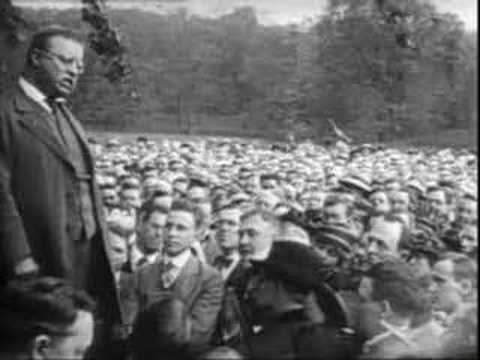 If you review the legislative history of the "trust-busting" railroad legislation of the late 19th century, you find the representatives of the railroads appearing as the principal advocates of "sensible" regulation. Why? Because they were being beaten up by their large customers (Standard Oil being the most important) and their unregulated competitors. We are seeing much the same thing now with General Electric and others actively supporting "green" regulation.
As for the virtues of Trust busting, what appalled people who thought the United States was governed by its Constitution and not by the "moral compass" of its betters was Teddy Roosevelt's unequal application of the Sherman Act. He wanted labor unions to be exempt from its provisions — as they now are — but he wanted the Act to be applied to all business combinations, even those where the parties themselves raised no objection. The Sherman Act's original intent was clear: to prevent the judiciary from enforcing commercial racketeering, from allowing a revival of the guild system of restrictions to entry into an area of commerce that 19th century Americans found so obnoxious.
As he did with so many laws, Roosevelt ignored the plain language of the Anti-Trust statute in favor of his own "living, breathing" interpretation. I think he did it for the best of reasons; he truly loved America and he wanted all Americans, even the ones he considered second-class, to love the country as much as he did. But, his good intentions were led astray — as so many of ours are — by his refusal to ask what the consequences of his reforms would be for individual liberty.
Feb
2
Volume, from Jim Sogi
February 2, 2010 | 2 Comments
Interesting drop in volume on today's up move in ES:
2010-02-01, 1896011
2010-01-29, 3068079
2010-01-28, 3052088
2010-01-27, 2634603
2010-01-26, 2449263
2010-01-25, 2080292
The old TA theory is that an up move on low volume is weak, and a down move on increasing volume is strong, but it doesn't prove out scientifically.
Sushil Kedia comments:
A homegrown theory I developed borrowing on the Chair's applications of the concept of struggle to markets interprets volume as a struggle for price discovery. Extending this with memetics, a higher volume indicating a higher struggle for price discovery meme implies an ongoing persistence of the meme. So, within any time frames or patterns or noise, if you perceive a meme then interpreting lower volume as lesser struggle tilting towards consonance and thus implying a fading meme comes by. This way of looking at price and volume relationships does lead to several testable ideas getting the gut feel closer to science.
Bill Rafter writes:
The only use we have found for volume is as a surrogate metric for volatility. Indeed S&P volume and VIX have very interesting relationships. However the standard TA mantras that (a) volume “confirms” price and (b) volume-weighting indicators makes them better, have not been confirmable.
Here is an excellent graphic I prepared relevant to volume.

Dr. Rafter is President of Mathematical Investment Decisions, a quantitative research consultancy
Kim Zussman writes:
Here's another check. SPY daily returns (c-c), with volume traded, 1993-present, were used to check for big up days = >+1% (0.01). Then calculated relative volume (RV) as:
(today's volume) / (average volume prior 5 days)
Then compared next day's return for two cases; if it followed a big up day which had low RV (RV<0.8) or a big up with high RV (RV>1.3):
t-Test: Two-Sample Assuming Equal Variances
low RV hi RV
Mean 0.0010 -0.0015
Variance 0.0002 0.0002
Observations 151 146
Pooled Variance 0.0002
Hypothesized Mean Difference 0.0000
df 295
t Stat 1.5263
P(T<=t) one-tail 0.0640
t Critical one-tail 1.6500
P(T<=t) two-tail 0.1280
t Critical two-tail 1.9680
Feb
2
Bottlenose Dolphins and the Market, from Alston Mabry
February 2, 2010 | 2 Comments
 Surely there must be some good market analogies here in this wonderful, brief video narrated by David Attenborough showing the feeding strategies of Bottlenose Dolphins.
Pitt Maner III comments:
Amazing video. Dolphins also can echo locate a pin on the bottom of a pool from large distances.
While we are on the topic — sessile, bottom feeders appear to make out fairly well in the long run also! Talk about a meal for a lifetime…
Dead whales constitute an unpredictable food source, as it's impossible to figure when and where one will die. And it's a one-shot deal. But nevertheless, when the hefty animals die, they sink to the seafloor and the payoff is big for marine species able to cash in. Scientists estimate one whale corpse provides the nutritional equivalent of 2,000-years worth of normal biological detritus sinking to the seafloor.
Nick Higgs is on a research cruise off Japan to find out more about the amazing ecosystems that form around dead whales on the seabed.
Feb
2
State Pensions, from Scott Brooks
February 2, 2010 | 1 Comment
 The pension problem in this country is a time bomb that is set to go and will likely either cripple the nation or be one of the final straws that breaks our back. Remember, pensions are backed up by the PBGC..
James Lackey writes:
I fear to quote history as a non-expert here and never ever want to imply predictions… the devalue-ists vs. the deflationists battles have always been apart of post crash, post war debate. Here we have choice of soup–the depression expert vs. the non computer using inflation expert with an American idol caught in an argument on how to restore past glory. With the people caught in the panic and demanding answers.
After Baldwin talked Churchill back to the Gold Standard they all realized prices were too high, so they had to subsidize (bail out).
Before FDR devalued, he cut govie pay and military pensions.
Pick your author on how good bad either path is/was…
Not sure if tea party baggers know how volatile these adjustments can be when the markets solve problems. Hey, wait, yeah they do. It's the NASDAQ.
Stefan Jovanovich writes:
I don't think American history offers many clues to what will happen next for jobs and incomes because there are no precedents for a country where half of the income went to teachers, government employees and people whose private sector jobs exist only because of regulations (lawyers, accountants). I don't offer that as a political statement, only an observation that we no longer have a situation where Keynesian deficits can produce more demand by creating government jobs whose workers buy things with their paychecks. We already have that economy now, and the multipliers from government borrowing and spending are now 0 or less than 0, not positive.
In terms of the dollar and its future value measured against other national currencies, I think you are right to draw lessons from the 1920s and 1930s; because that was the last time that ALL the world's trading nations devalued their currencies against gold and against each other. But that offers no clue as to how far the United States and others will go in taxing and restricting investment capital flows. The Great Depression became great because all the countries shifted to mercantilist currency and trade policies at the same time. As much as trade flows have fallen because of the GFC, the decline is nothing compared to the death spiral that occurred between 1930 to 1933.
Vincent Andres comments:
(Unfortunately) I completely share Scott's opinion.
Our states (we) have generously accorded overvalued pensions based on optimistic/erroneous previsions, (and this resembles _very closely_ to the subprime problem, where today's distribution of houses was based on tomorrow's expectations about their prices.) We thought we were able to build our present houses and our pensions by picking in the future, in the future of our kids, because as everyboby knew, trees were able to grow up to the sky.
The recurrence (in the mathematical sense) was build on the recurrence, but now we see the recurrence changing direction, trees are not growing up indefinitely; what will we do with our promised houses, promised health, promised pensions ? all those things paid by picking money in a infinitely rich future.
There are many excuses for those miscalculations (and not having know a war is probably the biggest excuse) which really made those systems function exactly as a Ponzi scheme. Today's worry is that we are unfortunately at the point where the Ponzi scheme explodes.
We live in interesting times–I also completely agree, on the other hand, looking a bit on the history side, this is not as dramatic as a WWIII.
In France (at least) WWI has seen its young generation slaughtered, while the elder were far less concerned (at least they were not slaughtered).
I wonder if our young generation would accept such a sacrifice? Such endebment for our houses, our healths and our pensions. (Maybe the massive mind-destroying we applied on our children will help them to not understand what we have done? Those days, our French government, like every 2 or 3 years is picking from Pierre's pensions to reverse to Paul's pensions (Pierre is in the private sector and Paul is in the public sector as for each reversal) just around 5/6 billions, nothing to become nervous, and, in fact, nobody seems annoyed, so, as far as today, it seems to work fine). But even those reversal, really –theft–, will not indefinitely be enough. One can only be amazed when one sees that, on one hand, farmers are committing suicide, silently, without revolt, while in the same country, state employees are retiring at 50, having spend 20% of their life striking and with such miserable results. How is such a thing possible? What mental ascendancy is at work to obtain such passivity/resignation, unconsciousness of the horrible injustice of the situation?
… Yes, the coming period will probably be interesting. My hope is also that things will happen with a minimum of violence, but, in a form or another, I doubt our irresponsible generation will escape the hour of truth.
Feb
1
Briefly Speaking, from Victor Niederhoffer
February 1, 2010 | 3 Comments
 Carroll Quigley (Bill Clinton's mentor) has a theory published in Tragedy and Hope that all civilizations tend to go through four stages: a start (in conquest), rapid expansion, crisis, hegenomic rule, and then contraction and decline. The contraction comes from the weakness of will that emerges from the solution to the crisis. Does this have market applications? Can it predict anything about our own stage?
Does the Federer win, as in the past, augur bullishness for stocks? As long as The Knicks have Robinson playing, they are bound to lose. He's what Bill James would call a player whose stats are a lot better than his game. Who would win the OJ Simpson award that Bill James gives out among CEOs and operatives from the Beltway? What are the reasons for the market's very special actions around the end of months when the bears have previously been in control? What is the equivalent of Bill James's marginal analysis of winning shares that enables him to predict the exact teams' records with variables such as hits, walks, runs, and total at bats? Also, what is the analog of his point that the only pitchers that last and are good buys on a team are power pitchers that have good stikeouts?
My friend Irving Redel believes gold will be a good buy slightly above 1000 as investors will buy it as the return from fixed income is too low, and they are frightened of stocks.
Thomas Miller writes:
I wonder why more investors wouldn't be looking at high dividend paying stocks during these times. Even if one is fearful of stocks, a diversified etf or fund with high paying dividend stocks, even US and foreign, would seem to warrant investigation for at least part of an investment strategy. Buying after market "corrections" of some fixed percentage number would seem to make this less risky. I believe a portfolio of high dividend stocks has shown to outperform SP 500 over time. The tax on dividends is lower. I wonder if investors would really pile into gold as an alternative to stocks, bonds, or cash, absent some international tensions rising or rampant inflation on the horizon.
Pitt Maner III comments:
Pre-announcement perhaps of interest to gold followers. Mideast tensions.
Meanwhile, state-run Press TV quoted Iranian President Mahmoud Ahmadinejad on Sunday as saying that the nation will deliver a harsh blow to "global arrogance" on February 11.
The deployments include expanded land-based Patriot defensive missile installations in Kuwait, Qatar, UAE and Bahrain, as well as Navy ships with missile defense systems within striking distance in and around the Mediterranean, officials said.
And here is an article about Iran as as explanation for rise in price of oil from July 2008.
Feb
1
Sports and Stock Stats, from Paul Marino
February 1, 2010 | 4 Comments
Just as Daily Spec is starting to present financial data in sports-statistic-like terms, Bloomberg has announced that it will use its analysis tools on sports.
Robert Smythe asks:
Can someone explain briefly the chart at the top of the page? What do these numbers mean? USB?
Alex Castaldo says:
These are the price moves in S&P futures and in Bond futures on the given day. (Sorry about the ugly abbreviation USB, the full word US Bonds did not quite fit the allotted space). In each case the nearby futures contract (currently March) is the one we use.
The price change for bonds is quoted in points and thirty-seconds of a point, as is traditional in Bonds. So for example on January 12 bonds rose by 1 point and 20/32, and this is shown as +1.20.
As Paul Marino notes, the whole thing is inspired by sport scorecards that show the recent wins/losses for a team.
The four colors are based on who wins and loses on any given day. A Red ink day is when both Equity and Bond investors lose, while Green is when bond and equity prices both go up. The mixed cases are: a warm orange color when the environment was favorable to those who take equity risk but unfavorable to those who avoid equity risk (i.e. bond investors), a cool blue when stock prices went down and bond prices went up (sometimes called a flight to safety or flight from risk day).
We hope you find our calendar interesting.
Feb
1
Study of the Emergent Layer, from Victor Niederhoffer
February 1, 2010 | Leave a Comment
 The Bronx Botanical Gardens has a nice exhibit of the four layers of life in a tropical rain forest: the emergent at the top that get most of the sun, the canopy, where most of the trees reach and where insects and birds are mainly active, the understory, clouded in shade, and the floor, where the debris falls and provides minerals for the roots of trees and food for large animals and insects. One wonders if the ensemble of stocks is divided into similar layers, and whether there is anything predictive about those that reach a certain height. Let's start with the S&P 500 and look at the emergent layer, stocks above 100. There are 12 of them:
Name Price Market value m Perf in 2009
AAPL 192 174161 90
AZO 155 7673 59
CME 286 19079 65
FSLR 113 9462 -20 First Solar
GS 148 78572 81
GOOG 529 168135 56
IBM 122 160771 33
ISRG 328 12631 218 Intuitive Surg
MA 250 32425 84 Mastercard
PCP 105 14811 62 Precision cast parts
PCLN 195 8585 191 Priceline
WPO 434 4085 11 Washington Post
What can be said about these companies that differentiates them? Five of them are Internet based. All of them are undoubtedly led by CEOs who embody the idea that has the world in its grip. What else?
A comparison with the understory below 10 is appropriate. AMD, BSX, CPWR, ETFC, EK, FTR, HBAN, IPG, JDS, KEY, LSI, MI, PCS, MU, MOT, NOVL, ODP, RF, S, TLAB, THC, TER, XRX — twice as many companies in the understory. Many were once in the canopy. How would this best be analyzed and something useful come out of it?
Feb
1
Andy Murray, from Charles Pennington
February 1, 2010 | 12 Comments
 It's frustrating that Andy Murray is one of the top few tennis players in the world right now. There is not much about his strokes or his strategy that's distinctive or interesting. His only distinction is his on-court personality — he scowls and sometimes swears after every error that he makes, as though his expectation is not to make any errors throughout the match. Federer, by contrast, treats his errors as an expected part of the game. His face shows no negative emotions; it looks like granite.
Everybody who gets to number one in tennis has some kind of distinctive flair. They never get there by doing everything like everybody else, just a little better. I hope Federer gets a more interesting opponent in the next three majors.
Feb
1
The Forbidden Fruit: Technical Analysis, from Kim Zussman
February 1, 2010 | 1 Comment
SPY's Friday close was the second consecutive below the simple 100DMA, after a long period above the moving average.
Going back to 1993, checked for instances when SPY closed < 100DMA two consecutive days, following at least 20 consecutive closes > 100DMA. Here are the mean returns for the next 5d, 10d, and 20d:
One-Sample T: 5d, 10d, 20d
Test of mu = 0 vs not = 0
Variable N Mean StDev SE Mean 95% CI T P
5d 18 0.010 0.021 0.005 (-0.00057, 0.02114) 2.00 0.062
10d 18 0.007 0.023 0.005 (-0.00447, 0.01933) 1.32 0.205
20d 18 0.004 0.040 0.009 (-0.01570, 0.02430) 0.45 0.656
All up, if not significantly. If only it were that easy…
« go back —Archives
- October 2026
- September 2026
- August 2026
- July 2026
- June 2026
- May 2026
- April 2026
- March 2026
- February 2026
- January 2026
- December 2025
- November 2025
- October 2025
- September 2025
- August 2025
- July 2025
- June 2025
- May 2025
- April 2025
- March 2025
- February 2025
- January 2025
- December 2024
- November 2024
- October 2024
- September 2024
- August 2024
- July 2024
- June 2024
- May 2024
- April 2024
- March 2024
- February 2024
- January 2024
- December 2023
- November 2023
- October 2023
- September 2023
- August 2023
- July 2023
- June 2023
- May 2023
- April 2023
- March 2023
- February 2023
- January 2023
- December 2022
- November 2022
- October 2022
- September 2022
- August 2022
- July 2022
- June 2022
- May 2022
- April 2022
- March 2022
- February 2022
- January 2022
- December 2021
- November 2021
- October 2021
- September 2021
- August 2021
- July 2021
- June 2021
- May 2021
- April 2021
- March 2021
- February 2021
- January 2021
- December 2020
- November 2020
- October 2020
- September 2020
- August 2020
- July 2020
- June 2020
- May 2020
- April 2020
- March 2020
- February 2020
- January 2020
- December 2019
- November 2019
- October 2019
- September 2019
- August 2019
- July 2019
- June 2019
- May 2019
- April 2019
- March 2019
- February 2019
- January 2019
- December 2018
- November 2018
- October 2018
- September 2018
- August 2018
- July 2018
- June 2018
- May 2018
- April 2018
- March 2018
- February 2018
- January 2018
- December 2017
- November 2017
- October 2017
- September 2017
- August 2017
- July 2017
- June 2017
- May 2017
- April 2017
- March 2017
- February 2017
- January 2017
- December 2016
- November 2016
- October 2016
- September 2016
- August 2016
- July 2016
- June 2016
- May 2016
- April 2016
- March 2016
- February 2016
- January 2016
- December 2015
- November 2015
- October 2015
- September 2015
- August 2015
- July 2015
- June 2015
- May 2015
- April 2015
- March 2015
- February 2015
- January 2015
- December 2014
- November 2014
- October 2014
- September 2014
- August 2014
- July 2014
- June 2014
- May 2014
- April 2014
- March 2014
- February 2014
- January 2014
- December 2013
- November 2013
- October 2013
- September 2013
- August 2013
- July 2013
- June 2013
- May 2013
- April 2013
- March 2013
- February 2013
- January 2013
- December 2012
- November 2012
- October 2012
- September 2012
- August 2012
- July 2012
- June 2012
- May 2012
- April 2012
- March 2012
- February 2012
- January 2012
- December 2011
- November 2011
- October 2011
- September 2011
- August 2011
- July 2011
- June 2011
- May 2011
- April 2011
- March 2011
- February 2011
- January 2011
- December 2010
- November 2010
- October 2010
- September 2010
- August 2010
- July 2010
- June 2010
- May 2010
- April 2010
- March 2010
- February 2010
- January 2010
- December 2009
- November 2009
- October 2009
- September 2009
- August 2009
- July 2009
- June 2009
- May 2009
- April 2009
- March 2009
- February 2009
- January 2009
- December 2008
- November 2008
- October 2008
- September 2008
- August 2008
- July 2008
- June 2008
- May 2008
- April 2008
- March 2008
- February 2008
- January 2008
- December 2007
- November 2007
- October 2007
- September 2007
- August 2007
- July 2007
- June 2007
- May 2007
- April 2007
- March 2007
- February 2007
- January 2007
- December 2006
- November 2006
- October 2006
- September 2006
- August 2006
- Older Archives
Resources & Links
- The Letters Prize
- Pre-2007 Victor Niederhoffer Posts
- Vic’s NYC Junto
- Reading List
- Programming in 60 Seconds
- The Objectivist Center
- Foundation for Economic Education
- Tigerchess
- Dick Sears' G.T. Index
- Pre-2007 Daily Speculations
- Laurel & Vics' Worldly Investor Articles
