Apr
3
Linear Trend Lines, Part I, from Phil McDonnell
April 3, 2009 |
 The Chair has issued a challenge for anyone who can prove of disprove the existence of linear trend lines as suggested by Jim Sogi.
The first issue in doing a market study is to develop an adequate definition of what a trend is. Given that the idea is widely and perhaps first used in Technical Analysis it is good to start there. Tom DeMark, a widely known and respected TA guru, defines a trend line as the line connecting two bottoms in a price series. This, of course assumes one has a good definition of a bottom. He defines a bottom as a daily low which has the property that the low of the previous day and the low of the next day are higher than the bottom low. Thus it takes three days to define a bottom day. The most recent bottom cannot be known until one day after it has happened.
The idea of a trend line is to find the most recent bottom and then go back to the next most recent bottom. The whole pattern takes at least 6 days to work out and can be much longer because there can be an arbitrary number of days between the two most recent bottoms. Our own John Bollinger has confirmed that this is essentially what his understanding is of how trend lines are used by practitioners.
The theory of a trend line based on lows is that it acts as support. In other words the market will tend to stay above the line more often than would be expected by chance. It should be noted that nothing in the above definition presupposes an uptrend or a down trend. In an uptrend the second low point is higher than the first low point. And the difference per day defines the slope of the line. In a down trend the second low is lower than the first.
There is another type of trend line which is based on the highs of the day. A high point is defined as the high day between two adjacent days, whose highs are both lower. Again two high point days are required to draw a well defined trend line.
Mathematically it is always possible to draw a line between two points, so one should not be surprised to find trend line patterns in random data as well as real market data. The real challenge is to test whether they occur more frequently or less frequently. More importantly do trend lines have any predictive value either as measured by higher probability of a successful trade or a higher average return?
The study looked at 1800 trading days of SPY, the S&P ETF. This period started 100 days ago and went back 1800 days. It should be noted that the SPY was down 1.5 points during this period resulting in an average daily return of 0.00% to 5 decimal places. The study was further classified into four categories based on whether it was a high point or low point trend and whether it was an up or down trend:
Low Up
Low Down
High Up
High Down
The measure of profitability was the simple next day close to close return for the trade.
For trends based on Low points we have:
Trend n # Up % Up Avg Profit Total Profit
Up 204 109 53.4 -0.212 -43.23
Down 202 115 56.9 +0.031 6.33
For trends based on High points we have:
Trend n # Up % Up Avg Profit Total Profit
Up 182 86 47.3 -0.143 -25.98
Down 225 106 47.1 -0.050 -11.22
Most of the results showed about 200 pairs of trend points. This means that the typical trend point pair took about 9 days to form and thus had about 3 days in between points. TA practitioners would expect more days to be up after a trend point pair is put in place. There appears to be weak support for this idea because for both cases based on Low points the % Up seems slightly favorable. However this is belied by the fact that the avg profit for Up trends is actually strongly negative. Thus the preferred strategy is probably to fade the appearance of and up trend pattern.
For High Points the expectation is that the market has reached an extreme. Thus we expect it to fall back. In fact all the above does qualitatively agree with that premise because both the % Up and the Avg Profit are negative.
The key to all of this is to test the results for significance. Often one has noted that when a trend line is broken there is sometimes a dramatic drop. The import of this is not whether it is true or not. Rather if true then it implies a negatively skewed distribution. Thus the standard normal / log-normal assumptions may be too far off. For something like this then that argues that it would be better to choose a bootstrap test for significance so that we do not have to worry about the normality of our data.
That is the subject of Part 2.
Dr. McDonnell is the author of Optimal Portfolio Modeling, Wiley, 2008
Jim Sogi writes:
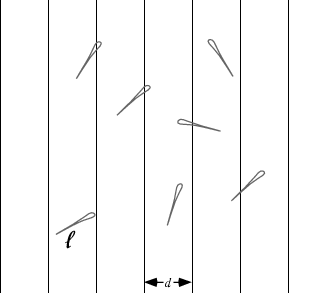 Thanks Phil. The problem with defining a 'trend line' is that a rather random number of bars may or may not form the trend 'line'. More than two points would be needed to define a trendline as any two points forms a line, so it become totally random as to which points when only two define it. Then when not all lines touch the support line, then it turns random again. By the way, I was wrong. Random walks DO regularly form 'trend lines' to the naked eye.
One idea is to follow the a variant to the solution to the math problem Buffon's Needle which determines the probability of a needle of a given length touching two parallel lines when its thrown down. The problem must be restated to determine the probability of a needle of fixed or variable length touching three or more points on a grid of timeseries points. Then the time series could be randomly simulated from actual data, and probability determined or randomly generated and compared to actual data. Here is a nice trailhead with the R code to visualize the problem.
If this code could be altered to solve the above variation, this might help solve this problem.
The solution may require limiting the time period to some defined time period such as a day, week or month so that the 'straw' has a defined length and require that the touches, touch within 1 point of an interval low to give a little slack as you do when eyeballing. However, there appear to be solutions to Buffon's Needle allowing for various or random length needle's. Perhaps Buffon's 'points' could also be lengthened to be short parallel lines that make up the time series, and use the formula to determine the probability that the needle (trendline) crosses three or more time series points to create the trendline.
Comments
Archives
- October 2026
- September 2026
- August 2026
- July 2026
- June 2026
- May 2026
- April 2026
- March 2026
- February 2026
- January 2026
- December 2025
- November 2025
- October 2025
- September 2025
- August 2025
- July 2025
- June 2025
- May 2025
- April 2025
- March 2025
- February 2025
- January 2025
- December 2024
- November 2024
- October 2024
- September 2024
- August 2024
- July 2024
- June 2024
- May 2024
- April 2024
- March 2024
- February 2024
- January 2024
- December 2023
- November 2023
- October 2023
- September 2023
- August 2023
- July 2023
- June 2023
- May 2023
- April 2023
- March 2023
- February 2023
- January 2023
- December 2022
- November 2022
- October 2022
- September 2022
- August 2022
- July 2022
- June 2022
- May 2022
- April 2022
- March 2022
- February 2022
- January 2022
- December 2021
- November 2021
- October 2021
- September 2021
- August 2021
- July 2021
- June 2021
- May 2021
- April 2021
- March 2021
- February 2021
- January 2021
- December 2020
- November 2020
- October 2020
- September 2020
- August 2020
- July 2020
- June 2020
- May 2020
- April 2020
- March 2020
- February 2020
- January 2020
- December 2019
- November 2019
- October 2019
- September 2019
- August 2019
- July 2019
- June 2019
- May 2019
- April 2019
- March 2019
- February 2019
- January 2019
- December 2018
- November 2018
- October 2018
- September 2018
- August 2018
- July 2018
- June 2018
- May 2018
- April 2018
- March 2018
- February 2018
- January 2018
- December 2017
- November 2017
- October 2017
- September 2017
- August 2017
- July 2017
- June 2017
- May 2017
- April 2017
- March 2017
- February 2017
- January 2017
- December 2016
- November 2016
- October 2016
- September 2016
- August 2016
- July 2016
- June 2016
- May 2016
- April 2016
- March 2016
- February 2016
- January 2016
- December 2015
- November 2015
- October 2015
- September 2015
- August 2015
- July 2015
- June 2015
- May 2015
- April 2015
- March 2015
- February 2015
- January 2015
- December 2014
- November 2014
- October 2014
- September 2014
- August 2014
- July 2014
- June 2014
- May 2014
- April 2014
- March 2014
- February 2014
- January 2014
- December 2013
- November 2013
- October 2013
- September 2013
- August 2013
- July 2013
- June 2013
- May 2013
- April 2013
- March 2013
- February 2013
- January 2013
- December 2012
- November 2012
- October 2012
- September 2012
- August 2012
- July 2012
- June 2012
- May 2012
- April 2012
- March 2012
- February 2012
- January 2012
- December 2011
- November 2011
- October 2011
- September 2011
- August 2011
- July 2011
- June 2011
- May 2011
- April 2011
- March 2011
- February 2011
- January 2011
- December 2010
- November 2010
- October 2010
- September 2010
- August 2010
- July 2010
- June 2010
- May 2010
- April 2010
- March 2010
- February 2010
- January 2010
- December 2009
- November 2009
- October 2009
- September 2009
- August 2009
- July 2009
- June 2009
- May 2009
- April 2009
- March 2009
- February 2009
- January 2009
- December 2008
- November 2008
- October 2008
- September 2008
- August 2008
- July 2008
- June 2008
- May 2008
- April 2008
- March 2008
- February 2008
- January 2008
- December 2007
- November 2007
- October 2007
- September 2007
- August 2007
- July 2007
- June 2007
- May 2007
- April 2007
- March 2007
- February 2007
- January 2007
- December 2006
- November 2006
- October 2006
- September 2006
- August 2006
- Older Archives
Resources & Links
- The Letters Prize
- Pre-2007 Victor Niederhoffer Posts
- Vic’s NYC Junto
- Reading List
- Programming in 60 Seconds
- The Objectivist Center
- Foundation for Economic Education
- Tigerchess
- Dick Sears' G.T. Index
- Pre-2007 Daily Speculations
- Laurel & Vics' Worldly Investor Articles
