Sep
11
Does the Mistress have NPD, from Dr. Kim Zussman
September 11, 2006 | Leave a Comment
Narcissistic personality disorder: (Summarized from DSM-IV-TR Fourth Edition)
Overview:
A pervasive pattern of grandiosity (in fantasy or behavior), need for admiration, and lack of empathy, beginning by early adulthood and present in a variety of contexts, as indicated by five (or more) of the following:

She has a grandiose sense of self-importance (e.g., exaggerates achievements and talents, expects to be recognized as superior without commensurate achievements).
She is preoccupied with fantasies of unlimited success, power, brilliance, her own beauty, or ideal love.
Believes that she is "special" and unique and can only be understood by, or should associate with, other special or high-status people (or institutions).
Requires excessive admiration.
Has a sense of entitlement - unreasonable expectations of especially favorable treatment or automatic compliance with his or her expectations.
Is interpersonally exploitative - takes advantage of others to achieve her own ends.
Lacks empathy: is unwilling to recognize or identify with the feelings and needs of others.
Is often envious of others or believes that others are envious of her.
Shows arrogant, haughty behaviors or attitudes.
Sep
11
My Mistress Cecilia, by Rod Fitzsimmons Frey
September 11, 2006 | Leave a Comment

My young son, now 18 months old, has been "singing" for almost a year. Since both his parents sing a great deal both to him and to each other, it seemed natural that he would pick it up early. This month, though, he started for the first time to mimic pitch correctly — very exciting.
What about musical tones make some sound lovely together and others clash terribly? Musicians call two notes consonant or dissonant depending on whether they blend or clash. Pythagoras discovered that when two strings were equally stretched, they would be consonant if their lengths were in the ratio of two small numbers such as 2:1, 3:2, etc. So important was this discovery of a law of nature being ruled by integers that it was extended to all the sciences, especially astronomy.
The simplest example of two notes that sound good together is when they are the same note, played one or more octaves apart. An octave separation between notes corresponds to a doubling of the frequency.
When a musical note is played on a stringed instrument, it has a primary frequency and numerous overtones, which are integer multiples of the frequency: for example the A below middle C has its primary frequency at 440Hz (by convention), while the E just above middle C is 660 Hz. The overtones of the A are 880, 1320, 1760, 2200, 2640 and so on. The overtones of E are at 1320, 1980, 2640, and so on. We see that the overtones line up with each other, and the result is a harmonious, or consonant sound.
A   440         880          1320         1760         2200         2640
E         660                1320                1980               2640
If on the other hand, we play the A with a G (freq ~ 785Hz, then the overtones clash with each other.
A   440         880          1320         1760         2200         2640
G             785                  1520                  2355
The result is a disharmonious or dissonant sound. Moving the frequencies of the note around to reflect integer ratios brings a sense of relief and correctness to the listener. This is true even if the notes are not real notes: for example, moving the G's fundamental up 100 Hz, the first harmonic down 200 Hz, and the third harmonic down 150 Hz is not a note found in nature, but can be produced by computer. It is consonant with the A because of its integer-bound relationship to it.
Musicians use these integer relations to great effect manipulating our emotions: they can elicit discomfort, relief, tension, and even laughter by moving further and more aggressively into non-integer ruled domains (dissonance) and resolving back into the more natural integer ratios that sound so lovely.
We know that the Mistress is a musician. Where in her symphony can we find the sources of consonance and dissonance that cause such anxiety and give such relief? An analogue to frequency in plucked strings might be found in volatility. As markets vibrate around whole numbers — fundamental frequencies — are other markets in consonance or dissonance with them? When SPX is ringing out the pure tone of 1300, are the vibrations of DAX part of a small-integer ratio? What has to happen to bring a dissonant market into consonance?
As a final note (yes, intended), one should probably be aware of the changing fashion of music. The notes that Bach wrote had mathematical progressions and rarely used dissonance: today's composers use dissonance to extract maximum effect and may never even resolve into consonance. You have to know your composer if you want to know when to applaud.
Sep
11
Why all the attention to the Fifth Anniversary?, from Allen Gillespie
September 11, 2006 | Leave a Comment
I asked myself this morning why all the attention, as opposed to the 4th, 6th, or some other random number. As best I can tell from my internet research, it is because the number five seems to be used as the number of humanity given that the body has five appendages (two arms, two legs, and a head) and five senses (hearing, sight, small, taste, touch). The fifth appendage provides the body symmetry. Thus remembering a fifth anniversary date must somehow reconnect us with our humanity. In music, the fifth is important because its addition makes a chord.
For the spec then, one might consider testing five market combinations like gold, bond, stocks, oil, the dollar for opportunities.
Michael Olds mentions:
Just one little note here. Five (actually probably any number) as standing for 'Man' is culture-specific. In Buddhist cultures it is six. There the mind is considered the sixth sense (and, unlike here, Man is considered to have one … little joke).
As alien as it may seem to most of us, the mind as a sense is considered to operate like all the other senses.
We have mind and we have mental objects. Mental objects coming into the range of mind, together with consciousness [an element, just like earth, water, fire and wave-form, and subject to 'conservation' (recycling) just like those elements] produce consciousness of ideas. String together consciousnesses of ideas, given direction by the specialized consciousness idea called intent, and what we get is what we know as thought.
How is this relevant to speculation and trading? One way is in how the idea could be used to free the trader from error bound up with ego. Ego brings bias, and bias ruin. Seeing the process in the way described above is seeing without the notion of ego. There is mental object data, mind data, consciousness data. There is no 'my mental object data' [let alone the truly messy 'I think'] to cause possessiveness and the resultant hesitation to let go of a bad idea…it is all just data.
Five is important because it is the hand. Half of two hands. Half of 10, on which our number system is based.
Five is the number of "comprehensive and yet simple" unity or a set; it is applied in all cases of a natural and handy comprehension of several items into a group, after the 5 fingers of the hand, which latter lies at the bottom of all primitive expressions of No. 5.
Sep
10
A Market Analogy, from Scott Brooks
September 10, 2006 | Leave a Comment
Since I have joined the spec list, I find myself looking for market correlations and market lessons in everyday life experiences. I had just such an experience tonight. I knew there was a correlation in this activity, but I was having trouble expressing it in my mind, let alone in a post.
My kids talked me into going out and jumping on the trampoline with them. First of all, as an aside: Jumping on a tramp is great exercise. As we were jumping all around, my mind kept thinking of connections to the market. We went up and down, we went sideways, and we fell on our behinds. We laughed a whole bunch. And there were even some injuries, and one incidence of tears.
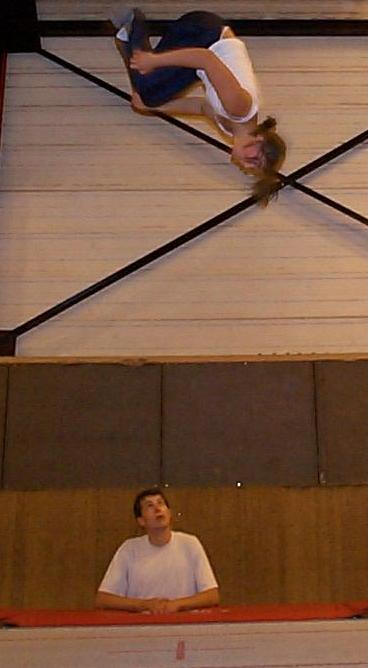
Was the analogy in the up and down and sideways motion? Not really, that would be a stretch and too obvious. Was it in the physics of the trampoline. I could get some major height on my jumps if I built up a bit of momentum. But my jumps were, more often than not hindered by bad timing with the other kids jumping. If I was coming down to hit a big bounce, but one of the kids hit the tramp as I was coming up, it killed my momentum and made for a weak jump, and sometimes resulted in me falling. Maybe the correlation was that sometimes strong stocks within a sector can be hindered by the other weaker stocks within the sector, and of course that holds true for the market as a whole. I decided that correlation was a bit of a stretch too.
I knew there was a connection, but I was not finding it. So I just decided to have fun with my kids, going up and down, sideways, bouncing off each other, falling down, and even getting hurt, but then getting back up to continue having fun. I just released my mind of the task of finding a market correlation.
Then my knee really started to hurt. It hurt bad. But I was having too much fun to quit, so I kept going. I was just having fun. I love my kids and I love being with them and doing things with them. Then, as things often do, because I released my mind from the task at hand, the answer came to me.
It does not matter how much the market goes up and down, or sideways. It does not matter if I fall down in the market. It does not matter if it hurts, or abuses me or makes me feel like I am unhappy. I love the market the mistress. I love playing with the market mistress. I love being the in game. I don't care if she abuses me. I don't care if she hurts me. I keep coming back from more. I simply love the game. I love the market. I love the mistress.
Just as I find personal joy, happiness and personal satisfaction from my wonderful kids (even when they drive me crazy), I find professional joy, happiness, and professional satisfaction when I get to play with the mistress (even when she drives me crazy!)
I read this post before sending it to the list to my oldest son, David, who many of you met at the spec party. He liked the post. He also said to tell everyone, "hello".
Sep
9
Beneficent Circles, by Victor Niederhoffer
September 9, 2006 | Leave a Comment
To what extent do vicious circles and beneficent circles work? Here is one that works for economic growth inspired by the division of labor:
Increasing the division of labor leads to enhanced output from improvements in the productivity of labor. This increases incomes and demand, and leads to larger markets. With larger markets, more division of labor can occur starting the circle over again. A break down in the relation between any of the links in the circle can stop the circle from working, and a negative chance in any of the sources can turn the circle into a vicious one.
A trading circle might work as follows. Good research leads to enhanced trading results, which leads to more capital, which enables more research to be made. The problem is that as you get too big, you tend to use up all the easy opportunities for profits in your field. And your research tends to bring you into new fields where you are not specialized to succeed.
How often do we see that when a system is applied to one market that it has never been tested for it fails. I understand a trader applied his methods for US stock markets once to markets in S.E Asia and went under by not properly taking account of the importance of the division of labor. On another front, I hear of a company that made most of its money by trading futures markets, applying its methods to individual stocks with the hubristic thought that the methods are transferable, and that brain power is directly related to success, and that foreign brain power is much superior to American. I wonder when the circle break down and become vicious in that instance?
Sep
8
Thai BBQ, noticed by Sam Humbert
September 8, 2006 | Leave a Comment
Life for woman who BBQs husband and feeds him to tigers
The Thai woman who arranged for her English ex-husband to be barbecued and had his remains scattered around a tiger sanctuary was jailed for life today. Mr Charnaud had divorced Pannada because of her gambling debts and had been awarded custody of their son Daniel, now seven. (.. ) They tried to shoot him with an antiquated long barrelled musket but it backfired. They then beat Mr Charnaud to death with iron bars and a lump of wood. The killers placed his body on an already prepared charcoal barbecue then cut up his cooked remains and spread them around the tiger reserve. (.. )
Sep
8
Everybody wants a BONAR, from Jaime Klein
September 8, 2006 | Leave a Comment
Woody Allen said that "hope is that thing with feathers". I read it in his memorable book Without Feathers. Why I am writing this instead of working? Because Argentina emitted a new series of seven year bonds and the demand was three times the supply. Figuratively, people pushed and trampled over each other to give their money to Argentina and get one BONAR. Only four or five years ago Argentina was broke and paid out its bonds at 20 or 30% of face value. Savers were harmed. People have no memory?
Sep
8
Accident Prevention, from Pitt T. Maner III
September 8, 2006 | Leave a Comment
 I wonder if there are certain parallels between risk management in the financial world and the prevention of accidents at job sites.
When I first started my career as an environmental geologist about 20 years ago the emphasis at that time was on data validation of laboratory analytical results. In other words, if you collected a soil or groundwater sample and had it analyzed for petroleum or solvent constituents (volatile aromatic hydrocarbons, chlorinated solvents, lead, etc.) you wanted to make sure the laboratory provided you with results that were accurate and reproducible. There were many small labs and some not that good, so you had to check the Quality Control/Quality Assurance (QA/QC) of the lab reports closely — bad data could lead to bad and costly decisions. Sort of like analyst reports?
As lab methods became more standardized and the environmental lab business consolidated and good labs rose to the top, QA/QC (while still important) was not as much of a focus for environmental consulting firms.
Today much emphasis in the environmental field is placed on health and safety of workers. Major corporations want subcontractors who will come to their sites and perform work (such as environmental assessment and remediation and construction activities) safely and without incidents. Accidents are costly events on a lot of different levels — financially to the company and the person involved and emotionally to the accident victim and his co-workers and family.
In order to perform work now at many company sites you need to provide a health and safety plan (HASP) that will address the hazards you expect to encounter and what you will do if you run into those hazards. What telephone numbers do you call, where is the hospital, what actions are you going to take if X occurs, etc.? Identify the risks and plan ahead at all times. Avoid exposures to toxic compounds. Be trained in First Aid and CPR.
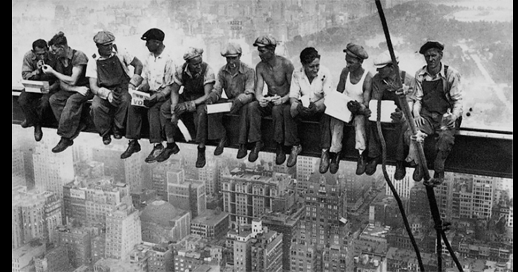 Now what is often seen in the field are risky work behaviors that can lead to serious injury or long-term disabilities. Why? Well, often the worker has been doing a task a certain way for a long time and he thinks the way he does it is acceptable and there is no reason to change. He does not appreciate or recognize the true risks in the way he does a task.
One old timer told me in the old days in Chicago it was considered perfectly acceptable for heavy equipment operators to go to lunch and drink ("pound") several beers and come back to work with a slight buzz and continue working.
In the field you try to make sure that people bring the proper tools for the job and the proper personal protection (i.e. hard hat, safety glasses, steel-toed boots, work gloves, etc.). You try to involve people who have the skills, the training, and the knowledge to do the work. And you always try to think of the worst thing that could happen in advance.
Now all this sounds rather dull and common sense but it is surprising to see how often one encounters risky behavior and how often a safety officer needs to remind people to protect themselves. People will do the darndest things to 1) Save time and be lazy; 2) Do it as usual when it is not a usual situation; 3) Be oblivious to the true risks — i.e. not educated in the task at hand; 4) See no benefit in doing something safely; and 5) Be part of a system which encourages risky behavior–i.e. "macho men don't need no stinking protection".
No matter how good your loss prevention system (and some have been shown to be extremely effective) is, however, the major thrust is that the individual is the one who has to take charge of protecting himself. Like the fight referee says, "gentlemen, protect yourselves at all times".
Well like investing there are times when you can overprotect yourself too. If you go to a site with minimal concentrations of constituents of concern wearing a chemical resistant suit in 98 degree weather you may die very quickly from heat stroke!
Always you need to adjust your level of protection to match existing conditions.
Sep
7
A Labor Day Lobster Hunt, from Jim Sogi
September 7, 2006 | Leave a Comment

A couple of years ago my surfing buddy and I went up north to the uninhabited valleys and had quite an adventure [read about it here]. We had always wanted to bring the family to show them this magical place full of ancient history and feeling, that was now deserted and overgrown with ancient ruins of temples and habitation from a millennium ago. We felt like we were approaching Jurassic Park.
The Labor Day Opening of Lobster Season hunt is becoming an annual event, so this year we took Sunseeker, a 61 foot Hatteras, and went in comfort and style, with hot showers, air conditioning, microwave ovens, stereo, TV, video, top flight dive and fishing gear: the works.

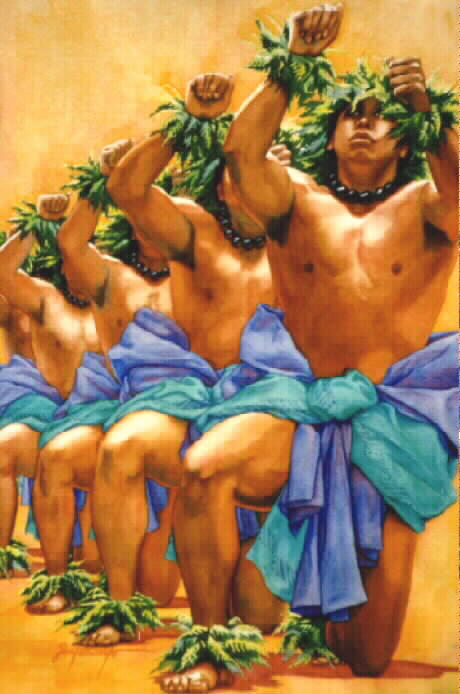 As we approached the valleys, my wife, a hula practitioner, recited the appropriate ancient Hawaiian chants and we left appropriate offerings to the local gods and powers that be in the valley. The locals call the feeling "chicken skin" , but you may know it as "goose bumps". Strawberry guava and lilikoi were in season. The stream with waterfalls gurgled in the bright tropical sun and we hunted crawdads and shrimp as we made our way up the valley. We saw where wild boar rooted. The big waterfalls off the towering cliffs threw sparkling diamonds of light and rainbows on the green sea foam while surfing the waves along the base of the cliff. Flying fish jumped out of the water and flew for dozens of yards ahead of the boat's wake. Birds hunted back and forth on the ocean searching for fish, and we followed the birds. The shore was covered with driftwood and we collected great canes and walking sticks. I wish I could have brought one back I found one that looked like Gandalf's staff for Vic and Laurel. I found out how useful they are when traveling through uncharted rough overland terrain to keep ones balance.
Despite the comforts oddly the big yacht was not as seaworthy as our primitive small Hawaiian outrigger canoe designed 1000 years ago with two intrepid adventurers with paddles. Despite relatively mild conditions, the big yacht could not stay overnight up North and could not handle the local conditions. Expensive chairs were tipping over and breaking. The crew scurried around fixing breaking things: a million things to break. When we went last time, the waves were 10 times bigger and the wind much worse, and we stayed without a problem overnight. The captain was cautious compared to how aggressive we were on our last trip with very basic, primitive tools. However, with the wives and kids along safety and comfort were the overriding concerns.
As always, I could not help but make market connections.
1. First, a simple strategy is the most powerful and with which you can be more aggressive as there are less variables to go wrong.
2. Complicated, expensive and bigger is not always better. It may be more comfortable, but depending on the goals, bigger is not always better.
3. The level of risk assumed will vary with the nature of that which is at risk. The risk level assumed on a million dollar yacht with women and children aboard is different than a $20,000 canoe with a couple of seasoned watermen aboard.
4. A couple of aggressive guys with skill and solid simple gear can compete favorably with the biggest and fanciest. It is the human factor the makes the difference.
5. The weather is always the overriding factor. No one, no matter how tough, how big, can overcome the powerful forces of nature.
6. Safety is the paramount consideration. Not returning or failing is not an option. The weather report and the weather are not always the same. It is good to be aware of that in advance and keep your eyes open and an eye on the sky and ocean, not just the ear to the weather radio.
7. There are always unexpected things in nature. Fish that fly in the air. Birds that swim in the water. Sharks with no bones or skeleton. Fish that turn iridescent colors. Stars that shoot across the sky. Oceans that glow and sparkle at night. Wind that goes in one direction, then in the opposite direction 50 feet away.
Sep
7
Upstaging Tom Cruise, from Dr. Mark Goulston
September 7, 2006 | 1 Comment

A super star does not a super apology make, but you don't have to be a superstar to make one.
Tom Cruise recently went over to Brooke Shields' home and apologized face to face for putting her down about taking meds for her post-partum depression. She not only accepted his apology, she had him join she and her family for breakfast. You don't have to be a "superstar" to give an apology and you can do something that even they don't do. You can give a "super apology."
Here are the five steps to making one, all done while looking the other person in the eye (to demonstrate sincere remorse which is the cornerstone of the process):
1. Say what you did wrong
2. Acknowledge how it hurt, disappointed, frightened or upset the other person
3. Admit you were wrong to do it and then apologize
4. Say what you are going to do to correct it and make sure it doesn't happen again
5. Ask those people you upset how you can make it up to them and then do it.
Michael Olds comments:
Dr. Goulston's response is well said from his point of view.
In the system of ethics taught by Gotama Saccyamuni [aka The Buddha] the manner of handling the situation where one has perceived that one has made an error in ethics is different than this. Gotama's manner of handling error might be found to be instructive here in your forum where there is clearly an effort being made to see things as they really are. In Gotama's system the process would better be called 'making conscious', and goes as follows:
1. Approach the individual transgressed against stating words similar to these: "Friend, I have committed a blameworthy, unsuitable act that ought to be admitted. I admit it."
2. Say what you did that you perceive needs to be admitted by describing your understanding of how what you did is wrong according to your system of ethics. Here, in Gotama's system, in highly simplified form: A) What was said was said knowing it was an untruth, B) What was done was done with intent to injure either mentally or physically, C) What was done was done with intent to take the un-given possession of another.
3. Ask that your admission be acknowledged as heard by the injured party with the intent that by having admitted it, brought it to consciousness face-to-face with the injured party where it cannot be easily forgotten, and where it will be easily remembered, future restraint will have been facilitated.
It will be seen that in this system there is no assumption that one understands what was experienced by the other person as a consequence of one's actions or to correct the situation.
This is because in this system there is the understanding that however much one may practice empathy there is known to be variation in beings which is largely beyond the scope of understanding of the ordinary person and which results in individuals being altered by events in various ways. We do not assume to know all.
With regard to correcting the situation it is understood that what is done is done and cannot be corrected. On the other hand there is no problem with expressing empathy ["I can imagine how I would feel…"] and doing a good turn for someone one has injured [compensating a person for losses incurred as a consequence of trusting in one's word, returning something stolen…perhaps manyfold, paying for medical care, and so forth].
In the case where one is unable to find and face the injured person this making conscious can be done face-to-face with some highly respected individual.
There is no expectation of 'forgiveness'; that is a thing that the injured party does for their own good. Should the injured person refuse to acknowledge having heard one's admission, that is considered their problem.
Sep
7
Fed Model: The Last Four Months of the Year, by Tom Downing
September 7, 2006 | Leave a Comment
In the table below, I have classified August to December returns for the past 27 years into 3 groups. A positive differential (Forward Earnings yield - 10 yr yield) has boded well for stocks. The current differential is about 2 percent, so the expected return is greater than 5 percent. Note that the unconditional mean is 3.89 percent for the last 4 months of the year, so the results are not as statistically impressive on that basis.
Also note that since 1979: when the differential has been greater than 0, the S&P has never dropped more than 4 percent (ignoring draw-downs) from August 31st to December 31st.
GROUP AVG STD N T %POS MAX MIN
DIFF < 0 0.07% 12.26% 9 0.02 67% 14% -25%
0 > DIFF > .01 5.38% 9.96% 9 1.62 78% 28% -4%
DIFF > .01 6.22% 7.08% 9 2.64 78% 18% -4%
ALL 3.89% 10.00% 27 2.02 74% 28% -25%
Sep
7
Option Valuation Using Historical Stock Data, from Dr. Alex Castaldo
September 7, 2006 | Leave a Comment
Thanks to a helpful hint from my colleague Vince Fulco I have recently become acquainted with an academic paper that I do not think I had seen previously, and would like to remark on:
Michael Stutzer: A Simple Nonparametric Approach to Derivative Security Valuation, Journal of Finance, Vol 51 #5, December 1996, pp1633-1652
As my friend Kris Falstaff often points out, the Black-Scholes framework for option valuation is based on an erroneous assumption, that stock price changes are lognormal. Of course alternative models can be and have been developed, such as those that incorporate jumps in prices and fluctuations in volatility, to get around this limitation. But then Kris could reply "that is not the real stock price process either."
A more radical approach is to make no assumptions about the distribution of stock price changes but just use the actual changes that have been observed in the past. This would amount to using a histogram of price changes instead of an analytical form for the distribution (for example the lognormal form). If the observation period is sufficiently long this should give an accurate representation of real life stock price changes. This can be called a 'nonparametric' approach or a 'historical' or 'empirical' approach to option valuation. ('nonparametric' in this context simply means "without assuming a distribution"). The Stutzer paper gives a simple procedure to implement this approach.
In brief there are three steps:
1. Using a large amount of historical price data, compute the empirical distribution of stock price changes over the time horizon T of interest (T= the maturity of the options we are trying to value). This gives a vector RH of all the possible price changes that have occurred over intervals of length T, and a vector PIHAT that assigns a probability to each. Since we have no reason to assume any one outcome is more likely than any other to occur in the future, all the entries in PIHAT should be the same, i.e. an equiprobable distribution. For example if we have 1000 different entries in RH, we should set PIHAT(i)= 1/1000 for i=1 to 1000.
2. We transform the empirical distribution found in (1) into a risk neutral distribution. Stutzer argues this should be done using the Kullback-Leibler Information Criterion. The vector of possible outcomes RH remains the same, but the probabilities PIHAT associated with these outcomes are replaced by a different set of probabilities PISTAR. The beauty of the Kullback-Leibler Criterion is that it gives an explicit, relatively simple way to compute PISTAR:
PISTAR(i) = \frac{exp[\gamma RH(i) / r^T}{\sum_j exp[\gamma RH(j) / r^T}
where \gamma is a constant given by another relatively simple expression, and r is the interest rate.
3. We can now compute the value of any option (or other European-style derivative) by taking the expectation of the payoff under the risk neutral distribution. For example to value a call option we would compute the expectation of Max[S-E,0] over all scenarios contained in the RH/PISTAR vectors.
It is a very interesting algorithm. The part that I am not completely convinced about is the idea that the Kullback-Leibler criterion is the correct one to use to find the risk neutral distribution; Stutzer has an explanation that makes it sound plausible, but somehow it was not completely persuasive (or rigorous) to me.
This is the best published paper on empirical option pricing in my opinion (although there are not many published), and it forms the basis for Emanuel Derman's Strike-Adjusted-Spread concept, that we can talk about next time.
Laurence Glazier comments:
This is very interesting and it would be good to see a worked example. It does rest upon an assumption that previous stock price movement is to some extent predictive of the future. Can we test if this is so? Also if Black-Scholes or similar is universally believed in by options traders does that not make it effectively true in a cultural context? I would be most interested in pricing theory to see an account made of the latent energy of an option, i.e. as the stock drifts slowly up, the option is gearing up, tensing to jump to the next level, and we want to identify this point so we can buy just beforehand. I am thinking here of a spiral motion up from a kind of Argand plane — when a full revolution is made the real option price moves up.
I think the weakness of Black-Scholes is the use of Vega, which is like the god of the gaps. It is a truly useful piece of social engineering, however, which enables the industry to run.
Sep
6
Ohio’s Oldest County Fair, from Pamela Van Giesen
September 6, 2006 | Leave a Comment

Every year I venture back to my roots to visit the Geauga County Fair where it often seems that time has almost stood still. Hoover's fudge has been selling the best fudge in the world to locals since the beginning of time; the corn dogs are hand dipped; the fries greasy and skinny and drenched with vinegar. The 4-H animal husbandry competition is always robust, the draft horses huge and wonderfully tricked out (the agricultural version of Harleys), the Amish kids are almost always found by the grandstand sneaking cigarettes. This year there seemed to be a few more veteran tents, the Dems still had a lousy location, the GOPers had prime real estate but both tents seemed a little empty (maybe everyone was getting corn dogs and fries and too sugary lemonade).
This year did bring some changes, though.
First, a couple of new Walmarts opened in Geauga County, one smack dab in the middle of Amish country and another at the other end of the county. I expected long faces but the locals appeared happy about it. The feeling seemed to be that existing clothing shops such as Peebles would sell more discount "upscale" goods (Woolrich, Tommy Hilfiger, et al.) and let Walmart have the very low end; Giant Eagle might feel it but since their produce is not so hot and their prices are not all that cheap maybe they deserve to go out of business, and Heinen's, the upscale grocery store, would be fine. Meanwhile, everyone was tickled about the low prices. Johan and I ventured into one of the Walmarts, my first visit to the establishment, and I have to say I loved it! I loved the greeter, loved the merchandise, and really loved the prices. It was bright and while not hip in the manner of Target, the goods were nicely displayed. The stores seemed to be doing decent business though it was a bit slow on Labor Day but that was because nearly the entire county was at the fair or stuck in traffic trying to get to the fair (we hit the fair early and took the secret back way, figuring that the wet weather earlier in the weekend would lead to high attendance).

The second change took place at the fair. This year we were fortunate to see the new coon hound races whereby three coon hounds chase a fake raccoon across a large pond and up a tree. It was a crowd pleaser and also offered some interesting lessons. In the first race the hound that seemed to have the greatest lead gave it up because his front legs were too high in the water and he was not properly using his back legs. He was fast, but not using all his equipment led to loss. In the final heat where the three previous winners faced off, two of the hounds were neck and neck the length of the pond. As they neared shore they started snipping at each other. Meanwhile, the dog that everyone had given up for loser and that appeared to be swimming in the wrong direction materialized out of nowhere to beat the other two to the tree. While the "neck and neck" hounds were busy snipping at each other, the apparently really smart hound swam the shorter distance to shore and then ran the rest of the way. Lesson: taking the shortest distance to the prize will not necessarily get you the win; it's important to play to your strengths (dogs run faster than they swim); and, finally, while you are busy looking at your closest competition someone else is bearing down out of left field. The crowd loved it and roared.
Ohio now has two of the poorest 10 big cities in the country (Cleveland and Cincy) but life in Geauga looked to be on an upward trajectory. A fair bit of building, some of it still in the planning stages, more businesses in most towns (though not all). Real estate prices not out of control. You can get a nice farm house, updated, with 6-12 acres in Middlefield for under $400k, and a sizeable ranch or colonial in a very desirable village in Cuyahoga County for $300k or less. One local realtor informed us that it is a buyer's market at the moment, softer than it has been since 9/11, but she is still selling homes. Over on the northwestern side of the state the fields were flush with nearly ready to harvest crops.
Folks looked to be happy and enjoying life. Maybe it was the $2.29/gallon gasoline in Chesterland or the agricultural subsidies. Maybe they are just too fat and happy to know otherwise. Or maybe more rural folks are naturally optimistic or see that life outside an urbanized view of things is not so bad. Anyway, it was nice to go home again and see that the standard of living continues to rise for most.
John Kuhn mentions:

Talk about memory lane: I caught my first calf in a calf scramble at the Idaho State Fair when i was around 11. 1953. Named him "Sir Cumference." Sold at .33/lb. An outstanding price as he weighed over 1000 lbs by the end of the summer a year later. Pretty good ROI, (small rope burn) for an 11 yr old. He had a nasty disposition however, even before the hideous heel flies began to emerge (the 2" long grubs migrate from eggs laid on heel up and out thru the back which ugly emergence irritated even the most docile beast. We would paint the stock in creosote but did not always get 'em soon enough). I got to show him and talk to the folks on the Sheriff Spud TV program too that year. I figured I was pretty much a celebrity what with the TV appearance and being the President of the "Pick and Shovel" club. 4H.
Geeze, makes me want to go out and buy me some cotton candy and fried dough. But now all you can get downtown where I live is mocha lattes. That standard of living thing.
Sep
6
Buy and Sell Orders, from Dr. Phillip J. McDonnell
September 6, 2006 | Leave a Comment

There are two types of buy / sell orders. Market orders are orders to be executed immediately at any available price. Limit orders are orders to be executed only if the specified price or better is reached. For all practical purposes the market maker bid-ask quote can be viewed as a limit order. The combination of market buy/sell and limit buy/sell gives us a total of 4 possible orders. To that we can add the cancellation of limit orders for a total of 6 possible type of trading orders. The case of cancellation of market orders is effectively eliminated because presumably the execution occurs so fast that there is no time for a cancellation.
So the interaction of these six orders is what determines a market. For a long time little was known about the distribution and interaction of these order types. The market micro-structure was a black box to most. However some early researchers, notably Vic and M.F.M. Osborne, studied the structure of markets. Vic went so far as to examine time and quote data when it was not widely available and to get permission to analyze specialists' books on the exchange in the 1960's. The findings are outlined in Education of A Speculator. A couple of key ones are:
1. Limit orders tend to be larger than market orders.
2. Given a market ticks up or down the next different tick will tend to be in the opposite direction with odds ranging from 4:1 to 7:1.
Today markets are a bit more transparent in that the order book is often available to participants willing to pay for it. However this opens up a new dimension of deception not previously available. Many orders are large bluff orders which are immediately canceled. Other gamers will repeatedly place and cancel an order at one second intervals. First this will create an aura of flashing quotes on a real time updated quote screen. Anyone who has ever seen the mesmerizing effect of a slot machine with its myriad blinking lights will quickly get the idea. The blinking lights have replaced the old time hypnotizing effect of the mindless ticker tape forever droning on.
Another trick is when there is a fairly small order on the bid or ask side and the gamester wants to attract attention to that side of the market hoping for someone to take the limit order out. They will use the same 1 second alternating big order then cancel routine to attract the eye just to the bid or the ask side of the quote. It reminds one of the mythical seductive sirens of ancient mariners seeking to lure the traveler over to the bid or ask side simply by attracting the eye.
The net result of the greater transparency has been to increase the deceptive aspects and the gaming dimension of order analysis. In addition effective analysis of order flow is now a job for a computer. Humans simply cannot keep up with the rapid fire order placement and cancellation. Even though the analysis is more difficult now compared to when Vic did his seminal studies of order flow at least we have the data.
Sep
6
Dr. Kim Zussman reviews The Devil’s Eye
September 6, 2006 | Leave a Comment
Don Juan the famous lover was dead and condemned to hell. Each day he awakes and chances to meet another lass who he proceeds to woo, until at last she begins to fall into his spell. Only just at the moment petals are quivering to fall from the rose, he would snap instantly back to the breeches of hell. This act he repeats every day, for an eternity of infinite frustration for Mr. Juan.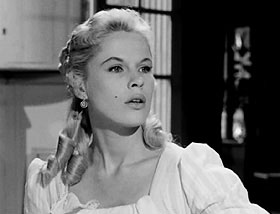
After much pleading by Don Juan to end his cycle of torture, the devil finds himself suffering with a sty. It turns out a vicar's daughter is still a virgin, and in seek of a cure the devil gives Don Juan a task to earn peace and be released from his condemnation. He was given one day on the surface to seduce the vicar's daughter, and if successful, he would be allowed to finally rest …
The irresistible Don was ecstatic — this would be easy! Up he went, and proceeded to work his unfailing magic on the lovely girl. She was a nubile blond maiden (there are lots of them in Sweden), 30 years his junior, graceful and sweet like a dream. Don proceeded to charm her, and though she resisted mightily she began to weaken. Yet before he could make the move that would save him from eternal condemnation, paradoxically something happened to him for the very first time. Don Juan fell in love.
He was tormented now. Could he violate his one and only love in the name of the devil, just to save himself? Even worse, his eternal charm began to flicker as he fell deeper in love with the girl, and his love made him look weak and pathetic to her.
Needless to say, Juan's infinite quests continue to this day.
Sep
6
The Salesman, from James Bitumen
September 6, 2006 | Leave a Comment
Several months ago, Victor wrote a beautiful post on The Salesman. "When you call a man a salesman, you flatter him," I think a quote from the piece read. It stuck in my mind, as did, "Nothing in the world happens without a sale being made." It was a piece that would flatter anyone associated with the art of sales. I took great comfort in it at the time, as I had recently returned to a sellside platform on Wall Street, mainly because I felt that the opportunities on the sellside, and the less rigid structure, offered a much greater reward in comparison to the rewards offered to a manager of market risk who is forced to operate under buyside confines best defined as ignorant, inept, and hypocritical.
But sales, as an art, is dying, at least in the industry we refer to as Wall Street. Yes, there are "research sales" people who still get all excited when a firm analyst comes out with a new recommendation. They make the call into the portfolio manager's office or analyst. "John, how are you? So nice to take my call. Listen, I have some really important things to discuss, but we will get to the dress your date was wearing the other night at the gala in a second… No, John, this isn't Mike from Buckingham. No, this isn't Mike from Weisel either. This is Mike, the guy with the Salsa moves from Pru… Now you got it, listen, about Ann Taylor, we love it today." Everyone is saying the same thing with the same routine. Institutional sales people still get goose bumps when calling a customer to schedule a meeting with the CEO of that new growth stock, but at the end of the day, they are just appointment makers. And the hundreds of firms making hundreds of appointments is disastrous.
What is even more scary is what happened earlier in my day. I had a conversation with my friend Tom, who recently made the switch from the still-in-existence telemarketing department of his firm to the institutional sales side. He only knows telemarketing of the retail kind, and he is not going to change his approach whatsoever. He has no research, just his own ideas. I am not so inclined to believe that such an approach is going to bring Tom a windfall in commissions from all of these hot hedge funds, but all sales efforts need enthusiasm and encouragement if they are ever going to get anywhere.
Here's a transcript of our Instant Message dialogue. I love Tom like a brother and I had to play along with him so that he would be excited and not lose enthusiasm to go out and write some tickets.
Tom: I am telling you, it isn't so often I get an idea like this one. You ready for it?
Me:  Go
Tom: NOC. You love it already, don't you?
Me:  I don't really know anything about it to be honest. What do you have?
Tom: Think of the geopolitical mess going on around the world. It is a nightmare
     to say the least. First, 9/11 -- the US and world starts to militarize. Then
     Iraq, Korea, you with me?
Me:  Yeah, I guess so.
Tom: Militarization is only going to continue -- everyone is going to continue to
     build arsenal and these NOC guys can't go wrong.
Me:  I suppose that could be the case, but I am on the other side. A Democratic
     landslide in the elections is a risk. And, that combined with a world that
     will politically and culturally start gravitating back to the left is going
     to be major inflection point in the business cycles of anything defense.
     Buy the cheap long-dated puts -- your risk is clearly defined.
Tom: Great thought, but you have to admit, defense is not a partisan issue, and
     you can't tell me America, as a nation, wants to be less safe.
Me:  So missile buying continues or escalates. Good luck with that. Anything else?
Tom: It is, no pun intended, defensive in a lousy market. Ha Ha Ha. Isn't that great?
     Gotta love the chart, decent forecast. This is a fast trade with a tight stop.
     Why don't you give me an order to buy 50k and let me trade it for you?
Me:  No thanks, but good luck with it. Appreciate it. But keep me up. I am too
     wrapped up taking all of the time off from my screens for these meetings.
Tom: Time off is time lost from making money. In fact, you are going to lose money
     by not having it on. Do want to lose money?
I am not going draw any brilliant conclusions here, but these examples are evidence that the salesmanship of today cannot beanything like of what is used to be, and this might be presenting all sorts of problems for Wall Street. This in no way is a prognostication of an unfortunate market direction, but it is representative of the times.
Sep
6
Carly Haiku, a Continuing Series, by George Zachar
September 6, 2006 | Leave a Comment
Sept. 6 (Bloomberg) — Hewlett-Packard Co. is being investigated by California's attorney general to determine whether the company broke the law in discovering the identities of board members who leaked confidential information to the media. (.. ) Fiorina, who was fired after more than five years, said her ouster came after she had a "fundamental disagreement" with board members about management changes they sought. In October 2005, she criticized unnamed directors for providing details of discussions that took place in January of that year to the media. "When confidential board conversations become public and what should stay inside the boardroom goes outside the boardroom, then a very important bond of trust is broken," Fiorina said in response to a question after a speech at the Massachusetts Institute of Technology on Oct. 7.
The boardroom antics
at HP never end. It's
like she never left.
She threatened Deutsche Bank,
and table-hopped at Davos.
Carly's "bond of trust"?
HPQ's leakers
forgot the obvious choice.
Dude! Use a pay phone!
Sam Humbert adds:
A coup in progress?
She's hearing whispers from her
hair and makeup guy.
Sep
5
Crocodile Hunter Dies Whilst Filming, from GM Nigel Davies
September 5, 2006 | Leave a Comment
This seems like a warning to us all, despite the relatively low-risk nature of our hunting.
Sep
5
A Few Points on Housing Markets and Banks, from George Zachar
September 5, 2006 | Leave a Comment
1. The markets, though imperfect, are right far more often than they are wrong.
2. Interest rates are low by any historic or absolute metric, and falling.
3. The stock market had the "Greenspan put", wherein investors believed Sir Alan would ride to their rescue, cutting interest rates if prices faltered. We are seeing the emergence of a "Bernanke put" on housing.
4. Extension of the old joke: If you owe a bank $1,000, you have a problem. If you owe a bank $10,000,000, the bank has a problem. If mortgage holders are upside-down $10,000,000,000, then the Fed has a problem.
5. There is a tremendous political interest for the chattering classes to induce fear in this area, making it hard to stay objective amid the screaming.
6. There is also great ambiguity about the mix of economic ordinary home purchasing, and speculative "investor" positioning. Real pain is likely to be concentrated primarily in the very last cohort of non- economic house buyers. How big is that group? And how are the vulnerabilities distributed? Those are the core questions that remain unanswered amid the daily scare stories.
Sep
5
Still Stable after all these Fears, from Dr. Kim Zussman
September 5, 2006 | Leave a Comment

Even with the recent pause in stocks that made Ben pause, volatility is still low and there has not been a steep decline in a while. How long exactly?
There are lots of ways to count this, but here is one: SPY daily closes 1993-present were checked to see if they were more than 10% lower than the high close of the prior 40 trading days (2 months). This method of screening does not specify the duration of the decline (bounded by 1, 40 days), only the magnitude, so the drops could span 2-40 days.*
Looking for declines this way does not eliminate all those nasty periods with many consecutive days meeting the loss 10%+ criteria, which clutters up attempts to gauge wait times between drops. To help with this, look-back days were counted only if the prior 3-days did not meet the 10%+ decline criteria.
Here are the ranked wait times, in trading days, between closes more than 10% less than the high close of the prior 40:
1160+, 388, 201, 161, 126, 98, 98, 50, 39, 39, 27, 24, 17, 11, 10, 10, 9, 9, 7, 7, 6, 6.
The top entry, 1160+, is from the start of the series in 1993, which you will recall from your almanac was another volatile period for stocks. The date of the next longest 388 day wait was April 2000, which more or less heralded the end of the 1990s bull run. (One wonders how many boys born 4/00 were named Herald).
History buffs will note that as of 9/1/06, the current streak without a big decline is 883 days-approaching the record length set in 1993.
Using macro analysis, compare and contrast the markets of the mid 1990's and today. Use this analysis to explain why volatility declined in both periods, and make a prediction of how many days are left before another down of 10%+. (This last bit turns the thing into an exam question for all the prof's on the list. If you use it please either send royalty of $0.25 to your ex-wife in my name, or mine in my name).
*this is a slight modification of something posted previously, only this way pins the day you look back from to survey your losses.
Sep
5
The Prophet, from Debra Kettle
September 5, 2006 | Leave a Comment

The Prophet by Kahlil Gibran has always been one of my favorite reads and is recognized as one of the classics of our time. In his work, Kahlil describes the art of parenting in a way that reminds us of the beauty and responsibility of raising children that allows for our offspring to experience their own journey without being tarnished by the personal agenda of parents. Application of the gifted insights of Gibran to investing might be considered both humorous and profound.
The Prophet (original version)
And a woman who held a babe against her bosom said, Speak to us of Children.
And he said:
Your children are not your children.
They are the sons daughters of Life's longing for itself.
They come through you but not from you,
And though they are with you yet they belong not to you.
You may give them your love but not your thoughts,
For they have their own thoughts.
You may house their bodies but not their souls,
For their souls dwell in the house of tomorrow, which you cannot visit, not even in your dreams.
You may strive to be like them, but seek not to make them like you.
For life goes not backward nor tarries with yesterday.
You are the bows from which your children as living arrows are sent forth.
The archer sees the mark upon the path of the infinite, and he bends you with His might that His arrows may go swift and far.
Let your bending in the archers hand be for gladness:
For even as He loves the arrow that flies, so he loves also the bow that is stable.
The End.
I am not surprised, given the dominant male presence in the world of finance, that the stock market has often been called a mistress. I would like to offer a new, perhaps more female minded perspective, and suggest that the market is less like a mistress and more like a child. What would happen if the mistress were ultimately married and bore a child? What tenets might need to ensue to shape the outcome of this intellectual and emotional shift? I think Gibran's piece, and viewing investments as children, offers a great new metaphor.

Most would agree that a full commitment is required of parenting. Planned or unplanned, a child makes certain demands of parents that must be met in order for the child to develop and thrive. Moral implications aside, a mistress is certainly a thrilling concept. The mistress metaphor seems to play on the internal ache and frenzy that the market causes many investors. Her risk is great, she can never be fully possessed, and often she drives investors to levels of despair and ecstasy emotionally and otherwise. The mistress is often blamed whereas we miss the real culprit, the lack of emotional management. I have always held the position that parenting, like investing, when done well is a predominantly intellectual enterprise and I would like to propose the head over heart approach of parenting as a new, perhaps just as playful and heart wrenching metaphor, for investing.
We all know that a full commitment to a mistress would render her no longer a mistress. The short version is that she would be given legitimate status. Soon to follow might be the ho-hum, the status quo, the banal, the boring, the responsible, the dutiful, even quiet desperation of legitimate union. A full and honorable marriage to the market would likely bear offspring . The children, the investments, and inevitable associated responsibilities cannot hope to compete with the excitement of an illicit love affair but might ultimately prove to better serve the future. Concepts such as balance, discipline, nurturing, boundaries, and limit setting would replace reckless abandon, passion, and longing. The former concepts, however, with regard to investing, might also make for a greater long term relationship. While indulgence might make a mistress happy. An indulged child rarely thrives. Neglect, probably more so as it reflects the mistress not the child, is not a good idea either if you know what I mean. Granted, the thrill, the lack of commitment, the not being required to spend holidays, the come and go as you please nature of a mistress, may make her more desirable as a metaphor, but I am optimistic that the benefits of a metaphor with a firmer foundation might be plausible and worthy of consideration. I realize that I risk my "image" as a fun loving, risk taking, emotions drenched, liberal in writing this piece. Truth be told, I am the type to run with scissors only to put them back where they belong.
So, back to Gibran. What exactly would be required of investors if they married the mistress and bore a child? What tenets might need to ensue to shape the outcome of this emotional and intellectual shift? So Here goes: With all due to respect to the genius of Gibran, I unleash, The New Prophet. [read the rest of this post]
Sep
5
Stocks as Molecules and How Phases Change, from Jan-Petter Janssen
September 5, 2006 | Leave a Comment
I wonder if the resemblance between how molecules are structured and how stocks are traded can be used to explain some "irrational" price moves that occur sometimes. By irrational I mean large jumps or declines in the price despite no new information.
When heat (energy) is added to a substance two things can happen: A higher temperature is observed, caused by higher kinetic energy. Or, if the substance changes phase, the heat will change the bonding of the molecules, increasing the potential energy. The idea is that stocks have phases (or equilibria) that change in much the same way.
Note the two fundamentally different reasons for trading: #1 Buy one, sell another to take advantage of differences in relative prices, #2 Buy or sell based on whether consumption or investing makes one better off.
These equivalents are being used: Temperature (kinetic energy) <=> The expectancy and return at the price where #2 buying and selling balances. Bonding (potential energy) <=> The value the #1-participants add to the market. Heat (kinetic + potential energy) <=> The price from the impact of both #1 and #2
Normally stocks can be thought of as being in the liquid state. Trades trying to benefit from the differences in valuation (#1) are the forces which keep the stocks connected. This will normally imply very little impact on the price from selling or buying (#2) in a particular stock when no new information is released.
When the net price impact from those who go in and out of the market (#2) is higher than the #1-traders can deal with, stocks will change phase.
If the change is a negative one, price will fall until we again find that Price = Money in / Shares out (#2), This new frozen price will be where the expectancy and risk is the same as for liquid stocks; i.e. a stock could fall from P=10 to P=5 despite no new information and be neither more nor less attractive than before. The reason is that the individual participants no longer have the benefits the #1 traders give them. Few will have incentives to trade because relatively small volumes will move the price in an unfavorable direction. A low price also harms the fundamentals, and private placements are less favorable for the existing shareowners; which can be considered costs of buying a frozen stock.

Similarly, when a stock boils it has more buyers than there are available sellers. A bubble will occur, and the participants who are fond of the stock have the power over its price. During the Internet bubble no one could stop it, and those who tried going short were most likely squeezed out anyway.
Whereas the individual stock must be in any of the three states, the entire market exists of a fraction of the stocks in each state. This is comparable to a pool of water which has an ice cube floating in it at zero degrees Celsius.
Sep
5
Shaping the Industrial Century by Alfred D. Chandler. A (very) brief review by George Zachar
September 5, 2006 | Leave a Comment
This is a bone dry 300 page genealogy of the European and American chemical and pharma industries, primarily of interest to historians. The lessons of focus, adaptability and barriers to entry are endlessly repeated.
The only non-obvious things I learned here was that the US chemical industry profited mightily from confiscated German patents during WWI, and that US pharma successfully exploited trade disruptions during WWII.
Sep
5
Waiting for Blotto, from Dr. Kim Zussman
September 5, 2006 | Leave a Comment
Along the lines of generational length of market regimes, I used DJIA daily closes to look at wait times between new 10 year highs (actually 2500 trading days). From the present back to 1928, each day looks back over the prior 10 years to see if it is a new high, and if so how many days has it been? Here is a graph of these results.

The bands of points cluster along two intervals (bull markets) when new 10 year highs were being set frequently: 1950-65, and 1982-2000. Notice there are gaps between the intervals, which represent the intervening bear markets of 1929-50 and 1965-82. During these bear periods, new 10 year highs were set infrequently (duh the market wasn't going up), so you see points during these periods representing many days. The longest was over 4000 days, and occurred in 1945, followed by 2500 in 1982, and 1677 in 1972.
Interestingly the current period (through 9/1/06) has not seen a new 10 year high for 1667 days (I put a point there to illustrate this, even though we have not yet seen the new 10Y high). So in 10 days, assuming the DOW does not jump over 300 points (i.e. youtube video of sniping Osama with a 50 cal. in slo-mo), we will be in the third longest wait since the 1930's!
Who cares? Perhaps these many-year length intervals are related to generational risk-aversion and memory of losses and ruin, which go on vacation when a new generation's pockets fill up. If the size of the gaps between bull markets has such consistency, the gap we are now in may have a number of years to go.
Sep
5
Debunk this Please! from John Alabaster
September 5, 2006 | Leave a Comment
The following quote was sent to me by a caring sharing type. Originally written by one Robert McHugh. It sounds like he has done a study; can you debunk it? I do not have as much data as you …
The probability of a decline — often significant — is high whenever the percent of Dow Industrials stocks above their 30 day moving average rises above 80.00 percent. We show every instance this happened over the past two years. There were 8 occasions when this occurred and 11 prior occasions if you include three that got close to 80.00 readings. All but one generated declines of several hundred points shortly thereafter. The one that did not resulted in a smaller decline, yet still a decline, and 60 days later we got a sharp decline. We sit Friday, September 1st, 2006 at 83.33, a twelfth occasion. So, if history is any lesson, we have a 91 percent chance of a sharp decline occurring over the next several weeks…It takes being a cock-eyed optimist, or having full faith in government intervention, to see a long-term Bull market rally continuing from where we stand today.
I am an optimist because it works — however cockeyed I may be sometimes!
Vic replies:
This is totally ad hoc. The period chosen is selective and probabilities are given rather than expectations. Many other factors besides moving averages of that length can be given. It is biased and helping a position along.
Sep
5
Craig Nelson on Technical Analysis and Practical Speculation
September 5, 2006 | Leave a Comment

I have read both of your books, and I loved the first one but am a bit disturbed by the second one, which goes into some length at proving the uselessness of technical analysis. After all, is not the study of price, any price, in all its shapes, forms, and expressions (whether it be patterns involving the prices themselves, trend lines, or other functions derived from, or based on, price) all part of the definition of "technical analysis"?
If that is the case, and I think you might agree, then could you not also dismiss "price patterns" found in earnings figures, regressions, correlations, and all that stuff covered in your second book as just different expressions of "technical analysis"?
If that is the case then pretty much all of what you covered in Practical Speculation can be disregarded if you consider my broader definition above and agreeing with you that all forms of technical analysis are essentially unreliable. In which case, (and assuming you also feel that fundamental analysis is useless and/or already reflected in the price), on what basis should one trade?
Sep
5
Turning Points, from Dr. Michael Olagnon
September 5, 2006 | Leave a Comment

In a recent post you used the words "turning points" that rung a familiar bell to my ears. In a follow-up to that article Dean Teffer complains about the jitter in the signal and the difficulty of defining correctly "turning points", and that also sounds familiar to me.
"Turning points" are typical of studies in materials fatigue. Engineers and statisticians who work in that field have developed "counting methods" (you should like the idea) in order to deal with the phenomenon. Fatigue is a mechanism by which a very small crack in the beginning extracts energy from a load history in order to make its way through a piece of metal. It has similarities with the problems exposed on your site in that the crack is "not interested" in jitter of small amplitude that does not let it open and grow, and in that due to the limitations of the fatigue testing machinery in the labs, the algorithms have to deal with discrete levels.
The most interesting and commonly accepted method for counting in fatigue is Rainflow. Here is a small presentation adapted from a fatigue study. Many results on level-crossing intensities, on time to the next maximum or to the next level-crossing, etc. have been developed by the statistician Igor Rychlik, his mentors Ross Leadbetter and Georg Lindgren, and his group at the University of Lund in Sweden. Even more interesting, all those theoretical results have been practically and reliably implemented into a Matlab toolbox, WAFO.
I have thought for more than a decade that those results might be of interest for trading and finance, but I did not have access to the huge databases necessary to test them in that field, nor the time to go and look for them. Perhaps you can find some bright young student to investigate it. Up to now, we have taken the point of view of the designer fighting fatigue, it would be pleasant to try to play it in the crack's seat!
Sep
5
A Tutorial on Measuring Risk in Stock and Options Portfolios, from Dr. Phillip J. McDonnell
September 5, 2006 | Leave a Comment
Measuring the risk of a portfolio which includes stocks and options can seem to be an insurmountable problem. Options move with respect to their underlying stock as a function of the option delta, and at the money option with a delta of .50 will move 50% as much as the underlying stock on a point basis. The CAPM theory says that stocks will move with respect to the market as a function of their beta. Empirical evidence says that the alphas are non-persistent, so only the beta need be considered. Thus a stock with a beta of 1.50 will move 150% as much as the underlying market index moves.
So if we wish to construct a portfolio scale metric which will measure the combined market response of a portfolio of stocks and long and short options we would simply multiply the delta and beta by the quantities suitably adjusted.
Suppose we had an IWM Russell 2K ETF call option with a delta of .50 and IWM is at $72 per share. We wish to convert the position to a common metric of an equivalent dollar amount of SP index.
Convert the option to a dollar equivalent IWM by taking 50% of $72 times 100 shares. This gives us $3600 dollars. Let's say the beta of IWM with respect to SP is 1.50. Multiplying $3600 by 150% gives us $5400 worth of pseudo SP index.
For a stock take the stock value of $7200 times the beta of 150% to get a dollar equivalent of $10,800.
Remember that a short position puts a minus sign in front of the above numbers. Also note that a put has a minus sign built in as well. For a short put it is -1 * -1 = +1. After the equivalent risk of each position is calculated then add them up with their signs to find the total of the portfolio.
A final note of caution - this type of analysis is an excellent way to measure linear risk for small movements in the underlying index. However for non-linear assets, such as options one may wish to consider other measures which include gamma and even the third and higher calculus derivatives of the option model.
Sep
5
A New Statistical Framework for the Market, by Victor Niederhoffer
September 5, 2006 | Leave a Comment
We are often confronted with a series of observations that form the basis for a decision. The classic example is the series of defective and acceptable products that come out of some manufacturing process. Another classic would be the lifetimes that occur when groups of patients are confronted with two treatments. In our own field, a series of prices from markets occurs, and it is helpful to inquire where it's going, what the process underlying it is, and what treatments might have described or predicted it.

A class of statistics called sequential statistics has been developed to deal with decisions, estimates and procedures for a series of observations where the decision is made before the end of the process. Sequential Statistics (University of Kentucky, 2004) is a provocative and challenging book by Zakkula Govindarajulu and covers the subject well. The book starts with a helpful introduction in which examples are given, the problems are put in perspective and a framework is provided. The author describes two-stage procedures where you stop at a certain point, get your bearings and estimates, and then continue sampling until a specified stopping rule is reached.
The second chapter is on the classic ways of treating such problems. The Sequential Probability Ratio Test is a procedure where the probability of observations coming from two different hypotheses is continuously calculated. When the ratios get beyond certain control bands, a decision is made that a difference in parameters exists. For example, after 10 observations of a heads-and-tails process, with 10 heads, it's 40 times more likely that the process came from a 0.90 heads process than a 0.50 process. So if one observed 10 out of 10 heads, one would be 97.5% confident that the process came from the 0.90 process.
The third chapter covers decision-making where there are not two simple alternatives but composite hypotheses concerning a range of values for the parameters. This chapter gives Bayesian procedures for non-parametric decision-making including ranks and sign tests, as well as methods for deciding between more than two hypotheses.
The fourth chapter covers methods of estimating parameters and confidence regions as you're going along in a sequence, including methods for determining regression estimates on a going-forward basis. Generalizations to cover decision-making with different loss functions and multiple significance tests are covered.
The fifth chapter covers applications to biostatistics, including problems dealing with optimal dosages, and lifetimes that arise from different treatments. Particular reference is made to a procedure called the up and down rule where you keep changing the dose level up or down by a unit based on whether it improved or hindered the outcome between the last measurements. The final chapter gives code and descriptions of Matlab programs that can be used to implement the major tests and procedures covered in the book.
Most of the methods used in the book can best be derived by simulation. That is, you would take a random series of numbers, and look to see what kind of statistics would be forthcoming based on the underlying process that determined the sequence at a given point. Signs, differences between means, variables and ranks of competing hypotheses would be calculated, and based on repetition, one would generate probabilities of occurrence for the statistics, and confidence regions for decision-making.
There are few if any references to uses of sequential statistics in the literature. Aside from their use in biostatics and quality control, most of them appear to be in the field of linguistics, where it is interesting to consider how people understand words based on the constituent phonemes involved. I believe there is a wide range of uses for sequential statistics in market decision-making. One important example would be in systems analysis where you are trying to decide whether a system is helpful or whether a phenomenon occurred. How far back do you go before you make a decision? Certainly not to the beginning of a period, because by then your data would be out of date. But you don't want to stop too early either, because then your data will be subject too much to chance. Given you've stopped at a certain point, how far do you wish to go forward before you conclude that the process has changed?
On another front, what confidence do you have that certain levels will be reached given the sequence that occurred in the past? Procedures similar to estimating the maximum of a 100 numbers when you're confronted with just the first n are similar to those that a student of sequential statistics would derive, but the procedures here are much more robust and precise.
Our whole field cries out for sequential statistics, and simple methods for applying them in practice would be useful to all.
“Sequential Statistics” often draws upon theoretical work in advanced calculus, probability theory, measure theory and statistics. It's not light reading or accessible to those who aren't already versed in the field. However, it will get you thinking about a class of problems, and provide useful guidelines, tables, and types of procedures and decision rules that should be immensely useful in quantitative finance and counting.
Sep
5
A Bond Maven Reads the Newswire, from George Zachar
September 5, 2006 | Leave a Comment
BN 11:08 *POOLE SAYS HE "DISTRUSTS" SURVEYS OF INFLATION EXPECTATIONS
This is the new news, to me. Everything else Poole said today is "I am above the fray" claptrap. The quote above is the first indication I have seen that the Fed is walking away from a metric they have consistently touted, to wit, that "inflation expectations" can be measured and used as a critical variable. We know that the TIPS spreads are FUBAR for a host of reasons. Now, if they "distrust" the surveys, how the heck are they supposed to straightface us with "well anchored" expectations? It's no coincidence that those surveys have been creeping up.
Sep
5
When Doomsdayists are the Photographers, from Russell Sears
September 5, 2006 | Leave a Comment
I consider myself lucky that my studies of the markets began with Investments by Bodie, Kane, and Marcus. Then before I could be corrupted, I started reading Vic and Laurel's books. The study of "Investments" begins by reading the difference between "real assets" and "financial assets". Then it explains their relationship to each other. How financial assets are used to transfer real wealth. This foundational underpinning often will clarify the fallacy in the arguments of the prophets of doom.
When the doomdayist is the photographer, one of the most common deceptions is to magnify the problem, then focus on only one side of the picture completely blurring the other side. He artistically crafts this clear snapshot of one side of the current state. Then he imagines a future world with both sides, but doomed to failure because of its imbalance.

Being interested in demographics, I often will read articles about the impending boomers retirement. This also is one of the doomsdayist most fertile grounds. The USA's boomers, the most productive generation in history will go from being a net producer of wealth to a net consumer. Transfers of this wealth will occur, either through boomers life or at their death. Because many in this generation have amassed a fortune, framing such pictures to imply your prophetic ability is a rich field. Also boomers want to know how this transfer will occur, to determine how to position their wealth. Do you hold "real assets" or "financial IOU's"?
Because of this great wealth, it is the rare author that will take a balanced look at how this transfer of wealth will occur. Often I find articles that will use the actuarial approach to the boomer's problem, that is taking the present value of future benefits then look at the current US debt and add it on to this social security present value and perhaps throw in a the present value of other future government debts.
All of this is put in fiscal terms, with mind numbingly large numbers even the most numerically literate has trouble understanding. The real wealth currently held by the US and the boomers is an ignorable blur. The conclusion is that the only solution is to devalue this debt by inflating your way out of it. Therefore you hold "real assets" such as gold, a doomsdayist favorite. This is of course what every generation X, Y, and Z'er will want; gold, hard assets.
This perhaps shows the brilliance of Mr. Gross's recent article No Cuts, No Butts, No Coconuts. He, like a good doomsdayist photographer, magnifies the problem. But unlike the fiscal doomsdayist, he focuses on the real imbalance. That is that the boomers have the real wealth, and the demand for that wealth will decrease. He uses housing as the basis for every real assets. He insist there will be a slowing of demand for housing therefore implies a slowing of demand for everything real. He implies that you especially do not want to hold a real company producing real wealth. He implies you certainly do not want to bet on the US, the current largest holder of the world's real wealth.
The intended message of this deflation is of course you want to hold bonds, or fiscal assets. Remember he is the biggest bond salesman around.
I would suggest that the truth lies somewhere in between. Boomers will have to transfer that wealth to someone. Generation X, Y and Z'ers clearly will not have to work as hard to obtain that wealth as the boomers did.
However, much of this ease in effort to meet needs will be due to increases in productivity, not totally inflation. There will be a slowing of demand for some assets, and a growth in demand for others. The more we look to the emerging markets to make up the shortfall in human capital, the more basis goods will be in demand. The more we look inward the more scientific discovery, quality and artistic expression, the human element, will be valued.
The younger generation will not lose an interest in obtaining wealth once their survival needs are meet. The US will not suddenly lose its real wealth advantage to motivate others. Neither will it loses its foundational ability to through creative destruction and nurturing of the individual spirit to produce wealth.
There will always be problems to solve and people reaching for the stars. In fact I would argue that, in a world where the fundamental shortage is human capital, in this world the wealthiest nations will be those that give the individual spirit the most freedom, not just the nations with the most humans.
Scott Brooks adds:
I have said this before, and I will say it again (even thought I am resoundingly ridiculed for saying it); losses hurt you more than gains help you.

If the premise of the long term positive drift of the market is true (which I believe it is), then getting good returns is simply a function of "showing up at the party". All one has to do is be there to get good returns. Unfortunately, getting good returns is not good enough.
Human beings are ruled by a two sided coin: greed and fear. When things are going well, we and forget the adage that "things are not as good as they seem", or worse yet, we think we are smarter than we really are. So we get greedy. "Hey, look at my returns, I'm pretty smart…so If I'm smart enough to get these returns, then why not go on margin, leverage the money and double, triple, quadruple my returns!"
And of course, you remain a genius, and/or your intelligence increases in direct proportionality to the acceleration or momentum of the "positive drift of the market" until the momentum or positive drift stops. Then you find out, in a very painful manner, what a margin call is.
Maybe you are not leveraged, maybe you just bought into the "safe stocks", argument, or the "new economy" stocks argument, or the "positive earnings" argument. And your newly acquired personal genius told you to hold onto to Cisco at 50 because it was recently up at 80 and it should be worth at least that much. Or Coca Cola, because it had positive earnings growth all thru '00, '01, '02. Or because the long term positive drift of the S&P 500 said keep being "long" even though the 1550 high ('00) is where it should be and not at 755 ('02) it got down to or even the approximately 1300 it is at now.
You see, it is during these times that the other side of the human nature coin rears it ugly head. Fear! Fear leads to rationalization. It leads some to be afraid to sell for fear of missing out on a big run … and thus they ride Cisco down to 12, or Enron to pennies, or Global Crossing to zero! Or maybe you sell after losing half your stake, and you become fearful and indecisive as to when to buy ever again, and the first time the market hiccups, you panic and have sleepless nights, and ulcers.

It does not matter how well you do when times are good. It does not matter how much you make during the market that has such a "positive drift" that tow truck drivers can buy an island, or dot com companies can advertise a monkey playing around in a suburban home garage for 30 seconds during the Super bowl and not even mention their name or what they do (or when tulip bulbs go from $1 to $600 and someone named Newton who missed out on the rise from 1 - 600 finally decided to jump on the tulip bandwagon). It does not matter during those times. What matters is how good you are during the bad times!
It does not matter what you make, it matters what you keep. It doesn't matter if you get 10,000% return, if you lose it all during a market hurricane.
The beaches of Florida may have long term positive effects on human beings (sunny days, warm weather, refreshing water), but you better get your butt off that beach when a hurricane is coming. Why? Because its hard to enjoy the beach if you are dead.
It is hard to enjoy the long term positive drift of the market if you have lost your nest egg, seed money, portfolio, clients, etc. Therefore, I submit to the site that the most important activity for any of us, is to become absolute experts at determining what is the likelihood that the markets are likely to decline. Therefore we should discuss what are appropriate courses of actions to take during those times. How do we recognize them? How do we know that the risk levels in the market are elevated?
What I am saying has nothing to do with being a bear, or discussing fear. It has to do with reality. How do we achieve good solid returns during the good times, and then preserve those gains during the bad times so that when the bad times are over, we have our portfolio intact and we can ride the new long term positive drift (the next wave) of the market again.
Why do I suggest this? Because losses hurt you more than gains help you!
Steve Leslie comments:
Nietzsche said that which does not destroy you makes you stronger. I say that depends on a person's evaluation of the experience. It hurts more when it is personalized.

Behavioral psychologists tell me that people avoid pain more than they seek pleasure. Or more importantly perceived pain. I am not a behavioral psychologist so I will allow some others to chime in.
After a plane crash people are reluctant to fly in a plane even though they stand a far greater chance of being killed driving to the airport. From personal experience I know that losses stay longer in your memory than wins. I can tell you every bad hand that has knocked me out of a major tournament. Or the putt I missed that cost me the club championship.
Everyone says they want the ball at crunch time but only a few of them really mean it. The rest hope that they are not called upon to face Mariano Rivera with the game on the line. Or having to make a knee knocker to go into a playoff with tiger Woods. (See Chris Dimarco at the Masters).
How about this one. Get a 50 percent return for 2005 receive your industries highest award CTA of the year, and then have a few months of drawdowns. Now you are a heel. It goes with the territory. Schadenfreude is ubiquitous.
It is a lot easier to be average or above average than it is to be exceptional or superior. It takes different wiring. Most analysts and all Re-elected politicians understand this, at least those who have long careers.
Dr. Kim Zussman contributes:
One hypothesis is that bull and bear markets have some correlation with the investment lifetimes of generations living through various markets.
For example my parents, who lived through the depression, did not own stocks when they were young because (besides not having much money) they had directly witnessed ruin. It was not until a close family friend did well in the bull of the early 1960's that they bought in the late 60's, and held down through the mid-70's. Thus from then on they eschewed stocks, pronouncing the mantra "Lost $20,000 in the stock market".
Undoubtedly there were many families burned like ours who got and stayed out by the end of the 1970's. By then, boomers only vicariously touched by the bad market of the 70's were becoming flush enough to buy stocks and help fuel the great bull that ensued.
So if painful memory of investment losses has lifetime effects in many people, this could explain some of the decade-length duration of bull and bear markets. And what effect, if any, the 2000-03 decline will have on the current cohort would seem to be a vital question.
Scott Brooks replies:
 All good insights, but I am not talking about just having some losses, I am talking about having a methodology to measure risk and the likelihood of downturns. How does one survive 1968 - 1982, or 1939 - 1946.
It seems to me that long term secular bear markets can be devastating to the long term drift theory. Just as a hurricane can damper the Florida beach experience. Markets seem to go thru long term secular trends. The last great bull basically lasted from 1982 - 1999, the one before that from 1950 - 1967.
If one looks at a chart of the long term market one will see that the long term bull cycles are punctuated by basically smooth sailing with the wind blowing pleasantly in the direction that we want to go. All one has to do in those markets is basically index and let the markets blow you to prosperity.
But if one looks at the long term bear cycles (for the sake of this discussion, a long term bear cycle is one where the market goes down and then takes many years to get back to its past high levels…i.e. it hit a high in 1968, proceeded to go down, and then did not get back to that high until 1982), one will notice that they last a long time (usually longer than a long term secular bull cycle) and one will notice that, unlike the smooth sailing of the long term bull markets, they are punctuated with extreme volatility.
Now I know that there are/were big downturns in the last bull market (1987, 1990, 1994, 1998 just to name a few) but they were quick. They went down, and within a short period of time (less than 18 months in the case of 1987) they were back to new highs. All I am saying is that there has to be a way to preserve capital during these downturns. There has to be a way of measuring the likelihood of their occurrence.
Make no mistake about it. I am a bull. But it is my job to be realistic about the markets, asses them and figure out a way to make my clients money. I do not care if the market is going up or down. It is my job to:
- Preserve my clients capital
- Grow my clients capital
- Perform actions 1 & 2 with the least amount of risk necessary
So, my questions to the are simply:
How do we reliably measure risk? How do we manage the portfolio's during higher risk times? How do we make a profit when conventional methodologies (i.e. long term drift) is out of favor, or when our personal pet systems, markets, sectors, regions, investment types, are out of favor, because they are experiencing a long term secular bear market?
Abe Dunkelheit contributes:
Marcel Duchamp, the famous French artist, was sharply criticized for his attitude towards the French Resistance in WWII. Instead of fighting against the Nazis he emigrated to the United States. In an interview he explained his attitude. He said to him it appeared that in any conflict there is a third alternative besides fighting for or against a perceived evil, which is withdrawal! Of course 'withdrawal' is a highly individual response to conflict; it cannot be the strategy of a whole nation. No wonder that such an attitude must seem to be anti-patriotic from the group's point of view.

The idea of long term investment is an illusion because investors as a group cannot survive the bear market periods. (The individual can but not the investors as a group.) The paradoxical situation is that the illusion of long term investment is necessary to keep the economy going. If we look at the wealth of the nation as an aggregate we see it growing; but if we look at individual lives we see much misery. Why is that? Because the wealth of the nation comes at a price! The price is the sacrifice of personal happiness. The welfare of the group depends on behavior that is not good for the individual! For the whole nation the investment meme is good but for the individual it is not!
What can one do? One can develop extremely individual solutions. I think one must become extremely individual in order to survive bad things which tend to hit whole nations. One must totally stay away from the crowd and eradicate anything which is crowd-like in one's own bosom. A lot of unconventional thought must go into the question of 'investment' but nothing definite can be said in an email.
There are many unpleasant truths and one must look at them. "When killers stop killing they get killed." (A wise gangster in a movie.) I do not know if I can make myself understood. What I am basically saying is that 'investment' cannot work for the many, not in the way it is advocated; it works only for the few, but in order to work for the few it needs the many. The whole thing, from a humanistic point of view, is perverse. Trading is not 'human', neither is 'life'. Yet, paradoxically, the long term effect of this 'inhumanity' is economical growth and prosperity, which is good for the group, at least in theory, but comes at a price, which is the sacrifice of the individual, because the individual member of the group ('the many') must be tempted to act in ways which are, from the individual point of view, not good.
As an example for unconventional ways of thinking/acting I studied how to lose money. It is said, people hold on to losers and cut winners. Some time ago I opened an FX account and traded such a strategy: buy low, sell high, based on hunches, otherwise hold (no stops). I did 100s of trades - and broke even! I had a dozen big losers which offset the 95% small winners. Now that was a basis to work from; I gained some highly precious insights from this experience. I learned, for example, that it is not wrong by default to hold on to losers and cut winners; what is wrong is doing this without regard to the liquidity process.
Among many other things, I noticed the unhealthy tendency to increase exposure after a particular market had gone up! In my opinion that is the real reason why people lose money. They tend to do the right thing after experiencing it was the right thing - only that it is now the wrong thing.
I also noticed that trading in and out of stocks is not increasing profits; but dramatically reduces drawdowns. I further noticed that profits tend to come 'like thieves in the night' - rather unexpected. I learned I cannot predict and do not predict. 90% of what I am doing is exposure (or inventory) management. No single decision holds meaning to me; I look and think in terms of the 'whole'. My trading tended to be highly fragmented and I had to stay focused all the time which was draining. Now I am still trading very actively but with a detached attitude, rather disinterested in any particular move. I hardly ever react. Almost all of my trades (entry/exit) are placed before the markets open. I also noticed that when the markets turn busy that this does not necessarily mean I will trade more; it means I will think more!
Finally, I was surprised how small but good decisions can add up to quite substantial profits. There is more to it, like a positive attitude; also useful is following news in conjunction with particular moves. I noticed that moves in individual stocks are often explained by news that are already known to the market for a week or more (like DELL); also that stocks can go up with hardly any comments (like EBAY). I also realized that it seems to be a good time to buy a stock now and not later when people recommend to buy it not now but later (like AMD).
Tom Ryan mentions:
In reply to Scott, it seems to this rather sunbaked speculator that there is an inherent conflict in logic here in the sense that having a long term goal, in this case growing capital, but an operational plan that is geared to minimizing a negative event in the very short term (preserve capital), well this will always produce a sub-optimal solution. if a client comes to me and says five years from now I want to look back and have made a 15% CAGR (doubled my money) but I don't want to suffer more than a 25% loss in any one year, then the reply has to be that really, they do not have a five year plan, they have a one year plan for each of the next five years. In other words the short term operating constraint always overrides the long term plan. Always.
As for risk, there is absolutely no reason for anyone to hire a money manager in order to pursue below average market risk as anyone can do that by calling 1-800 VANGUARD and apportioning the appropriate %s to stock and short term bond index funds to get whatever risk level they want. The only reason to hire a money manager is, to use Tim's phrase, to "pursue alpha". Now all strategies to pursue alpha boil down to one of two things, either selective/focus of positions (hopefully into things that will do better than the market average), or increased turnover of positions (trading). Theoretically, therefore, it is not possible to pursue alpha without above average risk. And yes, before I get 15 replies to this email (including from Melvin) it is possible to show in retrospection how someone or some strategy achieved higher returns with below average volatility or risk in the past, but theoretically, from day(0), all alpha pursuing non-indexed strategies have higher than average risk.
So at the end of the day the issue of how to grow and preserve capital at the same time, or grow capital whilst minimizing risk, can not be solved without proper definitions of risk, such as target CAGR, the significant time horizon, maximum leverage allowed, and what constitutes impairment of capital. Even with these factors mathematically defined, the solution will always have to be probabilistic rather than deterministic because we can only use the past behavior to construct general distributions which can guide us as to future expected behavior. Hence we have come full circle to my first assertion that there is a logical conflict between growth and preservation of capital i.e. your items one and two.
As a postscript: I suppose the one other reason for a layperson to hire a money manager even if they are not pursuing alpha would be to avoid fraud risk as brokers are subject to fraud from time to time. but fraud risk is hard to detect beforehand even for professionals as the past 10 years has repeatedly demonstrated. You can probably achieve the same effect much easier simply by some diversification.
Russell Sears adds:
I would disagree, short term draw downs do not always out weigh the long term goals, just usually. To paraphrase a recent conversation I had with Gordon H. "Principle protection is currently the biggest scam on Wall Street." Anybody that understands indexed options could design a plan that maximizes your exposure to a market, but limits your yearly loss.
The problem is two fold. One, doing so causes you to give up tremendous potential earnings, opportunity cost is high, as you suggest. Second, most advisers on Wall Street upon hearing this their mouths will salivate, they spotted the chump at the table.
How, do you get the client to understand you cannot make money without taking risk? And how do you explain that such a "no losses allowed" strategy, is a chump strategy that those without any integrity will gladly execute at your expense?
I wish I knew the answers, to that last one especially. My current strategy is to assume that most people with money are comfortable acknowledging "business risk", and you have to take business risk to make money. So I try to present "investment" risk as diversification of their current risk… it just has solid $ figures attached to it.
Sep
1
Photography and the Markets, from Hanny Saad
September 1, 2006 | Leave a Comment
Speculation is a very consuming endeavor that involves all the senses and extends to the imagination. You often hear these statements uttered by traders:
- "I smell a dead fish"
- "I see danger around the corner"
- "I didn't react fast enough"
- "I bought too soon"
- "I sold too soon"
- "I didn't see it coming"
- "I saw it coming, but couldn't act fast enough"
- And the familiar retrospective "I knew it"
As you can see these statements all involve the senses, the reflex and the imagination. One should normally find it beneficial for speculators to sharpen their senses and reflexes to pursue this potentially profitable but ever consuming game of speculation.
For example, you can listen to a flawed piece of music and try to spot which note is out of tune. You can also just play an instrument (more time consuming) to develop your hearing and imagination. You can develop your reflexes by playing a quick sport like Hockey or squash.
One endeavor I would like to talk about and that I trust no one has touched upon before is Photography. During the last three months, I spent most of my waking hours trying to sharpen my photography skills. Why photography? Photography is the process of making pictures by means of the action of light. Light patterns reflected or emitted from objects are recorded onto a sensitive medium or storage chip through a timed exposure. The process is done through mechanical, chemical or digital devices known as cameras. To catch that perfect photo, you need a good tool (camera), skills, good reflex and most importantly the imagination/vision and the sight to spot that perfect frame in the first place. Photography also involves treachery and deception. For instance, You want the viewer to focus on a certain subject in your photo. In that case, you put the subject in focus and blur the background (known as shallow depth of field). While the camera took a photo of a certain frame, the photographer used his skills to ensure that the viewer is focusing on one subject and ignoring all else.

Notice how in this picture the butterfly and the flower are in focus but the background is all blurred? You do that by using a wider aperture (lens opening) Other techniques involving moving subjects where you want to give the viewer the impression that a car is moving for instance is called panning. In this case you move your camera in the same direction as the moving subject for the effects.
While in photography the deceptions (a.k.a. art) are very well defined, It is not as cut and dry in markets. Let us start a discussion on deception in markets and how the markets want you to "focus" on a certain subject while ignoring the blurred background. What are the tools (aperture) the market uses to make you focus in the wrong direction.
Vic and Laurel started with the news, propaganda and the other doomsday scenarios including wars, bankruptcies, SARS, etc. that make you pay attention to a subject in focus (the news) and forget all about the blurred background (the markets' general upward drift) to your detriment. I will offer another (more micro) deceptive tool — it is the bid and ask size. Amateur traders pay attention to the size of the offer and bid which are insignificant most of the time but the big carnivores of the markets use them to "wrong foot" the naive into selling when the should be buying and vice versa.
Sep
1
NFP Comment - Can I go Home Now from C. Kin
September 1, 2006 | Leave a Comment
A largely in-line data set this morning may serve to further a flattering bias to the bond market. Among a few comments from primary dealers that I work with are indications that:
1. The 5yr area of the curve is exceedingly rich, largely for technical reasons (the on-the-run 5yr issue was tight in repo. this week, also Asian central bank buying).
2. February Fed Funds futures are indicating 5.20%, so there are slight odds of a rate cut 6 months out.
3. the hourly earnings figure (the only area of the report that was weaker than the Bloomberg estimate) provides a slight bias to flattening.
While I generally do not recommend trades, I would like to point out the the 1yr/2yr inversion is ~20bp following the NFP report. I am finding it hard to envision a reasonable set of circumstances that would not cause this relationship to flatten or normalize (on a constant maturity basis) over the next few months.
Sep
1
Prediction Markets for Promoting the Progress of Science, from Tom Ryan
September 1, 2006 | Leave a Comment
I thought this article was interesting … the gist being that profit oriented prediction markets can provide a useful counterpoint to unsubstantiated claims in science that are so regularly published in the media. In other words, a prediction market could act as sort of an "open source" technical review on claims being made regarding key, unresolved scientific issues.
Sep
1
Bacon on Regime Changes, from Steve Ellison
September 1, 2006 | Leave a Comment
Today is the last trading day before Labor Day and hence marks the end of the summer market period. In Secrets of Professional Turf Betting, Robert L. Bacon noted the shifts from winter racing to summer racing and vice versa as times when many betting systems stopped working or could not be used for a time until sufficient results from the new venues were available. He recommended a couple of all-purpose systems that could be used at any time (e.g., the horse that had won the largest percentage of races over the past year, provided it was not a favorite). For the transition from winter to summer tracks, he advised careful attention to workout times. Mr. Bacon favored horses that had raced on winter tracks over those that had spent the winter resting. If a winter-rested horse managed to win a race in early spring, the effort almost always resulted in poor results (with the public, remembering the win, betting heavily on the horse) the next several times out. Perhaps there is an analog that if a sick company such as General Motors manages to report good results, the effort required will so strain company resources that a period of below-average performance will ensue.
Sep
1
It is Pleasing to Me, by Victor Niederhoffer
September 1, 2006 | Leave a Comment

It is pleasing to me to see that there are few if any posts on this site regarding doomsday scenarios. Such are the kind that make owners of stocks and markets sell at the exact low. That has always been the way of syndicates, spread the news of impending pass of the dividend, and impending bankruptcy right before buying a tremendous line from the last sellers. Daniel Drew was famous for this with Erie stock, and in 1885 Worthington Fowler finally figured this out (helped by the advice of Colonel Smith) and bought a 1000 at 3, before writing 10 years on Wall Street in 1887. At the same time the chronic bear and ghost Jacob Little rushed from Trinity Church to New Street to short himself to his oblivion with the same stock … [read the full chapter entitled 'Drew Plays His One Stringed Lyre - Erie']
The same thing of course happens today with the markets. Right when we are hearing the most about how interest rates could never fall because Bernanke has to prove himself, or how SARS is going to destroy us all, how housing prices are going to rise 10% or oil go above 100, war in the Middle East is going to escalate, bombers are arrested in England, the President's popularity is at a new low, the Democrats are going to sweep the electorate, individual stocks are going up only on hype and there is chronic unemployment in factories in Bethlehem.
But such times are the time to buy, especially if the market has not gone up in a few years, and stock rate returns are 3% or 4% above bond yields.
I try not to allow such a coloring of the news from ghosts and fellow travelers of the modern-day syndicates to populate this site. You see, I would be doing you a big disservice, because you might think that there is more of a chance of doomsday now than any other time during the last 100 years when stocks went up 10,000-fold. If it were more likely, you would have to figure out whether that was bullish or bearish or whether it had been discounted, or whether there was anything on the other side that was more relevant.
I have tried, ladies and gentlemen, to provide an agenda for you free of propaganda, devoted to self improvement and an optimistic view of life that takes account of the resilience of the economy and the infinite nexus of connections that keeps the flow of capital and goods going; an agenda that takes account of the regularities between the shares of wealth, the Gini coefficients if you will, between those who take on risk and those who are indirect second-handers for the big traders trying to get you on the wrong foot so that they can quietly cover their positions at the bottom.
I hope it has not all gone in one ear and out the other.
Such marvelous insights have come from over 40 years of working in an environment as brutal and unforgiving an environment that exists on this planet — the management of OPM (Other People's Money).
Steve Leslie offers:
I add just a few thoughts pre-Labor Day weekend:
1. Crisis creates opportunity.
2. Confusion offers exploitation.
3. Those who are the least qualified are the most willing to offer advice.
4. Things are never as bad as they may seem, nor as good. They are somewhere in between.
5. It is better to win a small pot than lose a big one.
6. The general public usually has it wrong.
7. Listen to what people say, but watch what they do.
8. If someone is not committed to your success they most likely are committed to your failure.
9. Life is a journey, and not a destination.
10. We do not need to be told things as much as we need to be reminded.
11. Wherever you go, there you are.
12. And my all-time favorite: When you wrestle with a pig you both get filthy — but the pig likes it.
David Higgs comments:

In the book Fisherman's Luck, by Henry Van Dyke, 1899, there is a nice chapter titled, Lovers and Landscape. It begins with this quote:
He insisted that the love that was of real value in the world wasn't interesting, and that the love that was interesting wasn't always admirable. Love that happened to a person like the measles or fits, and really of no particular credit to itself or its victims, was the sort that got into the books and was made much of; whereas the kind that was attained by the endeavour of true souls, and had wear in it, and that made things go right instead of tangling them up, was too much like duty to make satisfactory reading for the people of sentiment.
239 pages full of preludes on old and foolish maxims, in 10 chapters. Very much a book that falls along the lines of Mr. Leslie's teachings.
« go back —Archives
- October 2026
- September 2026
- August 2026
- July 2026
- June 2026
- May 2026
- April 2026
- March 2026
- February 2026
- January 2026
- December 2025
- November 2025
- October 2025
- September 2025
- August 2025
- July 2025
- June 2025
- May 2025
- April 2025
- March 2025
- February 2025
- January 2025
- December 2024
- November 2024
- October 2024
- September 2024
- August 2024
- July 2024
- June 2024
- May 2024
- April 2024
- March 2024
- February 2024
- January 2024
- December 2023
- November 2023
- October 2023
- September 2023
- August 2023
- July 2023
- June 2023
- May 2023
- April 2023
- March 2023
- February 2023
- January 2023
- December 2022
- November 2022
- October 2022
- September 2022
- August 2022
- July 2022
- June 2022
- May 2022
- April 2022
- March 2022
- February 2022
- January 2022
- December 2021
- November 2021
- October 2021
- September 2021
- August 2021
- July 2021
- June 2021
- May 2021
- April 2021
- March 2021
- February 2021
- January 2021
- December 2020
- November 2020
- October 2020
- September 2020
- August 2020
- July 2020
- June 2020
- May 2020
- April 2020
- March 2020
- February 2020
- January 2020
- December 2019
- November 2019
- October 2019
- September 2019
- August 2019
- July 2019
- June 2019
- May 2019
- April 2019
- March 2019
- February 2019
- January 2019
- December 2018
- November 2018
- October 2018
- September 2018
- August 2018
- July 2018
- June 2018
- May 2018
- April 2018
- March 2018
- February 2018
- January 2018
- December 2017
- November 2017
- October 2017
- September 2017
- August 2017
- July 2017
- June 2017
- May 2017
- April 2017
- March 2017
- February 2017
- January 2017
- December 2016
- November 2016
- October 2016
- September 2016
- August 2016
- July 2016
- June 2016
- May 2016
- April 2016
- March 2016
- February 2016
- January 2016
- December 2015
- November 2015
- October 2015
- September 2015
- August 2015
- July 2015
- June 2015
- May 2015
- April 2015
- March 2015
- February 2015
- January 2015
- December 2014
- November 2014
- October 2014
- September 2014
- August 2014
- July 2014
- June 2014
- May 2014
- April 2014
- March 2014
- February 2014
- January 2014
- December 2013
- November 2013
- October 2013
- September 2013
- August 2013
- July 2013
- June 2013
- May 2013
- April 2013
- March 2013
- February 2013
- January 2013
- December 2012
- November 2012
- October 2012
- September 2012
- August 2012
- July 2012
- June 2012
- May 2012
- April 2012
- March 2012
- February 2012
- January 2012
- December 2011
- November 2011
- October 2011
- September 2011
- August 2011
- July 2011
- June 2011
- May 2011
- April 2011
- March 2011
- February 2011
- January 2011
- December 2010
- November 2010
- October 2010
- September 2010
- August 2010
- July 2010
- June 2010
- May 2010
- April 2010
- March 2010
- February 2010
- January 2010
- December 2009
- November 2009
- October 2009
- September 2009
- August 2009
- July 2009
- June 2009
- May 2009
- April 2009
- March 2009
- February 2009
- January 2009
- December 2008
- November 2008
- October 2008
- September 2008
- August 2008
- July 2008
- June 2008
- May 2008
- April 2008
- March 2008
- February 2008
- January 2008
- December 2007
- November 2007
- October 2007
- September 2007
- August 2007
- July 2007
- June 2007
- May 2007
- April 2007
- March 2007
- February 2007
- January 2007
- December 2006
- November 2006
- October 2006
- September 2006
- August 2006
- Older Archives
Resources & Links
- The Letters Prize
- Pre-2007 Victor Niederhoffer Posts
- Vic’s NYC Junto
- Reading List
- Programming in 60 Seconds
- The Objectivist Center
- Foundation for Economic Education
- Tigerchess
- Dick Sears' G.T. Index
- Pre-2007 Daily Speculations
- Laurel & Vics' Worldly Investor Articles
