It is good for your image with the friends, kids, and
others you are trying to impress to pepper your speech with
Wall Street talk of the 19th century so that you gain
gravitas as well as a rudder to understand present-day
manipulations and squeezes.
As an example of how effective this method can be, one notes with approval
the following example from Duncan Coker. Asked the other day for
his opinion of a certain stock, Coker responded:
“Looks like the syndicates are bidding up pooled interests and public taking
notices of tight control of capital stock and intentions of inside operators to
advance. Some of these operators loaning to the shorts precipitating a squeeze
for which the syndicate at that time unloads large blocks to the public.”
Mr. Coker, of course, is noted not only for his Conversational Activities; he
is also quite the debonair man about town who is equally proficient at Factory
Activities, see below (his family founded Sunoco Products) and Financial
Activities (he serves as head patternmeister at Vic’s firm) and such
Recreational Activities as fly-fishing and helicopter skiing. You can imagine
the enormous esteem this combination realizes upon the fair sex.
You, too, can take a step in this direction, by studying this list of words
from a dictionary the Collab and I are compiling, and using them to pepper your
lingo at work and at home. Be sure to engage in this luxuriant activity before
you trip the light fantastic or succumb to fair Morpheus each evening.
Charles A. Conant, Wall Street and the Country (New York: G.P. Putnam's
Sons, 1904)
Edward G. Riggs, "A Wall Street Vocabulary: A simple guide to the technical
terms of stock speculation," Munsey's Magazine, Vol. X, No. 4
(January 1894)
“Stock Exchange Investments,” Universal Stock Exchange, Ltd., 1897.
Blackingless
No one who has entered the precincts of the stock exchange will have failed
to notice certain nondescripts who constantly frequent the market. They are men
who have seen better days, but having dropt their money in the street, come
there every day as if they hoped to find it in the same place. These characters
are the ghosts of the market, fixing their lackluster eyes upon it, and pointing
their skinny fingers at it, as if they would say, "Thou hast done this!
They
flit about the doorways, and haunt the vestibules of the exchange, seedy of
coat, blackingless of boot, unkempt, unwashed, unshorn, wearing on their
worn and haggard faces a smile more melancholy than tears. (Fowler)
Body Blow
(From Bernard Baruch’s testimony before Congress
regarding the shorting of Steel Common in December 1916.)
Baruch: “The next day I covered a third of the stocks I was short on.”
Q. What did you do in Steel on December 13th?
A. I sold 23,400 shares
starting early in the day.
Q. Why?
A. I think the reason should be apparent to everyone. When I read the
German Chancellor’s speech, which, after the greatest war, was a declaration of
peace, I realized what this meant to business and finance. My mind worked to the
conclusion that a man of intelligence would act quickly and sell securities. The
technical position was bad and this speech was a body blow. Peace would
open an era of other activities but would raise trouble with the stock market.
(Hickernell)
Carried; Booming
Usually, a "foghorn" is not paid a salary. He is
"carried" for 100 shares or more of the stock he is booming by the operators who
give him instructions. (Hickernell)
"Carrying" Stock
To hold stock with the expectation of selling it at an advance .(Munsey's
Magazine)
Caught on the Rallies
Every man with a dollar's interest in the market was
broke, tied up or disgusted. The large traders, who made money on the way down,
got the big-head, over-sold, and were caught on the rallies. ("A Specialist in
Panics"
'Change
Amid the wonderful metamorphoses of the stock market, it behooves all to be courteous to
their fellows, for the Lazarus who picks up the crumbs that fall from the rich
man's table today, may himself dispense liberal charities tomorrow; the bankrupt
of yesterday may, in the circle of a single sun, become a power on 'change
Chiseler
The pool manager of a stock little known will also pay money to
the “chiseler.” The chiseler claims to have contacts which will enable him to
publish propaganda in the right places, to introduce the pool manager to the
right people, to arrange with financial editors of certain newspapers to comment
favorably upon the stock, and to develop a public interest in the other ways.
Money need not be paid to the “chiseler” unless he fulfills his bargain.” (Hickernell)
Clique
A combination of operators controlling vast capital in order to expand or break
down the market. (Munsey's Magazine)
Constitutional Bear
Somehow, the market is never more than 'barely steady'
to the constitutional bear. When it is dull, he quotes it 'soft,' which, in his
vocabulary, means declining, or in a condition suitable to be depressed. When it
is rampant, then it is 'just on the verge of a severe break,' and when its
tendency is upwards, it is only 'barely steady.' (Fowler)
Conversational Activity
Just before the unloading begins, the
pool manager may send lieutenants to numerous brokerage houses to inquire
whether they know of any large blocks for sale, 10,000 shares or more. They
remark: “We offer a commission to anyone who can acquire such a large block. The
stock is wanted by a capitalist who is keen to make an investment in the
company, but who does not wish to push up the price in the open market.” This
offer becomes gossip in each brokerage house. Presently the whole country hears
that the stock is “good” in the course of conversational activity at lunch
clubs, dinner parties, hotels, golf clubs and other places where people
congregate, and if only 500 people buy 100 shares each, the pool has sold 50,000
shares.” (Hickernell)
Corners
The history of the Street, for the past thirty-five years, is
one constant succession of these "corners," in which great fortunes have risen
and fallen like the waves on a stormy sea. Among the more remarkable of these
corners may be mentioned that in Canton, 1834 and 1835, when it sold up, from
60, its par value, to 300; that in Harlem, in 1864, which carried the price to
285, and that in Prairie du Chien, in 1865, which sold in three months, from 40
to 250. (Fowler)
Cover
A favorable day is selected when everything looks bright and sunny
in the financial world, a plausible report relative to the prospects of the
Railroad Company whose stock is under the control of the ring is noised abroad,
and different brokers are employed to bid up the price in the market in order to
frighten the bears, and at the same time they are notified to deliver the stock
which they have borrowed of the ring. Thus, the bears are compelled to cover,
that is, to close their contracts by buying and delivering the stock, which the
ring alone can sell them. (Fowler)
 Cross Currents
It is desirable not to have a fixed idea regarding the
duration of pool cycles or the longer swings which are influenced by the
business cycle. There are cross currents in every business cycle which prolong
or shorten the prosperity period. (Hickernell)
Crowd; Sponsors
It is impossible to judge the daily ripples. Floor
traders, the old Waldorf" crowd, the new Palm Beach crowd and professionals
generally are daily testing the market to ascertain whether sponsors are
supporting stocks or retreating. (Hickernell)
Delmonico's
Hear them talk, and you would suppose they lived on hope,
rather than on those delicious ragouts and choice wines which Delmonico, or
Schedler, or some of the other famed restaurateurs furnish them."
Disquieted
The public was disquieted to see the Australian
Agricultural Company run through all its capital of 41,900,000, with nothing to
show for it. (Train)
Favoring Conditions of the Hour, The
In the commercial world it sometimes happens that injudicious purchases result in disaster; but this is also induced
by excessive timidity or by slowness to seize upon the favoring conditions of
the hour, which wait upon the convenience of no one.” (Stock Exchange
Investments)
Financial Writers
You have walked through New Street. That is the common name for the Hall of Delusions. Retracing your steps, you will notice that all
buildings, new and old, stand with their rear elevations to New Street. From
that circumstance it derives a sort of privacy and other advantages, and is the
more suitably devoted to the uses of brokers, traders, put-and-call dealers,
financial writers, failures, touts, tipsters, moribund speculators, men of
mercurial fortunes, and all the other accidental human phenomena of a great
marketplace where wealth is continually changing hands. (Garrett)
Full Figures
'I made the orders at 1/8 above the even marks, having noticed
that in violent breaks the bottom prices were usually at full figures.' ("A
Specialist in Panics")
Gilded Speculator
Let not the hard-working lawyer, the burdened and
anxious merchant, or the hardy sons of manual labor, envy the gilded speculator,
though he recline on silken couches, and dally with the daintiest of viands, and
sip wines of the vintage of Waterloo, out of Bohemian glass. And yet...beneath
his frontal sinuses, amid the convolutions of his brain, the vulture passions
are at work, led on by their generals, ambition and avarice. Pining envy, fear
of an evil which always impends, rage over injuries inflicted by others, or by
his own weakness and incapacity, jealousy and hatred of successful rivals, all
hold carnival in the space of an hour, and are kept active and sleepless by hope
which quickens them with her enchanted wings."
Gunning a Stock
To use every art to produce a break when it is known that a certain house is
heavily supplied and would be unable to resist an attack. (Munsey's Magazine)
Hammering
If a group of operators believe a decline is in
order and think they can break the market, they first gently sell moderate
amounts short at top prices. They “put out” short lines over a period of weeks.
Hammering tactics do not begin until they are short of large amounts. Then
stocks are hammered. (Hickernell)
Harrowing Career of a Speculator
One day he is lifted to dizzy heights,
the next, plunged into black depths. He is hurried through dark labyrinths
through paths where a single step is destruction. He climbs on the edge of a
sword to a fool's paradise, where he tastes joys brief as a dream, and in an
hour is abased to the earth where he drinks the full cup of humiliation and
want. Blacksmiths' sparks flicker before his eyes. His blood regurgitates to his
heart, which beats on his ribs like a trip-hammer. Paralysis, apoplexy and
aneurism are watching for their prey. Not long since, a great man of the
"street
lay for weeks in the clutches of this last disease, and the muffled
door-bell told the results of this harrowing career of a speculator. When he
died, they said he left four millions. But he had paid for this colossal fortune
with a life worn out in middle age by the weary burdens and sharp vicissitudes
of the stock market. (Fowler)
Heavy
It is remarkable how many stocks react 50% from the crest of each
wave. A stock which reacts more than 50% is considered "heavy
It may be
desirable to shift from those which are "heavy
into those which react only 10%
or 20%, or not at all. (Hickernell)
Inferior Securities
In 1931 Washington believed that Wall Street had sold
out control of America’s gold to Europe in exchange for inferior securities. (Hickernell)
Insiders
It looked like a trade war, so I began to study these securities
with a view to buying the best among them when these new-blown balloons busted.
They were grossly over-capitalized, and their reports were made as glowing as
possible so that insiders could make a market for the shares. ("A Specialist in
Panics")
It Might Have Been."
Those saddest words of tongue or pen, "It might have been,
enter largely into the thoughts and conversation of the thoroughbred speculator.
If and but are the most frequent conjunctions in his vocabulary.
His whole life is a series of regrets, and strange to say, these regrets are
more often for what he might have made, but did not, than for what he has
actually lost. (Fowler, p. 34)
Kite Flying
Expanding one's credit beyond his limits. (Munsey's Magazine)
Learned a Valuable Lesson
Stock operator code for a sizeable loss. (Tom
Ryan, 12/29/04)
Magnanimous Proclamations
The prices which had been galloping up for ten
days now closed the heat with a rush. When Pittsburg was struck on the morning
call, Morse jumped into the center of the crowd and yelled at the top of his
voice, 'I'll give 105 for the whole capital stock, or any part.' He bluffed the
whole board. No one took him up on his liberal offers. But while he was holding
up the market price by making these magnanimous propositions, his agents were
busily at work selling Pittsburg on every side. (Fowler, p. 234)
Mania for Speculation
He presented a singular psychological phenomenon --
a distinct phase of the mania for speculation. He had got to look upon the
market as a live thing -- a fantastic monster. He spoke of it as of the feminine
gender. 'She rises.' 'She falls.' He seemed to think of it as a debtor which
owed him money. It was a question of revenge, however, with him, more than
money. He hungered for revenge for his losses. His operations were undertaken in
a spirit of vindictiveness against every stock in which he had lost. When he
made a lucky hit, he would flourish certified checks, and boast like an Indian
brave over the scalps which he had taken from an enemy. (Fowler)
Margin
Why do brokers' faces look black when their customers' margins have
nearly run out? When stocks begin to break, they often quietly sell their
customers' stocks. Then, after prices have declined so far as to leave little
apparent margin on the account, the customer, quite unconscious that his
stocks have been sold at a much higher price, finds himself subjected to various
influences to induce him to give the order to sell. His broker looks glum, and
talks of tight money, and the dangerous condition of the market. If the customer
gives the order to sell, of course the broker puts into his own pocket the
difference between the higher price at which he sold his customer's stock, and
the order to sell given under the pressure of those glum looks and bear talk. We
do not allege that all brokers are in the habit of doing this, but it is
certainly one of the ways by which the public are fleeced."
Milking the Street
The act of cliques or great operators who hold certain stocks so well in hand
that they cause any fluctuations they please. By alternating lifting and
depressing shares they take all the floating money in the market. (Munsey's
Magazine)
Mushroom Millionaires
The stock market began to fairly sizzle. All kinds
of new industrials were floated and boomed. The Waldorf was thronged with
mushroom millionaires. ("A Specialist in Panics")
Nameless Graves
As for the rabble of the unsuccessful, they cling to their
illusions, till want or decrepitude, or both, drive them into obscurity, to
ruminate over a misspent life, and be laid finally in nameless graves, by the
hand of charity. (Fowler)
Nondescripts
No one who has entered the precincts of the stock exchange
will have failed to notice certain nondescripts, who who constantly frequent the
market. They are men who have seen better days, but having dropt their money on
the street, come there every day as if they hoped to find it in the same place.
(Fowler)
One Word: Plastics
A phrase used to describe why seasoned portfolio
managers own the latest highflying technology stock even if it conflicts with
their investment style. (Tom Ryan, 12/29/04)
Operators
If a group of operators believe a decline is in
order and think they can break the market, they first gently sell moderate
amounts short at top prices. They “put out” short lines over a period of weeks.
Hammering tactics do not begin until they are short of large amounts. Then
stocks are hammered. (Hickernell)
Perturbations
The perturbations to which prices have been subjected on the
New York Stock Exchange during the past year have naturally caused revulsions of
feeling among those who have suffered from them, and much questioning of the
wisdom of some of the recent operations of prominent American financiers. (Conant)
Pine Box
When they have once entered the street, they never leave it
except in a pine box or a rosewood case, according to circumstances. (Fowler)
Plantigrade Bear
J.F. was the most plantigrade of bears. The panic of 1857
had changed him from an operator for a rise, into an operator for a fall. [OED:
flat-footed.] (Fowler)
Pool Cycle
A business cycle, however, may cover a period of three years or
more, while a pool cycle may last only 3 to 6 months. There may be five or six
pool cycles in one business cycle. (Hickernell)
“Pool Manager.” If the pool manager of XYZ moves the stock upward, the floor
traders will buy large blocks of XYZ if they think the move is just beginning.
But the pool manager does not want to give these floor traders an opportunity to
make a large profit. He changes his plans and breaks the stock down several
points. This frightens the floor traders, and they sell out promptly at a loss,
or when the stock recovers to the purchase levels.” (Hickernell)
Post-Divestiture Flourish
Refers to the tendency for a security price
to accelerate its move in the direction of one's position but only after
one has exited the position leaving one with the regret that one could
have doubled the profit if one had held on for only another
hour/day/week. (Tom Ryan, 12/29/04)
Prodigious Oscillations
Nearly all those prodigious oscillations in the
stock market which have startled the public for the past seven years have been
due to the influence of those powerful combinations which have obtained control
of certain stocks and made them dance up in long erratic jumps, or have hurled
them down still more swiftly and strangely. Hardly a week goes by without a
recurrence of these singular phenomena. Sometimes it has been Pacific Mail,
sometimes Erie, or Old Southern, or Pittsburg, or Reading. (Fowler)
Proposition
Gates was in bed but in a mood to negotiate. He said to the
Morgan partner, 'I will sell my L & N shares for ten million more than they cost
me.' The proposition was accepted. (Hickernell)
“Reaction.” A trader who refuses to buy a stock at 70 when the market is
dull, will buy on a reaction after the stock has risen to 82 and dropped to 76.
(Hickernell)
Quotations
The public often seems to forget that quotations in Wall Street
are only the mirror of their own estimate of the value of securities.
“Rigging.” The great and rapid development of railways in America ha sbrought
many securities on the English market….The powers exercised by “presidents,”
with enormous salaries and with opportunities for making money out of contracts
and by rigging the share market, are perilous to the interests of shareholders.
Political influence is largely exerted, and politics form a lucrative trade with
unprincipled adventurers in America.” (Stock Exchange Investments)
To Sell Out a Man
To sell down a stock which another is carrying so low that he is compelled to
quit his hold and perhaps to fail. (Munsey's Magazine)
“Semi-Scientific.” The swings of the pool cycles may have little relation to
fundamentals or earnings. For this reason the semi-scientific study of price,
action, top formations, resistance points and of other indicators of technical
position is necessary. Even if the study of price formations and resistance
points will never yield perfect conclusions and will never be an exact science,
it is also true the manipulated swings in the market will always be in evidence
and must be interpreted. (Hickernell)
Semi-Strong Form
An adjective used by financial academics when the
currently accepted theory is obviously wrong but as yet no alternative
hypothesis has been proposed. (Tom Ryan, 12/29/04)
“Settled Investment.” Some persons prefer a settled investment, such as
Consols, or corporation stock, or railway debentures, from which a small but
fixed income is derivable. Of late years the market prices of such securities
have risen, and they yield only about 3 per cent, or even less. The tendency is
toward yet higher prices, with a corresponding diminution in the return. It
seems to be becoming “fine by degrees and beautiful less,” until it threatens to
reach the vanishing point. As a result, persons of this description spend their
lives and resources in what Cowper describes as the profitless toil:
Of dropping buckets into empty wells,
And growing old in drawing nothing up.
(Stock Exchange Investments)
Sick Market
When brokers very generally hesitate to buy. Usually consequent upon
previous over-speculation. (Munsey's Magazine)
Solid Merchants
The Western Blizzard - a name applied by an ironical Wall
Street to the panic of '57 - howled and blustered down that narrow lane on
October 13. Blowing a clean swath through the nation's top-lofty credit,
it upended banks and solid merchants. (Davis, p. 93.)
Spectre of Panic
Above him hovers, day and night, a vast, dark formless
shape, threatening ruin and penury. This is the spectre of panic. (Fowler)
Squeezed Out; Figure of Importance
[Jacob Little’s] final failure was due to being right too soon. In 1856 he sold 100,000 shares of Erie short. The
Erie crowd calculated how high they would need to push the stock to squeeze him
and Little’s brokers were forced to buy back 100,000 Erie at a high price. He
never revived his fortune to a figure of importance after that. (Hickernell)
 Spilling Stock
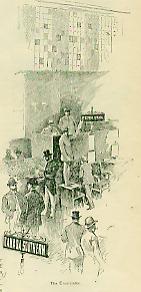
When great quantities of a stock are thrown upon the market, sometimes from
necessity, often in order to break the price. (Munsey's Magazine)
Trifling Commission
One-eighth of one percent equals $12.50 on a
transactions in a hundred shares of stock worth $10,000. Yet there are students
of Wall Street who charge to this trifling commission all the losses of
speculation. If, say these theorists, the speculator neither wins nor loses on
his investments he will be a bankrupt after a brief experience, because all his
money will be employed in paying commissions. (Munsey's Magazine)
Trinity Church
The 'whipsaw' market offered no rest and recuperation to
the traders who wanted to get their money back where they dropped it, nor to the
bankers who looked wearily up toward Trinity Church, expecting to see its green
lawn extended through Wall and Broad streets. ("A Specialist in Panics")
Twist
When the stock price has risen from 20 to 40 per cent, it suddenly
grows scarce. The bears find themselves troubled to make their deliveries. Now
the ring prepare to "twist" their antagonists. (Fowler)
Unloading
Just before the unloading begins, the
pool manager may send lieutenants to numerous brokerage houses to inquire
whether they know of any large blocks for sale, 10,000 shares or more. They
remark: “We offer a commission to anyone who can acquire such a large block. The
stock is wanted by a capitalist who is keen to make an investment in the
company, but who does not wish to push up the price in the open market.” This
offer becomes gossip in each brokerage house. Presently the whole country hears
that the stock is “good” in the course of conversational activity at lunch
clubs, dinner parties, hotels, golf clubs and other places where people
congregate, and if only 500 people buy 100 shares each, the pool has sold 50,000
shares. (Hickernell)
Wall Street
It dates back, the antiquarians tell us, to the year 1653, for
its first survey was in the palmy days of Petrus Stuyvesant when Schouts
Burgomasters and Schepens lorded it over the little colony of New Amsterdam. Its
name (one of the few remaining landmarks of the early Dutch possession) was
derived from the wall built of palisades and earth on the northern line of the
street to ward off the aborigines. But what contrasts has the light of two
hundred years painted between the mimic life of New Amsterdam and this great,
roaring, serious, tragic Babylon of today. No sign now of the quaint, peaked
roofs covered with Dutch tiles, the fort flying the blue lions of Holland, the
old stockade and half moon embankment at its lower end. But the ancient name of
Wall Street still remains. Its name is something more than a shadow, too, for it
is in fact Wall Street, still lined with a succession of fortresses,
behind whose bastions are garrisons well disciplined and alert, guarding the
treasures, if not the lives of a nation. Within its casements and vaults lie
piles of coin enough to excite the cupidity of ten West India companies, or to
lade a hundred Spanish galleons. Here the forces of commerce silently gather and
equip themselves for distant expeditions from which they return again with the
spoils of Ormus and of Ind. In these strongholds terms are dictated
to the vanquished, and treaties made. Towering over all stands old Trinity, like
a giant sentry, day and night, clashing out in peals and chimes of bells from
his watch-tower, 'All's well.' (Fowler)
Weakly Margined People
It wasn't what you could call a panic; it was one
of those ten- or twenty-point declines that come along every now and then,
shaking out weakly margined people and badly scaring those provided with big
margins. ("A Specialist in Panics")
For more of Victor Niederhoffer's writings,
click here>>>