Daily Speculations
Observations by Victor Niederhoffer (2003)
Anticipation (Dec. 20, 2003)
A Positive Suggestion (Dec. 15, 2003)
Dow 10,000 (Dec. 11, 2003)
Merrill and the Market (Dec. 11, 2003)
A 60th Birthday Post from the Chief Speculator (Wednesday, Dec. 10, 2003).
Morsian Fury (Thursday, Nov. 20, 2003)
Momentum Plays (September 2003)
The Only Market I Ever Found With Smiles Similar to Stocks (Oct. 6, 2003)
One of the Worst Things in the World (Oct. 1, 2003)
The Tree Thread (May 2003)
Anticipation (Dec. 20, 2003). A good net player in tennis is always crossing over. I was never a good doubles player in squash, although I did win the national doubles with three different partners. But the good ones always seem to be moving up front while their partners cover for them behind. In piano, it's important to practice putting the thumb in place for the next note well before it's time to play it. In my last violin lesson, the teacher explained that violinists always anticipate the next note on a different string by placing the fingers on the new string while playing the notes on the first string thereby saving time as the bow changes its plane from one string to next. So I conclude that to anticipate properly must be a general crucial factor in all life pursuits. The collab adds that putting stops and limits in place up front must be the counterpart in trading. And I always place my orders in advance to buy or sell a line at x below or above. Problem there is they catch you on the big moves the way they stole many millies from me the first time the Fed lowered the discount rate in 2000. I had limits to sell 10 above or so on a scale up. There's usually not enough time to trade the market properly if you first enter your orders once your price is hit. And before I tried casting a line which I learned by reading trout fishing advice I was often too late to trade. Which bring to mind one former employee of a somewhat argumentative disposition, who was always programming in Excel and somehow it always took him x minutes after the pattern to know when to trade to the ultimate hastening of his departure and my cost. I wonder what the generalization of this phenomenon is and how it relates to nature. Ontogeny follows philogeny comes to mind. Vic
A Positive Suggestion (Dec. 15, 2003). One of the good things that people can do with charts is to discern statistical relations that wouldn't be obvious unless many separate tests were run. I found that when I looked at VIX there were clusters of values in the mid-1990s, with the range being between 12 and 15 for 50 of 60 months. Then from 1997 to 2003 the range is between 20 and 30 with about 50 of 70 observations between 20 and 25. There is a regime shift clearly indicated as of mid-1997 with values since then averaging some 50% more than values before. The variability of VIX has also increased, with the average variability between months in 1992 to 1997 being some 2% and it moving up to 4% in 2000 to 2003. finally there is evidence of persistence with the serial correlation of the levels (not the changes) being very high -- let's call it 50%.
There's a more general point here. The problem with most chart readers is that they discern relations that are unique to them, and not necessarily inconsistent with randomness; they are prey to many biases including the bias of assuming that a random series has trend because the variance increases with time. Almost always in Murphy's charts in all his promotional books, he describes an intermarket relation on the charts. And I can't see it. All I see is two lines that are pretty coterminous because of common loadings with macroeconomic variables or the stock market itself.
OK, my positive suggestion is that all charts have automatic statistical findings that accompany them: runs, serial correlation, tests for co-movements, turning points, regime shifts, clusters, serial correlations, durations between extremes. In that way, there would be some standard to build up a common knowledge base and separate the charlatans from the merely uneducated, the visual decision makers from the countists, the left brain from the right, et al. Anyway it's a first and I believe positive step. Vic
Dow 10,000 (Dec. 11, 2003): One is sheepish, saddened, despondent to note that for once, we bagged more mallards than the President of the Old Speculators Association. The President bet us last month that the Dow would NOT close above 10,000 by year-end; today, it closed at 10,008.
Read the President's Nov. 14 challenge ("I'll bet you a nickel">>>
One hates to see the natural order reversed. We wrote the President to express our acute embarrassment. "I'll go to Dairy Queen and enjoy a Blizzard. and let this ugly situation play out in my absence," he wrote us at 2:17 p.m. Friday. The very thought of even temporarily shooting more ducks than the President is a sad one even when you know he will be out there at the ice hole tomorrow, even when you know he has a google of golden mallards in the back of the car for the little woman and kids. Our only explanation is in our Dow 10,000 column, "Dow 10,000: Be Careful What You Wish For," and our studies on round numbers. Summary>>> Data >>>
The President's Concession Speech: "Oh, Woe is Me"
The magic barrier has been
breached, bulls quiver in excitement, bears shudder in fear,
and Western Civilization is
saved. As one might have guessed from David's allusion, with
the Dow at 9992, I chose to flee to the nearest Dairy Queen
for a Butterfinger Blizzard while finishing (appropriately
enough) Tammy Bruce's "The Death of Right and Wrong." The
Blizzard was restorative, the reading wasn't. The wager, I'm
sure, seemed silly at the time. With a month and a half of
trading left in what has been traditionally the most bullish
time of the year, a 1.5% advance seemed a sure thing, Yet this
seemingly agile bull took a cumbersome 27 days to overcome a
minor hurdle. I returned in time to catch the always-subdued
Tyler Mathiessen attribute the triumph to the Fed's October
minutes and their prediction that inflation would remain a
non-event until at least 2005. This warmed my heart. (And all
the while I felt the Fed was my greatest ally!)
So I shall make good on my wager and direct the $5 million to the appropriate parties. With what remains of my assets I'll undoubtedly dump all into AMZN...or buy another Blizzard.
Editor's Note: The President of the Old Speculators Association, although represented on Daily Speculations by a real person, the rural Tennessean philosopher Jack Tierney, is the mythical embodiment of all the speculators who have ever lived -- just as the President of the Old Duck Hunters Association, as brilliantly memorialized in the short stories of sportswriter Gordon MacQuarrie, is the mythical embodiment of all the duck hunters and trout fishermen who ever lived. Here is a relevant passage from "Now, in June," Stories of the Old Duck Hunters (Stackpole, 1967). The narrator is the President's son-in-law, a would-be duck hunter and trout fisherman.
I was proud of my four fish. I showed them to the President. He said they were fish that would disgrace no man's skillet. He was sitting on the bank in the dark. His glowing cigar end attracted me. He was a little weary, and I felt a little guilty when he pounded me on the back and then said he nothing -- "but I had hold of one --the one!"
Nothing for Mister President. I do not like to wind up trout trips with him that way. And in all conscience, I seldom do.
We followed the bank back to the car and pulled off our waders. It was just ten o'clock. He slumped a little over the wheel, for he was beaten and he was tired. And then, before he stepped on the starter, he rolled down a window and took a good, long sniff of the Namakagon's June aroma.
"You know," he said, "I can tell by the smell in the air I am going trout fishing tomorrow."
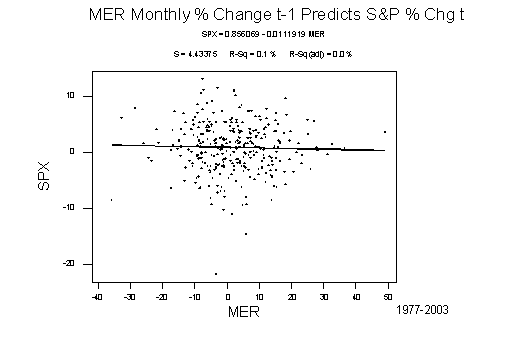
Merrill and the Market (Dec. 11, 2003) Jim Lorie always used to say when Merrill got to X times book, it and the market was a sell, and at ½ times book, it and the market was a buy. He was a director of that good firm for 25 years and my mentor for many years.
I didn’t alert my mentor to my birthday celebration at a “Chinese" restaurant in NY, because at 82 he's too old to travel for such. But I thought of him and missed him just the same. What incredible wisdom and decency and generosity and elegance and wit he had. In addition to the above he shared one characteristic with the alamatarian Yale Hirsch: He was never bereft of a joke, or loath to tell one. Pat Peterson at his ‘78th told how often he’d be at a board meeting at Treasury or Salomon and Jim would interrupt the meeting with an urgent phone message “hoooooo de dooooooooo” or some such other joke.
Merrill since 1980 has declined in 8 years., 1981 (20), 1984 (25), 1987 (12), 1990 (25), 1994 (30) , 1998 (15), 2001 (15) and 2001( 20). The gains in SP the next year average a nice 16%. Vic (12/11/3)
The regression equation is
SPX = 0.856069 - 0.0111919 MER
S = 4.43375 R-Sq = 0.1 % R-Sq(adj) = 0.0 %
Analysis of Variance
Source DF SS MS F P
Regression 1 5.12 5.1232 0.260616 0.610
Error 319 6270.93 19.6581
Total 320 6276.06
A 60th Birthday Post from the Chief Speculator (Wednesday, Dec. 10, 2003). On this day, one's thoughts turn of course to Galton. I read his passage on efficacy of prayer at a celebration last night: "One can take comfort that there exists a solidarity between themselves and what surrounds them, through the endless reaction of physical laws, among which the hereditary influences are to be included. They know that they are descended from an endless past, that they have a brotherhood with all that is, and have each his own share of responsibility in the parentage of an endless future."
Lest I be flamed, the thought led to Galton's lesser cousin, C. Darwin. In remarking that he had found a volute in a old gravel pit near Shrewsbury. he at once said that it would be the greatest misfortune to geology, if it hadn't been thrown there, as it would overthrow all that we know about the superficial deposits of the Midland Countries. "Nothing before had ever made me thoroughly realize that science consists in grouping facts so that general laws or conclusions may be drawn from them."
What facts can be grouped together about stocks so that general laws may be drawn from them ? I would say that we might start with the many facts about instances where some long-hoped-for event has transpired, and then the event has an opposite impact. Or what about the many sententious facts about one company striking gold in a endeavor, and the speed with which the positive news impacts other companies with direct and indirect relations to the gold? A fruitful field of inquiry? Vic (b. Dec. 10, 1943)
J.T. comments:
I remember in High
School I decided to take Advanced Chemistry instead of being
in the usual Chem class. The teacher of the AP class
was one hard-assed teacher who used to be a fighter pilot in
Vietnam and I knew he was arrogant, cocky, and egotistical. My
deduction at age 17 was that he was so stuck on himself that
he wouldn't allow less than a C in anyone of his classes. I
loved being challenged and knew that all of the other "Bright
Ones" would wonder what I was doing there. The relevance is
that in this class I learned a valuable lesson. Something
simple. The Periodic Table. The world was full of basic
elements that made up this table, these elements could be
placed together into compounds and you could spend your time
solving formulas based on these elements. This is what I have
been striving to due with the Stock Markets. The Peridic Law
arranges the elements according to there atomic number. Are
stocks arranged in some table according to their Market Cap?
Do we read the table from left to right like the ticker-tape
goes by? Are Growth stocks the Metals and Value stocks the
Gases?
Is the S&P this periodic
table? Bogle damn sure wants us to think so! When you split a
growth stock is it volatile like an atom? You can neutralize
an acid with a base but is the same accomplished with a merger
of two opposite companies into a conglomerate? I don't know I
am sure that the facts lay in some table like this for the
stocks. I have often thought that
there are only three basic things to speculate with: stocks,
bond, commodities. Then of course there exists derivatives
that come from these three. Maybe these are the Primary
Colors? The other two things though that you can speculate
with but have greater costs are Real Estate and
Art/Collectibles.
Trend-Following Puffery (Thursday, Nov. 27, 2003)
The following brilliant post attributes the success of trend followers to the lack of vig. But I, with Rand, would ask to check premises. The total trend-following profits of the large man posited, I am confident, is highly negative. Consider his two wipeouts at a non-WASP brokerage with big money and the third disaster when he came back with a new system. Self-reported results of trend followers are completely unbelievable. The principle of ever-changing cycles applies. The market gives some trends to set up big money to follow them and then takes back 100 times the money made. Consider the likely results of the baseball team owner in this light.
R.M.
Comments: A theory on why trend-following gets all the hype
It seems the trading-hype world has more examples of huge,
rags-to-riches trading stories of trend followers a la Richard
Dennis et al. But why should there be more examples of such
traders? Why aren't there as many high-profile stories of
traders who have built a fortune by continuously capturing
small price swings?
I have a theory. I call it: The Stupid Genius of the Lottery Player." In a backward way, trend following has one big advantage over all other systems of trading. Each dollar a trend follower makes in a "let profits ride" system is immediately reinvested, reinvested without additional vig or commissions costs. A swing trader, on the other hand, gets in and out of the market, thus paying constant vig and commission.
Moreover, once the trend follower is on a winning streak and in a heavily leveraged position, an increasing % of the trader's capital is at risk (assuming increasingly wide stop-losses, which is consistent with a trend following approach.) The advantage is that while the luck of the trend continues the costs of commissions & vig decrease %-wise. This is the reason most inexperienced, trend-following traders don t worry much about commission costs. If you re going to make a lot of money, or blow it all quickly in a few trades, the commissions & vig won t amount to much.
An analogy would be craps,
where casinos will allow you to bet up to a certain multiple
of your bet at even odds behind the line. Only in this case
imagine the casino allowing a player who wins on the first bet
-- in which the odds are in the casino's favor--- to
continually place subsequent bets at even odds as long as the
player keeps winning.
So a trend follower might effectively throw down $1000 on a
1,000-to-1 shot that he'll turn it into a million $. So about
1 in a 1000 traders succeed at this strategy. But a trader
looking to capture small moves has compounded costs to
overcome and thus sacrifices the luxury of dumb luck.
I'm not arguing that a trend-follower's odds are ever good, just that: So long as you can t beat the odds, you re better off just trying to get lucky.
As for traders who are
clever enough to get an edge on the market, the edge they get
tends to be a small edge. They can make money over time, beat
the averages, raise capital from investors and eventually make
a
fortune but that isn't nearly as exciting as hearing about
someone who started with $400 in the bean pits and turned it
into a few hundred million. Particularly not for someone with
much more than $400 in their pockets.
Therefore we have more stories of dumb-luck traders who used a trend following strategy to get rich. But they still aren't as numerous as lottery winners.

Source: Bloomberg LP
The graph shows that S&P prices during the day had one of their low-range days , 1031 to 1037, guaranteed to happen when I'm buying at 103075 and 103725 so the mistress can make money from everyone and not shed a few chips to me. However, note that during the last minute, mistress moves from 1033 to 103650 recapping, well, almost the entire philogeny. Thus,everyone has a chance to make the wrong move first during the whole day and then also at the last minute lest one enjoy the weekend. The more general question is, to what extent does the move at some small time in the future recap the moves from a long period in the past. For example, does the move during the U.S. hours recap the moves during the Japanese and European ones. Or does the move during the last x days of a week recap the moves during the first y days. A general question that might augment the psychophysical aspects of the EEG? -- Vic
Morsian Fury (Thursday, Nov. 20, 2003)
The market’s moves on Thursday brought to mind a passage on the fury directed at Robert Morse during 19th century panic memorialized inone of Vic's 100-year-old books: An appalling stillness like that which precedes a tornado followed. Then the storm burst. the board room seemed suddenly transformed into a Cyclopean workshop, where a hundred trip hammers were being plied. Pillar after pillar toppled... all day long the panic raged without pause or hindrance. Pandemonium. A crowd of ruined speculators reeled and surged up half crazed by their losses, and stupefied or maddened by drink, curses. ruin., run.... Above all the chorus of execration was heard the word "MORSE"... No epithet too vile with which to couple the name of that prostrate financier.
Yes, folks, that prostrate financier, 133 years before me, was Anthony Morse. He was sometimes to begging outside
Yes, folks, that prostrate financier, 133 years before me, was Anthony Morse. He was sometimes to begging outside Trinity Church, a broken man, just as I was after my fall in 1997. People still remembered how Morse used to bull them up, and whenever he was sighted near the graveyard, there would be an immediate 5% surge in Fort Wayne and Reading & Southern before people realized he was just a ghost. It reminds me of the time in 1999 that gold rallied to 350 and I got calls from all media to comment on a rumor that I was caught short 5 million ounces.
A similar resurrection took place Thursday in European trading. S&P futures were at 1042. News at 4 a.m. EST: Terror in Turkey. Stocks immediately drop to 1032. The great mistress of markets is happy that she caught everyone short. The market rallies to 1042, then at 9:25 a.m., the White House is evacuated (the government loves to show it’s doing something). Morse is back! Stocks immediately drop to 1032. Open there on panic selling at 9:30 a.m., then rally to 1041. Close at 1032, unchanged: the favorite denouement of the mistress of markets, who thereby gets everybody moving the wrong way. -- Vic (11/20/3)
Incredibly, one
still sees people accepting "seasonality over weekend" and other
shibboleths without
testing, or noting how it's changed and ephemeral, or adjusting for drift, or
taking into account uncertainty, or considering multiple comparisons, or even
producing an expectation or distribution for the last n periods. My gosh, the
Body Snatchers. -- Vic (10/31/3)
Crowding Out: The
idea that prices seem to trade at different volume levels is beautiful
descriptively but only known after the fact. If the idee fixee is tested
predictively, i.e., a study of whether prices that have had more volume at them
are good places to buy or sell, then it runs into the well-known opposite
principles of the universal principle of gravitation or the well-tested
proposition that a round numba is never a penumbra. These high-sounding
meta-systems are particularly dangerous because they can be interpreted in so
many different ways by the participants, thereby never being capable of being
falsified and consigned to the mumbo-jumbo world where they belong. But that''s
just my opinion after testing all the particular falsifiable forecasts that
such focus on things that people intuitively believe ( wrongly as described in
the worst-seller Practical Speculation), and showing their complete accord with
ran domness. --Vic (10/26/3)
The Delta Hedge Murder: Without mounting the high horse, I noted at the beginning of the year that all delta-neutral investments and funds-of-funds based thereupon would converge to a Sharpe ratio of -90. Also, that the contribution these delta-neutrals would make to the market would be in the trillions of dollars, and would dwarf the temporary superior returns they made in 2001 and 2002, and also that all the momentum traders, large short-sellers and users of systems based on buying the academic anomalies like the earnings surprises would lead to disastrous results considerably worse than random this year. Also that high fees, the regression phenomenon, commissions and bid-asked spreads would add to the grind and hasten the convergence to Sharpe -100 -- let's say an implicit -90% relative to the market over the next five years with a standard deviation of 1%.
My friend Mr. E and I arrived at this view from
separate vantage points, he based on power trading and adjustments and revenge
of the losers, I based on the ecology of markets. We both attended a conference
where we delivered these views, and were met by 750 erudite academics talking in
pseudo-academese about the gammas and the chaoses and the increasing difficulty
because of increasing elasticity. I got in some good tennis, but I don't think
the people who attended my talk paid too much attention to my warning.
I had to smile when I met a manager or two at a great counter's party on a recent weekend. A composite: "I am a delta-neutral hedger. Last year I was up 21% and my fund took in massive contributions based thereupon. This year: axe murder."
As a speculator friend observed: "In the
capital ecosystem, there are apparently niches for both the
successful compounder of wealth AND the person who is "merely" able
to gather assets -- the two populations not necessarily fully overlapping. This
knowledge, along with familiarity of the latter group's strategems, should
offer meals for a lifetime." -- Victor Niederhoffer, Sept. 23, 2003
Momentum plays are doing very well and that some of the promiscuous hypotheses of the behavioral finance duo at the University of Chicago are on the proper side this year. Because of the large variance of momentum strategies, there is always a tendency to get very excited with their highly excitable results. Regrettably, those who throw money at such systems after their retrospective good performance do not take into account in my opinion:
1. The variance effect mentioned above;
2. The multiple comparison effect, whereby one system always will be best;
3. The ever-changing cycles; or
4. The skill of some of our betters.
We note parenthetically that a similar bias with
variance increasing with time explains why random walks seem to bespeak of
trends. --Vic (September 2003)
The Only Market I Ever Found With Smiles Similar to Stocks was beans. By looking at actual prices in soybeans over the last 15 years, one could calculate the value of various options. The distant options were vastly overpriced, almost as much as stocks. However, recent intelligence that a certain fund made good money in September on a speculation in beans leads me to believe that those who sold the premium there may be ghosts. It is good to keep this in mind. -- Vic (10/6/3)
One of the worst things in the world is to be short a market as the sentiment percolates above 70%, and bulls become ebullient, and their buying power increases, and others who were chronic disbelievers jump onto the rising tide. One needs much more of an excess of bullishness for it to become bearish than one needs in the excess of bearishness to turn a market predictively bullish. (Yes, I've tested that one many times.) -- Vic (10/1/3)