Dick Sears Commentary:
Good News, Bad News
Last week I said that I welcomed earnings
season, because it brought to the market a
dose of reality. Now I'm beginning to wonder.
The right to future earnings is what the stock
market trades. Forecasting that future is never
easy, but quarterly reporting does provide a
useful measurement along the way. Between
reports, prices have only supposition to go on.
But once a report comes out, there is a new
reality to factor into the equation.
Sometimes the news is bad news, of course.
Last week a disappointing earnings report from
Flextronics International (FLEX) resulted in a
24% drop in price on the day it was announced.
In general, though, with Gilder stocks we expect
good news during earnings season, because
they're good stocks. If they weren't, we wouldn't
own them, LOL.
But as Brian Wesbury
pointed out
this week,
good news may not be enough.
Because of Sarbanes-Oxley and our generally
litigious culture, corporate managements today
are almost forced to give the investing public a
gloomy forecast of the future. When they do, a
significant drop in price usually follows. Yes,
when the next earnings season comes around,
or earlier as the truth leaks out, the stock price
will improve. But then comes another bad
forecast, and the cycle begins again.
It may be that we've reached a turning point in
the market's seasonal calendar. Before now
we would dread the earnings warnings that
preceded earnings season, and then hope to
make up for it when the real earnings came out.
But now we may come to dread the earnings
season as well. Our new threat is the cautious
guidance that follows even robust earnings.
A few weeks ago, I was feeling sanguine about
how few warnings there had been. I took it for
granted that we had a good quarter ahead of us.
I was partly right. Earnings so far have exceeded
expectations even more than they usually do.
But a series of gloomy forecasts has led to a bad
month of October.
All this new misinformation is something we will
have to come to terms with. In the meantime,
stock prices are taking a beating. And maybe
they'll never catch up. Maybe mandated gloom
will mean permanently undervalued stocks.
That's a gloomy thought. More likely, the market
will adapt, and we'll go on as before.
Speaking of misinformation, last week The Wall
Street Journal did a front page story on the crash
of Refco, the now notorious brokerage firm, in
which it was suggested that Victor Niederhoffer
might have had something to do with their failure.
The only evidence given consisted of vague
reports from anonymous sources.
Victor is a man for whom I have great admiration
and affection. He is also a man of great principle
and integrity. I have no doubt his hands in this
matter are surgery-clean.
But the affair does make an interesting story.
In particular it illustrates how the press acquires
misinformation and then runs amok with it.
Victor himself has given an excellent
explanation
of the press's failure. And a more arms' length
observer, Jon D. Markman, has written a very
good
article on Victor and his history with Refco.
Together they provide an instructive antidote to
some bad news gathering.
|
The Market This Week:
Comparison of
Returns for GTI Stocks
Makeup
of the GTI:
|
The Year to Date:
 From the GTI's Origin (1/1/99) to Now:  Weekly Change in the GTI, Last 52 Weeks:  Trailing 3-Month Returns, Last 52 Weeks: 
Volatility, Trend, Recovery:
|
|||||||||||||||||||||||||||||||||||||||||||||||||||||||||||||||||||||||||||||||||||||||||||||||||||||||||||||
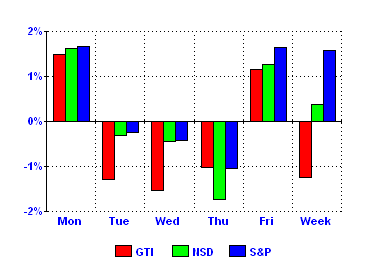
From the GTI's Origin (1/1/99) to Now
Weekly Change in the GTI, Last 52 Weeks
Trailing 3-Month Returns, Last 52 Weeks
Volatility, Trend, Recovery:
As an indication of volatility, this table shows average weekly change in the GTI
each year:
| Year | Ave Wkly Change |
| 1999 | 4.2% |
| 2000 | 7.7% |
| 2001 | 8.5% |
| 2002 | 6.8% |
| 2003 | 4.3% |
| 2004 | 3.4% |
| 2005 to Date | 2.0% |
As an
indication of trend, this table shows
number of up weeks for the GTI each year:
|
Year |
Number of Up Weeks |
As a % |
| 1999 | 39 of 52 | 75% |
| 2000 | 24 of 52 | 46% |
| 2001 | 22 of 52 | 42% |
| 2002 | 19 of 52 | 37% |
| 2003 | 31 of 53 | 58% |
| 2004 | 28 of 52 | 54% |
| 2005 to Date | 18 of 38 | 47% |
The GTI
fell 94.1% from its March 6, 2000,
high to its October 9, 2002, low.
Click here
for the details of its long recovery attempt.