June 2, 2006
Commentary:
Green Planet
No, I haven't become an environ-mental case.
There are too many of those already.
The green planet I have in mind is the stock
market, because it reminds me of the schools of
fish in that great TV series from the Discovery
Channel and the BBC,
Blue Planet.
Whenever there's any Fed action during market
hours, as there was on Wednesday, the market
flies off in one direction or the other. But then it
suddenly reverses itself, and it may change
direction several times before settling down.
It reminds me of how a school of fish responds to
a threat in the brilliantly filmed Blue Planet. Those
fish closest to the threat sense it first, and they
take immediate evasive action. The rest of the
school doesn't know what's happening, but it
takes the lead from those who do. Off the school
goes, swimming as fast as it can, until it gets
eaten, gets away, or discovers a new threat.
Some investors are expert at deciphering the
Fed's reports. They do a quick reading and take
speedy action. Other investors copy them, and
soon the entire market is fleeing in one direction.
But then the Fed watchers read the report more
carefully and see a threat (or opportunity) in the
opposite direction, and soon the entire market
has made a 180° turn.
The point is that when the market makes a
sudden move, many investors, perhaps most,
won't know what's going on. But they'll take a
cue from investors closer to the edge.
This phenomenon is not restricted to Fed
watching. It can happen whenever the market
receives important news whose impact is
unclear. Signs of economic weakness, such as
today's jobs report, are bullish, because the Fed
may stop raising rates. But they are also bearish,
because they may forecast a recession. The
market knows this means opportunities and
threats, but has trouble deciding which is which.
The result is strong action but frequent reversals.
Let's not carry our ocean analogy too far, though.
Say "big fish, little fish," and most people will
respond "stock market" or "business." Thanks,
Hollywood, but you should stick to what you
know something about, like nature films.
The Week Day by Day:
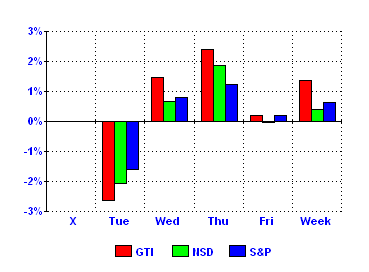
Sell in
May and go away,
or so they say. On
Monday it seemed there was no bottom, but
June is nevertheless off to a good start. Just
when you think you know where the market
is headed, it reverses. Who'd have thought that
after Tuesday we'd finish the week in the green?
The Week's Top Gainers and Losers
| Gainers | Losers | ||
| CPHD | + 9.9% | MVIS | - 11.3% |
| FNSR | + 5.6% | AMD | - 4.8% |
| ZRAN | + 5.4% | SIGM | - 4.5% |
| LNOP | + 5.0% | SYNA | - 2.8% |
| SMTL | + 4.6% | KEYW | - 2.1% |
Poor Microvision, down 46% in a month.
Returns for the Week:
Gilder Technology Index (GTI):
+ 1.4%
Nasdaq Composite
Index (NSD): + 0.4%
S&P 500 Index (S&P): + 0.6%
Historical Returns:
| Period | GTI | NSD | S&P |
| 1997 (est'd) | 21% | 22% | 31% |
| 1998 (est'd) | 48% | 40% | 27% |
| 1999 | 284% | 86% | 20% |
| 2000 | - 44% | - 39% | - 10% |
| 2001 | - 43% | - 21% | - 13% |
| 2002 | - 56% | - 32% | - 23% |
| 2003 | 130% | 50% | 26% |
| 2004 | 3% | 9% | 9% |
| 2005 | 5% | 1% | 3% |
| 2006 to date | 15.3% | 0.6% | 3.2% |
| Avg for 9+ yrs | 11.3% | 5.9% | 6.0% |
| Last 52 wks | 25% | 7% | 8% |
|
Since the
high of 3/06/00 |
- 75% | - 56% | - 16% |
|
Since the low of 10/09/02 |
329% | 99% | 66% |
Comparison of Returns
for GTI Stocks
By Whether or Not They Pay Dividends:
| Year | Do Pay Dividends |
Do Not
Pay Dividends |
| 2004 | 11.6% | - 3.3% |
| 2005 | 11.1% | 4.2% |
| 2006 to date | - 1.3% | 22.8% |
| Avg for 2+ yrs | 8.7% | 9.2% |
Room to Grow:
| GTI | NSD | S&P | |
|
Loss from the high to the low |
94% | 78% | 49% |
|
% of the loss recovered |
21% | 28% | 68% |
|
Return needed for a new high |
292% | 127% | 19% |
Graph of the
GTI's long recovery attempt.
Individual Year-to-Date Returns:
|
ADI |
- 3% |
GLW |
27% |
QCOM |
10% |
||
|
ALTR |
3% |
IKAN |
9% |
S |
2% |
||
|
AMD |
- 2% |
INTC |
- 26% |
SIGM |
- 19% |
||
|
BRCM |
9% |
KEYW |
9% |
SMI |
7% |
||
|
BWNG |
103% |
LNOP |
86% |
SMTL |
4% |
||
|
CPHD |
15% |
MVIS |
- 41% |
SYNA |
- 3% |
||
|
ENER * |
- 7% |
NETL |
27% |
TSM |
- 1% |
||
|
EQIX |
50% |
NSM |
2% |
TXN |
0% |
||
|
FLEX |
10% |
PCMS * |
- 25% |
XLNX |
7% |
||
|
FNSR |
136% |
PWER |
4% |
ZRAN |
60% |
*
Joined list this year (ENER
2/10, PCMS 4/7, SMTL 5/12).
Return is while in GTI only.

From the GTI's Origin (1/1/99) to Now:

Weekly Change in the GTI, Last 52 Weeks:

Trailing 3-Month Returns, Last 52 Weeks:

The GTI companies are those "Telecosm
Technologies" in the Gilder Technology
Report whose stock is readily available to
investors. If a company is not traded on the
NYSE, AMEX, or NASDAQ National Market,
it is not in the GTI.
There were 30 companies in the GTI this
week. They are listed, with year-to-date
returns, at the bottom of the column to
the left.
Advances vs. Declines:
Among the GTI stocks this week, there were
22 up, 8 down, 0 unchanged.
Volatility, Trend, Recovery:
As an indication of volatility, this table shows average weekly change in the GTI
each year:
| Year | Ave Wkly Change |
| 1999 | 4.2% |
| 2000 | 7.7% |
| 2001 | 8.5% |
| 2002 | 6.8% |
| 2003 | 4.3% |
| 2004 | 3.4% |
| 2005 | 2.1% |
| 2006 to date | 2.7% |
As an
indication of trend, this table shows
number of up weeks for the GTI each year:
|
Year |
Number of Up Weeks |
As a % |
| 1999 | 39 of 52 | 75% |
| 2000 | 24 of 52 | 46% |
| 2001 | 22 of 52 | 42% |
| 2002 | 19 of 52 | 37% |
| 2003 | 31 of 53 | 58% |
| 2004 | 28 of 52 | 54% |
| 2005 | 26 of 52 | 50% |
| 2006 to date | 12 of 22 | 55% |