Friday, November 4, 2005 Commentary: The Wrong Sox
You probably think from the headline that I'm going to complain about the White Sox' having replaced the Red Sox as World Champions.
No, I'm here to discuss the PHLX Semiconductor Sector index (the "SOX").
Last Friday, it fell 0.65%, which was a surprise to me, since it had been a good day for the GTI's semiconductor stocks.
When I looked into it, I found that 14 of the 19 stocks in the SOX were indeed up that day, but the index was weighed down by a single stock, MXIM, that fell 11%.
So far, so good, I guess, but as Paul McWilliams kindly explained to me at the Telecosm Lounge of the Gilder Forum, the SOX is not a good index.
First, it is price-weighted, which means higher priced stocks have proportionately greater effect than lower priced. Where is the sense in that?
Why should a 1% gain in a $40 stock count any more than a 1% gain in a $10 stock, let alone four times as much? The only difference between the two is a 4-for-1 split.
The Dow is also price-weighted, but it goes back before the age of computers, when calculations were a problem. (A price-weighted index is the soul of simplicity. All you have to do is maintain a hypothetical portfolio that owns one share of each company in the index.)
The GTI, on the other hand, is an equal-dollar index. Every company counts the same, because the index has the same dollar amount "invested" in each.
If the SOX were an equal-dollar index like the GTI, then on the day in question, instead of being down 0.65%, it would have been unchanged.
I'm not suggesting that the SOX do what the GTI does. You have to ask yourself, what is the purpose of the SOX? Presumably it is to tell us how the semiconductor sector is doing in the market. I think of it as a macroeconomic indicator, something intended to keep track of changes in the aggregate value of semiconductor stocks from day to day.
On that basis, if Intel's market value is ten times Broadcom's, the index needs to give ten times as much weight to Intel's performance. That's what weighting by market capitalization does.
If the SOX used market capitalization weights, then instead of being down 0.65% on the day in question, it would have been up 1.02%.
That's quite a difference. If it were the NASDAQ, it would be down 14 points vs. up 22 points, or gloom vs. dancing in the streets.
The SOX's 1.02% gain on a market cap basis represents the aggregate increase that day in the market value of all the stocks in the SOX index. Isn't that the information we were looking for?
Now the GTI, that's a horse of a different color. Its purpose is to measure for investors how the companies on GG's list are doing, always from the perspective of a potential investor. Here a weight by market cap would make no sense.
Who of us invests in proportion to market cap? Because Intel is ten times the size of Broadcom, do we buy ten times as much? I think not. If anything, we invest less in larger companies, on the grounds that they have less upside potential. We're all gamblers in Gilderland.
The GTI assumes an equal amount invested in each stock. To keep it up to date, every week it is rebalanced back to equal holdings. Without that rebalancing, the GTI today would have over 50 times as much in Qualcomm as in JDS Uniphase.
(A dollar invested in QCOM on January 1, 1999, is now worth $13.83, while a dollar in JDSU back then is worth only 27 cents today.)
Theory is fine, but how is the GTI in practice? Is it a good measure of how Gilder stocks are doing?
Several years ago, I graphed the GTI against my own Gilder portfolio. For the results, take a look at "Is it accurate?" It shows that the GTI tracked my portfolio like a bloodhound.
So . . . it's the wrong SOX . . . but the right GTI.
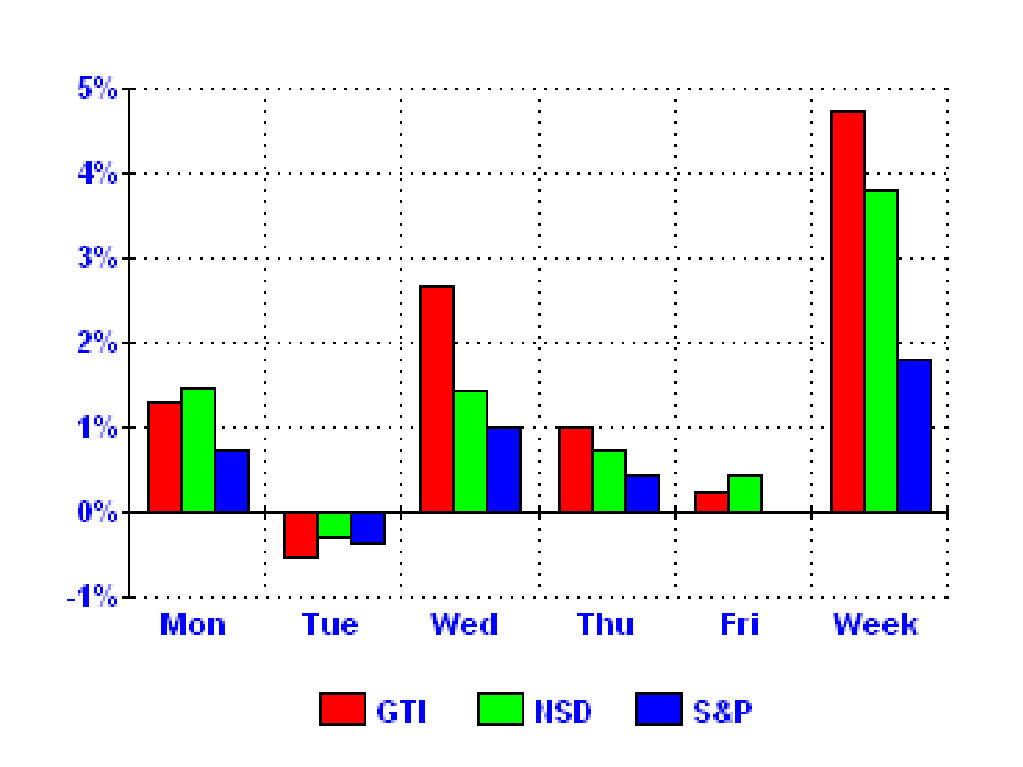
The Market This Week:
A very solid week, the best in almost six months, with encouraging resiliency. Perhaps good times are right around the corner.
JDSU has been a major disappointment this century, but it is up 56% in the last ten weeks.
Returns for the Week:
Gilder Technology Index (GTI): + 4.7%
Nasdaq Composite Index (NSD): + 3.8%
S&P 500 Index (S&P): + 1.8%