
|
|
|
|
 |
Daily Speculations The Web Site of Victor Niederhoffer & Laurel Kenner Dedicated to the scientific method, free markets, deflating ballyhoo, creating value, and laughter; a forum for us to use our meager abilities to make the world of specinvestments a better place. |
Write to us at:
 (address is not clickable)
Department of Physical Models
Physics offers insights into market interrelations.
10/23/04
Victor Niederhoffer: Levers and Markets
A lever is a bar or rope that moves around on a pivot or fixed
point called the fulcrum. Its is used to change the direction of output or velocity or to
reduce the power or force required from the input. There are many market pairs that function in
the same way as the lever, with their respective rotations saving or extending power and force.
Indeed, the whole subject of market interrelations, co-movement between markets, pairs trading
and correlations between markets might be helpfully be considered in the framework of levers.
There are three classes of levers:
The type 1 with the fulcrum between the input and output - things like the hammer and the seesaw;
these are used to change the direction of force as well as its magnitude.

The type 2 lever with the input and output to the side of the fulcrum with the input further
away - things like the wheelbarrow where the magnitude of force is intensified but not its
direction.
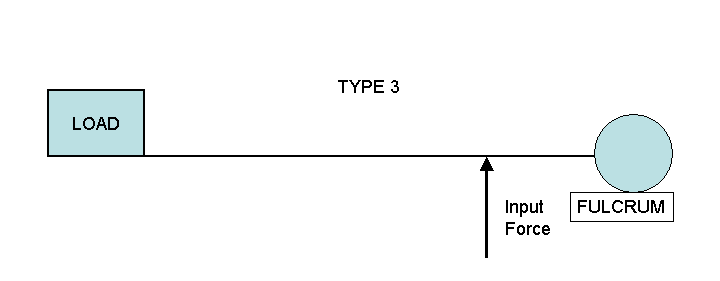
The type 3 lever where the input and output are on the same side but the output is farther away
from the fulcrum than the input.-In this case the magnitude of the output force is reduced from
the input, the direction of force is maintained but the input force is extended
over a larger distance. Things like the fishing pole and the baseball bat and tennis racket.
I find that bonds and stocks over the past 7 years rotate in a type 1 way with their correlation
of their changes on a day to day basis frequently running -0.25. The oil and gold, or dollar and
gold would be
examples of a type 2 lever with oil being the input driver of the gold and the correlation also
often over extended periods in the 0.25 level. The type 3 lever is typified by some distant
effects that stocks have on things like copper or soybeans where the correlation is attenuated
to the order of 0.10 or so.
Of course, such a model is descriptive and changing. The trick is to make these relations predictive. And efforts in that direction, perhaps illuminated by the movements of market pairs between these three types of levers might be most fruitful.