 |
The Collab
Write to us at:
Palais Coburg, Vienna, Nov. 17-23, 2005 Prague, Nov. 24-30
|
 (address is not clickable)
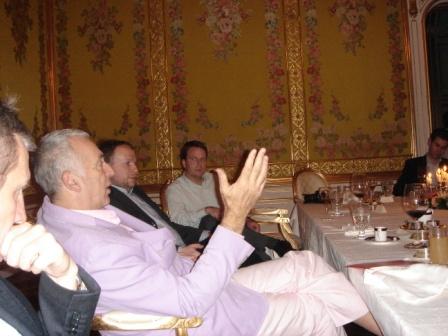
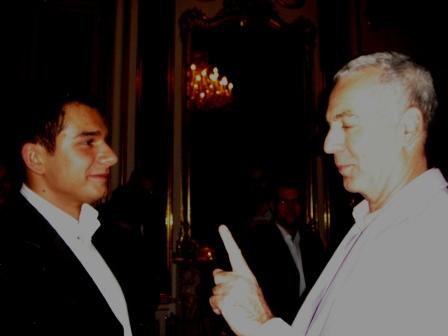
Vic explains a point at dinner hosted by the Institute for Strategic Capital Markets Research (ISK). A student group founded by investor Peter Puhringer, the institute aims to bridge the gap between theory and practice, and every year lets students manage 1 million euros as they please. The students invited Vic to Mr. Puhringer's exquisitely restored Palais Coburg in Vienna for a weekend of discussions, presentations, concerts and sumptuous meals.
A singer and I were there to lighten and, it was hoped, illuminate the discussions with a performance of Spec Songs. We were touched and inspired by the venue, for Johann Strauss himself had premiered two of his waltzes in that very room. In his honor, I performed an excerpt of the Shulz-Evler transcription of "The Blue Danube Waltz."
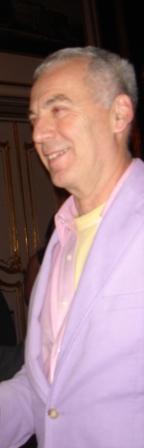
Above left, Vic is flanked by University of Vienna finance professors Josef Zechner and Engelbert Dockner. Right photo: Boris Simunovic, conference co-organizer with Mario Resch. The weekend went off so successfully that the students decided to continue with plans for a yearly event that will bring top investors to Vienna.
Mr. Puhringer has been a strong force behind the revival of the Austrian School of Economics, personified by Friedrich Hayek and Ludwig von Mises, in Vienna, where it long languished. His foundation is general sponsor of the Vienna Boys Choir.
11/25/2005
Vienna Notes
To be in Vienna is..
- To walk in the footsteps of Beethoven, Strauss, Mozart, Haydn, Brahms and Wagner.
- To see what Klimt and Schiele saw.
- To sit in the famous coffeehouses and eat torte.
- To see where the Polish general Sobieski turned back the Turks.
- To make a pilgrimage by subway to Niederhofstrasse.
- To visit Brueghel the Elder's marvelous paintings, including Childrens' Games and Winter Scene, in the Kunsthistorische Museum.
- To be amazed at the sweet politeness of the Viennese, who stop and help if you look befuddled at the subway and apologize profusely for coughing during the opera.
- To walk along the massively elegant opera house, city hall, museums and other public buildings on the giant Ringstrasse, built in the 19th century at no expense to taxpayers. The emperor ordered the old wall around the inner city to be destroyed, opening vast spaces. The land not used for public buildings sold to private developers.
- To learn about the immensely wealthy aristocracy and the court life impenetrable except by birth. How can one not sympathize with Beethoven, who defended his artistic and human aristocracy against Austria-Hungary's hereditary nobles? And things were much worse after Napoleon's defeat as the emperors cracked down on all discussion of reform.
- To marvel at the conservatism of the last major Emperor (1848 to 1916), who installed bathrooms in the Schonbrunn only after the Empress insisted.
- To learn that the famous balls of Vienna allowed commoners to mix with noble ladies (who would cut them dead the next morning).
- To drink the best hot cherry juice at Christmas fair street stalls.
- To see children dressed in down like little spacemen.
- To walk about in gently falling snow like in a snow globe that you turn upside down.
- To eat the best sausage (Beethoven once said that the Viennese would never rebel against the aristocracy so long as they had their sausage and beer, and after sampling the local fare at the outdoor street stalls, I know what he means)
- To eat the best venison and perch.
- To live in the most perfectly constructed buildings.
- To sit in the most sonorous orchestral concert hall.
- To be at the doorway to Eastern Europe.
- To understand a little better what the Hades happened in the 19th century.
- To learn that Mozart liked to gamble.
- To be tantalized by references to a stock market crash in 1873 that marred the World Expo here.
- To learn that speculation was a big form of entertainment in the late 1800s.
- To play on Bosendorfers, as Liszt did, and start to warm to their virtuosic qualities after a few dozen repetitions.
Recommended reading: The Austrian Mind, An Intellectual and Social History 1848-1938, and Neurosis and Human Growth. Perfect companions in Freud's town.
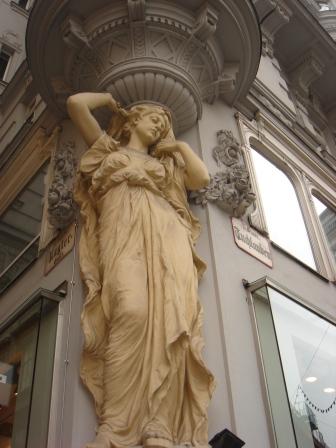
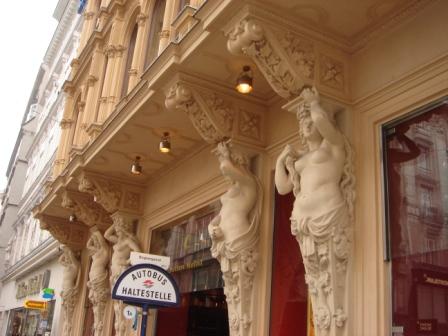
Caryatids; in Vienna, women carry their share
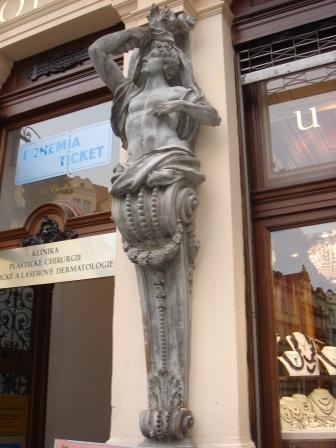
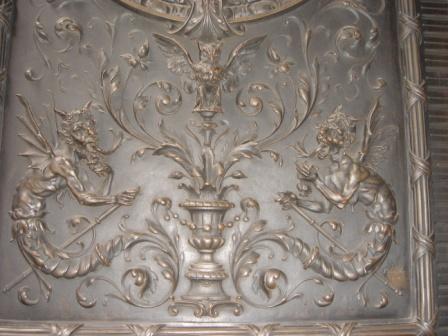
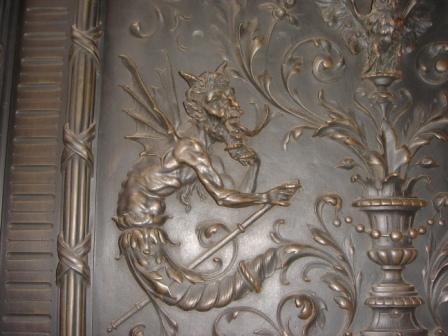
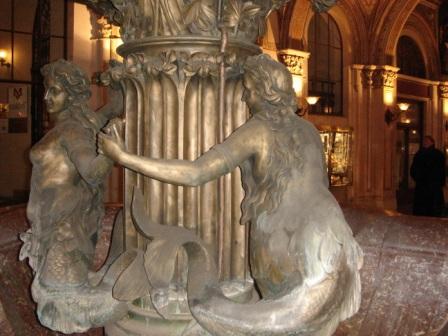
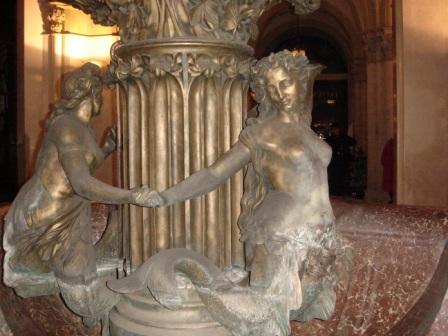
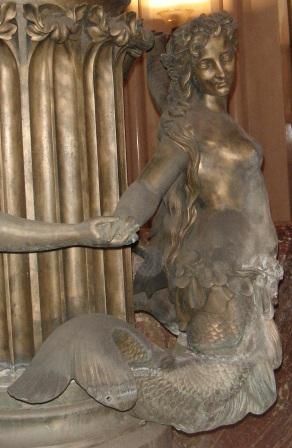
Mermaids in a mall
Merchant signs