 |
Daily Speculations
The
Web Site of Victor Niederhoffer and Laurel Kenner
Dedicated to the scientific method, free markets,ballyhoo deflation,
value creation and laughter.
True Stories by Steve Keely
Hobo Memoirs
Home
Write to us at:
 (address is not clickable)
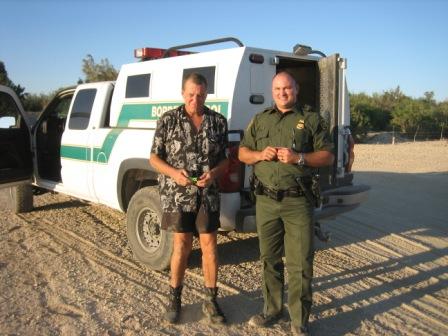
Bo apprehended by Border Patrol after
swimming across the Rio Grande from Mexico to Texas. (Photo by Diesel
Dysmon)
|
|
01/09/03
South of the Border
As you recall, I was rebuffed by the mountain spine when attempting to cross
Baja, Mexico from the Sea of Cortez to the Pacific Ocean last week. At that
point, I returned to San Felipe on the sea to recover, and on the first night
walked twice headfirst into the motel wall mirror thinking the light outline was
the bathroom door. With new intelligence, I attempted a second crossing north of
the first and ran into the same mountain spine. Though less lofty, I again
decided to turn back when I got terribly lost one night with wet feet in a box
canyon. I pulled out in a couple hours a bit shaken and something dawned on me.
The east approach to the little range is steeper than the west, giving a
scenario of any path from the east likely leading to a dead end, however any
route starting atop the spine and headed east likely courses to the sea. It’s a
funnel effect.
Unexplored Baja attracts a hiker with hundreds of remote spots (abandoned
settlements and mines and missions ) that dot the best maps and that haven’t
been seen since the three missionary waves (Jesuit, Franciscan and Dominican)
three centuries ago. My key to is the Baja Almanac, a homey topo-mapbok that’s
next to impossible to get. A San Felipe bookshop owner told me the demand is
such he wrote the publisher to no avail, then visited the Las Vegas address
which was only a mail drop. The drop secretary claimed there’s no publishing
house and never was, and that the mapbook author went to Baja two years ago to
gather more information and didn’t return. He’s figured to have either met an
oasis senorita, or perished.
Following the box canyon, it became a driving vacation as I turned the
Volkswagen (customized to pickup truck) northwest on the Ensenada highway to the
Laguna National Park. Sadly, the park is an excuse to litter a dry lakebed.
Ensenada was cleaner, and I found reason for guidebooks warning gringo motorists
to buy Mexican insurance, which I did. A car raced by in the passing lane,
pulled in and braked sharply in front of the VW, and stopped. The young driver
crossed his forehead in the sign of the cross and waited for a rear end
collision, but hadn’t counted on my having installed new brakes days earlier, so
collected just a red face.
The traffic dwindled down the Pacific coast, and I pausd for short hikes.
Strings of trailers line the ocean like pearls and are occupied by expatriates
or snowbird gringos, happy as clams. These are escape artists that I’ve
categorized by mode. There are mobile home, boat, pilot, hobo, bicycle,
globetrotting, and stationary trailer escape artist like the ones here. One
pointed to the correct dirt track for my next peninsular attempt, and added I’d
be walking in two feet of snow. So, I nixed the idea and wheeled south.
A dirt road slants west off the main north-south highway at Chapela and indeed
traverses to the Sea of Cortez, and this I drove. Average speed was a bumpy 10
mph for two days to and north along the sea to Puertacitos. I spoke again to
gringos, these airplane snowbirds who maintain dirt landing strips at the
beaches. One had a solitary palm tree at his beach home, the wonder of the small
community as no others grew on that flat playa. Years ago, he confided, he took
a rattle can of green spray paint and painted the leaves green, and now hadn’t
the heart to clue anyone the palm was dead. I suggested he take a yellow rattle
can and, one-by-one each week paint a leaf, so dignity would be preserved as the
tree gradually died.
In Puertacitos, a tiny fishing village on Cortez, boiling water pours from
underground at the beach to form pools that mix with cold seawater. A trench of
lava rock 20 feet long and two feet wide leads from an inland hot pool directly
into the sea, and the trick is to time the tide and waves so the mix is
comfortable. One slides along the trench with the temperature changes and
emerges refreshed.
I camped in the ubiquitous town dump and at sunrise was awakened by Mexicans
rolling past with wheelbarrows to sift for gringo deposits. It reminded me of
Sand Valley near the Coco Mt. gunnery range where my neighbor ´range runners´
recycle bomb fins. Many escape artists find Baja because of the impending
American war, something anticipated about a year ago in Sand Valley when the
daily bombing rate suddenly accelerated by a multiple of 20 and hasn’t died down
since as the Marines warm up..
The road north from Puertacitos to San Felipe is rightly reputed as Mexico{s
poorest asphalt highway. Mean speed was 25 mph while dodging potholes for hours.
Now, sitting at the Cyber Café in San Felipe, I ponder the next move. The lower
the cost of living in a given area, the more adventure - and Baja is dirt-cheap.
I just bought a bag of classic books at the used book store, rooms rent for $100
monthly, and the sun ever shines. However, there’s that nagging mountain spine.
One year decades ago, I tried to walk the length of Baja and failed. Same thing
a few years later with a walking endeavor. Then, five years ago, I completed the
1000 mile length (much farther off-road), doing the southern half by foot along
Pacific beaches and the northern half by bicycle along the Sea of Cortex. I want
to punctuate this history with a cross-peninsular walk.
For more of Steve "Bo" Keely's writings
Visit the Hobo page on
www.greatspeculations.com!