| Home |
 |
Letters
May 2006
Write to us at:
|
 |
 (not clickable). Please include your full name, and omit
attachments
(not clickable). Please include your full name, and omit
attachmentsNotice from the Editors: Competition for Contributions
Daily Speculations is dedicated to the scientific method, free markets, ballyhoo deflation, value creation and laughter. The material on this Web site is provided free by us and our readers. Because incentives work better than no incentives, each month we reward the best contribution or letter to the editor with $1,000 to encourage good thinking about the market and augment the mutual benefits of participating in the Daily Speculations forum. Prizes are awarded at the end of each month by the Chair and the Collab.31-May-2006
Curious Comments about the Website, by Daniel Powell
I'm enjoying your site immensely. But going through the archives it suddenly hit me that this site suffers from a bipolar disorder, or perhaps better said: a multiple personality disorder.
Approximately half the posts postulate that trend-followers are idiots.
The other half postulate that bears are idiots, as counting demonstrates unequivocally that equities move up at millions of percent per century.
I guess I'm not quite "there" yet, but it does seem like quite the puzzle to advocate following the main trend - "stocks go up" -- while at the same time saying "don't follow trends".
I guess it's this fundamental internal battle that gives your site that extra sizzle. Nevertheless, it might be amusing to address this head-on, to avoid confusion in the ranks.
31-May-2006
A Note from Sweden, by Martin Lindkvist
There was a big fall (again) this morning in Sweden, and the futures fell from the close of 943 yesterday and traded down to about 920 when you could almost smell the fear through the screen. Suddenly buy orders almost disappeared and there was a print of 20! No doubt someone who tried to put in 920 and messed up. Most systems have fail saves for this but not this one obviously. The print of 20 remained for a few minutes but the guy was then let off the hook and the low was established at 910.25. We are now at 937 and things suddenly seems a bit brighter and other European markets seem to have found their feet too. And tomorrow is the first of the month.
29-May-2006
George Washington is a Hero, by David Baccile
On this Memorial Day weekend, I just wanted to share what is for me an inspirational story. My 5 year old son, who has loved Buzz Lightyear, Batman, Luke Skywalker and all of the Super Friends, has taken a special liking to George Washington. I think that is so cool. We spent time today watching a couple of episodes of Liberty Kids (I recommend it for your kids), reading about GW and playing Redcoats versus "Bluecoats" with some makeshift revolutionary soldiers. Kids that age really are like sponges, he quickly learned some of the fighting tactics and strategies used by the Colonists to frustrate the British. When I asked my son to give me an example of who he thought was a hero, he told me George Washington (which was no surprise given how much we focused on him today) but then shared the story about GW, a British officer at the time, trying to warn General Braddock to alter his tactics for fighting the Indians. But Braddock would not listen and was killed shortly thereafter. It was amazing to me how much and how quickly children can learn. And he is genuinely excited about this stuff. Monday night on the History Channel is a 2 hour show on Washington's Warriors --another opportunity to learn about our nation's greatest President and Hero.
29-May-2006
Memorial Day, by Dr. Mark Goulston
On this Memorial Day weekend I drove by a local veteran's cemetery in Westwood, California, saw the sea of American flags and caught a local parade honoring those people who gave their lives so that freedom could live. Sounds hokey. Sounds like an inconvenient distraction from my "pedal to the metal" 24/7 life of pushing towards my goals... but it helps me to realize the truth of the the following quote* from my recent book, Get Out of Your Own Way at Work, especially when I realized how much the soldiers beneath the long expanse of white tombstones who died too young gave back to a world they didn't get to enjoy.
Wealth is what you take from the world; Worth is what you give back. What's your net worth.
There is a back story to getting that quote into my book. I had a disagreement with my editor who felt that a chapter entitled, "Succeeding at Life as Well as at Work" (in wich the quote is the usable insight provided at the end), just didn't fit in a book about overcoming self-defeating behavior. I wouldn't budge. We compromised and that chapter became the Epilogue.
29-May-2006
Memorial Day Thoughts, by Alan Millhone
I arose this morning and placed my American Flag on my front porch to pay homage to all those who have over the years given the ultimate sacrifice to keep the USA free . Today I pray for our troops stationed all over the globe, their parents and relatives as well who remain at home to worry about their safety.
My prayers are with our elected officials from our Commander In Chief on down that they will make educated and sensible decisions before sending our troops into harms way.
I proudly salute all those who have served and all those currently on active duty.
God Bless America.
Sincerely:
Alan Millhone
Belpre,Ohio
28-May-2006
Biodiesel Anecdotes, by Christian Eyerman
Filled up the Mercedes and the turbo diesel Passat wagon today at my gas station that has a biodiesel pump.
They told me that they had been averaging 1,500 gal per month after starting around 800 gal or so last summer
In April they did 5,000 gallons... In May they have so far done over 10,000 gallons... That's what I call growth I pay $2.99 at the pump for biodiesel and the same station is selling petrodiesel for $3.25 a gallon.This is all despite the biodiesel being out back behind the fence with no self serve - you have to wait for the attendant and no large trucks can presently be served- pickups and passenger vehicles only. The petrodiesel is on the island pumps with the gasoline, biodiesel is out back. This is a suburban gas station off of I-90.
They are in the process of moving the biodiesel to the main island. It will be interesting to see the growth when biodiesel is actually advertised right next to the petrodiesel pumps and the semi-tractor trailers can use it as well.
Just goes to show both how huge the growth can be when there is biodiesel being produced to serve the market and how early the industry is in its initial growth.
From my prior research, biodiesel is the fastest growing alternative fuel in the world - outstripping everything else in percentage growth terms by multiples since around 2001. It's not hard to understand why ... Multiple feedstocks to make it, no toxic by-products, clean burning, 1 for 1 replacement in any mixture from 1% to 100% bio/petro blend, no occupying armies required to secure supply, restores lubrication of fuel, better for your engine and fuel system, carbon neutral, and best of all.... for the last 2 months it has been around 20 cents cheaper per gallon at the retail pump than petrodiesel.
Total diesel used last year in the US - 44 Billion gallons.
Demand for biodiesel has been the fastest growing fuel demand growth in the world even at as much as $2 per gallon more than petrodiesel since 2000. Now in 2006 the price has inverted favoring biodiesel. At any kind of parity in price, the demand is absolutely untouchable by the supply. When I first bought my diesels and started using biodiesel I gladly paid $4.30 a gallon when petro diesel was $2.00 a gallon. It was part of an experiment to learn more about the potential for the industry and more importantly I knew that the fuel was better for my cars long term and that the price was certain to come down given the economics of biodiesel. The economics would attract capital and the production scaling would bring prices down. Well 2006 has shown this to be accurate. Plus the price of petro diesel has gone up 75% as well.
Our first biodiesel investment started production last year with around 1 million gallons a year. Within a month of closing the first round, they produced 2m gal a year rate and turned profitable, they are now producing full max from that first facility at 5 million gallons a year. That's all inside of 12 months. Retail like my pump above is not even much of their biz model yet the growth is incredible just to meet the insatiable fleet demand. GUSHER!
This is why I have two biodiesel cars and so far 2 private investments in biodiesel producers.
In Seattle you cannot even buy a diesel new off the lot and get the model/color/options etc you want, they are all sold. If you are thinking about getting a diesel this year don't hesitate, you may be waiting a long time like many people trying to buy Prius last year.
Every idiotic article that know-nothing journalists regurgitate 30 year old antiquated information about biofuels only helps to make the early comers to this industry even more far out ahead of the eventual insane gold rush mania that is going to sweep this industry. The economics are incredibly powerful and the growth rate has many many years ahead of it to put even the smallest dent in 44 billion gallons of diesel a year even without petrodiesel shortages due to war, hurricanes, peak production/decline, environmental disasters, etc. In fact, peace and global growth will only push demand higher while the supply of petrodiesel appears stalled at best and already peaked and now declining even in peaceful conditions at worst.
I'm even more excited about our second biodiesel investment because of its potential to scale nationally, and even globally, with duplicatable modular distributed production and highly efficient IT enabled management at a much much increased rate of production increase over the typical model of building huge one- off central facilities that take 18 months or longer to build out. The company's modular plants fit into a sea container footprint and produce 2m gallons a year each and are operating within a period of weeks. The opportunity is that the company will get to 100s of millions of gallons of scale with much less risk and much faster than anyone else entering the industry.
Fortunately there is tons of money to be made at any scale due to the economics/demand structure of biodiesel which is a good thing for consumers as well, so if you are considering investing in alternative energy or getting a diesel car for yourself - go for it...... it's a bio-gusher, you'll be glad you didn't hesitate.
FYI - Rudolf Diesel invented the diesel engine to run on peanut oil (and any kind of vegetable oil) so none of this is new. It just happens the economics and the cultural change is now irrepressible for the growth of this fuel.
28-May-2006
Is it Really True about the French?, by Kevin Elian
hot off the press, friend of mine out there traveling...
"Here's a story for ya. (my girlfriend) and I sitting at french cafe, jet lagged. Me on the Blackberry reading the news, _____ in a jet lagged, low blood sugar daze. After five minutes the French family seated next to us, begins having a long conversation in French - about us! Oh, they hate Americans, Americans only communicate by Blackberry, that boy has a beautiful girl and look how he ignores her, etc .... Little do they know that ______ is fluent.
After they get their check, I ask (my girlfriend) to speak with me in their tongue, and she complies, and I say oui! And they become quiet, and their daughter says where you from, and _____ says New York, and I add, but she lived here two years ... And the grandma says, awkwardly, "you speak French?" And I say Oh yes, beautifully, and ______says "oh, oui un petit peu". And I had such a big smile, as they scurried away .... f-*-*_ French!"
26-May-2006
Google Spiders, from George Zachar
Google's rolling out a new system where ad landing pages will be automatically spidered by a new AdsBot. The content of landing pages will help determine the quality of an ad campaign. That quality score, along with the amount you are willing to pay, is then used to determine an ad's AdRank, the position where an ad will appear in the results. A high quality score means you can rank higher even if you pay less than others. And not participating in the new spidering system can hurt your AdRank.
What's the deal? Didn't Google already spider landing pages as part of the announcement back in December that landing page content would be assessed? To my understanding from Google, only if the AdSense spider had seen the page for ad content placement purposes or if regular Googlebot had already indexed the page for inclusion in the web search index. If the page wasn't already visible to these or perhaps some other Google spiders, or had been specifically blocked from spidering, then AdWords couldn't assess it.
26-May-2006
Congratulations and Some Unique Fatherly Wisdom, from Antti-J. Pohjonen
Dear Vic and Laurel,
A big congratulations to the both of you on the arrival of little Aubrey Darwin. Having become a father myself recently, albeit first-time, the sensations are still very fresh. As fresh as Santa Catalina manzanitas (arctostaphylos catalinae). Do cherish all of the fantabalastic momentos! Wow. I am so very happy for you. What a joy!
Here are some thoughts of a process that I might term 'guerrilla training' that I have begun with my daughter, Aili-jalene. They may or may not be of relevance to you as well.
Animal focus:
Always focus, full focus. If you have ever seen a lion hunt - or a lioness, to be exact - in the dusk of the East African Savanna, you will no doubt have noted its total concentration, focus at the task at paw. At that moment, nothing else exists. Time is still. The world is silent. She only thinks of her prey. She has no option but to succeed. And she will focus until she does. In the same manner, you should focus on those things that you have chosen as important, selected as meaningful, decided as worthy of your time. Full focus. Full volume. Anything less will be wasting your talent.
Aromatherapy:
For years I was curious about aromatherapy. Not because I hadn't tried it, but because I wasn't sure how it was benefiting me. With the birth of my daughter, Now I know better. When younger (if one can be called 'younger' at five months) she sometimes had trouble falling asleep. Aromatherapy never failed. Here is how I found it best applied:
I would hold her in my arms while she was fussy or squirmish and slowly raise her towards my shoulder. When her face was parallel to my shoulder, I would raise my arm and expose my armpit/underarm. and she would instantly pass out from the fruitful aroma. Knocked out for a good 90 minutes. This I found to work especially well after a good grinder on the tennis court.
If there is a lesson here, it might be that just because you don't understand something at face value, doesn't mean that there is not a treasure buried underneath (or underarm).
Are you ready for Armageddon? Part of guerrilla training is always striving for the best possible preparation. You will find that Armageddon will most typically be of the personal kind.
Run uphill:
Go out to nature and exhaust your lungs and legs. This way you will be fit enough to face adversity, especially if unexpected. as well, it will help you understand the selected poems that the new mother sometimes recites to you. alternatively, if no hills are available, one can do 2 a.m. wind sprints on the streets of Manhattan a la Niederhoffer. Use both hands: become ambidextrous. Rare at birth, so your best bet is to learn it. Good things to begin with - you will probably engage in these activities regardless: using the computer mouse and brushing your teeth (though in the beginning this may bring out curious properties in your behavior as you strike your gums for the 28th time). Just use your left hand if you are right-handed and vice versa. Also, for important sports such as soccer and tennis, the benefits are infinite.
Naps:
I love naps. And so do you. I think many people forget the beauty of a good nap. A harmonious siesta. Even just a simple moment to reflect. Take rest. It is well known that the body needs to recover from your daily endeavors, be they guerrilla-related or not. But the mind needs its rest too. And often times more so.
Now I need a nap.
25-May-2006
Human Performance, from Nat Stewart
The article, "A Star is Born" by Stephen Dubner and Steven Levitt, starts off considering a question, "why are so many soccer stars born in early rather than late months." And moves to discuss the role of deliberate practice in gaining skill, which reminded me of Victor telling about his squash practice for so many years. I thought it was interesting.
Stefan Jovanovich responds:
It could be the cut-off date for the age groupings. When our daughter was a competitive swimmer and runner, the cut-off birthday was June 14th. If you were born on June 15th or later, you went into the higher age grouping. Many of the talented athletes who had "late" birthdays struggled in juniors because they were up against competitors who were as much as 10% older. All this evened out by the time they reached high school, but that was because you could not argue with the stop watch. In soccer, on the other hand, where almost all of the judgment about ability was based on the subjective assessment of the coaches, the players with the birthday advantage continued to be seen as superior based on their early "promise".
James Lackey adds:
We had the same thing in MX and BMX. Also, in all age groups you had rookie, novice and expert classes. My first full season of novice my dad spent a fortune taking all three of his kids to race our first national event in Springfield Illinois. My brother and I both "crashed out". My dad was so furious he said "that's it, your all now racing expert class." You needed 10 victories before you were moved up to expert. I do not think I had but a few.
We all went from winning novice at local races to not even qualifying in expert class. Yet, in a few short weeks we all came up to speed. The next national we found a new way to improve, race "open class" where age groups are broken into 11-13 14-16 etc and at some races there was a 14 and over open "pro am" where they allowed the pros to race in a regional weekend warrior event.
Our results were obvious. You improve and play up to your competition. Later, I raced only national events and practiced at the local track. It was obvious after a "tour" that would be three weeks of racing touching down in various cities, living in hotels, that just racing and the recovery times due to forced travel, I would return much faster than my training partners. I never understood it as a kid, but rest is as important as inroads. Making the main and finishing dead last in the pros is better than winning a class or local race.
22-May-2006
To Count, or Not To Count, from Gabe Ivan
Mr. Niederhoffer,
I've been following the spec list comments for almost a year now and I must say I'm impressed with what you've realized with your website. Kudos. I envy you for the way you lived your life and for your life philosophy in general, beyond your accomplishments in the capital markets. Having said that, I know we're not in the same league, yet when it comes to market wisdom, I would appreciate if you clarified something for me:
I'm a big adept of counting and testing everything in the "real world," however when in comes to markets, does counting really give one the edge? Today's environment (trading volume, players, rates etc.) is not the same as 5 or 10 years ago in almost all aspects, so how can statistical studies (# of runs up, index correlations) that span over a long period be valuable? This thought is puzzling me and I can't find a rational answer. I can see why counting would work on shorter time frames - maybe up to a year - but beyond that we're analyzing different "forces" at work with different market configurations.
And, if I can throw one more in: I'm reading The Alchemy of Finance, or I should say, I'm forcing myself to finish it. Since Mr. Soros is my second role model in this investing endeavor, and I realize he's a big adept of trends reinforcing themselves and therefore trend following to some extent. I know you two worked together for a while, yet it seems to me that your trading philosophies are totally opposite. Have you changed your view on the markets since, or is the book outdated and he's the one who has steered 180 degrees? (I don't expect you to answer this one since it involves a 3rd person not present in discussion, but I thought I would try. Like one of my childhood lectures heroes used to say, "You don't know if you're a hero or a bandit until you try it."
21-May-2006
I Cried Over a Horse Today, from Steve Leslie
On April 1st, I wrote an article entitled "Heart of a Champion". This was a tribute dedicated to one of the greatest athletes of the 20th century and unquestionably the greatest racehorse of all time, Secretariat. The performances which "Big Red" gave during his march through and conquest of the triple crown in 1973 were practically indescribable and are forever embedded in the hearts and minds of every follower of the "Sport of Kings". His work would rival that of any of the great operas of all time including Mozart, Verdi, or Bizet.
Today, I witnessed a Greek tragedy. Today I wept.
Today, I was graphically reminded how precious life is and how something as majestic and powerful as a thoroughbred racehorse could also be so fragile so "human".
During the running of the 131st Preakness Stakes, Barbaro, the winner of this year's Kentucky Derby and prohibitive favorite to win the race, pulled up lame after only 12 seconds into the contest. He was sickeningly holding his right hind leg in the air and had to be halted by his jockey Edgar Prado. A silence fell over the crowd of over 118,000 the likes of which I can not ever recall while he stood in the middle of the track directly in front of the grandstand and was slowly loaded into the equine ambulance.
Tests concluded within moments and to the horror of the crowd that the strapping 3-year-old stallion fractured his right hindquarters above and below the ankle a decisive career ending and life threatening injury. Surgery will be performed Sunday at the University of Pennsylvania's new state-of-the-art veterinary hospital in Kennett Square, Pa.
Just two weeks ago, Barbaro was the toast of the town, the Golden Child, the potential first Triple Crown winner since Affirmed in 1978. Two weeks ago they were talking about a legacy, today, all they could talk about was his life. In the aftermath, a much less celebrated horse, Bernardini won the race. He ran it in something and paid something but I don't know what it was nor do I really care. My thoughts were far beyond any horse race or cashing a parimutual ticket.
As I said, today I witnessed something far more chilling. Today I watched a real-life tragedy. And I wept.
19-May-2006
Can an Old Dog Learn New Tricks? from
James Sogi
In addition to her many admirable qualities it is great when my daughter is around since at 22 years of age with a new college degree, she knows everything. I used to know everything when I was that age, and it was good. Now, I'm not so smart anymore, and need to learn many new things. But as the saying goes, "It's hard to teach an old dog new tricks." Chair has good advice and I follow it. But it's not always easy and the question still remains, how do you learn new things?
When I learn a new song on the guitar, like the latest one, Sultans of Swing by Dire Straights with Mark Knopfler, it takes about a week to get it down. One or two days to figure out the notes and get the fingers to play while reading the music, practice playing the song about 50 times, which is about 7 times a day for 7 days, I get it memorized, and it stays with me for 40 years easily as I can remember my old songs. The Hawaiian songs are harder because I don't know the language, so there are no pre-programmed tracks, and I have to wear the grooves in over an over before they stick. This must be the process of creating chemical synapse connections between the neurons in the cerebral cortex. However, I am lucky. Kumu Hula (Master of Hula) Ulalia Ka'ai Berman, advises me on the nuances of Hawaiian music. She has practiced the art for over 55 years and is a master of the art. How better to learn?
When first learning to ski, many people look down the hill and the first natural reaction is to lean back. It is the wrong and worst thing to do and causes a loss of control. The proper thing to do is lean forward down the hill, but the body's natural reaction is to lean back. Learning to overcome the natural urge is the main hurdle to progress. Many sports have this same thing where the body's natural reaction has to be deprogrammed before progress is made. Lack, Genghis Khan and Fast Runner have all taught us these things. A good ski instructor can can see right away what you are doing wrong, even if you yourself don't 'see' what the problem is. The next difficult step is the process of having the cerebral cortex override the control of the amygdala to achieve skill and grace, then wear in the grooves into the neural pathways with practice. The highly recommended Bodies exhibit in New York shows actual dissected examples of how the amygdala is a completely separate little lizard like brain wrapping inside the larger cerebral cortex. The learning process involves an interchange between the ancient and the modern brain functions.
How does one learn the art of Speculation?. The initial reaction is to try follow the market, but that doesn't work. Some sort of fear reaction makes it hard to buy a down market, like this morning Friday, May 19th, 2006 for example when everyone around is in full panic/margin call mode, but that can be a good time to buy. Selling as price goes up is also against the natural inclination as many found out this past week but which can be profitable. Also holding a position as price drops against creates many internal reactions. Panicking and bailing is the wrong reaction, but the body wants you to do it, and you have to overcome the urge to make progress. This applies on a number of scales from minutes, to hours to days to years. It was not until I learned to overcome the natural fear reaction of buying or holding when the market is down that I began to make progress as a trader. Learning requires practice and overcoming the natural mistakes.
Chairman of the Speculator's List, Dr. Victor Niederhoffer, PH.D., advises, "Hold longer!" I am learning. Learning skills from a master of the craft makes a big difference. So we of the list and those who read Daily Speculations are lucky in this regard.
Learn to learn, and not only do you have a meal for life, but the knowledge and skill base can grow with time to practice and natural ability and effort. Anything becomes possible.
19-May-2006
Thoughts on Signals and Noise, from Gary Rogan
The definition of signal involves "communication". Before one can talk about noise related to a signal, shouldn't one define the signal and who is communicating what to whom? All the talk about the "language of the markets" notwithstanding, has anybody been able to extract "the signal" from the mountains of numerical data that markets generate, even in retrospect? Is the signal what an infinitely wise, cool, and collected super-brain would do with all the currently available information? Or is the signal what a bunch of sheep would do with given all the uncertainty out there? Would the super-brain consider the possible reaction of the sheep or would it be "just the facts ma'am, just the facts" kind of a brain? In the end, you either make money or you don't over a specific period of time. Is being able to make the most money "the signal"? Then how can one trade on the noise?
Paolo Pezzutti responds:
I guess that the power of the concept is that you have no need to know the signal in order to trade noise. Noise is something intrinsic to the market, to its mechanisms, its different players, its liquidity, the underlying assets. Basically its structure. Or microstructure.
19-May-2006
Art and Markets? A suggestion from Stephen Wood
Victor,
I think it would be interesting to have a section devoted to paintings and sculpture representing different aspects of commerce, culture and sports. Perhaps, the section could start with paintings that you have had commissioned or have found inspiring. Similar to the books and movies section where people can provide a list or representation that relates to a particular area of intrigue or aspect of the market.
17-May-2006
Letter To a Newborn Son, from a Dishwasher
M.B.
Inspired by Dr. Niederhoffer's letter to an newborn son, I offer this:
If your anything like your father, it's likely that you won't listen to a word I say. I don't blame you. Therefore, I'll do my best to keep you safe and healthy, provide opportunities for you to experience life, and you do your best to learn a few things about the world and about responsibility before you turn 18 because if you haven't moved out by that age, I'm kickin' you out.
Love, Dad
p.s. If you're not like your old man and are looking to me for some answers, you're a little out of luck, because I don't have them. But I know of some guys that might have some...Jesus, Gandhi, Socrates, DaVinci, Mozart, Van Gogh, Newton, Descartes, Kant, Keynes, Confuscius, and Zinedine Zidane...the list goes on, but you get the point. I'll teach you to read and the laws of soccer, the rest is up to you. But you're still gone when you turn 18.
17-May-2006
Desert Citing, from Tom Ryan
On Sunday on the way home Just east of Chiliaco out in the Mohave we saw two guys running thru the desert heading north with water jugs in both hands and I am thinking, where the hell are they going? Don't think they were going to visit Bo. At first I am thinking they are lost but then I thought no, they seemed to have some purpose to their stride so maybe Las Vegas to work in a kitchen I guess. And we think that 6000 guardsmen are gonna' stop people with that kind of determination? Btw, Are you Texicans getting those troops or are we. I didn't quite catch the details. Not that details are W's forte
16-May-2006
Such Timing, Such Cycles, from Sushil Kedia
Just heard on the local CNBC, an interview with Dr. Doom of Asia stating that the commodities cycle generally continues for 22-25 years and hence the present cycle being only five years old has a lot of steam yet to come. Irrespective of whether this comes true or not in the future, one feels "doomed" when none but one with a Dr. before his name makes a prophecy based on just few cycles' observation extrapolated.
If it has happened thrice in the past, then it would happen the fourth time and if it happens the fourth time then it would keep happening so on and so forth the nth time? Of all the possible days, the soothsaying had to be broadcast on this channel only when a rebound inside fear is happening. Such timing, such cycles. I can't get the spin.
15-May-2006
Rescue and Rwanda, from Bud Conrad
Victor,
I thank you for this forwarded message ostensibly on Rescue, which brings up applications for investors.
My son is in Rwanda helping with AIDS. There are many problems beyond description including the organization he is employed by. I think the message of a time clock fits that very different environment too, and am sending the message there.
15-May-2006
Efficient Markets, from Jason Shapiro
Your friend who talks about his domino effect loses me from the very start, because he assumes efficient market means the current price is always efficient so the price should never change.
Efficient markets, as you well know, merely means the return on an asset is commensurate with its risk. Nowhere does the theory hold that prices are always at the correct level.
Jan-Petter Janssen responds:
With the efficient price I mean a theoretical price which reflects all current information. Even a perfectly priced stock will fluctuate as new information occurs. Random walk in other words.
I have assumed that the price (that is actually traded at) most of the time will be different from this. Very simplified a sinus curve is used to illustrate.
Put the sinus curve aside and imagine the market existing of two groups; the ignorant and the informed. The ignorant will, if they are the only participants, push the price in a random walk which is totally independent of the theoretically correct efficient price's random walk. When the difference is large enough the informed ones will exploit this and correct the price.
The profit I referred to were not the actual profit they will make, but the expected profit. As the informed traders are vulnerable because random news will affect the price between the entry and the exit, even a perfectly informed trader will risk a huge loss. If he is forced to cover, he will not correct the price, but actually push it in the wrong direction. This is extremely dangerous as it may start a domino effect of informed traders being forced out of the market.
15-May-2006
Ever-Changing Cycles Notice, from Art Cooper
I'm sure you'll be interested in the article by Richard Wiggins, "There's Danger in Dividends," on pg. 48 of Monday's Barron's. The article hits on the theme of ever-changing cycles as described in Ed Spec, and notes how, once a strategy becomes popularized, it ceases to work. Wiggins warns particularly against dividend investing, which he says is now very much on vogue.
15-May-2006
The Captain's Alarm-Clock Stop, from Michael Olagnon
Last week, I went with a colleague to meet Charles "Carlos" Claden and retrieve material for a presentation that we will give on his behalf at a workshop at Cape North on emergency marine operations. Carlos is probably the most respected captain of a rescue and assistance tugboat in Western Europe, and meeting him is a pleasure equal to none. After we heard some rescue stories that could inspire novels and movies, the discussion wandered to the decision making process, and he showed us 5 slides about the problems as he sees them:
- Stubbornness, desire to succeed and being dragged along lead to ignore previously defined limits.
- Having a large audience gives a tendency to show off, and to take risks that one wouldn't take if he were alone.
- Having a long record of successes gives exaggerated self-confidence.
- Being considered as an expert in one's field mutes those with common sense, as they believe that the expert, whatever tired and under pressure he may be, knows better.
- And last, but not least, the more extreme the conditions, the more people feel compelled to take [any kind of silly] action just not to remain idle.
He then smiled and said: "Do you know how I deal with those problems ? I use an alarm-clock to stop ourselves from over-passing the limits. When we engage into an operation, say getting the towline across, pumping the water out of a flooded compartment, restarting an engine on board a disabled ship, we make an estimate of the duration it should take to complete, and I set an alarm on the bridge to ring after that time plus a small margin. If the alarm rings, we disengage from the operation whatever its status is and try something else."
Isn't it odd that such an alarm that would seem more suited to a trader's workplace, should rather ring to save lives and ships on the bridge of a 21,700 HP tugboat?
Bruno Ombreux asks a question on behalf of his friend Michel.
There are so many educated members on the list, perhaps one knows if there exists some serious work, by "serious" we mean not TV talkshow style, on decision making in emergencies. For instance in medecine, mountain or sea rescue, military operations, trading, etc.
Steve Ellison suggests this article:
By: Murgallis, Robert P., Harvard Business Review, 00178012, Jul/Aug2005, Vol. 83, Issue 7/8
15-May-2006
A Short Unstructured Rant of a
dishwasher, M.B.
The restaurant that I work for is poorly managed. The owner (majority shareholder if you will) has no idea what goes on in his restaurant, specifically, how the manager runs the place. “Capitals are increased by parsimony, and diminished by prodigality and misconduct (Adam Smith, The Wealth of Nations)”. Quite simply, the manager does not care about his performance. He has a comfortable position no matter how bad or how good the business does. Perhaps it’s the fault of the owner. He may not be offering the proper incentives. Perhaps he could restructure the manager’s position, whereby, the manager’s pay is based solely on his performance. Employers need to exist with employees on a reciprocating basis. John Stuart Mill saw this as necessary for industrial society to progress free of social unrest, but I’m not discussing the unhappy Prol’etaire. I’m referring to a business owner that has no idea that he should be very upset at how he’s being treated by his employees. Yes, he’s making money, but is he making as much as he could? Is his money being employed in the most efficient way possible? He doesn't know. Maybe the owner is happy, perhaps his plate is full. But this doesn’t excuse the fact that my coworkers are complacent with mediocrity. It’s a pervasive theme throughout their lives. They’re just too concerned with discussing their favorite sitcoms over bottles of the owner’s wine and smoking cigarettes. I wonder where society would be if everyone adopted that sort of attitude. (Was it Aldous Huxley, in Brave New World that discussed the purpose of propaganda as not being to tell people what to think, but to tell them what not to think about? I think television, alcohol, and cigarettes could qualify.) No worries, the John Galts will take care of everything. The dishwashers will clean up the mess. We hope.
15-May-2006
Risk, by Duncan Coker
Some inconsistencies I was thinking about over the weekend over how I view risk and often make miscalculations based on supposed conventional wisdom. I thought I would share.
Typically trading with leverage is viewed as risky and not encouraged. Margin rules on stocks are only 2-1, but on futures this goes much higher. On the other side owning a house is encouraged as a safe and good investment. But on a not un-typical home loan of 10% down, I am leveraged 10-1. In addition, this may be my biggest investment as it is for most Americans. So such much for diversification and playing it safe. A 10% move in housing prices taps 100% of equity.
Forex trading is a perceived as a high risk professional market, that average investors should not dabble in. However most Americans unless short some hard currency are implicitly long the US dollar to the tune of 100% of their net worth. I am a forex traders vs other floating currency whether I care to acknowledge or not, and am having a rough year. My plans to pick up and move to Japan or Europe have suffered a serious set back.
For some markets I choose to mark to market and acknowledge profit and loss and other other markets I don't. In stocks I do, bonds and real estate I don't. The fact the bonds have gone down so much is offset by the notion the all will be regained at maturity. This is true, but for the moment the loss is real. It is easy to rationalize that positions will change over time or to get attached. But, in owning a position, every day I don't close that position is the same a saying I am putting that position on for the first time. A good exercise it to ask yourself, if I was 100% in cash right now, would I buy this position at this price today. If the answer is no and you are long a stock, house, job, maybe even a significant other or relationship, then it is probably time to rethink things.
Some Sunday thoughts and good trading to all next week.
15-May-2006
Donald Boudreaux's Letter to the Economist in Remembrance of
Jane Jacobs
Three sincere - not Bronx! - cheers for your remembrance of Jane Jacobs (Obituary, May 13). She was indeed wise. Among my favorites of her insights appears in her book Cities and the Wealth of Nations, where she observed that national boundaries do not define economic boundaries:
Nations are political and military entities, and so are blocs of nations. But it doesn't necessarily follow from this that they are also the basic, salient entities of economic life or that they are particularly useful for probing the mysteries of economic structure, the reasons for the rise and decline of wealth.
If Ms. Jacobs ever is taken as seriously as she deserves to be taken, future generations will look back on our hysteria over national "trade imbalances" with the same bemusement that we look back on past generations' hysteria over witches, saloons, and rock 'n' roll.
14-May-2006
James Lackey gets response from Copper Trader
James Lackey wrote:
I was shocked by the quote "only the kids made money in last copper moves in the pits" as they were too stupid to realize...which reminded me of Tech in 1999 and we were too stupid as kids to realize it was just one of many changing cycles. A much better trader would have embraced the young men set out to make their fortunes. The bottom line is my job is to take risk and make money
Dear James,
As we don't know one another, I think that you may have innocently misconstrued the intent of my comments from the other day regarding the copper pit. I was by no means implying anyone was "stupid" for being consistently willing to go long a runaway market. Rooting against another's success would be contrary to my nature, as I am partial to those who spiritedly stick their necks out.
With that in mind, please don't confuse a cautionary reflection with an exercise in schadenfreude. Rather, it is, in fact, a form of embracing a fellow trader by advising them that methodologies and parameters, i.e., position size and profit/loss expectations, are almost exclusively a function of the underlying volatility. Amongst those who have cut their teeth on an exchange floor, it is almost incumbent upon the more experienced to admonish the younger to be extra careful during extraordinarily unprecedented times for a particular market. In that world, to fail to do so would invite bad karma.
At the same time, there are strong bull moves and then there are parabolic anomalies the likes of which one does not see very often, if ever. Such is copper. A two-month, two-dollar move in copper is 50k per contract. To put it in perspective, that's like gold moving 500 bucks in but 8 weeks. Or, even more consequently, the S&P mini's going up 1000 handles by the 4th of July. What would such a difficult to fathom scenario do to models and traditional notions of risk for trading that market? They would need to be adjusted.
As young floor traders, we were almost programmed to trader larger and much more frequently than personal equity would suggest because of the acute geographical advantage of being able to buy the bid and sell the offer. Looking to make a tick or two. In 30 seconds. It's a perfectly fair edge peculiar to the floor, and not an insignificant one at that. There's a reason why people are willing to pay upwards of 25 grand/month to lease a NYMEX seat these days, for example. Under relatively reasonable market conditions, it's a formula that usually bears fruit provided the risk of vacuum is manageable. Or else things get, well, skewed a bit. (Been there. It's a lonely place.) And historically metals go to downside vacuums the way moths go to flame. Afterwards, there are a bunch of guys standing around shell-shocked and speechless, our pre-collapse euphoria having gone the way of the incinerated moth.
I just meant to say in my earlier post that trading styles should be a function of the market cycles, not the other way around. Maybe I'm wrong, but if two months ago a copper trader was comfortable with taking 20 or 40 lot positions all day long, it would be imprudent for them not to consider reducing their size when going long at this lofty point. Especially when they are accustomed to taking profits much smaller than potential losses. Plus, the exploded volatility could be a friend waiting to happen for those willing to decrease their size.
We all admire the pluck of risk takers. But it's one thing to chance touching a hot stove, and another to go in the pit each morning and constantly do an Icarus impersonation. Not with 4 dollar copper out there just looking to melt some undercapitalized wings. When the profit potential is by trading style 10 grand and the downside risk is being out of business, that is just not a good ratio.
I will defer to the more learned and experienced amongst us, but perhaps one of the central keys to consistent success in trading is not only recognizing the difference between reasonable and inordinate risk, but how to strike a balance between the two.
I apologize for not having more effectively communicated my thoughts on this subject in my earlier remarks.
Tom
13-may-2006
A Study in Bamboo and Speculating, from Steve Leslie
There is much to be learned about speculating from the growth and characteristics of the bamboo. The similarities between bamboo and growth stocks are remarkable and the investor and speculator alike can dramatically improve their financial returns by studying the bamboo.
The largest of the grasses, there are over 1600 species of bamboo, 64 percent of which are native to Southeast Asia. Thirty-three percent grows in Latin America, and the rest in Africa and Oceania. In North America there are only three native species of bamboo as opposed to the 440 species native to Latin America Bamboo varies in height from dwarf, one foot (30 cm) plants to giant timber bamboos that can grow to over 100 feet (40 m). It grows in a lot of different climates, from jungles to high on mountainsides.
Bamboo is the fastest growing woody plant in the world (some species grow faster than others). Bamboos grow faster than other trees because of the rhizome system in them. The same plant will grow at a different rate and size in different conditions. Poor conditions result in smaller slower growth, but generally the bamboo still looks good. Feeding such bamboos will accelerate growth and size, if required.
The growth of Bamboos varies from species to species. The Bamboo tree devotes most of its energy to develop the rhizome system of roots in the initial years.
As a bamboo grove develops, the new culm (canes) become larger in diameter and the height increases in each NEW cane until the grove reaches maturity. The oldest culms are usually the smallest in size. The new culms, produced during the Spring of each successive year, will emerge larger than the previous year's growth, as a general rule. This is due to the increase in the underground system of rhizome or roots. [Read about Growing Habits of Bamboo]
The larger the plant you begin with, the larger the rhizome system and the faster it will begin to produce larger and numerous shoots (new Spring growth). You CAN NOT short cut the amount of time it takes a species to establish it's rhizome system. It is very important to realize that the bamboo division you begin with is only going to grow underground. The culms (cane) attached to the rhizomes or roots has finished growing and will only support the rhizome system. So do not expect the culm to take off and get larger or taller. Each Spring the culm emerges the diameter it will be and grows to the height it is going to be in a couple of months. You can begin with several bamboo divisions and this will increase the amount of bamboo you have each year. You can however establish a grove of bamboo with just one good division.
It takes bamboo about three full years, in the ground, before the mother plants really take off and start producing multiple shoots. The mother plant ( no matter what size that you begin with) is FINISHED GROWING IN DIAMETER AND HEIGHT, but the rhizome will grow outward underground. Bamboo is a (grass) colony plant and most of the bamboo grove will be underground. Each Spring, the new culms will begin to emerge larger in height and diameter than the previous Spring's growth, until the mature size of that species is reached after several years.
12-May-2006
Markets and the News, from Paolo Pezzutti
Yesterday at 1417(military time) the E-mini S&P was at 1326.50. At 1418, it was at 1321.50. At1423, back at 1327. At 1434, down again at 1321.75. At 1446, up again at 1329.75. It does not happen every day. It occurred in coincidence with the news about interest rates. The market in a few minutes reflected investors' uncertainty. The E-mini closed the day then at 1327.75 only 2 points below the previous day's close -- substantially in a balance after the oscillations that like a pendulum followed the news release. This morning no additional information was available to investors, no particular event occurred during the night. Soon after the open prices have developed a trend day to the downside. What additional elements were provided to the public to unbalance the market's sentiment? What is the reason why prices did not drop yesterday right after the news release instead of this morning on "rate fears" as the media report? Is this behavior predictable?
12-May-2006
Monopoly Game Probabilities and Mercantilism Observations, from James Lackey
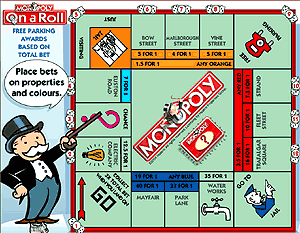 Probabilities in the game
of Monopoly.
Probabilities in the game
of Monopoly.
Perhaps a descriptive answer to "how does this change for the counters" is simple game theory. When my wife and 10- year-old and friends get "tired" of me running the game they simply set out to ruin "me" It's a very simple solution to make uneconomic trades that will hurt an individual's outcome to win the game. Yet, if played correctly as a team "might" make it much more difficult for the non-teamed player to win.
Yet, Free trade is mutually beneficial.
Another silly game "Risk" reminds me of "how we won the cold war". The after the factness Reagan/Baker "knew" that a rapid increase in US defense spending would sucker punch the Soviets with their high GDP/defense and low productivity.
Is it too extreme to ask how to tag team the USA/Japan with the high fixed costs, high productivity, and valuations of intellectual property?
Plot: Trick our own bankers into cutting off supplies of money (the mysterious force of inflation) The USA haters cut off supplies of oils, gold, copper, platinum, palladium or "cornering the markets" in a truly 19th Century JP Morgan plot.
Then slam the markets with an overplus of supplies as men from Putin and Chavez Bank walk into the trading pits and say "relax men we have millions to lend" and in the end destroying all incentive for domestic production. Limit up...Limit down...payback. Russian backed "peace treaty.. fair trade".
Even "if" the craziest conspiracy theory was to come from the 10-year-olds.....the American ability to adapt to change, human nature and the mutual benefits of free trade would of course win the set and the match. However anything can happen in a short term game, possibility/probability.
All I know is all the new babies on the spec list, Britney is pregnant again after just a few months according to the National Enquirer. My wife says "I want another baby," I said, "ummm sweetheart we have three perfect children, most of our friends have none." She said, "precisely, we must make up for their lack of production." She got me with my own words.
Latest headline was 50% of children in the US are from recent immigrants. Thank goodness for illegal immigration. I am serious. Looks like our "quota" was a few million a year short on all fronts.
 We had a near three standard deviation event in
Japan yesterday. (May 10). 2y swap rates rose 9 bp. The daily
normalized volatility is a little more than 3 bp at 3.15 so 9.0/3.15 = a
2.85 event. I mentioned this to a few colleagues and friends trying to
point out just how rare the event was. Theoretically, it should happen
about once every two years! I am not sure what this may herald since
Japanese short rates are coming off an unusually long period of low
volatility. Anyway, it got me thinking about tail events and the normal
distribution (ND). After all, the ND assumption is a basic building
block in finance. Let us go back to the October 1987 stock market
crash. S&P futures lost 20.5% on a single day. At the time, the daily
volatility was about 1.5%. So it was a 13.6 standard deviation event!
How probable is this? First, let's look at the question empirically.
That means we will draw our conclusion based upon actual observations or
counting, not theory.
We had a near three standard deviation event in
Japan yesterday. (May 10). 2y swap rates rose 9 bp. The daily
normalized volatility is a little more than 3 bp at 3.15 so 9.0/3.15 = a
2.85 event. I mentioned this to a few colleagues and friends trying to
point out just how rare the event was. Theoretically, it should happen
about once every two years! I am not sure what this may herald since
Japanese short rates are coming off an unusually long period of low
volatility. Anyway, it got me thinking about tail events and the normal
distribution (ND). After all, the ND assumption is a basic building
block in finance. Let us go back to the October 1987 stock market
crash. S&P futures lost 20.5% on a single day. At the time, the daily
volatility was about 1.5%. So it was a 13.6 standard deviation event!
How probable is this? First, let's look at the question empirically.
That means we will draw our conclusion based upon actual observations or
counting, not theory.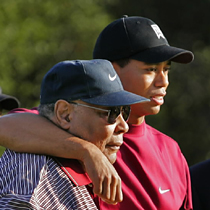 "I knew Tiger was special the day he was born," Earl
Woods said in a May 2000 interview with The Associated Press.
"I knew Tiger was special the day he was born," Earl
Woods said in a May 2000 interview with The Associated Press. I came across a recent article published by a well
known market pundit, enlisting a chat of the Wilshire
5000 Composite Index from April 2000 through July 2002
to bolster his 20-year-old argument for an imminent
market crash followed by a deflationary depression.
He had annotated the chart with all the Fed Funds Rate
changes that occurred during this time period. In the
article he then went on to say that the Fed action
does not have any influence on the direction of the
market, based on the chart that of course showed
interest rates declining along with declining stock
prices. The article ended with the usual claim that
only his particular brand of wave counting provides
accurate market forecasts and you can fill in the
blank. Of course the whole article is suspect but
what is the real story?
I came across a recent article published by a well
known market pundit, enlisting a chat of the Wilshire
5000 Composite Index from April 2000 through July 2002
to bolster his 20-year-old argument for an imminent
market crash followed by a deflationary depression.
He had annotated the chart with all the Fed Funds Rate
changes that occurred during this time period. In the
article he then went on to say that the Fed action
does not have any influence on the direction of the
market, based on the chart that of course showed
interest rates declining along with declining stock
prices. The article ended with the usual claim that
only his particular brand of wave counting provides
accurate market forecasts and you can fill in the
blank. Of course the whole article is suspect but
what is the real story?