Letters to the Editors
August 2006
Write to us at: (not clickable).
Please include your full name, and omit attachments

|
Daily Speculations |
|
| |
Letters to the Editors
August 2006 Write to us at: | |
Notice from the Editors: Competition for Contributions
Daily Speculations is dedicated to the scientific method, free markets, ballyhoo deflation, value creation and laughter. The material on this Web site is provided free by us and our readers. Because incentives work better than no incentives, each month we reward the best contribution or letter to the editor with $1,000 to encourage good thinking about the market and augment the mutual benefits of participating in the Daily Speculations forum. Prizes are awarded at the end of each month by the Chair and the Collab. Past winners31-Aug-2006
A Random Walk, from Michael Olds
I have just finished reading The Education of a Speculator for the second time. I read it when it first came out and this time was almost like I had not read it before. Always a sign to me that a book has much to learn from. I thank you for this book, you have honored your father with it.
A practice I have found helps me from pestering my buy-and-hold broker with my gut feel impulses to zip in and out of stocks: I have set up a very small Ameritrade account. It satisfies the need to do something when I have an idea. I am about at break-even after three years...but I have got a hot one that will pay off any day now!
It seems to me someone with your resources could measure this business of selling just before the rise and buying just before the drop. Stick you on an Ameritrade account and have your traders take opposite positions from you? I swear there is some part of me that is psychic and knows what to do. Looking back I can see "I knew that" over and over. Ego/doubt gets in the way and I almost always miss the trick. Put it down to the processing power of the mind if you like, it would still be a wonderful thing to be able to get right.
Hobo's and Music. Have you heard the story of Moondog? The fellow that used to stand outside City Center in a Viking outfit? Some German girl came along and made friends, discovered his talents as a composer, cursed America roundly for the way it treats it's geniuses and brought him to Germany where he first became a hero and has now begun to shake things up finding errors in Bach.
I am not much in touch with the world, so it has taken me until now to feel interested in seeing if I could find out more about your story which lead me to this site. I have not read everything yet, so please pardon the question: Is there some place where we can hear/read your story from the end of The Education of a Speculator to at least the point where this website takes over? I gather you hit bottom at least once after that.
Take Care, Michael.
30-Aug-2006
A Kiss of Death for the Commodity Index?, from James
Bitumen
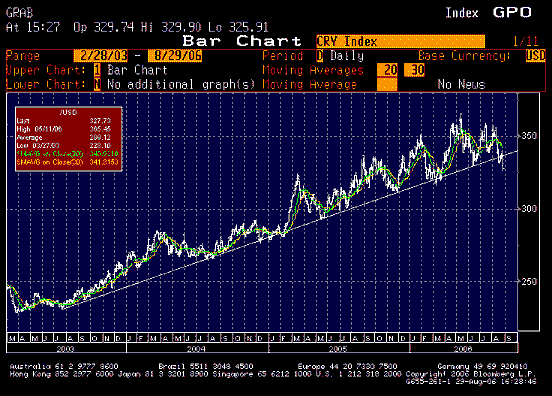
We have been well educated on the dangers of Technical Analysis 101 by the Chair on numerous occasions, yet for today's discussion, it is very important. I have been paying close attention to this trend line in the Commodity Index for a long time. I think Bernanke and Co. has as well. To them, it is a very good gauge of the inflation risks created by the all-too-discussed Bull Market in Commodities. Well, TA 101 might suggest that the bull might be broken here, and I certainly think that is the case. Not for technical reasons, but for fundamental and market dynamic reasons. God forbid the trend followers jump on it, because we know that will be a big problem for CRY Index Bears - A Kiss of Death for the medium term.
Anyway, getting back to today's lesson, stock bulls should be jumping for joy:
As Joey Battapaglia of old school CNBC footage would say, "Ya get ya tek, get ya banks, ya get some retail, and ya just buy 'em up...."
29-Aug-2006
A Question for the Forum, from Ryan Maelhorn
I am a day trader. It is pretty easy to be a day trader. Mainly this is because I have the ability to make sure I never get in over my head, and I have no clients to answer to that could skew my thought processes. Hedge funds do not have this option. It's easy to pop in and out of stocks for ten to one hundred thousand dollars at a time. Making a five percent daily return in this manner is not that difficult. I can remain stealthy and elusive in these amounts. If I make a few thousand dollars a day, it is a perfect world.
However, how can a sum of money as large as a billion do this? I do not believe it can. True, the entire capital of a hedge fund would never be put into one investment. But the smaller the amount at play, the smaller the amount of return. The smaller the amount of return, the higher the amount of angry client phone calls. Also, there are only so many good day trades available each day. So the idea of dividing up invest capital and evenly distributing it between, say, twenty day traders may not work either. Besides, that is still fifty million per trader -- not very day tradable.
I read the Chairman's note on the May crash. How the ones who really profited where the ones who had some extra cash lying around. My first thought was, "Boulderdash! Why don't they just sell their stocks when they went south of the 10 or 20 DMA, wait a few days to make sure the bottom was in, and re-invest?" My next thought was to realize that simply because of the sheer size of their investments, they could not. It might have taken them a week to sell everything off, even via huge market orders. By then, the crash was almost over.
It seems because of all the above, hedge funds would have to be swing traders at least, and long term holders at most. Though incongruously, SAC's theme seems to be "trade actively and trade often." I am just curious to know how a billion dollars can be put to work everyday in the market.
I would never expect to receive exact advice about this, but am hoping for a list of possibilities. It is fascinating to me that such large amounts of money can be made to work in the markets at all, let alone for such high returns that clients are willing to give 40% of the profits their money has made as payment back to the fund. I am sure I don't have to explain to anyone here what trying to buy or sell 30% of the average daily volume of a stock all at once does to the PPS. I am also sure that I do not have to explain that buying much less than that, or doing so in too prolonged of a manner, would drastically reduce the investment's effectiveness for a fund.
29-Aug-2006
How do you Organize your Papers? From David Wren-Hardin
I have been thinking recently about how to organize all of my academic/research/interesting articles that I have accumulated over time. Back in my academic days, this was easy. I had a filing cabinet -- yes, an actual physical structure -- that I put actual physical copies of papers in, filled under such archaic conventions as subject and author. I had a bibliographical database, endnote I think, that made building a citation list easier, and allowed me to search on a computer for what I had, but no access to the actual articles.
Now, of course, many papers are in PDF format, and as an options trader, a lot of the things I save and read are not necessarily peer-reviewed, formal journal articles. As a result, I have accumulated a list of links to papers scattered over various computers and browsers, downloaded copies of papers saved to various hard-drives, and even a separate conversation-tag in gmail for "interesting articles" But I don't know what I have, or where what I have is.There are a few solutions:
Print everything out, and save copies. Puts everything in one place, but takes up room, and does not solve the searchability / indexing issue.
Download copies of anything that can be downloaded, and save to a hard drive. Does not necessarily solve the indexing issue, although some articles could be searched via software tools. Also limits access to whatever computer I have saved everything on.
Put all copies in a web-briefcase like yahoo. I could organize them into folders by author, subject, etc, and have them everywhere. Space issues would loom however, and forcing a physical structure on an electronic medium seems inelegant, there should be a more robust way to link everything together.
There are obviously combinations of possible solutions, but I am sure there are those here with even bigger piles of articles than I have accumulated, so I thought I would look here for previous solutions.
Bruno Ombreux contributes:
Rich Bubb recommended The Brain to me last year. I tried it, kept it and can only recommend it too. I am using it as a lab notebook where I keep and organize all the results of my market studies. And by the way, I forgot to thank you for this suggestion. So thank you Rich.
25-Aug-2006
Pollyanna Ballyhoo, from Jeff Baatenberg
Often these pages speak of the the longevity of the rise of man or 1,000,000% returns in stocks. Those who dare suggest gloom and doom are teased for betting against drift. For all the pride taken in personal libraries, I have not noted Austrian economics examined here.
I would like to note two cycles: the first of which may give more pain than the 1930's or 1970's, the second of which may pause the ascent of man more than any previous event.
The credit bubble: According to Austrian economics a fiat currency always ends in hyperinflation. We may, of course, get to struggle with deflation first.Peak Oil: 2005 will be the year of worldwide peak oil production. Anyone who suggests otherwise is not heeding the Chair's admonition to count.
25-Aug-2006
Trends are a Moot Point, from Bruno Ombreux
I think trends are a moot point and this term should be banished from vocabulary.
If the S&P moves from 1296.25 to 1296.50, this is a 0.25 USD trend, even though some call it bid/ask bounce. If it goes up 100000% in one century, this is a trend too, even though some will call it drift.
We are in the realm of semantics. What is very real, on the contrary, is the way to trade.
If one trades in the direction of the most recent move, a move being defined as the percentage change over one's trading horizon, one is "trend-following". If one fades the direction of the most recent move, one is counter-trend trading. And if one is buying stocks on dips, he is countertrend trading in the short-term and trend-following in the long-term.
So we have different trading styles, let us call them contrarian and bigger-fool-theorist or rightful believer in the long term success of Capitalism. But we do not have trends. And we do not have un-trends.
What needs to be done is dependant on market behavior for a given horizon, which is easily measurable with simple statistical tests, albeit ever-changing so prone to creating losses for lazy people.
18-Aug-2006
The Ubiquitous Trading Desk, from Jay Pasch
It really is a pleasure to have the trading desk's computers available from the den, or the tree-house, or the hotel suite, or the next continent, or anywhere on the planet that offers web access. Citrix Systems, an undisputed leader in remote access offers an effective, stable, simple, and low-cost technology that extends the trading computers' keyboard, mouse, monitors, printers, to well, anywhere.
16-Aug-2006
Arthur Cooper on the Roth 401k
The new pension bill makes Roth 401(k) plans permanent, which should encourage their adoption. Previously, Roth 401(k)s had been set to expire after 2010, which discouraged employers from offering them. See the article on p D2 of today's WSJ.
16-Aug-2006
Pam Elgar recommends American Prometheus
I am reading a book I feel compelled to bring to your attention: American Prometheus by Kai Bird and Martin Sherwin. It is the triumph and tragedy of Robert Oppenheimer and I think you will find it as fascinating as I do, although I am still in the early years.
14-Aug-2006
Philosophy in the IDF, from Laurence Glazier
Once upon a time I wrote a dissertation on the Ethics of Warfare, an attempt to use mathematical logic to determine the best - or least bad - course of action. I never considered the possibility of an enemy whose goal was self-destruction, without scruples even for themselves. The evolution of religious suicidal terrorism has undermined those ideas, but I find it heartening that the Israeli army devotes great attention to philosophy as battles are waged partly in the mind.
I found an interesting article on how the IDF considers the philosophy of the meaning of spatial locations, studying texts on architecture and post-structuralism, relevant even more today as Hezbollah has been busily redefining the meaning of Lebanese apartment block balconies and hospitals.
Jim Sogi responds:
Laurence ... Great article, and it applies to trading: "the philosophy of the meaning of spatial locations".
What was interesting for me was not so much the description of the action itself as the way he conceived its articulation. He said:
this space that you look at, this room that you look at, is nothing but your interpretation of it. [...] The question is how do you interpret the alley? [...] We interpreted the alley as a place forbidden to walk through and the door as a place forbidden to pass through, and the window as a place forbidden to look through, because a weapon awaits us in the alley, and a booby trap awaits us behind the doors. This is because the enemy interprets space in a traditional, classical manner, and I do not want to obey this interpretation and fall into his traps. [...] I want to surprise him! This is the essence of war. I need to win [...] This is why that we opted for the methodology of moving through walls.
Theory is important for us in order to articulate the gap between the existing paradigm and where we want to go. Without theory we could not make sense of the different events that happen around us and that would otherwise seem disconnected.
A speculator can assume an alternate theory of the market 'space'. We know the weakness of certain spatial (technical) assumptions in the market, and thus know the assumptions of the market participants. By adopting a different theory the goal of making money can be accomplished. The goal of other market participants appears to be safety which causes various behaviors that give opportunity to alternate theorists. The saying that speculators assume risk is inaccurate. The speculator observes times when others perceive that there is high risk, which is manifest by risk avoidance behavior or news media blaring false fire signals. Alternately when things are guaranteed to go up, like last Fed week, in fact they do not. Walls in the mind also can be broken down.
14-Aug-2006
Manufacturing Myth, a
letter from Donald Boudreaux to the Editor of the Washington Post
Dear Editor:
Karl von Schriltz is distressed that America has three million fewer manufacturing jobs today than in 2000 (Letters, August 13). He should relax. Eighty percent of America's economy now is in the service sector - the sector with the best jobs.
In an economic unit smaller than the US economy - the family - applause rather than distress typically greets the "loss" of manufacturing jobs. For example, my parents are delighted that I work in the service sector, as a college professor, rather than in the manufacturing sector (shipbuilding) that employed my father and grandfather. I'm delighted, too. If almost everyone aspires, for themselves and for their children, to work in service-sector jobs such as physician, lawyer, architect, journalist, and educator, why should we lament an economy that increasingly allows us to fulfill this aspiration?
Sincerely,
Donald J. Boudreaux
Chairman, Department of Economics
George Mason University
Gary Rogan comments:
It seems to me that if someone laments the loss of manufacturing in the U.S., this does not necessarily mean that in order to be logically consistent he or she should consider those jobs to be more desirable than service jobs. I would also think that the fact that service jobs are extremely prevalent does not mean that they are more desirable. One could conclude that the market is working to replace manufacturing jobs with service jobs, and question "the wisdom" of the market without having a burning desire to sign up for the next assembly line opening. Similarly, when garbage is piling up in the streets one can complain without having any aspiration to become a garbage collector.
10-Aug-2006
Not my Intention, from Jim Sogi
While it is not my intention to diminish the potential seriousness of the current situation, it is my business. I am paid to be somewhat skeptical of both the news media and the governmental agencies fostering the recent "story" and scare tactics. No details of the alleged plot, or who the suspects are have emerged despite a large scale operation purportedly having been conducted to counter these alleged terrorists. It does not add up to me.
First of all elections are coming and the war is in play, as shown in the Connecticut primary, with incumbents here and in UK being responsible for the war. Remember the staged orange alert in New York Harbor during the last election? I can only imagine a Muslim soccer team with a can of gas in the garage, talking on cell phones to their cousin in France and being rounded up as a sophisticated, international terrorist plot.
I will be interested to see how many convictions there actually are. The government needs to keep 'em scared to keep 'em down. The news is mighty sketchy as usual, vague and filled with supposition and conjecture masquerading as analysis. Whatever your political affiliation, the war in Iraq is not going well. Nothing like a good scare and a few arrests to restore faith in the powers that be, and scare the living daylights out of the markets of course.
Finally, I am very skeptical of the way the price led the news yesterday, so it is appropriate to beat the evil goblins with not only a cane but with an iron bar, until they agree to give up the gold.
Matthew Alexander sends in an article from the Wall Street Journal:
Bank of England Releases List of 19 Terror Suspects -- Associated Press, August 11, 2006 12:41 a.m.
LONDON -- The Bank of England froze the assets of 19 people early Friday, naming them as people arrested Thursday in connection with an alleged terror plot to bomb British passenger jets.
"On the advice of the police and security services, the Treasury has instructed the Bank of England to issue notices to effect a freeze of the assets of a number of individuals arrested in yesterday's operations," a Treasury statement said.
Most of those named in the list were London residents, and many bore Muslim names. (See the bank's statement) Scotland Yard had no immediate comment.
The latest threat became public early Thursday when British police said they had arrested 24 people who may have been only days away from trying to carry out a coordinated attack on flights from Britain to the U.S.. Pakistani authorities later said they had made prior arrests that may have been connected to the plot.
The bank released the following names: Abdula Ahmed Ali, Cossor Ali, Shazad Khuram Ali, Nabeel Hussain, Tanvir Hussain, Umair Hussain, Umar Islam, Waseem Kayani, Assan Abdullah Khan, Waheed Arafat Khan, Osman Adam Khatib, Abdul Muneem Patel, Tayib Rauf, Muhammed Usman Saddique, Assad Sarwar, Ibrahim Savant, Amin Asmin Tariq, Shamin Mohammed Uddin, and Waheed Zaman ...
The oldest person on the list, Shamin Mohammed Uddin, is 35 years old. The youngest, Abdul Muneem Patel, is 17.
TJR responds:
I too have been having thoughts in this direction, particularly after reading the Aug. 11th (pre-Hair Gel Bomb) Economist. The article "The Poodle's Dilemma" details the difficulties faced by Tony Blair, including slipping support in his party and the popular polls. For those of a similar mind, or anyone interested in politics as a contact sport, I recommend the DVD of the British series "House of Cards", and its sequels "To Play the King" and "Final Cut".
The series features an impeccable performance by Ian Richardson as the Machiavellian Tory politician Francis Urquhart on his march to become Prime Minister. As portrayed by Richardson, the PM will use all means to improve his position including ginning up a little terrorist activity. If you view politics with a mix of cynicism and black humor, it is definitely worth watching.
09-Aug-2006
A Letter to the Pessimists, from Sushil Kedia
"The Oil Bulls would take it all away as this contract goes to 80 and if not, then certainly by the time it goes to 100." One heard such a statement nearly daily when the Goldman Sachs report hit the world on a quarter ending last year for several weeks. The pessimists had found a lateral thought to dismiss the expansion of prices in just about everything. Even if every equity Index is going to a new high, and every piece of real estate on every continent is expanding in value/price it will finally all land at the feet of the Oil Pashas!
Well, the classic round number struggle is being witnessed at the 75 + zone, creating the necessary tension before the whiskers of 80 are played with, but have the Oil Bulls taken it all away? From 40 then they could not take it away until it is now near 80; but maybe there is some bigger numerological secret the perma-bears have, which justifies how it will all fall down by 100?
Does anyone else fail to see if investors in all the various assets are any poorer, or if wage earners are living a lower quality of life than four quarters ago?
My dear pessimist friends, your perverse urges to even find a friend in the oil bull have not played out to your wishful thinking. How could, in your desperation, you choose to befriend a bull at all, even if this one was oily? See, bulls have prevailed together as much as the bears have.
Because, you see some of the bulls other than the oil one huffing and pausing for the moment, my dear bears, I suspect you would be prone to getting entrapped once more, while engaging in a mighty push, only to be ensnared downwards with your own weight. Just a couple of the more famous perma-bears tried changing camps a couple of months ago and see how readily the bulls accommodated you. Now, after several rounds of further last bouts of defeat, most of you turn into a positive (oh that is actually negative) surrender. The bulls, it can be seen clearly, are today a much lighter herd.
Oh until a new high is seen you are quite hopefully pessimistic of the world. Then so be it that you do get negative about your pessimism as the new high is sought by the bulls yet again despite shrinking volumes and open interests across markets.
It appears our pessimistic friends across most of the world are willing to accommodate the gains that the optimists are pushing for, right until a re-test of the all time highs, seen not too long ago. The declining struggle and the rising will of the pessimists to finally accept a bright future as measurable from the shrinking volumes and open interest, gives me a basis to start preparing for finally agreeing with the pessimists in the coming months ahead. But, then even while one like me would place my mouth and money in the latter part of the year on declines, the pessimists would still be disagreeing with this soul since they would be pessimistic about the outlook of a declining market in '07 too (thanks to the Senator, who taught how in each of the 10 years that happened in the last 100 with a 7 at the end, it happened only thus that you pessimists have been dealt a better hand where the low of the year came after the high was seen and at a good absolute distance). But still, like has been happening we have to remain in disagreement even in that.
I do not know why some people can never agree? Ah I see, you still believe oil will go to 100 and the only positions you want to hold despite a 33% rise pending in oil per your expectations is to be still holding shorts on everything else. But when oil will go down and only when this one bull will go down then only you would give up your pessimism. Got it. My tiny ganglia it appears, have finally got it.
09-Aug-2006
From a Blue and Gold Buckeye, by Steve Leslie
I am 49 years old, born and bred in the Buckeye State. I take pride in my Midwest upbringing growing up in the middle of the rust belt. One thing that we take very seriously is football. Every kid either plays it or follows it and we all enjoy Saturday afternoons watching our favorite team on TV.
When I was young, you had a choice of being a college football fan of either the Ohio State University or Notre Dame -- do not even think about the team up north. As a practicing catholic my choice was made for me. I can honestly say that I have been a committed fan to the Golden Domers for at least 43 of my years. I remember watching the 1966 match-up between Michigan State and Notre Dame on television when network coverage was very limited, and listening to them on the Westwood One radio network while raking leaves with my dad in mid-November.
Through that period I have enjoyed some great highs with Ara Parseghian, Dan Devine, Lou Holtz and some pretty low lows with Gerry Faust and Bob Davie. I have watched some of the greatest players to have ever played the game, seen some of the greatest games and rivalries and through it all, I have never wavered in my love for the school nor the values that they stand for.
There is speculation that Notre Dame is on its way back to elite status with head coach Charley Weiss at the helm but only time will tell. I did notice that they are rated #3 in the preseason poll behind Ohio State and Texas but who knows where they will finish. One thing is for sure and that is that they have a legitimate team, and a future NFL quarterback in Brady Quinn. I cannot wait for their opening game in 4 weeks, as the season promises to be exciting with football played at the highest level.
I guess the one thing that I really love about Charley Weiss is that when the Irish run out of the tunnel to take the field before the game he casually walks out with a bold and calm look on his face. He just exudes quiet confidence. No rush, no fuss, he patiently walks on as if he is on a leisurely stroll through the park, fully prepared to take care of business and the task at hand.
That to me, is what great competitors are all about. You see it through the years in the likes of men like Walter Payton, Barry Sanders, Roger Staubach, Reggie White, Joe Montana, Tom Osborne and others. Men who know what it is like to be a winner but don't feel the need to bring the attention to themselves. They let their results do the talking for them on the field of play where it really matters.
When the Irish take the field for their classic early season match-up with Michigan take the time to watch Charley Weiss and his total demeanor, and you may just say to yourself, "that is the way that a champion walks."
08-Aug-2006
Bo Keeley on A Reasonable Life
I recently read A Reasonable Life: Toward a Simpler, Secure, More Humane Existence by Ferenc Mate
I enjoyed these chapters for learning things I could agree with: the death of the individual, the myth of the steady job, humane small towns, and the self-helpless society.From Publishers Weekly:
'In this scattershot jeremiad, Mate takes on virtually all of modernity, concluding with a romantic paean to country life. A one-time city dweller who now lives in Tuscany, the author criticizes houses ("huge, unused barns"), "the myth of the steady job," corporate ownership, agricultural practices, cities and individualism--all in a shrill and hyperbolic prose style. He does have some worthy recommendations: why we should convert our lawns to gardens; how children should be taught defenses against advertising. But other ideas, like junking the television set ("Open an upstairs window . . . and throw the heinous sonovabitch as far as your arms let you!"), make him sound like a cranky Luddite. "Most of you might dismiss this as the raving of some idealist," acknowledges the author; indeed, he courts that assessment.'
07-Aug-2006
Kim Zussman on the Shoemakers
A planetary Geologist and Caltech professor, Gene Shoemaker and his wife Carolyn, were acquaintances years ago when once researching photographic emulsion enhancements for long-exposure astronomical photography. Gene's main interest was impact craters, and he did his dissertation on the Arizona meteor crater. One of his discoveries was 'shocked quartz'; mineral crystals with structural changes diagnostic of past meteoric impact. Gene and Carolyn searched for asteroids that might cross the earth's orbit, and Carolyn as a late-in-live observer discovered more comets than any woman in history (including Shoemaker-Levy 9, the multi-part comet that struck Jupiter in 1994). In addition to yearly travel to Mt Palomar to image the sky, they used to travel to the Australian outback in search of impact craters identified in satellite images. On one of these trips in 1997, Gene died in an automobile accident.
In 1998, Lunar Prospector was launched; which went on to discover frozen water in some of the polar craters of the moon. The spacecraft contained a small vial with the ashes of Dr. Shoemaker, which had been arranged with his family to commemorate his life-long hope to go to the moon. Lunar Prospector was crash landed into one of the putative water-containing craters, but no water plume was observed.
Visitors to Meteor Crater, east of Flagstaff Arizona (old Rte 66), can visit a museum with exhibits on astrogeology which include many references to the work of Dr. Shoemaker.
01-Aug-2006
A letter on Photosynthetic Energy, sent in by Steve Ellison
Can humans replicate Hoagland and Dodson's Chloroplast Ballroom to generate energy? Kris has suggested that we could. The Department of Energy is funding research into generating energy by mimicking the photosynthesis process
Solar photochemical energy conversion is a long-range option for meeting the world's future energy needs. An alternative to solid-state semiconductor photovoltaic cells, the attraction of solar photochemical and photoelectrochemical conversion is that fuels, chemicals, and electricity may be produced with minimal environmental pollution and with closed renewable energy cycles.
The 'special pair' model for electron donor chlorophyll molecules in photosynthesis was introduced by Joseph Katz and James Norris of Argonne National Laboratory (ANL). Photosynthetic molecular models for light to chemical energy conversion were developed by Michael Wasielewski of ANL and by Professors Gust, Moore, and Moore of Arizona State University.
Scientific Challenges:
In solar photoconversion, knowledge gained in charge separation and long-distance electron transfer needs to be applied in a meaningful way to activation of small molecules (CO2, N2, and H2O) via photocatalytic cycles. The major scientific challenge for photoelectrochemical energy conversion is that small band gap semiconductors capable of absorbing solar photons are susceptible to oxidative degradation, whereas wide band gap semiconductors, which are resistant to oxidative degradation in aqueous media, absorb too little of the solar spectrum. Ongoing research activities include multibandgap, multilayer cascade-type semiconductors, photosensitized nanoparticles, and surface coatings that protect against photocorrosion. Experimental and theoretical studies on photosynthetic pigment-protein antenna complexes should lead to advances in design of efficient and robust artificial light-collecting molecular assemblies. Computational chemistry methods incorporating recent advances in calculation of excited states should be developed and applied in design of photocatalysts and molecular dynamics simulations in artificial photosynthesis. Fundamental studies on photochemical reaction pathways offer opportunities for less energy intensive and more environmentally benign processing of specialty chemicals and high volume industrial intermediates. [Read More]
Henrik Andersson adds:
As a young student I remember being captivated by Stenbjörn Styring and his colleagues lecturing about Artificial photosynthesis and replicating Photosystem II to split water to produce hydrogen. Now prof. Styring is Chairman of the Swedish Consortium for Artificial Photosynthesis:
In a unique effort the project integrates, in a long time effort, two front-line topics: artificial photosynthesis in man-made systems to make hydrogen from sun and water, and photobiological hydrogen production in living organisms. Hydrogen production on large scale by these methods is still distant, but has a vast potential and can, if successful, have large impact on future energy systems. The scientific risk is high - the research is very demanding. Thus, our objective is to explore, integrate and carry out the basic science necessary to develop these novel routes.
It is fascinating fact that photosynthesis is responsible for our coal, oil, natural gas etc. as well as the oxygen we breath.
Letters to the Editors: Archive