Archives
June 15-30, 2006
Write to us at:
 (not clickable).
Please include your full name, and omit attachments.
|
Daily Speculations |
|
|
| |
Archives Write to us at:
|
30-Jun-2006
Briefly Speaking, by
Victor Niederhoffer
The book The Truth
About Markets by John Kay contains a modern compilation of
numerous examples of central planning gone astray. There is a nice
story about Nikita Khrushchev's visiting Iowa and concluding that the
source of American prosperity was corn, and that corn was the future
for Russia. He imposed it and it led to disaster and his toppling. A
similar example shows the destruction and poverty and famine that
followed Mao's Great Leap Forward in 1957 where 100 million people were
forced to live in communes. Similar examples are
 given with the disaster that
followed England’s nationalization of electricity in 1947,
and the fiasco that followed when they attempted to generate
electricity with five gas powered nuclear reactors, and the incredible
destruction and poverty and crime and ruination that followed the
public housing Title 1 programs of the US detailed in Martin Anderson's
The
Federal Bulldozerozer. Kay attributes these disasters to the
attempt to plan by a single voice without feedback from customers. This
leads to sluggishness, lack of accountability, misleading information,
lack of pluralism, waste, deadweight costs, misallocation of resources,
and enormous unintended consequences involving cronyism and
perquisites. All these examples played out over years and involved
losses in the 10-figure range.
given with the disaster that
followed England’s nationalization of electricity in 1947,
and the fiasco that followed when they attempted to generate
electricity with five gas powered nuclear reactors, and the incredible
destruction and poverty and crime and ruination that followed the
public housing Title 1 programs of the US detailed in Martin Anderson's
The
Federal Bulldozerozer. Kay attributes these disasters to the
attempt to plan by a single voice without feedback from customers. This
leads to sluggishness, lack of accountability, misleading information,
lack of pluralism, waste, deadweight costs, misallocation of resources,
and enormous unintended consequences involving cronyism and
perquisites. All these examples played out over years and involved
losses in the 10-figure range.
A much better example of the disaster of central planning is the recent month’s destruction of wealth set off by the coordinated set of plans to jawbone the economy and inflation down set off by the Fed Open Market Meeting of May 10, 2006. It started with an attempt to show that inflation was rampant, the public didn’t get it, and the markets needed a dose of tightening to bring things back to proper order. The attempt was imposed from above, based on the vision of a single personage who coordinated a series of staged speeches about how vigilant the Fed was and how concerned about the failures of the knowledge of individuals they were. The loss of wealth that it set off was in the $3 to $4 trillion range as all the emerging markets, Asia, Europe, and Latin America declined 10 to 20% in lockstep from a $45 trillion or so base. By June 29, 2006 it was all over. The last Open Market meeting emphasized how restrained inflation was, how the Fed would be guided by markets in the future, and how the tightening might be near its end. The world markets recovered an average of 5% from their recent lows, and will undoubtedly move back to their former levels in the due course of reasonable time, perhaps a few months. But what deadweight costs, what frictional costs, what individual hardship and poverty was created by it all.
What fools these central planners must think we are. What arrogance of power Khrushchev, Mao, Fred Lee and Ben Bernanke displayed in trying to consolidate power about them. What stooges the media and other bit players in the debacle were as they fanned the flames of total economic Armageddon as if puppets in a performance.
Let the story of this recent disaster in centralized planning, this superposition of the vision of a single leader for the wisdom of the market, this attempt to consolidate power behind a single voice (possibly engendered by the pretty woman transgression), serve as a vivid, and compact episode in the US of why market based solution, and pluralism, and suffering the consequences of failure are so necessary to the common good. And let us learn how to profit from such orchestrated forays in the future.
Mexico's nationalization of the oil industry in 1938 is another example of poor central planning. Pemex is so inefficient that in a few years Mexico will become an oil importer despite its being seated on vast oil reserves in the Gulf of Mexico.
They don't have the technology or the people to drill in deep waters and as outsourcing is forbidden by the law those reserves will remain under the sea.
30-Jun-2006
Celebrating the
Fourth of July by Tim Melvin
So here we are once again, the fourth of July Weekend fast upon us. For those of us here in the States it is a celebration of our nation's birth, a unique nation founded on principles that were unheard of at the time, with a belief in individual liberty and independence. While some may argue that we have strayed from that path, it remains true that the US has been the guiding light of freedom in this century and the one past. Those of us from here will this weekend celebrate our nation's birth. I imagine the rest of the world will use the opportunity to remind themselves of how much they hate us but that's not going to stop the party.
With the exception of a brief opening Monday for the markets, it shapes up as a four-day holiday weekend for most of us. Here on the island, it is shaping up as a typical Melvinian bacchanalia with festivities starting tonight and rolling right on through until Tuesday evening. There will be the fermented and distilled beverages, the end product of grains, grapes and juniper berries flowing across the docks, there will be roasted domestic farm animals over the fire, steamed pots of squirming crustaceans, the uniquely American sound of southern fried rock and roll will blast across the docks at both redeye dock bar and the jetty all weekend, the speedboats will growl and rumble and we'll fly across the bay at 70 mph just for the sheer joy of the speed, scantily dressed women all around showing off the end product of endless hours in the gym and tanning booths. There will be laughter and dancing, drinking and dining in the sun, with American flags everywhere flapping in the breeze that swings in off Eastern bay. The whole damn crew will be out and about this weekend with wives, girlfriends (including a new contender for the current incantation of the one true love of my life) the whole shebang. It is just too much fun to miss.
As always, I like to recall why we are celebrating and to toast those who sacrificed for the right to be here this day on this dock with these friends. I have written much in the past of the sacrifice of our military and will mention it here for we all know that without them, there would be no party this day, no cold beers in hand, no burgers on grill. They lived, fought and died that we may be free and I honor and thank them for that. I have written on past fourths to thank the greedy bastards, the capitalists who built this economic engine that sustains us all. This year, in light of the recent tumultuous markets and the blasting that Victor received on several ill conceived chat boards during the upheaval for his risk taking (although in the Bloomberg article he clearly stated that he favored taking large risk for large returns over time), I pause to think of the exceptional risks taken by exceptional men and women over the past 230 years to build this nation we call home. They have risked their lives, their money, and their effort. Many of them failed over and over only to get up and push doggedly on until they met success. The taking of extreme risk to achieve extreme rewards seems to be an inherent characteristic of our nation and I think today we should drink, grill and dance in celebration of these risk takers.
To celebrate the original risk takers, the incredibly brave 56 signers of the American Declaration of Independence. These 56 were committing an act of treason against King George. Affixing their name to the document was a death sentence. Yet they all signed this document with the last paragraph acknowledging the risk they were taking ''And for the support of this Declaration, with a firm Reliance on the Protection of Divine Providence, we mutually pledge to each other our Lives, our Fortunes, and our sacred Honor." Of these 56, nine died in the war. Five were captured. Eighteen of them had their homes burned by the redcoats. Several of them lost their entire fortune and never recovered, dying broke and bankrupt. They had to know the very real possibility of this future, but they also recognized the vast potential of the republic they brought into existence with their signature. So they signed, taking the extreme risk for the extreme reward of liberty.
We celebrate those who left the relative safety of the Eastern seaboard to push into the interior and onward to the Pacific in search of land and opportunity for themselves and their families. Think of Lewis and Clarke setting forth to map the way westward with no real idea of what they would discover. From 1804 to 1808 they traversed the continent, encountering hostile natives, unknown wildlife (they were the first, to their dismay, to describe an encounter with the enormous grizzly bear), fierce weather and unknown hardships. But they went, opening the path for westward expansion of the young nation. We celebrate all the trappers and trackers, as well as the pioneer families who struck out with no knowledge of the outcome but a firm unshakeable belief that they could take the risk, overcome the obstacles and achieve success and prosperity.
We celebrate the risk takers in business, people like Henry Ford, Sam Walton, Andrew Carnegie, Tom Watson, even Bill Gates. These men risked their reputation, their capital and their effort to build lasting companies that changed the face of not just America but the world. Walt Disney who had already gone broke a couple of times but persevered in his vision and changed the world of entertainment forever; Ray Kroc who expanded one little burger stand into a fast food empire; We celebrate all those as well who rise each day to open the bakery, the print shop, the small business that serve us each day, often opened on a string and a prayer along with credit card debt, risking ruin to chase their dream and making our lives easier in the process.
We celebrate those who expanded the frontiers of science and exploration pushing forward into areas no one thought they could succeed. People like the Wright brothers, Thomas Edison and Jonas Salk who pushed the frontiers of their field and changed the world forever by virtue of their courage to push the envelope and their dogged determination to succeed where others had failed. We celebrate the courage of the Apollo astronauts who pushed on to broaden man's knowledge of the universe even though the first of the spacecrafts had exploded resulting in the fiery death of their friends and fellow astronauts; Neil Armstrong taking that great step into uncertainty. We salute the Shuttle astronauts who continue to fly, as well as all those who risk reputation and career to continue to push ahead against the diseases and ailments that have faced man since the dawn of time. They have expanded our knowledge, lengthened our lives and provide light, power and comfort to the world as a result of their taking of great risks to achieve greatness.
It was George Bernard Shaw who said, "The reasonable man adapts himself to the conditions that surround him. The unreasonable man adapts surrounding conditions to himself. All progress depends on the unreasonable man." Although Shaw was Irish, in that statement, he captured the heart and soul of America. It has been our willingness to push the edge, venture into the wilderness and explore the frontier that has made our nation great. I think Victor is quite correct when he said most people today do not take enough risk. It is in the taking of risk that lays the seed of greatness, of discovery and of success. Our nation was birthed by those who took the risk of leaving all they knew to come to a new world full of hope and adventure. It was birthed by men who risk everything to achieve liberty, not just for themselves but also for a whole new nation and those would followed over the next 230 years. It has expanded and prospered by risking it all in business, in science and across all endeavors. We exist as a nation because we have always embraced risk.
So raise your glass of sparkling gin, hoist your beer and pay tribute to those who have gone before; many succeed, many failed but they all knew the exhilaration of being alive and risking it all, be it money or reputation of their very life so they we may enjoy the lives we live here today. Then celebrate as only Americans can, with cold adult beverages, rock and roll, loud boats, fireworks blasting a multi-colored tribute across the early night sky, the freedom and independence we all have to succeed, to fail, to participate in a venture like this site that expands our minds and opportunities and create new friendship with the incredible mix of risk takers that reside here. Happy Fourth of July. If you are in the Mid-Atlantic area, stop in redeye's over the weekend and I'll stand you a drink and a hunk of roasted flesh in honor of our nation and our opportunities.
30-Jun-2006
Timing Duration and
Yield Curve Bets by Edward Talisse
Forward rates do not have any predictive power. Researchers have documented that spot rates develop much slower than the forward curve implies. However, forward rates are high in information content. They include expectations and the market price for bearing risk. The market price of risk is a slippery concept in fixed income. In equities, it is simply the expected return over the risk free rate divided by the volatility of the market. In both markets it is time varying. You are supposed to buy when the market price of risk is high and sell when it is low.
Sounds easy, right? So how do we measure the market price of risk in fixed income? There is no right answer, but here is an approximation:
Forward rate = Spot Rate +1/2fr (t) - 1/6 (volatility)2 (t) where fr represents the market price of risk. Lets look at a real example in Japan. At The Money (ATM) forward rate 10y1y = 2.93%, spot 1y = 60 bp, volatility = 26.5% or 81 bp normalized and T =10. Work through the formula and you will get fr = 48 bp. This means the forward rate includes 48 bp compensation for bearing risk. It has nothing to do with expectations. Track the 48 bp over time. Receive 10y1y rates when it goes higher and pay when it goes lower. Why try and out guess the market? Go long when you are paid handsomely to do so. Go short when you are not. This is just a timing strategy for traders. Long-term investors will do better following the deterministic component of stocks and bonds. For stocks, it is of course, the positive drift that the Chair so frequently points out. For bonds, it is mean reversion. By the way, 10y1y represents the 1y rate 10 years from now.
29-Jun-2006
Market Imperfections,
from Victor Niederhoffer
The book Market Failure or Success, edited by Tyler Cowen and Eric Crampton, is a collection of articles about when and if markets fail, and the solutions that the market comes up to preclude failure. It deals extensively with the role of prices in providing information. Two contrasting views are tested:
The book deals with such topics as credit rationing, price rigidities, path dependence, quality uncertainty, frictional costs, lock-ins, opportunistic behavior, prisoner's dilemmas, loan guarantees, kinked demand curves. Articles presenting the modern idea that government intervention is necessary everywhere because markets don't work, mainly based on the work of Akerlof, David, Samuelson and Williamson, are presented. Next, empirical tests and market-solution articles are presented to show that such market imperfections are solved by the market.
The articles get me thinking about the current moves by the Fed to remedy what they see as a market imperfection. The question is whether individuals are not alert enough to the dangers of inflation, and businessmen are too ready to pass on prices because they mistakenly feel inflation is going to be more likely than it would be with a vigilant Fed. Thus, the dignitaries at the Fed and their counterparts all over have been dispatched to pass on the message that the Fed will prevent inflationary expectations from taking root. The minutes, the statements, and everything else have been coordinated in this direction.
The market solution would be that market prices provide a better signal of what inflationary expectations are then the anecdotal feel and ideas as to the resoluteness and steadiness of the head man at the Fed.
I notice there is a cyclical pattern of moves following Fed meetings, where the signaling effect of one regime, kicked off by a meeting, is followed by an opposite effect following the next meeting. Such a solution would be consistent with a Hayekian view of stock prices, which provide relevant information about the activities of an extended order of sophisticated buyers and sellers of equity capital.
In line with the signaling effects of Fed meetings, I note that when there is a big decline in S&P 500 from one meeting to the next, measured from the close one day before the meeting, there is a tendency for a reversal in conjunction with the next meeting as measured from the close one day before to the close one day after:
Date of Price Change(%) since Price Change(%) from Day Before
Meeting Previous Meeting to Day After Meeting
 10 31 2005 -2.4 1.4
 05 02 2005 -1.4 1.0
 08 09 2004 -6.1 1.1
 03 15 2004 -3.0 1.7
 01 28 2003 -4.1 -1.6
 09 23 2002 -7.7 0.8
 08 12 2002 -7.1 1.8
 06 25 2002 -7.5 1.9
 05 06 2002 -9.6 3.4
 01 29 2002 -3.6 2.6
 10 01 2002 -11.5 3.0
 08 20 2001 -3.1 -0.7
 06 26 2001 -3.1 0.5
 03 19 2001 -14.8 -3.4
As the total correlation between price moves the month prior and the next two days is insignificant and close to zero, this was approved by the Minister of Non-predictive Studies.
29-Jun-2006
Giving Proper Credit
for Breakthrough Work by Saurabh
Singal
The name of Ito's Lemma has been changed to Ito-Doeblin Lemma. It is a tragic tale that leads to this. Wolfgang Doeblin was a mathematician whose work was in the same exalted league as that of Levy and Kolmogrov. He was born in Germany. His father, a well known author, was on the black list of the Nazis so the family moved to Paris in 1933.
In 1939, Doeblin was called up for the army on the front line. So his career as a mathematician lasted only five years, but he collaborated with Frechet and Paul Levy in that brief time. In 1940, the part of Lorraine where he was fighting fell to the invading German army. To avoid being taken a POW he shot himself. Before doing that, he had filed his recent work in the National Academy of Science in Paris. The packet lay unopened for 60 years, but it was found some years ago and one of his results was almost the same as Ito's well known result, but independent of him. So in the newer publications, the reference is to Ito-Doeblin formula as opposed to only crediting K. Ito.
29-Jun-2006
A Retired Daytrader Reads
the Newswire, by James Humbert
Trillium, Schonfeld Fined $490,000 for Improper Nasdaq Quotes
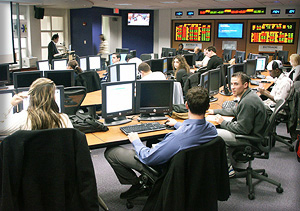
June 29 (Bloomberg) -- Trillium Trading LLC, along with eight of its traders, and Schonfeld & Co. were fined a total of $490,000 by NASD to settle allegations of sending improper quotes to the Nasdaq Stock Market.
NASD, which announced the fines today in an e-mailed statement, said the firms affected the open of trading in over 1,000 stocks over a two-week period in 2004.
The two brokerages and traders agreed to the fines without admitting or denying wrongdoing. Telephone messages left at the two brokerages weren't immediately returned.
 Reminds me of the old days.
Using
small orders and going up a penny at a time, odd lots, to hold up a
down market, taking away plus tick bids etc. Well, that's what I am
assuming. They're just traders and don't make markets so I don't kno
w
any other way to send "improper quotes." I did get yelled at one day
trading COMS with a
7-share bid refreshing on
Island
to upset ###### ####### holding on the offer, selling 100 shares every
15 seconds and he was buying on Instinet.
Only guy that would and
could make a silly ###### ####### trader would be ####### #####, lock a
MSCO mumbo
offer with a 1000 share bid through his offer, and make him look like
an idiot.
####### ##### used us to help him moved stocks up, and as they
came back in ####### ##### would buy 'em back and work their order.
Reminds me of the old days.
Using
small orders and going up a penny at a time, odd lots, to hold up a
down market, taking away plus tick bids etc. Well, that's what I am
assuming. They're just traders and don't make markets so I don't kno
w
any other way to send "improper quotes." I did get yelled at one day
trading COMS with a
7-share bid refreshing on
Island
to upset ###### ####### holding on the offer, selling 100 shares every
15 seconds and he was buying on Instinet.
Only guy that would and
could make a silly ###### ####### trader would be ####### #####, lock a
MSCO mumbo
offer with a 1000 share bid through his offer, and make him look like
an idiot.
####### ##### used us to help him moved stocks up, and as they
came back in ####### ##### would buy 'em back and work their order.
For the life of me I still can't figure out the vitriol ###### ####### had against daytraders and how silly they acted. But the gist is, if you're a market maker you can do all sorts of fun things the rest of us can't. But then again, it costs a fortune to make markets and even back in '98, after the '97 order handling rules, many of the small-time market makers gave up and came over and became daytraders themselves.
29-Jun-2006
Cassius Coolidge,
from Steve Leslie
C. M. Coolidge is the most famous American artist you've never heard of, even though his paintings occupy a rarefied echelon of artworks with Edward Hopper's Nighthawks, Grant Wood's American Gothic, and Andy Warhol's Campbell Soup Cans. These signature works, for better or worse, are indelibly burned into the subconscious slide library of even the most un-art historically inclined person through their incessant reproduction on all manner of pop ephemera: calendars, t-shirts, coffee mugs, the occasional advertisement. The difference with Coolidge's most famous image and these others, however, is that Coolidge's subjects seem to have gambling problems and, one surmises, doggy breath.
Cassius Marcellus Coolidge (September 18, 1844-January 13, 1934) was a United States painter named after the brother of the famous statesman Henry Clay and best known for a series of nine paintings of anthropomorphized Dogs Playing Poker.
In 1903, Coolidge contracted with the advertising firm of Brown & Bigelow of St. Paul, Minnesota, to create sixteen oil paintings of dogs in various human poses.
Nine of them depict dogs playing poker. On February 15, 2005, two of these much imitated paintings, A Bold Bluff and Waterloo, went on the auction block expecting to fetch between $30,000 and $50,000 but surprisingly sold for $590,400. The auction set an auction record for Coolidge, whose previous top sale was $74,000.
His style inspired American Illustrator Arthur Sarnoff to create his Dogs Playing Pool series. As Yakov Smirnov says "What a country!"
28-Jun-2006
Patterns in Music and
Trading, from Laurence
Glazier
In music there is an eternal question which is the more important factor, melody or rhythm? I intuitively have always gone for melody, though perhaps rhythm is more accurate, for each pitch is produced by a rhythm happening scores of times per second. The truth is that probably the most important factor is harmony, the third member of this trinity.
Rather than use the term melody, in this question, one can more subtly use the notion of shape. A melody does not have to be accurately sung to identify a tune, it merely needs to go up and down where appropriate, and this, the Parsons Code, can be used to look up the piece of music.
Last year some research was done by Peters, Anthony and Schwartz to show that the rhythm, taken by itself without the tune, can likewise often identify a piece of music.
We have in trading a similar challenge to codify and test patterns, removing all that is unnecessary to identification. In the manner of point and figure or Gann swing, it is tempting to apply similar approaches in trading. Perhaps it is necessary to subtract in some way the influence of the grand market wave (S&P) and eddies of the market sector and look for patterns in what is left. There is some math, inevitably, to be done.
28-Jun-2006
Finding New Fields,
from Hany Saad
Even as demand rose sharply, crude oil prices were declining. The answer is simple. Petroleum production was increasing at an ever more rapid rate than consumption. Overproduction has been the industry's recurring chronic occupational disease. To understand this, it is necessary to examine briefly the two principal causative factors. The first is the deep seated, obsessive fear of oil famine which has gripped the world ever since Edward Drake brought in his Titusville well. From the very beginning, many people -- experienced oil men and learned scientists, to say nothing of politicians and pundits among them -- have thought and said the world's petroleum supply was limited and would be soon exhausted. Alarmists' predictions of the imminence of critical oil shortage has always been one of the factors which inspired stampedes to locate new oil sources, to find new fields, and drill more wells.
This is an excerpt from J. P. Getty's My Life and Fortunes, written by the man himself in the 1960s. How his wise words ring true today. This is not only a great lesson in supply and demand, but also in how recent events can shape public psychology, forever to its detriment.
The recency of the "bear market" at the turn of the century and the Fed's role in precipitating it by raising interest rates is ingrained in the public's memory the same way the oil shortage was in the 1900s. Now the mere mention of a "Fed meeting" sends shivers down operators' spines as they start liquidating their longs or hedging defensively. Also, the same psychological bias prevented all the operators of 1929 from making a cent in all the prosperous years that followed.
It's the reason astute fund managers, upon sensing a market turn in 1987, fired all their senior staff who experienced the Panic and were scarred for life by it and hired inexperienced kids to avoid this costly psychological bias as the experienced traders shorted every rally while the Dow doubled and tripled.
Now is the best time in history to invest in equities, as this psychological bias has kept stocks at very attractive and unsustainable levels. And yes, I have my money where my mouth is.
28-Jun-2006
Word of the Day, from
James Sogi
The term mumbo jumbo comes from the writings of Francis Moore and Mungo Park, eighteenth century explorers of the Niger region of west Africa. Mumbo Jumbo was a fictitious god who was impersonated by men of the tribes he encountered in order to terrify the women and keep them under control. Now mumbo jumbo means incomprehensible nonsense we hear about the markets every day, used to terrify the public.
Dr. Kim Zussman replies:
In preparation for upcoming family trip, we viewed a program on the history of kings of England. There were many kings dating from the time of Arthur (about year 600), and even a greater number of battles and wars. One great difference from the present was the apparent need of people to subject themselves to, and even worship monarchy; possibly in search of physical and psychological security.
Another theme was myriad wars, including the War of the Whiskers and the War of the Rough Wooing, often waged at the behest of royal dictators. Each have historic causes usually attributed to territory, religious, or ethnic disputes.
Studying the War of the Market suggests a common cause to all wars; humans and other animals are programmed to compete and conflict. The causes listed in history books are too varied and random to explain the recurring need to delineate and fight unless the common denominator of biology is at work.
Panics and great sell-offs, as well as galloping bull markets, can be given retrospective battle themes and historical labels, but behind it all are men swinging swords.
28-Jun-2006
Barbecue Pizza, from
David Higgs
For you gas burner grillers who tired of the same old fare, you know the stuff that flys, swims or had 4 legs...........try bbq'ing a pizza.........here's how you do it: first get you a box of fire bricks then arrange them in your bbq grill. fire it up real hot at first for aseptic reasons then lower the setting to medium and cook to your desire. I won't suggest the toppings, cheese or sauce, that's to personnel but, bell pepper ( all colors ) olives (green), onions, tomatoes, a veggie affaire a good start for a change and the thinner the better, sorry Chicago! Below is a beginner's dough recipe:
Makes One 15-Inch Pizza Or Two 9-Inch Pizzas:
1 1/2 teaspoons active dry yeast
6 tablespoons warm (110°F) water
6 tablespoons milk
2 tablespoons extra virgin olive oil« -
1 tablespoon fine cornmeal
1/2 teaspoon salt
1 tablespoon rye flour
About 1 3/4 cups unbleached white flour
1 to 3 tablespoons additional flour for rolling the dough
Dissolve the yeast in the warm water and set aside in a warm place for 3 to 4 minutes. Meanwhile, combine the milk, oil, and cornmeal in a 1-quart bowl. Add the yeast mixture, then the salt and rye flour; mix well. Gradually add the white flour, making a soft, workable dough. Turn out onto a lightly floured work surface and knead for about 5 minutes, sprinkling in a little flour as necessary to keep the dough from sticking to the surface. Put the dough into an oiled bowl and turn it once so the surface is coated with oil. Cover the bowl with a kitchen towel or plastic wrap and let the dough rise in a warm place until it has doubled in bulk, about 35 to 40 minutes
28-Jun-2006
Cash and
Carry, from Easan Katir
Shortly after the Euro 500 note was issued, the dollar rate of depreciation increased. The theory was that sheiks and apparatchiks could transport five times the cash in the same suitcase using Euro notes. US $500 note on the drawing boards?
George Zachar replies:
 I
thought the Euro 500 note was introduced
right at the start-up of the single currency.
Alas, for the sheik or apparatchik who wishes to move or maintain
mountains of covert capital, is there really an alternative? Is it
possible that the Euro's ECB/London regulatory complex offers greater
security?
I
thought the Euro 500 note was introduced
right at the start-up of the single currency.
Alas, for the sheik or apparatchik who wishes to move or maintain
mountains of covert capital, is there really an alternative? Is it
possible that the Euro's ECB/London regulatory complex offers greater
security?
There's no chance the US Treasury will produce a denomination greater than $100, because as the dollar's purchasing power declines over time, more and more transactions will be forced to go electronic, and hence into the government's database.ase.
28-Jun-2006
Tokyo Observations,
by James Tar
 My first observation focuses
on the so-called "boom" in Japan. Nikkei soaring (recent dump of
~10-20% no bother). Economic recovery. Real estate reflating. Consumers
spending (from the mattress account). Hmm. Why then does commuter
traffic seem so depressed? Where are all of these hard working people?
Why are the shopping malls so empty? Why is there such a lack of the
once so obvious glowing neon advertisements?
My first observation focuses
on the so-called "boom" in Japan. Nikkei soaring (recent dump of
~10-20% no bother). Economic recovery. Real estate reflating. Consumers
spending (from the mattress account). Hmm. Why then does commuter
traffic seem so depressed? Where are all of these hard working people?
Why are the shopping malls so empty? Why is there such a lack of the
once so obvious glowing neon advertisements?
Train traffic has been light, to say the least. Immigration at Narita, despite nine flights from abroad landing within 30 minutes, was the easiest I have ever been through. Baggage claim roundabouts were empty. If commerce is high and recovery is underway, should I not expect something different? /p>
The Bank of Japan has recently removed more liquidity from the system than ever before and I wonder if this has anything to do with it. Restaurants in Roppongi are empty! Bring on the Sake? Hardly...
I am not drawing any conclusions here, just that I do not know what all the cheer is about for the Japan Miracle when the streets say something different. Perhaps Turkey over the weekend -- the huge raise in rates -- said something clear: it is time to reel in consumption. Has Japan pre-emptively taken notice?
Turkey is ominous for the rest Emerging Market Land. "Let's take rates high enough so we maintain a positive interest rate differential, keep our currency strong, to squelch foreigners' selling our assets -- stocks -- and crush fears of an economic nightmare." You can see what a nasty virtuous cycle this becomes.
28-Jun-2006
David Hillman Reviews
Broken
Trail
Not much TV watching takes place in my household, but the past couple of nights, the tube was tuned to AMC for Robert Duvall's latest work, Broken Trail. Without giving up too much, this is a story of Print Ritter (Duvall) an old cowboy who inherits his sister's estate. Estranged from his mother, Print's nephew Tom (Thomas Haden Church) is cut out entirely, but in fairness Print proposes a business deal. They go to Oregon from their native Nebraska, purchase a herd of 500 horses and profit by driving them east to Montana for sale to the military. Tom signs on somewhat reluctantly to a 75/25 split and they set off on this great adventure. Along the way, they encounter an inevitable cast of nasty characters and good-hearted souls. At one point, five Chinese girls who had been sold into a life of slavery and prostitution become their wards. They plan to care for them until they can deposit them in the first available safe haven. Nearing a town, Tom is instructed to take the girls in and find someone to care for them. Tom and his fiddle-playing drover Heck (a very likable Scott Cooper) find no there is no civil authority in the rough and tumble mining town, which is more or less run by the saloonkeeper madame to whom the girls were to be delivered originally. She wants 'em back. Tom refuses. He and Heck hurriedly load the girls into the wagon, along with a kindly whore (Greta Scacchi) and a pistol-whipped Chinese man. They're confronted in the street by the madame and her thugs. Tom levels a rifle at the thugs, who back off. As the wagon thunders off, the madame screams "What about my property?" Tom turns his horse, looks back and answers, "That's the price of being a capitalist, lady!"
Some days you get the bear, some days the bear gets you, eh lady?
There are many lessons in this four hours related to business, entrepreneurship, trading, markets, etc. Not the least of these is about taking great risk and using good decision-making to manage that risk. In going for it, Print risks it all and Tom has nothing to lose -- two sides of the same coin. There is something to be learned about the partnership of the wisdom of age and the skill of youth. Fairness and integrity are themes. Mentoring another. Theft, deception, negotiation and luck are involved as well.
While this may not be on the same level as Louis L'Amour's work or the story of Monte Walsh, there are similarities to both, although real students of the Western genre, such as Victor, would be better judges and reviewers. However, the story was inspired by documented tales of the period, the characters are engaging, the performances are very good and there's enough poignancy and pathos here to make for an enjoyable viewing. While violence and the prostitution angle may render this unsuitable for young children, there was nary a four-letter word uttered. While that might not be very realistic, it was welcome.
And for the musical among us, the score was co-composed by the famed and accomplished Van Dyke Parks, so it's quite good and features a suitable western twang. Encore presentation July 6, 8 PM EDT. Enjoy.
27-Jun-2006
Streaking, from
Victor Niederhoffer
All streaks except one were broken yesterday. The three S&P down opens in a row, the six S&P down 3:30 to closes, the five S&P down Mondays. The exception: the seven non-updays in bonds in a row, now eight. I turn my counting attention to what happens when such streaks are broken, when the S&P has dropped 50 or so in the previous 30 days, and what happens when the last move around the Fed Open Market Committee meeting was down. On a qualitative level, there is much talk about how Chairman Bernanke is strong-arming his colleagues into maintaining a very vigilant stance against inflation (or when strong-arming fails, easing them into retirement) so that his own image as an inflation fighter can be maintained for the good of all. I have found that a powerful executive, whether at Grace, GE, Tyco or Enron, is usually very effective at gaining compliance with his wishes for his personal empowerment, always spun as for the good of all, but that such maneuvers often backfire and lead to total disgrace and revulsion as hysteresis takes its inevitable toll.
As yesterday marked the ninth consecutive day of rising ten-year yields, some of my contacts have been chattering about what the circumstances were during the last such occurrences.
Ckin responds:
There were two occurrences of nine straight down days in 1975 (July and September). The context of this timeframe was the Whip Inflation Now button.
There were 11 straight down days in April 1974. That was contemporaneous with the release of a collection of audiotapes from a President who was not a crook.
27-Jun-2006
Defensive Driving for
Speculators, by GM Nigel
Davies
Earlier this week I attended a defensive driving course where I learned a number of things which may be of value to specs. For example, the acronym COAST means the following:
 Of
these five, the most important factors were
space and time, the idea of increasing space (by decreasing speed at
appropriate moments) between you and the other vehicles gives you more
time. My ears pricked up at this point as time and space are two of the
major factors in chess.
Of
these five, the most important factors were
space and time, the idea of increasing space (by decreasing speed at
appropriate moments) between you and the other vehicles gives you more
time. My ears pricked up at this point as time and space are two of the
major factors in chess.
It also struck me that there was a great analogy with markets here if one substitutes leverage for speed. The inappropriate application of leverage can leave one with little space (adverse excursion) should things go wrong and therefore little time for the trade to work favourably. By anticipating possible hazards, on the other hand, one can manage ones leverage in a way that will avoid the necessity of sudden stops (stop-losses if you use them or running out of margin if you don't). This in turn can produce a smoother and less dangerous drive. ve.
A few other acronyms:
BOB and MIC (Hazards on the either side of the car, BOB meaning 'Boy on Bike' and MIC meaning 'Motorcycle in Center')
OUT (Over, under and through as a means of observing hazards at junctions)
Pitt T. Maner III responds:
Another interesting aspect of defensive driving is that it is very important that all the occupants inside your vehicle are wearing their seat belts. Given the forces involved in an accident (Mass times Acceleration) a person in the backseat without a seat belt can fly forward and injure/kill themselves and you (even if you have a seatbelt on). Babies of course should always be secured properly and those that think they can hold on to a baby in a car when there is an accident have no idea of the forces involved.
With respect to markets one might say it is easy for the investor to underestimate the forces and risks involved.
In my daily driving on a state highway, I typically can easily change lanes for the first mile. After that, however, is a traffic light at which traffic gets clumped together and often becomes bumper-to-bumper from that point on. As I approach this light, I assume it may be my last chance to get in the right lane without needing to drive aggressively (which I would rather not do, since there is a non-negligible risk in my small city that the person I cut off might be a co-worker or a teacher at a child's school).
An impending shrinkage in one's available choices is often a trigger to action. Examples in the markets include approaching expirations of options and futures contracts. Are there other circumstances in which many market participants' choices shrink, possibly driving predictable actions?/p>
Laurence Glazier replies:
Another, slightly different analogy, traffic tends to slow some distance before a road narrows, and then speed up through the narrow part, this may be an example of Bernoulli's principle. Seems very similar to narrowing of daily range.
Can the principles of fluid mechanics be applies to guesstimate the extent of move when daily range expands again? If the likely move can be deduced from option prices, one might be able to derive the appropriate coefficients. Perhaps I am reinventing a model here.
Pitt T. Maner III replies:
And then you have the rubberneckers, who are quite prevalent in south Florida on the interstates who will come to a stop to look at the most insignificant fender bender, construction activity on the side of the road or highway patrol car with a flashing light. It is a strange phenomena that can slow traffic for miles. Complex psychology of vicarious thoughts.
The "moth" effect in which a driver will subconsciously stir towards a vehicle, light source, or object on the shoulder of the road--particularly at night. A great danger to those fixing flat tires or doing car repairs. Driving hypnosis.
The dangers of not paying attention at 70 mph... looking away for a second or two and covering hundreds of feet in the interim. Cellphone accidents about 7 to 1 higher?
Studies in complexity or chaos theory that suggest that leaving gaps between you and the next car and allowing other drivers (particularly trucks) to enter in an orderly fashion can help alleviate traffic congestion...
And again the log increase in forces associated with each 10 mph in velocity. Avoid a head-on collision whenever possible.
Craig Maccagno replies:
Then do it all in Florida on a motorcycle which most would say is less safe, and you'll find quite the contrary. Much easier to avoid accidents due to better stopping power, faster acceleration, and unsurpassed maneuverability. Not to mention there's no being able to chat on your cell phone, or fiddle with a CD player, or any number of other distractions on a bike.
27-Jun-2006
Disclosure
Victor Niederhoffer has no positions in individual stocks mentioned in his posts. He trades futures and options actively for his account and others. At present he has a net long position in stock market index options and net short in futures, but this position can change within and between days, and frequently does.
Mike Long flames:
Disclosure, eh? That's new. Distraction? Deception? Music to my ears. Though I might even go long with you for the end-of-quarter paint job. Maybe.
27-Jun-2006
David Wren-Hardin
Inquires: Any Thoughts on "Inside the House of Money"?
27-Jun-2006
26-Jun-2006 It is always good to hear from former students, especially if
they have advanced to prominent and successful careers, even if they
sometimes try to grab me by the beard. Such a pull came recently from
one of the best of my 1970ish class at Berkeley, Dr.
William Rafter, now a math investment personage: Now Bill knows as well as anyone that I am one of the world's
most ardent deflators of seasonality and cyclicality and I don't
believe them predictive, but merely descriptive, and so beset by
multiple comparisons and changing cycles to be completely destructive
of value. Indeed, I have found that almost all who use seasonality as a
descriptive tool have stopped trading and if they haven't they have
special interests in using a descriptive factoid to help their already
ingrained position along, in perhaps the hope that poor followers will
further their thinking along. Such
is the case for example with some ardent
exponents of the January barometer. When January is down, as it was in
2000, and the market drops another 70 points the rest of the year,
they're bearish as a thousand devils, but in 2001 when it's up 40 in
January, why, that's bearish, also thus justifying the 218-point drop
that followed. Moving to 2003, well, it's down again 25 points in January,
and the 260-point rise the rest of the year was an anomaly. In 2004, it
did work, up 20 points, with another 80 points the rest of the year,
but it wasn't bearish, so forget it for the rest of the year. In 2005, it's down 20 in January, and that's bearish again,
let's shout it from the rooftops. But indeed the market rises 37
points, an anomaly. In 2006, the market's up 32 points in January, but
there must be something wrong with its bullish position as it's the
second year of a Presidential election cycle and 2002 and 1990 were
down years. And if it happens to be up in 2007, why everyone knows that
the third year of an election cycle is bearish. That's typical of
seasonal indicators. They explain everything, are good for all
eventualities in helping a previously engrained prediction, and are
changeable as the tides and about as accurate, 50% correct in real
life, like the January barometer, which is widely trumpeted as one of
the best.
But in honor of my former student and my friend the fund
manager, I thought it would be
worthwhile to look at the moves in the second week after quarterly
expirations. For example, if the current quarterly expiration was June
16, we
would look at the move from the close of Friday, June 23rd, to the
close on
Friday, June 30th (if a four-day week followed without a Friday close,
I looked
one day forward to the fifth day, a Monday). Here are results: I
have the same degree of confidence for such a seasonal study
as I do for the January Barometer, but as they say in Fiddler, 27-Jun-2006 I am reading
Westward
by Rail, William Fraser Rae's account of his 1869 trip to and
across the United States. In the first chapter, he briefly recounts his
transatlantic voyage. Excerpt: 26-Jun-2006 As of June 26, the S&P was at 1245, expected forward
S&P 500 earnings for the next 12 months were 89.22, and the
yield on the 10-year T-note was 5.22 percent. From these numbers, one can calculate a Fair Value of the
S&P 500 by dividing expected forward earnings by the yield on
the 10-year note, which results in a reading of 1709 (89.22/0.0522) This implies that the S&P 500 is 37 percent
undervalued at these levels (1709/1245-1). However, one cannot really interpret this as an expected
return for the market, because 'equilibrium' may also be brought about
through adjustments to interest rates and expected earnings, not just
stock prices themselves. We prefer to base our forecasts on the spread between the
forward earnings yield (consensus estimated 12 months earnings divided
by the S&P 500 level) on the S&P 500 and the yield on
the 10-year Treasury note. The forward earnings yield is currently at a
1.95 percent premium to the 10-year note yield. On the eight occasions
when this differential has been greater than 1 percent, the S&P
500 has risen eight out of eight times for an average of 14.8 percent
in the subsequent 12 months. Our regression model (which is based on
the aforementioned differential) currently forecasts a 18.2 percent
return for the next 12 months. See
full
details. 25-Jun-2006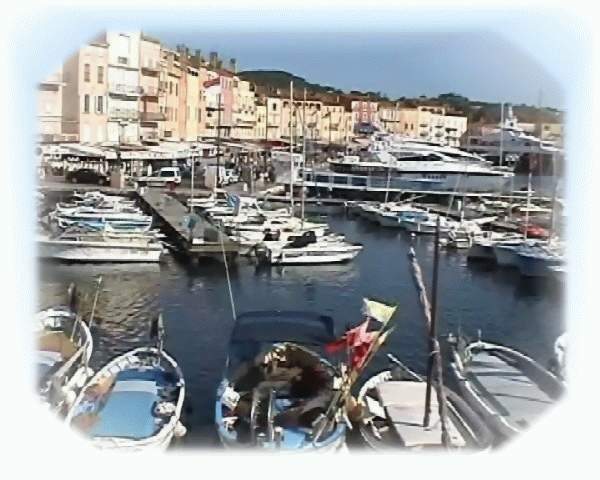 OK, we all
know that charts are a waste of time, and the current account story
that is driving the dollar weaker is all papers seem to focus on these
days. For all dollar bears I suggest a trip to Europe where prices in
Paris (expensive), Rome (very expensive) and St. Tropez (super
expensive) compared to anywhere in the US exist. It is almost
impossible to believe that the Dollar can go beyond $1.30/Euro when one
is now paying an average of $10 for a beer, $75 per head for a meal
$500 for hotel room - where the service is not great and the quality of
everything is far behind the average US hotel. I went to a fairly well
known club in St. Tropez where any drink (even a water) was $31. So
hotel, food and drink are way overpriced compared to New York (which is
overpriced compared to the rest of US). What about fashion? Isn't the
clothing one of the reasons people visit Italy? This was the most
disappointing part of the trip, where all the fashion houses are so
globalised that prices in France and Italy are the same everywhere and
even the Italian fashion houses are expensive and so homogenous that
all the stores have the same products. In fact the most interesting
labels are now non-European like
Ed Hardy/a>,
DSquared,
etc. Make no mistake, Europe is a great tourist destination and
culturally fantastic but I am going to the Americas on my next vacation
it is far cheaper. I wonder how many others feel the same.
OK, we all
know that charts are a waste of time, and the current account story
that is driving the dollar weaker is all papers seem to focus on these
days. For all dollar bears I suggest a trip to Europe where prices in
Paris (expensive), Rome (very expensive) and St. Tropez (super
expensive) compared to anywhere in the US exist. It is almost
impossible to believe that the Dollar can go beyond $1.30/Euro when one
is now paying an average of $10 for a beer, $75 per head for a meal
$500 for hotel room - where the service is not great and the quality of
everything is far behind the average US hotel. I went to a fairly well
known club in St. Tropez where any drink (even a water) was $31. So
hotel, food and drink are way overpriced compared to New York (which is
overpriced compared to the rest of US). What about fashion? Isn't the
clothing one of the reasons people visit Italy? This was the most
disappointing part of the trip, where all the fashion houses are so
globalised that prices in France and Italy are the same everywhere and
even the Italian fashion houses are expensive and so homogenous that
all the stores have the same products. In fact the most interesting
labels are now non-European like
Ed Hardy/a>,
DSquared,
etc. Make no mistake, Europe is a great tourist destination and
culturally fantastic but I am going to the Americas on my next vacation
it is far cheaper. I wonder how many others feel the same.
Seasonals, by Victor
NiederhofferIn response to Rod Fitzsimmons Frey's June
7, 2006 post on seasonality and Fourier Analysis
The 21-day cyclicality you found is caused by options
expiration, there being on average 21 trading days in a month. For an
illustration, look at the open interest:
One of the best ways to create a surrogate or
smoothed data set is to analyze the data series for cyclic behavior,
find the best fitting cycles and put them together. The magenta line
below is a composite of the 10 most dominant cycles that can be
obtained from the dataset using Fourier Analysis.
This cyclic behavior is an excellent way to fit past
data. Furthermore, since one has the formulae for their construction,
those formulae can be used to produce a cyclic prediction. But just
because you can do something, does not mean that you should do it.
Although FA can be used to generate a prediction, that prediction has
no reliability. Many other smoothers are not good predictors either;
it's just that most people believe that the past cycles will be
repetitive. The Chair might have a horse racing parallel. Chiefly, the
cyclic values are not stable/constant over time. That is, if you
cyclically analyze N days through the most recent Monday, and then
analyze an identical number of N days through Tuesday, the entire fit
of Tuesday values will be different from the entire fit of Monday
values. Thoroughly revisionist history. Contrast that with what happens
if you smooth with other tools like (perish the thought) moving
averages. -- Bill Rafter
Year January Rest of Year
2000 -75 -74
2001 46 -218
2002 -18 -250
2003 -25 256
2004 20 80
2005 -30 67
22006 32 ? Thus, when a global macro fund manager recently
sent me some seasonals
showing that if you look at quarterly options expirations only, and
stop well before 2001 (when the
week after the September expirations the market rose 75 points), you
can come up with numbers showing the market has a tendency to go down
the week after quarterly expiration (always the third Friday of the
month). It would be amazing indeed if one weren't able to come up with
something of that
nature, considering you are varying the week (before, during or after),
the
quarterly or monthly, and the starting point, and if not the options
expirations, perhaps the bond auctions, or FOMC meetings, or G8
meetings. With this many degrees of freedom and multiple
comparisons, it's well over 99% that you'll be able to pick and choose
and find a week that in the last three years has gone down an average
of 1% with a 80% chance of a decline.
Such is guaranteed to happen, as Jimmy Cannonnnon
liked to say.
Thus, when a global macro fund manager recently
sent me some seasonals
showing that if you look at quarterly options expirations only, and
stop well before 2001 (when the
week after the September expirations the market rose 75 points), you
can come up with numbers showing the market has a tendency to go down
the week after quarterly expiration (always the third Friday of the
month). It would be amazing indeed if one weren't able to come up with
something of that
nature, considering you are varying the week (before, during or after),
the
quarterly or monthly, and the starting point, and if not the options
expirations, perhaps the bond auctions, or FOMC meetings, or G8
meetings. With this many degrees of freedom and multiple
comparisons, it's well over 99% that you'll be able to pick and choose
and find a week that in the last three years has gone down an average
of 1% with a 80% chance of a decline.
Such is guaranteed to happen, as Jimmy Cannonnnon
liked to say.Moves in S&P500 the Second Week Following Expiration
Year-end 2002 to present
Date of Close, first week Close, second Week Change
Friday after after Expiration after Expiration
Expiration
12 27 02 868 906 +38
03 28 03 905 922 +17
06 27 03 968 997 +29
09 26 03 991 1025 +34
12 26 03 1091 1118 +27
03 26 04 1105 1141 +36
06 25 04 1183 1173 -10
09 24 04 1113 1135 +22
12 23 04 1256 1259 + 3
03 20 05 1216 1218 + 2
06 24 05 1231 1236 + 5
09 23 05 1249 1263 +14
12 23 05 1286 1285 - 1
03 24 06 1313 1303 -10
06 23 06 1264 ? ?
Total +206It doesn't matter at all,
But all the same,
it's nice to know.
An 1869 View of
Passport Control, by Steve EllisonWhen the voyage was drawing to its end, a notice was
posted up outside of the saloon, to the effect that the Government of
the United States required every passenger to fill up a form with
particulars as to age, occupation, last legal residence, purpose in
visiting America, and as to whether or not this was the first visit.
Such an intimation took the majority by surprise. If it had emanated
from the despotic Government of Russia, or from the Government of the
police-ridden kingdom of Prussia, no surprise might have been
exhibited. Despots are fond of asking impertinent questions, and are
wont to act as if travellers ought to be placed in the same category as
the plague, and treated accordingly. While the war lasted, the
Government of the United States was justified in resorting to the
obnoxious passport system, and treating every stranger as a foe or a
spy in disguise. Happily, this excuse cannot be urged now that treason
has been extinguished and the Union has triumphed. The Americans on
board were as much puzzled and annoyed as the visitors to the land of
freedom. They used vigorous terms in characterising what was simply an
indefensible demand. They were the more angry because they knew that a
similar interference with liberty of action does not take place when a
steamer nears the coast of the United Kingdom, and they disliked the
comparison which could be drawn to the disadvantage of their own
country.
Fed Model Update, by
Tom Downing
Capital Allocation, by Dan Grossman
 I assume the main reason the
Soviet Union collapsed
economically, rather suddenly and mysteriously, after decades of
supposedly growing faster than, and catching up with, the US, was
massive
capital misallocation. In the first decades of the Soviet Union, its
government-planned (remember "five-year plans" ?) investments to
increase production of machine tools, and to basic industries such as
steel and hydroelectric power, were probably a reasonably sound
economic strategy for a
primitive economy to catch up to the US and Europe. But as the Soviet
economy and the world economy in general grew more complex, the
government investment misallocations became more and more costly and
inefficient.
I assume the main reason the
Soviet Union collapsed
economically, rather suddenly and mysteriously, after decades of
supposedly growing faster than, and catching up with, the US, was
massive
capital misallocation. In the first decades of the Soviet Union, its
government-planned (remember "five-year plans" ?) investments to
increase production of machine tools, and to basic industries such as
steel and hydroelectric power, were probably a reasonably sound
economic strategy for a
primitive economy to catch up to the US and Europe. But as the Soviet
economy and the world economy in general grew more complex, the
government investment misallocations became more and more costly and
inefficient.
One of the great, if not the greatest, advantage of a free market economy over a government planned one is more efficient capital allocation resulting from the decisions of millions of businesses and individuals. But if this is true, why is China (hardly a free-market economy when it comes to capital) able to grow so much faster than the US for so many years? Are the Chinese numbers masking major misallocations that will sink their economy as well? Are they able to keep things going longer than the Soviet Union simply because they are a little more skillful, and significantly more free market, than the Soviets were? But unless they convert to a true free market, and a bottom-up rather than top-down capital allocation, will the result be the same? If capital allocation is so important, I would think so.
 Turning to US public companies, where is the
analysis of which
companies are allocating their capital better than others? The Sage is,
deservedly, much criticized on this site. But his advantage at
Berkshire Hathaway seems to be mostly capital allocation. When I went
to
Lewistown,
Pennsylvania, for the birth of Aubrey, Vic took me on my
first visit
to a Dairy Queen. It was a complete slum. Obviously no capital had been
invested in it since the 1950s or 60s.
Turning to US public companies, where is the
analysis of which
companies are allocating their capital better than others? The Sage is,
deservedly, much criticized on this site. But his advantage at
Berkshire Hathaway seems to be mostly capital allocation. When I went
to
Lewistown,
Pennsylvania, for the birth of Aubrey, Vic took me on my
first visit
to a Dairy Queen. It was a complete slum. Obviously no capital had been
invested in it since the 1950s or 60s.
If Dairy Queen had been a separate public company, or a division of a normal company striving for a high-class image, it would have been allocating investment capital every few years to update, refurbish and freshen its locations. No usual CEO would want to preside over 30,000 dirty, unpleasant ice cream/hamburger parlors. But the Sage is happy to milk Dairy Queen as a cash cow and invest all the cash flow in his insurance operation or in acquiring similarly old-fashioned cash-generating companies of the type the Specs hate. (I realize the Lewistown location may be a franchise. But I believe the analysis of company-owned Dairy Queens would be much the same.)
Public companies use return-on-investment analysis to justify their investments. But anyone who has ever been witness to such an investment analysis knows the numbers are most often unscientific projections used to justify what company management wants to invest in. And companies are supposed to pay higher dividends and buy back stock when they do not have opportunities sufficiently attractive to justify investment of their cash flow. But then a single large acquisition, whether for cash or stock, can override years of supposedly more rational capital allocation.
If capital allocation is important, where and how do we analyze which companies are better at it?
David Baccile replies:
The Quest For Value by Bennett Stewart is a classic in the field of return on investment analysis, and more recently Alfred Rappaport and Michael Mauboussin wrote Expectations Investing. These are excellent texts and I am sure someone of Mr. Grossman's experience in the field is already familiar with them.
Steve Ellison replies:
 Microsoft at one point had
$56 billion in cash. The company has invested billions in MSN, XBox,
and other businesses that have yet to prove themselves to be good
returns on investment. Giant corporations often misallocate capital for
several reasons. Large "competition-free" zones often exist within
these companies, creating complacency among employees and an
environment in which ideas are not subjected to the type of brutal
competition that an entrepreneur would face. After the entrepreneurial
founders depart, hired management is often risk-averse. Large companies
also find it much more profitable in the short term to cater to their
existing customers than to develop breakthrough innovations that would
take years to grow to even $1 billion in revenue, as documented by Clayton
Christensen in The
Innovator's Dilemma. The focus on existing customers
guarantees that breakthrough innovations that create billions of value
generally come from smaller companies or start-ups.
Microsoft at one point had
$56 billion in cash. The company has invested billions in MSN, XBox,
and other businesses that have yet to prove themselves to be good
returns on investment. Giant corporations often misallocate capital for
several reasons. Large "competition-free" zones often exist within
these companies, creating complacency among employees and an
environment in which ideas are not subjected to the type of brutal
competition that an entrepreneur would face. After the entrepreneurial
founders depart, hired management is often risk-averse. Large companies
also find it much more profitable in the short term to cater to their
existing customers than to develop breakthrough innovations that would
take years to grow to even $1 billion in revenue, as documented by Clayton
Christensen in The
Innovator's Dilemma. The focus on existing customers
guarantees that breakthrough innovations that create billions of value
generally come from smaller companies or start-ups.
26-Jun-2006
The Right Tool for
the Job, by James Sogi
 Compliance
with social norms is encouraged.
Kids all have to wear hip huggers. Businessmen wear suits. People want
to fit in. Contrary thinkers are shunned. In the markets, people want
to be part of the crowd, follow the trend. Few want to buck the trend,
disagree, stand out. While this is fine in Cincinnati, it leads to
losses in the markets. The market goddess has a way of training
operators. She might give you a few tidbits, and get you feeling pretty
good. You think, gee, I'm so smart, I'm so good. It must be my skill.
So you keep doing the same thing. Then the market changes, and you
realize that it was not your skill or how smart you were, but it was
luck. What you were doing was lucky to fit what the market was doing.
Given the law of everchanging cycles, it has to be like that. What
worked in one cycle, cannot work in a different cycle. The question is
when is the cycle changing.
Compliance
with social norms is encouraged.
Kids all have to wear hip huggers. Businessmen wear suits. People want
to fit in. Contrary thinkers are shunned. In the markets, people want
to be part of the crowd, follow the trend. Few want to buck the trend,
disagree, stand out. While this is fine in Cincinnati, it leads to
losses in the markets. The market goddess has a way of training
operators. She might give you a few tidbits, and get you feeling pretty
good. You think, gee, I'm so smart, I'm so good. It must be my skill.
So you keep doing the same thing. Then the market changes, and you
realize that it was not your skill or how smart you were, but it was
luck. What you were doing was lucky to fit what the market was doing.
Given the law of everchanging cycles, it has to be like that. What
worked in one cycle, cannot work in a different cycle. The question is
when is the cycle changing.
My friend Tai has an 8,000 square foot shop filled with hundreds and hundreds of tools. A tool for dados, a tool to snip metal, a tool to sand inside corners, a tool to do every little different job perfectly. The market has a million little jobs to do. Each one requires different tool. What you do not want is a really good hammer. When everything starts looking like a nail, trouble is ahead. There must be many different market tools for each little market job. The question is always: what is the right tool for the right job? The second question is: how do the tools work? You can really mess up a nice table with a big saw or hammer, or even a clumsily wielded piece of sandpaper, or the wrong weight sandpaper. There are dozens of different grades of sandpaper. Each stock must have its own tools. Each market has a whole different set of tools. Each cycle has a different set of tools. It takes time to hone each tool, learn to use it with skill. Whenever I work on a car, I strip the bolts, and its off to the shop to redo double the work. I never have the right tools. I try and use an adjustable wrench and< a vice grip for all the jobs. The results are predicable.
26-Jun-2006
Be Sure to Wear Some
Flowers in Your Hair, from Tom Marks
 On an empirical and localized note, San
Francisco is where spirited ideologues go to learn that the Revolution
isn't coming, nor should it. All the hippies from the fabled if foggy
60s have been pushed out by a huge wave of postmodern Bolsheviks, right
down to the "make podcasts, not war" bumper stickers on their
top-of-the-line BMWs. Hardly the unmistakable seeds of impending
anarchy. From my observations, the only politics these folks are truly
interested in is how to better jockey for a larger slice of the their
tech companies' IPOs. And there's nothing not martial about the tactics
employed. San Francisco is the most conservative liberal stronghold
I've ever come across. It's a function of the real estate values and
the considerable spoils. Everything else is an illusion born of a sense
to be fashionably correct.
On an empirical and localized note, San
Francisco is where spirited ideologues go to learn that the Revolution
isn't coming, nor should it. All the hippies from the fabled if foggy
60s have been pushed out by a huge wave of postmodern Bolsheviks, right
down to the "make podcasts, not war" bumper stickers on their
top-of-the-line BMWs. Hardly the unmistakable seeds of impending
anarchy. From my observations, the only politics these folks are truly
interested in is how to better jockey for a larger slice of the their
tech companies' IPOs. And there's nothing not martial about the tactics
employed. San Francisco is the most conservative liberal stronghold
I've ever come across. It's a function of the real estate values and
the considerable spoils. Everything else is an illusion born of a sense
to be fashionably correct.
Stefan Jovanovich responds:
 Top-of-the-line BMWs are a distinct minority in
San Francisco, and the
ideologues are entirely home grown. Even gays have stopped coming in
any numbers, now that the ravages of rent control have completely taken
hold.
Top-of-the-line BMWs are a distinct minority in
San Francisco, and the
ideologues are entirely home grown. Even gays have stopped coming in
any numbers, now that the ravages of rent control have completely taken
hold.
The city's liberalism comes not from tech company IPO money (most of which still resides in the 280 suburbs) but from the sources of employment. The three main employers in San Francisco are government, schools (government) and health care (also government, when you consider how much of the bills are paid by Medicare and Medical). In the 60s the city still had a steel fabrication industry, a printing industry, a garment industry and a shipping industry -- now all gone. Then, we had real live Communists and a Republican mayor. Now we have a "fairness" Socialist who has just budgeted the largest pay raise in the city's history, even as tax revenues continue to stagnate.
San Francisco is not America; it is Brussels with even worse football teams.
26-Jun-2006
Captain of His Own
Ship, by Steve Leslie
 Ten years ago the greatest
modern-day pitcher, and one
of the top pitchers in the history of baseball, was
diagnosed by his team to be past his prime and not
worth it financially to retain his services. He was in
the midst of a year of sub-par performance resulting
in a losing record for the season. Talks began to
circulate that since he was a power pitcher, perhaps it
would be best to trade him while he still had some
value, or let him sign with another team at
the end of the season rather than pay him a large
salary. This was fueled in part because of a comment
from the General Manager of the team stating that he
was in the twilight of his career and after all how
long would his arm hold out. All of this at the ripe old age of 33.
Ten years ago the greatest
modern-day pitcher, and one
of the top pitchers in the history of baseball, was
diagnosed by his team to be past his prime and not
worth it financially to retain his services. He was in
the midst of a year of sub-par performance resulting
in a losing record for the season. Talks began to
circulate that since he was a power pitcher, perhaps it
would be best to trade him while he still had some
value, or let him sign with another team at
the end of the season rather than pay him a large
salary. This was fueled in part because of a comment
from the General Manager of the team stating that he
was in the twilight of his career and after all how
long would his arm hold out. All of this at the ripe old age of 33.
So after spending 13 seasons with the same team, providing Herculean results, he signs as a free agent with another team ,and what follows in 1997 is quite remarkable. He leads the league in wins with 21, in strikeouts with 292, and in ERA with 2.05, which was 2.5 runs less than the league average. This is the Triple Crown achievement for pitchers. Naturally he is voted winner of the Cy Young Award, which recognizes the top pitcher of the year. This is the fourth time he receives this prestigious award. Many will suggest that this was the highlight of his career.
 He didn't stop there. He
goes on to win three more Cy
Young Awards, and another Triple Crown in 1998, and is
traded to yet another team at the end of the 1998 season, in exchange
for three players,
Homer Bush, Graeme Lloyd and David Wells.
From there he wins two World Series Rings in 1999 and 2000.
He didn't stop there. He
goes on to win three more Cy
Young Awards, and another Triple Crown in 1998, and is
traded to yet another team at the end of the 1998 season, in exchange
for three players,
Homer Bush, Graeme Lloyd and David Wells.
From there he wins two World Series Rings in 1999 and 2000.
Now, at the age of 43, he is back in the Major Leagues pitching for his fourth team. He is currently one of only four pitchers to strike out more than 4000 batters in a career, and has appeared in 673 games, winning 341, with a career ERA of 3.02. His 341 wins is a record for any right-handed pitcher in the live-ball era, post 1920. Only Warren Spahn has more wins of any pitcher at 363. He also struck out 20 batters in a nine inning game. He accomplished that feat twice, the only person to do so.
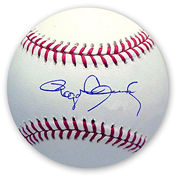
Who is this illustrious pitcher who was cast aside 10 years ago by a baseball team he loyally served for 13 years? Who refused to accept the criticism and "professional evaluation" of others? Who refused to have anyone other than he write his epitaph and chose instead to captain his own ship?
The pitcher is Roger Clemens. That's right, Roger "The Rocket" Clemens. Greatest modern day pitcher. A true legend in his own time. An icon of the game. Now you know the rest of the story.
25-Jun-2006
On Declines, by
Victor Niederhoffer
 There is considerable Sturm
und Drang concerning the market. The tension rose when the S&P
futures declined for a third week in a row, even while Europe and Asia
recovered. Investors Intelligence reported a draw
between bullish and bearish newsletters at 35.6% apiece, the lowest
differential since October 2002 when the S&P was 800.6 and
rallied 15% to 936 during the next two months. Just 34.4% of individual
investors are bullish, vs. 41.6% bearish. This raging bearishness comes
in conjunction with the longest-lived of all gloomy columnists, whose
absence at the front of the leading financial weekly has aroused much
speculation in recent months, who has been continuously bearish since
1964, when the Dow was 900.
There is considerable Sturm
und Drang concerning the market. The tension rose when the S&P
futures declined for a third week in a row, even while Europe and Asia
recovered. Investors Intelligence reported a draw
between bullish and bearish newsletters at 35.6% apiece, the lowest
differential since October 2002 when the S&P was 800.6 and
rallied 15% to 936 during the next two months. Just 34.4% of individual
investors are bullish, vs. 41.6% bearish. This raging bearishness comes
in conjunction with the longest-lived of all gloomy columnists, whose
absence at the front of the leading financial weekly has aroused much
speculation in recent months, who has been continuously bearish since
1964, when the Dow was 900.
Not since the publication of Practical Speculation in February 2003 when the S&P was preparing for a sustained rally after a three-year nosedive have so many been so bearish with such scorn and hope for disaster for buy-and-holders such as myself. (NB: Laurel and I sent the final proofs of PracSpec to the publisher in October 2002, when the S&P was at a low of 800.6.)
 Many streaks of bearishness
have blazed like comets against the iron-gray market sky, including
runs of down
opens, last half hours, down weeks in stocks, and runs without a rise
in bonds.
Under the circumstances, some proper counting of recent streaks seems
in order.
Many streaks of bearishness
have blazed like comets against the iron-gray market sky, including
runs of down
opens, last half hours, down weeks in stocks, and runs without a rise
in bonds.
Under the circumstances, some proper counting of recent streaks seems
in order.
Let's start with the recent spell as of June 23, 2006, of declines from 3:30 p.m. to close. It turns out that such declines as of the close give merely a temporary soporific to the forces of detritivism and are visited by highly bullish activities in the foreseeable futures. Rumors that longs have been forced to liquidate apparently fueled the flames. One turns next to what happens after five consecutive declines on the first day of the week, as follows:
Date Decline
5 22 06 -9
5 30 06 -23
6 05 06 -15
6 12 06 -16
6 19 06 -12
It's only happened 20 or so times that the first day has been down around this many times in the last 6 years, so the expectation of 1% the first day, with more the rest of the week, is just barely at the lines of statistical significance. One can't help note after seeing such a pattern that the run of down Fridays and Mondays has brought back many pleasant memories of my former partner Frank Cross, who jointly discovered the Friday down, Monday down relation with me, with a z of -10 or so, back to 1900 through 1975, with a cumulative loss of following it subsequently of thousands and thousands of times on your futures shorts. I also note a run of exactly three declines in a week in the averages as follows:
 Date of Move next week 2d week 3rd week
4th wk 10 21 05 1.3 1.8 1.3
 0.5 3 20 05 0.2 0.5 -3.3
 1.1 1 21 05 0.5 2.2 0.4
-0.4 0 22 04 3.0 3.2 1.2
-0.1 7 23 04 -0.5 1.4 -3.2
 1.1 5 21 04 2.4 0.3 1.2
-0.2 3 26 04 3.1 -0.2 -0.5
 0.5 2 07 03 -2.7 0.8 1.1
 0.7 9 13 02 -5.3 -1.9 -2.3
-3.9 6 07 02 -1.8 -1.7 -0.2
-7.2 4 23 02 -1.1 1.3 -5.0
 0.1 2 16 01 -4.2 -1.0 -4.2
-0.1 11 24 01 -1.8 1.2 -2.2
 0.1 9 22 01 -1.0 -1.0 -1.7
-2.7 5 19 01 -2.2 6.3 -1.0
 0.2 2 25 00 4.9 0.7 4.6
 4.1 9 24 99 0.3 3.6 -5.9
 3.5 8 06 99 1.7 0.5 0.7
 0.7 5 28 99 2.2 -2.2 3.2
-1.8 8 07 98 -2.4 1.9 -4.2
-4.3 12 26 97 3.2 -4.4 3.3
 0.3 10 31 97 0.6 0.1 3.1
-1.1 3 28 97 -1.2 -2.3 3.1
 0.1 7 19 96 -0.6 -0.3 3.0
-0.4 6 24 94 0.6 0.4 0.6
-0.1 1 08 93 0.9 0.0 0.2
 1.4 10 09 92 1.0 0.4 0.5
-0.1 6 19 92 -0.0 1.1 0.4
-0.1 9 22 90 2.2 -3.6 3.2
-1.9 8 17 90 -4.0 2.6 0.3
-2.1 totals 0 11 0
-12
What can you say with a study like this except that there was a period of eight consecutive times that the next week was a decline, and the rest of the period was reversal-prone?
Other interesting counting questions are the run of seven days in a row without a rise in the bond futures, and the run of three consecutive down opens in stocks.
Perhaps such counting will be of interest to those who wish to build a foundation for meals for a lifetime.
25-Jun-2006
Quote of the Day,
from Dale Irwin:
The weak are the most treacherous of us all. They come to the strong and drain them. They are bottomless. They are insatiable. They are always parched and bitter. They are everyone's concern, and like vampires they suck out life's blood.
Do you think this is true? Do you know who said it?
25-Jun-2006
Hedge Funds:
Corruptors of Youth?, by Dr. Kim Zussman
While not surprising, it is possibly diagnostic that many of the best/brightest are chemotactically attracted to recent financial fad-hedge funds. Back in the 1980's, I knew a number of lads trained in astronomy, astrophysics, or physics who accelerated toward the glamour and panache of star-wars research in lieu of observatory work.
Further back it was the Manhattan Project.
The problem with this approach is that the demand fuelling the attraction eventually subsides. The wall fell, and Japan surrendered. Is it possible that scientists usually deployed in weapons research, now lieutenants in financial wars, speaks not only about the nature of fads, but also the changing nature of warfare?
24-Jun-2006
Applications of the
Bass Diffusion Model, by Victor Niederhoffer
 One of the hot topics in marketing these days is
applications of diffusion models to help in predicting and stocking new
products. The Bass diffusion model, developed by F. M. Bass in 1969,
is used especially for products such as videos and new electronics,
where the
customers can be segmented meaningfully into two groups, one who like
new things and are called the innovators, and the other who like to
watch what others do
and buy based on how many other people are buying.
This
paper by Philip Hans Franses (200k pdf) is a good review. The
practical solution to the Bass model is to estimate a hazard rate for
the chances of the target audience
buying the products, similar to the SSRN model used in epidemics and
discussed
here before, as equal to two parameters one based on the hazard rate
for
innovators, and one for the imitators. In practice this is estimated by
a
regression of the expected number of adopters in one period based on
the
cumulative level of adoptions and its square up to that period. An
alternate
method is to estimate the two hazard rates with simulation and see
which fits
the observed sales level best.
One of the hot topics in marketing these days is
applications of diffusion models to help in predicting and stocking new
products. The Bass diffusion model, developed by F. M. Bass in 1969,
is used especially for products such as videos and new electronics,
where the
customers can be segmented meaningfully into two groups, one who like
new things and are called the innovators, and the other who like to
watch what others do
and buy based on how many other people are buying.
This
paper by Philip Hans Franses (200k pdf) is a good review. The
practical solution to the Bass model is to estimate a hazard rate for
the chances of the target audience
buying the products, similar to the SSRN model used in epidemics and
discussed
here before, as equal to two parameters one based on the hazard rate
for
innovators, and one for the imitators. In practice this is estimated by
a
regression of the expected number of adopters in one period based on
the
cumulative level of adoptions and its square up to that period. An
alternate
method is to estimate the two hazard rates with simulation and see
which fits
the observed sales level best.
An obvious application of the Bass model to markets is to predict the growth of IPOs, and rapidly growing companies thru applications of the Bass model. What strikes me as perhaps more intriguing is to look at the movements of prices from one level to another as the outcome of the activities of innovators and imitators. How long does it take for the innovators to get from one price level to another. And then what add-on effect is produced by the imitators. What is the likely level at which the usual sigmoid curve of growth could be expected to reach an asymptote. The time unit of consideration could be days in a week or time to reach each price during say a day.
This is a good project for someone wishing to look at movements in prices in a way that's not standard, and I will report a few results on this subject in the near future I encourage all to consider the application of new product diffusion models to markets and recommend the paper An Examination of New Product Diffusion Models by Jean-Pierre Van de Capelle and study of this graph of the last two days' intraday prices in the averages as grist for the mill.

24-Jun-20062006
Dr.
Kim Zussman: FDR
FDR stands for "False Discovery Rate", a statistical method to adjust for the role of luck in genetics and sports team streaks. In this paper, FDR is used to look for true alpha beyond lucky streaks in stock mutual funds:
They find that luck severely influences historic performance (whereas 8% of growth and income funds have positive conventional alpha, adjusting for FDR changes this to 0%), and that removing effects of luck most severely effects the lower performance tail (many more funds have truly negative alpha than truly positive, which might be expected in light of fund fees). Using FDR, 20% of funds have negative alpha, and 1.9% are positive, and the authors conclude that historic poor performance of active management is attributable to the negative alpha group.
Another way to look at this is from the perspective of an individual investor: Indexing in its many forms proved superior in the past due to negative active alpha and management fees, and the effect is even worse when adjusting for luck. What is the chance that individuals can pick stocks even as well as highly incentivized pros, who on average blow it completely?
Of course another interesting application of FDR would be hedge funds and CTAs.
24-Jun-2006
Models in Finance,
from Vince Fulco
There is a beautiful mention of the raison detre for models grounded in the scientific method in the article "Making Money From Mathematical Models" by David Harding (pp. 61-65) found in Mathematical Models in Finance edited by Howison, Kelly & Wilmot:
I have stressed that a theory or model is scientifically valueless unless it is capable of making empirically falsifiable predictions. In economics and the study of markets there can be no more incorruptible measure of utility than profit accrued by arbitraging predictions of a model against the common view (the market). The quest to "beat the market" is thus more than a venal desire for money or an egotistical desire to win, it is also a means of obtaining the most ruthlessly honest evaluation of the scientific utility of a model and method.
24-Jun-2006
Goats, from Dan
Grossman
Here"s an interesting company that produces therapeutic human proteins (i.e., biotech drugs) through the expression of the human gene in the milk of goats. The appropriate human gene is spliced into the fertilized egg of the goat so that the protein is produced in the adult"s milk. The protein in then separated out of the milk for therapeutic use. This turns out to be more efficient and cheaper than the usual biotech methods of producing the protein.
24-Jun-2006
Timing Commodities, by
Dr.
Kim Zussman
The paper here use information in the the Committment of Traders (COT) report to create "dynamically managed strategies" which "exhibit superior out-of-sample performance".
Alston Mabry responds:
This article grabs one's attention because (1) it's relatively short, and (2) the authors make intriguing assertions about the predictive abilities of their model.
From the paper:
We focus on the information contained in the "Commitment of Traders (COT)" report, published by the CFTC. This report summarizes the size and direction of the positions taken by different types of traders in different markets. Our findings indicate that there is indeed significant informational content in this report, which can be exploited by an active portfolio manager. Our dynamically managed strategies exhibit superior out-of-sample performance, achieving Sharpe ratios in excess of 1.0 and annualized alphas relative to the S&P 500 of around 15%.
The authors develop a model that creates a portfolio which is a time-varying mix of the S&P 500, a 1-month CD rate (as the risk-free asset), and the commodities, oil and copper. They then test this model "out of sample" over a period and sub-period: May 2000 - May 2006, in which the S&P was essentially flat, and May 2002 - May 2006, when the S&P was marginally up ("marginally" compared to the big moves in oil and copper). During both periods oil and copper saw very large gains. The authors" conclusion is that their model beat the S&P.
Perhaps the Sharpe ratio in excess of 1 is the key issue here, because it seems obvious to say that over time period T, during which index S was essentially flat, a mix of S plus booming assets O & C beat S alone. In fact, for the overall period May 2000 - May 2006, the CD-rate beat the S&P all by itself (though with a Sharpe ratio of zero or less).
In Figure 3, Panel A, the authors show the graph of their portfolio against the S&P during the period May 2002 - May 2006. It appears the model portfolio returned about 100% over this time period. If one creates an alternative portfolio that is long 25% S&P, 25% oil, 25% copper and 25% "risk-free" CD (at approx .02% per week), this alternative portfolio returned 120% over the same time period,
However, the authors state that the question is not simply whether money could be made by investing in commodities during the time period under study:
Our results imply that the CFTC data can be used to construct reliable signals that tell a portfolio manager when to switch from equities into commodities and vice-versa. In particular, even when we estimate our model only until early 2000, the resulting strategy successfully exits the equity market in mid-2000 (just before the collapse of the dot.com bubble), and increases its exposure to commodities. Similarly, while our strategies ride part of the commodities boom, they remain conservative, and in particular trade out of commodities before the crash of May 2006. In summary, the question we address here is not, "could you have made money if you had been invested in commodities in the period from 2002 until the end of 2005?" but rather "could you have known when to get into commodities and when to get out?" With the benefit of hindsight, the answer to the former question is of course "yes," our results provide an affirmative answer even to the second question.
The first claim is that the model gives signals "that tell a portfolio manager when to switch from equities into commodities and vice-versa". The supporting instance given is that "the resulting strategy successfully exits the equity market in mid-2000". Looking at the Figure 3, Panel B1, one sees that for the 2002-2006 time period, the model allocated to the S&P only during (approximately) Q2 2003, Q4 2004, Q2 2005 and Q4 2005-Q1 2006.
So, the model did not like being in the S&P, and missed large moves in H2 2002 and also H2 2003-H1 2004, when the S&P was up over 20%. In its defense, the model weighted oil and copper heavily during the period H2 2003-H1 2004, and that period is when the model had its steepest increase.
The authors state, "while our strategies ride part of the commodities boom, they remain conservative, and in particular trade out of commodities before the "crash" of May 2006." Well, yes, in a sense: The model drops out of copper almost entirely by mid-2004, and decreases the oil position to nil by mid-2005. From May 2004 through May 2006, oil was up about 90% and copper about 240%, so the model misses the biggest part of the commodities boom. And to say that the model avoids the May 2006 "crash" by pulling out of commodities 1-2 years ahead of time might be considered a stretch.
The central claim of the authors is that the model generates "signals that tell a portfolio manager when to switch from equities into commodities and vice-versa". One could argue that the model provided such signals in 2002 to early-2004, but failed significantly mid-2004 to 2006. (Perhaps the form moved away from the model some time in 2004.)
Also, one could argue that the S&P is not an appropriate benchmark, compared to a long 25%/25%/25%/25% allocation among the four assets. Such an allocation produced a return greater than the model, though possibly with more volatility and a lower Sharpe ratio.
24-Jun-2006
The Mother Tongue,
from GM
Nigel Davies
The comedy Clockwise with John Cleese features a headmaster who turned his life around by learning not to be late. But under pressure (and on the verge of his greatest achievement) his rigid discipline (and life) starts to fall apart.
I think there's an important lesson here. Observation has led me to believe that abilities learned relatively late in life are vulnerabilities, just waiting for pressure to appear before they become brittle. On the other hand our 'innate' strengths tend to persist through thick and thin.
There are many examples of this in chess. The openings we learn first are always the most natural and it's known that players who learn the moves early tend to make fewer blunders. Chess is their mother tongue and they're never at a loss for an appropriate expression.
For this reason I think it's important that we tailor our game plan in whichever endeavor we pursue, to fit with our 'innate' (early learned) strengths rather than the ones acquired with great effort. And the same thought increases the importance of starting our kids on the right track.
24-Jun-2006
Presumably these images can be used as blueprints to make a
working model, in order to decipher what the ancients were attempting
to model. The mechanism's complexity speaks of an enduring quest to
replicate and understand the universe, even at a time when there were
only unenlightened pagans. George Zachar responds: What I found interesting about this discovery is that it calls
into question the the standard historical narrative of
Copernicus' "discovery" of the heliocentric nature of the
solar system. That parallels the now-accepted notion that the first
Europeans to "discover" the Americas were not Spaniards led by Columbus
in 1492, but were Vikings ruled by Eric the Red or his
contemporaries around 1000. Henry McGilton responds: Interesting comments in Cod
by Mark Kurlansky (somewhat paraphrased): 23-Jun-2006 You must learn to allow patience and stillness to take
over from anxiety and frantic activity. The good
player is patient. He is observant controlling his
patience and organizing his composure. When he see an
opportunity he explodes -- martial artist Jim Lau
quoted by Joe Hyams in Zen in
the Martial Arts.
Very few games events or sports work this way with the
winner being the one who withdraws from the activity
at the appropriate time. Nobody goes to a casino and
says I am only going to play a few hands, or I am
going to get into a card game so I can fold for three or four
hours. We never think of a Mississippi gambler as sitting at a table
for a whole evening and winning one
big hand. But in order to be successful, that is
exactly what you will have to do to win at the game.
There will be times when others get to play and you
don't. And seemingly they are winning a lot of pots.
Although it appears on the surface that nothing is
going your way , realize that beneath the surface
activity is bubbling. Like lava in a dormant volcano. It is only a
matter of time, until the cards get
sorted out, and then you can explode and take down the
big hand. It will happen it just takes time./p>
TThe same can be said of trading. Inaction can be your
weapon of choice here. Most of trading should be
observing . Watching and waiting. Reading and
researching. Counting and charting. until you find
that proper position to enter. The one in your view
that has the greatest opportunity for success. Most of
the traits that are critical for success but run
contra-trend to that of a trader.
Unfortunately, the events that give you the greatest
chance for success are rare there just aren't that
many great stocks, or events that you can exploit. And
there can be great spaces in between events.
Understand this and embrace this and work at doing
nothing. Come prepared and relaxed and alert./p>
When
things do happen and everything aligns in your
favor, you will have the capital rested and at hand
ready to exploit the situation.
Believe me it will pay off handsomely in the long run. Which is what
all traders should be about and that is
the long run. GM Nigel Davies
responds: There are some nice parallels with chess here. One of the
distinguishing features of professional chess players is that they
often seem to do very little, keeping their position flexible until
there's a good opportunity to strike. Weaker players tend to rush in
with a one-sided plan, even if it's unsound. Bronstein opined that the goal in chess was to 'make a
combination', but implicit in this view is the idea that it usually
isn't easy to find the right moment! He'd probably say that the goal in
trading was to 'place a trade'. Tarrasch meanwhile advised that you
should 'sit on your hands'. Marlowe Cassetti adds: On the topic of wagering, or, the euphemistic gaming,
for many years I have
followed political forecasting via the TradeSports site.
Somehow the
people who put their money where their mouth is are pretty good at
picking
election results. The current line is Republicans keeping control of
the
Senate 80.4/81.7 (bid/ask) and control of the House 51.1/51.5
(bid/ask). Stay tuned
to see how the results change as the open interest expands. 23-Jun-2006 A jerk is a know-it-all who doesn't know what he is talking
about.
They are able to carve a wide path through the serenity in your lives,
because
you are so aghast, dumbfounded, and appalled by their outrageous
behavior.
Recognizing a jerk is the first step to removing
them from your life.
Instead of reacting assertively, you stand
transfixed, like a deer in the
headlights of a car. It takes almost all your self-restraint to keep
your cool
in the face of their audacity, which is why it is so difficult to "just
say no"
to jerks. They are the opposite of a mensch. The Jerk
Checklist: A mensch is an everyday saint. These are the people most of us
wish we could
be. If you're lucky, you may have one grace your life.
A mensch is not just a human being, but a humane
being. Without being a
Pollyanna, these people manage to be positive, optimistic, and generous
in
their thoughts and deeds towards others. Menschen leave the world
better than
they found it, whereas jerks leave the world better by leaving it.
The Mensch Checklist: 23-Jun-2006 See Lifehacker
for the full article. An excerpt:
23-Jun-2006
Their speed and efficiency isn't a coincidence. When I reach
the
pick-up window, I can see their whiteboard inside, where they post
statistics on the speed of their drive-through service, and often the
results of contests that they hold to set drive-through speed records.
Today the whiteboard was celebrating a new record: 139 cars during
the noon to 1pm lunch hour rush. That's an average of 25.9 seconds
per car, and yes, they probably do track the decimal. I was thinking about what this kind of speed means. It doesn't
mean
that it would take just 25.9 seconds if I were the only car there,
because part of their speed results from their parallel processing of
cars. There's an order window, a window to pay, and a window to
collect food, and at any given time, all three windows are occupied.
It does mean, though, that if I arrive at McDonald's and see that I'm
the 5'th car in line, then the waiting time that I should expect is
5*26 = 130 seconds. Not too shabby! I think they've made 1 mistake
out of literally hundreds of my morning visits; in that case they
misheard me, and I was probably mumbling (I'm a former professor). 22-Jun-2006
You get three eggs (any way you want them), three pieces of
meat (I get three
sausage patties), a 1/2 order of biscuits and gravy, an order of hash
browns, two pieces of toast, and a big glass of orange juice (which
they'll gladly re-fill at no charge) for $6.95. I simply can't eat it
all. I get a "to-go" box and finish up the other half of the meal for
lunch!/p>
With tax and tip, you get out of there for nine dollars, for
what works out to
be, essentially, two meals!
Some things are still pretty inexpensive in small town America!
But the effects of inflation are there in other ways. These small
towns are literally dying.
The best and the brightest leave for greener pastures. The farmers are
being choked out because you simply can't make a living on a 500 acre
farm (and that's a big farm in that area). The ones who stay are the ones who simply don't have many
other
choices. So you end up with an area of that has an overabundance of
people that are simply not "capable". Not capable to do much so solve
their plight in life. Not capable enough to see that their way of life
is dying. And even if they could, they are not capable enough to come
up with a solution to solving that problem.
That capable people are all out buying their food at IHOP (in the
cities) or they're buying up the land that the farmers can no
longer make a living off of. Greetings from the
heartland, Highmore SD.
The post by Scott Brooks was so well
written and tells a tale of our life in
rural communities and small towns. Our heritage is a culture within a
culture. Of course, there is more to the
story. Visiting our area is a treat, just like visiting New York, Kansas
City,
Omaha, or Las Vegas is for us. You are
moved back in time to a slower, richer pace. Some of our best and
brightest do move to brighter lights. Not true
of all. Many of our farmers and ranchers are college grads and run
operations that rival the financing and net
worth of many mid-size businesses. There are those in our midst that
invest in the stock market or trade a good
number of futures contracts, hedging their grain and livestock or
buying
for their needs. Our middle school
and high schoolers attend classes in brand new school house. We are
presently raising money to refurbish our
local swimming pool. Some of our streets are not paved, but we are
charmed by gravel roads!
Other truths are self-evident. This is the greatest place in the world
to raise children. Having said that, we have
our own problems with drugs and alcohol. There is precious little new
building in this area, so the old is
maintained and repaired. We boast about the same number of bars as we
have places of worship! Our
towns are just barely holding their own, like the bottom of any chart.
Maybe we are just on the edge of a big,
new surge of growth that is hidden from view. Come visit sometime, our
homes and hearts are always open. Dr.
Kim Zussman says: Investment thesis would be to send daughters to college in
Midwest so
they hook up and marry there. Once the grandbabies come poppin', sell
pricey coast-state homes and businesses and equity emigrate to Branson,
MO to live like a Tsar. (two-bedroom condos around here recently going
for $500k) And, speaking of rare treats, anyone know where to get some
bear meat?
David Higgs replies: Jeff Guimeny's Howard's Grove Meat Market, 211 South Wisconsin
Dr., Sheboygan, WI 53083. Jeff's makes bear sausage for Ted Nugent.
Hmmmm, Hmmmm... Good! 22-Jun-2006 When you feel under attack, be it from outside, or from your
insecurity inside, try counting to three as follows: Think of the first thing you want to say and don't say it,
pause and then
think of second thing you want to say and don't say that, pause again
and
finally think of the third thing you want to say and do say that. The
first
thing you want to say is about defending yourself. The second thing is
about
retaliating. The third thing is about finding a solution. 22-Jun-2006 Hysteresis:
Sir
James Alfred Ewing has given the name of Hysteresis to the
subject of the lag
of magnetic effects behind their causes. He has shown that under
constant
magnetizing force the magnetism will go on slowly and slightly
increasing for a
long time: this is called magnetic creeping or viscous hysteresis.
"There is a good deal of hysteresis, that is a time lag between the
cooling
and the setting to be expected of the jelly." A simple electronic
circuit that displays hysteresis is the Schmitt
trigger. II first came across the concept of
hysteresis when I did something very good
or very bad as a little boy and it took a long time for the
consequences of
that behavior to eventually manifest itself in the result. I next got
some
physical manifestation of it when I spent many years as an electronics
hobbyist
constructing all sorts of op amp circuits that had triggers and buffers
that led to a delayed but inevitable reaction of the output dampened by
negative
feedback from the input. The enclosed link to Schmitt triggers is one
that I
found particular pleasure with and helped me and my friend, Leon
Foreman, on the road to designing an
automatic toilet lid opener.
TThe hysteresical effect of the interest rates on stock
markets is a bit
more subtle now. It was all changed by the 1987 crash when stocks went
down 30%
or so in two days and interest rates dropped by a comparable amount.
Since that
time, the reaction has been much more convoluted and delayed. And the
movement
of bonds yields in mid May to above 5.0 % from 4.7 %, in conjunction
with the
gold and energy moves up was the Schmitt trigger that led to the
delayed
reaction of the 10% stock market decline.
The
hysteresisal effects are almost as inevitable as the
circuits I played
with with my op amps and I recommend going to your local electronics
store, and buying a couple of 8-volt batteries, a good op amp or two,
some resistors and
a capacitor or two for a good hands on ( Montessori like ) rendition of
what's
happening today as first Europe goes up, then Asia stumbles, then the
US fails, then Asia goes up, then Europe goes up, then finally the
hysteresic effect of a nice rise in the US inevitably follows.
Henry Gifford adds: In the heating and cooling industry, "Hysteresis" is sometimes
used to
describe steadiness of a system, or fluctuation around a temperature
set point. (Or price point).
Setting the equipment for a small differential can, in theory,
make for more
accurate control, but it can also lead to "hunting" for the correct
temperature, resulting in overshooting and undershooting the setpoint.
Too
wide a differential can make for clumsy control too. The trick, as with
many
things, is to get it just right. The analogy to trading is too obvious for me to go on about. Henry McGilton notes: The
"laws" of hysteresis were derived by Charles
Steinmetz in the 1890s. These "laws" were really "rules of
thumb,"
derived by Steinmetz from tens of thousands of empirical
observations. While we all agree that Francis Galton and Francis Bacon are
historical
role models of those who observe and count, I have long felt that
Steinmetz goes unrecognized as a first-class empiricist. At the
time he derived the rules of thumb for hysteresis, there were no
mechanisms to even come close to explaining the effect -- from a
practical
engineering perspective, Steinmetz had derived equations to model the
behavior of magnetic materials in varying electric fields, but with
no theory to explain why magnetic materials behaved the way they did. A coherent explanation of hysteresis had to wait for the
emergence of magnetic domain theory sometime in the 1970s.
So I vote to place Steinmetz high in the ranks of the greatest
empiricists. John Lamberg mentions: While the original query relates to magnetic effects, it
brought to mind
some interesting properties of Teflon that electrical and mechanical
engineers learn the hard way. A quick search didn't uncover the
information I was looking for, but I found something better: Steve Ellison
comments: In the physical movement of goods, lags occur because moving
goods takes
time. In many manufacturing situations, dozens of parts must be on
site in order to build a product. If any one part is not present, the
build will be delayed. Therefore, any unexpected change in demand
results in material being in the wrong place relative to plans. This
effect occurs most obviously and dramatically when demand unexpectedly
goes up, but can also occur with stable demand when the mix of product
options or features shifts. Lags also occur because of prior imbalances and filtering of
information as it is disseminated. Firms that do not ship to end
users are at an information disadvantage because their perception of
demand is shaped primarily by their suppliers. Information from
suppliers is often biased by the suppliers' own needs. For example,
if consumer demand turns up for a product, but a firm has excess
inventory of the product, the firm's initial reaction is likely to be
relief that it might avoid an inventory write-off -- it will probably
not
communicate the increased demand to its suppliers. When it finally
does communicate a persistent upturn, the delay combined with the need
to reverse tactics will magnify the increase of supply it requests. A
10% increase in end user demand may result in a 30% increase in orders
to suppliers. The suppliers may do the same to their suppliers,
resulting in increasing oscillations that Hau Lee of Stanford calls
the bullwhip effect. Gary Rogan offers: By far the biggest use of hysteresis in electronics today is
to protect inputs
of digital chip from switching multiple times in the presence of noise.
Essentially all modern chips, such as microprocessors, have this
protection
built in. Once the chip "decides" that it needs to switch in a
particular
direction, a small noise spike will not cause it to switch back, thanks
to
hysteresis, thus providing some measure of noise immunity. This
contrasts
with the state of affairs at the dawn of the computer age when the
dominant
application was in "core" memories that relied on the magnetic
hysteresis to
remember 1's and 0's in each of the tiny magnetic toroidal rings called
"cores". Addendum: Hysteresis is everywhere. Once a politician announces a
position on some issue,
if he immediately reverses himself based on some minute amount of new
information he will be perceived as unstable and unreliable. Arguably,
Kerry
lost to Bush becasue he was successfully portrayed as lacking
hysteresis in his
decision-making. You don't want to vote for something and than vote
against it
too soon if you're a politician. Hysteresis is essentially shifting the decision point towards
the decision once
the decision has been made. It's a well-understood psychological
phenomenon
that human beings will tend to look for support for their decision once
it's
been made more than pure neutrality would call for. Hysteresis doesn't
have to
be symmetrical. Decisions made out of fear tend to shift the decision
point
more than decisions made out of hope. Perhaps that's why it's easier to
kill an
economy with interest rates than to restart it. 22-Jun-2006
It leads me to look at compression and
expansion in monthly moves.
Inspired by resilium and Dennis, I felt it might be apt to clear the
decks by doing a little counting to see if anything of relevance might
arise. I have done such counting since 1980 to ascertain what happens
in months following declines of 1.5 % or more in the S&P, when
that decline was
preceded by a rise. Here's an enumeration: What
conclusions can one draw? During the months following a
first decline of
1.5% or more, the chances of a rise are 72% and the average change is
1.3%
including the 22% decline which followed the Sept. 1987 decline of 2.4
%. During
the 90's there were about two such initial declines of 1.5 % or more a
year, and
35 of 37 were followed by rises. During the current decade of the
naughties,
there was a run of negative results with six of eight negative from
2000 to 2002. I see some market analogies to strategies employed by
bivalves in clamming up during such periods. Dr.
Kim Zussman adds: In addition, from a longer-term perspective, the mid '90s was
a period
of expansion of volatility moving to the late '90s. Though the
short-term correlation of stock return with volatility is strongly
negative, this was certainly not the case through the course of the
'90s. Of course that was back before little Al was inventing global
warming
and still putting finishing touches on ARPANET. Which inventor
can we turn to now to fire up hopeless investors about new new new
possibilities? Perhaps Mackey's conversion of wind to groceries? Even
this post proves such resources
exist outside Arab lands. Jun-22-2006 In case anyone should feel that they are "pikers," there are
much smaller
fish in the ocean of the world's markets. An article in WSJ talks about
Indian day traders who work in internet cafes where
you pay 25c an hour for web access. One guy has a profit target of $10
a
day. I would like to know what the transaction costs are, what brokers
they
use, etc. (and whether I can sign up for an account) 21-Jun-2006 BBefore the advent of computers and a single playing
session, games were adjourned after 40 moves so the
players could go for dinner. Sometimes they'd be
continued on a separate day, so tournaments could last
three weeks or more after the normal rounds, rest days and
days set aside for adjournments.
The early part of my career came at the back end of
the times when we still had adjournments, and I
remember the care with which positions had to be
analyzed. One had to expect that one's opponent would
find the most unpleasant moves with which to test you,
even more so than during the course of a normal game.
Cooperation was really the last thing to be expected,
or even a normal distribution of mistakes. Does this thinking have an application to markets? Perhaps it
does in terms of risk control. We continually deal with 'expected
outcomes', but what if we turn this around and consider the "worst"
that the
market can do to us. Imagine it is a malevolent beast
designed to exploit every point of vulnerability in
our game. Can one still win, get a draw or even just
survive? And what moves will one play to keep the game
going as the beast sets about taking our position apart? Perhaps my background in chess makes me rather too
paranoid to play markets in an optimal fashion, I go
into every game expecting a deadly, conscious and
adaptable opponent. There again, maybe there is some
merit in this way of looking at things from this perspective, if only
to be ready for the worst. 21-Jun-2006 I recently re-read chapter 10 of Victor's book
Education
of a Speculator. Under the heading is a quote that I feel is
pertinent to recent market movement and subsequent rhetoric.
Over 20 pages are devoted to this subject of deception. The
use of this tactic has been, and still is, constantly used by many, but
is effectively used by only a few. In my opinion, one of the many
reasons why Dr. Niederhoffer has been successful in trading is his use
of this device. I recently visited an "elite" financial markets chat site and
read a rather lengthy thread about Victor. Both sides fought it out for
hours it seemed. My question is: How in the world can anyone (with
exception of he who is sitting across the room from him) know how he is
trading? In email conversations with Victor, he has
graciously answered all of my ignorant and uneducated questions, which
visibly demonstrated his charitable character. With this said, what
makes me think that he would show me his hand? It is rather
presumptuous of anyone to assume that he would. What I am trying to say
is that Victor is sitting where he is because he is a master of his
art. I would be wise to sit and listen -- really try to listen -- to
what he is saying. 21-Jun-2006 Unlike poker, chess and even tennis, soccer is a game one
hardly uses in analogy to markets. But, since the World Cup in soccer
is on, I gave myself the liberty to study soccer and try to draw some
analogies with markets. In this case, I will analyze a small segment of
the game, namely the penalty shootouts.
I'll use France vs. Switzerland and France vs. Korea
to illustrate my point. I picked these two games since the French
players are said to be the most talented, most expensive in the soccer
world next to the Brazilians, and since they are playing against what
you could safely label much inferior teams in these two cases. At any
rate, the French ended a very sterile game with a 0-0 tie against the
Swiss who, although lacking in talent and experience, played a very
good defensive game. They also tied last week with Korea 1-1. All the
top teams in this World Cup displayed very disappointing performances.
Even when they won, they won by very narrow margins as in Brazil's 1-0
win over Croatia. It is unusual, since the teams should be more
cautious during the advanced stages of the Cup, not the preliminary
ones. This made me think that a team with a very strong defense and
a bit of luck could make the finals and easily win with a good penalty
shootout strategy, i.e. the chance that the weaker will score a win
against the better team is higher than you might think as demonstrated
by the final scores so far. In other words, many big matches can and
will come down to a penalty shootout and that's where the weaker team
has a perfect opportunity to heighten its chances. Given the importance of the shootouts, it is almost painful to
realize most coaches don't spend much time with their players to
perfect their technique and design elaborate strategies to win them.
It's not unusual to watch the coach caught totally off-guard after a
tied game and wondering whom to pick for the shoot-outs, and in extreme
cases wandering around asking for volunteers amongst the players. Skeptics might ask, is there such a thing as a penalty
shootout strategy? It's all luck, right? In fact, it is not. Penalty
shoot-outs occur when the game is still tied after final time. There
has been a lot of cases where the better team lost with the penalty
shots.. One very vivid (and painful) example is France Vs Germany in
1982 where France was the better team all around yet lost to the
Germans by the penalty kicks after a 3-3 tie. I remember this one in
particular as I had a substantial bet riding on it. I made all the
calculation possible to make the bet and was right throughout the whole
game as France was leading during the game, then again by 3-1 till the
last 5 minutes of the extra time. The one thing I left open in my
elaborate calculations is the penalty shots. So, like the coach above,
I was not prepared for the penalty shots as they are the exception not
the rule in most games. In the markets as the chair puts it: "as usual,
the unusual". It is the little extra effort and preparation that can
make all the difference in the soccer matches as well as in the
markets. What are the unusual events that the traders (like the coach
above) need to prepare for? In a market with an average annual drift of
10% year over year how can a trader be prepared for adversity similar
to the recent beating we are experiencing now.
Back to the penalty shots: Five players must take a
kick (only one kick / player). The coach has to decide which five
players to choose and which order to put the players in. Knowing that,
statistically, one in every four shots is missed, should the coach
start with his best player out of the five? In fact the correct answer
is to put them in reverse order of ability. So you actually save your
best player to the final kick since the stakes rise with every
shoot-out.
I argue that it is more important to be prepared to manage
your open positions than to just open a position. Any fool can press a
certain sequence of keys and open a position. What differentiates the
experienced from the amateurs is how well they manage the position
whether a losing or a winning one. Should one buy puts to hedge his
longs in down markets? should stops be used? Should you sell calendar
and credit spreads instead of outright naked positions to avoid total
wipe-outs? ts? A (not entirely scientific) study by British researches
suggests that heart attacks increased shortly after an England/
Argentina match that ended in a penalty shoot-out. they conclude that
in the interest of public health penalty shoots should be abandoned. Do
you feel the same kind of rush when your long positions gap down right
at the open. Researchers blaming public health on penalty shoot outs
are like Malaysian prime minister Mahatir's blaming the ruin of the
economy on those darn speculators. A field simulation of penalty shoots was designed. It
investigated the relative merits of approaching the penalty kick with
either a keeper-independent or keeper-dependent strategy. In the
keeper-independent strategy, the shooter selects a target location in
advance and disregards the goalkeeper's actions during the run-up. In
the keeper-dependent strategy, the shooter makes a decision resting on
the anticipation of the goalkeeper's movements during the run-up. Ten
intermediate-level soccer players shot at one of two visually specified
targets to the right and left side of the goal. In the
keeper-independent strategy condition, participants were told that the
visually specified target would not change. In the keeper-dependent
strategy condition, participants were told that in half of the trials
the visually specified target would change side at different times
before ball contact, indicating that the direction of the kick needed
to be altered. The results showed that penalty-taking performance was
apt to be less than perfect in the keeper-dependent strategy condition.
A decrease in the time available to alter kick direction resulted in a
higher risk of not only an incorrect but also inaccurate shot
placement. It is concluded that anticipating the goalkeeper's movements
may degrade penalty kick performance, mainly due to insufficient time
to modify the kicking action. Is it more advisable to buy a market regardless of which way
the media pundits and the permabears want you to lean? Is one more
prone to make judgment mistakes reading the newspapers and listening to
the so called "experts" than buying and selling strictly based on
science? This said, I believe the role of the speculator should be more
likened to the goalkeeper rather than the shooter. First, as in
speculation, the goalkeeper is starting off with a negative expectation
since most shooters score with penalty shots. The same as the trader.
However like the speculator, there are a lot of tricks the goal keeper
can use to enhance his odds. The shooter often give away some clues to which way he will
shoot the ball. The eyes, the approach, the movement of the hip, the
head, etc... The trader, like the goal keeper would do better off
studying correlation between different markets for clues. How a spike
in gold can give a warning signal for the stock market? What does a gap
down mean? Is it better to buy on up days or down days? Is the Nikkei a
pilot fish for the Dow? what about the Tadawul index? do they have
private information about natural resources that the rest of the world
doesn't have access to etc..? Much more importantly, it's been well researched and proved
that almost 70 to 80 % of the kicks taken went to the opposite side
from the kicker's dominant foot according to the DiCicco 2000, yet the
keepers choose to ignore all these clues over the years and jump
randomly one side or the other. In Triumph of the Optimists, the authors proved without
leaving a shadow of doubt that the markets have an upward drift over
the years. Yet, speculators still choose to short the stock market in
the face of this overwhelming upward drift disregarding the odds. The
most important lesson one learned from the chair is that markets have
an upward drift year in and year out and that the odds favor the long
side even (and specially) during unfavorable times like the last few
days. Ryan Carlson adds: Due to the increase in volatility and the greater
emphasis on certain economic releases, I've felt that
attempting to capture the immediate post-release move
presents itself much like a penalty kick situation in
soccer.
In the reading stack for my upcoming vacation is the
following paper "Testing
Mixed-Strategy Equilibria
When Players are Hereongeneous: The Case of Penalty
Kicks in Soccer." Perhaps
others here might find some interest in it as well.
Of course, trading data announcements is extremely
risky but technology has made it easier to capture
trades and add safeguards to limit risk.
24-Jun-2006 Here's
an interesting company that produces therapeutic human
proteins (i.e., biotech drugs) through the expression of the
human gene in the milk of goats. The appropriate human gene is
spliced into the fertilized egg of the goat so that the
protein is produced in the adult's milk. The protein in then
separated out of the milk for therapeutic use. This turns out
to be more efficient and cheaper than the usual biotech
methods of producing the protein.
24-Jun-2006 The paper
here use information in the the Committment of Traders
(COT) report to create "dynamically managed strategies" which
"exhibit superior out-of-sample performance". Alston Mabry responds: This article grabs one's attention because (1) it's
relatively short, and (2) the authors make intriguing
assertions about the predictive abilities of their model. From the paper: The authors develop a model that creates a portfolio which
is a time-varying mix of the S&P 500, a 1-month CD rate (as
the risk-free asset), and the commodities, oil and copper.
They then test this model "out of sample" over a period and
sub-period: May 2000 - May 2006, in which the S&P was
essentially flat, and May 2002 - May 2006, when the S&P was
marginally up ("marginally" compared to the big moves in oil
and copper). During both periods oil and copper saw very large
gains. The authors' conclusion is that their model beat the
S&P.
Perhaps the Sharpe ratio in excess of 1 is the key issue
here, because it seems obvious to say that over time period T,
during which index S was essentially flat, a mix of S plus
booming assets O & C beat S alone. In fact, for the overall
period May 2000 - May 2006, the CD-rate beat the S&P all by
itself (though with a Sharpe ratio of zero or less). In Figure 3, Panel A, the authors show the graph of their
portfolio against the S&P during the period May 2002 - May
2006. It appears the model portfolio returned about 100% over
this time period. If one creates an alternative portfolio that
is long 25% S&P, 25% oil, 25% copper and 25% "risk-free" CD
(at approx .02% per week), this alternative portfolio returned
120% over the same time period, However, the authors state that the question is not simply
whether money could be made by investing in commodities during
the time period under study:
The first claim is that the model gives signals "that tell
a portfolio manager when to switch from equities into
commodities and vice-versa". The supporting instance given is
that "the resulting strategy successfully exits the equity
market in mid-2000". Looking at the Figure 3, Panel B1, one
sees that for the 2002-2006 time period, the model allocated
to the S&P only during (approximately) Q2 2003, Q4 2004, Q2
2005 and Q4 2005-Q1 2006. So, the model did not like being in the S&P, and missed
large moves in H2 2002 and also H2 2003-H1 2004, when the S&P
was up over 20%. In it's defense, the model weighted oil and
copper heavily during the period H2 2003-H1 2004, and that
period is when the model had it's steepest increase. The authors state, "while our strategies `ride' part of the
commodities boom, they remain conservative, and in particular
trade out of commodities before the `crash' of May 2006".
Well, yes, in a sense: The model drops out of copper almost
entirely by mid-2004, and decreases the oil position to nil by
mid-2005. From May 2004 through May 2006, oil was up about 90%
and copper about 240%, so the model misses the biggest part of
the commodities boom. And to say that the model avoids the May
2006 "crash" by pulling out of commodities 1-2 years ahead of
time might be considered a stretch. The authors' central claim is that the model generates
"signals that tell a portfolio manager when to switch from
equities into commodities and vice-versa". One could argue
that the model provided such signals in 2002 to early-2004,
but failed significantly mid-2004 to 2006. (Perhaps the form
moved away from the model some time in 2004.) Also, one could argue that the S&P is not an appropriate
benchmark, compared to a long 25%/25%/25%/25% allocation among
the four assets. Such an allocation produced a return greater
than the model, though possibly with more volatility and a
lower Sharpe ratio. 24-Jun-2006 The comedy 'Clockwise'
with John Cleese features a headmaster who turned his life
around by learning not to be late. But under pressure (and on
the verge of his greatest achievement) his rigid discipline
(and life) starts to fall apart. I think there's an important lesson here. Observation has
led me to believe that abilities learned relatively late in
life are vulnerabilities, just waiting for pressure to appear
before they become brittle. On the other hand our 'innate'
strengths tend to persist through thick and thin. There are many examples of this in chess. The openings we
learn first are always the most natural and it's known that
players who learn the moves early tend to make fewer blunders.
Chess is their mother tongue and they're never at a loss for
an appropriate expression. For this reason I think it's important that we tailor our
game plan in whichever endeavor we pursue, to fit with our
'innate' (early learned) strengths rather than the ones
acquired with great effort. And the same thought increases the
importance of starting our kids on the right track.
24-Jun-2006
Presumably these images can be used as blueprints to make a
working model, in order to decipher what the ancients were
attempting to model. The mechanism's complexity speaks of an
enduring quest to replicate and understand the universe, even
at a time when there were only unenlightened pagans. George Zachar responds: What I found interesting about this discovery is that it
calls into question the the standard historical narrative of
Copernicus' "discovery" of the heliocentric nature of
the solar system. That parallels the now-accepted notion that the first
Europeans to "discover" the Americas were not Spaniards led by
Columbus in 1492, but were Vikings ruled by Eric the Red
or his contemporaries around 1000. Henry McGilton responds: Interesting comments in
Cod
by Mark Kurlansky (somewhat paraphrased): 23-Jun-2006 You must learn to allow patience and stillness to take over
from anxiety and frantic activity. The good player is patient.
He is observant controlling his patience and organizing his
composure. When he see an opportunity he explodes -- martial
artist Jim Lau quoted by Joe Hyams in
Zen in the Martial Arts.
Very few games events or sports work this way with the
winner being the one who withdraws from the activity at the
appropriate time. Nobody goes to a casino and says I am only
going to play a few hands, or I am going to get into a card
game so I can fold for three or four hours. We never think of
a Mississippi gambler as sitting at a table for a whole
evening and winning one big hand. But in order to be
successful, that is exactly what you will have to do to win at
the game.
There will be times when others get to play and you don't.
And seemingly they are winning a lot of pots. Although it
appears on the surface that nothing is going your way ,
realize that beneath the surface activity is bubbling. Like
lava in a dormant volcano. It is only a matter of time, until
the cards get sorted out, and then you can explode and take
down the big hand. It will happen it just takes time./p>
TThe same can be said of trading. Inaction can be your
weapon of choice here. Most of trading should be observing .
Watching and waiting. Reading and researching. Counting and
charting. until you find that proper position to enter. The
one in your view that has the greatest opportunity for
success. Most of the traits that are critical for success but
run contra-trend to that of a trader.
Unfortunately, the events that give you the greatest chance
for success are rare there just aren't that many great stocks,
or events that you can exploit. And there can be great spaces
in between events. Understand this and embrace this and work
at doing nothing. Come prepared and relaxed and alert./p>
When things do happen and everything aligns in your favor,
you will have the capital rested and at hand ready to exploit
the situation. Believe me it will pay off handsomely in the
long run. Which is what all traders should be about and that
is the long run.
GM Nigel Davies
responds: There are some nice parallels with chess here. One of the
distinguishing features of professional chess players is that
they often seem to do very little, keeping their position
flexible until there's a good opportunity to strike. Weaker
players tend to rush in with a one-sided plan, even if it's
unsound. Bronstein opined that the goal in chess was to 'make a
combination', but implicit in this view is the idea that it
usually isn't easy to find the right moment! He'd probably say
that the goal in trading was to 'place a trade'. Tarrasch
meanwhile advised that you should 'sit on your hands'. Marlowe Cassetti adds: On the topic of wagering, or, the euphemistic gaming,
for many years I have followed political forecasting via the
TradeSports site. Somehow the people who put their money
where their mouth is are pretty good at picking election
results. The current line is Republicans keeping control of
the Senate 80.4/81.7 (bid/ask) and control of the House
51.1/51.5 (bid/ask). Stay tuned to see how the results change
as the open interest expands. 23-Jun-2006 A jerk is a know-it-all who doesn't know what he is talking
about. They are able to carve a wide path through the serenity
in your lives, because you are so aghast, dumbfounded, and
appalled by their outrageous behavior.
Recognizing a jerk is the first step to removing them from
your life.
Instead of reacting assertively, you stand transfixed, like
a deer in the headlights of a car. It takes almost all your
self-restraint to keep your cool in the face of their
audacity, which is why it is so difficult to "just say no" to
jerks. They are the opposite of a mensch. The Jerk Checklist: A mensch is an everyday saint. These are the people most of
us wish we could be. If you're lucky, you may have one grace
your life.
A mensch is not just a human being, but a humane being.
Without being a Pollyanna, these people manage to be positive,
optimistic, and generous in their thoughts and deeds towards
others. Menschen leave the world better than they found it,
whereas jerks leave the world better by leaving it.
The Mensch Checklist: 23-Jun-2006 See
Lifehacker
for the full article. An excerpt:
23-Jun-2006
Their speed and efficiency isn't a coincidence. When I
reach the pick-up window, I can see their whiteboard inside,
where they post statistics on the speed of their drive-through
service, and often the results of contests that they hold to
set drive-through speed records. Today the whiteboard was
celebrating a new record: 139 cars during the noon to 1pm
lunch hour rush. That's an average of 25.9 seconds per car,
and yes, they probably do track the decimal. I was thinking about what this kind of speed means. It
doesn't mean that it would take just 25.9 seconds if I were
the only car there, because part of their speed results from
their parallel processing of cars. There's an order window, a
window to pay, and a window to collect food, and at any given
time, all three windows are occupied. It does mean, though,
that if I arrive at McDonald's and see that I'm the 5'th car
in line, then the waiting time that I should expect is 5*26 =
130 seconds. Not too shabby! I think they've made 1 mistake
out of literally hundreds of my morning visits; in that case
they misheard me, and I was probably mumbling (I'm a former
professor). 22-Jun-2006
You get three eggs (any way you want them), three pieces of
meat (I get three sausage patties), a 1/2 order of biscuits
and gravy, an order of hash browns, two pieces of toast, and a
big glass of orange juice (which they'll gladly re-fill at no
charge) for $6.95. I simply can't eat it all. I get a "to-go"
box and finish up the other half of the meal for lunch!/p>
With tax and tip, you get out of there for nine
dollars, for what works out to be, essentially, two meals!
Some things are still pretty inexpensive in small town
America! But the effects of inflation are there in other
ways. These small towns are literally dying. The best and
the brightest leave for greener pastures. The farmers are
being choked out because you simply can't make a living on
a 500 acre farm (and that's a big farm in that area). The ones who stay are the ones who simply don't have many
other choices. So you end up with an area of that has an
overabundance of people that are simply not "capable". Not
capable to do much so solve their plight in life. Not capable
enough to see that their way of life is dying. And even if
they could, they are not capable enough to come up with a
solution to solving that problem. That capable people are all
out buying their food at IHOP (in the cities) or they're
buying up the land that the farmers can no longer make a
living off of.
Greetings from the heartland,
Highmore SD. The post by Scott Brooks was so well written
and tells a tale of our life in rural communities and small
towns. Our heritage is a culture within a culture. Of course,
there is more to the story. Visiting our area is a treat, just
like visiting New York,
Kansas City, Omaha, or Las Vegas is for us. You are moved
back in time to a slower, richer pace. Some of our best and
brightest do move to brighter lights. Not true of all. Many of
our farmers and ranchers are college grads and run operations
that rival the financing and net worth of many mid-size
businesses. There are those in our midst that invest in the
stock market or trade a good number of futures contracts,
hedging their grain and livestock or buying for their needs.
Our middle school and high schoolers attend classes in brand
new school house. We are presently raising money to refurbish
our local swimming pool. Some of our streets are not paved,
but we are charmed by gravel roads! Other truths are
self-evident. This is the greatest place in the world to raise
children. Having said that, we have our own problems with
drugs and alcohol. There is precious little new building in
this area, so the old is maintained and repaired. We boast
about the same number of bars as we have places of worship!
Our towns are just barely holding their own, like the bottom
of any chart. Maybe we are just on the edge of a big, new
surge of growth that is hidden from view. Come visit sometime,
our homes and hearts are always open.
Dr. Kim Zussman says: Investment thesis would be to send daughters to college in
Midwest so they hook up and marry there. Once the grandbabies
come poppin', sell pricey coast-state homes and businesses and
equity emigrate to Branson, MO to live like a Tsar.
(two-bedroom condos around here recently going for $500k) And, speaking of rare treats, anyone know where to get some
bear meat?
David Higgs replies: Jeff Guimeny's Howard's Grove Meat Market, 211 South
Wisconsin Dr., Sheboygan, WI 53083. Jeff's makes bear sausage
for Ted Nugent. Hmmmm,
Hmmmm... Good! 22-Jun-2006 When you feel under attack, be it from outside, or from
your insecurity inside, try counting to three as follows: Think of the first thing you want to say and don't say it,
pause and then think of second thing you want to say and don't
say that, pause again and finally think of the third thing you
want to say and do say that. The first thing you want to say
is about defending yourself. The second thing is about
retaliating. The third thing is about finding a solution. 22-Jun-2006
Hysteresis:
Sir
James Alfred Ewing has given the name of Hysteresis to the
subject of the lag of magnetic effects behind their causes. He
has shown that under constant magnetizing force the magnetism
will go on slowly and slightly increasing for a long time:
this is called magnetic creeping or viscous hysteresis. "There
is a good deal of hysteresis, that is a time lag between the
cooling and the setting to be expected of the jelly." A simple
electronic circuit that displays hysteresis is the
Schmitt trigger. II first came across the concept of hysteresis when I did
something very good or very bad as a little boy and it took a
long time for the consequences of that behavior to eventually
manifest itself in the result. I next got some physical
manifestation of it when I spent many years as an electronics
hobbyist constructing all sorts of op amp circuits that had
triggers and buffers that led to a delayed but inevitable
reaction of the output dampened by negative feedback from the
input. The enclosed link to Schmitt triggers is one that I
found particular pleasure with and helped me and my friend,
Leon Foreman, on the road to designing an automatic toilet lid
opener.
TThe hysteresical effect of the interest rates on stock
markets is a bit more subtle now. It was all changed by the
1987 crash when stocks went down 30% or so in two days and
interest rates dropped by a comparable amount. Since that
time, the reaction has been much more convoluted and delayed.
And the movement of bonds yields in mid May to above 5.0 %
from 4.7 %, in conjunction with the gold and energy moves up
was the Schmitt trigger that led to the delayed reaction of
the 10% stock market decline.
The hysteresisal effects are almost as inevitable as the
circuits I played with with my op amps and I recommend going
to your local electronics store, and buying a couple of 8-volt
batteries, a good op amp or two, some resistors and a
capacitor or two for a good hands on ( Montessori like )
rendition of what's happening today as first Europe goes up,
then Asia stumbles, then the US fails, then Asia goes up, then
Europe goes up, then finally the hysteresic effect of a nice
rise in the US inevitably follows.
Henry Gifford adds: In the heating and cooling industry, "Hysteresis" is
sometimes used to describe steadiness of a system, or
fluctuation around a temperature set point. (Or price point).
Setting the equipment for a small differential can, in
theory, make for more accurate control, but it can also lead
to "hunting" for the correct temperature, resulting in
overshooting and undershooting the setpoint. Too wide a
differential can make for clumsy control too. The trick, as
with many things, is to get it just right. The analogy to trading is too obvious for me to go on
about. Henry McGilton notes: The "laws" of hysteresis were derived by
Charles Steinmetz in the 1890s. These "laws" were really
"rules of thumb," derived by Steinmetz from tens of thousands
of empirical observations. While we all agree that Francis Galton and Francis Bacon
are historical role models of those who observe and count, I
have long felt that Steinmetz goes unrecognized as a
first-class empiricist. At the time he derived the rules of
thumb for hysteresis, there were no mechanisms to even come
close to explaining the effect -- from a practical engineering
perspective, Steinmetz had derived equations to model the
behavior of magnetic materials in varying electric fields, but
with no theory to explain why magnetic materials behaved the
way they did. A coherent explanation of hysteresis had to wait for the
emergence of magnetic domain theory sometime in the 1970s. So
I vote to place Steinmetz high in the ranks of the greatest
empiricists. John Lamberg mentions: While the original query relates to magnetic effects, it
brought to mind some interesting properties of Teflon that
electrical and mechanical engineers learn the hard way. A
quick search didn't uncover the information I was looking for,
but I found something better: Steve Ellison comments: In the physical movement of goods, lags occur because
moving goods takes time. In many manufacturing situations,
dozens of parts must be on site in order to build a product.
If any one part is not present, the build will be delayed.
Therefore, any unexpected change in demand results in material
being in the wrong place relative to plans. This effect occurs
most obviously and dramatically when demand unexpectedly goes
up, but can also occur with stable demand when the mix of
product options or features shifts. Lags also occur because of prior imbalances and filtering
of information as it is disseminated. Firms that do not ship
to end users are at an information disadvantage because their
perception of demand is shaped primarily by their suppliers.
Information from suppliers is often biased by the suppliers'
own needs. For example, if consumer demand turns up for a
product, but a firm has excess inventory of the product, the
firm's initial reaction is likely to be relief that it might
avoid an inventory write-off -- it will probably not
communicate the increased demand to its suppliers. When it
finally does communicate a persistent upturn, the delay
combined with the need to reverse tactics will magnify the
increase of supply it requests. A 10% increase in end user
demand may result in a 30% increase in orders to suppliers.
The suppliers may do the same to their suppliers, resulting in
increasing oscillations that Hau Lee of Stanford calls the
bullwhip effect. Gary Rogan offers: By far the biggest use of hysteresis in electronics today
is to protect inputs of digital chip from switching multiple
times in the presence of noise. Essentially all modern chips,
such as microprocessors, have this protection built in. Once
the chip "decides" that it needs to switch in a particular
direction, a small noise spike will not cause it to switch
back, thanks to hysteresis, thus providing some measure of
noise immunity. This contrasts with the state of affairs at
the dawn of the computer age when the dominant application was
in "core" memories that relied on the magnetic hysteresis to
remember 1's and 0's in each of the tiny magnetic toroidal
rings called "cores". Addendum: Hysteresis is everywhere. Once a politician announces a
position on some issue, if he immediately reverses himself
based on some minute amount of new information he will be
perceived as unstable and unreliable. Arguably, Kerry lost to
Bush becasue he was successfully portrayed as lacking
hysteresis in his decision-making. You don't want to vote for
something and than vote against it too soon if you're a
politician. Hysteresis is essentially shifting the decision point
towards the decision once the decision has been made. It's a
well-understood psychological phenomenon that human beings
will tend to look for support for their decision once it's
been made more than pure neutrality would call for. Hysteresis
doesn't have to be symmetrical. Decisions made out of fear
tend to shift the decision point more than decisions made out
of hope. Perhaps that's why it's easier to kill an economy
with interest rates than to restart it. 22-Jun-2006
It leads me to look at compression and expansion in
monthly moves. Inspired by resilium and Dennis, I felt it
might be apt to clear the decks by doing a little counting to
see if anything of relevance might arise. I have done such
counting since 1980 to ascertain what happens in months
following declines of 1.5 % or more in the S&P, when that
decline was preceded by a rise. Here's an enumeration: What conclusions can one draw? During the months following
a first decline of 1.5% or more, the chances of a rise are 72%
and the average change is 1.3% including the 22% decline which
followed the Sept. 1987 decline of 2.4 %. During the 90's
there were about two such initial declines of 1.5 % or more a
year, and 35 of 37 were followed by rises. During the current
decade of the naughties, there was a run of negative results
with six of eight negative from 2000 to 2002. I see some
market analogies to strategies employed by bivalves in
clamming up during such periods.
Dr. Kim Zussman adds: In addition, from a longer-term perspective, the mid '90s
was a period of expansion of volatility moving to the late
'90s. Though the short-term correlation of stock return with
volatility is strongly negative, this was certainly not the
case through the course of the '90s. Of course that was back before little Al was inventing
global warming and still putting finishing touches on ARPANET.
Which inventor can we turn to now to fire up hopeless
investors about new new new possibilities? Perhaps Mackey's
conversion of wind to groceries? Even this post proves such
resources exist outside Arab lands. Jun-22-2006 In case anyone should feel that they are "pikers," there
are much smaller fish in the ocean of the world's markets. An
article in WSJ talks about Indian day traders who work in
internet cafes where you pay 25c an hour for web access. One
guy has a profit target of $10 a day. I would like to know
what the transaction costs are, what brokers they use, etc.
(and whether I can sign up for an account) 21-Jun-2006 BBefore the advent of computers and a single playing
session, games were adjourned after 40 moves so the players
could go for dinner. Sometimes they'd be continued on a
separate day, so tournaments could last three weeks or more
after the normal rounds, rest days and days set aside for
adjournments.
The early part of my career came at the back end of the
times when we still had adjournments, and I remember the care
with which positions had to be analyzed. One had to expect
that one's opponent would find the most unpleasant moves with
which to test you, even more so than during the course of a
normal game. Cooperation was really the last thing to be
expected, or even a normal distribution of mistakes. Does this thinking have an application to markets? Perhaps
it does in terms of risk control. We continually deal with
'expected outcomes', but what if we turn this around and
consider the "worst" that the market can do to us. Imagine it
is a malevolent beast designed to exploit every point of
vulnerability in our game. Can one still win, get a draw or
even just survive? And what moves will one play to keep the
game going as the beast sets about taking our position apart? Perhaps my background in chess makes me rather too paranoid
to play markets in an optimal fashion, I go into every game
expecting a deadly, conscious and adaptable opponent. There
again, maybe there is some merit in this way of looking at
things from this perspective, if only to be ready for the
worst. 21-Jun-2006 I recently re-read chapter 10 of Victor's book
Education of a Speculator. Under the heading is a quote
that I feel is pertinent to recent market movement and
subsequent rhetoric.
Over 20 pages are devoted to this subject of deception. The
use of this tactic has been, and still is, constantly used by
many, but is effectively used by only a few. In my opinion,
one of the many reasons why Dr. Niederhoffer has been
successful in trading is his use of this device. I recently visited an "elite" financial markets chat site
and read a rather lengthy thread about Victor. Both sides
fought it out for hours it seemed. My question is: How in the
world can anyone (with exception of he who is sitting across
the room from him) know how he is trading? In email conversations with Victor, he has graciously
answered all of my ignorant and uneducated questions, which
visibly demonstrated his charitable character. With this said,
what makes me think that he would show me his hand? It is
rather presumptuous of anyone to assume that he would. What I
am trying to say is that Victor is sitting where he is because
he is a master of his art. I would be wise to sit and listen
-- really try to listen -- to what he is saying. 21-Jun-2006 Unlike poker, chess and even tennis, soccer is a game one
hardly uses in analogy to markets. But, since the World Cup in
soccer is on, I gave myself the liberty to study soccer and
try to draw some analogies with markets. In this case, I will
analyze a small segment of the game, namely the penalty
shootouts.
I'll use France vs. Switzerland and France vs. Korea to
illustrate my point. I picked these two games since the French
players are said to be the most talented, most expensive in
the soccer world next to the Brazilians, and since they are
playing against what you could safely label much inferior
teams in these two cases. At any rate, the French ended a very
sterile game with a 0-0 tie against the Swiss who, although
lacking in talent and experience, played a very good defensive
game. They also tied last week with Korea 1-1. All the top
teams in this World Cup displayed very disappointing
performances. Even when they won, they won by very narrow
margins as in Brazil's 1-0 win over Croatia. It is unusual,
since the teams should be more cautious during the advanced
stages of the Cup, not the preliminary ones. This made me think that a team with a very strong defense
and a bit of luck could make the finals and easily win with a
good penalty shootout strategy, i.e. the chance that the
weaker will score a win against the better team is higher than
you might think as demonstrated by the final scores so far. In
other words, many big matches can and will come down to a
penalty shootout and that's where the weaker team has a
perfect opportunity to heighten its chances. Given the importance of the shootouts, it is almost painful
to realize most coaches don't spend much time with their
players to perfect their technique and design elaborate
strategies to win them. It's not unusual to watch the coach
caught totally off-guard after a tied game and wondering whom
to pick for the shoot-outs, and in extreme cases wandering
around asking for volunteers amongst the players. Skeptics might ask, is there such a thing as a penalty
shootout strategy? It's all luck, right? In fact, it is not.
Penalty shoot-outs occur when the game is still tied after
final time. There has been a lot of cases where the better
team lost with the penalty shots.. One very vivid (and
painful) example is France Vs Germany in 1982 where France was
the better team all around yet lost to the Germans by the
penalty kicks after a 3-3 tie. I remember this one in
particular as I had a substantial bet riding on it. I made all
the calculation possible to make the bet and was right
throughout the whole game as France was leading during the
game, then again by 3-1 till the last 5 minutes of the extra
time. The one thing I left open in my elaborate calculations
is the penalty shots. So, like the coach above, I was not
prepared for the penalty shots as they are the exception not
the rule in most games. In the markets as the chair puts it:
"as usual, the unusual". It is the little extra effort and
preparation that can make all the difference in the soccer
matches as well as in the markets. What are the unusual events
that the traders (like the coach above) need to prepare for?
In a market with an average annual drift of 10% year over year
how can a trader be prepared for adversity similar to the
recent beating we are experiencing now.
Back to the penalty shots: Five players must take a kick
(only one kick / player). The coach has to decide which five
players to choose and which order to put the players in.
Knowing that, statistically, one in every four shots is
missed, should the coach start with his best player out of the
five? In fact the correct answer is to put them in reverse
order of ability. So you actually save your best player to the
final kick since the stakes rise with every shoot-out.
I argue that it is more important to be prepared to manage
your open positions than to just open a position. Any fool can
press a certain sequence of keys and open a position. What
differentiates the experienced from the amateurs is how well
they manage the position whether a losing or a winning one.
Should one buy puts to hedge his longs in down markets? should
stops be used? Should you sell calendar and credit spreads
instead of outright naked positions to avoid total wipe-outs?
ts? A (not entirely scientific) study by British researches
suggests that heart attacks increased shortly after an
England/ Argentina match that ended in a penalty shoot-out.
they conclude that in the interest of public health penalty
shoots should be abandoned. Do you feel the same kind of rush
when your long positions gap down right at the open.
Researchers blaming public health on penalty shoot outs are
like Malaysian prime minister Mahatir's blaming the ruin of
the economy on those darn speculators. A field simulation of penalty shoots was designed. It
investigated the relative merits of approaching the penalty
kick with either a keeper-independent or keeper-dependent
strategy. In the keeper-independent strategy, the shooter
selects a target location in advance and disregards the
goalkeeper's actions during the run-up. In the
keeper-dependent strategy, the shooter makes a decision
resting on the anticipation of the goalkeeper's movements
during the run-up. Ten intermediate-level soccer players shot
at one of two visually specified targets to the right and left
side of the goal. In the keeper-independent strategy
condition, participants were told that the visually specified
target would not change. In the keeper-dependent strategy
condition, participants were told that in half of the trials
the visually specified target would change side at different
times before ball contact, indicating that the direction of
the kick needed to be altered. The results showed that
penalty-taking performance was apt to be less than perfect in
the keeper-dependent strategy condition. A decrease in the
time available to alter kick direction resulted in a higher
risk of not only an incorrect but also inaccurate shot
placement. It is concluded that anticipating the goalkeeper's
movements may degrade penalty kick performance, mainly due to
insufficient time to modify the kicking action. Is it more advisable to buy a market regardless of which
way the media pundits and the permabears want you to lean? Is
one more prone to make judgment mistakes reading the
newspapers and listening to the so called "experts" than
buying and selling strictly based on science? This said, I believe the role of the speculator should be
more likened to the goalkeeper rather than the shooter. First,
as in speculation, the goalkeeper is starting off with a
negative expectation since most shooters score with penalty
shots. The same as the trader. However like the speculator,
there are a lot of tricks the goal keeper can use to enhance
his odds. The shooter often give away some clues to which way he will
shoot the ball. The eyes, the approach, the movement of the
hip, the head, etc... The trader, like the goal keeper would
do better off studying correlation between different markets
for clues. How a spike in gold can give a warning signal for
the stock market? What does a gap down mean? Is it better to
buy on up days or down days? Is the Nikkei a pilot fish for
the Dow? what about the Tadawul index? do they have private
information about natural resources that the rest of the world
doesn't have access to etc..? Much more importantly, it's been well researched and proved
that almost 70 to 80 % of the kicks taken went to the opposite
side from the kicker's dominant foot according to the DiCicco
2000, yet the keepers choose to ignore all these clues over
the years and jump randomly one side or the other. In Triumph of the Optimists, the authors proved without
leaving a shadow of doubt that the markets have an upward
drift over the years. Yet, speculators still choose to short
the stock market in the face of this overwhelming upward drift
disregarding the odds. The most important lesson one learned
from the chair is that markets have an upward drift year in
and year out and that the odds favor the long side even (and
specially) during unfavorable times like the last few days. Ryan Carlson adds: Due to the increase in volatility and the greater emphasis
on certain economic releases, I've felt that attempting to
capture the immediate post-release move presents itself much
like a penalty kick situation in soccer. In the reading stack
for my upcoming vacation is the following paper "Testing
Mixed-Strategy Equilibria When Players are Hereongeneous: The
Case of Penalty Kicks in Soccer." Perhaps others here
might find some interest in it as well. Of course, trading
data announcements is extremely risky but technology has made
it easier to capture trades and add safeguards to limit risk.
21-Jun-2006 Found
around 1900 in shipwreck off Grease, the "Antikythera Mechanism" is
being analyzed with help of micro
CT scanning
.
Found
around 1900 in shipwreck off Grease, the "Antikythera Mechanism" is
being analyzed with help of micro
CT scanning
. Giovanni Caboto (John Cabot) found land, though it
wasn't Asia...a vast rocky coastline ideal for drying fish, by a sea
teeming with cod...Cabot reported the wealth of this New Found Land,
which he claimed for England. Thirty-seven years later, Jacques Cartier
was credited with 'discovering' the St. Lawrence, and claimed it for
France. Cartier also noted the presence of 1,000 Basque fishing
vessels...But the Basques, wanting to keep a good secret, never claimed
it for anyone...
Poker, Trading and
Patience, by Steve Leslie Inaction at the poker table
is one of the greatest,
most powerful tools that a poker player can possess.
It is also one of the most difficult to develop. This
is the skill that the best poker players work the
hardest at as it is critical to success at the game.
Inaction at the poker table
is one of the greatest,
most powerful tools that a poker player can possess.
It is also one of the most difficult to develop. This
is the skill that the best poker players work the
hardest at as it is critical to success at the game. It is this activity or
inactivity that will become
your greatest weapon. You judge your involvement by
the hands that you choose to play. If the hand does
not start out right or you miss your flop, then you
throw it away. If you have thrown away the last 40
hands and the next hand is a pair of rags you throw
those away also. There just aren't that many hands
that are profitable in the long run. Understand this
before you sit down at the game. Constantly remind
yourself this rule. You are there not to play hands
but to win money. The one who at the end of the
evening or the end of the tournament has the chips is
the winner. It is not winning pots that is your
objective, it is winning the right ones. Your job is
to be observant. To wait and wait and wait for that
one moment when you will explode, and capture the
chips.
It is this activity or
inactivity that will become
your greatest weapon. You judge your involvement by
the hands that you choose to play. If the hand does
not start out right or you miss your flop, then you
throw it away. If you have thrown away the last 40
hands and the next hand is a pair of rags you throw
those away also. There just aren't that many hands
that are profitable in the long run. Understand this
before you sit down at the game. Constantly remind
yourself this rule. You are there not to play hands
but to win money. The one who at the end of the
evening or the end of the tournament has the chips is
the winner. It is not winning pots that is your
objective, it is winning the right ones. Your job is
to be observant. To wait and wait and wait for that
one moment when you will explode, and capture the
chips. Traders are action players.
They are the alpha males.
They like to move money. They constantly are in a
struggle between good and evil. In this respect they
are like the Neanderthals, but instead of clubs, they
like to fight by using money as a weapon. If they are
not in a battle they think that they should be.
Traders are action players.
They are the alpha males.
They like to move money. They constantly are in a
struggle between good and evil. In this respect they
are like the Neanderthals, but instead of clubs, they
like to fight by using money as a weapon. If they are
not in a battle they think that they should be.
I Want Two Menschen,
from Dr. Mark Goulston
Improving Your Home
Network, from Jay Pasch[This project involves] converting a
regular old $60 router into a
powerful, highly configurable $600 router. The router has an
interesting history, but all you really need to know is that the
special sauce lies in embedding Linux in your router. I found this
project especially attractive because: 1) It's easy, and 2) it's
totally free. After a relatively simple firmware upgrade, you can
boost your wireless signal, prioritize what programs get your precious
bandwidth, and do lots of other simple or potentially much more
complicated things to improve your computing experience.
Counting at
McDonald's, by PProf.
Charles Pennington I've
always thought that my McDonald's in Norwalk, CT (340 Main Street) was
exceptional, with very professional employees. Elide,
the morning manager, always recognizes my voice when I'm ordering and
automatically puts some strawberry jam in with my Egg
McMuffin.
I've
always thought that my McDonald's in Norwalk, CT (340 Main Street) was
exceptional, with very professional employees. Elide,
the morning manager, always recognizes my voice when I'm ordering and
automatically puts some strawberry jam in with my Egg
McMuffin.
IIHOP Insanity, from
Scott Brooks If you want a good breakfast value then I
recommend the Cowboy Cafe
in Mercer, MO.
If you want a good breakfast value then I
recommend the Cowboy Cafe
in Mercer, MO.
Easy as 1-2-3, from Dr. Mark Goulston
Hysteresis, from
Victor Niederhoffer A hysteresis loop, a graph showing how the value of
some property of a
hysteretic system varies as the agent causing it is varied from one
value to
another and back again, having the form of a closed curve. -- OED (A
good graph for all market people to have handy at all times.)
 Indeed, hysteresis is one of those universal
concepts that comes up in all
aspects of psychic, physical and market life. The most vivid times I
came
across it in markets are the delayed but inevitable reactions of
markets to
movements in interest rates. It used to be that the stock market and
the bond
market almost invariably went in the same direction during the year.
This
relation trumped all others, including the good earnings good stock
market
relation (which doesn't exist) and helped explain and predict many a
market
movement. Indeed, the work of Tom Downing and the Spec Duo on the Fed
Model is an excellent example of a modern update of that
work. It's one of the reasons
that, even more than usual, the triumphalists have the wind at their
back these
days, although the extreme negativity of stock market
sentiment, at a 30-month low, and the hoped for Dow 5000 of all those
who hate enterprise is another highly bullish factor, (this latter
always engendered
for the next 10 years after a market crash as we had in 2000-2002).
Indeed, hysteresis is one of those universal
concepts that comes up in all
aspects of psychic, physical and market life. The most vivid times I
came
across it in markets are the delayed but inevitable reactions of
markets to
movements in interest rates. It used to be that the stock market and
the bond
market almost invariably went in the same direction during the year.
This
relation trumped all others, including the good earnings good stock
market
relation (which doesn't exist) and helped explain and predict many a
market
movement. Indeed, the work of Tom Downing and the Spec Duo on the Fed
Model is an excellent example of a modern update of that
work. It's one of the reasons
that, even more than usual, the triumphalists have the wind at their
back these
days, although the extreme negativity of stock market
sentiment, at a 30-month low, and the hoped for Dow 5000 of all those
who hate enterprise is another highly bullish factor, (this latter
always engendered
for the next 10 years after a market crash as we had in 2000-2002).  All
that is a given. But I would like to focus more on another aspect
of the hysteresical effect. That is the movement of the Arab markets
which was a
concurrent circuit that helped to trigger the whole hysteresical
effect. It
started in Feb with such things as the Saudi Arabian market above 20000
in Feb
month end up steadily over the previous six years from 3000. It fell to
below
10000 on May 13, 2006. That was the trigger, along with the interest
rates for
the effects that followed with accompanying accidentals relating to the
CPI,
the changing of guard at the Fed, and the unfortunate dinner meeting
which
sparked the need to gain credibility. Since that time, every market in
the
world has had a mini crash ranging from 10% to 25% Japan moves down
from 17000ish in mid May to 14200 on June 13. The Dax moved down from
6143 on May 13 to
5294 on June 14. Since that time, things have become normalized. The
hysteresical effect is in reverse. The Sasftdx has moves up steadily
from 1000
to 12729. The Nikkei has moved above 15000 to 15135. The Dow from 10700
on June
13 to 11100 at today's open. The Dax is pushing 6000 again.
All
that is a given. But I would like to focus more on another aspect
of the hysteresical effect. That is the movement of the Arab markets
which was a
concurrent circuit that helped to trigger the whole hysteresical
effect. It
started in Feb with such things as the Saudi Arabian market above 20000
in Feb
month end up steadily over the previous six years from 3000. It fell to
below
10000 on May 13, 2006. That was the trigger, along with the interest
rates for
the effects that followed with accompanying accidentals relating to the
CPI,
the changing of guard at the Fed, and the unfortunate dinner meeting
which
sparked the need to gain credibility. Since that time, every market in
the
world has had a mini crash ranging from 10% to 25% Japan moves down
from 17000ish in mid May to 14200 on June 13. The Dax moved down from
6143 on May 13 to
5294 on June 14. Since that time, things have become normalized. The
hysteresical effect is in reverse. The Sasftdx has moves up steadily
from 1000
to 12729. The Nikkei has moved above 15000 to 15135. The Dow from 10700
on June
13 to 11100 at today's open. The Dax is pushing 6000 again.Date Dax Nikkei SP Saudi Date Dax Nikkei SP Saudi
28-Apr 6,009 16,906 1,326 13,043 26-May 5,788 15,970 1,293 10,385
1-May 6,009 16,925 1,318 13,417 29-May 5,755 15,915 1,293 10,519
2-May 6,051 17,153 1,328 13,000 30-May 5,622 15,859 1,270 10,832
3-May 5,968 17,153 1,323 13,053 31-May 5,692 15,467 1,282 11,201
4-May 6,039 17,153 1,327 12,751 1-Jun 5,707 15,503 1,296 11,610
5-May 6,113 17,153 1,339 12,751 2-Jun 5,687 15,789 1,298 11,610
8-May 6,127 17,291 1,337 11,376 5-Jun 5,621 15,668 1,280 12,181
9-May 6,140 17,190 1,340 10,598 6-Jun 5,502 15,384 1,276 12,423
10-May 6,118 16,951 1,338 10,074 7-Jun 5,543 15,096 1,266 11,408
11-May 6,054 16,862 1,322 10,046 8-Jun 5,383 14,633 1,266 11,994
12-May 5,916 16,601 1,305 10,046 9-Jun 5,464 14,750 1,261 11,994
15-May 5,857 16,486 1,307 11,859 12-Jun 5,395 14,833 1,246 12,078
16-May 5,851 16,158 1,305 10,764 13-Jun 5,292 14,218 1,232 11,936
17-May 5,652 16,307 1,279 10,692 14-Jun 5,305 14,309 1,241 12,046
18-May 5,666 16,087 1,273 11,046 15-Jun 5,422 14,879 1,267 12,046
19-May 5,672 16,155 1,281 11,046 16-Jun 5,376 14,879 1,260 12,046
22-May 5,546 15,857 1,272 10,147 19-Jun 5,439 14,860 1,248 12,610
23-May 5,678 15,599 1,263 10,367 20-Jun 5,493 14,648 1,252 12,633
24-May 5,587 15,907 1,271 10,341 21-Jun 5,503 14,644 1,261 12,729
25-May 5,706 15,693 1,286 10,385 When a thermostat on the
wall is set to 74 degrees, what happens in the
winter when the room cools to 74? The heat comes on. Okay. At what
temperature
does the heat turn back off? That depends on the equipment used, much
of
which has a variable "differential" between on and off points. (Usually
a
sliding or rotating part of the thermostat)
When a thermostat on the
wall is set to 74 degrees, what happens in the
winter when the room cools to 74? The heat comes on. Okay. At what
temperature
does the heat turn back off? That depends on the equipment used, much
of
which has a variable "differential" between on and off points. (Usually
a
sliding or rotating part of the thermostat)...It just goes to show that if you have the best
materials, and the finest
concept, and you misapply things just a little, you can get some
terrible
results...
Compression and
Expansion, by Victor Niederhoffer An interesting discussion of
compression and expansion appears in
Chance
in Biology by Mark Denny and Steven Gaines. They point out
how compression and
expansion assist the flapping of an insect's wing. Compression of the
insect wing as it flaps is stored in a tendon made of a protein rubber
called resilin, which stores the elastic energy created by the flapping
of wings. A similar
mechanism is found in bivalves, where a protein called abductin is
stored in a
pad called resilium. The hearts of vertebrates have similar rubbery
materials that store energy. Dennis remarks, "A consideration of the
energetics of
flow in pipes, however, shows that it costs less to move blood through
the
body's plumbing if the flow is steady rather than pulsatile." Such a
consideration should be written in stone at the door of all trading
rooms.
An interesting discussion of
compression and expansion appears in
Chance
in Biology by Mark Denny and Steven Gaines. They point out
how compression and
expansion assist the flapping of an insect's wing. Compression of the
insect wing as it flaps is stored in a tendon made of a protein rubber
called resilin, which stores the elastic energy created by the flapping
of wings. A similar
mechanism is found in bivalves, where a protein called abductin is
stored in a
pad called resilium. The hearts of vertebrates have similar rubbery
materials that store energy. Dennis remarks, "A consideration of the
energetics of
flow in pipes, however, shows that it costs less to move blood through
the
body's plumbing if the flow is steady rather than pulsatile." Such a
consideration should be written in stone at the door of all trading
rooms. Next Next
Month Month Month Month
Date %Chg %Chg Date %Chg %Chg
----- ----- ----- ----- ----- -----
02/79 -3.6 5.5 06/94 -2.7 3.1
05/79 -2.7 3.8 09/94 -2.7 2.1
10/79 -7.0 4.3 11/94 -4.0 1.2
12/80 -6.0 -4.5 07/96 -4.6 1.9
04/81 -3.0 -2.3 12/96 -2.1 6.1
12/81 -3.0 -1.8 03/97 -4.2 5.8
05/82 -3.9 -2.0 10/97 -3.4 4.5
07/83 -3.3 1.1 05/98 -1.9 3.9
10/83 -1.5 1.7 02/99 -3.2 3.9
05/84 -5.9 1.8 05/99 -2.5 5.4
07/84 -1.6 10.6 07/99 -3.2 -0.6
07/86 -6.0 7.0 01/00 -5.0 -2.0
09/86 -8.0 5.4 04/00 -3.0 -2.2
12/86 -2.8 13.0 07/00 -1.6 6.1
09/87 -2.4 -22.0 09/00 -5.4 -0.5
03/88 -3.3 0.9 02/01 -9.2 -6.4
11/88 -1.9 1.5 06/01 -2.5 -1.0
02/89 -2.9 2.0 01/02 -1.5 -2.0
01/90 -7.0 9.2 09/02 -11.0 8.6
06/91 -4.8 4.5 12/02 -6.0 -2.7
09/91 -1.9 1.2 03/04 -1.6 -1.7
11/91 -4.4 11.0 07/04 -3.4 0.2
01/92 -2.0 1.0 01/05 -2.5 1.9
03/92 -2.2 2.8 03/05 -1.9 -2.0
08/92 -2.4 0.9 10/05 -1.8 3.5
04/93 -2.5 2.3 05/06 -3.1 0.0
02/94 -3.0 -4.6
Small Traders, from
Vinh Tu
The Forgotten Art of
Adjournment Analysis, by GM Nigel Davies Despite the importance of adjournment analysis
only
Paul Keres devoted much attention to the matter, writing a chapter
about it in
The
Art of the Middle
Game. As you read this chapter it becomes clear that
the process of falsifying ones ideas increases greatly
in intensity.
Despite the importance of adjournment analysis
only
Paul Keres devoted much attention to the matter, writing a chapter
about it in
The
Art of the Middle
Game. As you read this chapter it becomes clear that
the process of falsifying ones ideas increases greatly
in intensity.
Deception, by David
Lamb Speaking of Stonewall Jackson:
 A favorite device with him was to institute inquiries
in the presence of the crowd around him as to roads and watercourses in
a direction which he did not intend to take; even to order maps to be
prepared, and roads laid down, as though for instant use. Having thus
set every gossip talking and predicting his intentions, he would calmly
march directly in the opposite direction. Mystery, mystery, is the
secret of success!
Soccer, Penalty
Shots, and Markets, by Hany Saad A study shows a lower
success rate with the fourth and fifth penalties than with the first
three. Since players have to deal with stress and since stress rises
with every penalty kick, the correct answer is to leave your best
players till last as they are usually more able to deal with stress.
Yet, from watching most of the games that ended in penalty shoot-outs,
the coaches always start with their best players which is the wrong
answer.
A study shows a lower
success rate with the fourth and fifth penalties than with the first
three. Since players have to deal with stress and since stress rises
with every penalty kick, the correct answer is to leave your best
players till last as they are usually more able to deal with stress.
Yet, from watching most of the games that ended in penalty shoot-outs,
the coaches always start with their best players which is the wrong
answer.
Goats, from
Dan Grossman
Timing Commodities, by
Dr. Kim ZussmanWe focus on the information contained in the
`Commitment of Traders (COT)' report, published by the CFTC.
This report summarizes the size and direction of the
positions taken by different types of traders in different
markets. Our findings indicate that there is indeed
significant informational content in this report, which can
be exploited by an active portfolio manager. Our dynamically
managed strategies exhibit superior out-of-sample
performance, achieving Sharpe ratios in excess of 1.0 and
annualized alphas relative to the S&P 500 of around 15%.
Our results imply that the CFTC data can be used
to construct reliable signals that tell a portfolio manager
when to switch from equities into commodities and
vice-versa. In particular, even when we estimate our model
only until early 2000, the resulting strategy successfully
exits the equity market in mid-2000 (just before the
collapse of the `dot.com' bubble), and increases its
exposure to commodities. Similarly, while our strategies
`ride' part of the commodities boom, they remain
conservative, and in particular trade out of commodities
before the `crash' of May 2006. In summary, the question we
address here is not, `could you have made money if you had
been invested in commodities in the period from 2002 until
the end of 2005?', but rather `could you have known when to
get into commodities and when to get out?'. With the benefit
of hindsight, the answer to the former question is of course
`yes', our results provide an affirmative answer even to the
second question.
The Mother Tongue, from
GM Nigel DaviesFound
around 1900 in shipwreck off Grease, the "Antikythera
Mechanism" is being analyzed with help of
micro CT scanning
. Giovanni Caboto (John Cabot) found land, though it
wasn't Asia...a vast rocky coastline ideal for drying fish,
by a sea teeming with cod...Cabot reported the wealth of
this New Found Land, which he claimed for England.
Thirty-seven years later, Jacques Cartier was credited with
'discovering' the St. Lawrence, and claimed it for France.
Cartier also noted the presence of 1,000 Basque fishing
vessels...But the Basques, wanting to keep a good secret,
never claimed it for anyone...
Poker, Trading and Patience, by Steve LeslieInaction
at the poker table is one of the greatest, most powerful tools
that a poker player can possess. It is also one of the most
difficult to develop. This is the skill that the best poker
players work the hardest at as it is critical to success at
the game.It
is this activity or inactivity that will become your greatest
weapon. You judge your involvement by the hands that you
choose to play. If the hand does not start out right or you
miss your flop, then you throw it away. If you have thrown
away the last 40 hands and the next hand is a pair of rags you
throw those away also. There just aren't that many hands that
are profitable in the long run. Understand this before you sit
down at the game. Constantly remind yourself this rule. You
are there not to play hands but to win money. The one who at
the end of the evening or the end of the tournament has the
chips is the winner. It is not winning pots that is your
objective, it is winning the right ones. Your job is to be
observant. To wait and wait and wait for that one moment when
you will explode, and capture the chips.Traders
are action players. They are the alpha males. They like to
move money. They constantly are in a struggle between good and
evil. In this respect they are like the Neanderthals, but
instead of clubs, they like to fight by using money as a
weapon. If they are not in a battle they think that they
should be.
I Want Two Menschen, from
Dr. Mark Goulston
Improving Your Home Network, from Jay Pasch[This project involves] converting a regular old
$60 router into a powerful, highly configurable $600 router.
The router has an interesting history, but all you really
need to know is that the special sauce lies in embedding
Linux in your router. I found this project especially
attractive because: 1) It's easy, and 2) it's totally free.
After a relatively simple firmware upgrade, you can boost
your wireless signal, prioritize what programs get your
precious bandwidth, and do lots of other simple or
potentially much more complicated things to improve your
computing experience.
Counting at McDonald's, by
PProf. Charles PenningtonI've
always thought that my McDonald's in Norwalk, CT (340 Main
Street) was exceptional, with very professional employees.
Elide, the morning manager, always recognizes my voice when
I'm ordering and automatically puts some strawberry jam in
with my
Egg McMuffin.
IIHOP Insanity, from Scott BrooksIf
you want a good breakfast value then I recommend the Cowboy
Cafe in Mercer, MO.
Easy as 1-2-3, from Dr.
Mark Goulston
Hysteresis, from Victor Niederhoffer A hysteresis loop, a graph showing how the value
of some property of a hysteretic system varies as the agent
causing it is varied from one value to another and back
again, having the form of a closed curve. -- OED (A good
graph for all market people to have handy at all times.)
Indeed,
hysteresis is one of those universal concepts that comes up in
all aspects of psychic, physical and market life. The most
vivid times I came across it in markets are the delayed but
inevitable reactions of markets to movements in interest
rates. It used to be that the stock market and the bond market
almost invariably went in the same direction during the year.
This relation trumped all others, including the good earnings
good stock market relation (which doesn't exist) and helped
explain and predict many a market movement. Indeed, the work
of Tom Downing and the Spec Duo on the
Fed Model is an excellent example of a modern update of
that work. It's one of the reasons that, even more than usual,
the triumphalists have the wind at their back these days,
although the extreme negativity of stock market sentiment, at
a 30-month low, and the hoped for Dow 5000 of all those who
hate enterprise is another highly bullish factor, (this latter
always engendered for the next 10 years after a market crash
as we had in 2000-2002). All
that is a given. But I would like to focus more on another
aspect of the hysteresical effect. That is the movement of the
Arab markets which was a concurrent circuit that helped to
trigger the whole hysteresical effect. It started in Feb with
such things as the Saudi Arabian market above 20000 in Feb
month end up steadily over the previous six years from 3000.
It fell to below 10000 on May 13, 2006. That was the trigger,
along with the interest rates for the effects that followed
with accompanying accidentals relating to the CPI, the
changing of guard at the Fed, and the unfortunate dinner
meeting which sparked the need to gain credibility. Since that
time, every market in the world has had a mini crash ranging
from 10% to 25% Japan moves down from 17000ish in mid May to
14200 on June 13. The Dax moved down from 6143 on May 13 to
5294 on June 14. Since that time, things have become
normalized. The hysteresical effect is in reverse. The Sasftdx
has moves up steadily from 1000 to 12729. The Nikkei has moved
above 15000 to 15135. The Dow from 10700 on June 13 to 11100
at today's open. The Dax is pushing 6000 again.Date Dax Nikkei SP Saudi Date Dax Nikkei SP Saudi
28-Apr 6,009 16,906 1,326 13,043 26-May 5,788 15,970 1,293 10,385
1-May 6,009 16,925 1,318 13,417 29-May 5,755 15,915 1,293 10,519
2-May 6,051 17,153 1,328 13,000 30-May 5,622 15,859 1,270 10,832
3-May 5,968 17,153 1,323 13,053 31-May 5,692 15,467 1,282 11,201
4-May 6,039 17,153 1,327 12,751 1-Jun 5,707 15,503 1,296 11,610
5-May 6,113 17,153 1,339 12,751 2-Jun 5,687 15,789 1,298 11,610
8-May 6,127 17,291 1,337 11,376 5-Jun 5,621 15,668 1,280 12,181
9-May 6,140 17,190 1,340 10,598 6-Jun 5,502 15,384 1,276 12,423
10-May 6,118 16,951 1,338 10,074 7-Jun 5,543 15,096 1,266 11,408
11-May 6,054 16,862 1,322 10,046 8-Jun 5,383 14,633 1,266 11,994
12-May 5,916 16,601 1,305 10,046 9-Jun 5,464 14,750 1,261 11,994
15-May 5,857 16,486 1,307 11,859 12-Jun 5,395 14,833 1,246 12,078
16-May 5,851 16,158 1,305 10,764 13-Jun 5,292 14,218 1,232 11,936
17-May 5,652 16,307 1,279 10,692 14-Jun 5,305 14,309 1,241 12,046
18-May 5,666 16,087 1,273 11,046 15-Jun 5,422 14,879 1,267 12,046
19-May 5,672 16,155 1,281 11,046 16-Jun 5,376 14,879 1,260 12,046
22-May 5,546 15,857 1,272 10,147 19-Jun 5,439 14,860 1,248 12,610
23-May 5,678 15,599 1,263 10,367 20-Jun 5,493 14,648 1,252 12,633
24-May 5,587 15,907 1,271 10,341 21-Jun 5,503 14,644 1,261 12,729
25-May 5,706 15,693 1,286 10,385When
a thermostat on the wall is set to 74 degrees, what happens in
the winter when the room cools to 74? The heat comes on. Okay.
At what temperature does the heat turn back off? That depends
on the equipment used, much of which has a variable
"differential" between on and off points. (Usually a sliding
or rotating part of the thermostat)...It just goes to show that if you have the best
materials, and the finest concept, and you misapply things
just a little, you can get some terrible results...
Compression and Expansion, by Victor NiederhofferAn
interesting discussion of compression and expansion appears in
Chance
in Biology by Mark Denny and Steven Gaines. They point out
how compression and expansion assist the flapping of an
insect's wing. Compression of the insect wing as it flaps is
stored in a tendon made of a protein rubber called resilin,
which stores the elastic energy created by the flapping of
wings. A similar mechanism is found in bivalves, where a
protein called abductin is stored in a pad called resilium.
The hearts of vertebrates have similar rubbery materials that
store energy. Dennis remarks, "A consideration of the
energetics of flow in pipes, however, shows that it costs less
to move blood through the body's plumbing if the flow is
steady rather than pulsatile." Such a consideration should be
written in stone at the door of all trading rooms. Next Next
Month Month Month Month
Date %Chg %Chg Date %Chg %Chg
----- ----- ----- ----- ----- -----
02/79 -3.6 5.5 06/94 -2.7 3.1
05/79 -2.7 3.8 09/94 -2.7 2.1
10/79 -7.0 4.3 11/94 -4.0 1.2
12/80 -6.0 -4.5 07/96 -4.6 1.9
04/81 -3.0 -2.3 12/96 -2.1 6.1
12/81 -3.0 -1.8 03/97 -4.2 5.8
05/82 -3.9 -2.0 10/97 -3.4 4.5
07/83 -3.3 1.1 05/98 -1.9 3.9
10/83 -1.5 1.7 02/99 -3.2 3.9
05/84 -5.9 1.8 05/99 -2.5 5.4
07/84 -1.6 10.6 07/99 -3.2 -0.6
07/86 -6.0 7.0 01/00 -5.0 -2.0
09/86 -8.0 5.4 04/00 -3.0 -2.2
12/86 -2.8 13.0 07/00 -1.6 6.1
09/87 -2.4 -22.0 09/00 -5.4 -0.5
03/88 -3.3 0.9 02/01 -9.2 -6.4
11/88 -1.9 1.5 06/01 -2.5 -1.0
02/89 -2.9 2.0 01/02 -1.5 -2.0
01/90 -7.0 9.2 09/02 -11.0 8.6
06/91 -4.8 4.5 12/02 -6.0 -2.7
09/91 -1.9 1.2 03/04 -1.6 -1.7
11/91 -4.4 11.0 07/04 -3.4 0.2
01/92 -2.0 1.0 01/05 -2.5 1.9
03/92 -2.2 2.8 03/05 -1.9 -2.0
08/92 -2.4 0.9 10/05 -1.8 3.5
04/93 -2.5 2.3 05/06 -3.1 0.0
02/94 -3.0 -4.6
Small Traders, from Vinh Tu
The Forgotten Art of Adjournment Analysis, by
GM Nigel DaviesDespite
the importance of adjournment analysis only Paul Keres devoted
much attention to the matter, writing a chapter about it in
The Art
of the Middle Game. As you read this chapter it becomes
clear that the process of falsifying ones ideas increases
greatly in intensity.
Deception, by David LambSpeaking
of Stonewall Jackson: A favorite device with him was to institute
inquiries in the presence of the crowd around him as to
roads and watercourses in a direction which he did not
intend to take; even to order maps to be prepared, and roads
laid down, as though for instant use. Having thus set every
gossip talking and predicting his intentions, he would
calmly march directly in the opposite direction. Mystery,
mystery, is the secret of success!
Soccer, Penalty Shots, and Markets, by Hany SaadA
study shows a lower success rate with the fourth and fifth
penalties than with the first three. Since players have to
deal with stress and since stress rises with every penalty
kick, the correct answer is to leave your best players till
last as they are usually more able to deal with stress. Yet,
from watching most of the games that ended in penalty
shoot-outs, the coaches always start with their best players
which is the wrong answer.
Tempers and Tough Trading, by
Dr. Philip McDonnell
 Coupled
with this are all of the usual human frailties and individual
stories. This trade went bad because of... That trade would
have done well except... Thought naturally turns to feelings
of anger. Perhaps one feels rage at the Mistress of the
Market. She deserves it, she betrayed us all. As the fist
curls to deliver the well deserved revenge the thought occurs
-- whom are you going to punch -- the ephemeral bobbing and
weaving Mistress? The Mistress disappears into the chaos of
Wall Street. There will be no Justice today.
Coupled
with this are all of the usual human frailties and individual
stories. This trade went bad because of... That trade would
have done well except... Thought naturally turns to feelings
of anger. Perhaps one feels rage at the Mistress of the
Market. She deserves it, she betrayed us all. As the fist
curls to deliver the well deserved revenge the thought occurs
-- whom are you going to punch -- the ephemeral bobbing and
weaving Mistress? The Mistress disappears into the chaos of
Wall Street. There will be no Justice today.
The anger remains. Whom then to lash out against? Who is at fault? Self-doubt intrudes. Was it a flaw in my trading paradigm? Am I to blame? Self-respect and cognitive dissonance prevent us from seriously challenging our own skills. A good trader needs to have confidence in his skills. Thus we are left with only one possible outlet for or anger. We visit it upon others whether deserving or not. Spouses, children, co-workers are all in our sights now./p>
Many of those assaults and outbursts remain unseen, behind closed doors. But visible signs are everywhere as well. Victor has reported "countless" negative letters brimming with Schadenfreude. One would submit that the underlying motivation is much like the fourth grader on the playground. He is embarrassed because he can't read so he beats up a third grader to feel better about himself. So too the trader who is staring at a big loss feels better about himself if he can anonymously attack someone else.
Beyond the infantile antics of the Chair's kibitzers, the symptoms have even appeared among longtime DailySpec contributors. Some have begun sniping at each other. Symptoms might include taking comments made by others and personalizing them, or attacking with little justification.
At the risk of sounding like the setup for a Jeff Foxworthy joke, if you're tempted to lash out at someone and your account is down for the last month or two you just might want to take a breather before doing so.
21-Jun-2006
Mid-October Buy, from George Criparacos
(Victor doesn't believe in this, but it's interesting anyway.)
One likes the assumption that there will be a buying opportunity into a major low in mid-October, due (among other causes) to the 2nd year of the presidential cycle. Knowing that there will be buyers at the currently unknown level of the market in October, one wonders if the mistress will manage to provide the cake and eat it too. But the much anticipated future major opportunity is essentially a call option to those who are currently long and who are willing to speculate that this opportunity might come at higher market levels with the risk profile essentially of a call option.
21-Jun-2006
Counting Hostile Strategy, by
GM Nigel Davies
Below is a just-completed experiment in computer/counting hostile strategy, played in a correspondence tournament in which computers are allowed. After White's pawn sacrifices the machine will invariably assess the position as better for Black, and most of the time this will be correct. But the stultification of Black's pieces and White's open lines means that White has "enough" compensation. Still, I couldn't reach more than a draw, at least not this time.
What is the machine's answer? A more sophisticated evaluation function would seem to be required, but the problem with this may be that the thinking would be too convoluted, the pluses and minuses too difficult to weigh. Organic brains seem to be better in this department.
[Event "FICGS__CHESS__CLASS_SM__000001"]
[Site "FICGS"]
[Date "2006.5.30"]
[Round "1"]
[White "Davies,Nigel"]
[Black "de Vassal,Thibault"]
[Result "1/2-1/2"]
[WhiteElo "2521"]
[BlackElo "2407"]

1.e4 c5 2.Nf3 d6 3.c3 Nf6 4.d3 Nc6 5.g3 g6 6.Bg2 Bg7 7.O-O O-O 8.Re1 e5
9.a3 h6 10.b4 Be6 11.Bb2 Qb6 12.Qe2 Nd7 13.Nbd2 a5 14.b5 Qxb5 15.Nc4 Bxc4
16.dxc4 Qb6 17.a4 Ne7 18.Bc1 Qc7 19.Bd2 Nb6 20.Reb1 Ra6 21.Ne1 Qd7
22.Qd1 Nxc4 23.Bc1 Nb6 24.Bf1 c4 25.Rb5 f5 26.Rab1 Qc6 27.Be3 Nbc8
28.exf5 Nxf5 29.Nc2 Kh7 30.Bg2 d5 31.Bxd5 Qf6 32.Qe1 Ncd6 33.R5b2 Nxe3
34.Nxe3 e4 35.Nxc4 Qxc3 36.Qxc3 Bxc3 37.Re2 Rb8 38.Nxd6 1/2-1/2
21-Jun-2006
The Influence of Anecdote on Markets, by Victor Niederhoffer
 Reading
through the book
Chance in Biology by Mark Denny and Stephen Gaines, one
sees numerous examples of randomness and anecdote in
biological systems. One of the key exhibits in the book is how
spider webs, which are pound for pound four times stronger
than iron and can absorb three times as much energy as Kevlar,
derive their properties. The secret is that crystals of
ordered proteins are aligned and these are joined together by
randomly arranged protein chains.
Reading
through the book
Chance in Biology by Mark Denny and Stephen Gaines, one
sees numerous examples of randomness and anecdote in
biological systems. One of the key exhibits in the book is how
spider webs, which are pound for pound four times stronger
than iron and can absorb three times as much energy as Kevlar,
derive their properties. The secret is that crystals of
ordered proteins are aligned and these are joined together by
randomly arranged protein chains.
There is a comparable resilience and strength that randomness provides in markets. And on Father's Day, I feel I should provide some helpful examples of how this combination can be used properly and understood to everyone's benefit.
Let's start with one of the gravest fallacies out there today. The midterm elections are very bearish -- four-year bearish cycles in the years 1998, 2002, 2006 et al. thing. On the surface, if you look at the last four mid-year elections, and you stop in September, it's possible to come up with an average decline in those months that is somewhat improbably say, one in ten in isolation as follows:
Year First 9-months move Last 3-months move
2002 -30% 8%
1998 +6% 21%
1994 -1% -1%
1990 -14% 8%
1986 ... ...
That's it. But, but, but. How many degrees of freedom, how many implicit hypotheses are in there. There's the years mid two, the four years, the nine months and the stopping in 1990 knowing that the move in 1986 was +6% in the first nine months. You have four observations. Pretty sickly. Given that you knew that 2002 was a big down year, it was almost impossible not to find something that would show three of four up, a negative average chance with literally hundreds of hypotheses. And yet, this type of selective stopping and starting, retrospective picking of years that rhyme or sequence with the last bad years and selecting of tops and bottoms underlies so much of the work in using anecdotes to predict markets.
 Let's
turn to former Governor Poole, who has detected anecdotal
signs that energy prices are creating spillover price
increases in other markets. Yes, there are prices that are
being increased. Are there any that are being decreased? For
example, the 50% reduction that Intel announced on old
microprocessors?
Let's
turn to former Governor Poole, who has detected anecdotal
signs that energy prices are creating spillover price
increases in other markets. Yes, there are prices that are
being increased. Are there any that are being decreased? For
example, the 50% reduction that Intel announced on old
microprocessors?
I am reminded of the company I had for sale that was doing everything right and had a million ingenious techniques of manufacture and consumer benefit for its tools. Sears was their main customer and I asked them: why not put through a price increase to them? They pointed out that because of Sears's 2000 stores, they couldn't accept a price increase without notice of at least six months before they could update the computer systems they all used. I asked them what about a price reduction. "Oh, that they can put through immediately."
I turn to quarterly earnings. It's been financial dogma for 25 years that when a company misses its forecasts, it performs worse in the future. But is this true any more? Many retail companies find that they have a bad mix of goods on occasion and they clear everything out on those occasions. I have a friend who runs what I believe to be the most successful retail fund of all time, and he points out that he makes money by buying the companies that report the bad quarters because it makes the comparisons much better in the future, when good new stuff comes into their stores.
Another example of the improper use of anecdote in markets comes when earnings warnings come. These are always much worse than expected for the company. But of course if you announce the worst things that are happening to any company, and you don't announce the good things, then you are always likely to be anecdotally noting the bad, and inferring that these ephemeral announcements for a given company are representative of the totality.
Gaines, in his magnificent and insightful book, uses the proper treatment of randomness, to explain the proper size of arteries, why horses hold their heads up, how scallops swim, what the extremes in sound are at a cocktail party, how to predict the size of waves, the life expectancies of jet engines, the limits of human longevity, and the likelihood of the next .400-hitter in baseball. The market person can use the techniques of randomness to explain the proper size of positions, why it is good to buy markets with positive drift, what the proper value of derivatives should be, what the size of likely declines and rises will be in a day, and the likelihood of the next 10% drop or rise in a market.
I would be interested in other examples of the improper use of anecdote in markets and proper remedies and techniques for dealing with it and I call on readers for mutual enlightenment.
20-Jun-2006
Book Recommendations, from
Larry Williams
John Bollinger mentions:
I just read Larry's prior recommendation, Coming Out of the Ice. Courage in the face of incomprehensible adversity is the theme of this true story by Victor Herman. It is a amazing tale of an American caught in Stalin's Russia and is highly recommended for traders or anyone else who faces adversity
20-Jun-2006
Words, from
DDr. Gershon Lesser
We all have been exposed to an education. But the street, not the university, has taught us that words are far more furious, damaging and chaos-inducing than bullets. Once you issue your words, you cannot ever recall them, no matter the damage you had not intended.
I am reminded of a teacher: liken him to a priest or an advisor to those in need of repentance. One day a man arrived with the comment he had been told by another words are more dangerous than armaments. He did not understand, although he had himself issued some damaging words which initiated the lesson.
The teacher told him he could absolve his sins as had been put upon him by his religious advisor for having uttered damaging words.
The teacher then told the man: "Go to a chicken yard and collect a full sack full of feathers, and come back with them. "This done, the teacher told him: "Now go to the middle of the city and empty the sack into the air. "When he had done his task, the perpetrator returned.
The teacher then said: "Now, go to the center of the city and pick up each feather and return it to the sack. Then bring the sack back to me."
When the student realized not one feather was available to him and all had blown in the breezes to other destinations, his grief was large. How could he be absolved if he did not do what the teacher required? e returned empty handed.
The teacher then responded: "My son, your words were not different than your feathers except the feathers damaged no one, but your words were hurtful and destructive, arrogant and angry. Yet words issued as feathers blown about are never to be returned to the issuer, and the damage can never be healed."
When you wish to speak, monitor first for the effects, then monitor for the purpose of communication. Then decide if you wish to utter the words at all. You may not be in the attack mode your words placed you, and thus repentance might not be needed ever again.
20-Jun-2006
Extinction, from
Dr. Kim Zussman
 Thirteen
thousand years ago, on the channel islands off the coast of
present Santa Barbara, a
pony-sized elephanthant breathed his last breath. Pygmy
species are thought to be evolutionary adaptations to harsh
conditions and sparse food, and similar transformations have
been observed in other species.
Thirteen
thousand years ago, on the channel islands off the coast of
present Santa Barbara, a
pony-sized elephanthant breathed his last breath. Pygmy
species are thought to be evolutionary adaptations to harsh
conditions and sparse food, and similar transformations have
been observed in other species.
Mastodons and other mammals once common to north America went extinct about 11000 years ago, around the time of recession of the last ice age. It is unclear whether climatic changes explained their demise, but the die off of species lasted many thousands of years.
It seems that successful species must commit and develop biological inertia in order to thrive, in the collection of energy and dispersal of genome, within their places and times. Whereas small changes in climate or food sources can be accommodated by adaptive strategies and migrations, large changes over short periods kill off entire species.
The inertia is a powerful force. One can envision how lush vegetation fed by regular heavy rains will support vast animal life for millennia. Or how, after not too many decades of drought and desertification, feeding and reproduction of many forms will have ended forever.
The mastodons lie in stone state now, in commemoration of their struggle and inevitable demise. Like all fossil life, they bear sculpted witness to each little piece we all contribute to the world. Were their consciousnesses floating free somewhere in the aether it is doubtful their mortal spirit to live would be subsumed by the honor of becoming the rock.
Yishen Kuik adds:
In the latest National Geographic, a tribute is paid to Peter Benchley, who penned Jaws. In the movie, Richard Dreyfus (Hooper) marvels:
Mr. Vaughn, what we are dealing with here is a perfect engine, ah, an eating machine. It's really a miracle of evolution. All this machine does is swim and eat and make little sharks. And that's all. Now why don't you take a long close look at this sign. Those proportions are correct.
The shark apparently has remained largely unmodified over the millennia - the exception that proves to rule of adaptation to ever changing cycles. Are there strategies that are like sharks - the rare ideas that can survive unmodified for extensive periods of time even as the market shape shifts through its cycles?
On the topic of orb designs, sharks and other long lived evolutionary results, Wikipedia offers two interesting words:
Living Fossil : a term for any living species (or clade) of organism which closely resembles species otherwise only known from fossils and has no close living relatives.
Lazarus taxon : a taxon that suddenly reappears, either in the fossil record or in nature (i.e., as if the fossil had "come to life again"). Lazarus taxons are also assumed to be living fossils, except in one special case (see below.
But my favorite term has to be Elvis Taxon: in paleontology, an Elvis taxon (plural taxa) is a taxon which has been misidentified as having re-emerged in the fossil record after a period of extinction, but is not actually a descendant of the original taxon, instead having developed a similar morphology through convergent evolution.
Pitt T. Maner III responds:
In discussing these "recent" Pleistocene extinction events one must not forget the possible relationships to the appearance of Clovis-age Paleoindians on the scene in the Americas. Also there is one archeologist who believes that these Paleoindians brought hunting dogs with them that could have further stressed the mega-fauna environment with diseases and overkill.
Here (730K pdf) is an interesting paper that demonstrates the complexity involved in determining the exact cause(s) of the Pleistocene extinction events (the actual model is available here ).
I wonder if one could use this as a general model for market crash events--there seem to be quite a few analogies or metaphors to play with. Sort of reminds one of the old SimWorld game where you try to bring your planet along to the point where it is cool enough to support life--my planet always ended up as a water world dominated by fish--the result of an impatient modeler. Has anyone used the book title "The Impatient Investor"? How about a SimInvestor game? I digress...
As far as survival of the fittest goes, the irony is that the Spanish come 9 or 10,000 years later and decimate the native Indian populations with diseases and reintroduce horses (that went extinct in the Americas).
19-Jun-2006
IInordinate Intra-Week Declines and Substantial Reversals, by
Andrew McCauley
 At
its low this week, the S&P ASX 200 Index was down just over
-4% and has since rallied from that level in the order of 4%.
Intuitively, I suspected that a rise in the index of just over
4%, after an inordinate weekly decline, would have used up a
fair amount of positive ammunition. Therefore creating a short
term selling opportunity. Never one to trust my own or anybody
else's intuition I headed for my envelope and pencil to test
my theory.
At
its low this week, the S&P ASX 200 Index was down just over
-4% and has since rallied from that level in the order of 4%.
Intuitively, I suspected that a rise in the index of just over
4%, after an inordinate weekly decline, would have used up a
fair amount of positive ammunition. Therefore creating a short
term selling opportunity. Never one to trust my own or anybody
else's intuition I headed for my envelope and pencil to test
my theory.
Sadly, my intuition was lacking. Recording all intra week declines and reversals, over the past 10 years, reveals a positive bias for the next week in the order of 1.25%. The data is suggestive of approximately a one-in-ten shot of occurring by chance. The rally has had a good start, but we have still got a way to go. The speculator, who remains long over the coming week, will more than likely be eating steak with me next Friday. Shall I book lunch now?
19-Jun-2006
19-Jun-2006
18-Jun-2006 Truth. Ah, there's the rub. What is truth? Most
truth precipitates to someone's agenda. Most agendas
reveal truthful truth and seek to obtain the vote. But is
truth a product of democracy? Is truth the mere child of a
vote? the blind led by the blindest? Trust is not truth.
How much truth has been faked out by truth? And how often
has it been asked: what is the answer, when the genuine
pronouncement should have been: what is the question? Medicine
has a dream for example. It has the truth of this moment.
Faked out over its historic years it has yet to find one that
is truth. Trust, yes. 666 cures syphillis, discovered
by my granduncle. Trust offered by all of medicine. Truth, not
at all. And so it is. But Einstein never did know of string theory. What did that
lack do to his relativity theory? Truth is merely your perception versus another's. The world
was flat until it wasn't. Your relationship with whomever is
viewed by you as truth. Your perception, therefore. You'll
need to check it out with your relationship. There just may be
another truth lurking. But your reality may have little to do
with your relationship's reality. And reality for one is not
at all the same as reality for another. Perceptions are filtered by the myths of our five senses,
which feel the need to exclude the possibility there are many
more dimensions. The best of scientists do not know the
truth. And if science doesn't, then who does?
Received truth may only be a single unit of time, not
present as a quark is not, when looked upon the second moment.
Reaction, or proaction, is doing, not knowing. No connection
with truth.
18-Jun-2006
18-Jun-2006
Laurence Glazierzier
adds: Another observation from wildlife, from Linda Goodman as I
recall: "In wild areas where no-one tramples, you will observe that
dandelions grow a long stem before flowering, whilst on
manicured lawns or other places where they are not universally
popular or find themselves under foot, they flower just above
the grass." How does the dandelion know when to flower?
John Lamberg re-offers:
Do You Have Dandelions in Your Portfolio?
18-Jun-2006 Thought you might get a chuckle from this: “Dad, I hate you,” says Brady, my 9 year old
bundle of joy. “Just kidding! It’s opposite day” he quickly
adds lest I get too discouraged that he, too may be
turning on me. Opposite day indeed. In my world as a retail investment
broker it seems what is good is bad, bad is good, no news is
good news and even the deafening silence of my telephone
bodes well for the future. Twenty four years of active
duty in the slice of middle America where I have carved out
my practice has given me a front row seat to witness every
mistake that John Q. Public can and will make and it’s times
like the present that provide some small solace in this the
summer of their discontent. Every polite “no thank you “ I
receive in my futile attempt commit investable balances of
my best clients are another brick in the wall, an anecdotal
but virtually flawless leading indicator that better times
are directly ahead. You say you want to sell everything?
That 4% CD sure seems enticing? What do I have in Preferreds?
How might we participate when gold goes to 1000? And so it
goes, as the lemmings form a single file at the precipice of
disaster at their own hands, easy prey for the a feast at
the table of the uncompromising Market Mistress. “Hi Honey, how was your day?,” my Lovely greets me as the
first friendly voice I have heard all day. “Well, all of my clients realized stocks look cheap,
commodities are too high, the Fed’s done tightening and oh,
a bunch of them thanked me for helping them stay invested,”
I say. “Didn’t Brady tell you? It’s opposite day!” 18-Jun-2006 18-Jun-2006 Everyone seems to be very worried about a rising CPI, but
it turns out that the market does better when inflation is
heating up. Since 3/1989, regress the next-month return of the
S&P vs the annualized CPI averaged over each of the preceding
12 months (which I'll just call "CPI").. result: So we've had "higher" returns when trailing CPI was
highest. Also, regress S&P next month return vs "CPI"-"CPI"(12
months ago): This relation tells us that the market does better when
inflation has been heating up over the past year, and the
finding borders on statistical significance.
17-Jun-2006 There's a show on the Science channel about the development
of what is called the "standard model" in cosmology, involving
dark matter and dark energy. They interviewed a skeptical
physicist, Prof. Mike Disney of the University of Cardiff, and
he had a nicely quotable comment: 17-Jun-2006 My friend Tai Lake
is one of the world's top fine woodworkers featured on the
cover of Honolulu Magazine, and sells to the richest of the
richest: a true master. I asked him, "Do you make mistakes?"
He smiles and says, "Yes, I do, but at my level, they can't
really be noticed by the untrained eye." He pointed out a
small dado inset into a intricate Chinese pattern of
interlocking grids of wood pieces. He said he would fit a
piece of wood in the small space on the bottom of a chair and
it would not be noticeable. In many professions and arts there
is no room for mistakes, and so practice by necessity must be
on a very high level at every step, at every moment. Mistakes
are just not acceptable. There is some room for fine judgment
calls, but not for error in execution. Market operations these past few weeks left little room for
mistake either in judgment or execution. With 20-40 point
swings, your judgment calls needed to be good on timing, and
more importantly execution needed to be perfect. A botched
execution was looking at a 10-20 point swing. Yikes. A bad
judgment call, say buying an hour or two too early or holding
too long meant some major equity swings and extra battle time
to 'fix' the mistake. All the ducks needed to be lined up just
right. How accurate is good? Tai says when working with an organic
material there are natural imperfections, knots, bug holes,
etc., so perfection is hard to achieve. He did say his latest
table is perfect. George mentioned about the faux accuracy of
broad economic measures. On the other end is the basic
imperfection of mathematics and statistics. We really can't
compute the actual area under the curve because we never
really know what Pi is, or for that matter the square roots of
many numbers are not real. There will be a rounding at some
level which as Dr. Phil pointed out magnifies in complex
calculations. At a practical level, How often do you get
bottom tick and top tick and get the full swing? How often can
you do it again and and again? It appears the best can do it
consistently. Unforced errors are especially dangerous. At lower levels
of performance elimination of repeated stupid mistakes goes a
long way to increase returns. At high levels, unforced errors
become fatal in careers, sports, survival situations and
markets. The opposition will certainly use them to move in for
the kill. Unforced errors have a tendency to cluster and
snowball, leading to demise. Changing market conditions should not be an excuse for
sloppy judgment and bad execution. Realization that perfection
should be attainable in market operations as close as humanly
possible taking into account a reasonable margin of judgment
latitude in a probabilistic environment gives a good realistic
performance goal.
17-Jun-2006
I have looked at this picture daily for quite some time before
seeing,
during some recent extrospection, that it shows the twin-towers in the
background. It is a celebration of progress to the modern day:
Independence day, a land of freedom, in the harbor of the capital of
human possibility./p>
The painting recalls Galton's regression to the mean. There
is, from
our evolved perception, so much gravity to each moment's news. Yet
over the course of decades there are significant trends that transcend
the noise. While regressing, I chanced to look up Prof. Shiller's data on
NYSE
stocks since 1871. His site provides monthly closing prices, and
dividends, nominally as well as inflation-adjusted. As is well known,
real stock returns (log (real price + real div)) are overwhelmingly
positive over time, as a chart
of this regression readily shows. There is a great deal of noise overlying the trend of human
progress,
as it is good to remember when we are too full or too empty of
ourselves. Henry Gifford notes: Perhaps that picture shows an older version of the twin-towers. On the site of the World Trade Center there were two tall
office towers
built by the government in 1908 to fill a supposed need to encourage
trade
by railroad. They were the old style, heavy, fire resistant design,
with a
good safety feature: a connecting bridge on a high floor so someone
could
escape from one to the other. If you look closely in the picture on
your
wall you might see the bridge. When they were vacant and about to be torn down they were used
for fire
safety experiments conducted by Brooklyn Polytechnic Institute and
NYFD.
Fire Commissioner O'Hagan lit the first test fire, and they used
temperature
recording equipment to record spread of smoke and heat in a tall
building,
with and without stairway doors open. They also performed the first
test of
a stairway pressurization system, in which a large fan blows air into
the
stairway to keep it clear of smoke. The test found the concept was
workable,
and similar systems have been installed and used in many buildings
since
then. I find the contrast in fire safety between the old and new
buildings sad and
ironic. 17-Jun-2006 Legendary gold trader
Irving Redel is always a font of wisdom and today while admonishing me
for
possibly taking on a modicum of extra risk relative to my age, he
suggested the
rule of 100. Always trade with no more than (100 less your age) % of
your wealth. He also told me that all commodity traders know that the
time to sell a
market is when it's going down and buy a market is when it's going up.
I told him
that doesn't work in stocks, and he said: what about Nasdaq from 800 to
5000 and
back and what about individual stocks like Intel down from 27 to 24;
that was the time to sell. I didn't know whether to laugh or cry.
I've said it a million times. The cause of it all, aside from
the romance, was the trendfollowing index at 1250. Please, please study
Simons or Marshall to see what happens when price goes up a in the
short turn. The supply curve moves outward to the right and technology
comes in to reduce the rate of
return on a competitive business to the risk free rate. If costs are
fixed or
declining, and the profits are fixed, where is the room for expanding
price? Okay. Now that the trendfollowing index is back to 1100, no need
for them to
crow about their profits, no need for front page stories in the
magazines, no
need for them to liquidate every thing they own in order to meet their
calls. One notes that many margin calls have a
three and five-day cutoff point under normal circumstances. Does that
open the door for some variable cyclicality studies of what happens,
say, six days after a crash? I often note that
certain firms are very good at the upgrading of an industry at crucial
times during market history. I wonder if they are also
very good at the buying of depressed equities in that field the day
before
such upgrades. I am inspired in this thought by the classic scene in History
of Violence where the older brother compliments the younger
one, "You're still very good at the killing." Also by the strange
relative bids that emerged in certain issues right before recent
upgrades.
One notes a tendency for vivid announcements to be the start of major
moves. Such was the case for the recent stock market decline, which
started with the April CPI announcement, on May 17. Is
there an inordinate tendency for the moves to end on the corresponding
announcement and what does this have to presage vis-a-vis the coming
smoke signal on the next Open meeting June 29? 6/18/2006
A huddle
of men and women before dawn in the scrubby desert hills outside Los
Angeles. Edwards Air Force nearby. We talk quietly. Suddenly,
fiery glory, streaking right over our heads. We had come for this, but
we gasp anyway. It is the SR-71,
stealth reconnaissance plane, the legendary "Blackbird,"
beautiful sleek secret ideal of every aerospace-crazed Southern
California boy and girl no matter how old. The huge plane headed off toward Washington, D.C., where the
pilots would park it at Dulles Airport -- for good, it was said. Once
top secret, it would rest there, out in the open, for every eye to see. "They didn't really need to turn the afterburners on," said
Mike Dornheim, organizer of our little group's homage to the great
plane. My friend Mike knew just about everything there was to know
about planes, secret or not, and he was friends with the pilots and
engineers in that tight community of people making history in the
floating island of Southern California's aerospace industry. He worked
as a senior editor for Aviation Week, an edgy authoritative journal
where the writers were pilots who could fly the planes they wrote about
and often did, reporting on the experience the way a movie critic
reviews a movie. He was an insider, and that's how he knew when the
SR-71 would fly for the last time and where we could see it taking off.
Mike had been an engineer for Boeing up in Seattle,
and moved
easily into journalism, winning numerous awards. His industry contacts
were unparalleled -- he knew the language and he was one of them. He
had an innocent blue-eyed openness about him, combined with a pleasant
cynicism, that made him a lot of friends. I was working for a little
paper in the South Bay aerospace complex, writing about military
satellites and aircraft and the Air Force war strategy think tanks like
RAND and the Aerospace Corp. Mike introduced me to Lockheed's Ben Rich,
father of stealth, and to many other bright, funny, terribly competent
engineers whose names you wouldn't know. He was so humble that I knew him for more than 15 years
without ever
learning that he had gone to Stanford on a math scholarship at 16 and
had his M.S. in engineering at 21. I only learned of this
accomplishment yesterday and in the most terrible way when a friend
called to say. Mike died in a car crash on June 3. I've been thinking a
lot about Mike and what he was like and how he spent his 51 years. He had dinner with a couple he had known for years, Tom and
Jan Kaminski, at the beautiful old Saddle Peak Lodge, up in the Santa
Monica Mountains. "He was in great spirits," said Tom. "We shared a
bottle of wine. He had venison." Mike told Tom and Jan that the road he took driving up to the
inn was boring, and he would take a more interesting road on the way
down. Tom didn't hear from him that week, but it wasn't uncommon for
them to let several days go by without seeing each other. Nor did
Mike's colleagues at Aviation Week notice his absence. Mike often
worked on his own and didn't always come into the office. It wasn't until Friday that Mike didn't show up for an event
and another old friend became concerned. She filed a missing persons
report. The police said they would keep an eye out for his license
plate. That didn't satisfy his friends. Mike was a pilot himself, and
had many pilot friends. They flew in from all points and began a search
in the hills, without results. Finally, one of them called on friends
in the county search and rescue team. They found Mike's Honda in the
bottom of a ravine two miles from the restaurant, on its roof, with
Mike inside. Mike was an expert on risk, but I am not telling this story to
make a point about trading. He was a true friend, the sort of friend
who keeps track of you through the years. He once took my mother flying
-- she had earned her pilot's wings as a young woman and still was
crazy about it. It meant so much to her. Two weeks before he died, out
of the blue, he sent me a birthday card. Nobody remembers my birthday
any more, except for my dear Aunt Louise, who is in her '80s and used
to make me clothes. Mike and I exchanged news. I told him about Aubrey
Darwin, born to Victor and me on May 3. He said he still lived in the
same rambling wood frame house in Los Angeles, with a garage full of
classic racecars, now accompanied by two motorcycles. He said he had
ingrained a little lecture I gave years ago him about the phrasing of a
certain passage in a Beethoven sonata he played. He was the kind of
friend who remembers things, who makes you feel important. It has probably been 10 years since I last saw him, but his
death hurts in a way that years don't muffle. 17-Jun-2006 A contact in China reports when foreigner comes to start
business,
supplies all arrive very late or not at all at very high prices. Labor
is hard, permits impossible, transport slow, building very slow, and
business bleeds and bleeds, until they give up in disgust. New Chinese
owners take over business, and all of a sudden, supplies come fast and
cheap, labor problem solved, permit greased through, and business makes
money! 16-Jun-2006 17-Jun-2006
I played Seven-Card Stud. I did not play Texas Hold'em. There
is
simply not enough information on the table to make informed
decisions in Hold'em. The most objective data you've got is seven
cards. At a full stud table (seven players; some casinos it's eight),
you get to see 17.3% of the cards in deck
right away (seven up cards on the table including your up card, plus
the two cards
in your hand for a total of nine cards). Then you are treated to more
and more data as more cards are turned face up. That is hard objective
data. That is the science of playing poker. Then comes the art of playing poker. Paying attention to
tendencies is the biggest. Unlike a Hollywood movie,
there are very few if any people that have a "tell" (i.e., someone
twisting
his ring when he's bluffing).
You also want to get into the good games. If you want to win money,
then you
do not want to play against other good players. Too much work.
You want to play against gamblers.
I can't emphasize that enough. Gamblers need to win. They bet on things that they have no
control over like
sporting events. These are the guys that you want to play against. They
don't count (at least not as well as probably you or I do), they don't
pay
attention to details at the table (again, at least not as well as you
you or
I). But the bottom line with me is that I would not play Hold'em.
Stud is
much better. Unfortunately, I don't know where you can find a Stud game
nowadays.
Certainly not a casino. My advice is to look for a good underground
poker
house to find a good stud game. I would not play on
line. You are simply giving up way to much subjective
data, such as observing tendency's that players exhibit.
You are also giving up some very good ploys.
For instance: In poker there is a saying: "never show you're cards
unless the other guy pays to see them." This means that if you raise
and the
other guy folds, you should not show him your cards.
I completely disagree with this. If I put a good bluff on a guy, and he folds, I would (if I
felt it was
appropriate and to my advantage) flip my hole cards around and very
nicely
(not rubbing it in), say, "Sorry man, I stole it from you." That would
get
in his head and was something that I could use again later.
Why is this important? Because you don't want to take too much
money from
them all at once. If you take so much that it hurts, they won't be back
again.
Kind of like the stock market. Quality investors/advisors need the
little
guys in the market so that it's easier to make money. But when the
market
gets greedy (crashes, in this analogy) it scares away the little guy
(the
gambler). And now you no longer have his bankroll to tap into.
The funny thing is that if you win with humility and treat the em>gamblers
with kindness and don't hurt them too bad (in their pocket book)
they'll
keep coming back again and again just to play with you.
Unfortunately, this is not something that you can do on an online game,
or
at least not do efficiently. Find a real stud table with at least five to seven players at
it. Watch the game
unfold for a while. Figure out who are the playersplayers
and who are the gamblers.
Never sit at a table with more than one other player.
Try and sit with as many gamblers as possible. Always be nice.
Always treat the other players with respect.
Smile. Announce judiciously that you've got the nut hand (when it's
to your
advantage).
Show your cards when you bluff someone, but only do it when it's to
your
advantage (think: How can I get into this person's head). Make sure you act the same way all the time, which means
smile. And win
and "lose" graciously. Compliment someone when they simply beat you
with a
better hand. Never change your demeanor, unless it's to your advantage. If you're there to win money, never waste your time trying to
win money from
other "players." It requires too much effort, and is not cost
efficient. If
you're there to win, play against gamblers. Watch the movie "Rounders"
as it has a few good tips in it on playing poker. Same is true with "The Color of
Money", as it gives some good tips on how to win money. Both
movies are chocked full of bad advice, but there are
some nuggets of wisdom in them. When you are ready to leave a table, announce, "this is my
last time around,
then I have to leave." You announce this when you are the dealer (even
though you probably won't actually be doing the dealing). This means
that
the next time the deal gets back to you (makes one trip around the
table),
you are leaving. When the deal does get back to you announce, "this is
my
last hand." This is a courtesy that will go a long way with other
players. Never leave a table that you plan on coming back to on a big
winning hand,
unless you've announced it in advance that you are leaving on that
hand. If
that is the case, sincerely thank everyone for an enjoyable evening,
tip the
dealer, and consider sweetening the pot (this means that you throw some
money in the pot as you're leaving as a gesture of kindness to the
other
players, so the next player that wins, wins some extra money).
The "gamblers" will like and appreciate this, and they will love to
play
with you. And that is a "good thing."
17-Jun-2006 So S&P stocks with CEOs with military experience
gained 21% over the
3-year period ending Sept 2005, vs. the 11% for the S&P 500.
But the
S&P equal weighted index returned 38% over
that period. I would expect almost any subset list of S&P companies
(e.g. "S&P companies in the first half of the alphabet") to
have beaten the regular cap weighted index over
that period. The recent out-performance of the S&P equal-weighted
index should
always be kept in mind, as it explains many apparent out-performance
anomalies.
16-Jun-2006 I am not writing the Fed Chairman off, not yet anyway. But he
has clearly made some stupid mistakes: You can see, and probably have directly felt, how
poorly planned the
Fed is at this moment. And, coinciding with the recent encouraging move
in the Treasury Department, we just might need the return of the
departed tennis playing icon in some official, yet ironic, advisory
capacity to restore a real confidence in the markets. 16-Jun-2006
It was a Sunday, not unlike any number of Sundays in the past.
I
awakened to the stillness of nature, lit my lavender- scented candle,
put the yoga mat down on the bedroom floor, fired up the VHS (how 20th
century of me) and prepared for Sunday yoga. Within two minutes, I
heard the doorbell ring. I ignored it. It rang again and I ignored it.
Then, the pounding on the door began in earnest. I did something which
I
have never done. Never. I left my room, left the yoga and answered the
door. It was an old friend, stopping by with supplies and to say
"Hello." Of course, I invited him to come in, and we proceeded to sit
down in the living room to chat. Within about three minutes, I heard the blaring sound of the
smoke
alarm. I was in disbelief and immediately came to the conclusion that
the alarm had malfunctioned and all I would have to do was to find a
way
to turn it off. As I ran toward the alarm, I looked into my bedroom
and saw - to my shock and amazement - that my bed was on fire. My bed
was
burning and flames were everywhere, shooting to the ceiling and
spreading rapidly to the nearby bed table and up into the window
coverings. Horrified, I ran headlong into the room, screaming for my
friend to
bring water; and, immediately began fighting the fire with my bare
hands. It seemed the harder I fought, the more the fire spread. I was
not convinced that it was going to be impossible to put out the fire.
Seconds seemed like hours. My friend brought a small amount of water,
but it was not enough. I ran from the room to get more water. By then,
the entire mattress was on fire, and smoke filled the room. Finally,
we managed to put out the fire, leaving the room, the carpet, the
mattress, books, papers and everything in sight in a haze of smoldering
smoke. My hands were burned badly, and I suffered intense smoke
inhalation
which left me barely able to speak for one week. Soaking the hands in
water for 18 hours, alternating with aloe vera leaves minimized any
scaring. The chest X-rays results are due to come in today, and I am
anxious about them, as I suspect the damage was not minimal. By trying to be a hero, I ended up damaging myself. The damage
is not
irreparable, but it was unnecessary. Trying to be a hero left me
physically and mentally traumatized. Please don't pity me? Hey -- I am here and writing to you, so
it can't
be all that bad! Learn from my mistakes, just as I have learned.
Remember that life is not about what happens to you. It is about who
you are as a person and what you do with what happens to you. Our task,
when faced with adversity, is to learn from it as we heal, repair and
restore. Market and Trading Lessons Learned From The Burning Bed: Abe Dunkelheit responds: I was wondering if there is any lesson here apart from not
answering
the door. Metaphorically speaking, answering the door is like opening
the Pandora's box. Picking up the phone is equally dangerous. It is
said
a man is wise not because he knows the answers to the
most complex problems but because he knows how to avoid them in simple
ways. "Avoidance" sounds anti-heroic and, in fact, it is. Yet human
beings as a species have succeeded by their ever increasing ability to
avoid harmful things. If you have an umbrella you probably can avoid
getting wet and catching a cold. Of course, there are so many
micro-lessons in the story. All of them, analogically speaking,
superfluous once one internalizes the macro-lesson: "Don't socialize
during market hours." Nothing good can ever come out of it. 16-Jun-2006 Saw an article recently on BBQ "planking."
Have seen this in a few specialty catalogs, apparently its an old-time,
and until recently lost technique for preparing grilling meats and fish
on an aromatic plank of wood. Allegedly it imparts a pleasant and
unusual flavor. The plank gets soaked in water for a few hours
beforehand so as to prevent it from igniting. I'm curious to try it
myself. Would love to hear feedback, reports, experience, etc.
16-Jun-2006 St. Louis Fed Chair Poole displays
a working knowledge of
changing cycles, and cautions markets that the Fed may
decide to ignore benign data if the negative anecdotes
accumulate. He even talks about money supply! The observation that correlations are
changing or disappearing does not
mean that the economy has fundamentally changed. In particular, it is
likely that the correlation between the growth of monetary aggregates
and the inflation rate (or even nominal income growth) will be small in
low inflation environments. Yet central bankers who fail to monitor the
growth rates of monetary aggregates do so at their own peril. History
illustrates that rapid and accelerating monetary growth, positive or
negative, is a recipe for the demise of the low inflation regime into
inflation or deflation. Just because a low inflation environment has
been established, central bankers cannot print money without restraint.
Large correlations, then, provide evidence that the central bank has
failed to exploit relevant information; as policy becomes more
effective, correlations tend toward zero. Statistical studies to detect pass-through from recent energy
price
increases have failed to show significant effects in U.S. price data
but
stories about widespread pass-through are becoming increasingly common.
We may - and I emphasize "may" because my purpose is to make a general
point and not to conduct a full analysis of the current situation -
face
more inflation pressure than currently shows up in formal data. 16-Jun-2006 So I finally got around to reading the Clews classic
"Fifty
Years on Wall Street" (with foreword by Victor).
This post isn't a review. But I noticed that there's
a lot of language and references in this book that
are totally unfamiliar to me, not being of that milieu. The first one I found was on page five: ..."There was no
Ferdinand Ward game connected with it.".... What!? So I searched a bit (I am trying to avoid saying
"Googled" but darn it's hard) and found that this guy was a scoundrel. From: "The
Ulysses S. Grant Association" In early 1884, Ulysses S. Grant thought that
he was a wealthy man on the
road to greater prosperity. On May 5, however, the firm of Grant and
Ward
collapsed, ruining Grant himself and numerous members of his family. Ferdinand Ward had caused this disaster. He had induced his
partner, Ulysses
S. Grant, Jr., to believe that the firm was worth some fifteen million
dollars when it actually hovered on the edge of bankruptcy. Former
President
Grant had followed his son into the firm as a silent partner, but many
investors thought that his was the "Grant" in the firm name. Once hailed as the "young Napoleon of finance," Ward ruined
the Marine Bank as well as his own firm. Although Ward talked about
profitable investments, incoming funds often went straight to his
pockets to support his lavish personal spending. Ward's method was "to
borrow millions, pay interest out of the principal, hypothecate
securities, and overdraw bank accounts."  A
friend asked me how Dirk Nowitzki can be such an effective
shooter (um, the last two games notwithstanding) when he
always seems to be fading, or moving, in his shot. It's true
that he moves while he's shooting. It looks awkward, but he's
actually pretty textbook - he sets the ball in his dominant
hand right about eye-level, then while generating power from
his quads/ankles/feet, he extends the ball straight up into
the air, and at the apex of his shot, he releases the ball in
a motion that resembles a kid who is reaching up to retrieve a
cookie from a cookie jar, it's really just one right angle -
from the wrist on down, he's straight, but at the wrist, he
extends it 90 degrees. When done correctly (Jordan, Bird,
Gervin, Havlicek) it's a beautiful and quiet motion. And
coaches will tell you not to move when you shoot - however,
that's not entirely a problem, and that's because even if you
move or have your feet cockeyed when you begin your shot, the
important thing is "where your feet are when you land." You
should land fairly squarely - feet separated about the same
distance apart as your shoulders (a bit wider), and the foot
that correlates to your dominate hand should be about four
inches ahead of the less-dominant one. Watch dirk - when he
lands, he doesn't stumble or fall backwards and it's because
he's managed to keep his weight distributed evenly and his
feet are moving in air to provide a soft and secure landing. I
think there's a parable here, and I'll most likely create one
to explain the concepts of shooting, steadfastness and
competitive edge to my three boys. For now, they just like
hearing more about the cookie jar.
A
friend asked me how Dirk Nowitzki can be such an effective
shooter (um, the last two games notwithstanding) when he
always seems to be fading, or moving, in his shot. It's true
that he moves while he's shooting. It looks awkward, but he's
actually pretty textbook - he sets the ball in his dominant
hand right about eye-level, then while generating power from
his quads/ankles/feet, he extends the ball straight up into
the air, and at the apex of his shot, he releases the ball in
a motion that resembles a kid who is reaching up to retrieve a
cookie from a cookie jar, it's really just one right angle -
from the wrist on down, he's straight, but at the wrist, he
extends it 90 degrees. When done correctly (Jordan, Bird,
Gervin, Havlicek) it's a beautiful and quiet motion. And
coaches will tell you not to move when you shoot - however,
that's not entirely a problem, and that's because even if you
move or have your feet cockeyed when you begin your shot, the
important thing is "where your feet are when you land." You
should land fairly squarely - feet separated about the same
distance apart as your shoulders (a bit wider), and the foot
that correlates to your dominate hand should be about four
inches ahead of the less-dominant one. Watch dirk - when he
lands, he doesn't stumble or fall backwards and it's because
he's managed to keep his weight distributed evenly and his
feet are moving in air to provide a soft and secure landing. I
think there's a parable here, and I'll most likely create one
to explain the concepts of shooting, steadfastness and
competitive edge to my three boys. For now, they just like
hearing more about the cookie jar.
Trading Lessons from "The Last Samurai," by Dr. Rudolph Hauser As
some of you know, I do not as a rule comment on trading
lessons as I myself do not trade. Even when I was working for
Oppenheimer and for Oppenheimer Capital my focus was always on
a longer-term horizon. But on thinking about a movie I saw on
AMC last night, "The
Last Samurai"", I decided to make an exception as there
seemed to be many valuable lessons for traders (and many
others too) in that movie. For those not familiar with the
movie, it deals with an actual period of Japanese history,
namely the Meiji Restoration and a last war of resistance to a
change in their status and way of life by the samurai. It is
told as the story of an American hero cavalry captain (a
fictional creation, I suspect) who drinks to deal with his
guilty conscience for having taken part in a slaughter of an
innocent Indian tribe. His superior officer whom he hates as
that officer was responsible for the attack comes to him with
an offer to help train a Japanese army of raw recruits in
modern warfare techniques at a pay level he cannot afford to
turn down. A minister in the government whose railroad
properties are being attacked wants this army to move to stop
it even thought the captain demonstrates that they are not yet
prepared to fight. But his hated American superior agrees to
engage. Despite their guns, which the samurai refuse to use,
the raw army suffers a horrible defeat. The American captain
participates. The samurai leader spares his life because the
captain fought so bravely and well. He is helped to recover
from his wounds in the rebel's winter mountain retreat. There
he slow comes to appreciate his captors and in time starts to
learn Japanese and their customs. He comes to love them and
finds some peace with himself. During a truth the samurai
leader goes to the capital only to find himself held as a
captive. The American captain who had been freed helps to
rescue him. He joins the samurai in a final battle with the
now trained, well armed and numerically superior army in which
the samurai actually gain the upper hand for much of the
battle thanks through there great skill and shrewd battle
tactics, only to find themselves mowed down by an array of
Gattling guns kept in reserve at the rear of the army line.
As
some of you know, I do not as a rule comment on trading
lessons as I myself do not trade. Even when I was working for
Oppenheimer and for Oppenheimer Capital my focus was always on
a longer-term horizon. But on thinking about a movie I saw on
AMC last night, "The
Last Samurai"", I decided to make an exception as there
seemed to be many valuable lessons for traders (and many
others too) in that movie. For those not familiar with the
movie, it deals with an actual period of Japanese history,
namely the Meiji Restoration and a last war of resistance to a
change in their status and way of life by the samurai. It is
told as the story of an American hero cavalry captain (a
fictional creation, I suspect) who drinks to deal with his
guilty conscience for having taken part in a slaughter of an
innocent Indian tribe. His superior officer whom he hates as
that officer was responsible for the attack comes to him with
an offer to help train a Japanese army of raw recruits in
modern warfare techniques at a pay level he cannot afford to
turn down. A minister in the government whose railroad
properties are being attacked wants this army to move to stop
it even thought the captain demonstrates that they are not yet
prepared to fight. But his hated American superior agrees to
engage. Despite their guns, which the samurai refuse to use,
the raw army suffers a horrible defeat. The American captain
participates. The samurai leader spares his life because the
captain fought so bravely and well. He is helped to recover
from his wounds in the rebel's winter mountain retreat. There
he slow comes to appreciate his captors and in time starts to
learn Japanese and their customs. He comes to love them and
finds some peace with himself. During a truth the samurai
leader goes to the capital only to find himself held as a
captive. The American captain who had been freed helps to
rescue him. He joins the samurai in a final battle with the
now trained, well armed and numerically superior army in which
the samurai actually gain the upper hand for much of the
battle thanks through there great skill and shrewd battle
tactics, only to find themselves mowed down by an array of
Gattling guns kept in reserve at the rear of the army line. The
first lesson is the army's disastrous attempt to fight the
superb samurai warriors before they are adequately trained.
The army is unable to function with their weapons in the heat
of the battle and is slaughtered. One lesson here is do not
attempt to trade in a big way until you have learned the
techniques of your trade and know them well enough to be able
to carry on without emotions of fear driving you to panic and
trading disaster when events start to turn against you. The
captain is most impressed while he is a captive by how the
samurai train relentlessly from dawn to dusk to prefect their
fighting skills. Those are the skills that allow them to even
attempt to go against guns with swords and bows and arrows.
Constant practice and efforts to improve one's skills helps to
make a better trader is the second related lesson. While at
the winter camp, the samurai are attacked by a group of ninja.
We do not know who sent them and perhaps there where just
added for dramatic effect. But the point here is that aside
from different fighting techniques that emphasize stealth, the
fighting skills are similar, as is the fact that both sides
did not use firearms. Still fighting those ninja off was a
difficult task, and they came close to killing the samurai
leader. The trading lesson here is that no matter how much you
work hard and practice, you still might not have an edge
because there are many others doing the same thing as you are.
Even an edge in insight will be lost in time. One of the
ironies was why computer techniques did not lead to better
trading results. One person having such techniques would
indeed have a great edge. But soon all will have the methods
and tools. You will have to spend more and work hard just to
keep up, but that alone will not continue to give you an edge
when your competition does the same. The result for the
industry is more expense without greater returns. One has to
constantly continue to come up with new better ideas and
techniques in order to maintain an edge.
The
first lesson is the army's disastrous attempt to fight the
superb samurai warriors before they are adequately trained.
The army is unable to function with their weapons in the heat
of the battle and is slaughtered. One lesson here is do not
attempt to trade in a big way until you have learned the
techniques of your trade and know them well enough to be able
to carry on without emotions of fear driving you to panic and
trading disaster when events start to turn against you. The
captain is most impressed while he is a captive by how the
samurai train relentlessly from dawn to dusk to prefect their
fighting skills. Those are the skills that allow them to even
attempt to go against guns with swords and bows and arrows.
Constant practice and efforts to improve one's skills helps to
make a better trader is the second related lesson. While at
the winter camp, the samurai are attacked by a group of ninja.
We do not know who sent them and perhaps there where just
added for dramatic effect. But the point here is that aside
from different fighting techniques that emphasize stealth, the
fighting skills are similar, as is the fact that both sides
did not use firearms. Still fighting those ninja off was a
difficult task, and they came close to killing the samurai
leader. The trading lesson here is that no matter how much you
work hard and practice, you still might not have an edge
because there are many others doing the same thing as you are.
Even an edge in insight will be lost in time. One of the
ironies was why computer techniques did not lead to better
trading results. One person having such techniques would
indeed have a great edge. But soon all will have the methods
and tools. You will have to spend more and work hard just to
keep up, but that alone will not continue to give you an edge
when your competition does the same. The result for the
industry is more expense without greater returns. One has to
constantly continue to come up with new better ideas and
techniques in order to maintain an edge. The
final battle (see above) has an important lesson. If you are
very good at what you do, you may be able to remain profitable
for some time against those using better more modern
techniques, but in the end you cannot expect to come out ahead
when the other side is using superior new techniques. No
matter how well you do what you do, it may not be good enough.
This ties in with an overall lesson. As Milton Friedman has
observed what differentiates man from other animals is not the
ability to reason but a tendency to rationalize. The samurai
clung to their old weapons and fighting methods that had
served them well for so long partly out of force of habit and
pride. But these changes threatened to remove them from their
privileged place in society with all that meant for their
prosperity and power. When ordinary people could use new
weapons with modest training compared to the long and intense
training of the samurai, they had lost their edge in society
that they were not willing to lose. So the insane tendency to
refuse to embrace the new which they claimed would be
depriving them of their ancient culture-- which is the terms
in which they expressed their reason for resistance-- was in
part an act of rationalization of an attempt not to face the
reality of the change in their status. It would have made far
more sense to use the new weapons and attempt a coup using
them then to go on or to find other ways to employ their
skills and habits (which they eventually did). This is a bit
like those who learned to trade using traditional technical
analysis or traditional Graham & Dodd methodologies and
falling to embrace newer statistical and quantitative
techniques that give traders such as Vic an advantage. Doing
so would require new investments in learning those methods,
admitting what one did in the past was no longer good enough
and therefore in a sense having been wrong, and facing the
prospect of looking like an amateur compared to those who had
already mastered the new techniques. Far easier to denounce
the new as having flaws and claiming the old methods are
superior, just as the samurai did. But too often that leads to
fatal failure.
The
final battle (see above) has an important lesson. If you are
very good at what you do, you may be able to remain profitable
for some time against those using better more modern
techniques, but in the end you cannot expect to come out ahead
when the other side is using superior new techniques. No
matter how well you do what you do, it may not be good enough.
This ties in with an overall lesson. As Milton Friedman has
observed what differentiates man from other animals is not the
ability to reason but a tendency to rationalize. The samurai
clung to their old weapons and fighting methods that had
served them well for so long partly out of force of habit and
pride. But these changes threatened to remove them from their
privileged place in society with all that meant for their
prosperity and power. When ordinary people could use new
weapons with modest training compared to the long and intense
training of the samurai, they had lost their edge in society
that they were not willing to lose. So the insane tendency to
refuse to embrace the new which they claimed would be
depriving them of their ancient culture-- which is the terms
in which they expressed their reason for resistance-- was in
part an act of rationalization of an attempt not to face the
reality of the change in their status. It would have made far
more sense to use the new weapons and attempt a coup using
them then to go on or to find other ways to employ their
skills and habits (which they eventually did). This is a bit
like those who learned to trade using traditional technical
analysis or traditional Graham & Dodd methodologies and
falling to embrace newer statistical and quantitative
techniques that give traders such as Vic an advantage. Doing
so would require new investments in learning those methods,
admitting what one did in the past was no longer good enough
and therefore in a sense having been wrong, and facing the
prospect of looking like an amateur compared to those who had
already mastered the new techniques. Far easier to denounce
the new as having flaws and claiming the old methods are
superior, just as the samurai did. But too often that leads to
fatal failure. Considering
the early setbacks in the final battle faced by an
overconfident army which was drawn into a trap by the
retreating samurai, we are reminded that even with superior
means one can overlook certain factors because of
overconfidence and simple oversights that could be fatal- as
Long Term Capital discovered. There are times when the old
methods combined with some acceptance of change can lead to
victory, as the Russians in Afghanistan found out Elements
such as the unusually cold winter facing Napoleon in his
Russian campaign can also result in defeat. In the end there
is much that can defeat a trader, no matter how good they are,
how modern the techniques, how much they work and how much
they practice. Too much is happening and unpredictable events
can cause havoc in the best of plans. Trading like war is a
high-risk business.
Considering
the early setbacks in the final battle faced by an
overconfident army which was drawn into a trap by the
retreating samurai, we are reminded that even with superior
means one can overlook certain factors because of
overconfidence and simple oversights that could be fatal- as
Long Term Capital discovered. There are times when the old
methods combined with some acceptance of change can lead to
victory, as the Russians in Afghanistan found out Elements
such as the unusually cold winter facing Napoleon in his
Russian campaign can also result in defeat. In the end there
is much that can defeat a trader, no matter how good they are,
how modern the techniques, how much they work and how much
they practice. Too much is happening and unpredictable events
can cause havoc in the best of plans. Trading like war is a
high-risk business.
Truth, from
Dr. Gershon Lesser
Finis Africae, from Tim Hewson Just
back from North Africa and surprised to learn the Algerian
Central Bank has one of the largest reserves in the world. I
was told 9th largest, but the Bloomberg table ranks them 12th
excluding gold, with their reserves increasing over40% in the
last year. The reason is natural gas, which makes up 95% of
their export earnings according to the CIA website. Note Libya
not too far behind. The thought of traders pricking up their
ears then they hear an African central bank is on the bid was
farfetched a few years ago, but maybe the day is coming sooner
than we think.
Just
back from North Africa and surprised to learn the Algerian
Central Bank has one of the largest reserves in the world. I
was told 9th largest, but the Bloomberg table ranks them 12th
excluding gold, with their reserves increasing over40% in the
last year. The reason is natural gas, which makes up 95% of
their export earnings according to the CIA website. Note Libya
not too far behind. The thought of traders pricking up their
ears then they hear an African central bank is on the bid was
farfetched a few years ago, but maybe the day is coming sooner
than we think.=================================================================
Current % of Year Ago MOM YOY
($ Billion) Total ($ Billion) % %br>=================================================================
Worldwide ** $4,455.46 100.0% $3,849.29 1.9% 15.7%
=================================================================
China $875.07 19.6% $659.14 2.5% 32.8%
Japan $842.80 18.9% $823.86 0.4% 2.3%
Taiwan $260.94 5.9% $253.17 0.7% 3.1%
Russia $247.90 5.6% $146.50 7.3% 69.2%
Korea $224.69 5.0% $206.10 0.8% 9.0%
Eurosystem * $168.16 3.8% $179.16 1.9% -6.1%
India $156.74 3.5% $133.95 2.0% 17.0%
Singapore $128.86 2.9% $116.00 0.7% 11.1%
Hong Kong $126.50 2.8% $122.40 -0.4% 3.3%
Mexico $76.05 1.7% $60.70 5.7% 25.3%
Malaysia $74.95 1.7% $72.49 2.8% 3.4%
Algeria $65.91 1.5% $46.18 5.7% 42.7%
Brazil $63.51 1.4% $60.39 14.7% 5.2%
Turkey $59.02 1.3% $37.12 1.4% 59.0%
Thailand $57.00 1.3% $48.40 -0.3% 17.8%
Norway $48.38 1.1% $40.62 7.9% 19.1%
Australia $46.05 1.0% $37.55 9.5% 22.6%
Indonesia $44.17 1.0% $34.61 3.2% 27.6%
United Kingdom $42.71 1.0% $39.97 4.6% 6.9%
Poland $42.09 0.9% $36.06 -3.1% 16.7%
United States $40.09 0.9% $39.93 -0.8% 0.4%
Libya $37.90 0.9% $26.41 -6.1% 43.5%
ECB * $37.21 0.8% $37.05 5.2% 0.4%
Germany * $37.16 0.8% $40.33 -4.7% -7.8%
Switzerland $34.34 0.8% $35.12 -1.6% -2.2%
Canada $33.66 0.8% $31.46 -1.1% 7.0%
Nigeria $32.98 0.7% $22.28 -8.6% 48.0%
Israel $32.31 0.7% $26.47 15.8% 22.1%
Birds in the Bushes, from
Roger Arnold I'm
not sure if there is anything to be gleaned from this
observation and question concerning the markets but I will
offer the observation and query anyway. I have three birds
building different nests in bushes around my house. They are
in high human traffic areas, one in front and two in back of
the house, by three different kinds of birds. The one in front
is a Robin, the other two are smaller of some variety I do not
know the name of. The nests are all in easily accessed areas,
for humans or otherwise, and all are between three - four feet
off the ground, in the bushes. You can literally look right
down into the nests. One is right next to the front door, the
two in back are in bushes within one foot of patio furniture
that is used often. Odd behavior, at least from my experience.
As it is fathers day though, I will assume it is because the
birds think of my home as a safe place and me as their
protector. Or they simply learned through the animal grape
vine from the squirrels in the eaves, that I am a softy.
I'm
not sure if there is anything to be gleaned from this
observation and question concerning the markets but I will
offer the observation and query anyway. I have three birds
building different nests in bushes around my house. They are
in high human traffic areas, one in front and two in back of
the house, by three different kinds of birds. The one in front
is a Robin, the other two are smaller of some variety I do not
know the name of. The nests are all in easily accessed areas,
for humans or otherwise, and all are between three - four feet
off the ground, in the bushes. You can literally look right
down into the nests. One is right next to the front door, the
two in back are in bushes within one foot of patio furniture
that is used often. Odd behavior, at least from my experience.
As it is fathers day though, I will assume it is because the
birds think of my home as a safe place and me as their
protector. Or they simply learned through the animal grape
vine from the squirrels in the eaves, that I am a softy.
Opposite Day, from Rodger Bastien
Track the
Shakespeare/S-x Ratio Over Time, via
Roy Niederhoffer
Surprising CPI Numbers, from "The Minister"
Charles Pennington(S&P next month return %)=0.18+0.21*("CPI")
R=5%; N=205(S&P next month return %)=0.79+0.41*("CPI"-"CPI 12 months ago")
R=11%; N=205
Quote of the Month, from Alston MabrySome of these cosmologists pretend that the
subject's nearly over; we just have to do a few more
observations, a few more computer calculations. But I think
they're missing the whole message of scientific history,
which is [that] the greatest obstacle to progress in science
is the illusion of knowledge.
Mistakes, from
James Sogi
The
Long-Term Picture, from Dr.
Kim Zussman Hanging in my office is a
gift from a friend; a print of July 4 fireworks over a balmy
night in New York harbor. Many ships circle below the festive sky
lights, including sailboats and steamships from long ago; an homage
to some bygone era.
Hanging in my office is a
gift from a friend; a print of July 4 fireworks over a balmy
night in New York harbor. Many ships circle below the festive sky
lights, including sailboats and steamships from long ago; an homage
to some bygone era.
Briefly Speaking,
from Victor Niederhoffer With Dan Grossman out of
the country on a humanitarian cause, I didn't have anyone to tell me
what happened today and I certainly am not going to read the news for
the first time, nor is the Enquirer out yet. However, I would speculate
that with the market down, the Fed boys have been instructed to bull it
up. As Brandt said, no need to be all this tough if the racket is going
to do the talking. In the final analysis, there must have been some
underdeveloped countries such as India that were being hurt too badly
by the six trillion or so the Fed's rehabilitative stand took from the
markets. The purpose of life is sacrifice. Let's not make the LDs
suffer too much just because the Fed chair was
embarrassed by a s-xy one. Get out there and say we're not unmindful of
the
economy or that we've got a dual responsibility or some such. At least
that way we
can't be accused of helping the productive and the wealth builders.
With Dan Grossman out of
the country on a humanitarian cause, I didn't have anyone to tell me
what happened today and I certainly am not going to read the news for
the first time, nor is the Enquirer out yet. However, I would speculate
that with the market down, the Fed boys have been instructed to bull it
up. As Brandt said, no need to be all this tough if the racket is going
to do the talking. In the final analysis, there must have been some
underdeveloped countries such as India that were being hurt too badly
by the six trillion or so the Fed's rehabilitative stand took from the
markets. The purpose of life is sacrifice. Let's not make the LDs
suffer too much just because the Fed chair was
embarrassed by a s-xy one. Get out there and say we're not unmindful of
the
economy or that we've got a dual responsibility or some such. At least
that way we
can't be accused of helping the productive and the wealth builders.
In Honor of an
Engineer, My Friend
Mike Dornheim
No Such Thing as an
Easy Yuan, from James
Sogi
Weekly Commentary from Dick
Sears: "Blue
Mondays"
My Poker Days, by
Scott Brooks When I was in my early 20s, I paid for college,
room and board, bought a
car, had a lot of fun and still had a nice stash of dough in my dresser
drawer from playing poker. When I got of out college I gave serious
consideration to playing poker full time.
When I was in my early 20s, I paid for college,
room and board, bought a
car, had a lot of fun and still had a nice stash of dough in my dresser
drawer from playing poker. When I got of out college I gave serious
consideration to playing poker full time. I also found that it was to
my advantage to let my fellow players know that
I had the "nut hand" once in a while (nut hand = winning hand). When
you've
got a guy beat, sometimes its best to let him walk away with his
dignity and
a bit of money in their pocket.
I also found that it was to
my advantage to let my fellow players know that
I had the "nut hand" once in a while (nut hand = winning hand). When
you've
got a guy beat, sometimes its best to let him walk away with his
dignity and
a bit of money in their pocket.
From Ministry
of Non-predictive Studies
Fedspotting,
from James Humbert
The Burning Bed, from
Dr. Janice Dorn June 4, 2006 was a day to
remember and one filled with many lessons learned.
June 4, 2006 was a day to
remember and one filled with many lessons learned.
BBQ:
Planking Ideas? from Mr. Ckin
Fed Talk,
from George Zachar
Fifty Years on Wall
Street, from Jeff Sasmor
