Archives
Aug. 1-15, 2006
Write to us at:
 (not clickable).
Please include your full name, and omit attachments.
|
Daily Speculations |
|
|
| |
Archives Write to us at:
|
15-Aug-2006
A Topsy Turvy Market, by Victor
Niederhoffer
 Everything
has been topsy turvy over the last six trading days. To put
it all into perspective, let me start with the beginning of
the month on August 2nd, which was down rather than the old
faithful up. Next, a weak employment report was followed by
a terrible afternoon decline. The day before the Fed meeting
(invariably bullish) was bearish. The move to the Fed
meeting on Tuesday at 2 p.m. was also down, when, again, it
is invariably always up.
Everything
has been topsy turvy over the last six trading days. To put
it all into perspective, let me start with the beginning of
the month on August 2nd, which was down rather than the old
faithful up. Next, a weak employment report was followed by
a terrible afternoon decline. The day before the Fed meeting
(invariably bullish) was bearish. The move to the Fed
meeting on Tuesday at 2 p.m. was also down, when, again, it
is invariably always up.
When the Fed did not tighten, the market went down from 1277 to 1271. The next day the market had the expected rise to 1288, but then in the afternoon, for some strange reason, went back down to 1268. The next day news of the London arrests brought the market down to 1263 overnight only to rise to 1277 during the day, and close at 1276. Again, on Friday, the market looked like going back down to 1266, before closing strong in last half hour at 1272 with the United Nations announcement coming after the close, and the Saudi market up 2.5% on Saturday.
The one strategy that worked was do the opposite of what you should. When the news was good, sell; when the news was bad, buy. Five out of the last six days have been down. Two outside days in a row occurred on Tuesday and Wednesday. There were four lower lows in a row from Monday to Thursday, and a visit to within a point of that Thursday low on Friday at 1266.
At a time like this one can only take comfort in the thought that it is the summer, the market does not have its usual ways of making money, as trading is attenuated, and as usual, the unusual occurs.
I turn to the long term drift, the return from stocks of six percent a year, growing at five percent, versus a ten year bond yield of less than five percent, and quantify this in the Fed Model for a rudder in these stormy waters.
Jim Sogi adds:
The August 14th market was down on the day, on news of peace. Crude was down and gold was down. It again seemed topsy turvy. The market is up this morning, obviously. I read that the Fed gets the economic releases a day early. I wonder how closely guarded this information is. In Ed Spec Dr. Niederhoffer mentions that the Japanese seem to have good early information about economic data. Japan looked pretty strong last night and yesterday. Question: Why would the DAX be up so much also on the U.S. P.P.I. news?
15-Aug-2006
A Summary Review of
Assassinations: Evaluating the Effectiveness of a Counterterrorism Policy Using
Stock Market Data
by Asaf and Noam Zussman. Written by Owen Wilson

The study ‘Assassinations: Evaluating the Effectiveness of a Counterterrorism Policy Using Stock Market Data’ is by Asaf and Noam Zussman, brothers who work at Cornell University and the Bank of Israel respectively. The premise of the study is to evaluate the effectiveness of Israel’s policy of assassinating members of Palestinian terrorist organizations by examining Israeli stock market reactions to these assassinations and attempted assassinations. This works on the premise that the market reacts positively to moves that are thought to promote peace (effective counterterrorism) and negatively to moves that are seen as counterproductive to peace.
Assassination is one of most controversial forms of counterterrorism for several reasons. Counterterrorist assassinations such as these could be seen as extra-judicial executions, and they can be morally objectionable most often due to the risk of hurting non-combatants. This paper considers that counterterrorist assassinations can be ineffective, or worse, counterproductive at times. The paper offers an unusual analysis of when counterterrorist assassination attempts are perceived as productive, and as counterproductive through quantitative analysis of the Tel Aviv Stock Exchange. This builds on the fact that ‘terrorism has had a significant adverse macroeconomic effect on Israel.’
The study focuses on the period of the Second (Al-Aksa) Intifada, charted
from September 2000, until April 2004 (when the data was taken), a period in
which 600 Israeli civilians were killed in Palestinian terrorist attacks, and
Israel carried out more than one hundred known assassination attempts.
Assassinations have been part of Israeli counterterrorism policy since the
1950s, but this period has seen a marked increase in their frequency, and with
it an increasing debate focus in Israel on their effectiveness. This debate has
to consider the destructive effect of assassination on the immediate
capabilities of a terrorist
 organization but also the potential motivational effects on a terrorist
organization, and their support base, of an attempt.
organization but also the potential motivational effects on a terrorist
organization, and their support base, of an attempt.
The Zussmans collated data on assassination attempts (successful and un-successful) and their success from several Israeli and Palestinian sources. Next they built a set of criteria for measuring each target’s importance, using a mixture of expert opinion and Israeli media coverage. Media coverage was used to incorporate more fully investor perception, but removes the study slightly from an attempted analysis of counterterrorist assassinations to one of market perceptions. This also means that the measure of a target's importance is affected to a degree by the day’s other news stories. Classification of the target’s role in an organization (measured on a spectrum from military to political) was also used, but was done solely by experts.
The findings show 136 trading days in which assassination attempts took place, with an average percentage change in the Tel Aviv 25 of -0.01. On average the market did not react to attempted assassinations. This lack of reaction changes however when the targets are grouped based on their seniority and role. The Zussmans show several regressions of the data using varying group criteria, all of which find strong and significant reactions of the TASE 25 to the attempted assassination of senior terrorist targets. The results show that the market reacted negatively to the attempted assassination of a senior political leader (between a -0.7 and -1.1 percentage move) and positively to the attempted assassination of a senior military leader (between a 0.5 and 0.7 percentage move). The Zussmans also show that the market did not react to the attempted assassination of non-senior targets, whatever their role. All results were factored with the NASDAQ stock market index in order to nullify exogenous factors.
The length of time between the attempted assassination and the most recent terrorist attack on Israel, and surprisingly the success or not of the attempted assassination, were shown have an insignificant effect on the markets, whereas the number of non-combatants that died in any attempt had a negative and significant effect. The evidence also suggests that all effects persist for several days, rather than being ‘blips’ in the market, and that the Palestinian stock market, represented in the study by the Al-Quds Index, mirrored the results in the Israeli Index. This could reflect the reliance of the Palestinian economy on the Israeli economy, or perhaps show a common view regarding solutions to the conflict as held by Israeli and Palestinian investors.

The most important result of the Zussmans’ analysis is that the reaction of investor perception to assassination attempts depends on the seniority and the role of the target. The market does not react to low ranked terrorists (perhaps they are not reported?), but the assassination of a senior political leader is seen as counter productive, whereas the assassination a senior military leader it is seen as productive. This fits with the hypothesis that the military leader, in charge of planning, training, arming, etc. is much more instrumental in the short term capabilities of a terrorist organization, and is also perceived by the investors to be perceived by the Palestinians to be a ‘fair’ target -- their assassination would have destructive effect on terrorist capabilities without too strong an effect on terrorist motivation. A political leader on the other hand, in charge of politics/motivation and very probably in greater contact with the Palestinian people than a military leader, would be much more of a motivational ‘liability’ to attempt to assassinate. Their death would also have a considerably smaller short term effect on the terrorist capabilities of any group.
Finally, the study does not look into any effect that the style of assassination may have, perhaps a rocket strike is perceived as more ruthless than a sniper? Obviously it is also a measure of perceptions of peace rather than actual peace. Despite this, it seems a very effective and unique study, giving insights into a very controversial Israeli defence tactic and investor mindset.
Asaf Zussman (the author) comments:
Overall the reviewer did an excellent job, but I do have some minor comments:
We chose to highlight the effectiveness in combating terrorism rather than peace promotion. The two are obviously linked but the link is certainly not a simple one (e.g. Israel has been quite successful in combating terrorism, especially in the West Bank, but still there is no peace). Also, we found that assassination attempts on low ranked targets are reported, especially by Palestinian sources. Finally, we looked in to differentiating between the modes of assassination, but found no significant results.
Vic adds:
Based on what I saw of the paper it suffers from multiple comparisons, an infinite number of latent hypotheses, and the results are completely consistent with no past or predictive effects. It seems a better idea to take more significant events, like increases in hot tension, quantified.
15-Aug-2006
Vig Line? from
Kim Zussman
FVL is a closed-end fund which owns Value Line #1 rated 100 stocks, and rebalances weekly. Unlike the VL advisory service paper returns, FVL price includes slippage effects of trades, as well as management fees and of course the CEF discount, (unlike mutual funds, CEF trades like a stock and the NAV can and usually does differ from the quote.)
In any case, FVL has been trading for about 3 years, and may thus serve as a vig-adjusted test of VL returns. I compared FVL's weekly closes to the trading ETF's SPY (SP500), IWO (R2K growth stocks), and IWN (R2K value stocks), all adjusted for dividends. One could take issue with comparison of a CEF to an ETF, or the validity of growth and value definitions used in IWO and IWN, however all of these are tradable vehicles which were available as alternatives to investors, and the ETFs can serve as benchmarks.
Weekly returns of FVL were regressed against SPY, IWO, and IWN; slopes are beta and intercepts are alpha.
The regression equation is:
FVL RT = - 0.00064 + 1.11 SPY RT
Predictor       Coef   SE Coef      T      P
Constant   -0.000644  0.001269  -0.51  0.613
SPY RT       1.11155   0.08740  12.72  0.000
The FVL weekly return has a negative (but not significantly different) intercept on SPY, and highly significant slope with coefficient 1.1.
The regressions of weekly FVL returns on IWO and IWN are similar, except slope for FVL is of course lower against more volatile small stock ETFs:
The regression equation is:
FVL RT = 0.00005 + 0.622 IWO RT
Predictor      Coef   SE Coef      T      P
Constant   0.000052  0.001219   0.04  0.966
IWO RT      0.62236   0.04573  13.61  0.000
The regression equation is:
FVL RT = - 0.00107 + 0.760 IWN RT
Predictor       Coef   SE Coef      T      P
Constant   -0.001066  0.001239  -0.86  0.391
IWN RT       0.76033   0.05669  13.41  0.000
ANOVA comparison of mean weekly returns shows, as one might expect, that FVL and the ETFs were not significantly different though FVL was lowest:
Individual 95% CIs For Mean Based on Pooled StDev
Level     N     Mean    StDev  -------+---------+---------+---------+--
FVL RT  161  0.00161  0.02258  (------------*-------------)
SPY RT  161  0.00203  0.01443    (------------*-------------)
IWO RT  161  0.00251  0.02662      (------------*-------------)
IWN RT  161  0.00352  0.02164          (------------*-------------)
                              -------+---------+---------+---------+--
                                   0.0000    0.0025    0.0050    0.0075
It is not clear whether variation in the CEF discount adds or subtracts from the stock selection return of FVL, however one reads there are plans to change to an un-discountable ETF, which suggests concern about either returns dilution or ownership aversion.
Scott Brooks adds:
Why is the S&P the gold standard for such measurements? I am not trying to be antagonistic, just curious as to why? It seems to me that it simply won the 'index popularity contest'. It does not make sense to me logically to choose it, especially since it is a cap weighted index, and therefore, only the top 30 to 50 stocks really drive the index value, and the smallest 450 to 470 stocks play little or no role in the movement of the index.
People do not own stocks in cap weightings (or in price weightings if you consider the Dow 30), they own them individually, more favoring equal weighting. Especially in light of the reduction in trading costs and there really no longer being a need to buy in round lots. People seem to buy $5,000 worth of a stock, as opposed to buying "X" shares of the stock. It has been my experience that if someone had $100,000, they would own $5,000 worth of 20 different stocks, (trading cost not withstanding). It would seem to me that an equally weighted asset class/sector/region index that most closely resembles the portfolio you actually hold would be a better way of measuring beta. Or at least some broad market index (like the Wilshire 5000, if it were equal weighted.)
Can anyone give me clarity on this issue, or correct my false assumptions/observations.
Dr. Phillip McDonnell responds:

I would agree that the primacy of the S&P as an index metric is mainly due to winning the index popularity contest. However it does have some real advantages in its favor.
Personally I would have no quibble with choosing any appropriate index. As Dr. Zussman showed it is relatively easy to calculate a beta and alpha for any index, however a money manager should remember that the index choice can be a two edged sword. If one chooses a benchmark which is equally weighted and it out-performs, then one must beat that benchmark as well to show superior alpha. Is it a better benchmark or a better rope to hang yourself?
15-Aug-2006
An Educational Question, from Scott Brooks

As many of you already know, we home school our kids. Our reasons for doing this are quite diverse, but the bottom line is that we want to give our kids opportunities that they would otherwise not get in a traditional school setting.
With that in mind, here is my question.
Thinking back to when you were in school, what do you wish you could have studied or spent more time doing? What do you know now, as an adult, that you wish you had done when you were a kid?
Since we have a lot of leeway in what we teach our kids, I would like to get feedback from you all, in terms of what we could do at the beginning of this new school year to embark on a journey of education that will help to lead my kids to a greater depth or knowledge, and teach them how to be better thinkers.
What do you wish you had read? What do you wish you had studied? What do you wish you had had more lessons in? My goal is to guide my children to a more successful life.
Please keep in mind that my kids are 11, nine, seven and four. My four year old will be concentrating mainly on learning to read and putting together puzzles and so forth, but suggestions for early childhood development activities are welcome too.
Yossi Ben-Dak offers a few ideas:

Pamela Van Giesen contributes:
I wish I had done everything as a child. The one thing that I think adults have a tendency to do with children is 'direct' them. Even if not intentional such oversight of allowable or encouraged activities can be someone stultifying. For instance, at one point I wanted to play drums; my parents preferred the flute (for obvious reasons). I replied by asking for clarinet; they stuck by flute. I ended up playing flute (and hating it), piano, and eventually oboe. I was told I could play drums once I was proficient in 3 other instruments. By the time I was capable, I was bored with playing things I hated. Now I play nothing. Hindsight being 20/20 it would have been better had I been encouraged to try it all till I found what I was looking for.
In other words, whatever your curriculum, in addition allow for and heartily encourage your children to explore whatever tickles their fancy. They may decide or show that they have an affinity for something you never thought of.
Tom Larsen comments:

In my case, growing up in the sixties, it was decided that I was 'gifted', and therefore I was tracked into the traditional college prep pursuits. I did well in those things, but was not allowed to take music classes -- I was told I had no talent for it. I was not allowed to take auto shop either (in Flint, Michigan, no less, where we were all into cars.) Also business classes in high school were reserved for people who were not expected to go to college, so I never learned a thing about economics, finance, or business. Looking back this all seems really dumb. Fortunately, my uncles, my brother and my father educated me about mechanical things somewhat. I never did learn about music. Much later, I got an MBA after working in the business world for a while.
Most of this I simply consider educational malpractice -- the result of the public education fads of the day. My parents consented because their dream was for me to be the first in our family to graduate from college. I did that but after I graduated, I worked as a long distance furniture mover for several years, to my family's dismay. It was fun to work with my hands and drive a big truck to places I had never been before. I may have been making up for gaps in my education. Or possibly, it was a search for excitement and action, which eventually also led me to the trading floor.
Rod Fitzsimmons Frey mentions:
More (some!) economics. Real economics, not the social justice flavor that I recall being fed. The Chair's recommended The Economic Way of Thinking by Paul Heyne is superb and your oldest would understand it easily. Once its lessons are absorbed all other lessons in social sciences will be accelerated.
Dylan Distasio adds:
I would recommend starting the older ones on some kind of 'Great Books' program that covers the Western Canon. The five foot shelf of books (Harvard classics) while somewhat dated translation wise is a nice start. Googling 'great books' will bring up a wealth of suggested program also.
I think this would form a great basis for how to think, and yield great fruits.
R.S. offers:

I am a firm believer that for the little ones there is no substitute for a Father's love. I tried to spend a solid hour with my young girls every day -- they can decide what to do. My oldest loved for me to dance with her. Not that I was any good but swing dancing is a blast with a 4 year old. The youngest, more reserved, liked being read to and playing games and puzzles, and now swimming. A Father that works at earning their child's respect yields proper respect for authority, self-esteem and love of learning and a lifetime of searching for teachers whose efforts are worth learning from.
For the older ones, I would suggest learning goal setting and dreaming big. First the dreaming. The hover parents of today, set the goals for their kids, so their world is going to be filled with team players, that are incapable of setting goals for themselves. Guiding and supporting are not "making." A consistent theme of all the great runners I have met, is that their parents allowed them to run, not made them.
Provide the best teachers/coaches you can find, which comes naturally to a proud successful Dad. As Pam suggests, be flexible, allowing them to find their own talents. Drive is hard and takes patience many now do not have. But do not underestimate your contribution to their success. Simply by telling them they can and it is worth trying, and recognizing each step in the path rather than over emphasizing the final dream.
Second the goal setting. It is a bit puzzling for parents to distinguish between a dream and necessary or prudent objectives. Literacy, both linguistic and numerical are not optional. Staying fit, and keeping a clear mind is not optional. Learning to set goals in these areas can carry over to the dreams.
Incentives work. George told of paying for chapter book reading. This summer I have a similar tale. At 11 my daughter put on 30 extra pounds in 6 months due to a thyroid condition. We tried the 'hover parent' routine, told her exactly what she could and could not eat, tried to drag her through workouts, etc. No interest, even her budding interest in boys did not get the job done, not a pound. This year we switched tactics, she could eat whatever she wanted, she could exercise when ever she wanted. But she got $5 a lbs, which doubled to $10 if she lost 15 lbs and finally if she reached the 30 lbs she gets to use the money to buy a puppy, which we will kick in the rest for. But she needed to lose 20 by the start of the school year and 30 by year end. She lost 22 lbs in 6 months ready to start school a new person.
The principles of goal setting are:
What I found very encouraging is seeing her using those same principles of goal setting on her own, and her increased self-esteem.
Of course, as others said encourage them to explore deeper into subjects connected to their interest. I taught myself, Trig and Calculus 1 because I was a electronics geek in high school, and scored in the top 1% math part of college entrance exams because of this. I am sure several here did, but probably not by only formally taking algebra in HS. This may be the key to developing a responsibility to learn, not to be taught, or spoon feed.
Finally, help them to explore art, but as others suggest teach them to critique an artist by the bankruptcy or gold mine of their philosophical principles. Not just their guttural manipulation of an artist pandering to political correctness, and the lazy masses trying to feel good about themselves.
Dennis Burkey adds:
I wish I had learnt more mathematics. Do not let them learn math by using calculators, but teach them to solve problems using a pencil and paper. The kids do not have to be exceptionally bright... just hard work and practice will turn them into an above average math student which will open many doors later, in the sciences, medicine, finance, economics, etc.
Nigel Davies tells us:
I was very bored at school and hated it. I would sit through the lessons just wishing they would end, doing enough to get through the exams but little more.
I thought about chess most of the time and learned what I could from books that I bought with my weekly pocket money. So in a sense I was not self-taught, I had the very best teachers such as Lasker, Capablanca, Botvinnik and Tal. But a guide would have been useful, plus encouragement rather than the reverse. Kids that wanted to do music or drama got teachers but not those who were interested in less approved subjects.
You can learn a lot using chess as a prism. The development of the game mirrors aspects of human history and culture and the different venues for tournaments give you a knowledge of geography. The game is fair in that you get what you deserve and the balance of attack and defence teaches the nature of risk and proportionality in ones ventures. Above all there is logic running through every stage of the game and the knowledge that if you do not falsify your own ideas your opponent will do it for you.
I believe that these aspects of chess will be present in many other fields as well, but only when the are mastered rather than dabbled in. So the problem with school as I see it is that there are far too many subjects, and many of these depend not on logic for their truths but just the prevailing opinion of the day.
What should be studied in schools? I actually think it should be the stuff that kids are really interested in rather than what is dictated from on high. They should bring in games, sports, building/repairing machinery, gambling, bbq and songs and build the science around these as required. Come to think of it this would be something like a spec-list for kids, which kind of explains why I ended up here.
Adi Schnytzer contributes:
I do not think it matters much beyond attempting to get across math and literary skills. Let them read what they like out of everything and anything good you can think to offer them, be it in literature, social sciences or physical sciences, and definitely use experiments in teaching physical sciences. The fact is that most kids will behave differently, one from the other, and even that same approach to all will yield very different results. My difficulty with home schooling is that I do not believe that anyone has the skills to teach everything well, and schools serve the purpose of laying on morons who at least in one area each may know a smidgeon more than I do! So, Adam Smith would have me send them there.
What I fight very hard against is the attempt by schools to impart values. This I believe must be done at home if you really care about the future of your kids. In my experience with 5 kids, 4 of whom have finished high school and one of whom has a science degree, they all approach learning in unbelievably different ways and at varying stages. Two of them were almost total write-offs at school because they were not motivated but the older of them literally took off as soon as he hit an air force, with tight monitoring and well defined incentives. He has not looked back. The second one is also doing far better now. My great joy is that all my kids are great people and a joy to be with! One should not ask for more than that.
Pit T. Maner III offers:
Thinking in a stream of consciousness mode:
First off I would say that learning a language at an early age would be a great benefit -- it just did not happen in the American public schools I went to in the 60s. The best time to learn, as everyone knows, is at a very young age and it would be wonderful to be immersed in another culture while learning their language.
Modern math as presented in the early 70s was a series of longer and longer multiplication and division problems, and I remember the graphite pencil smudges on my sore fingers after doing line after line of these boring, mindless exercises that were printed on the front and back of an endless number of cards that you were supposed to work through at your own rate. Most of the textbooks then also ignored practical application of math skills, there were very few word problems. Hopefully there is time left to improve in this area.
What things interested me as a kid? Field trips to the diamond mine in Arkansas, the battlefield at Vicksburg, and the Space Museum in Huntsville; visiting rock outcrops and going on fossil and mineral collecting expeditions, London in 1969, coin collecting, sports, science, reading (still need to read more of those classics), etc. There are so many great geological and natural treasures in the U.S., and you can learn so much out in the field. It is also nice when you combine it with a collecting hobby. Even Nabokov chased butterflies.
At age 12 I was using the Gameplan College Football magazine to keep power ratings on teams and try to predict outcomes, that was a lot of fun. Others my age enjoyed similar hobbies with baseball teams and percentages. I never proceeded to serious gambling, thank goodness, it was hard enough to figure out who would win without throwing in points!
Like the English documentary series Seven Up, Seven plus Seven, etc. seems to show, a lot of children tend to follow along a path established early on. Maybe not always, but it is strange to see snips of film comparing someone at different ages and how little they change in some aspects.
A 60 minutes episode on the Sudbury Valley school many years ago presented the "democratic" approach to educating youngsters. This approach has a certain appeal to it and evidently is being copied by several other private schools. Extracting the best aspects of that model would seem to be a useful approach to education. Can you do a mixed strategy of home schooling, some classroom experience, various educational means, or is that too risky?
For advanced children or adults The Great Courses presents interesting college level material and they even have a course on statistics now.
Many of the students in my high school who participated in debate (they had an excellent teacher) and learned public speaking have done quite well in life. Most people fear public speaking worse than death. Giving a child the ability to be comfortable in such situations and think on one's feet would be a tremendous gift.
George Zachar adds a couple of thoughts:
Travel as much as you can with your children. Once they are old enough to tolerate day-long confinement in an aircraft, etc., take them out of the U.S. so they are less prone to provincialism.
An earlier poster suggested the Scientific American. I too subscribe, but I only started passing them on to my 11 year old son after I had trained his B.S. filters to screen out the PC junk masquerading as 'social science'.
From an Ayn Rand fan:
Sadly, kids in public schools these days only learn about Martin Luther King, Sacagawea, and Rosa Parks. Time spent dealing with historical white men has been rationed down to about 10%. Even in book stores in the kids biography section, the same theme emerges. A second grader in my family spent 2 days on Rosa Parks but wasn't familiar with the term "Founding Fathers". She spent a week preparing for Earth Day, and drew an award-winning poster telling people not to cut down trees, but couldn't answer my question of how her poster paper was made.
Finding good material for home schooling is a challenge. Home schooling is not an option for my family, but I am going to definitely supplement and de-brainwash my daughter's education when she starts school. Here is the most exciting supplemental educational material I have yet seen, from a school friendly to Ayn Rand and Objectivism, and thus reason, individual rights and capitalism, called The Remote History Program for Children.
Starting in September, 2006, for the first time ever, the VanDamme Academy history curriculum will be available to students everywhere! This academic program, designed for students at the elementary school level, teaches the history of Western civilization, from the Ancient World, through the European Middle Ages, to modern America.
Mark Herman offers two thoughts:
First, take your children to the woods, and teach them the art of survival on worms, weeds and weasels. Spend a weekend in the north country, and when they return to civilization, they will know as much then as when they are ready to teach their own.
Second, Remember Wordsworth
My heart leaps up when I behold
A rainbow in the sky:
So was it when my life began;
So is it now I am a man;
So be it when I shall grow old,
Or let me die!
The Child is father of the Man;
I could wish my days to be
Bound each to each by natural piety.
My children are 3, 12 and 19, and all bringing astonishing lessons to me every day.
Bruno Ombreux adds:
As a kid, I was subjected to various educational programs in experimental schools. There is one and only one experiment I am very happy with:
Set theory, using Venn diagrams.
Venn diagrams are fun and really easy to teach to kids aged 9-10. This is great because it teaches logic too. Logic is the most important skill of all possible skills. It is the foundation for clear and correct thinking, mathematics, rhetoric. If you want your kids to learn logic the best and easiest way is through Set theory with Venn diagrams.
Basic set theory, Aristotelician logic, Boolean algebra ... they are all the same thing presented differently. Therefore, with set theory, kids get a strong foundation for understanding all the rest. It makes it really easy to understand probabilities too, because probabilities are grounded in set theory / Boolean algebra. From probabilities, it is easy to get to statistics.
The second thing I would teach kids is grammar. English grammar plus a second language. Then I would make sure they see the logic in grammar, and they understand that mathematics is just a language with a very rigorous grammar/logic. Math is but a language using the rules of logic to create news words with old words. Nothing to be frightened of.
Once the kids get this straight, they are all set to become creative mathematicians.
Also I found a very interesting article on teaching math to kids. It really stresses the importance of linking math to physical reality. For instance, 3+3 and 2+2+2 are physically different, even though mathematically they are both represented by 6/2.
6 / 2 = 3, because 3 + 3 = 6, and 6 / 2 = 3, because two goes into six three times, namely 2 + 2 + 2 = 6.
The author, Ron Aharoni, is very bright. He saved math education in Israel. Today, thanks to his efforts, Israel is second only to Russia in producing creative mathematicians.
This is interesting to traders too, because in a recent interview, Jim Simons of Renaissance said that he wasn't hiring American employees any more, because the American educational system was not producing the right people. America is no longer producing creative mathematicians of Simons' class.
Also, if people realized that -20% is more or less 5 times -3.75%, they would stop worrying about stock market crashes like 1987, and keep talking about such events for the next 50 years. A stock market crash is only 5 bad NASDAQ days, or one bad day for a lone small cap, which happen all the time.
No big deal. So why do people keep worrying about these non-events? Lack of education in mathematics?
15-Aug-2006
Option Put/Call Ratio vs. SPX, from Nick Porcella

In last Sunday's New York Times, there was an article regarding a paper done at MIT comparing a hypothetical portfolio of stocks: buying the 20% of stocks with the lowest put-call ratios while shorting the top 20% of those with the highest put call ratio. The positions were adjusted weekly based on the changing data. The authors report a whopping 62% average annual return over the 12 years from 1990 through 2001. Perhaps Vic and Laurel can send copies of their books to the Times and to the authors to help explain why this is at best ballyhoo and at worst manipulation of those who know no better. The glaring key omission: they excluded transaction costs, which would be high with a weekly rebalancing based on put/call ratio data. In addition, their data set seems somewhat small. Listed options have been traded for much longer periods, so why did the authors choose this period only? Why did they exclude transaction costs? And why would an obscure academic paper be mentioned in the Times? Ah, yes: the Chicago Board Options Exchange just happens to be starting a subscription service at the rate of $600/month for deep datasets. I have not read the original paper but have read multiple sources commenting on it, and it apparently is gaining traction. I do believe a comprehensive dataset from the options exchange would be a valuable research tool, however this seems to fall in the "too good to be able to be realized" section of market lore.
To read the article
...
14-Aug-2006 A good Patton quote for this war, this election and these markets: 14-Aug-2006 "The Cosmic Landscape: String Theory and the
Illusion of Intelligent Design", was written by
Leonard Susskind,
who "is the Felix Bloch Professor in Theoretical Physics at Stanford
University since 1978, and is a member of the National Academy of
Sciences.” So this is a high-powered author. His specialty in physics is string theory, an intensely mathematical area
that has tried to bridge the gap between quantum mechanics and
general relativity. My impression is that in order to really
understand what is going on in string theory one would need to
undertake a multi-year apprenticeship, plowing through some very
difficult math. I have not done that, and I doubt I would be able to, so
my feel for the subject is limited. I can try to read books like
this one for the layman, and try to understand as much as I can
through the simplified analogies that the author presents. The author proposes that string theory provides perhaps the only way
to understand the apparently coincidental facts about our universe
that make life possible. It has long been observed that the universe
appears finely “tuned”
to enable the possibility of life. One can make a long list of fundamental physical parameters (e.g.
the ratio of the electric to the gravitational force, the charge to
mass ratio of the electron, the energy of a certain excited energy
state of the carbon nucleus, etc.) which, were they to take on
slightly different values, would make life, or sometimes even stars,
planets, and galaxies, impossible. The most astonishing case of apparent “tuning” of the universe has
been clarified over the past decade or two, the value of the
“cosmological constant”. Einstein proposed the idea of a
cosmological constant in his first papers on general relativity. It
was an ad hoc device that he put in the theory so that the universe
would be static, with unchanging distances between galaxies. Soon
afterward, in 1929, Edwin Hubble demonstrated with his observations
that the universe is expanding and not
static, so Einstein retracted the idea of the cosmological constant,
calling it his “biggest blunder”. Though Einstein did not propose any mechanism for his cosmological
constant, there is a clear candidate mechanism. In quantum
mechanics, the “vacuum”, or the volume of space that has been
evacuated of all matter, is a very lively place, with “virtual”
particle-antiparticle pairs forming and annihilating. There is
energy and even an effective mass associated with these quantum
effects, and that energy can be a factor that can cause the universe
to either contract or expand, depending on its sign. “Fermion”
particles (such as the electron) would cause a contraction, but
“boson” particles (such as the photon) would cause expansion. The problem is that if one calculates the cosmological constant from,
say, electrons, its magnitude is absurdly large. If the total
cosmological constant were anywhere near this magnitude the universe
would either collapse immediately or expand at such a rate that
matter could not form. Other particles (e.g. photons) make
contributions of opposite sign and similar but not the same
magnitude, so there is a possibility that the contributions from all
the particles could cancel each other exactly. They would, however,
have to cancel to about 1 part in 10 to the 120’th power, in order to
be consistent with current observations! Nobel Prizewinner
Steven
Weinberg has also shown that even with an only slightly less perfect
cancellation, say a one part in 10 to the 119’th, the
stars and galaxies would never have formed from the early universe. This incredibly precise cancellation of the cosmological constant is
the most outrageous example of what looks like a “tuning” of the
universe to galaxies, stars, planets, and life to form. String theorists, in their initial efforts, hoped that string theory
would provide a unique explanation of the values of the several dozen
particle masses and coupling constants of the “Standard Model” of
elementary particle physics. Susskind describes, however, the
process by which string theorist were forced to conclude that their
general idea could be consistent with about 10 to the 500 different
possibilities, each of which would be kind of like its own little
Standard Model, with its own value of the cosmological constant and
just about everything else. The 10 to the 500 possibilities are the
“Landscape”. Initially this finding was thought to be a disaster for string
theory. Susskind proposes, however, that it is actually a great
blessing. He proposes a “multiverse”, that there are a very large
number (presumably much greater than 10 to the 500) universes out
there. Within one universe, all the other universes are beyond the
“event horizon”, and therefore can not be observed. A key point
(which I haven’t fully grasped) is that random factors cause each of
the universes to be different, and to “populate” a different part of
the “Landscape”. Therefore each universe would have its own little
Standard Model. From this perspective, it is not surprising that our universe appears
remarkably tuned to life. The explanation is that there are many,
many, many other universes where no life exists. Since there are so
many, each with very different properties, it is not so surprising
that you could find one (or more) that is remarkably tuned for the
possibility of life. And once you believe that, you realize that
there is nowhere else that we could possibly be living. Susskind presents his work as a refutation of the idea of Intelligent
Design. What a newcomer might take away, though, is how respectable
the idea of Intelligent Design really is, that the best physicists
must postulate a near infinity of unobserved universes out there
existing in parallel with ours, in order that ours can have its
exceptional properties as the result of random chance rather than
design. The concern about the “fine tuning” problem is widespread
among the physics/cosmology elite (see, for example,
Steven Weinberg’s
discussion.) I have not emphasized here the experimental observations that have
been emerging over the past couple of decades that have had great
impact. The most important are observations and mapping of the
“cosmic microwave background”, the faint afterglow of the Big Bang,
which is sort of like observing the red glow of burning coals, except
that instead of red we are seeing microwaves, and the coals are the
early universe, observed now at a temperature of just a few Kelvin
above absolute zero. These experiments, the “COBE” and “
WMAP” map out fluctuations of the
night sky of 1 part in 10 to the 5 of the temperature of the early
universe. This experimental subject is probably a little more
accessible to us mortals than is string theory. I think astronomy
buffs and others will find it fascinating. Steve Ellison responds: George Gilder makes the same point in the July 17 issue of
National Review: Gilder argues that information is independent of, and superior to, the
vehicle that transports it. In a computer, the physical layer of
silicon is only the means for transporting the information contained
in the programs and content. Similarly, biology is so rich in
information that it cannot be explained adequately by physics and
chemistry. In the human body, "just to assemble some 500 amino-acid
units into each of the trillions of complex hemoglobin molecules that
transfer oxygen from the lungs to bodily tissues takes a total of some
250 peta operations per second" (250 x 10^15). Gilder does not stop there, but steps squarely into the intelligent
design camp by asserting that there is another level above information
in this hierarchy: mind. "Wherever there is information, there is a
preceding intelligence." James Morin adds: Brian Green has authored a couple of books on String Theory as well that, with no physics or
mathematical education beyond high school (aside from stats) I found rather easy to read.
Elegant
Universe and Fabric of the Cosmos
are the titles...for the more auditory or visual specs
, there is a two part series on NOVA occasionally that provides a good overview as well. 14-Aug-2006 A grinder is a term used by golfers and it has two
definitions: This is a golfer who is not of elite status and
his game does not bring him victories. He is out
there working for his money every week picking up the
left-over purse money. As a result, he has to compete
in more tournaments than a top-level player, play in
more Monday morning qualifiers, compete in more
pro-ams and corporate events, and is generally seen as
struggling to stay on the tour. These are the guys who
you see teeing off first on the weekend, and then
quickly leaving after their round is over on Sunday
and running to the next tournament. Ben Hogan was a
grinder and almost quit the tour because of his
abysmal financial state. Alternatively, any pro can be a grinder for a tournament. This is
when they just don't have their 'A' games and are
fighting on every hole just to stay above water. Even
a Jack Nicklaus, Tom Watson or Tiger Woods can be a
grinder for a period of time. They realize that all
the pieces of the puzzle are not fitting but they
still fight for every piece of real estate that they
can and put every conceivable effort to put the ball
in the jar. They know that eventually their game will
come around and the results will be shown on the
scoreboard and in their bank account. After Tiger Woods breakout year in 1997 he actually
went through a very difficult year in 1998 when he
could not buy a tournament win. He was in the process
of reworking his swing and as a result he struggled.
It all turned around in June of 1999. Woods won the
Memorial Tournament in June and 17 tournament wins in
2 years, 32 in 5 years and 7 out of 11 major
tournaments. I see this market as a grinder's market. The solution
to the puzzle is just not there yet and it is very
difficult to make money. There is plenty of backing
and filling and there is not enough liquidity for a
sustained drive. It is quite disheartening to not see
the results. But take heart. Things will change, they
always do. They will get sorted out eventually and a
trend will develop. The key is to stay solvent and
survive to be a part of it when it does. Think of yourself as General McAuliffe of the 101st
airborne during
The Battle of Bastogne in the winter
of 1944. Patton's 3rd Army 4th armored division
is on its way to the rescue. The Choice is yours.
14-Aug-2006 When I was a kid there was this little bit of matinee
subterfuge that we would
perpetrate at the movies. Seeing that there was a 1 o'clock screening followed by a 3 o'clock
screening, my associates and I would would wait until the crowd from the first
show would exit en masse, whereupon, ticket-less but determined, we would nonchalantly walk
in backwards amongst them. Once upstream and within the safety of the lobby, we
would then make our way to the emptying seats and patiently wait for the curtain
to come up again. As childhood mischief goes, not exactly hotwiring cars for a
joyride but OK by suburban standards. Later, when I was a fledgling clerk in the silver pit, I soon noticed a
variation on this theme. Banks and dealers will all have phones directly to the pit, constantly manned by
a clerk whose job it is to parrot the bid/offer, by who, and what size. The
larger of these players will have two or more phones to different brokers on the
floor, all in competition with one another for that bank's business. And all
the clerks know what other clerk is on with what bank, and what's transpiring at
any given time. The guys in the pit are largely in the dark about these clerk
dynamics because a lot of this activity is happening behind them. Literally. Having been doing this for all of a couple weeks, the trader from the
bank asks me a couple of times to size up the bid in the ring after I inform him
of a large offer out there. Now he knows that I'm going to ask the broker I
worked for what the aggregate bid size is, and later realized that he also knows
that other people are going to hear me. (It's difficult to be deft at something
you've been doing for two weeks.) Considering the confluence of circumstances
and sensing an edge, the eavesdroppers would presumably get short, whereupon, he tells his other more seasoned clerk (around, say, 8 weeks --
survival skills develop quickly in the wild...or else) to very discretely advise
his broker to not hit any bids but rather to take the large offer. Then he bids
for more through multiple channels, though in such a way that he probably is not
going to get hit. Opportunistic shorts are now left in the lurch. As they
cover, the fresh long in turn typically sells out the physical off the floor on
terms friendly to his interests, I would learn later. His plan all along. The first time this happened my naiveté was taken aback by how quickly and
decisively a supposedly sophisticated bank could change it's mind. The second
time it happened, I smiled one of those small, private, epiphany smiles,
thinking, oh, the old walk-in-backwards approach. How quaint. In the ensuing
years, I cannot believe how many times I've seen this little stratagem deployed
and the large scale on which it is sometimes done. Just like the movie situation, timing is key. It was easier to salmon
one's way into a matinee than a night show because the ushers trying to prevent
it had been in a darkened theatre for a while. But now they had to stare out
into the sunlight looking for what was making its way against the exiting tide.
Takes a little while for their eyes to adjust. Such was the salmon's edge. It is the same for the markets, and just like there will always be an unwitting rookie
clerk out there to further the deception of a cagey participant, there will
always be a media prone to being duped again into helping some concern get out
of their large, long-term position. A colossal oil company suddenly discovers
that it has not a localized leak but rather systemic corrosion problems over a
vast network of pipes. Crude quickly jumps. But when everybody's eyes adjust
days later to the blinding sun of pervasive press coverage, it's actually down
for the week. While unleaded gas has plunged as if it were an anvil tossed from
a cliff. Hmmm. If you can artfully walk in backwards when everybody's slowly coming out, it
would logically follow that one can discretely exit when everybody's rushing in.
Especially when the hype is at high tide and the sun is in their eyes. 14-Aug-2006 A Spec recommended this book written in 1933. The interesting thing about old
books is that they adopt unused
market theory from a different cycle, from a different paradigm than the
current market thinking that the majority follows now-a-days. What was old
may now be coming back into use in the changing cycles. Sometimes
thinking out of the box leads to a winning strategy. This book is about
grain trading and though some of the numbers are different now there
were many grains of truth and wisdom and interesting approaches to
trading that are worthy of mention and which should receive a warm
reception by Specs, and present some good ideas and variations for
testing. He presents tables of historical prices, averages of the lows
and highs, and the ranges which give good information on descriptive
statistics. He tested his systems and rules on historical data. A few points: Would other knowledgeable specs offer comment on whether these ideas work in
today's grain markets? Russ Herold adds: I knew I liked Jim Sogi's work, and made it a point to look him
up and to shake his hand at the dinner last month. In
checking my Amazon wish list, it reminds me that that I had
ordered my copy on July 15th 2006, and so Profitable Grain
Trading must be waiting in my 'to be read' queue in the
upstairs library. Thanks for the Book Review. The book just moved up in the 'to be read'
queue, on the distillation that: I had not been able to put my finger on so clean a formulation
of the matter, but an element in the computation of the figure
of merit for targeting a tradable underlying for study needs
to include formal consideration of the natural resistance to
manipulation of that market. Thanks as well to the list at large. Without the list's
book reviews and literate discourse I doubt that I
would have found the fascinating OODA advocate, John Boyd, through the
biography
Boyd : The Fighter Pilot Who Changed the Art of
War, and
Certain
To Win: The Strategy Of John Boyd, Applied To Business. The concepts are easier, and more useful to train from
(probably due to the more tactical focus) than
Seven Habits. Another gem that I would not have found but for the
List is The Drucker
Institute's
Be Know Do The U.S. military's emphasis and
effectiveness in training and growing
leadership talent (internal to itself) is so easy to be unaware of. More generally, also recommended for its look behind the
conventional (
Reminiscences of a Stock Operator) view of
Jesse Livermore and the pre-SEC era is
Jesse Livermore: The
World's Greatest Stock Trader, but not recommended is the
disappointing additional editorial matter added to the already
marginal Livermore 'original' content in How to Trade in
Stocks, by the same author. I have been meaning build a web tool to catalog, and
hold reviews of my library's growth as to investment and
trading titles, in a systematic and searchable fashion,
(Amazon's reviews are all well and good, but the quality of
reviewers is so uneven.) I shall poke around a bit more, but so far I have found a
promising candidate, under a O.S.I. approved license in
Kallimachos. It looks to be a project which will be be easy
to set up and extendable -- I would like to graft on the
ability to maintain per user private notes and reviews, and
this looks 'do-able' without too much pain. 14-Aug-2006 I have been doing a lot of driving this last week and
noticed some interesting things when there are delays
and frustration sets in: More people try to get in the 'fast' lane, with the
result that it becomes the slower one. The distance between vehicles closes considerably
as drivers try to get those extra few metres closer to
their destination.
Scott Brooks adds: I hate rush hour traffic. Back when I used to have to drive in it (early to
mid 1980s and based on a 4 lane per side highway), I decided that I wanted
to find a way to minimize my time in it. I started keeping track of certain
things and came to a few conclusions which I will list here, strictly from
memory. Here is what I observed. In conclusion: 14-Aug-2006 Every short position in the market is a postponement of demand for the
underlying into the future. If this is true, which seems clear since it
cannot be negated, then every long position too should be a postponement of
supply into the future. However, the majority of the positions in the market are long (if not
leveraged then owned stock) and despite such postponement of supply into the
future, prices of equity have multiplied at the fastest pace for over a 100
years. How does this add up? If such a perspective of interpreting longs and
shorts was correct then the behavior of equity prices should not have been
any different than of commodities etc. in the long run. What is missing? Over and above the multiplication in value coming by due to re-investment in
growth there appears to be another deeper explanation possible. The later
one participates in owning the means of production and means of growth and
value the more one has to pay for them. Like the insurance policy for a term
of 20 years when bought at the age of 35 will cost substantially more than
if done at the age of 25 and the same way in which an investor stands to
capture more compound if she starts investing earlier in life. At a
social level the Capitalist engine of markets seems to be dispensing
equitable economic justice. Those who are undertaking the risks of owning the means of production and
the means of creation of growth and value are compensated increasingly
by the latter participants. From each according to his capacity, to each
according to his needs, as espoused by Lenin is actually thus being played
out with genuine alacrity and fairness by the markets. The Socialist
focus was on getting income in these ways, while markets have taken care of
allocating the means of producing income and sharing of risks too in an
equitable way. So, despite a short position being a source of demand for a financial
instrument into the future and despite a long position being the source of
supply similarly, the under-ownership of risk as getting more and more
evenly distributed is more than compensating for the inverted supply curve
in the investment markets. Could, deep in the unforeseeable future, there be such an
even distribution of ownership of means of production per one's capacity and
per one's needs that the under-ownership premium would then vanish? Is the
drift in equity prices over the last 100 years a causation of the human
enterprise or is it due to a skewed distribution of the ownership of the
human enterprise? 14-Aug-2006 Is the investor going to be fully invested all the time, or does he have an
escape? That is, should the first set of sectors be equities vs.
treasuries. Let's call that a strategic overlay, or the first on-off
switch. Then is the investment going to be long-only, long with a hedge, or
long-short? Next comes the equities universe. What group are you considering: 10 S&P
economy sectors, the 64 S&P industry sectors (GICs), high liquidity ETFs of
economic sectors, country ETFs, Fidelity funds, Dow Jones 18 European
sectors, or small cap funds accepting new money. The list can be endless.
We have rotated all of the above, and can attest that the hardest of the lot
is the 10 S&P economy sectors. We would not even consider rotating a list
of just four sectors, as was done in the referenced article. Once you have chosen your universe, you have to pick an out-of-sample period
and run cross correlations on the assets. The cross correlations should not
be on the levels or changes, but on the scoring that you will eventually
use. Your purpose here is to reduce the likelihood of always being in the
same combinations of assets. You wouldn't mind doing so if they were all
moving up together, but the opposite would destroy you, and must be avoided.
This is the only subjective part of the entire process: you will personally
have to decide the level of cross correlation you will accept. You can of
course test this also, but there will be obvious breakpoints that make sense
to the experienced researcher. Thus if you start out with the 64 GICs,
cross correlation may reduce that number down to about half. This should be
done blind. Also, some of the 64 have only one stock, and you may want to
eliminate such a sector. The choice of ranking or scoring device is the most critical part of the
entire process. Most of the industry professionals we know use a
"quarterly" rate of change or relative strength calculation. For example,
we have been told that R***x uses a moving 63-day rate of change for their
sector rotation fund on the 64 GICs culled down to 56. They have passable
results which outperform the market, and several hundred million in that
fund alone. The problem with either moving rate of change or relative
strength is that those calculations produce fairly erratic scores. They can
be improved by some slight smoothing prior to ranking, or by skipping days
(e.g. scoring and ranking every other day), but your task is to find what
works best. We have done some work with counting as a ranking device, but
our experience is that using counting works best only if we choose to be
particularly risk-averse in a long-only program. Oh, and don't assume that
a ranking/scoring device is just one indicator, as combinations work best. The best ranking device we have found absolutely knocks the cover off the
ball, but it is not obvious. Although it is very robust and clearly
non-random, we don't yet understand why it works, and are reluctant to use
it until we do. Should the sectors be risk-adjusted? If telecoms and utilities have equal
rankings on a given day, do you want to discriminate in favor of the least
volatile, say by subtracting half a moving standard deviation? Our results
show that doing so on sectors reduces both returns and drawdowns. That's
unexpected, as usually reducing drawdowns and increasing returns are
handmaidens. However if you are ranking proprietary funds, risk-adjusting
outperforms not doing so across the board. That is, penalizing managers for
bad behavior really works. This suggests that (a) certain managers really
have talent and fat tails, and (b) they can be discovered by some quant
work. Then comes the question as to how many assets out of our population are
going to be traded. This can be tested empirically. R****x commissioned a
white paper which suggested that 3-5 sectors was optimal. Yet R****x uses 8
out of their 64-culled-to-56, probably for marketing reasons (so we've been
told). Our results show that whatever number you pick, numbers in that
vicinity work well too, so it's robust. We generally recommend using at
least 3 assets to reduce volatility. But using more than 10 percent of the
population curtails returns. Some of the professionals we have spoken with
have told us that their "second quadrant" outperforms their "first
quadrant". Should that happen to you, you need to do more work at finding a
better scoring method. However many assets you choose to hold, add an equal number of money-market
assets. That is, if you choose to buy 3 assets, then to your culled
population, add another 3 assets, all consisting of money-market. Then rank
the whole lot. If your top 3 assets are X, Y, and money market, then buy
that mix. If an equity asset cannot outperform money-market, don't buy it.
This means you will have to construct an asset consisting of the compounded
effect of money-market, which is a great thing to have in your toolbox
anyway. Some professionals do not like holding money-market assets in a
client's portfolio for marketing reasons. If a client sees a large portion
of his assets in cash, he's inclined to find something else (usually wrong)
to buy with it. There are also some programs that rank say 15 assets
side-by-side with 15 money-markets. Then if the market tanks, you will
probably be in mostly cash before that happens. That is a fairly
conservative way to go, usually producing acceptable, albeit low, returns,
but with very low drawdowns. Risk-averse types take notice. How frequently do you look to change the assets? Recasting the investments
everyday is not typically the best choice (as you will choose a lot of
one-day-wonders), but there is a sweet spot that is robust. Interestingly,
on some programs, recasting as infrequently as monthly isn't all that bad.
That is, it still beats the S&P hands down, and a whole lot of hedge funds
to boot. A variation on the question as to how many assets to hold, is the percentage
allocation among those held assets. Equally weighting the allocations may
be the first choice to consider, but it is certainly not the last. Then you
have to deal with rebalancing the equity among the assets and the frequency
of that rebalancing. The academic literature just on the frequency of
rebalancing is quite substantial. If you consider a hedged strategy, you have to choose whether you are going
to hedge initial equity only (never readjusted for equity changes), a full
hedge (adjusted daily for all changes), or somewhere in-between. The
frequency of hedging is also a variable that should be tested. Upon doing
so you will also find a sweet spot that is robust. Readjusting the hedge
can also be subject to an on-off switch. That is, if your strategic overlay
says that equities look weak, the switch forces you to go to a fully hedged
condition from less so. What is best depends on the yardstick used by the investor. The investor
may seek to maximize returns, minimize drawdowns, maximize the ratio of the
two, or some other statistic. Success is achievable. For example, it is
certainly possible to create a program in which the compound annual rate of
return exceeds twice the maximum drawdown, or with a Sharpe Ratio north of
2. Given all of the degrees of freedom discussed above, it would certainly be
naive to expect a simple four-sector program chosen on the basis of relative
strength to produce hedge fund returns. It is wrong for the abstract to
imply that investment success cannot be achieved. However, the author is
right in that the typical investor cannot use such a simple strategy to
produce superior performance. But that's not because it cannot be done.
Rather it's because the typical investor is not up to the task of doing the
research necessary.
12-Aug-2006 I have to spend a little more time reviewing the concept
in my head but I may have just read one of the best books I
have
12-Aug-2006 On a recent Sunday morning in Central Park, we sat in a
wisteria-clad arboretum talking about life and markets. One
tells Victor how significant his "letters to my son" series
are in one's own family, and that my son reads them with
great interest. "Yes, we're waiting for your contribution,"
he replies. So here is one... Learn computer language(s) Once upon a time about four hundred years ago in Europe,
and a thousand years ago in China, movable type was
cutting-edge high technology. Tim Berners-Lee's Internet is
as big an inflection point in western history as Johann
Gutenberg's movable type press in 1440, and as in eastern
history as Bi Shing's movable type press in China in 1041.
Printed books and periodicals opened up a new world of
intellect, previously known only to monks and aristocrats.
There were two general groups: There were the intelligentsia,
who could read and write. Then there were the illiterate,
who couldn't. The literate group had many more religious,
commercial and intellectual opportunities. This new facility
disseminating the treasures of the intellect set the stage
for the development of science. The internet is the stage for another evolutionary surge.
One needs to participate or be left behind with those who
only read, write human language, listen to iPods, watch
television. These days as a basic skill one should at least
be able to code a web page with XHTML and CSS as easily as
one typed a letter on an IBM Selectric twenty years ago. One
should learn a real computer language to work with data as a
farmer harvests a crop, a miner refines ore. It's a basic
skill of this millennium. It's another great divide. There is
a joke which carries a kernel of this truth: 'there are only
10 kinds of people in the world...those who understand
binary and those who don't." Understand how computers fit in to our life. Several
generations ago one's family may have had a cook, a driver
and domestic servants. To communicate and give instructions
one learned their language. They were intelligent and did
what one told them, but of course, one needed to talk to
them in a way they could understand. Here in the early years of the millennium, computers and
the internet appear to be our servants for the foreseeable
future. Intelligent yet docile, with superior memory and
reasoning powers, few personal problems, they will do what
one tells them, they will help us develop and progress, as
long as we speak their language. Therefore it is important
that you learn how to talk to them. HTML is an easy way to
start. C++ is a good way to continue. Other dialects abound.
No problem. Gutenberg and the thousand printers who went
into business around Europe had similar challenges. Remember when your father taught you touch typing, and
your resistance, sloth, inattentiveness? A few years later
you said, "I'm really glad I learned to type," as you
happily spent hours IMing friends around the world, and
completed school projects. Now one's efforts to teach you to
communicate with your computer are on the same trajectory.
For a reader intimidated by these thoughts, open up a
page of Notepad. Type this: <html>Hello New Millennium</html>
Save the file on your desktop with name: Hello.html. Now
double click on its icon, and you will see your first web
page. That's it. No big deal. Easier than planting a
petunia. A skill for these times. There are other skills to learn, which seem to apply to
any age. For example, after Gutenberg printed a calendar, he
went on to print scriptures, then indulgences, over
borrowing
to expand his business, defaulting on his debts, and his
creditor repossessed his printing equipment and went into
business for himself. But that is a lesson for another
letter. 11-Aug-2006 I got my paws on a 1897 CBOT telegraph code book which
provided shorthand words to describe market activity.
Rather than type the entire phrase, individual words
were designated to substitute. The chapter 'State of the Market - Upward' provides 80
different ways to describe rising prices and provides
16 blank keywords for individuals to create additional
phrases. A few examples: Plebian -- Short sellers are buying freely It ought to be republished and issued to many in the
trading community as Financial Phrases on Demand. 11-Aug-2006 The story of of the war in Iraq is not
going well, the actual war is going so well that for Americans it is
largely over. The casualty rate from IEDs is now down to little more
than twice what the rate would be if the same number of troops were
being deployed in continuous live fire exercises. Non-combat transport
accidents are now almost as significant a risk as getting attacked. The
security situation in Baghdad is 'worse' only because the end game is
now being played out - principally with the Sadr militia. What is
remarkable is that most of the work is being done by the Iraqi army
rather than U.S. forces. The story of the war is being written by al Reuters and the holy trinity
of the Los Angeles and New York Times and the Washington Post. These
are the lineal descendants of the same people who sat around the Hotel
Caravelle in Saigon and were so pissed off at having the war actually
come to them during Tet that they were determined to see Westmoreland
pay for their spilled drinks and other inconveniences. When the British won their counter-insurgency wars in Asia and Africa in
the 1950s, no one in the London press celebrated. The victories in this
war will be equally unheralded. If anyone needs a political conspiracy theory for last night and today's
events and their likely follow-on, a better one would be that the
Republicans have been devilish enough to take away women's cosmetics and
grooming aids. Talk about uniting the home front! Ashton Dorkins responds: I'd like to respond to your statement "The story of of
the war in Iraq is not going well, the actual war is going
so well that for Americans it is largely over." While I
think the first part of your claim has some merit, the
second part is utterly preposterous. It seems the basis for
your claim "the actual war is going so well " is that US
fatalities/casualties are declining. The primary reason for this is because Iraq is mired in
civil war. The target has shifted from the occupying force
to enemy at home & this new reality makes the US military
position untenable. No point getting bogged down in a civil
war, forced to choose a side, might as well stay out of it.
So yes," the war for Americans is largely over." But how
many more Iraqi lives will be lost before the real war is
over? How long will the country tear itself apart before a
lasting peace is in place? And to what end? A country
bitterly divided along sectarian lines? Of course the media focus has been largely negative &
many good stories failed to make the light of day. But death
& destruction should be emphasized over a few feel good
stories. Then hopefully the true costs of war will be
considered by future generations before they decide to
embark on such grand nation building adventures. For a true picture of what's going on in Iraq, I'd
thoroughly recommend you read "Fiasco: The American Military
Adventure in Iraq" by Thomas Ricks. Perhaps then will you
grasp just how bad conditions are in Iraq and really
understand why the war is largely over for Americans. If
this is your idea of a war going well, I'd hate to see one
not going well. Stefan Jovanovich replies: The divisions in Iraq that upset you so much
existed long before oil was discovered in the Gulf. The Kurds have been
struggling for centuries against the Persians, Turks and Arabs. The
Sunni and Shia relationship mirrors the Flems and
Walloons; the only difference is that your need the fingers of not one
but two hands to count the centuries of their historical antagonism. To
blame all this on the poor US is not only bad history but also the
height of a particular kind of left-liberal American arrogance. If you would like an example of a war's "not going well," I can offer you
my own: Vietnam. You begin by assassinating Vietnam's
elected leader, you do not call up the Reserves and National Guard, you
institute a draft, you allow tactical decisions to be made by someone
with no military experience with an arrogance matched only his
ignorance, and then you withdraw air cover and material support so your
allies (who have suffered 10 times the proportionate casualties that you
have) can be abandoned to Communist tyranny. I would recommend you find source material other than the Washington
Post if you want to understand what is going on in the Gulf. The Post
used to have a first-rate military reporter:
Rick Atkinson. But he has
escaped Donny Graham's politically-correct playpen and is now struggling
with the second volume of his history of the US armed forces in WW II in
Europe.
Thomas Ricks is to military historians what J#hn K#rry is to war heroes. 09-Aug-2006 Announcements of expected moves, like yesterday's break in the 17 consecutive interest rate hikes by the Fed, are often accompanied by dialogue to the effect that 'this by no means indicates that the end is near.'
I remember the 'once is enough' mantra
that Larry Lindsay was always dispatched to repeat when the Fed began to
increase interest rates in the past. One is also reminded of the Hungarian saying 'the more
they deny they are going to do it again, the more I count my silver.' The last two Fed announcements, which were seemingly bullish but were
greeted with revulsion and bearish reactions in the news, bring to mind the 'beaten
favorite' syndrome at the races -- it is always good to consider betting on a beaten favorite
after they lose, and their odds go up. The overnight move, after seemingly disappointing reactions to a Fed announcement is a horse from that same stable, frequently opening up, after the bears and the news boys beat it down in the favored race the previous day. The Harness Eye, a racing paper, gives statistics on the money made by betting on beaten favorites. It will be interesting to see the outcome of today's beaten favorites tomorrow. Steve Leslie replies: Your post on Good Odds made me think of corollaries. One in particular, is in professional football.
Sports bookmakers will tell you this is by far the
most popular sport that the public wagers on and the
most profitable for the casino. Year in and year out,
pro football pays for the entire year for the casinos
other wagering activities. As an anecdote, bookmakers
generally lose big in baseball. An interesting factoid about the wagering public is
that they have a tendency to bet on the favorite, so
they are consistently laying points. In a sport,
where spreads are tight and teams are evenly matched,
the results of the game usually hinge on intangibles
such as turnovers and injuries. Therefore betting
on a favorite can turn out to be a losing strategy in
the long run. Also, one other interesting fact about pro football is
that the performance of a team last week is totally
irrelevant as to what is going to happen this week
with respect to the posted spread. So gamblers tend
to fall prey to Gambler's fallacy. They will bet
against a team, because the team had a bad week and
then find themselves on the losing end of the bet.
This happens so often in pro football that the term
"On Any Given Sunday" was invented. This force is so powerful that many handicappers will
never bet the spreads in the pros choosing instead the
lines where it it at least more statistical. Or they
will leave the pros alone and concentrate on college
football, especially the smaller conferences such as
the Mid American Conference or Big Sky where
information is not so readily available and therefore
edges can be found. In the end, sports wagering is very difficult to win
at and football is the most difficult of all, so if
you do decide to wager, and we are a gambling public,
keep the bets reasonable, accept the fact that you
will probably lose your bankroll by the end of the
year, and only bet for entertainment. 10-Aug-2006 You have forced your way through the shop past the thick barricades of Books
You Haven't Read, which were frowning at you from the tables and shelves,
trying to cow you. But you know you must never allow yourself to be awed,
that among them there extend for acres and acres the Books You Needn't Read,
the Books Made For Purposes Other Than Reading, Books Read Even Before You
Open Them Since They Belong To The Category of Book Read Before Being
Written. And thus you pass the outer girdle of ramparts, but then you are
attacked by the infantry of Books That If You Had More Than One Life You
Would Certainly Also Read But Unfortunately Your Days Are Numbered. With a
rapid manoeuvre you bypass them and move into the phalanxes of the Books You
Mean To Read But There Are Others You Must Read First, the Books Too
Expensive Now And You'll Wait Till They're Remaindered, the Books ditto When
They Come Out In Paperback, Books You Can Borrow From Somebody, Books That
Everyone's Read So It's As If You Had Read Them, Too. Eluding these
assaults, you come up beneath the towers of the fortress where other troops
are holding out: 09-Aug-2006 Always back and forth with my father in law. He is a MD and Bible
salesman. For years I just appeased him, went to church yada yada. I
figured if I kept it to the basics it would be cool to have G-d
back me up as a dad for the kids. Well, sometimes everyone takes things
too far. I just had to put my foot down on a few things. One was guilt
and I refuse to lay it on heavy and raise my children to feel
guilty about too much. Must be balance is the gist. Funny, my wife
studied child psych in college. Yes, she busts out the textbooks and
I lose 10-1. However I don't put up with the shades of grey mumbo
jumbo when it comes to science and my kids. But today I just went ballistic. There is a book called
SOZO: Survival Guide for a Remnant Church.
The author, Ellis Skolfield, paints a picture of what
the next few years may be like for Christians everywhere, then
outlines what believers need to do if they wish to survive the "Satanic
holocaust that will soon engulf us." Okay, so the Bible salesman sent me this book maybe three years ago.
I flipped through it and it reads like the
Prudent Bear site,
At the Crest of the Tidal Wave,
Debt Disaster, and any other bearish Wall Street publication
you can think of. I do not need that nonsense in my subconscious, so like all
things repugnant, I listen to little and put it down. When I am sad I
read a bit about Africa and I usually "feel better about the good ol' USA." Point is, around the Christian campfire, SOZO is really
making the rounds. From Nostradamus, "a Persian madman will start the
end," to Revelation "when the desert blooms," every time there's a
conflict near some mystic place or some terrible storm hits: "the end
of the world, are you ready?" Heck no. 09-Aug-2006 Speaking of cheating in cycling, which seems a hot topic in the world of
sports right now, the picture here shows what has been found by a collector, who bought a
racing bicycle dating from the 1930s. In the handlebar, concealed in the interior empty
space, there was a bunch of nails used to flatten opponents tyres. Please note
that in those days racers had their spare tyre on them and to change a flat one
required quite a lot of time. Interesting tactic, but I wonder if it can be applied to the markets. 09-Aug-2006 Fed Day was no fairy tale. The problem with story lines is that they are
linear and backward looking. The market is future discounted. Thirdly, the story is usually someone else's agenda, not
your own. Believing in fairy tales is not conducive to the bank account.
Chair also notes in Ed Spec that turning points are volatile, and that
when the Fed makes rare changes in direction it often continues for a
long time in the same direction. Despite this, Grimm's Fairy Tales are a gold mine of entertaining
lessons on life and trading to be learned. Take for example The Story
of a Youth Who Went Forth to Learn What Fear Was. Market action often shows fear at work,
causing unforced errors by market participants and traders.
This story is about a dull boy who lacked fear, and in the typical
three vignettes endured three scary situations without fear, dealt with
his adversaries ruthlessly and ended up with the treasure. Another
interesting analogy with fairy tales and the market is the use of
threes: three scenes -- three scary drops. The announcement made
believers in fairy tales go long at the false pop. Same story as last
Friday. 'When I asked him how he was going to earn his bread, he actually wanted
to learn to shudder.' During the first trial he grabs the scary black
cats and nails their paws to the table and drowns them, and then cuts up the
rest. In the second trial scary things failed to make the boy shudder
where others would have run in panic. He plays nine pins with dead men
using skulls for a ball. He says nonchalantly without fear, "lost a
couple of farthings." In the last trial, the old ghost says,
"If you
are stronger, I will let you go", so he seized an iron bar and beat
the old man till he moaned and entreated him to stop, when he would give
him great riches...The old man led him back into the castle, and in a
cellar showed him three chests full of gold. "Of these," said he, "one
part is for the poor, the other for the king, the third yours." During these scary trials the best course is not to shudder, but to
seize an iron bar and beat the living daylights out of it to collect the
treasure. Secondly even a dullard without fear can do well by applying
the unique ability to deal with scary situations without fear.
08-Aug-2006
Other conclusions are that the lesser the degree of competition, the more inelastic
is the region in which the company prices, i.e. demand will be less responsive to any given price increase.
Increases in demand for firms that do not face much competition increases their profits in the short run, and may do even more so
in the long term when plant size can change to accommodate the extra demand. Cost innovations are also very
profitable for such firms. Since profit margin serves as a proxy for how differentiated a company's
products and processes are relative to its competitors, I thought it might be
helpful to have a list of companies classified by profit margins. Note that the
high profit margin companies all tend to trade at a much higher p/e than other
companies, however, the basic economic model shows that companies that face
many competitors will have their profits reduced to the point of the risk free
return -- so this is to be expected. Any studies on profit margins versus stock market
return would be interesting. Thanks to Mr. Dude Pomada, who is soon to tie the knot, for the following
calculations. Here are the Dow 30 companies, based on the previous 12 months both operating margin & profit margin,
sorted by profit margin:
Single-Minded, from
James LackeyYou must be single-minded. Drive for the one thing you have decided. You will find that you will make some people miserable; those you love
and very often yourself. And, if it looks like you are getting there, all kinds of people, including some whom you thought were loyal
friends will suddenly show up and do their hypocritical best to trip you up, blacken you and break your spirit.
Professor Pennington reviews
The Cosmic Landscape by Leonard Susskind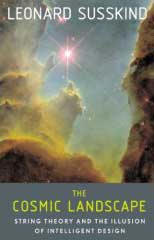


Scientists attempt to explain the exquisite hierarchies of life and
knowledge through the flat workings of physics and chemistry alone.
Information theory says this isn't possible if there's just one
universe, and an earth that existed for only 400 million years before
the emergence of cells."
Grinders, from Steve Leslie
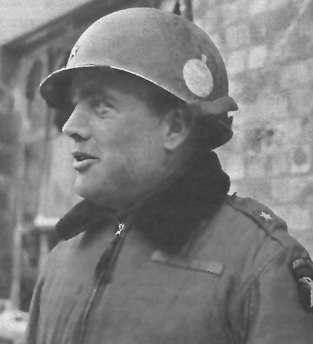
Walking in Backwards, from Tom Marks 
Profitable Grain Trading by
Ralph M. Ainsworth, reviewed by Jim Sogi
8. Mechanical and technical methods work better for
commodities than stocks as they do not rely on the honesty
of management.
Fast Lane, from
Nigel Davies
Can't Get the Drift, from Sushil Kedia
Sorry, Mr. O'Neil, from
Dr. William Rafter Investors can certainly use a sector rotation strategy to
produce returns which outperform the market, or even some
hedge funds. Many hedge funds would be wise to consider such
a strategy. However it's not as easy as the plan described
in
this article's abstract. Nor should we expect
it to be; the market is not easy-pickings. But recognize what market returns
we are talking about: since say 1990, the S&P has had about an 8 pct
compounded annual rate of return, while experiencing about a 46 pct maximum
drawdown. Those numbers can be beaten, and not just by the pros. As with
any game, being an informed participant enhances your success. Without
getting too far into proprietary methodologies, let me provide some insight
as to what a sector rotator must consider (with a few tips included):
Investors can certainly use a sector rotation strategy to
produce returns which outperform the market, or even some
hedge funds. Many hedge funds would be wise to consider such
a strategy. However it's not as easy as the plan described
in
this article's abstract. Nor should we expect
it to be; the market is not easy-pickings. But recognize what market returns
we are talking about: since say 1990, the S&P has had about an 8 pct
compounded annual rate of return, while experiencing about a 46 pct maximum
drawdown. Those numbers can be beaten, and not just by the pros. As with
any game, being an informed participant enhances your success. Without
getting too far into proprietary methodologies, let me provide some insight
as to what a sector rotator must consider (with a few tips included):
Tim Melvin Reviews Present Value ever read.
Present Value, by Sabine Willet
(a lawyer of
all things), is sort of post 9/11
Bonfire of the
Vanities that
raises some intriguing and perhaps necessary questions. The
story follows the travails of a couple, this time she is the
hard driving over achieving spouse and he is a senior member
of management with a large toy company who should have risen
higher but prefers sailing and running to actually caring
about business and finance. He is adequate, fairly
compensated but not driven by any means She out earns him by
10 to 1 and unlike most North American males, he doesn't
seem to give a good crap. The bottom of course has to and
does fall out of their world with some Enron style
shenanigans and the book covers what happens to them each as
the world falls apart. Sabine uses the artful device of a
economics professor appearing in flashback to set the central
tome and ask the critical questions. It is easy in one of
these books to make the business world the bad guy and make
it entirely touchy feely business is bad. Sabine avoids that
by having the clever professor raise the questions. We all know
that the supply and demand set the value of damn anything
and that the marketplace is the final arbiter. Most of us on
this list live are lives by these precepts and rightly so.
Ultimately at the end of the day they are true. But are
commerce and marketplace the only measure of value in the
world or are their perhaps others? And if they are, asks the
professor, can you run on two tracks at once. Ordinarily
these books break down right here and insist that only some
nebulous concept of true love is worthy and you must be poor
as a church mouse to experience it. The book allows you to
draw different conclusions if you so desire. The use of
satire and rollicking humor helps tell the story and ask the
questions that we all should ask ourselves from time to
time. a good read that is also fun and thought provoking. A
rare combination.
ever read.
Present Value, by Sabine Willet
(a lawyer of
all things), is sort of post 9/11
Bonfire of the
Vanities that
raises some intriguing and perhaps necessary questions. The
story follows the travails of a couple, this time she is the
hard driving over achieving spouse and he is a senior member
of management with a large toy company who should have risen
higher but prefers sailing and running to actually caring
about business and finance. He is adequate, fairly
compensated but not driven by any means She out earns him by
10 to 1 and unlike most North American males, he doesn't
seem to give a good crap. The bottom of course has to and
does fall out of their world with some Enron style
shenanigans and the book covers what happens to them each as
the world falls apart. Sabine uses the artful device of a
economics professor appearing in flashback to set the central
tome and ask the critical questions. It is easy in one of
these books to make the business world the bad guy and make
it entirely touchy feely business is bad. Sabine avoids that
by having the clever professor raise the questions. We all know
that the supply and demand set the value of damn anything
and that the marketplace is the final arbiter. Most of us on
this list live are lives by these precepts and rightly so.
Ultimately at the end of the day they are true. But are
commerce and marketplace the only measure of value in the
world or are their perhaps others? And if they are, asks the
professor, can you run on two tracks at once. Ordinarily
these books break down right here and insist that only some
nebulous concept of true love is worthy and you must be poor
as a church mouse to experience it. The book allows you to
draw different conclusions if you so desire. The use of
satire and rollicking humor helps tell the story and ask the
questions that we all should ask ourselves from time to
time. a good read that is also fun and thought provoking. A
rare combination.
A Letter to my Son, by Easan Katir
Ryan Carlson on the
Chicago Board of Trade Telegraph Book
Pledge -- Everything offered is being taken
Pledging -- More disposition to buy
Plentiful -- Everything on the market has been taken
Plenty -- Good enquiry and few sellers
Pliable -- Good enquiry
Stefan Jovanovich on the War in Iraq
Good Odds on the Beaten Favorite, from Victor Niederhoffer
A Segment from
If On a Winter's Night a Traveller by Italo Calvino, sent in by Al Mabry
Eschatology, from James Humbert I grew up with an atheist dad. He digs math and problem-solving and his middle name is work.
I married into a Christian family. I was in Gulf being a scud-stud (Garry Trudeau, the
Doonesbury
dude, gave me the cartoon scud-stud button in Kuwait after the war).
Anyway, I found myself praying to something.
I grew up with an atheist dad. He digs math and problem-solving and his middle name is work.
I married into a Christian family. I was in Gulf being a scud-stud (Garry Trudeau, the
Doonesbury
dude, gave me the cartoon scud-stud button in Kuwait after the war).
Anyway, I found myself praying to something.
Cycling Tricks, from Andrea Ravano
Have No Fear, from Jim Sogi
Degrees of Competitiveness, from Victor Niederhoffer One of the key chapters in price theory books such as
Price Theory
and Applications by Peter Pashigian, is on the pricing policies and resulting profits
for companies, which are based on the degree of competition they face, the
elasticity of demand for their products, and their durability. One important
conclusion is that the more differentiated a product is, and therefore less competition it has to contend with,
the greater that company's profit margins. The basic theorem initially being that all firms
price where the extra unit of revenue equals the extra cost incurred by the production of one more unit.
One of the key chapters in price theory books such as
Price Theory
and Applications by Peter Pashigian, is on the pricing policies and resulting profits
for companies, which are based on the degree of competition they face, the
elasticity of demand for their products, and their durability. One important
conclusion is that the more differentiated a product is, and therefore less competition it has to contend with,
the greater that company's profit margins. The basic theorem initially being that all firms
price where the extra unit of revenue equals the extra cost incurred by the production of one more unit.DOW30 Oper Margin Profit Margin
MSFT 37.20 28.45
INTC 31.46 22.31
KO 26.13 21.09
MRK 27.51 21.04
JNJ 26.47 20.61
C 24.46 20.44
PFE 29.90 15.76
AXP 18.68 15.39
MO 25.14 15.14
MMM 23.66 15.11
PG 19.42 12.73
MCD 19.52 12.72
GE 15.07 11.05
XOM 14.93 11.01
T 14.06 10.91
JPM 19.40 10.62
VZ 19.02 9.85
AIG 20.82 9.62
IBM 10.29 8.71
DIS 12.86 7.93
CAT 10.41 7.85
DD 8.07 7.71
UTX 12.13 7.18
HD 11.49 7.16
HON 8.97 5.98
AA 8.15 4.71
BA 4.02 4.69
WMT 4.90 3.59
HPQ 5.72 2.77
GM -7.30 -5.49
Peter Gardiner comments:
A direct comparison of profit margins (without adjusting GAAP statements) may be quite misleading, as for example r&d for a software company like Microsoft, or advertising for a consumer products company such as Proctor and Gamble is expensed, while the massive capital expenditures required for, say Intel, are amortized. The amount of net invested capital required to produce $1 dollar of revenue, or $1 of pre-tax income may yield a differently ordered list.
08-Aug-2006
Bearish Sentiment as a Contrary Indicator, by Andrew McCauley
Inspired by the postings Sentiment, by Timothy Roe and Pessimism, from Victor Niederhoffer on the Daily Speculations website, I decided to investigate these observations in more detail.

General market sentiment tends to lead investors down the wrong path. There exists a negative relationship between the sentiment of the American Association of Individual Investors (AAII) and future Dow Jones Industrial Average returns.
The AAII has been conducting a weekly sentiment survey of its members since July 1987. It asks respondents to categorize themselves as Bullish, Bearish or Neutral. They then assign a percentage to each group from the total sample. (For the purpose of this study, I use the percentage of Bearish individuals as a gauge of investor sentiment.)
Since 1987, the average percentage of Bearish individuals is 28.31% with a standard deviation of 9.25%. For the week ending 21/07/06, the Bearish percentage stood at 58%. That is over three standard deviations from its mean. Indeed, a very high percentage of Bearish individuals. With this in mind I decided to record all the occasions whereby the Bearish Individuals measure, strayed three standard deviations from its mean, to roughly 56%.
There have been 8 occasions when the AAII percentage of Bearish individuals recorded a score of 56% or more and 12 months later the DJIA was up on average by approximately 20%, with a t stat of 2 and a win rate of 100%. The percentage return is almost double that of all other rolling 52 week periods. In reality the data slightly overstate forecast returns and does not approach statistical significance due to some overlapping and clustering of data. However, the data are suggestive of much higher levels for the DJIA 3, 6, 9 and 12 months out.
I also decided to test future returns when the percentage of Bearish Individuals fell between three and two standard deviations from its mean or roughly 56% to 46%. For mine, still a relatively high outcome. The data in this group were consistent with the previous findings that a high level of Bearish sentiment is positive for future returns. I found 33 occasions that produced a 12 month average return in order of 15%, with a t stat of 2 and a win rate of over 85%. Again the data are somewhat overstated due to overlapping and clustering of data, but the general picture appears to be positive.
Interestingly, if we include the reading of 58% recorded on 21/07/06, then 8 times out of 9, three standard deviation observations occurred when military conflict was omnipresent in the mind of investors.
Six readings of greater than or equal to 56%, occurred between August and October 1990, a time when Iraq invaded Kuwait. The DJIA never traded below its October low again.
A reading of 56% was recorded in October 1992. The month's news was heavily dominated by the US Presidential campaign. Again the DJIA never traded below its October low.
In late February 2003, Bearish sentiment was at 58%, approximately one month before coalition forces invaded Iraq. The first week of March marked the low for the DJIA, a low that till this day has not been breached.
The recent reading of 58%, recorded in late July 2006, coincided with the Israel & Lebanon conflict, & the DJIA trading at 10,868. Perhaps this could be a multi year low. We will find out over time.
The data are consistent with Lord Nathan Rothschild's musing that he liked "to buy when the cannons are thundering and sell when the trumpets are blowing", circa 1810.
For Australian investors the data are also suggestive of positive things to come. Of the 8 times that the AAII percentage of Bearish individuals was equal to or above 56%, the All Ordinaries Index gained on average 16.58% over the next 12 months versus all other rolling 12 month returns of 7.03%. Just over double the average, with a t stat in order of 2 and not one negative 12 month period.
Maybe our Bear will not be depressed for too much longer, because he can be associated with an up stock market.
James Tar objects:
The foundation "Bear Sentiment as a Contrarian Indicator" rests on is flawed. Mr. McCauley makes an obvious mistake. What needs to be considered is that everyone is finally looking at Bull/Bear Sentiment Gauges these days to help formulate an opinion on market direction. Present market chatter, and everyone is saying it, is "The Bear Sentiment is so high we cannot go lower." Everyone is fixated on this, so much so that the herding on the weekly polls and data (AAII releases) for a contrarian indication of market direction should be a clear warning to the speculator that such a method has now become extinct. The market has perhaps outsmarted once again. Meaning, it might be time to look to these polls as confirmation.
I deeply regret writing such bearish commentary. But if we are truly going to advance our study and discussion of the markets, such a reversal in the foundation of such a widepsread utilisation of "contrarian indicators" must clearly be considered.
Andrea Ravano comments:
I have seldom seen so much negative feeling and low expectations in stock markets, than those surrounding me at present. Private bankers from here and there (I will not mention the countries the calls come from, because I am afraid to offend) mention again and again the risks of war in the Middle East, the price of oil, the risk of inflation etc.. The consensus seems so large that I am a bit puzzled by the market show of strength relative to the so many, possibly sidelined, if not straight short investors.
Which, of course, leads me to believe that if nothing unreasonable happens in terms of terrorism, we might see world stock markets rally by year end, if not sooner.
08-Aug-2006
That's How I See It, from
Larry Williams
 It is not good to
take another's property.
It is not good to
take another's property.
Not good spiritually. Not good in terms of the real world of Smith and Wesson and lawyers; it doesn't work. There is a penalty to be paid.
All ultimately pay for violating others' rights. Socialism sells itself as fair by taking property from one class and giving it to another. I grew up as poor as anyone but was shown, early on, that it is wrong to take -- steal -- my neighbor's raspberries, simply because he had them and we didn't. Why should his work reward me? Can you answer this in your doctrine of fairness? The raspberries were not mine, not of my work, and for me to take them injured my neighbor. That's the key to socialism: injure someone to gain control over another group.
Is it fair to another person for me to use what he has built and not compensate him for it?
Is it fair that I come over to your house and take something you created and convert it to mine? Give me your address and tell me when you won't be home and I'll know how much of a socialist you really are.
Give me your address and I will only take what I want -- like all good socialists. It is inherently wrong that you have things I do not have and the only way to correct this is for you to give them to the state to give to me, or give them directly to me.
The most important right of them all is the right to own property. Abridge that right at your expense. That's how I see it.
08-Aug-2006
Risk Management, by Terry Zink
This post by Terry Zink was the winner of a writing contest on the blog site Fickle Trader, which is hosted by Jon Tait. Jon ran the competition, inspired by something Vic once said in an interview with Dave Goodboy -- "In general you get paid for taking risk in the market." -- hoping to get people to think more about what they are really doing when they trade; managing risk.
To Read Risk Management, by Terry Zink
08-Aug-2006
Market VaR and Future Returns, from Gabe Carbone
The idea that higher returns are preceded by periods of higher risk is pretty well known around these parts. This idea was successfully put to the test by the Chair and the Collab in PracSpec with the VIX swing system (p. 109).
Value-at-Risk is a popular risk management (or possibly risk description) measure. It is widely used (and abused) in finance. Basically, the (1-day) VaR of a portfolio is the critical value in the left tail of the normal distribution, below which (usually) 5% of daily portfolio returns would fall. The VaR says nothing about the magnitude of the returns that fall below the critical value.
Instead of just using the normal distribution, VaR can be calculated using a Monte Carlo simulation of returns (the generating distribution can be one that is fatter-tailed than a normal one). Also, VaR can be calculated by re-sampling from the empirical distribution of returns, and ranking them according to magnitude. The VaR number then becomes the xth-percentile of the re-sampled returns. This can be repeated many times, and an average VaR number calculated from the many simulations.
I wondered whether the market's VaR was in any way predictive of its future returns. To answer the question, I calculated the 1-day VaR for the QQQQs (NASDAQ 100 etf), and compared this to the subsequent QQQQ returns. The way I calculated the VaR number for each day was to resample from the empirical distribution of the previous 30-days of one-day returns. I did this 1000 times, and took the average VaR number from each simulation. This was done daily from 26 April 1999 through to June 23. This VaR number was compared to the subsequent QQQQ returns. Note that VaR calculation periods are overlapping.
There seems to be little correlation between VaR and subsequent returns. I looked at both subsequent 1-day returns and subsequent 30-day (overlapping) returns.
Found here is the (heavily commented) Matlab code I used to calculate the VaR numbers, for those who would like to try the same (or try to find errors).
07-Aug-2006
Word of the Day:
Diachronic, from Jim Sogi
In medieval times things were explained diachronically, that is things were explained according to a historical narrative. If the explanation fit into the story line it was accepted as a valid explanation. Subsequent thought and development of the scientific method changed thinking to synchronic thought, the ability to challenge a hypothesis. Discoveries were made in ways that were not possible by reliance on a story line.
Some modern market thinking is more appropriate to times when joisting was the means for resolving disputes, than to the 21st century. With Fed day coming up tomorrow, diachronic thinking is all too common, and the public are appealing to the Fed to 'tell us a story.' The Fed are telling them a story alright, but is engaged in manipulation of expectations which is not only inherently dishonest, but the idea that a government entity can manipulate the expectations of a global market in a manner that they can predict is true hubris.
The fairy tale is that a pause or even a hint will make equities go up and the economy will live happily ever after, but as the Brothers Grimm found them, real fairy tales are often of woe and sadness, and full of the violence and cruelty that filled the brutish lives of old. And the moral of this story? Stick to the scientific method.
07-Aug-2006
Briefly Speaking, by Victor Niederhoffer
I came across much in A History of Bel Canto about the outpouring of optimism and creativity that led to bel canto and the Baroque period, following the defeat of the Turkish at Lepanto in 1571. I wonder whether this is a general phenomenon at the end of a war, especially between different religious groups? I wrote a report in 1975 on the likely impact of the end of the Vietnam war, and what happened after the end of the Second World War, which had a similar theme.
Art Cooper mentions:
G.K. Chesterton's poem about this battle is one of my favorites. I also believe that the optimism and creativity of the roaring 20's is further to this effect.
Stefan Jovanovich comments:
The explosion of brass band music after the Civil War might also fit the paradigm. It brought us both John Philip Sousa and Dixieland. In one of his recorded interviews Louis Armstrong talks about how the war surplus (every regiment in the Civil War had had a full band) made brass instruments cheap enough that even the poor blacks in New Orleans could afford them.
In 1867 Sousa's father, who played trombone in the Marine band, enlisted John Philip in the Marines at age 13. It was, in John Antonio's opinion, the necessary parental cure for his son's having tried to run away from home to join a traveling circus band.
07-Aug-2006
Chasing Tail, from
Dr. Kim Zussman
Mr. Cassetti recently wrote, "Suffice to say, many studies now show that missing the worst days is more important that participating in the best days" about returns on the S&P 500. I was intrigued about what this meant, and if true, what it says about the distribution of returns.
To analyze this, S&P 500 weekly returns since 1950 were ranked, and the compound final return was calculated, (I used weekly returns since this was less cumbersome than daily returns). Then I compounded returns for an hypothetical/supernatural trader who managed to be in the market for all but the best and worst week-pairs out of all 2950 weeks. The next trader was in for all but the best two and worst two, and so on, for a total of about 1477 ranked returns. (trader 1477 was only in the market for the middle-return two weeks out of 55 years, which seems implausible enough that I might try it).
Here is a chart of the compound returns found be successively eliminating week pairs, neglecting transaction costs. The pink line corresponds with a final return for B/H of about 75 (7500%).
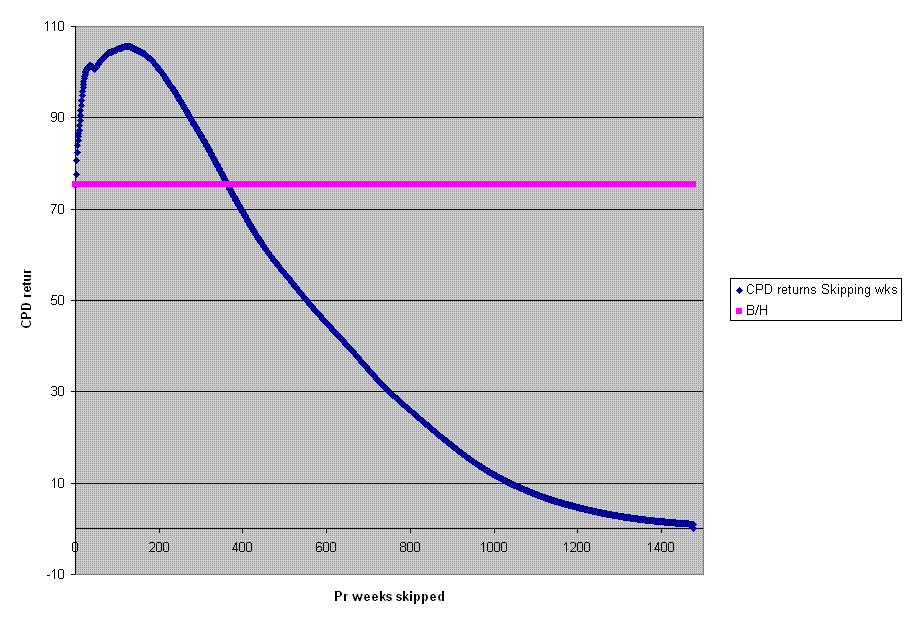
Note that while it is true that compound return improves by removing both top and bottom weeks, further successive removal actually hurts returns. After X > 363, removing additional top and bottom weeks reduces the return. Also since only 363/1475 top + bottom week-pair eliminations improve returns over buy and hold, if (without skill) you try to eliminate such weeks, you have about a 75% chance of under-performing.
This exercise is a successive subtraction of the extreme tails from the returns distribution, and shows that unusually large down weeks are greater in magnitude than unusually large gains. In 75% of the week pairs (just over +/- 1SD), the corresponding ranked gainer weeks are larger than losers. Another curiosity is the kink in an otherwise smooth curve around (elimination of) weeks 36 to 4, which could result from some kind of asymmetry in the tails.
I have one further chart, this time showing compounded returns for weeks of SP 500 since 1950, either:
Yellow = B/H
Blue = Successive dropping of top return weeks
Pink = Successive dropping of bottom return weeks
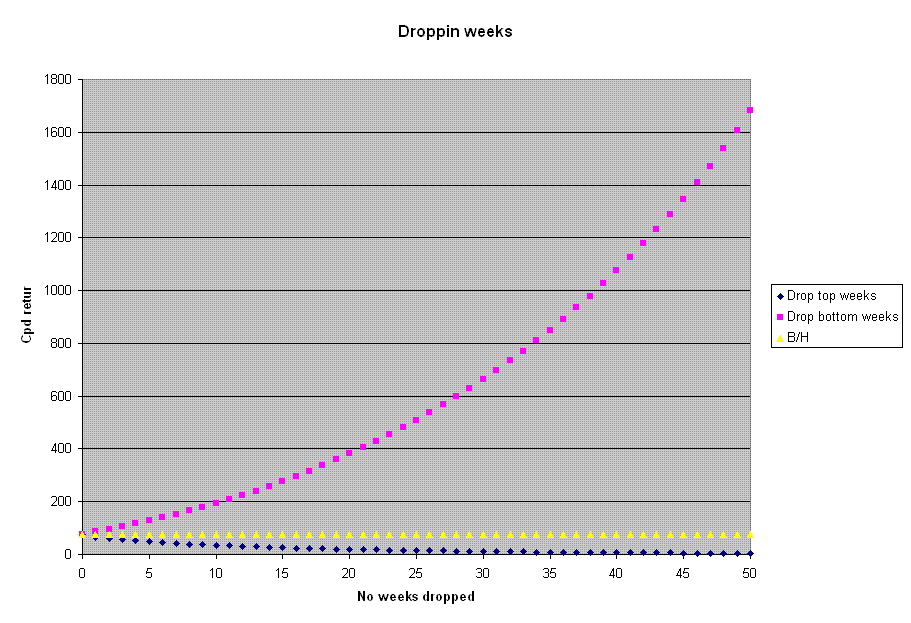
Clearly, if you want to try your luck in staying out of bad weeks there could be major payoff; and the penalty for missing top weeks is not as important as the gain of missing bottom weeks. For example, magically avoiding the bottom 20 weeks gives a compounded return of 381 (vs. B/H=75), an increase of five times. Whereas using a special proprietary home-spun strategy, missing the top 20 compounds to 20, means that you realize about a quarter as much.
How to avoid the very worst days seems like a good goal all around.
07-Aug-2006
Education of a Speculator: Redux, from Jim Sogi
We have all read Education of a Speculator, but how long has it been since you have picked it up? I have recently been re-reading it again for the fifth time, and having had the privilege of meeting Dr. Niederhoffer, studied his ideas in depth and meeting many who are mentioned in the book, it all takes on a completely new meaning. I highly recommend a re-visit as there are many hidden gems.
On page 136, Sir Francis Galton says, "An incapability of relying on oneself, and having faith in others, are precisely the conditions that compel brutes to live in herds." The necessity of self reliance is self evident, but faith in others is an easily overlooked and important idea that brutes miss. It is part of what makes them brutish and causes them to be many time losers.
Dr. Niederhoffer says, "Trading from the middle is a sure recipe for disaster." Where is the middle? A price volume chart shows where the greatest number of trades are, and typically it is in the middle of the daily range. The trades on the edges are the hardest to take, but will definitely not be with the public, and may present and overlay. A lesson learned from the visit to the racetrack was that in handicapping, the public favorite is almost immediately tossed out in the initial screen or process of elimination, which increases the odds of an overlay due to the parimutuel system of decreasing the layout to the odds on favorite. The basic process appeared to be a binomial system of eliminating the worst half, and by doing so increasing the probabilities in the remaining. Dr. Niederhoffer discusses a similar system in analyzing test questions. In the markets, elimination of even 40% of the sure losers with negative bias, and eliminating over 50% of all the losers will give some sort of edge. Add that to a good execution system which executes in the correct 50% of the range and there is a recipe for some success.
"A good speculator builds his position from a single base linked to a long, flexible chain of trades. ...The dollar's going to be weak because the government's going to keep the interest rates down so jobs will be good when the election comes." (Sound familiar?) But caveat! "Mix it up! The patterns are reshuffling and realigning." p. 139
On the endowment effect Dr. Niederhoffer reflects on his 90s fund's investors' complaints about their 150% gains being eroded by a 30% drop in one day. They felt entitled to that money under the endowment effect. I speak authoritatively about the endowment effect because I am an expert. The key to greater gains, Dr. Niederhoffer advises, is to hold on to trades longer, and this past two weeks is a perfect example. In order to makes the large gains, drawdowns are part of the process. The endowment effects makes unrealized capital gains too dear to part with, and so they are realized prematurely. The thinking goes like this, 'I can buy them back at a lower price.' Jump forward to 12 points lower. Now the buy back is obvious but the thinking goes like this, 'what if it keeps going down and I lose my hard earned gains to which I am eternally entitled to as mine?' Whereupon the market jumps back to new highs. A big joke in our family is the observation, and now the recollection, of young children playing with each other, and the ever present dialogue is, "MINE!" It seems to be an ingrained part of the psyche.
07-Aug-2006
Professionals and Amateurs, from Nigel Davies
What is the difference between a professional and an amateur investor? One way of distinguishing the two is via management fees, the pro trades other peoples money with a structure of fees whilst the amateur trades his own money.
The phenomenon of funds charging fees whilst underperforming the index is well known to all of us. Fairer funds will charge on profits only, but even here there is a problem. A fund that breaks even after a down year and an up year is much worse for investors than one that breaks even in both years. This is because of the charges on profits whilst not returning money to investors if the fund loses.
What effect will this have on professionally managed money? I believe there will be a bias in favor of accepting greater risk, just as weekend chess tournaments (typically with 3 prizes) foster a high risk strategy with volatile outcomes.
Is this good for investors? I do not think so, and frankly the hairs on the back of my neck stand up whenever I see advertised 'bonuses on profits'. Markets are hard enough (monkeys with darts beating 'pros' most of the time) without giving people bonuses for achieving volatile results.
07-Aug-2006
Making a Stand, from
GM Nigel Davies
"Give me a place to stand and with a lever I will move the whole world." -- Archimedes
The problem it seems is in finding a place to stand. Trying to force matters by standing on shifting sands is precarious at best. So perhaps it is better to go with the flow until suddenly you find yourself washed up on a tiny island of solidity. Then you get your lever out.
George Zachar adds:
I have white water rafted once, in a very benign stretch of the Colorado River headwaters. Prior to pushing off, the guide gave our group a serious lecture on safety procedures, one of which is appropriate in this context:
If for some reason you find yourself out of the raft and in mid-river shallow water, under no circumstance are you to plant your feet and try to stand. Stay afloat and try to guide yourself away from rocks and toward shore, using your paddle or arms. Any attempt to stand in the moving water, no matter how slow it seems to be flowing, is very dangerous. The pressure/force can quickly overwhelm you, and once exhausted you will not be able to stay afloat or avoid hazards.
The market parallels are many, and obvious.
07-Aug-2006
Prof. Mark McNabb on Baseball
I dropped in on the Orioles vs. Yankees game yesterday and found the Yankees fans to be far more entertaining than the locals. In fact the amusement cause me to miss seeing some pitches, (the Orioles' pitchers must have been Landis-ized or the NY hitters on Prozac so it was worth watching the performance from the mound).
Having said that ... as if one can say they actually see the pitch. When the Yankees would come to U.N.C. and play the Tarheels in March, I used to think the pro game was all about pitching, but seeing the guns on every fielder makes you appreciate defensive play and at the least notice other parts of the game more.
A friend says he would rather watch the games on TV, and that actually going to one is too distracting, like attending a Formula One race and only remembering what tops the Ferrari girls wore. I have to say that this is true for everything but college basketball it seems.
Markets are similar with bits and pieces of honey draped on every news release, only to discover that each is meaningless and the price action says all:
Market gets all it wants and needs nothing -- last Friday ...
If retail data over the next two weeks confirm the long bond, late August will be a nice buying opportunity to early August's selling opportunity.
04-Aug-2006
Jim Sogi Reviews
Of Wind and Waves: The Life of Woody Brown

Of Wind and Waves is an inspirational documentary about the life of Woody Brown, pilot, surfer and sailor. He was the son of a wealthy Wall Street broker but left New York for life in California and Hawaii where he pioneered sail planes, surfing and catamaran sailing. I knew him when he was younger in Honolulu, where he was a local legend. The film portrays a vibrant and positive thinking adventurous man, and at 93, he still has that same vibrancy and tells stories of his big wave exploits. The move captures his love for life and love for people and shows how his positive attitude shaped his life. He eschewed Wall Street for a life on the ocean. Woody was also featured in the film, Surfing for Life, about seniors surfing and keeping the stoke alive which is also highly recommended -- a great movie to inspire the elderly and those who will be soon to keep active, fit and positive.

The wonderful thing about modern technology is now a life on Wall Street and a life on the ocean are no longer mutually exclusive. It is possible enjoy the company of wonderful friends at Delmonicos on Wall Street one weekend and at the Beach Club at Kukio the next. There was a wonderful reception for Woody at Kukio private Beach Club where we met Woody. He is more lively at 93 than most at 40 and regaled us with surf stories. When I introduced Woody to pro-surfer Shane Dorian, they compared stories of surfing 60 and 80 foot waves! Our neighbor and cover model, Lokilani McMichael, and others of our local water-men and water-women community were there for a beautiful and glamorous evening under the moon and stars, next to the ocean with the trade winds blowing.
04-Aug-2006
A Worm's Eye View from the Coffee Pit, by Tom Printon
The trading week began with agents searching for liquidity above the previous weeks high, unable to create a bait ball. The effect was that agents spent the balance of the Monday session and most of Tuesday's puking longs. Late in Tuesday's session though began the signal that something was afoot -- commercial users started to cancel back month resting orders and aggressively pay up. On the Wednesday session the market opens higher and vacuums up. The market moves up so fast that not many agents could get long. Thursday finds the trend followers heading for the same exit but this time the decomposers are waiting; bid it up then give it to them.
That has been the price action in coffee this week. The explanatory narrative will be Hurricane Chris heading to New Orleans coffee warehouses, and supply problems in Vietnam.
04-Aug-2006
Geoff Garbacz Predicts the British Pound will Roll Over

I specialize in analysis of Outlier situations, and no you will not find information about this product on our web site. This is a proprietary process we share normally with a few clients and friends. The premise is simple -- Standard deviation + Trend + Volume = Excellent signals. We stop ourselves if the signal does not work after five days.
Our latest call is the British Pound Futures to roll over as of today's close. We will follow up this call with our results.
04-Aug-2006
Who is
Ricky Bobby? By Steve Leslie
Lucille Ball was once asked which television shows she enjoyed. Upon reflection she mentioned Three's Company. As you remember this show's premise was a bachelor sharing an apartment with two single women. The original cast included John Ritter who played the handsome and very available Jack Tripper and supported by Suzanne Somers, as the gorgeous yet ditzy Chrissy Snow, with Joyce DeWitt as the cute yet practically minded Janet Wood. Three's Company was one of many situation comedies of its era that had very little depth to it and whose story-lines were very simple and oftentimes insulting to one's intelligence. Although fun to watch, the show was extremely transparent and cutesy. Surprisingly or not, it enjoyed a run of seven years on television and spun off a sequel entitled The Ropers.
The interviewer asked Ms. Ball, who took her acting and role as executive producer of Desilu Productions very seriously, why she would watch such a basic show as this. Her remark was "Sometimes you just don't want to have to think a lot."
I muse over this quote from Lucille Ball when I observe the great and ever increasing popularity of NASCAR racing. Only Professional football ranks higher in popularity in American Sports, and NASCAR has become hugely popular with women. If you have ever been to a race you will see this extraordinary phenomenon at work. Fans come adorned with t-shirts exhibiting their favorite driver and they outfit their cars with numbers reflecting their car and/or man. They flock to on-site retail trailers and consume great volumes of memorabilia which are sold during the event. Many, will drive their Motor Homes, buses and other RVs from all over the country and park them in the infield of the track for the week. Dale Earnhardt 'the intimidator', probably the most popular of all modern day drivers and founder of an amazing corporation that bears his name, is revered today as a messiah rivaling that of Elvis in popularity. He actually died on the most famous of all tracks on the last lap during a wild dash to the finish at the 2001 Daytona 500, almost like a great gladiator who is finally defeated in one definitive battle in the Roman Coliseum.
On the surface, NASCAR racing is extremely easy to follow. The cars go around in a circle very fast, and the first one to the finish line is the winner. In between, you have numerous crashes, mishaps and fights in the stands along with a few inebriated souls who may just pass out beside you. If you are lucky you might be given a free philosophy lesson from the gentleman or gentlewoman nearby who seems to be missing one too many teeth. You don't have to pass a test, you don't need a deep understanding of x's and o'x or explain why a baseball diamond is 90 feet from each base, or even how soccer players can be offside and a game can end in a tie.

All that is required is to know a driver's name, his car number and that Tom Cruise really didn't win the Daytona 500. If you wish, you may sit in the stands for 4 plus hours while you drink your favorite beer or other form of spirit, moonshine included, smoke your particular brand of cigarette, eat your favorite type of fried food, all of which are prominently displayed on the automobiles which circle the track, and scream to your hearts content. During the race, you can complain about or admire Tony Stewart for being a driving hazard, voice your displeasure that Jeff Gordon is too good looking to win a race or wonder aloud whatever happened to Dick Trickle. It could be a very rewarding experience for those who happen to be wired that way.
In the end, perhaps that is all that the public-at-large really wants, something that allows them to find relief and escape their own world for a short time... and concomitantly, this is the role of industry, to find out what it is that the masses want and deliver it to them in the least abstruse way possible.
J. T. Holley replies:
Mr. Leslie's assumptions about NASCAR are so far from reality that it isn't funny. Knowing his poker background, I can assure you that 100% of the pit crews in NASCAR have forgotten more math than he knows. Half the Bubbas that he would sit down at the track beside could talk circles around him in regards to the nuances of racing and what it takes to triumph. My father was part of the #21 pit crew for eight years, and I grew up in NASCAR traveling the U.S. This is where I learned competition, very much as Vic did on the beaches and boardwalks of Brighton.
03-Aug-2006
Pessimism, from Victor Niederhoffer
There was an interesting article on Bloomberg recently about pessimism in the U.S. markets due to the war in the Middle East, and I always wonder, in a situation like this what it would ever take to make a pessimist change his views? Perhaps a move above a moving average, a fall in yields below five percent, a move in Israeli stocks to above the 800 level (TASE 100) that it was at on July 5th, a week before the kidnapping. Perhaps a cessation of interest rate increases or the end of the secular bear market? Are we now due for the sixth consecutive significant excursion downwards after the employment report ?
03-Aug-2006
ProShares Quotes, from Alston Mabry
If you want to see some spooky quote slippage, try to get quotes from different sources (Yahoo, Google, MSN) for the newer ProShares index ETFs for the S&P, QQQQ and MidCap 400. Each fund is meant to track 200% of either the index move (QLD, MVV, SSO) or the inverse of the index move (QID, MZZ, SDS).
These pairs are supposed to be opposites, but meeting the 200% target must be tougher than it looks:
QQQQ: + 1.12%
QLD: 64.67 +1.17 +1.84% 217,500
QID: 73.20 -1.50 -2.01% 374,900
MidCap 400: +0.65%
MVV: 71.63 +0.60 +0.84% 47,200
MZZ: 72.65 -0.92 -1.25% 54,700
S&P: +0.60%
SSO: 73.70 +0.56 +0.77% 73,200
SDS: 69.69 -0.82 -1.16% 137,800
Or maybe there is somebody arbitraging the heck out of this stuff!
03-Aug-2006
Down on the Farm, from Scott Brooks

Even though I do not trade in grains, I know that many around do, so I thought I would write a report about what is happening at ground level with grain. This report is based on my farm in N.W. Missouri.
First, let me cut to the chase. It is dry. Very very dry.. But the problem goes deeper than that ... literally.
It all started this winter. Whereas we normally get a couple feet of snow, we only got a few inches. That snow sitting on the ground, slowly melting into the soil, creates a water store deep within the soil that the plants can draw on during bad times. Think of it as an emergency fund, a build up of cash to be tapped into when times are rough. That emergency fund does not exist this year.
Now, you may think that we are not having a bad drought because the rainfall numbers for the spring and summer are only off by around six to nine inches, but that is very misleading. You see, we had a giant rainstorm in the spring that dumped over 5 inches of rain on my farm in period of a couple days. The problem with that is that the ground cannot absorb that much rain that quickly, and most of that water merely washed away top soil on its way downstream. So it looks like we are not that far behind in terms of actual rainfall, but in terms of moisture in the soil, we are hurting pretty bad.

After that initial rainfall it was a fairly dry spring.
Since the spring we have had a fairly steady rainfall during the growing season, around half an inch to three quarters of an inch every couple of weeks. That is not great, but that rainfall is allowing the soybeans and corn to grow. Unfortunately, this years grain crop has a lot in common with many Americans in that it is living rain fall to rain fall (paycheck to paycheck), just one step ahead of disaster.
Now disaster is staring us straight in the face. Just like most of the country, we are bogged down in a stifling heat wave with temperatures having been above 100 for over a week now. Couple that with clear sunny skies sucking the moisture out of the ground, and even the plants themselves, and you have got a potential problem brewing.
There is no subsoil moisture because of the lack of snow and steady spring rains, and no real surface moisture because of the heat and blaring sun. The only good news is that the heat wave is scheduled to break on Friday, August 3rd. They predict Cooler temperatures, only in the upper 80s to mid 90s, and some rain is forecast. The bad news is that we are coming into what my grandpa called the 'dog days of summer' -- the hottest time of year with the least amount of rain.
Time to start hoping for one of those years that are a statistical anomoly. We desperately need to have a wet August.
02-Aug-2006
Optimal Searching, from Dr. Phil McDonnell
If you have ever lost your keys or your wallet you will understand this problem. What is the best way to find things?
Every student of Computer Science is required to learn a technique called a binary search. The primary requirement of a binary search is that the list of items to be searched must be sorted in order from smallest to largest or A to Z. Given that fact, the search examines the item in the middle of the list and is able to rule out all of the items before or all of the items after the examined one. Half are eliminated in one look. For the half which remain we again look at the middle element and further reduce the remaining possibilities by half. Using this technique one can search a list of up to 1,024 items by examining only 10 elements.
Sometimes we do not have the luxury of a perfectly sorted list of items. Occasionally the list may have increasing values up to a certain point and then declining values thereafter. Such an arrangement is known as an unimodal distribution -- it has only one peak somewhere in the middle. For example a list of the probability values of the normal distribution would have one peak in the middle and a decline thereafter. In optimization problems such a pattern arises quite naturally, with the values to be optimized rising up to a certain point, after which they will fall. That point is the optimum (maximum).
To search a unimodal list the search of choice is called a Fibonacci Search which relies on the spacing between the Fibonacci numbers to calculate its next step size. As such it is more adaptable than the binary search. Under certain circumstances it can be shown that the Fibonacci search is an optimal search algorithm for such problems.

The Chair has frequently noted that the financial ecosystem requires much upkeep; a massive numbers of people and huge capital investment are required to keep the markets functioning all cost money. The source of revenue to fund these operations comes from three main sources, commissions, market spreads and professional advice and the key driver of all of these revenue sources is volume. The relationship between volume and commissions and market making profits are obvious. Order flow is everything to a commission broker or market maker. However those who sell advice also thrive on volume which is a proxy for interest in the market. When the public is interested in the market more money flows in and a certain portion of that money needs advice. The entire ecosystem of the financial industry thrives on volume, when volume is maximized the health of the financial system is maximized.
In this context it may be that the objective of the markets is not to maximize the price discovery process but rather to maximize the volume of trading, after all the health of the markets is integrally bound to the health of the financial system itself. If volume optimization is the real goal of the market is it not likely that the market uses an efficient search technique to discover the optimum. In this context the Fibonacci search is the best known algorithm for such a search in a unimodal volume environment.
One hastens to note that this is quite different from the mystical application of Fibonacci numbers which some traders try to apply in the price domain.
02-Aug-2006
Traveling, from Alston Mabry
To throw a small coin into the fountain:
A quick look at the TASE-100 (Tel Aviv Stock Exchange top 100 Index) provides only randomness, but I wonder, do the year to date daily TASE-100 adjusted closes cluster around the tens?
For the TASE-100 daily adjusted closes y.t.d., calculate the distance for each to the nearest ten, for example:
Date: 11-Jul-06
Adj. close: 831.77
Nearest ten: 830
Distance: 1.77
For all days y.t.d.:
Mean: 2.37
Standard Deviation: 1.48
Which appears consistent with randomness.
Victor responds:

Is it useful to think of the market as traversing various stops on a grand tour, a la Around the World in 80 Days? Right now for example the 10 year bond yield, which has been above 5% for several months has just dropped below that point. The Nikkei has spent much time below and around 15,000 and is now at 15,500. The TASE was below 800 at the start of the war in the Middle East, and has now gone above. The NASDAQ is around 2,000. The Dax is now confronting 5,700, having got to 5,697 today. Are these levels necessary for other markets to perk? Are they predictive or absorbing? What are your thoughts?
02-Aug-2006
J. P. Highland on
Alan Abelson and the C.F.A. Meme
Last week I got infected by the C.F.A. Meme, the Meme is telling me that if I want to achieve something in this life then I must have the C.F.A. certification. I decided to follow the Meme blindly, and ordered the materials to study for the December exam.
The company from which I got the materials also offers an every Tuesday video chat with the guy that prepared the whole course, in which he answers questions. Yesterday's best question was, 'Why are you such a jerk?'
Everything was going fine until the last minute when our mentor made the following comment, "I would suggest you guys read Barron's Magazine, which is a must read publication in this industry, and especially Mr. Alan Abelson's column, which I've been reading for decades".
It frightens me to think how many C.F.A.s that have been prepared by this guy have followed his advice and became Abelson's fans, which means that the cult of the bear keeps growing.
Rick Ackerman mentions:
Keep an eye on those housing stats, J. P., since they are the most powerful recruitment tool the cult of the bear has possessed since the Dust Bowl. This forum's Roger Arnold -- no cultist in my book -- makes them go down like a soufflé.
Regarding Alan Abelson, whom I have worked with, he is the last, and the very best of a dying breed of hard-hitting journalists. Maybe a little too hard-hitting, since his relentless devotion to unpopular facts probably cost him his managing editorship job in the wake of the 'mild' recession of 1990-91.
Andrea Ravano adds:
It is things like this that mean there are more cheap stocks for us to buy. Is the fact of opposing views not a great opportunity for careful speculators?!
02-Aug-2006
Tom Ryan on the Tucson Flood

On Monday we experienced a substantial flood event on the Rillito River which runs east-west through the city here. Measurements of the peak flows indicate the largest ever measured for the Rillito, and the second largest based on models (the models of the 1913 flood indicate slightly higher flows). Now that the water has receded, it is clear that the end result is:
U.S. Army Corps of Engineers 1, Mother Nature 0. The river did not jump the flood protection structures on the banks, and very little damage resulted, compared to the last two floods in 1983 and 1993. As a result of those two floods the feds and the county engineered the Rillito Riverbed in the 1990s, widening in places, raising banks, and soil cementing twelve feet thick on all banks, in effect 'channelizing' the river. Well it worked although the high water came within a few feet of topping throughout the course of the downstream section of the river and topping the nine bridges across the river (two of which were damaged enough to be closed).
There are some other interesting aspects to consider:
Leverage. Although the volume of the flow appears to be in the 50-100 year return period category, the precipitation that created the flow was in the 5-10 year category (2-3 inches in 12 hours).
Pre-conditions. The large flows resulted from a relatively small amount of rain due to the ground already being saturated by previous days of rain.
Efficiency. Rainfall was concentrated in the foothills of the Catalina Mountains, rather than the valley or high up in the range. This led to a rapid concentration, high water mark effect.
Unpredictable Consequences. The worst damage to the banks from scour and to the bridge piers is from objects (tree trunks, propane tank, Honda Civic are just a few of the items I witnessed) entrained in the flows hitting and snagging on the bridges and structures.
Market analogies left to the reader!
02-Aug-2006
Some Thoughts on Trading, from Rudolf Hauser
It is necessary to separate profits from trading for oneself from those managing other people's money. Those proceeds derived from fees and percentages of profits from trading other people's money where those other people bear the risk of loss do not count.
Trading is a way of earning a living. The investments are starting capital and time and effort spent trading, with the latter measured against opportunity costs of not have engaged in alternative activities. Results include not only net worth but also the income taken out over the years for personal needs, alternative investments, gifts, etc. The question from a personal view is whether the returns on time/effort and capital have been adequate to justify the risk and emotional impact of such risk.
Extraordinary returns cannot be achieved without taking extraordinary risks as a general rule. Sometimes a small bet like in a lottery that can easily result in a 100% loss but is insignificant relative to total net worth/ income can result in a huge killing, but the odds of that are very small. But for larger sums and as a general rule it means taking major risks to one's entire net worth in that to make such gains one has to place most to well in excess of one's net worth at risk. The only shelter is to use legal means to shelter some assets, such as doing one's trading in limited liability corporate forms. By such risk one not only means that the incompetent will lose. Such risks consist of factors difficult to know in advance, to unknowable. Skill and ability will give one an edge on the former but not on the latter. A certain amount of diversification and skill at cutting and hedging against losses will also help. But given the risks talked about, it means even the best will fail at times either because of a lapse in the skills (mistakes that could possibly have been avoided) or pure bad luck with regard to the unknowable.
Some have developed great skills and abilities and have been able to make those amazing profits over time. Reversals will happen and results have to be judged over a career. One should compare not to the peaks when one really lived well but to what life would have been like had a different less risky course been followed from the start. Better to have lived well for a time than not at all, unless the final result is so much worse than it would have been with the less risky course. (This ignores the possible psychological costs such as the negative effect of letdown vs. a steadier path even if less on average, which have to be considered as the overall criteria should be one's happiness properly defined. When considering psychological costs one also has to consider the psychological benefits from riding high etc. and utility values placed on different outcomes and timing impact. These will vary with the person, so that only the person himself can really judge, not the outsiders. This is because only the person him or herself will know their preferences and utility values and state of mind, and then only upon much reflection.)
The best course is to know when one has enough, and to focus on keeping that rather than getting much richer. That is if one has gotten rich, know when to stop taking such risks and getting out while one is ahead. As to having someone invest for one, you can only hope to get super rich doing so if the person doing the investments is able to deliver such results for prolonged periods. One time results, mixed track records or no prior success means the odds of the person having the right skills is less and the odds of success are lower. The odds are higher with someone like Vic or Krisrock who have shown evidence of such skills. But one can never know when the risk will catch up with them. So do not place all one's assets with any one trader over one time. It may just turn out to be when the skilled turn unlucky. Diversify over time and traders. Returns could be higher by concentrating or they can also be a total wipeout. My guess is that chess is mostly skill and not luck, but trading, which is not governed by fixed rules like chess, has a much greater element of luck. Even a chess player turned loser because of personal distractions could come back when those distractions are removed. A skilled traded turned unlucky just has to get lucky. To the extent that losses were due to the avoidable, the lessons learned might have made them a better trader. On the other side, there might be negative emotional scars from the experience that will reduce trading ability (which requires ability to restrain emotions). And new mistakes are always possible. But the odds of one who has shown skills over time doing well again are probably higher than those of one who has never demonstrated such skills convincingly in the first place.
02-Aug-2006
New Stories from Bo Keeley, as part of the series
Executive Hobos and 9/11
02-Aug-2006
Photographs from the Spec Party 2006
02-Aug-2006
Mother Goose and the Principles of Economics, a Report by William Koeblitz
02-Aug-2006
Extinction: Bad Genes or Bad Luck? by David M. Raup, reviewed by Victor Niederhoffer

This book by David M. Raup, a biologist at the University of Chicago, of the Stephen Jay Gould genre, identifies everything about extinction that we thought was true but is not. The author's main thesis is that extinction is a mostly random event; due to catastrophes and bad luck, and not related to the process of evolution that is part and parcel of the Darwinian idea. The author believes that the most likely explanation for the major extinctions that we have had is not competition, nature, or physical causes, but meteorites of colossal energy that fell on the earth regularly some 18 million years ago and still threaten us today.
In the process of debunking everything that we have been taught about extinction the author comes to six conclusions that are of great explanatory value for all species, all companies, and all investment styles:
There have been five major extinctions in the history of the earth. They are usually classified as Ordovician-Silurian, 440 million years before present, Late Devonian, 365 b.p., Permian-Triassic 250 b.p., End Triassic 200 b.p., and Cretaceous-Tertiary, 65 b.p., and a high percentage of species and genera were killed off in the years surrounding each of these markers. The author has developed some nice graphs to show what the likely number of species that died are, given the number of genera that were killed in each cataclysm.

There is an interesting but naive chapter in the book on the relation of extinction to industries. Raup argues that most of the companies around today were not in existence 50 years ago, and the cause of their disappearance, merger or bankruptcy corresponds to the causes of species disappearance or phyletic transformation. The author draws parallels between such things as that the total number of companies names was lower 50 years ago, just as biodiversity was less, and that certain industries wax and wane just as species do:
Above all, stock prices as well as the composition of the entire market, are virtually unpredictable from... decade to decade. And so it was with biological evolution in... the most recent 500 million years.
There is an excellent chapter in this book on the history of life, some nice methods of graphing durations and the branching of species, and some good anecdotes about all the famous species like the trilobites and the dinosaurs that did disappear with a debunking of the common explanations.
The book focuses on an extremely important part of the process of life, and shows some interesting methods for sorting fact from fiction.
A Few Points on Extinction in the Markets from Jeremy Lyter
Gary Rogan adds:
This book should be required reading for those who advocate "focused" portfolios. What you do not know will eventually kill you if you are too concentrated. The most amazing thing for me about evolution has always been the fact that for over a billion years the range of temperatures and other environmental conditions on earth were within a narrow enough range not to kill every organism in our branch of the evolutionary tree. When the dinosaurs were wiped out, the mammals and many other species did manage to survive. What are the chances that over such a long time the temperatures were not high enough long enough to kill all non-extremophiles on Earth? Perhaps we are simply unbelievably lucky and there is essentially zero chance for other intelligent life in the universe for this very reason.
Steve Ellison mentions:
In January I reviewed Evolutionary Catastrophes: The Science of Mass Extinction by Vincent Courtillot:
"Courtillot presents evidence that at least seven major hotspots have emerged under continental plates in the past 300 million years. The initial emergence of each of the seven hotspots resulted in clusters of massive volcanic eruptions that coincided with large numbers of extinctions. Courtillot theorizes that major hotspots originate deep in the mantle, at the boundary with the core. This layer of the earth's interior is also associated with the magnetic field. Intriguingly, the two greatest mass extinctions in the period studied, at the ends of the Permian and Cretaceous periods, each occurred after abnormally long periods of magnetic field stability. Usually, the earth's magnetic field reverses polarity every few million years, but it went 35 million years between reversals in the Cretaceous period. Courtillot theorizes that the lack of reversals might have been due to the boundary layer between the core and mantle growing to a greater than usual thickness, which might have inhibited polarity shifts while at the same time becoming more unstable and leading to a more dramatic 'correction', i.e., formation of a more intense hot spot, than usual." [Read More]
Generalizing this idea, long suppression of needed adjustments leads to cataclysm in other disciplines as well. In seismology, the longer the interval between major earthquakes, the more devastating the earthquake is likely to be. In politics, the century-long period of European stability after the Napoleonic wars gave way to World War I.
Jim Sogi adds:

On Extinction -- Sharks have survived since 100 million years before dinosaurs. They have a simple system. They constantly cruise around and eat the weak or struggling fish, they never pick fights with the strong. They go check it, they give it a test, and then they eat it. If there is any problem, they are gone. They are really really tough skinned and lack any emotion whatsoever. Smaller fish are dominated by fear. The small sharks hunt in packs. The big ones travel the globe. There are always always going to be dead, dying or injured or weak struggling fish around.
On Diversity -- Changing cycles demand diverse trading styles. The 1980s favored buy and hold. The late 1990s were great for short term trading opportunities. Early this spring was terrible for short term, and these past few months are great again for short term trades with multiple 7-15 point moves. Horizontally it is good to be able to trade several styles to fit the seasons and cycles. Vertically, like a fund, allocate portions of capital to different styles or asset classes to achieve diversity. The issue is not whether short term or high frequency trading is in itself good or bad, but how it fits in with the current cycle and with asset allocation.
02-Aug-2006
J.T. Holley on One Way to Avoid an Ass Whoopin'

A phrase that comes to mind when looking at the fate of the original Jack Schwager's Market Wizards, is 'A pat on the back is a few small vertebrae away from a kick in the rear end.' Countless times no one sees the ass whoopin' coming due to the warm feeling they feel for being on top or the taste of success, resting on laurels.
Every time someone is mentioned in an article, book, or put up on a pedestal for the World to emulate and trade after, the edge vanishes, the trader goes bust or has his first down year, standard deviation increases dramatically, his wife leaves him with half of his wealth. When does Vic suggest to Count or test those strategies of our colleagues? After the pat on the back or the kick in the rear?
Do these things happen simply due to the fact that they happen to everyone in life and we are just forcing a correlation? Maybe. Is it because a pat on the back is the magic formula to hoodoo someone, the abracadabra of forced failure?
I do not know, but I do know that one of the most powerful principles that Mr. Bill espoused was anonymity. It is a word in the namesake of A.A.. Anonymity keeps one out of the light and focused on current affairs, wax still clinging to wings. Want to quit smoking, do not tell a single soul! The more people you tell you are going to quit, the more people you will have asking you if you are thinking about a cigarette, which triggers a craving. It is the same thing with positions taken during the day, week, month or quarter. You know the significance points, the edge, but if you share your new found trade with everyone then they call you on the down ticks, adverse headlines and such and once again trigger your 'switching' cravings.
I would just rather keep my name and face out of the books, TV, award ceremonies and stadiums and stick to doing what got me there anyways. It is easy for me because I suffer from fear of success, but anonymity is powerful in so many ways. Principles before personalities.
How many CTAs, Hedge PMs or Speculators do you know that run from the press, keep below the radar, do not accept awards, and donate and give anonymously or without fanfare? Are they always doing it to conceal and protect positions, net worth, personal information and liberties? No. I say they know and fear a little bit, the fear that comes from that 'kick in the butt' after the 'pat on the back.' There is no upside from being a part of financial pornography, but discretely sharing and learning amongst friends who practice the same principles as you do is priceless. That way we grow as speculators and individuals and maintain our edges for the most efficient amount of time.
Rudolf Hauser adds:
Part of the problem is the tendency to engage in grand projects or take greater risks to keep up the reputation established by publicity, but I suspect that to a greater extent this is just a symptom of overconfidence in one's ability as a result of great success. This leads to exaggerated expectations of what one can get away with in terms of risks, grand assumptions, and a reduction in the fear that keeps one sharp and trying harder. These attitudes can exist without the publicity as well, and of course, it is a natural human tendency to attribute success mainly to one's abilities and insufficiently to luck when one is doing well, and the reverse when one is doing poorly.
Dr. Janice Dorn comments:
It is posts such as this one that elevate the spirit, give pause, put so much into perspective, and remind us to be, always, in gratitude and humility. Thank you, J.T..
In his early writings on market psychology, circa 1912, Selden said that the man with a million dollars is a silent individual, the time when it was necessary for him to talk is past, and now, his money does the talking. The one thousand men with one thousand dollars each however, are conversational, fluent, verbose to the last degree.
Steve Leslie offers:
Here are my two cents:
I heard Lou Holtz the great football coach once say "Things are never as good as they might seem, nor as bad, they are always somewhere in between."
'Pride Goeth before a Fall.' Pride is considered by Pope Gregory to be the the most severe of the Seven Deadly Sins.
I saw an interview with Greg Raymer WSOP Champion of 2004. He said that when he won the WSOP bracelet he did not let it go to his head. He realized that it was more a reflection of great fortune and luck for one week, than the fact that he was that much better than the field. He did not want to be one of those who won the title and then went broke the following year, so he plays within himself.
01-Aug-2006
Jared Albert Defends Daytraders
 Most people assume that a daytrader is a guy losing his $10,000 account in CMGI, who
will have to go back to moving refrigerators for a living. Sadly, that is not too
far from the truth for a guy running his own money, given time, using any
investment approach.
Most people assume that a daytrader is a guy losing his $10,000 account in CMGI, who
will have to go back to moving refrigerators for a living. Sadly, that is not too
far from the truth for a guy running his own money, given time, using any
investment approach.
Another reason for the negative reaction is jealousy. It makes people green with envy to imagine a guy taking down mid six figures while working four hours a day in his pajamas from home.
But the reaction that I respect, is the more experienced traders who recognize that there are size limits to daytrading and that if one wants to play in the big leagues one has to develop a higher level of sophistication, no matter how successful one may be as a daytrader. These same experienced souls recognize how easy it is for a guy running his own money to destabilize when the market changes and crash and burn.
My professor, who was at Solly when it was Solly and was the fourth guy at LTCM, looked at my resume and my sheets and told me that I had the worst resume he had ever seen (after 10 years of daytrading) and that I needed to get beyond daytrading because if I was not careful I would be 40 when cash equities went away and then I would be a greeter at Wal-Mart.
Of course the flip side is that for many of the investment/trading guys out there who are not doing something as 'easy' as daytrading to make a living, their 'sophistication' is just a crutch to hide behind as they will under perform indexing year after year.
The bottom line is that dollars are green and if you have got the nerve to do it on your own and can do it, then you can write your own ticket and live the way you want to live. As has been well discussed on the list, money doesn't buy happiness once one can pay the bills, so it is mostly the intellectual challenge that should push any successful daytrader into the 'big leagues.'
Nat Stewart comments:
In the 1990s and 2000s some on the sidelines missed opportunities and were afraid to take a chance. They often now manifest their impotence in hatred for those who shoot for a dream and are willing to assume risk. The day trader phenomenon of the late nineties created a mass mob of little Abelsons, waiting for the fall and relishing the reports of young upstarts getting their comeuppance.
Yishen Kuik adds:
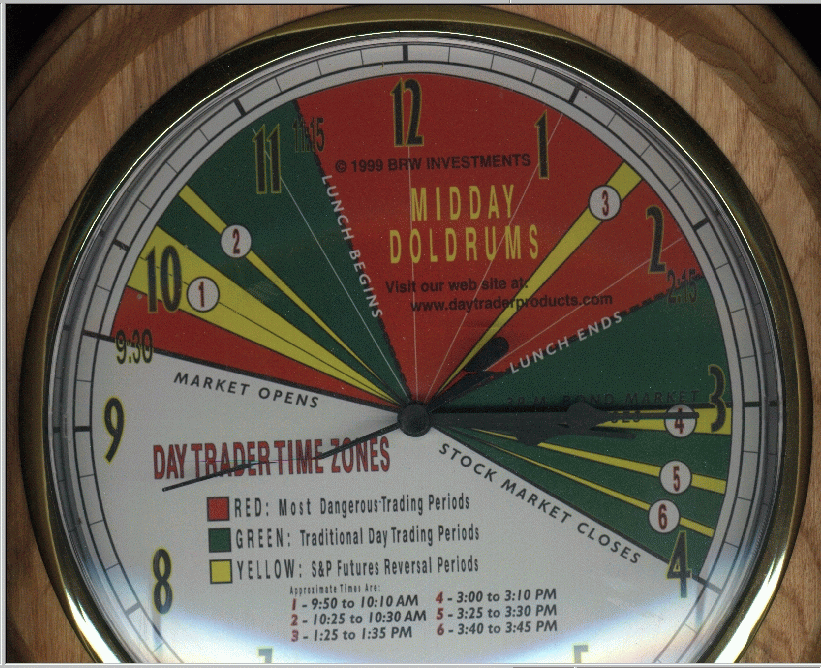
In the late 1990s thousands of otherwise unremarkable young people were making a great deal of money as day traders. Public knowledge of this was fairly widespread -- perhaps you recall the television ad where stock trading Junior lands his helicopter on the front lawn of the family home, as Dad looks on bewildered.
It was about upsetting the perceived status quo, young upstarts making fortunes doing apparently nothing too strenuous while 'the rest of us' were left behind, looking stodgy and foolish. When the NASDAQ collapse came and a lot of these mo-mo fortunes were destroyed, the moment of schadenfreude was too delicious for the general public to resist. The public's smug satisfaction that "we were right after all" led to the comforting notion that those who day trade are indeed fools who will soon lose all their money.
I think therefore that the public's enmity towards daytrading is partially explained by the need to protect its own fragile ego -- it hurts too much to believe that someone sitting at home in his pajamas can draw down 7 or 8 times the median wage while Joe Public sits in his cubicle cursing out the boss.
Craig Cuyler mentions:
I came across some guys that had a fund in Switzerland about a year ago they were posting plus ten percent returns per month scalping the Dax and Dax options. They developed some software for the Deutsche bourse and had a data pipe line that was a few seconds faster than the rest of the market. The were buying or selling bullets and making five to ten ticks all day on many many trades. It lasted about six months until their method was discovered. Articles on the Flipper have also appeared over the past year, and it is the same story, they have a very short lifespan. There are some other very short term strategies that I have seen for trading futures based on NYSE tick, that work quite well. I just think that, for the reasons I have given, the equities are very risky, and perhaps you bleed to death slowly until rampant markets like pre 2000 come along again.
01-Aug-2006
Producer Surplus and Price Variations, from Prof. Gordon Haave

In order to price-discriminate, a firm must be able to prevent the transfer of the good once it is sold. So, for example, if a Broadway producer knew exactly who was willing to pay $5 for a ticket, and who was willing to pay $1000, it would have difficulty trying to charge $1,000 to those willing to pay $1,000 because the people willing to pay $1,000 would contract with those who are willing to pay $5 to buy their tickets for $10.
Restaurants get around this by creating different meals for children and delivering them only to children. Movie theaters and other outfits check IDs before giving their discounts to seniors. Airlines charge based on customer profiles (how soon in advance you buy, or whether you stay over Saturday night) and do not let you transfer tickets to others. Universities charge everyone the $1,000 and then pretend to be generous by giving aid to those who they think can only afford the $5.
So what does this mean for markets?
01-Aug-2006
Survivorship Bias, noticed by
George Zachar
Despite Suicides, Denmark Happiest Country
LONDON, Aug. 1 (UPI) -- Despite having Europe's second-highest suicide rate, Denmark has topped the list of the happiest countries in the world in a study published Tuesday.
