To print article, click
Print on your browser's File menu.
Go back
Go back
Posted 7/19/2001

Related Resources
Keep track of Victor Niederhoffer and Laurel Kenner's picks on their Recommendations page.
Follow their Dow Reversals portfolios.
Share your biotech thoughts and studies at this message-board thread.
The artful alternation of up and down moves shakes out flat-footed traders who go with a trend once the trend becomes apparent.
|

The Speculator
Make money to the beat of the S&P 500
Like a waltz, the index makes its moves in three steps -- two months down probably signals a rally to follow, and two months up raises the odds of a downbeat.
By Victor Niederhoffer and Laurel Kenner
“It lives on repetition and yet on constant metamorphosis.”
-- Ernst Toch, “The Shaping Forces in Music”
Music, like mathematics and language, probably arose as a natural outgrowth of human activities and emotions, nature’s sounds and rhythms, and the milestones of life. Walking, running and swimming have certain elemental rhythms that the earliest music captured. Australian aborigines to this day perform dances about hunting, fishing and courting.
 Money Plus. Easy online tools and free Bill Pay, too. |
Even a cursory study shows the similarity between musical notation and the charts used by traders. No wonder that orchestral musicians during their breaks are often admonished to study the music and not their stocks.
We don’t mean that the market follows classical sonata form, with primary and secondary themes, development and recapitulation. Rather, just as music builds on rhythmic motifs, the market has patterns and phrasing. Even minute-by-minute ticks in the Standard & Poor’s 500 Index ($INX) follow a tempo that accelerates and slows, signaling turns with an artist’s timing that can be read by discerning traders.
The patterns grow directly out of the psychological game that the mistress of markets plays with her devotees. By taking advantage of the public’s fears and hopes, she collects her tolls and greases the wheels of the infrastructure. The artful alternation of up and down moves shakes out flat-footed traders who go with a trend once the trend becomes apparent.
The profit-oriented investor might be wise to study the market’s rhythms, preferably while listening to her favorite music.
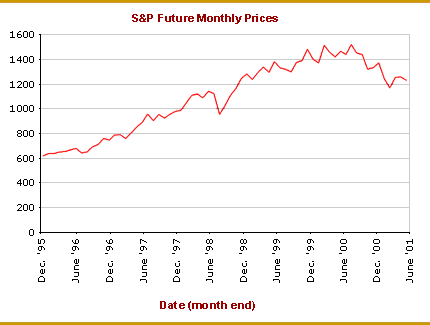
A good way of classifying moves in consecutive periods is to look at the direction of a move in one period and its direction in the previous period. Timing is everything in music and markets, and we therefore experimented with monthly moves of various durations in the S&P 500 futures index. We discovered a waltz rhythm: two months where the total return is down followed by one month up; or two months where the total return is up and one month down.
We then constructed a table of these moves using 5½ years of data. The results show that when the direction of the total move over two months was down, the chance of a rise the next month was 76%. When the move in the previous two months was up, the chance of a rise was only 57%.
Looking further at the results, it turns out that several calamitous moves followed two-month rises. But there was just a single unfortunate decline in months after two-month declines. We were reminded of the distinction drawn by the 19th-century statesman Benjamin Disraeli between misfortune and calamity: If his worthy rival Gladstone were to fall into the Thames, Disraeli once said, that would be a misfortune. If someone were to fish him out, that would be a calamity.
The right equation
Putting it all together, the best predictor of the next month seems to be 12 points minus 18% of the change in the preceding two-month period. (If the change is negative, then, you add the two numbers together.)
Note that the level of the S&P as of the end of May was 1,256. As we write, the index is at about 1,200 -- some 56 points lower. Thus, if the S&P were to hold steady for the rest of July, the expected change for August would be 18% of 56 plus 12 points, or a total of 22 points.
This equation explains some 5% of the total variation of the monthly changes in the S&P 500 over the period. The probability of explaining this much variation or more by chance is about 7%.
Regrettably, the variability of that forecast relative to the actual can be expected to be 32 points -- almost 50% more than the forecast -- so there is considerable uncertainty.
Testing a hypothesis on earnings season
Many concertgoers like to study the monthly music of the market, and many like to improvise their own solos to go with its accompaniment. One group of speculative improvisers believes that the market likes to go down during earnings-warning months and then go up for the next two months.
Earnings warnings occur most heavily toward the end of a quarter. However, S&P futures over the past five years have returns of 1.44% in the first month, 0.67% in the second month and 2.74% in the third month of a quarter.
While this might tempt one to conclude that the third month of a quarter is “best,” the variability among the months is at least five times higher than the averages themselves. In short, it's not reasonable to conclude that these differences in moves are distinct from randomness.
• Baseball's lesson: Invest in home runs, 7/12/01
• Biotech: An investing frontier for risk-takers, 7/05/01
• 5 Dow greyhounds ready to run, 6/28/01
more...
“When playing at Lord Holland’s someone asked (Paganini) to improvise on the violin the story of a son who kills his father, runs away, becomes a highwayman, falls in love with a girl who will not listen to him, leads her to a wild country spot and suddenly jumps with her from a rock into an abyss where they disappear forever. He listened quietly and, when the story was at an end, asked that all the lights should be extinguished. He then began playing … several ladies fainted and the salon, when re-lighted, looked like a battlefield.”
Like the improvisations of Paganini, and of Wynton Marsalis today, the market’s riffs have never been heard before in quite the same way, nor will they ever be heard that way again, though they often sound familiar. And no forecast, no matter how perfect, can be expected to explain all the variations that will be realized.
MSN Money's editorial goal is to provide a forum for personal finance and investment ideas. Our articles, columns, message board posts and other features should not be construed as investment advice, nor does their appearance imply an endorsement by Microsoft of any specific security or trading strategy. An investor's best course of action must be based on individual circumstances.