To print article, click
Print on your browser's File menu.
Go back
Go back
Posted 5/17/2001

Related Resources
Keep track of Victor Niederhoffer and Laurel Kenner's picks on their Recommendations page.
Also follow their HighVolatility portfolio.
|

The Speculator
How the Fed's moves shake markets
You know the conventional wisdom: when interest rates fall, bond prices rise, and investors can bid up stocks as well. In the real world, the most important relationship is between bond and stock prices. Use that to decide when to get in or out.
By Victor Niederhoffer and Laurel Kenner
This situation of mine was the precise situation of every mortal that breathes. If your banker breaks, you snap; if your apothecary by mistake sends you poison in your pills, you die. Handle Queequeg’s monkey-rope heedfully as I would, sometimes he jerked it so that I came very near sliding overboard.
--Herman Melville, Moby Dick
The relationship between the stock market and interest rates is one of the keys to understanding markets.
 Money Plus. Easy online tools and free Bill Pay, too. |
The conventional wisdom, encountered by the investor at every turn and embodied in almost every piece of market commentary, is that stocks and bonds are tightly and fatefully bound together. “Stocks rose on optimism for lower interest rates (higher bond prices),” runs a typical headline. And its twin: “Stocks fell on concern that interest rates are headed higher (bond prices are headed lower.)"
Investors are taught that stock values are based on a discounted stream of future earnings and dividends, and that the higher the interest rate, the lower the value of the earnings. They also are told that stocks and bonds are alternative investments, and when yields on bonds are high, investment in stocks is crowded out.
But is this conventional wisdom true? In part. Long-term rates can jerk up so much that they cause stocks to slide, but the relationship between long-term rates and stocks is a very subtle one, as we shall show below. Knowing its intricacies can help you decide whether you want to be in stocks or bonds.
As we write Tuesday afternoon, the market is gyrating madly. The Fed just cut the federal funds rate to a seven-year low of 4%, bond yields are at six-month highs and short-term rates are at four-year lows.
Are these relationships bearish or bullish? Are they predictive or descriptive? Are they constant, or ever changing?
To unravel this mystery, we first constructed a series of actual bond and euro prices. But the relationships between these prices are so complex that we quickly decided it was necessary to perform some triage. Finding that short-term interest rates have little if any predictive relationship to stock prices, we chose to concentrate instead on the relation between stock and bond prices.
The stock-to-bond ratio
But first, a review of Bonds 101.
A bond's yield represents the interest rate that would equalize the present value of the fixed payments with the current price and its price at maturity. Thus, bond yields and prices are on a seesaw; when one goes up, the other goes down.
Now, back to the mysterious relationships between bonds and stocks. A good way to think about it is to consider how many bonds it would take to buy one S&P 500 futures contract. For example, if the S&P is at 1,000 and Treasury bond futures are quoted at 100, the ratio is 10-to-1. If the S&P is at 1,700 and bonds are at 100, the ratio is 17-to-1.
Think of it as opportunity cost. If the ratio is 17-to-1 and you buy one unit of stocks, you forego buying 17 units of bonds.
Over the past six years, the ratio of S&P 500 stock futures to Treasury bond futures has oscillated between 11-to-1 and 17-to-1.
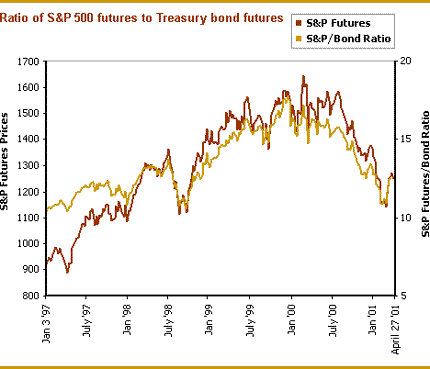
Other things being equal, stocks were less attractive as potential investments on occasions when the ratio of S&P 500 futures to long bond futures was highest, and more attractive when it was lowest. For example, the ratio was very low, about at its current levels, during the Long Term Capital Management credit crisis of 1998. As the S&P 500 ($INX) moved up 400 points during the next year and a half, the ratio moved up to 17-to-1. From that level, the S&P 500 fell from 1,500 to its current level of roughly 1,250, accompanied in its descent by the ratio.
Regrettably, the level of the ratio doesn’t tell you anything about the subsequent move in stock prices. In technical terms, the correlation is close to zero.
The change counts
More useful for predicting where the stock market may go next are changes in the stock-to-bond ratio. Over the past six years, using the ratio of current stock futures to current bond futures, we find a very strong inverse relationship between changes in the ratio and subsequent changes in the S&P 500. For every one-point increase in the ratio, the S&P could be predicted to fall an extra 14 points. And when the ratio falls one point, the S&P could be expected to rise 14 points. In other words, if stocks prices move too fast compared with bonds, and you will soon see -- perhaps as soon as a week -- stocks move down again. If prices fall too fast, a rally is soon to follow.
Note that in considering a relationship of this nature, it is good to keep in mind not only the magnitude of the link but its certainty. Based on the variabilities involved, we can say that the chance that this is a true departure from randomness approaches 98%. The system was at its least useful when there were large rises in the ratio. These should have been followed by large declines; instead, S&P prices were all over the map in the following week. The two big declines in the ratio were more predictive, both being followed by very substantial rises in the S&P. (E-mail us for a table of the data, if you are interested.)
Here’s how it works in practice. Last week, the stock-to-bond ratio rose 0.18 point, as shown in the table below.
Friday, May 4
| Stocks | Bonds | Ratio |
| 1273.2 | 102.11 | 12.44 |
Friday, May 11
| Stocks | Bonds | Ratio |
| 1251.8 | 99.06 | 12.62 |
Recent Articles
• Last year's casualties are this year's prospects, 5/10/01
• Make volatility and uncertainty your friend, 5/3/01
• A soulful lesson on investing and real value, 4/26/01
more...
You can calculate the index yourself by using the Treasury bond and S&P 500 Index futures prices quoted in major newspapers -- for example, the “Futures Prices” section of The Wall Street Journal.
For those with long memories, large increases in the stock-to-bond ratio are quite scary.
In the year before the October 1987 crash, stocks had rallied some 40%, while bonds had declined some 15%. The stock-to-bond ratio increased by about 50% in that period. In two terrible days, the ratio corrected back to the year-earlier level.
Thus, the collective unconscious of the market always experiences grave anxiety when an increase in the stock-to-bond ratio to extremely high levels brings back memories of those loathsome times.
Thus, we've shed light on another speculative canard (“stocks rise on optimism for falling interest rates”) and presented its true predictive value.
MSN Money's editorial goal is to provide a forum for personal finance and investment ideas. Our articles, columns, message board posts and other features should not be construed as investment advice, nor does their appearance imply an endorsement by Microsoft of any specific security or trading strategy. An investor's best course of action must be based on individual circumstances.