To print article, click
Print on your browser's File menu.
Go back
Go back
Posted 5/10/2001

Details
 |

Related Resources
Keep track of Victor Niederhoffer and Laurel Kenner's picks on their Recommendations page.
Also follow their HighVolatility portfolio.
|

The Speculator
17 stocks to help you recover from loss
After a year of tears, anger and teeth-gnashing, it's time to start the healing process. Stocks that have already been through the wringer might be a good place to start.
By Victor Niederhoffer and Laurel Kenner
Moderate lamentation is the right of the dead, excessive grief the enemy to the living. -- William Shakespeare, All's Well That Ends Well
Psychologists who study depression observe that people seem to equate losses of all kinds with loss of a loved one. If so, stages of grief that normally follow bereavement may be instructive for the investor with lots of red in the portfolio.
 Money Plus. Easy online tools and free Bill Pay, too. |
When someone dies, those close to him go through days of shock, even denial, then waves of crying and intense pain. Acceptance of the loss may take many months, during which time they may be anxious and unable to feel pleasure. They're also likely to feel anger -- toward doctors, toward people thought to be unappreciative of the departed, toward themselves for having mistreated the lost person, toward the loved one for departing.
Mourners need to pass through all three stages of grief in a timely way in order to move their focus off the past, according to the half-dozen psychology texts we consulted. They need to forgive those who caused the grief or risk falling into dysfunctional behavior.
We'll show today that this applies equally to the market. Investors who fail to put their grief behind after suffering losses are likely to avoid the best medicine for financial recovery. We're not equating losses in the market with the loss of a loved one. But as Paul Heyne puts it so well in "The Economic Way of Thinking," "Almost everybody prefers more money to less."
Nothing has fallen like tech
Nowhere have losses in wealth been more prevalent over the past year than in tech stocks. The Nasdaq 100 reads like a roster of lost friends:Yahoo! (YHOO, news, msgs), down 90% since March 24, 2000;Palm (PALM, news, msgs), down 86%, Lucent (LU, news, msgs), down 83%, JDS Uniphase (JDSU, news, msgs), down 83%;Nortel Networks (NT, news, msgs), down 77%.
If those stocks could talk, their stories would rival "Accordion Crimes" -- Annie Proulx's masterpiece about an instrument that passes through many hands and hard times. We'd hear tales of fallen hopes, hidden miseries, broken promises, retirements postponed, business plans discarded, marriages not begun, vacations not taken, colleges not attended, homes not bought.
The market itself is doing fairly well at coping with the death of many of its biggest constituents. On April 3, the Nasdaq 100 ($NDX.X) was down 70% from March 2000 highs and the S&P 500 ($INX) was down 28%. Since then, of course, there has been a substantial recovery. The Nasdaq 100 is up 38% as of Tuesday's close, and the S&P is up 14%.
Yet some investors and the financial media seem to be stuck in the past. That's part of the usual grief process, for bereaved people often blame themselves for not doing enough to prevent the loved one's death. If the guilt goes on too long, though, therapy is needed in which one is encouraged to talk about the loved one, the death, and the meaning of the loss, until one can come to terms with reality.
How long do we mourn?
Fortune magazine's May 14 issue is typical. The magazine is packed with negative stories on fallen techs such as Cisco Systems (CSCO, news, msgs) and Apple Computer (AAPL, news, msgs) -- as well as their enablers in the investment banking and brokerage research community. It even includes a mea culpa for featuring Cisco chief John Chambers on its April 2000 cover with the question: "Is he the best CEO in the world?" and an apology titled "Diary of a Financial Pornographer" in which columnist Nelson Schwartz writes: "By early 2001, with the Nasdaq imploding and Lucent trading at $12 and Cisco down more than 75% in 12 months, I felt my own culpability rising faster than the red ink."
But how long should this breast-beating drag on? We are reminded of Queen Victoria's 10 years of seclusion after the death of Prince Albert, or Dante's decision to bury his best unpublished poems with his dead wife. Victoria eventually found new happiness in a friendship with her prime minister, Benjamin Disraeli, and Dante concluded eight years later that it was pointless to let some of the finest works he had produced molder in the grave. The grave was opened, and the poems were retrieved and published to immediate acclaim.
Our research suggests that rather than hibernating for up to a decade, investors can find therapy back in the market. For ultimately, the key to a healthy life is to focus on the present and future. In the market, a healthy approach would be to reconsider relations with the stocks that betrayed us by falling -- those chipped icons, those sources of funereal misery.
As always, we would begin by counting. We asked Tom Downing of Value Line to determine the fate of fallen stars from 1986 to the present among the 3,000 stocks that Value Line covered during that period.
He found 1,118 separate cases in which a stock had declined 60% or more in a year. Each of the stocks was selected the first day it registered a 60% decline from its closing price one year previous. Overlap was eliminated. We originally wanted a study of 90% declines, but changed to 60% to get a larger sample that wasn't dominated by penny stocks.
On average, these beaten-down stocks rose 20% over the next six months, vs. 13% for all Value Line stocks in those six-month periods.
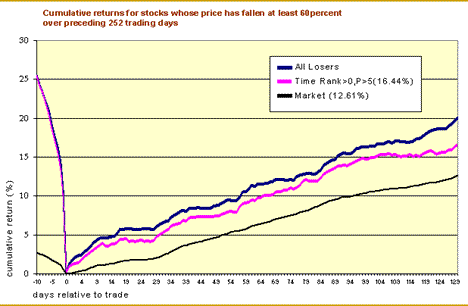
The superior performance of the beaten stars was consistent throughout the period. After just 21 trading days, the beaten stars were up 4% relative to the averages. This margin increased continuously, until by six months it had advanced to a full seven percentage points. (The middle line in the chart shows comparable superior performance for the subset of stocks above $5 that weren't given any "timeliness" ranking at all by Value Line.)
Since the average variability, or standard deviation, of the performance of the 1,118 stocks was some 75%, the speculator could expect to experience much uncertainty in implementing such a strategy. However, with this high a number of observations, the results seem significant from both a practical and statistical viewpoint.
The results support the view that a proper therapy for those suffering losses in the market or of loved ones is to confront the situation directly, perhaps with a purchase. The variability of the Value Line study is too high to recommend any group of Value Line stocks that are off 60% as a ready-to-wear stock-picking system. Yet the principle can be used as a basis of further screens, such as insider buying and high Value Line rankings. One might start with the Nasdaq 100 stocks that have fallen 60% in the past year, and then run further screens.
Looking for gold in abandoned mines
Nasdaq-100 Stocks > -60% (May 8, 2000-May 8, 2001)
| Stock | % Decline |
| Nextel Communications (NXTL, news, msgs) | -67 |
| Cisco Systems (CSCO, news, msgs) | -68 |
| Ericsson (ERICY, news, msgs) | -70 |
| CNET Networks (CNET, news, msgs) | -71 |
| Amazon.com (AMZN, news, msgs) | -72 |
| McLeodUSA (MCLD, news, msgs) | -72 |
| PMC-Sierra (PMCS, news, msgs) | -74 |
| JDS Uniphase (JDSU, news, msgs) | -74 |
| Broadcom (BRCM, news, msgs) | -74 |
| Palm (PALM, news, msgs) | -75 |
| Exodus Communications (EXDS, news, msgs) | -76 |
| Conexant Systems (CNXT, news, msgs) | -77 |
| At Home (ATHM, news, msgs) | -77 |
| RealNetworks (RNWK, news, msgs) | -77 |
| Metromedia Fiber Networks (MFNX, news, msgs) | -79 |
| Level 3 Communications (LVLT, news, msgs) | -81 |
| Yahoo! (YHOO, news, msgs) | -84 |
| BroadVision (BVSN, news, msgs) | -84 |
| Ariba (ARBA, news, msgs) | -88 |
| CMGI (CMGI, news, msgs) | -90 |
| XO Communications (XOXO, news, msgs) | -91 |
| Inktomi (INKT, news, msgs) | -93 |
Recent Articles
• Make volatility and uncertainty your friend, 5/3/01
• A soulful lesson on investing and real value, 4/26/01
• You can hit big with $5 stocks, 4/19/01
more...
Also, the MSN MoneyCentral Stock Screener can be put to good use for this concept. We screened for stocks that declined at least 60% in the past year, with recent net insider buying, $250 million minimum market cap, a price of $3 or more and at least 10,000 shares traded daily. We came up with a list of 17 names. Click here a link to a screen we call The Sub 60s; here are the stocks it pulls up as we write.
| Name | Market Cap (millions) | % Chg 12 Mos. |
| CTS (CTS, news, msgs) | 701.57 | -60.2 |
| Cypress Semiconductor (CY, news, msgs) | 2,867.26 | -60.5 |
| Corning (GLW, news, msgs) | 21,486.18 | -63.5 |
| Primedia (PRM, news, msgs) | 1,328.97 | -64.7 |
| XM Satellite Radio (XMSR, news, msgs) | 526.68 | -68.7 |
| Nuance Communications (NUAN, news, msgs) | 447.65 | -70.7 |
| Sirius Satellite Radio (SIRI, news, msgs) | 652.25 | -72.4 |
| Nortel Networks (NT, news, msgs) | 50,779.77 | -72.9 |
| Crown Cork & Seal (CCK, news, msgs) | 540.20 | -73.3 |
| Circuit City (CC, news, msgs) | 2,866.19 | -73.9 |
| Sepracor (SEPR, news, msgs) | 2,306.49 | -74.6 |
| DiamondCluster Intl (DTPI, news, msgs) | 514.97 | -78.9 |
| Inet Technologies (INTI, news, msgs) | 421.63 | -79.2 |
| Ditech Communications (DITC, news, msgs) | 414.85 | -85.9 |
| CacheFlow (CFLO, news, msgs) | 346.75 | -87.4 |
| Netro (NTRO, news, msgs) | 266.05 | -88.4 |
| XO Communiciations (XOXO, news, msgs) | 1,414.58 | -90.3 |
At the time of publication, Laurel Kenner and Victor Niederhoffer did not own shares in any of the equities mentioned in this column.
MSN Money's editorial goal is to provide a forum for personal finance and investment ideas. Our articles, columns, message board posts and other features should not be construed as investment advice, nor does their appearance imply an endorsement by Microsoft of any specific security or trading strategy. An investor's best course of action must be based on individual circumstances.