Daily Speculations
A Record Run Without a 2-Day Decline
(Posted 7:30 p.m. Friday, Jan. 23)
The market has not been down two days in a row since Dec. 3. That's 31 trading days, a record. On only 13 occasions has the market failed to go down twice in a row within 21 to 30 trading days (30 is the previous record.)
Such a run, and all similar long runs without two consecutive down days, were highly bearish to the next instance of a "success" -- i.e., two down days -- with Z on the order of -2 and expectations of -12% with a four-day duration being the norm. --Vic
We asked Tom Downing, former assistant to the legendary Value Line chief researcher, Samuel Eisenstadt, to compute the Poisson probability of the failure of a two-day decline to occur over a 32-day period.
prob of 0 successes in 32 pds where intensity
=1/4 is .000335 (2981 to 1)
Since 1996, the record for num days without 2
consecutive up days is 30 days through 9/24/01
with prob of .00055 (1808 to 1)
-- Tom Downing
From Alex Castaldo:
Why?
The expected number of events in 32 periods is 32/4 = 8
The probability of zero events is
(8**0) * EXP(-8) / 0!
or
EXP(-8)
which equals
0.000335463
From: Alix Martin
Date: 01/23/2004 13:10:58
When you don't see who's the fish, you're the Poisson... But :
In this case I don't see the need to approximate the binomial
distribution with the Poisson one, as the binomial coefficient is
trivial :
0 successes in 32 tries of prob 1/4 = (3/4)^32 = 0.0001
Yet not only is the result different by a factor of 3, but it is also
irrelevant to the problem of sequences of 32 days without 2 down days in
a row, since failed attempts at a down-down sequence take between 1 and
2 days :
Up : failed attempt in one day
Down-up : failed attempt in two days
To find the probability p(n) of n days without a down-down sequence, I
would point out that
last day up last day down
P(n) = 1/2 * p(n-1) + 1/4 * p(n-2)
And p(2) = 3/4, p(1) = p(0) = 0
Then, recursively, p(32) = 0.00094036
Still off by a factor of 3, but in the other direction...
Alix
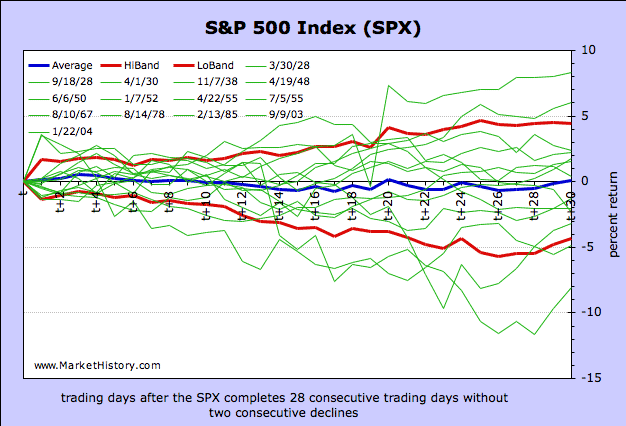
Performance of SPX in the
trading days following a 28-day run
From Gibbons Burke, editor,
www.markethistory.com
From Gibbons Burke: I just joined the list today and found this question
interesting,
and fairly easy to answer with a system I use all day long - the Market
Information Machine or "MIM" from www.lim.com (Reg FD: the company
which owns the site I run.) By my reckoning, running the following query
in the MIM, the current count is 28 as of Thursday. The reason my count is
different is that I
don't increment the counter over a holiday:
SHOW
SPX: SPX
Net: 1 value move of SPX
xcount: xcount
WHEN
IF 1 value move of SPX is less than 0 and 1 value move of SPX 1
value ago is less than 0
THEN
xcount = 0
ELSE
IF SPX is defined and SPX 1 value ago is defined
THEN xcount = xcount+1
ENDIF
ENDIF
AND
Date is within 2 month
Here are the results of this query. The xcount column shows the current
length of the run. It resets to zero when two trading days in a row
show a net change less than zero:
Date Day SPX Net xcount
11/24/2003 Mon 1052.0800 16.7999 1.0000
11/25/2003 Tue 1053.8900 1.8101 2.0000
11/26/2003 Wed 1058.4500 4.5599 3.0000
11/27/2003 Thu NaN NaN 3.0000
11/28/2003 Fri 1058.2000 -0.2500 4.0000
12/01/2003 Mon 1070.1200 11.9200 5.0000
12/02/2003 Tue 1066.6200 -3.5000 6.0000
12/03/2003 Wed 1064.7300 -1.8900 0.0000
12/04/2003 Thu 1069.7200 4.9900 1.0000
12/05/2003 Fri 1061.5000 -8.2200 2.0000
12/08/2003 Mon 1069.3000 7.8000 3.0000
12/09/2003 Tue 1060.1801 -9.1200 4.0000
12/10/2003 Wed 1059.0500 -1.1300 0.0000
12/11/2003 Thu 1071.2100 12.1599 1.0000
12/12/2003 Fri 1074.1400 2.9301 2.0000
12/15/2003 Mon 1068.0400 -6.1000 3.0000
12/16/2003 Tue 1075.1300 7.0900 4.0000
12/17/2003 Wed 1076.4800 1.3500 5.0000
12/18/2003 Thu 1089.1801 12.7001 6.0000
12/19/2003 Fri 1088.6600 -0.5200 7.0000
12/22/2003 Mon 1092.9399 4.2799 8.0000
12/23/2003 Tue 1096.0200 3.0801 9.0000
12/24/2003 Wed 1094.0400 -1.9800 10.0000
12/25/2003 Thu NaN NaN 10.0000
12/26/2003 Fri 1095.8900 1.8500 11.0000
12/29/2003 Mon 1109.4800 13.5900 12.0000
12/30/2003 Tue 1109.6400 0.1600 13.0000
12/31/2003 Wed 1111.9200 2.2800 14.0000
01/01/2004 Thu NaN NaN 14.0000
01/02/2004 Fri 1108.4800 -3.4401 15.0000
01/05/2004 Mon 1122.2200 13.7400 16.0000
01/06/2004 Tue 1123.6700 1.4501 17.0000
01/07/2004 Wed 1126.3300 2.6599 18.0000
01/08/2004 Thu 1131.9200 5.5901 19.0000
01/09/2004 Fri 1121.8600 -10.0601 20.0000
01/12/2004 Mon 1127.2300 5.3700 21.0000
01/13/2004 Tue 1121.2200 -6.0100 22.0000
01/14/2004 Wed 1130.5200 9.3000 23.0000
01/15/2004 Thu 1132.0500 1.5300 24.0000
01/16/2004 Fri 1139.8300 7.7799 25.0000
01/19/2004 Mon NaN NaN 25.0000
01/20/2004 Tue 1138.7700 -1.0599 26.0000
01/21/2004 Wed 1147.6200 8.8500 27.0000
01/22/2004 Thu 1143.9399 -3.6801 28.0000
I then changed the query to see how many other 28 day streaks without a
two-day loser have occurred in the entire history of the SPX:
SHOW
SPX: SPX
Net: 1 value move of SPX
xcount: xcount
WHEN
IF 1 value move of SPX is less than 0 and 1 value move of SPX 1
value ago is less than 0
THEN
xcount = 0
ELSE
IF SPX is defined and SPX 1 value ago is defined
THEN xcount = xcount+1
ENDIF
ENDIF
AND
xcount is exactly 28
Here are the 14 results:
Date Day SPX Net xcount
03/30/1928 Fri 19.2800 0.3300 28.0000
09/18/1928 Tue 21.1800 -0.1000 28.0000
04/01/1930 Tue 25.3700 0.2700 28.0000
11/07/1938 Mon 13.3200 0.1500 28.0000
04/19/1948 Mon 15.4500 0.0200 28.0000
06/06/1950 Tue 18.8800 0.2800 28.0000
01/07/1952 Mon 23.9300 0.0100 28.0000
04/22/1955 Fri 38.0100 -0.3100 28.0000
07/05/1955 Tue 41.6900 0.5000 28.0000
08/10/1967 Thu 95.5300 -0.2500 28.0000
08/14/1978 Mon 103.9700 0.0100 28.0000
02/13/1985 Wed 183.3500 2.7900 28.0000
09/09/2003 Tue 1023.1700 -8.4700 28.0000
01/22/2004 Thu 1143.9399 -3.6801 28.0000
So, the emprical results suggest this happens on 14 of 19095 trading
days in the history of the SPX or 0.073%.
I changed the query again to see how long those runs have ever been
extended to find the record runs:
SHOW
SPX: SPX
Net: 1 value move of SPX
xcount: xcount
WHEN
IF 1 value move of SPX is less than 0 and 1 value move of SPX 1
value ago is less than 0
THEN
xcount = 0
ELSE
IF SPX is defined and SPX 1 value ago is defined
THEN xcount = xcount+1
ENDIF
ENDIF
AND
xcount is at least 28
and got this result:
Date Day SPX Net xcount
03/30/1928 Fri 19.2800 0.3300 28.0000
04/02/1928 Mon 19.0200 -0.2600 29.0000
04/03/1928 Tue 19.0200 0.0000 30.0000
04/04/1928 Wed 18.9900 -0.0300 31.0000
04/05/1928 Thu 19.2300 0.2400 32.0000
04/06/1928 Fri NaN NaN 32.0000
04/09/1928 Mon 19.2700 0.0400 33.0000
04/10/1928 Tue 19.1000 -0.1700 34.0000
04/11/1928 Wed 19.4400 0.3400 35.0000
04/12/1928 Thu 19.4100 -0.0300 36.0000
04/13/1928 Fri 19.7300 0.3200 37.0000
04/16/1928 Mon 19.6400 -0.0900 38.0000
09/18/1928 Tue 21.1800 -0.1000 28.0000
09/19/1928 Wed 21.1800 0.0000 29.0000
09/20/1928 Thu 21.2200 0.0400 30.0000
09/21/1928 Fri 21.3600 0.1400 31.0000
09/24/1928 Mon 21.3400 -0.0200 32.0000
09/25/1928 Tue 21.4100 0.0700 33.0000
09/26/1928 Wed 21.4000 -0.0100 34.0000
04/01/1930 Tue 25.3700 0.2700 28.0000
04/02/1930 Wed 25.1100 -0.2600 29.0000
04/03/1930 Thu 25.1600 0.0500 30.0000
04/04/1930 Fri 25.5400 0.3800 31.0000
04/07/1930 Mon 25.6700 0.1300 32.0000
04/08/1930 Tue 25.4600 -0.2100 33.0000
04/09/1930 Wed 25.8700 0.4100 34.0000
04/10/1930 Thu 25.9200 0.0500 35.0000
04/11/1930 Fri 25.8400 -0.0800 36.0000
11/07/1938 Mon 13.3200 0.1500 28.0000
11/08/1938 Tue NaN NaN 28.0000
11/09/1938 Wed 13.7900 0.4700 29.0000
11/10/1938 Thu 13.7000 -0.0900 30.0000
11/11/1938 Fri NaN NaN 30.0000
04/19/1948 Mon 15.4500 0.0200 28.0000
04/20/1948 Tue 15.4600 0.0100 29.0000
04/21/1948 Wed 15.5400 0.0800 30.0000
04/22/1948 Thu 15.6800 0.1400 31.0000
04/23/1948 Fri 15.7800 0.1000 32.0000
04/26/1948 Mon 15.6500 -0.1300 33.0000
06/06/1950 Tue 18.8800 0.2800 28.0000
06/07/1950 Wed 18.9300 0.0500 29.0000
06/08/1950 Thu 19.1400 0.2100 30.0000
06/09/1950 Fri 19.2600 0.1200 31.0000
06/12/1950 Mon 19.4000 0.1400 32.0000
06/13/1950 Tue 19.2500 -0.1500 33.0000
01/07/1952 Mon 23.9300 0.0100 28.0000
01/08/1952 Tue 23.8200 -0.1100 29.0000
04/22/1955 Fri 38.0100 -0.3100 28.0000
04/25/1955 Mon 38.1100 0.1000 29.0000
04/26/1955 Tue 38.3100 0.2000 30.0000
04/27/1955 Wed 38.1100 -0.2000 31.0000
07/05/1955 Tue 41.6900 0.5000 28.0000
07/06/1955 Wed 43.1800 1.4900 29.0000
07/07/1955 Thu 42.5800 -0.6000 30.0000
07/08/1955 Fri 42.6400 0.0600 31.0000
07/11/1955 Mon 42.7500 0.1100 32.0000
07/12/1955 Tue 42.7500 0.0000 33.0000
07/13/1955 Wed 42.2400 -0.5100 34.0000
07/14/1955 Thu 42.2500 0.0100 35.0000
07/15/1955 Fri 42.4000 0.1500 36.0000
07/18/1955 Mon 42.3600 -0.0400 37.0000
08/10/1967 Thu 95.5300 -0.2500 28.0000
08/14/1978 Mon 103.9700 0.0100 28.0000
08/15/1978 Tue 103.8500 -0.1200 29.0000
08/16/1978 Wed 104.6500 0.8000 30.0000
08/17/1978 Thu 105.0800 0.4300 31.0000
08/18/1978 Fri 104.7300 -0.3500 32.0000
02/13/1985 Wed 183.3500 2.7900 28.0000
02/14/1985 Thu 182.3900 -0.9600 29.0000
09/09/2003 Tue 1023.1700 -8.4700 28.0000
01/22/2004 Thu 1143.9399 -3.6801 28.0000
So, 38 seems to be the record for these runs. It's interesting to note
that, early on, when the SPX got on a roll like this it rarely stopped
at 28, but the extended runs seem to have tailed off somewhat since S&P
futures started trading, and the markets have gotten more efficient.
Is there anything portentous about these 28-without-a-two-day-drop-runs?
Let's see:
%exec.skip: FIRST 1 week
LET theSec = SPX
LET ATTR theEvent = IF
IF 1 value move of SPX is less than 0 and 1 value move of SPX 1
value ago is less than 0
THEN
xcount = 0
ELSE
IF SPX is defined and SPX 1 value ago is defined
THEN xcount = xcount+1
ENDIF
ENDIF
AND
xcount is exactly 28
THEN 1 ENDIF
SHOW
t+1: percent_move from today to 1 value later of theSec
t+2: percent_move from today to 2 values later of theSec
t+3: percent_move from today to 3 values later of theSec
t+6: percent_move from today to 6 values later of theSec
t+10: percent_move from today to 10 values later of theSec
WHEN
theEvent is defined
The answer? Not anything you can bet on in the short term (and it is
less so the farther out you look) unless you want to say it's bearish
based on the more recent events:
Date Day t+1 t+2 t+3 t+6
t+10
03/30/1928 Fri -1.3485 -1.3485 -1.5042 -0.9336
1.8672
09/18/1928 Tue 0.0000 0.1889 0.8499 1.0387
0.3777
04/01/1930 Tue -1.0248 -0.8278 0.6701 1.9708
1.4584
11/07/1938 Mon 3.5285 2.8529 2.1772 -1.5015
-3.9039
04/19/1948 Mon 0.0647 0.5825 1.4887 0.6473
0.4531
06/06/1950 Tue 0.2648 1.3771 2.0127 0.5297
-0.2648
01/07/1952 Mon -0.4597 -0.7940 -0.2925 0.5432
1.9641
04/22/1955 Fri 0.2631 0.7893 0.2631 0.0789
-0.3157
07/05/1955 Tue 3.5740 2.1348 2.2787 1.3193
0.9834
08/10/1967 Thu -0.3978 -0.9316 -0.7956 -0.7851
-2.5542
08/14/1978 Mon -0.1154 0.6540 1.0676 0.3270
-0.0192
02/13/1985 Wed -0.5236 -0.9545 -1.1017 -2.1707
-1.1781
09/09/2003 Tue -1.1973 -0.6597 -0.4437 0.2737
0.5727
01/22/2004 Thu NaN NaN NaN NaN
NaN
Avg 0.2022 0.2356 0.5131 0.1029
-0.0430
AvgPos 1.5390 1.2256 1.3510 0.7476
1.0967
AvgNeg -0.7239 -0.9194 -0.8275 -1.3477
-1.3727
PctPos 38.4615 53.8462 61.5385 69.2308
53.8462
PctNeg 53.8462 46.1538 38.4615 30.7692
46.1538
Maximum 3.5740 2.8529 2.2787 1.9708
1.9641
Minimum -1.3485 -1.3485 -1.5042 -2.1707
-3.9039
StdDev 1.5757 1.3116 1.2764 1.1620
1.6934
ZStat 0.1283 0.1797 0.4020 0.0886
-0.0254
Variance 2.4830 1.7204 1.6291 1.3503
2.8677
14 Occurrences
Looks like the current run will be ending at 28, if the SPX finishes
the day without a nice rally.