The “Fed Model”
Similar in spirit to the Stock-Bond Ratio is the “Fed Model”, which postulates a relationship between market returns, P/Es, and bond market yields. It has been thought to be used by the Fed itself and was originally named and extended by Dr. Edward Yardeni, now at Prudential Securities. Some (such as Clifford Asness, founder of the $10.5 billion AQR Capital Management in "Fight the Fed Model: The Relationship Between Stock Market Yields, Bond Market Yields, and Future Returns") have argued that the Fed Model is theoretically unsound. While we think that the Fed Model is far from bulletproof, we feel that it is a useful tool in our market timing toolbox. The main point of the Fed Model is that, if the forward earnings yield of the S&P Index is higher than the 10 year treasury yield, stocks are “undervalued“ and vice versa. If expected earnings yield is lower than what you can earn risk-free on a ten-year bond, it does not pay to hold stocks, while if S&P yield is higher than 10 year note, then investors are receiving a premium for taking the additional risk inherent in stocks.
Analysis
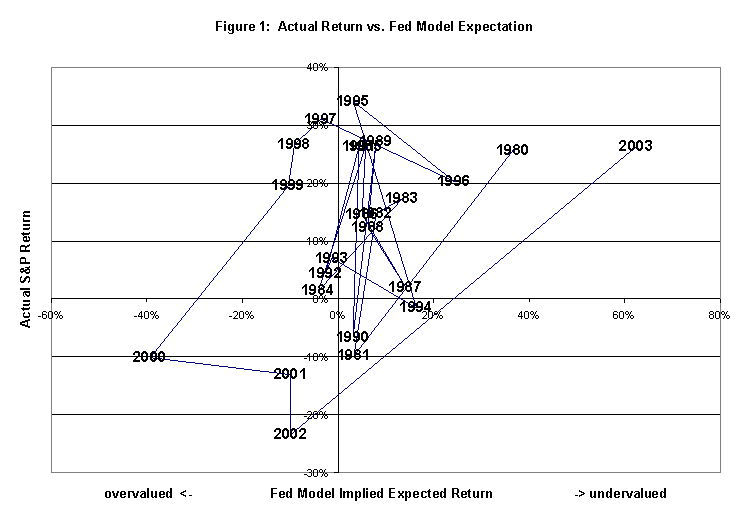
We used year-end 12 months “forward” earnings (available from Thomson via Prudential) and interest rates from 1980 through 2003 to study this relationship. A convenient way of looking at the relationship is to estimate the Fair Value of the S&P 500 by dividing forward S&P Earnings by the current 10 Year Yield. If this Fair Value is less than the current value of the index, then the S&P is considered overvalued and vice versa. For example, the current S&P is at 1113, expected earnings for the next year for the S&P 500 are 67.62 and the current yield on the ten year T bond is 4.45 percent. Use the T bond yield as the discount rate for Forward Earnings to calculate Fair Value: Fair Value = Fwd Earnings/10 Year Yield = 67.62/.0445 = 1520. Then divide Fair Value by the current index reading to determine under/over valuation: 1520/1113-1 = 36% implied expected return. We then compare this implied return to the realized S&P performance over the subsequent year. Figure 1 shows a scatter plot of this relationship for the years 1980 through 2003. The correlation of this implied expected return and the subsequent actual return is 0.42. Encouragingly, splitting the data into two time periods (1980-1991 and 1992-2003 respectively) yield correlations of greater than 0.40 in each of the periods, indicating a relatively stable relationship through time (although with admittedly small number of observations (12) in each sample).
Market Timing
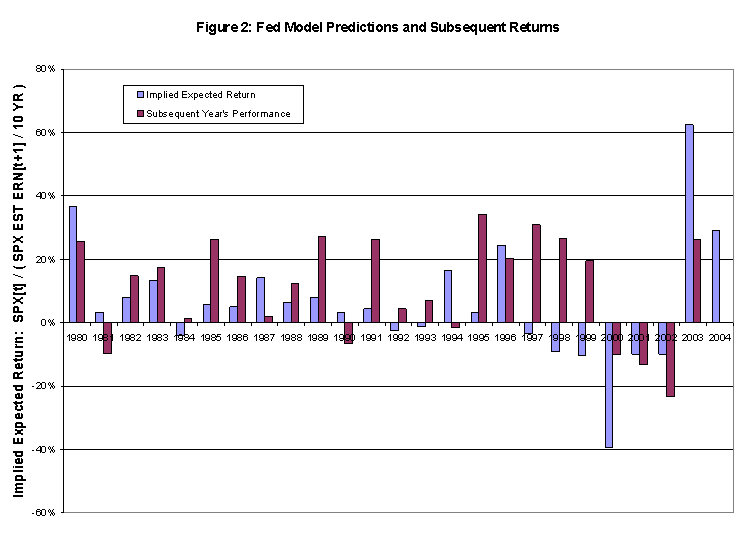
Expected Returns implied by the Fed Model were generally positive throughout the 1980s, as were stock
returns. The model turned negative in 1997 and indicated a particularly strong overvaluation in 2000, the
year in which the tech bubble finally burst. If one were to have strictly adhered to the Fed Model as a market
timing tool, one would have expected markets to rise in 2003 and one would also have stayed away from the
market in 2000,2001, and 2002 thereby avoiding a 40 percent drawdown. But one would also have been out of
the market in 1997-1999, when the S&P 500 returned 98 percent.
Current Forecast 10/07/04
We have found that the best way to specify the Fed model relationship for forecasting purposes is in the
form: S&P Return[t+1] = a + b * ( Forward Earnings Yield[t+1] - 10 Year Yield[t] )
Estimating a linear regression of the form above, we obtained the following equation:
S&P Return[t+1] = 0.089 + 5.803 * ( Forward Earnings Yield[t+1] - 10 Year Yield[t] )
Tstats 2.77 2.23
p-values 1.11% 3.63%
The adjusted R-Squared of 0.147 is quite high for a predictive regression in the financial markets and indicates that
almost 15 percent of variation in subsequent returns was explained by the independent variable over the time period studied.
To determine current Fed Model forecast:
Current S&P (as of 10/07/04) stands at 1134
Fwd.Earnings = 12 months forward earnings for the S&P 500 = 69.44
Forward Earnings Yield = Fwd.Earnings / S&P = 69.44/1134 = 6.12%
10.Year.Yield = The Current Yield on 10-Year Govt Bond is 4.25%
Substituting these numbers into the regression formula :
0.089 + 5.803 * ( 0.0612 – 0.0425 ) = 19.7 %
Therefore, Fed Model yields a forecast of about 19.7% for next 12 months.
T Downing in collaboration with Victor Niederhoffer and Laurel Kenner
Manchester Trading
Data Sources:
* Forward Earnings available from Prudential on a monthly basis from beg 1979 in a PDF file (155 KB).
* 10 Year Treasury Yield obtained from Bloomberg ( USGG10YR Index )